CHAPTER 3
Cell structures and
their functions
JOEL G. SORIA, MD, MBA-H
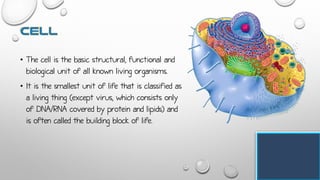
• The cell is the basic structural, functional and
biological unit of all known living organisms.
• It is the smallest unit of life that is classified as
a living thing (except virus, which consists only
of DNA/RNA covered by protein and lipids) and
is often called the building block of life.
1. Cell Metabolism and Energy Use
2. Synthesis of molecules
3. Communication
4. Reproduction and Inheritance
• All organisms are composed of one or more cells
• Cells are the basic unit of structure and function in organisms.
• All cells come only from other cells.
The observations of Hooke, Leeuwenhoek, Schleiden, Schwann,
Virchow, and others led to the development of the cell theory
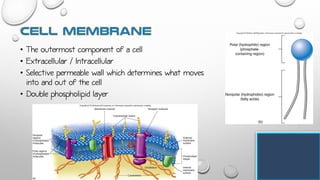
• The outermost component of a cell
• Extracellular / Intracellular
• Selective permeable wall which determines what moves
into and out of the cell
• Double phospholipid layer
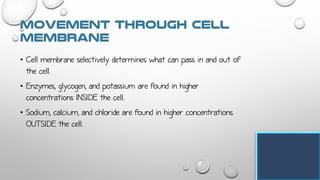
• Cell membrane selectively determines what can pass in and out of
the cell.
• Enzymes, glycogen, and potassium are found in higher
concentrations INSIDE the cell.
• Sodium, calcium, and chloride are found in higher concentrations
OUTSIDE the cell.
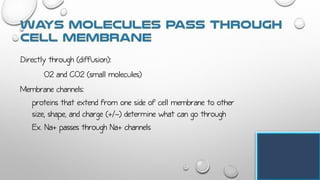
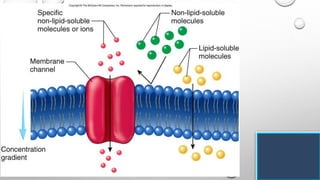
Directly through (diffusion):
O2 and CO2 (small molecules)
Membrane channels:
proteins that extend from one side of cell membrane to other
size, shape, and charge (+/-) determine what can go through
Ex. Na+ passes through Na+ channels
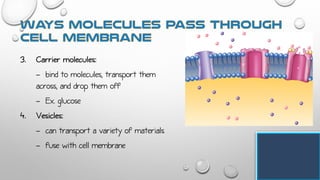
3. Carrier molecules:
- bind to molecules, transport them
across, and drop them off
- Ex. glucose
4. Vesicles:
- can transport a variety of materials
- fuse with cell membrane
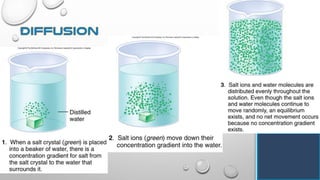
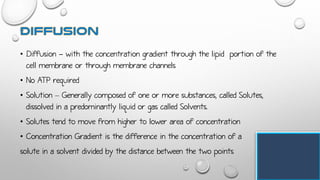
• Diffusion - with the concentration gradient through the lipid portion of the
cell membrane or through membrane channels
• No ATP required
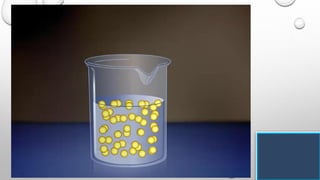
• Solution – Generally composed of one or more substances, called Solutes,
dissolved in a predominantly liquid or gas called Solvents.
• Solutes tend to move from higher to lower area of concentration
• Concentration Gradient is the difference in the concentration of a
solute in a solvent divided by the distance between the two points
• Concentration gradient:
- measures conc. difference at 2 points
- greater the distance the faster the solute
will travel
• Filtration:
movement of fluid through a partition with holes
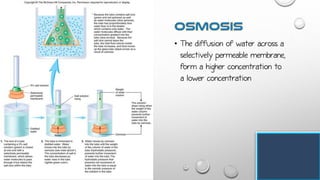
• The diffusion of water across a
selectively permeable membrane,
form a higher concentration to
a lower concentration
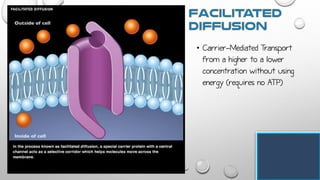
• Facilitated Diffusion
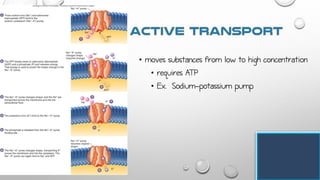
• Active Transport
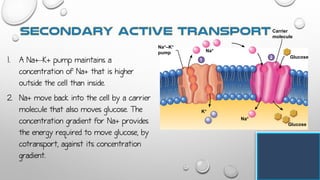
• Secondary Active Transport
• Carrier-Mediated Transport
from a higher to a lower
concentration without using
energy (requires no ATP)
• moves substances from low to high concentration
• requires ATP
• Ex. Sodium-potassium pump
1. A Na+–K+ pump maintains a
concentration of Na+ that is higher
outside the cell than inside.
2. Na+ move back into the cell by a carrier
molecule that also moves glucose. The
concentration gradient for Na+ provides
the energy required to move glucose, by
cotransport, against its concentration
gradient.
K+
1
2
Na+–K+
pump Na+
Carrier
molecule
Glucose
Glucose
Na+
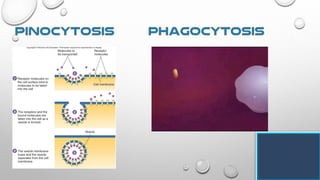
• Process that brings materials into cell using vesicles
• 2 types of Endocytosis
1. Pinocytosis (cell eating)
2. Phagocytosis (liquid particles)
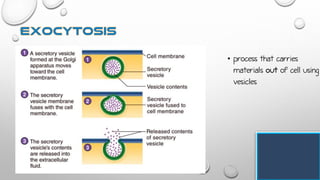
• process that carries
materials out of cell using
vesicles
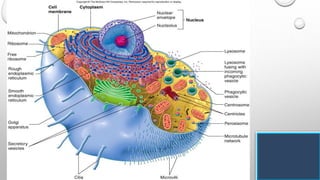
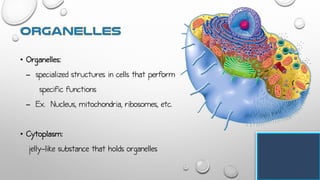
• Organelles:
- specialized structures in cells that perform
specific functions
- Ex. Nucleus, mitochondria, ribosomes, etc.
• Cytoplasm:
jelly-like substance that holds organelles
20 MINS BREAK
BEFORE WE
PROCEED TO
THE NEXT TOPIC
… CELL
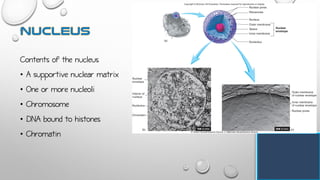
Contents of the nucleus
• A supportive nuclear matrix
• One or more nucleoli
• Chromosome
• DNA bound to histones
• Chromatin
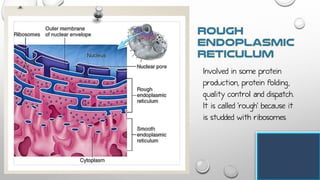
Involved in some protein
production, protein folding,
quality control and dispatch.
It is called 'rough' because it
is studded with ribosomes
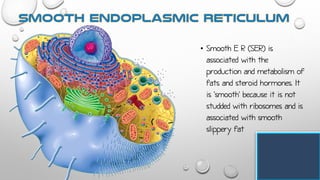
• Smooth E R (SER) is
associated with the
production and metabolism of
fats and steroid hormones. It
is 'smooth' because it is not
studded with ribosomes and is
associated with smooth
slippery fat
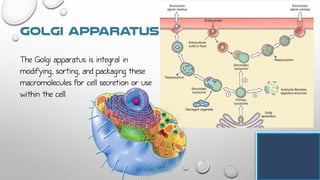
The Golgi apparatus is integral in
modifying, sorting, and packaging these
macromolecules for cell secretion or use
within the cell
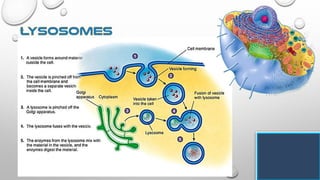
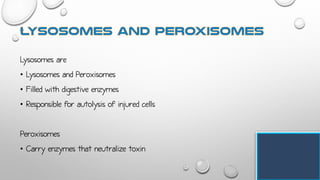
Lysosomes are
• Lysosomes and Peroxisomes
• Filled with digestive enzymes
• Responsible for autolysis of injured cells
Peroxisomes
• Carry enzymes that neutralize toxin
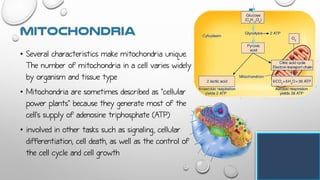
• Several characteristics make mitochondria unique.
The number of mitochondria in a cell varies widely
by organism and tissue type
• Mitochondria are sometimes described as "cellular
power plants" because they generate most of the
cell's supply of adenosine triphosphate (ATP)
• involved in other tasks such as signaling, cellular
differentiation, cell death, as well as the control of
the cell cycle and cell growth
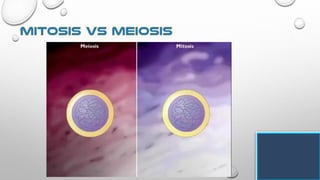
• formation of 2 daughter cells from a single parent cell
• uses MITOSIS & MIOSIS
Components of Mitosis
Chromatid: 2 strands of chromosomes that are genetically identical
Centromere: where 2 chromatids are connected
Centrioles: small organelle composed of 9 triplets
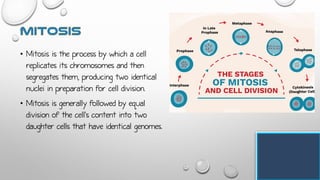
• Mitosis is the process by which a cell
replicates its chromosomes and then
segregates them, producing two identical
nuclei in preparation for cell division.
• Mitosis is generally followed by equal
division of the cell's content into two
daughter cells that have identical genomes.
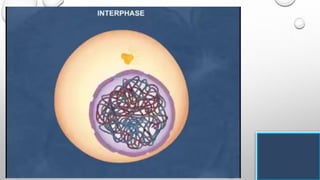
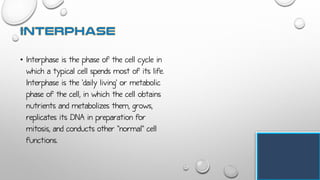
• Interphase is the phase of the cell cycle in
which a typical cell spends most of its life.
Interphase is the 'daily living' or metabolic
phase of the cell, in which the cell obtains
nutrients and metabolizes them, grows,
replicates its DNA in preparation for
mitosis, and conducts other "normal" cell
functions.
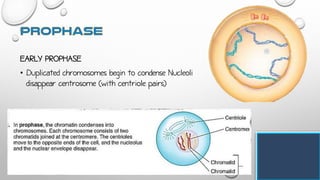
EARLY PROPHASE
• Duplicated chromosomes begin to condense Nucleoli
disappear centrosome (with centriole pairs)
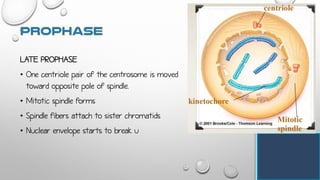
LATE PROPHASE
• One centriole pair of the centrosome is moved
toward opposite pole of spindle.
• Mitotic spindle forms
• Spindle fibers attach to sister chromatids
• Nuclear envelope starts to break u
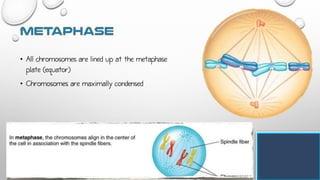
• All chromosomes are lined up at the metaphase
plate (equator)
• Chromosomes are maximally condensed
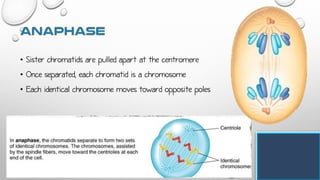
• Sister chromatids are pulled apart at the centromere
• Once separated, each chromatid is a chromosome
• Each identical chromosome moves toward opposite poles
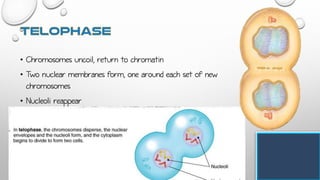
• Chromosomes uncoil, return to chromatin
• Two nuclear membranes form, one around each set of new
chromosomes
• Nucleoli reappear
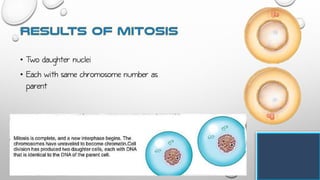
• Two daughter nuclei
• Each with same chromosome number as
parent
Chapter 3 Cells.pdf
Chapter 3 Cells.pdf

Chapter 3 Cells.pdf

  • 1.
    CHAPTER 3 Cell structuresand their functions JOEL G. SORIA, MD, MBA-H
  • 2.
    • The cellis the basic structural, functional and biological unit of all known living organisms. • It is the smallest unit of life that is classified as a living thing (except virus, which consists only of DNA/RNA covered by protein and lipids) and is often called the building block of life.
  • 3.
    1. Cell Metabolismand Energy Use 2. Synthesis of molecules 3. Communication 4. Reproduction and Inheritance
  • 4.
    • All organismsare composed of one or more cells • Cells are the basic unit of structure and function in organisms. • All cells come only from other cells. The observations of Hooke, Leeuwenhoek, Schleiden, Schwann, Virchow, and others led to the development of the cell theory
  • 6.
    • The outermostcomponent of a cell • Extracellular / Intracellular • Selective permeable wall which determines what moves into and out of the cell • Double phospholipid layer
  • 7.
    • Cell membraneselectively determines what can pass in and out of the cell. • Enzymes, glycogen, and potassium are found in higher concentrations INSIDE the cell. • Sodium, calcium, and chloride are found in higher concentrations OUTSIDE the cell.
  • 9.
    Directly through (diffusion): O2and CO2 (small molecules) Membrane channels: proteins that extend from one side of cell membrane to other size, shape, and charge (+/-) determine what can go through Ex. Na+ passes through Na+ channels
  • 11.
    3. Carrier molecules: -bind to molecules, transport them across, and drop them off - Ex. glucose 4. Vesicles: - can transport a variety of materials - fuse with cell membrane
  • 12.
    • Diffusion -with the concentration gradient through the lipid portion of the cell membrane or through membrane channels • No ATP required • Solution – Generally composed of one or more substances, called Solutes, dissolved in a predominantly liquid or gas called Solvents. • Solutes tend to move from higher to lower area of concentration • Concentration Gradient is the difference in the concentration of a solute in a solvent divided by the distance between the two points
  • 14.
    • Concentration gradient: -measures conc. difference at 2 points - greater the distance the faster the solute will travel • Filtration: movement of fluid through a partition with holes
  • 15.
    • The diffusionof water across a selectively permeable membrane, form a higher concentration to a lower concentration
  • 16.
    • Facilitated Diffusion •Active Transport • Secondary Active Transport
  • 17.
    • Carrier-Mediated Transport froma higher to a lower concentration without using energy (requires no ATP)
  • 18.
    • moves substancesfrom low to high concentration • requires ATP • Ex. Sodium-potassium pump
  • 20.
    1. A Na+–K+pump maintains a concentration of Na+ that is higher outside the cell than inside. 2. Na+ move back into the cell by a carrier molecule that also moves glucose. The concentration gradient for Na+ provides the energy required to move glucose, by cotransport, against its concentration gradient. K+ 1 2 Na+–K+ pump Na+ Carrier molecule Glucose Glucose Na+
  • 21.
    • Process thatbrings materials into cell using vesicles • 2 types of Endocytosis 1. Pinocytosis (cell eating) 2. Phagocytosis (liquid particles)
  • 23.
    • process thatcarries materials out of cell using vesicles
  • 24.
    • Organelles: - specializedstructures in cells that perform specific functions - Ex. Nucleus, mitochondria, ribosomes, etc. • Cytoplasm: jelly-like substance that holds organelles
  • 25.
    20 MINS BREAK BEFOREWE PROCEED TO THE NEXT TOPIC … CELL
  • 27.
    Contents of thenucleus • A supportive nuclear matrix • One or more nucleoli • Chromosome • DNA bound to histones • Chromatin
  • 29.
    Involved in someprotein production, protein folding, quality control and dispatch. It is called 'rough' because it is studded with ribosomes
  • 30.
    • Smooth ER (SER) is associated with the production and metabolism of fats and steroid hormones. It is 'smooth' because it is not studded with ribosomes and is associated with smooth slippery fat
  • 31.
    The Golgi apparatusis integral in modifying, sorting, and packaging these macromolecules for cell secretion or use within the cell
  • 33.
    Lysosomes are • Lysosomesand Peroxisomes • Filled with digestive enzymes • Responsible for autolysis of injured cells Peroxisomes • Carry enzymes that neutralize toxin
  • 34.
    • Several characteristicsmake mitochondria unique. The number of mitochondria in a cell varies widely by organism and tissue type • Mitochondria are sometimes described as "cellular power plants" because they generate most of the cell's supply of adenosine triphosphate (ATP) • involved in other tasks such as signaling, cellular differentiation, cell death, as well as the control of the cell cycle and cell growth
  • 35.
    • formation of2 daughter cells from a single parent cell • uses MITOSIS & MIOSIS Components of Mitosis Chromatid: 2 strands of chromosomes that are genetically identical Centromere: where 2 chromatids are connected Centrioles: small organelle composed of 9 triplets
  • 36.
    • Mitosis isthe process by which a cell replicates its chromosomes and then segregates them, producing two identical nuclei in preparation for cell division. • Mitosis is generally followed by equal division of the cell's content into two daughter cells that have identical genomes.
  • 37.
    • Interphase isthe phase of the cell cycle in which a typical cell spends most of its life. Interphase is the 'daily living' or metabolic phase of the cell, in which the cell obtains nutrients and metabolizes them, grows, replicates its DNA in preparation for mitosis, and conducts other "normal" cell functions.
  • 38.
    EARLY PROPHASE • Duplicatedchromosomes begin to condense Nucleoli disappear centrosome (with centriole pairs)
  • 39.
    LATE PROPHASE • Onecentriole pair of the centrosome is moved toward opposite pole of spindle. • Mitotic spindle forms • Spindle fibers attach to sister chromatids • Nuclear envelope starts to break u
  • 40.
    • All chromosomesare lined up at the metaphase plate (equator) • Chromosomes are maximally condensed
  • 41.
    • Sister chromatidsare pulled apart at the centromere • Once separated, each chromatid is a chromosome • Each identical chromosome moves toward opposite poles
  • 42.
    • Chromosomes uncoil,return to chromatin • Two nuclear membranes form, one around each set of new chromosomes • Nucleoli reappear
  • 43.
    • Two daughternuclei • Each with same chromosome number as parent