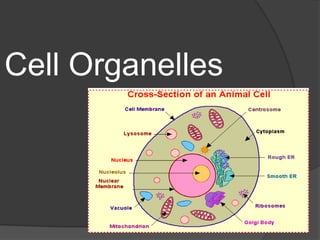
Cell Organelles
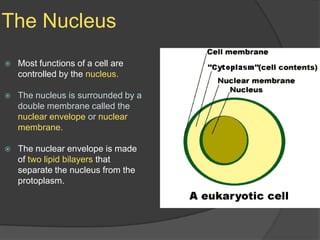
The NucleusMost functions of a cell are controlled by the nucleus.The nucleus is surrounded by a double membrane called the nuclear envelope or nuclear membrane.The nuclear envelope is made of two lipid bilayers that separate the nucleus from the protoplasm.
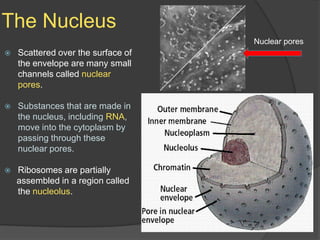
The NucleusNuclear poresScattered over the surface of the envelope are many small channels called nuclear pores.Substances that are made in the nucleus, including RNA, move into the cytoplasm by  passing through these nuclear pores.Ribosomes are partially      assembled in a region called the nucleolus.
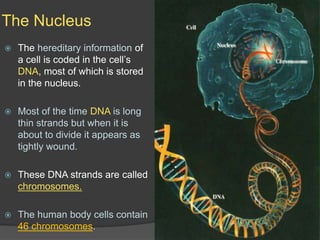
The NucleusThe hereditary information of a cell is coded in the cell’s DNA, most of which is stored in the nucleus.Most of the time DNA is long thin strands but when it is about to divide it appears as tightly wound.These DNA strands are called chromosomes.The human body cells contain 46 chromosomes.
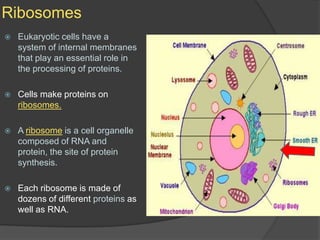
RibosomesEukaryotic cells have a system of internal membranes that play an essential role in the processing of proteins.Cells make proteins on ribosomes.A ribosome is a cell organelle composed of RNA and protein, the site of protein synthesis.Each ribosome is made of dozens of different proteins as well as RNA.
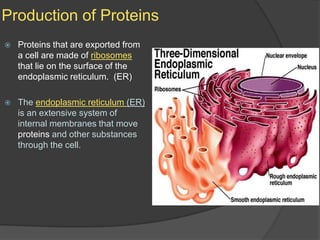
Production of ProteinsProteins that are exported from a cell are made of ribosomes that lie on the surface of the endoplasmic reticulum.  (ER)The endoplasmic reticulum (ER) is an extensive system of internal membranes that move proteins and other substances through the cell.
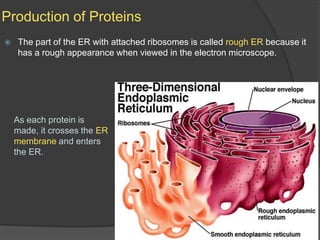
Production of ProteinsThe part of the ER with attached ribosomes is called rough ER because it has a rough appearance when viewed in the electron microscope.As each protein is made, it crosses the ER membrane and enters the ER.
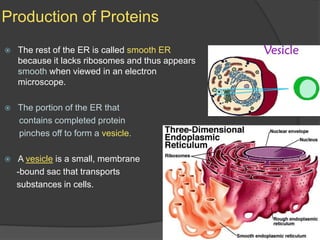
Production of ProteinsThe rest of the ER is called smooth ER because it lacks ribosomes and thus appears smooth when viewed in an electron microscope.The portion of the ER that       contains completed protein      pinches off to form a vesicle.A vesicle is a small, membrane     -bound sac that transports     substances in cells.
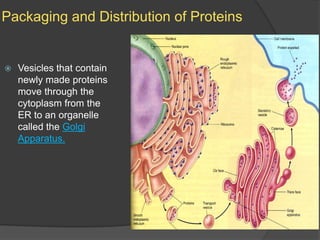
Packaging and Distribution of ProteinsVesicles that contain newly made proteins move through the cytoplasm from the ER to an organelle called the Golgi Apparatus.
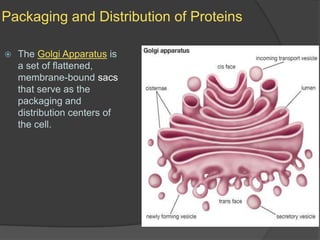
Packaging and Distribution of ProteinsThe Golgi Apparatusis a set of flattened, membrane-bound sacs that serve as the packaging and distribution centers of the cell.
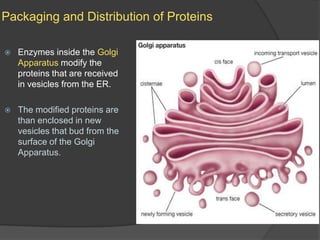
Packaging and Distribution of ProteinsEnzymes inside the Golgi Apparatus modify the proteins that are received in vesicles from the ER.The modified proteins are than enclosed in new vesicles that bud from the surface of the Golgi Apparatus.
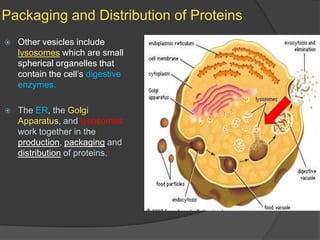
Packaging and Distribution of ProteinsOther vesicles include lysosomes which are small spherical organelles that contain the cell’s digestive enzymes.The ER, the Golgi Apparatus, and lysosomes work together in the production, packaging and distribution of proteins.
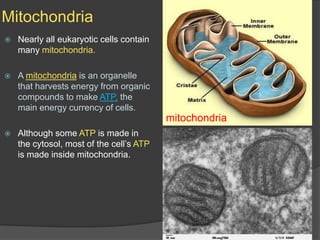
MitochondriaNearly all eukaryotic cells contain many mitochondria.A mitochondria is an organelle that harvests energy from organic compounds to make ATP, the main energy currency of cells.Although some ATP is made in the cytosol, most of the cell’s ATP is made inside mitochondria.mitochondria
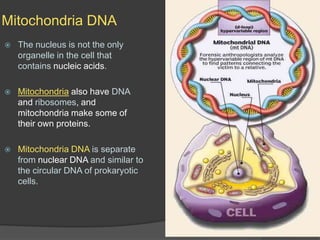
Mitochondria DNAThe nucleus is not the only organelle in the cell that contains nucleic acids.Mitochondria also have DNA and ribosomes, and mitochondria make some of their own proteins.Mitochondria DNA is separate from nuclear DNA and similar to the circular DNA of prokaryotic cells.
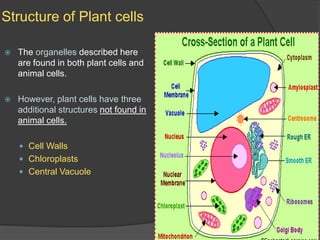
Structure of Plant cellsThe organelles described here are found in both plant cells and animal cells.However, plant cells have three additional structures not found in animal cells.Cell WallsChloroplastsCentral Vacuole
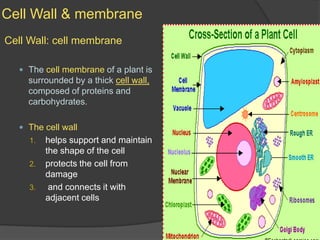
Cell Wall & membraneCell Wall: cell membraneThe cell membrane of a plant is surrounded by a thick cell wall, composed of proteins and carbohydrates.The cell wall helps support and maintain the shape of the cell protects the cell from damage and connects it with adjacent cells
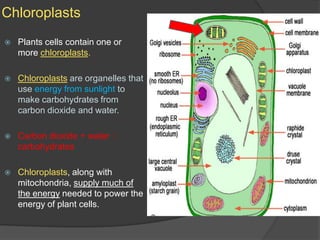
ChloroplastsPlants cells contain one or more chloroplasts.Chloroplasts are organelles that use energy from sunlight to make carbohydrates from carbon dioxide and water.Carbon dioxide + water  carbohydratesChloroplasts, along with mitochondria, supply much of the energy needed to power the energy of plant cells.
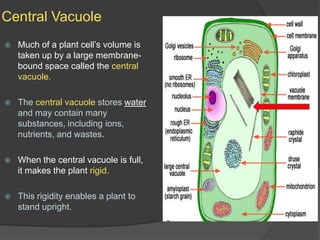
Central VacuoleMuch of a plant cell’s volume is taken up by a large membrane-bound space called the central vacuole.The central vacuole stores water and may contain many substances, including ions, nutrients, and wastes.When the central vacuole is full, it makes the plant rigid.This rigidity enables a plant to stand upright.
Cell organelles

Cell organelles

  • 1.
  • 2.
    The NucleusMost functionsof a cell are controlled by the nucleus.The nucleus is surrounded by a double membrane called the nuclear envelope or nuclear membrane.The nuclear envelope is made of two lipid bilayers that separate the nucleus from the protoplasm.
  • 3.
    The NucleusNuclear poresScatteredover the surface of the envelope are many small channels called nuclear pores.Substances that are made in the nucleus, including RNA, move into the cytoplasm by passing through these nuclear pores.Ribosomes are partially assembled in a region called the nucleolus.
  • 4.
    The NucleusThe hereditaryinformation of a cell is coded in the cell’s DNA, most of which is stored in the nucleus.Most of the time DNA is long thin strands but when it is about to divide it appears as tightly wound.These DNA strands are called chromosomes.The human body cells contain 46 chromosomes.
  • 5.
    RibosomesEukaryotic cells havea system of internal membranes that play an essential role in the processing of proteins.Cells make proteins on ribosomes.A ribosome is a cell organelle composed of RNA and protein, the site of protein synthesis.Each ribosome is made of dozens of different proteins as well as RNA.
  • 6.
    Production of ProteinsProteinsthat are exported from a cell are made of ribosomes that lie on the surface of the endoplasmic reticulum. (ER)The endoplasmic reticulum (ER) is an extensive system of internal membranes that move proteins and other substances through the cell.
  • 7.
    Production of ProteinsThepart of the ER with attached ribosomes is called rough ER because it has a rough appearance when viewed in the electron microscope.As each protein is made, it crosses the ER membrane and enters the ER.
  • 8.
    Production of ProteinsTherest of the ER is called smooth ER because it lacks ribosomes and thus appears smooth when viewed in an electron microscope.The portion of the ER that contains completed protein pinches off to form a vesicle.A vesicle is a small, membrane -bound sac that transports substances in cells.
  • 9.
    Packaging and Distributionof ProteinsVesicles that contain newly made proteins move through the cytoplasm from the ER to an organelle called the Golgi Apparatus.
  • 10.
    Packaging and Distributionof ProteinsThe Golgi Apparatusis a set of flattened, membrane-bound sacs that serve as the packaging and distribution centers of the cell.
  • 11.
    Packaging and Distributionof ProteinsEnzymes inside the Golgi Apparatus modify the proteins that are received in vesicles from the ER.The modified proteins are than enclosed in new vesicles that bud from the surface of the Golgi Apparatus.
  • 12.
    Packaging and Distributionof ProteinsOther vesicles include lysosomes which are small spherical organelles that contain the cell’s digestive enzymes.The ER, the Golgi Apparatus, and lysosomes work together in the production, packaging and distribution of proteins.
  • 13.
    MitochondriaNearly all eukaryoticcells contain many mitochondria.A mitochondria is an organelle that harvests energy from organic compounds to make ATP, the main energy currency of cells.Although some ATP is made in the cytosol, most of the cell’s ATP is made inside mitochondria.mitochondria
  • 14.
    Mitochondria DNAThe nucleusis not the only organelle in the cell that contains nucleic acids.Mitochondria also have DNA and ribosomes, and mitochondria make some of their own proteins.Mitochondria DNA is separate from nuclear DNA and similar to the circular DNA of prokaryotic cells.
  • 15.
    Structure of PlantcellsThe organelles described here are found in both plant cells and animal cells.However, plant cells have three additional structures not found in animal cells.Cell WallsChloroplastsCentral Vacuole
  • 16.
    Cell Wall &membraneCell Wall: cell membraneThe cell membrane of a plant is surrounded by a thick cell wall, composed of proteins and carbohydrates.The cell wall helps support and maintain the shape of the cell protects the cell from damage and connects it with adjacent cells
  • 17.
    ChloroplastsPlants cells containone or more chloroplasts.Chloroplasts are organelles that use energy from sunlight to make carbohydrates from carbon dioxide and water.Carbon dioxide + water  carbohydratesChloroplasts, along with mitochondria, supply much of the energy needed to power the energy of plant cells.
  • 18.
    Central VacuoleMuch ofa plant cell’s volume is taken up by a large membrane-bound space called the central vacuole.The central vacuole stores water and may contain many substances, including ions, nutrients, and wastes.When the central vacuole is full, it makes the plant rigid.This rigidity enables a plant to stand upright.