This document provides an overview of anatomy, physiology, and medical terminology. It defines anatomy as the study of the structure of the body and outlines what anatomy covers, such as the microscopic organization and development of body parts. Physiology is defined as the study of function in living organisms and its major goals are to understand how the body responds to stimuli and maintains stable internal conditions. Medical terminology used to describe body positions and regions is also reviewed.
• The scientificdiscipline that investigates the structure of the
body.
• “Anatomy” means to dissect, or to cut apart and separate, the
parts of the body.
• Covers: Structure of the body, microscopic organization,
processes by which they develop.
• Examines the relationship of the structure of the body part and
its function
3.
• Systemic: studiesbody systems
• Regional: studies body regions (medical schools)
• surface: studies external features, e.g., bone projections
• anatomical imaging: using technologies (x-rays, ultrasound,
MRI
4.
The study offunction in living organisms.
• It explores the mechanisms by which the organisms control
their internal environments regardless of what happens in the
outside (or external) environment.
Major Goals of Physiology:
• Understand and predict the body’s response to stimuli.
• Understand how the body maintains conditions within a
narrow range of values in a presence of a continually changing
environment.
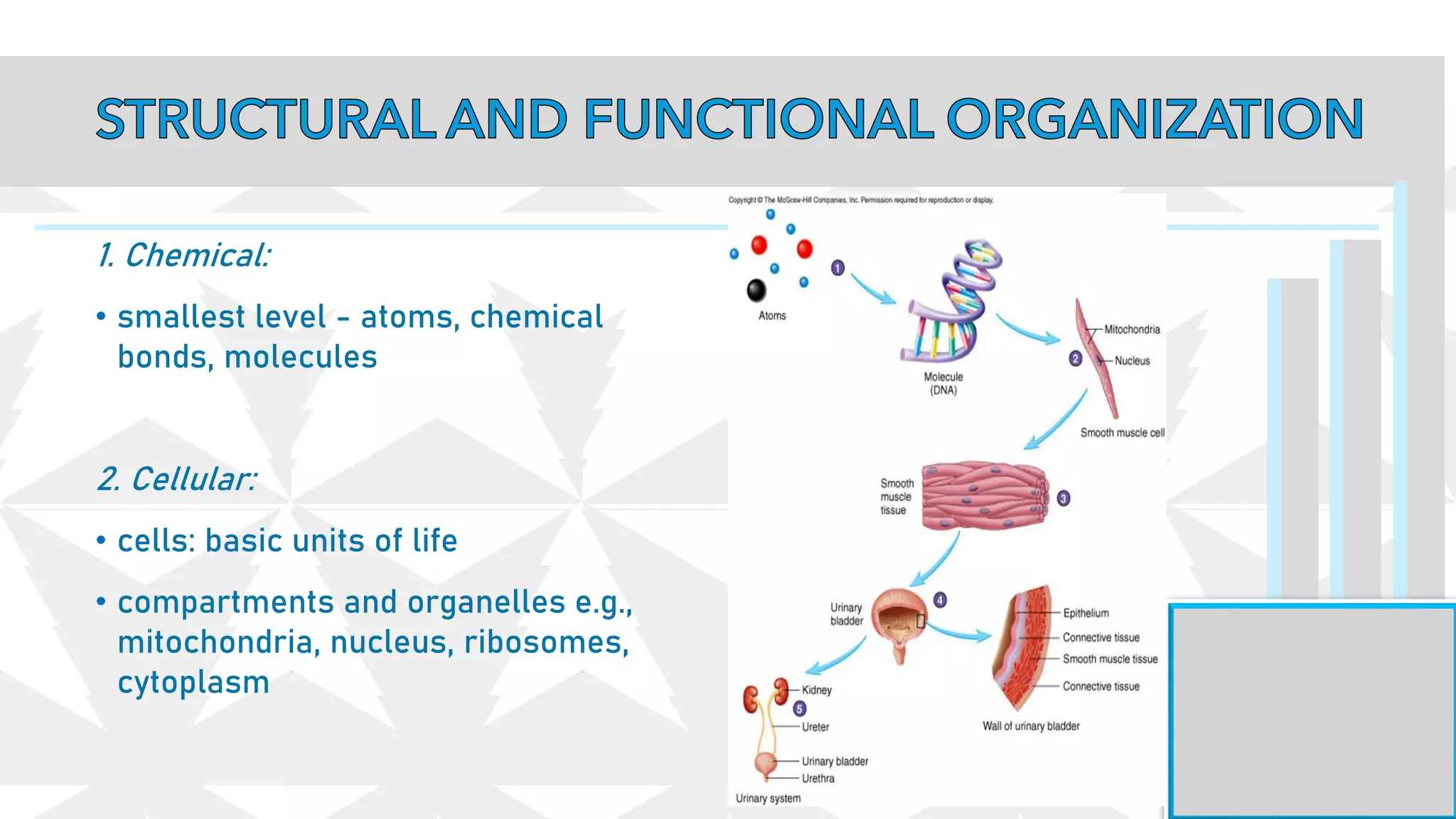
1. Chemical:
• smallestlevel - atoms, chemical
bonds, molecules
2. Cellular:
• cells: basic units of life
• compartments and organelles e.g.,
mitochondria, nucleus, ribosomes,
cytoplasm
7.
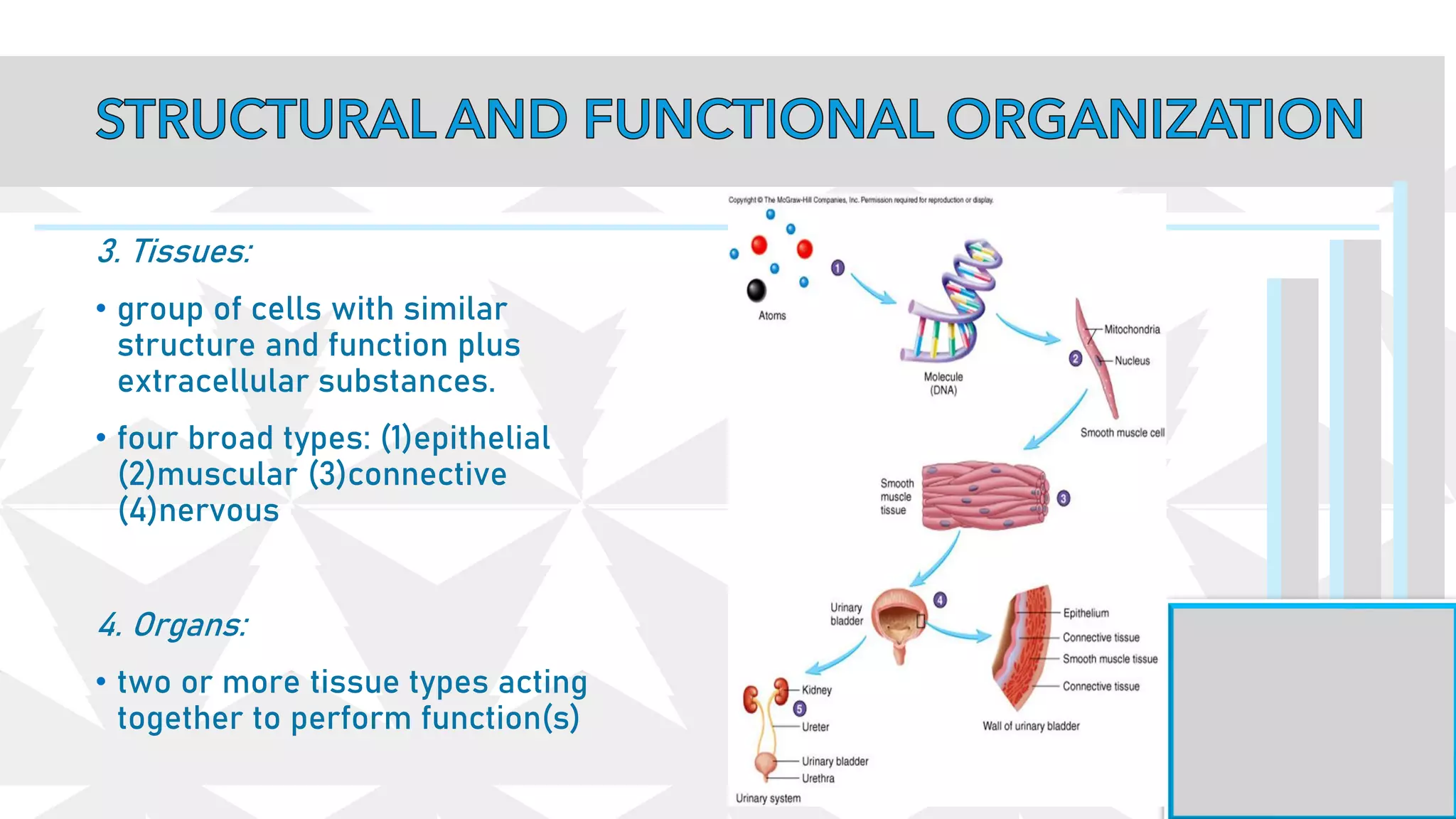
3. Tissues:
• groupof cells with similar
structure and function plus
extracellular substances.
• four broad types: (1)epithelial
(2)muscular (3)connective
(4)nervous
4. Organs:
• two or more tissue types acting
together to perform function(s)
8.
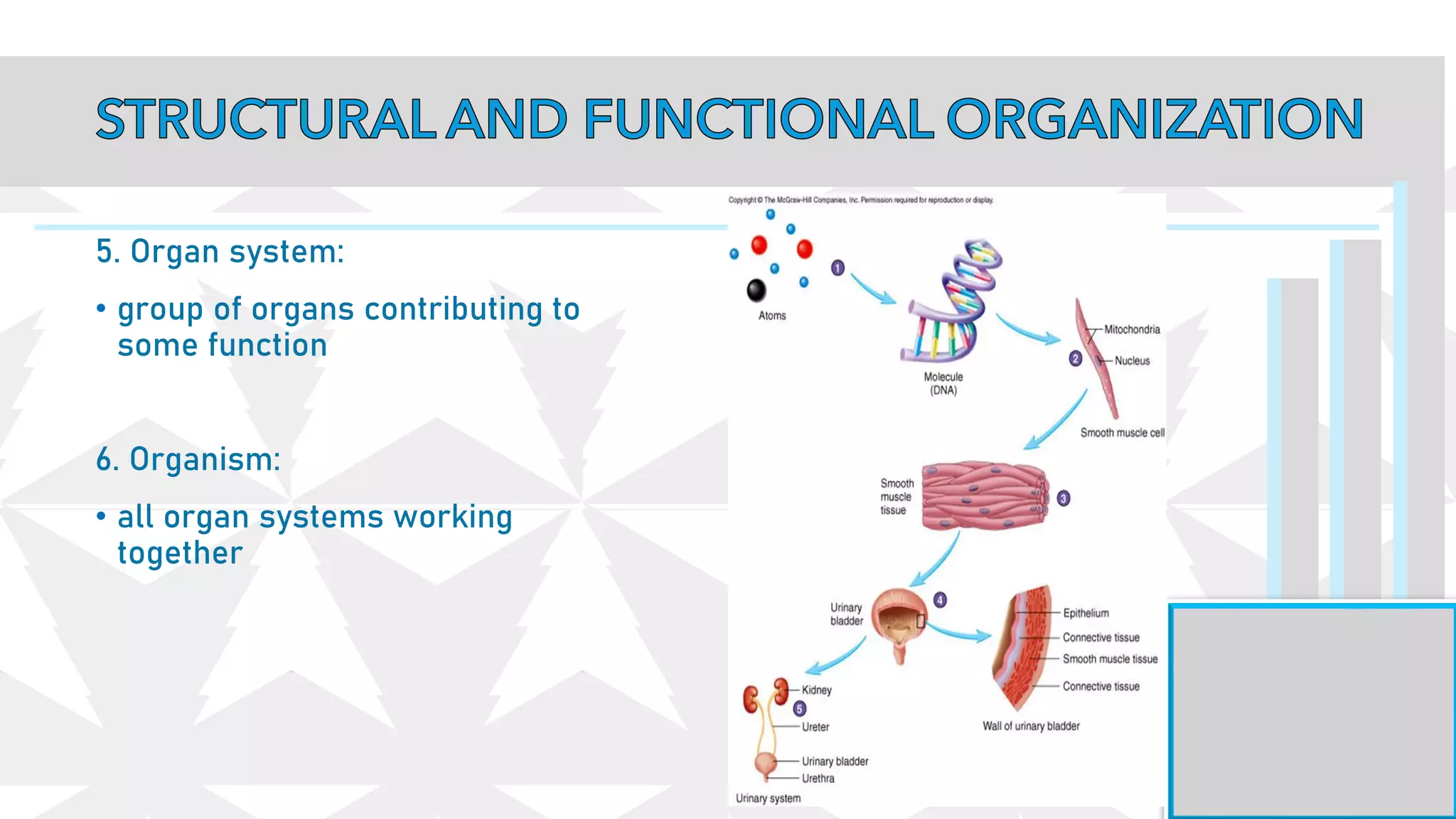
5. Organ system:
•group of organs contributing to
some function
6. Organism:
• all organ systems working
together
15.
Organization:
• functional interrelationshipsbetween parts
Metabolism:
• sum of all chemical and physical changes sustaining an organism
• ability to acquire and use energy in support of these changes
Responsiveness
• ability to sense and respond to environmental changes
• includes both internal and external environment
16.
Growth
• can increasein size
• size of cells, groups of cells, extracellular materials
Development
• changes in form and size
• changes in cell structure and function from generalized to
specialized – differentiation
Reproduction
• formation of new cells or new organism
• generation of new individuals
• tissue repair
17.
• Maintenance ofconstant internal environment
• variables: measures of body properties that may change in
value
Examples of variables:
body temperature blood glucose levels
heart rate blood cell counts
blood pressure respiratory rate
18.
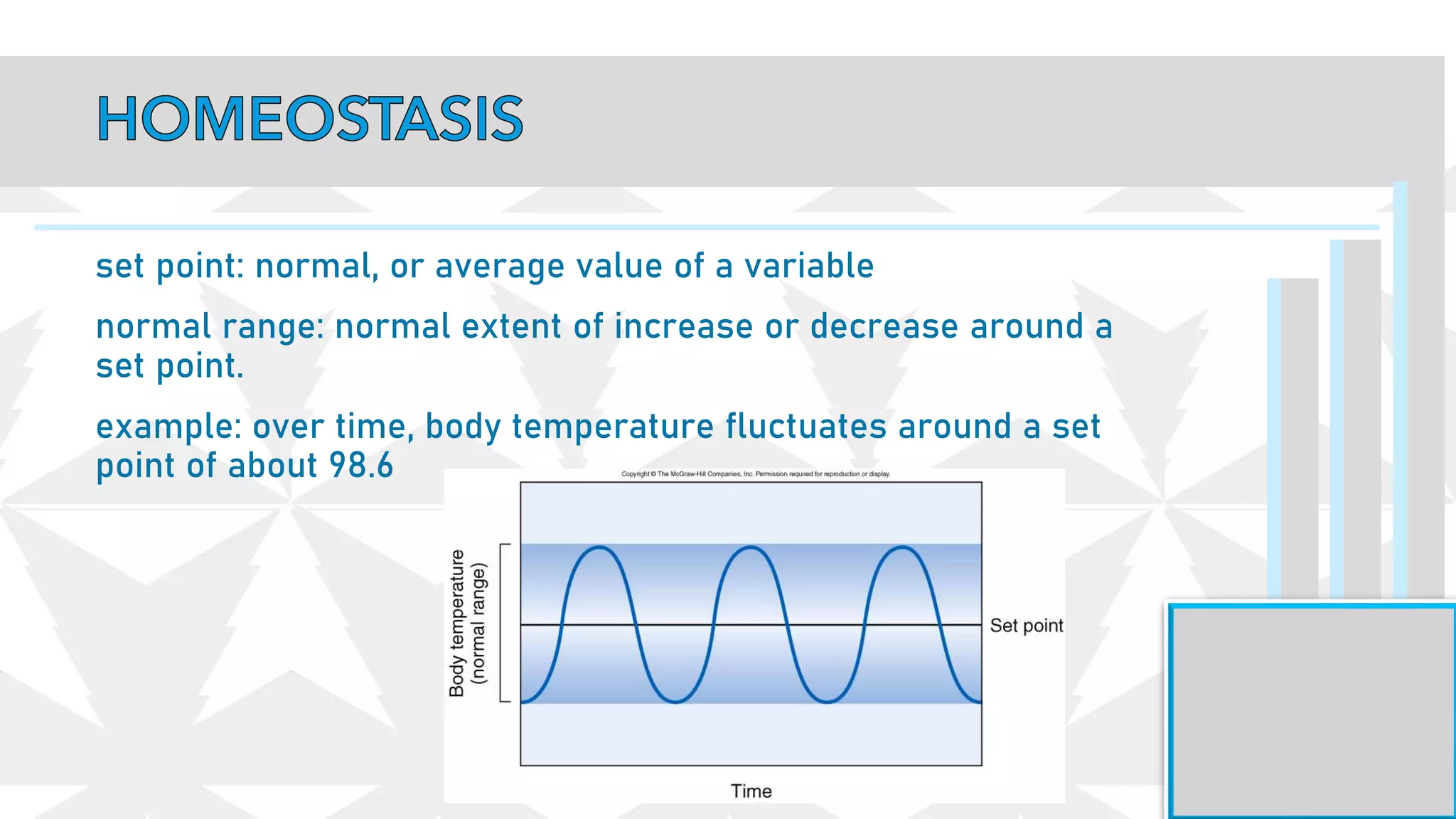
set point: normal,or average value of a variable
normal range: normal extent of increase or decrease around a
set point.
example: over time, body temperature fluctuates around a set
point of about 98.6
19.
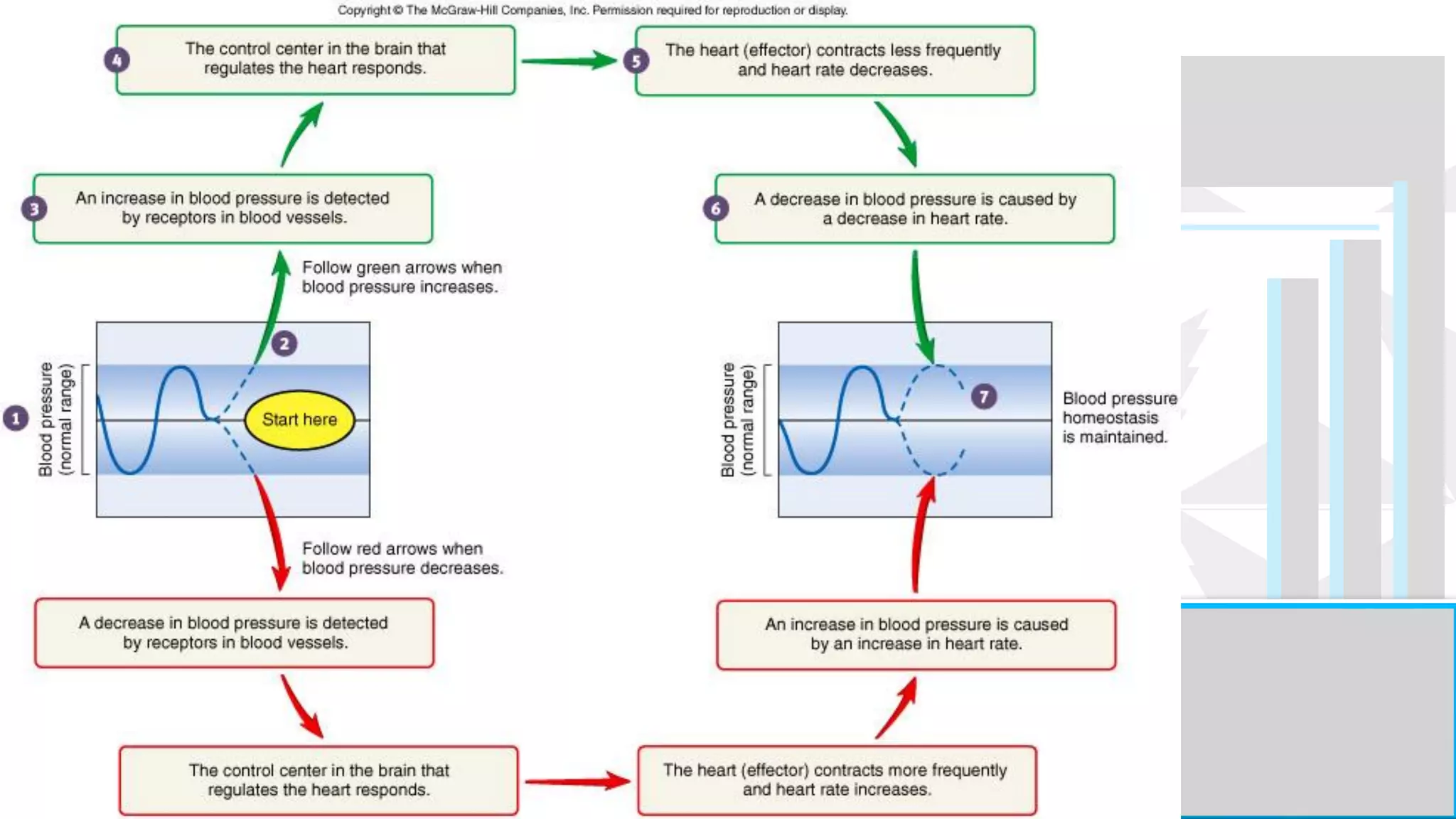
• mechanism thatmaintains homeostasis
• - negative feedback response:
• detection: of deviation away from set point and...
• correction: reversal of deviation toward set point and
• normal range
21.
1. Receptor:
• detectschanges in variable
2. Control center:
• receives receptor signal
• establishes set point
• sends signal to effector
3. Effector:
• directly causes change in variable
22.
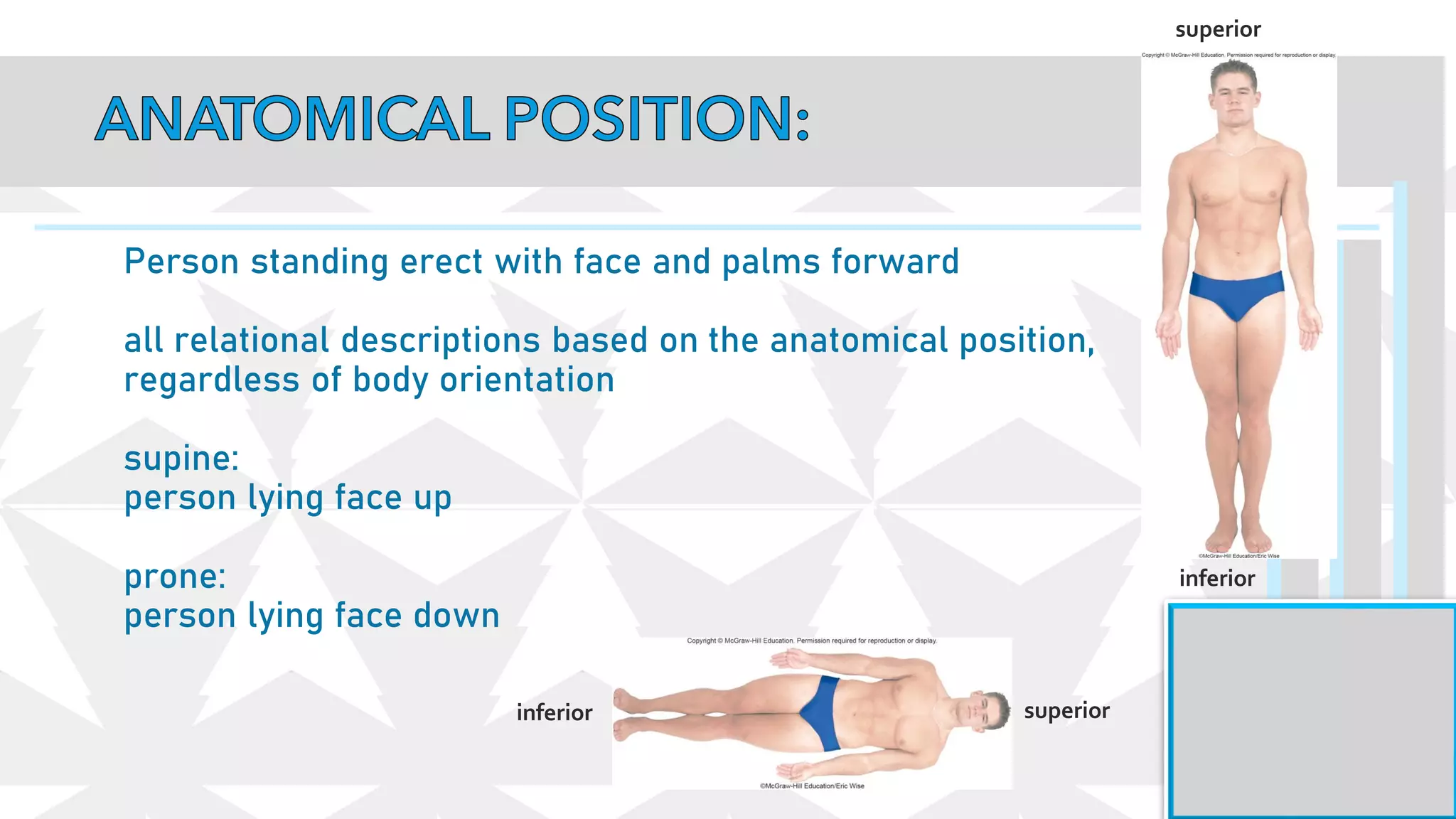
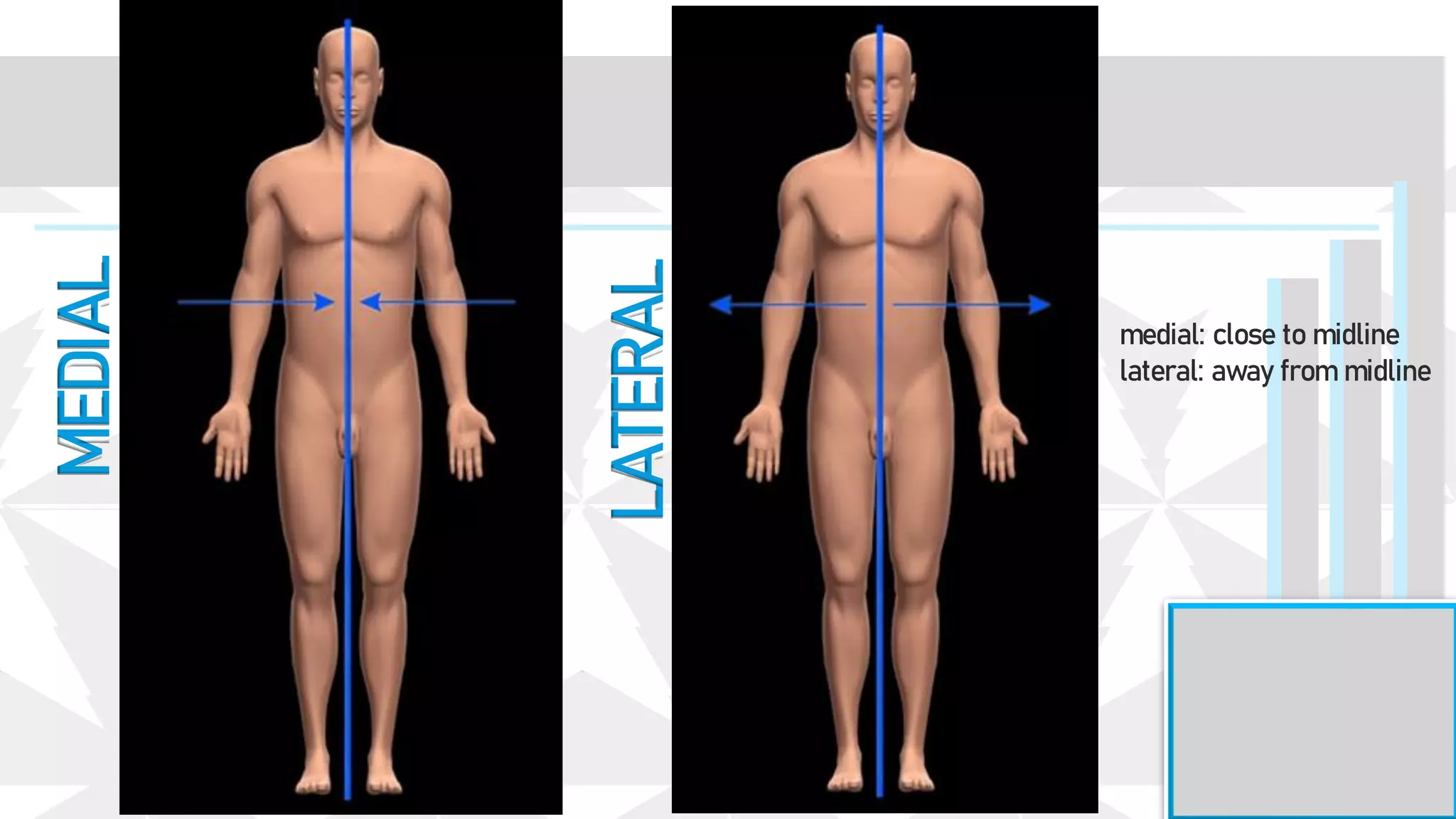
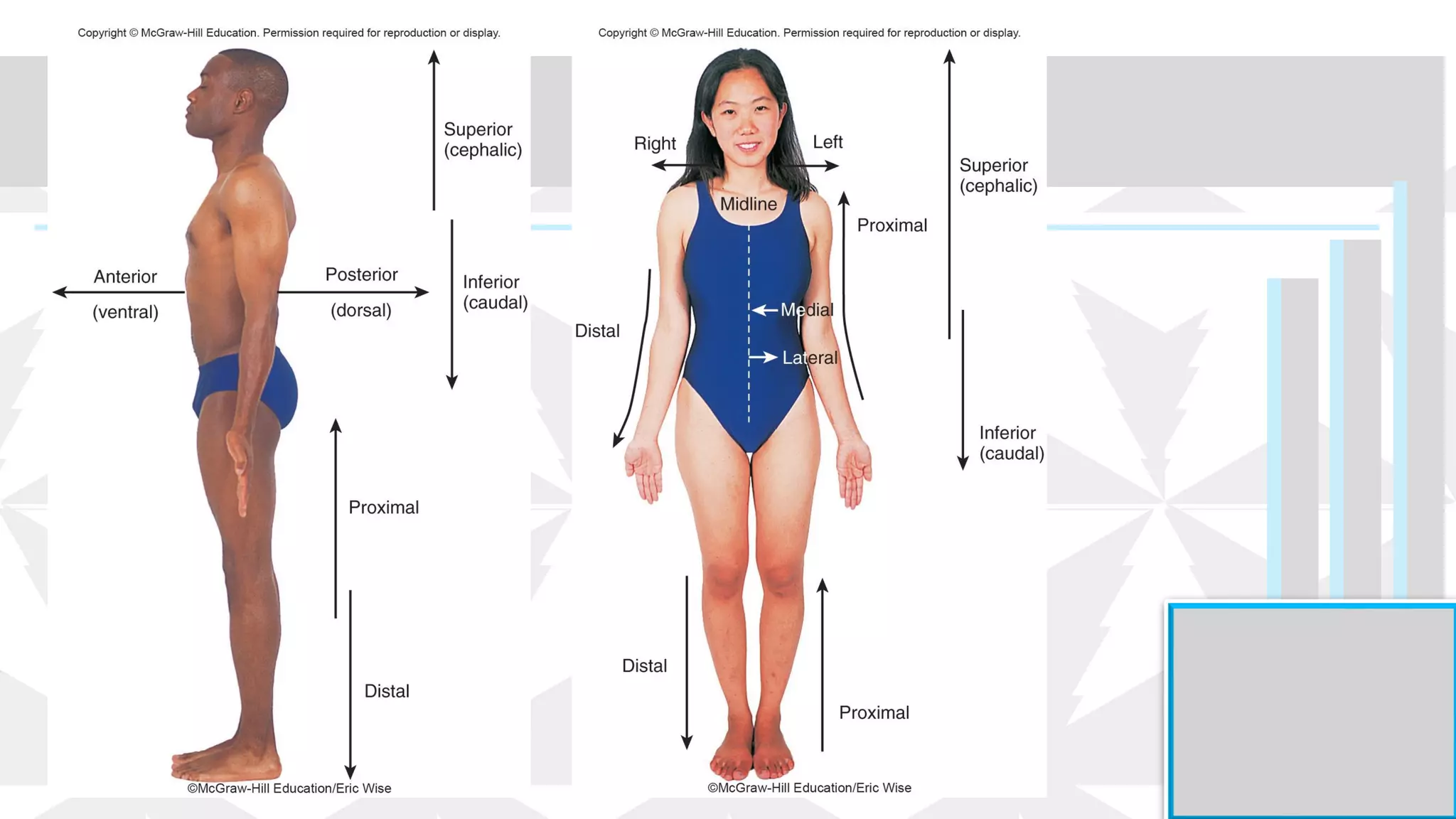
Person standing erectwith face and palms forward
all relational descriptions based on the anatomical position,
regardless of body orientation
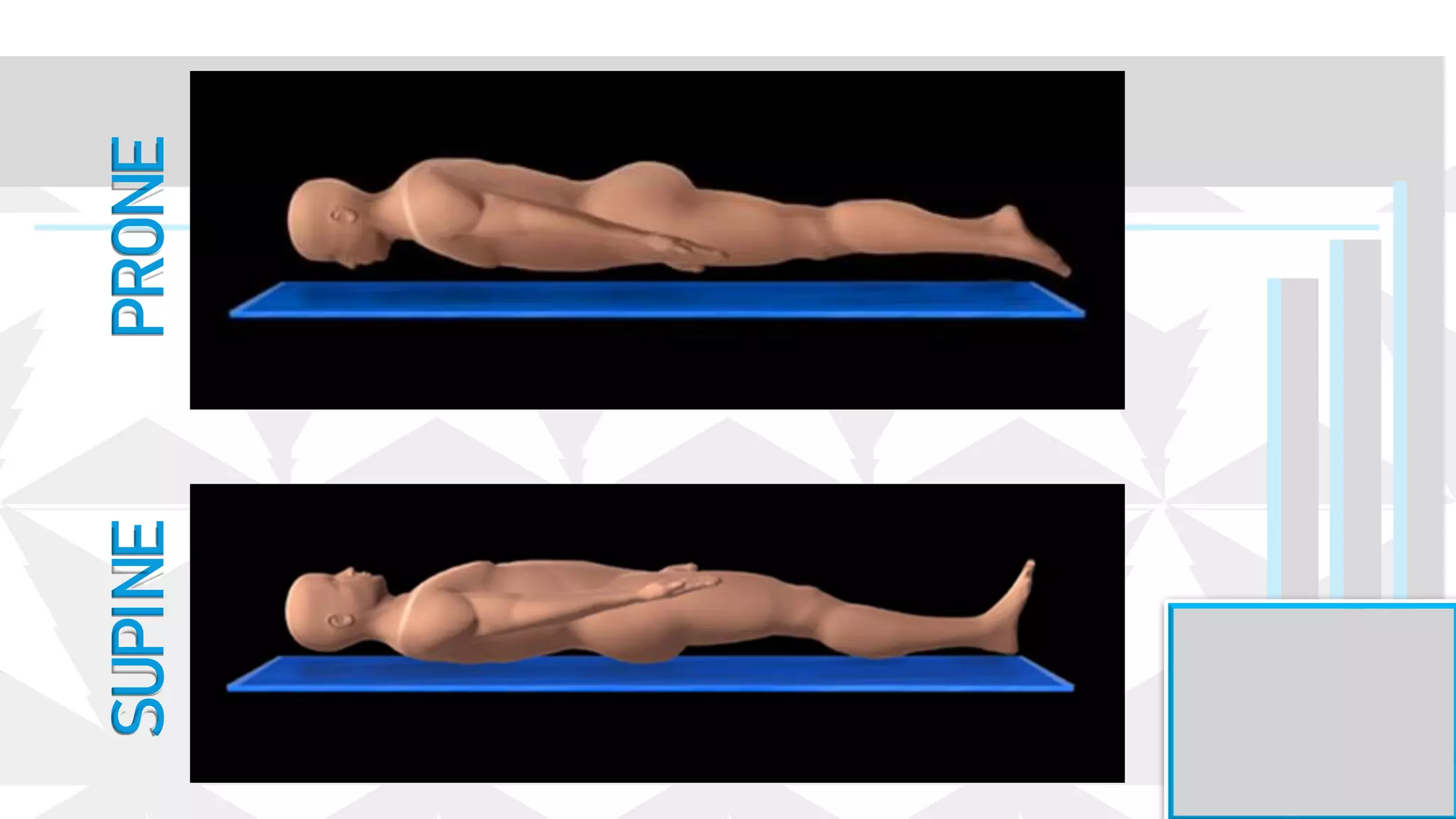
supine:
person lying face up
prone:
person lying face down
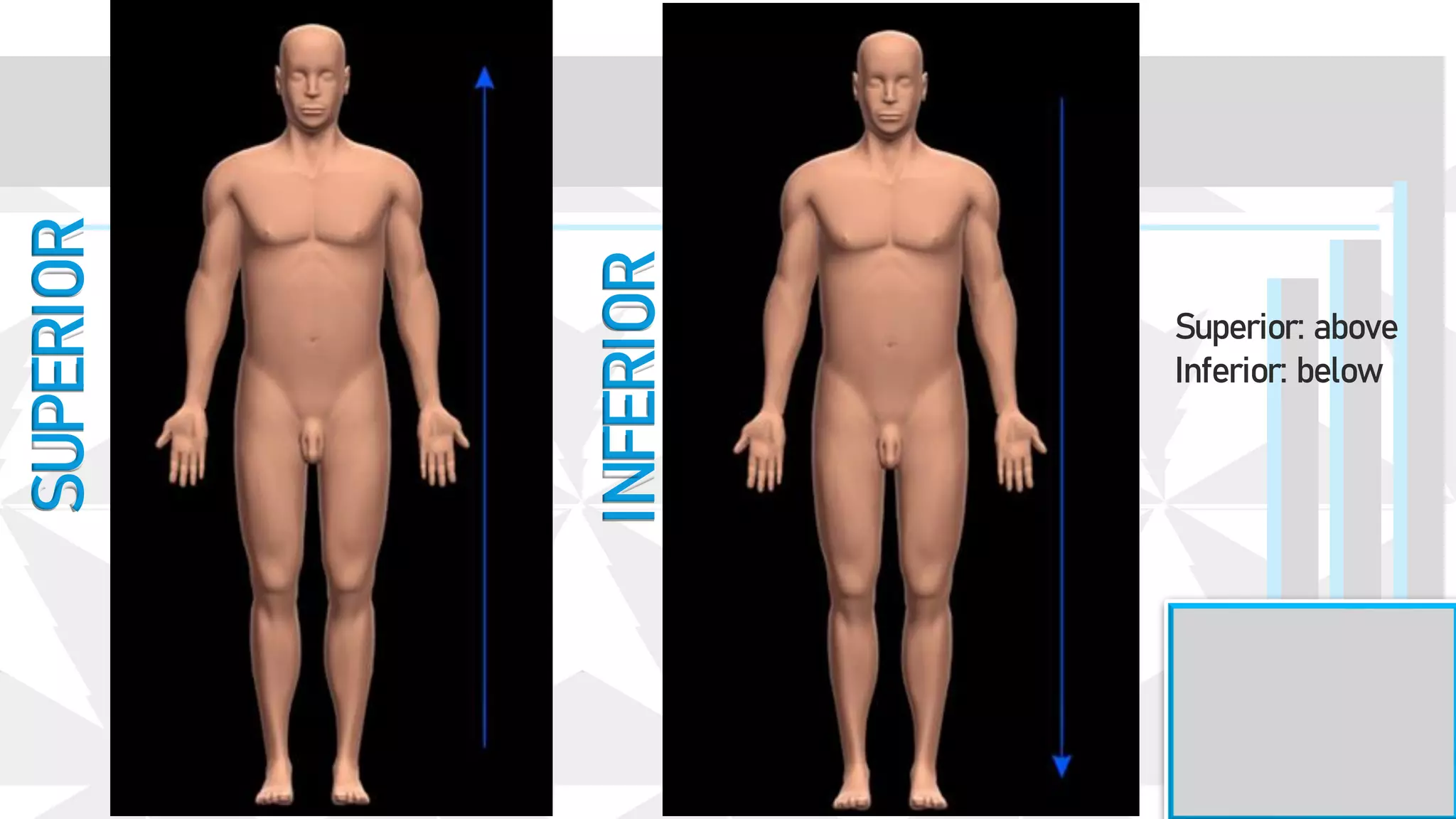
superior
inferior
superior
inferior
29
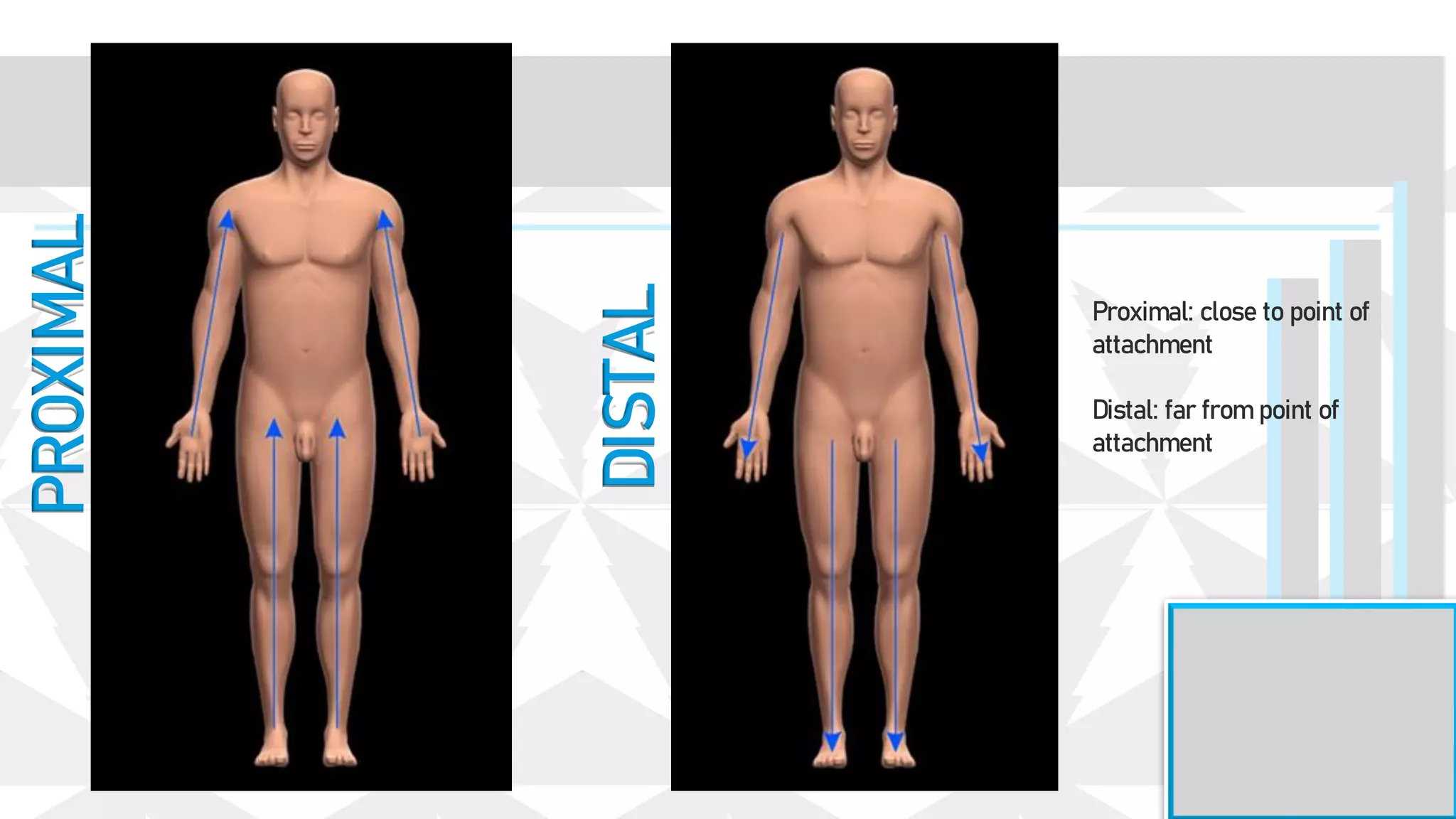
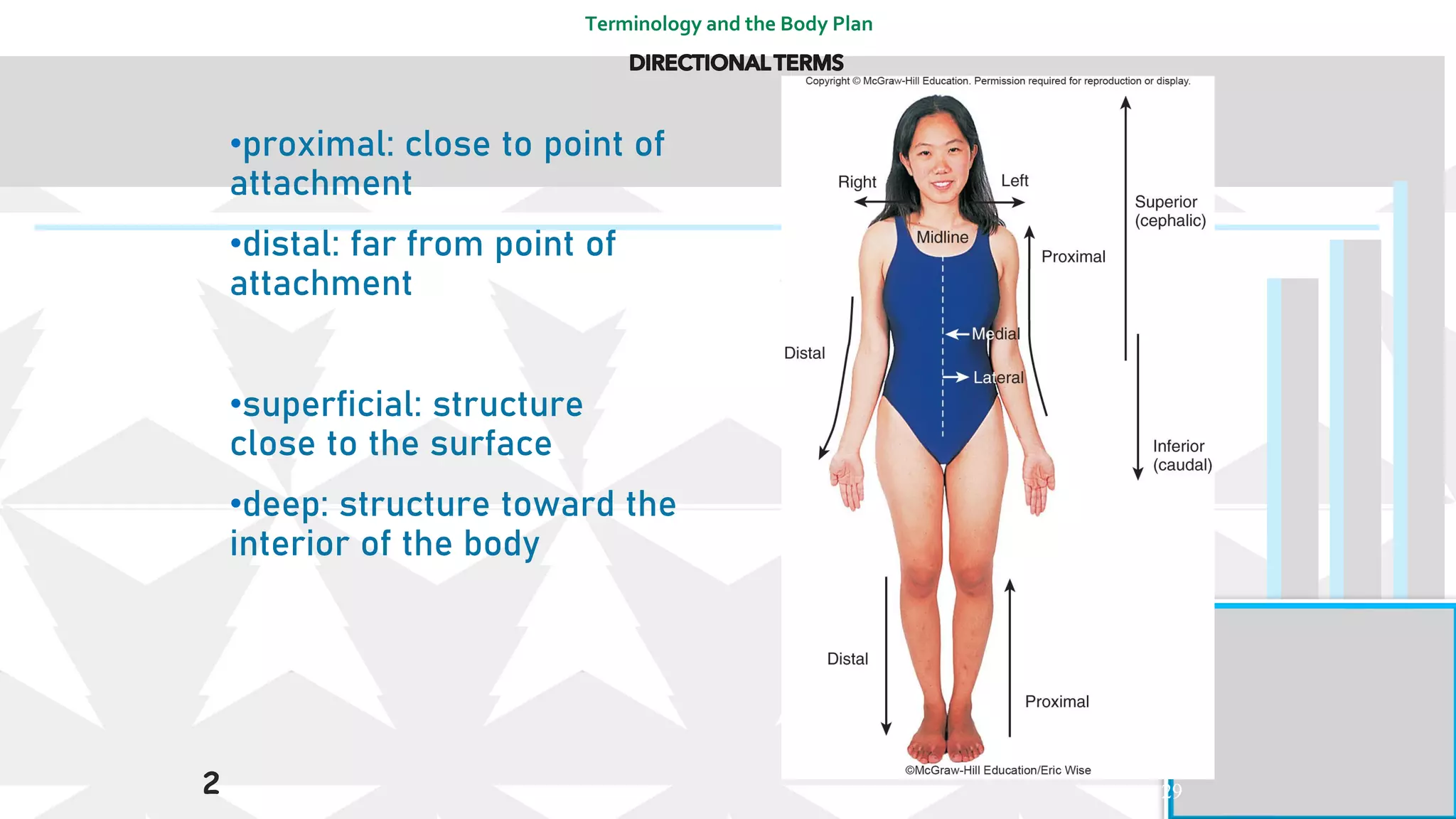
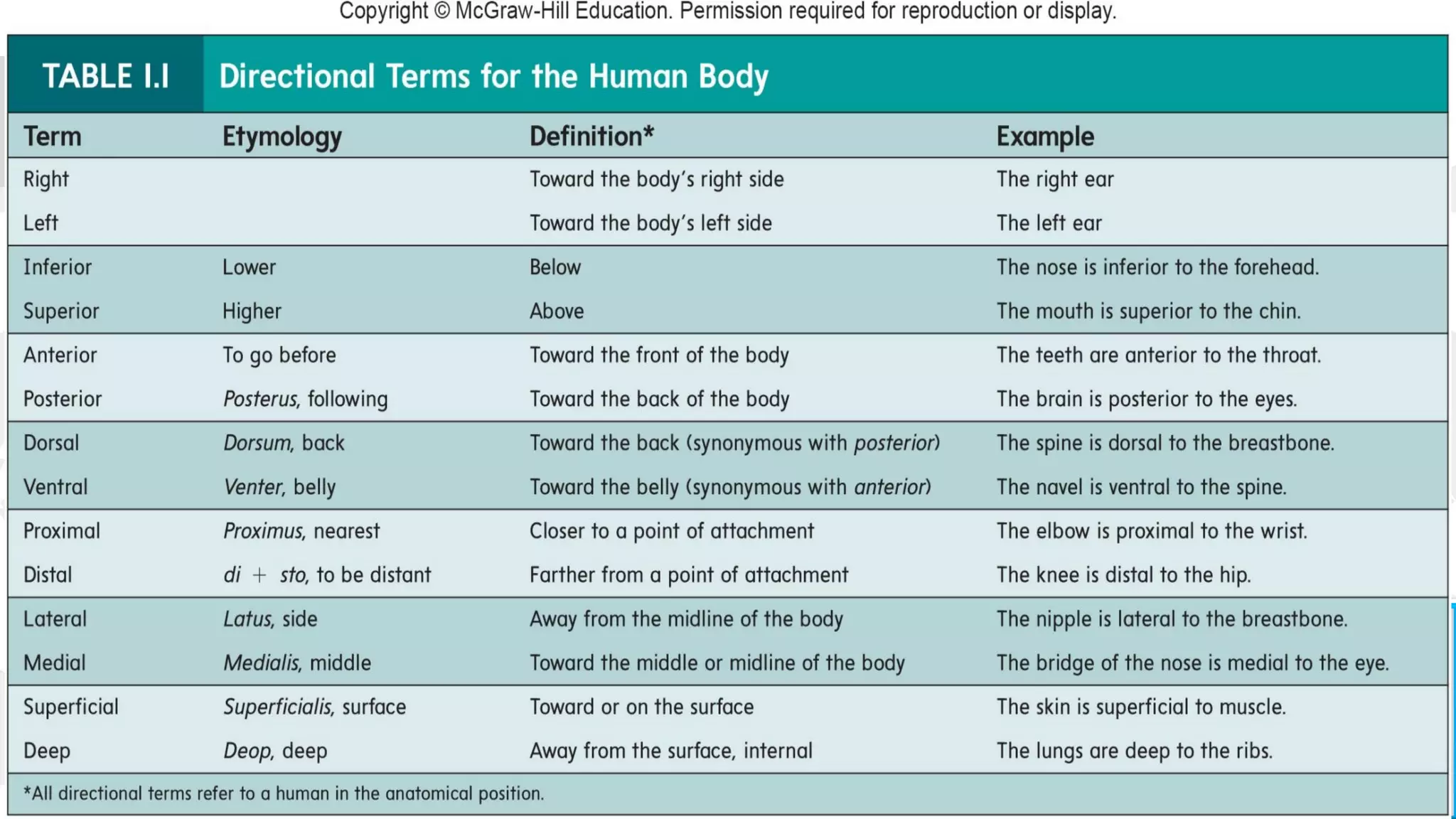
•proximal: close topoint of
attachment
•distal: far from point of
attachment
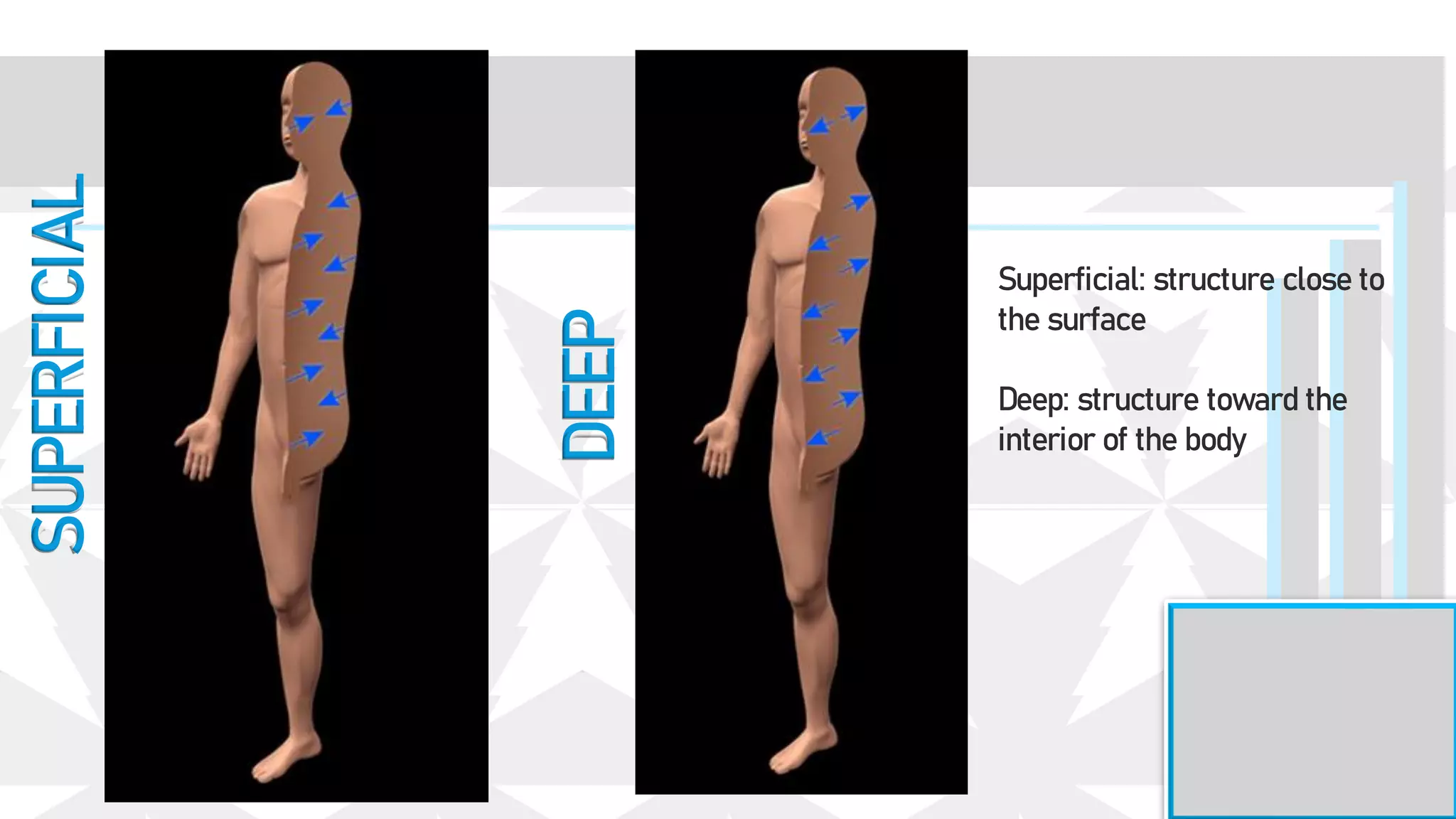
•superficial: structure
close to the surface
•deep: structure toward the
interior of the body
Terminology and the Body Plan
2
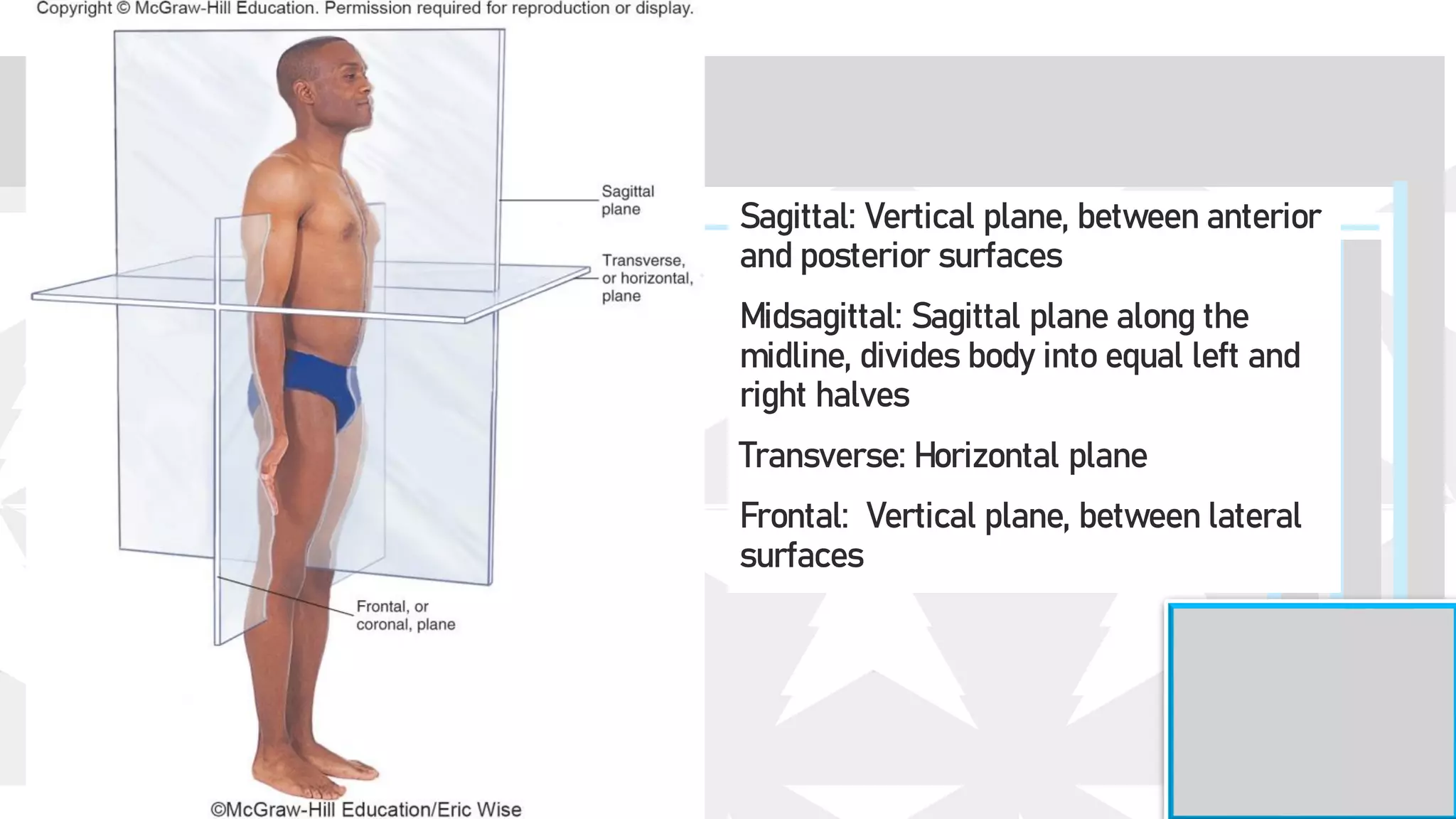
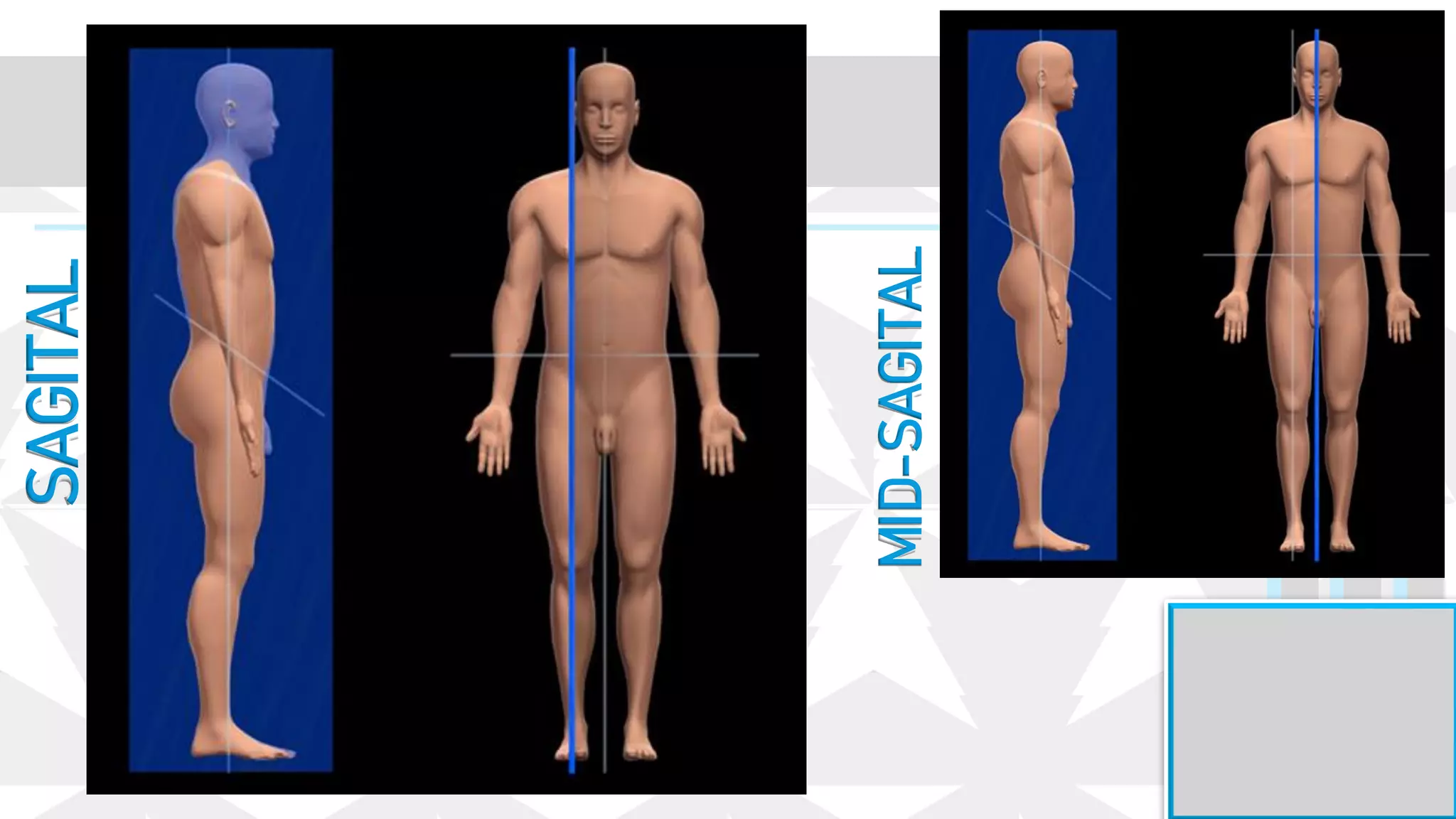
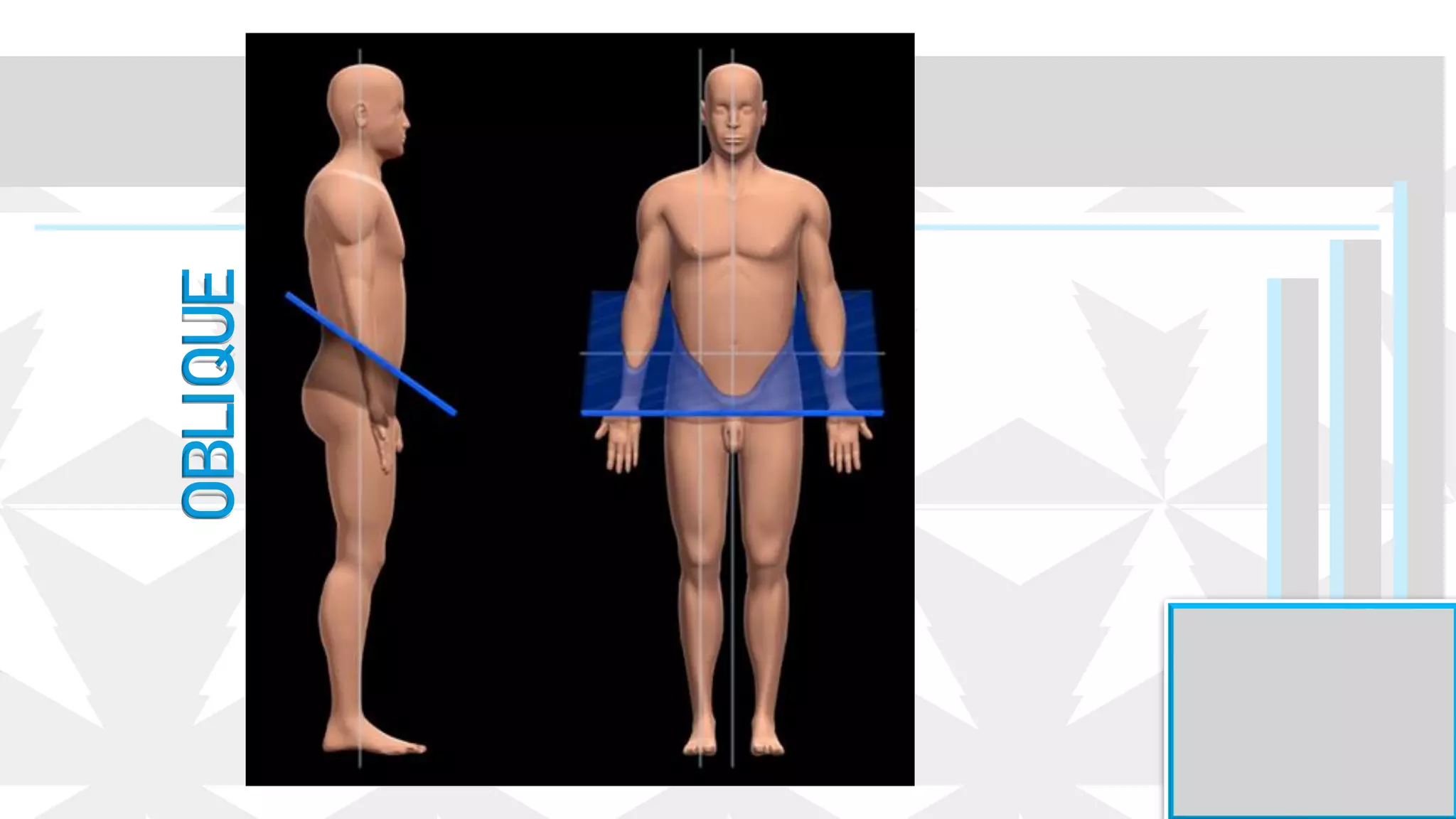
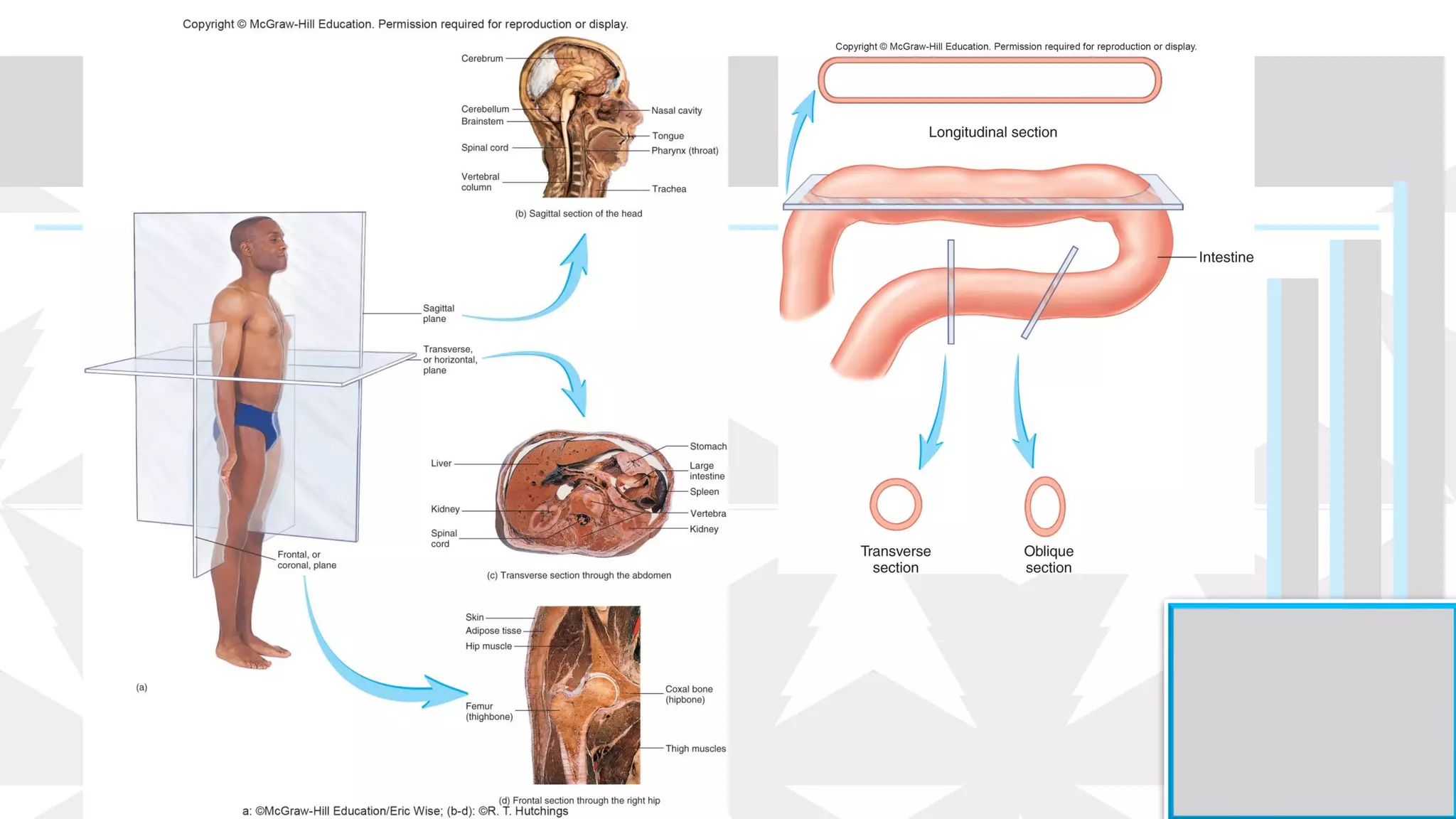
Sagittal: Vertical plane,between anterior
and posterior surfaces
Midsagittal: Sagittal plane along the
midline, divides body into equal left and
right halves
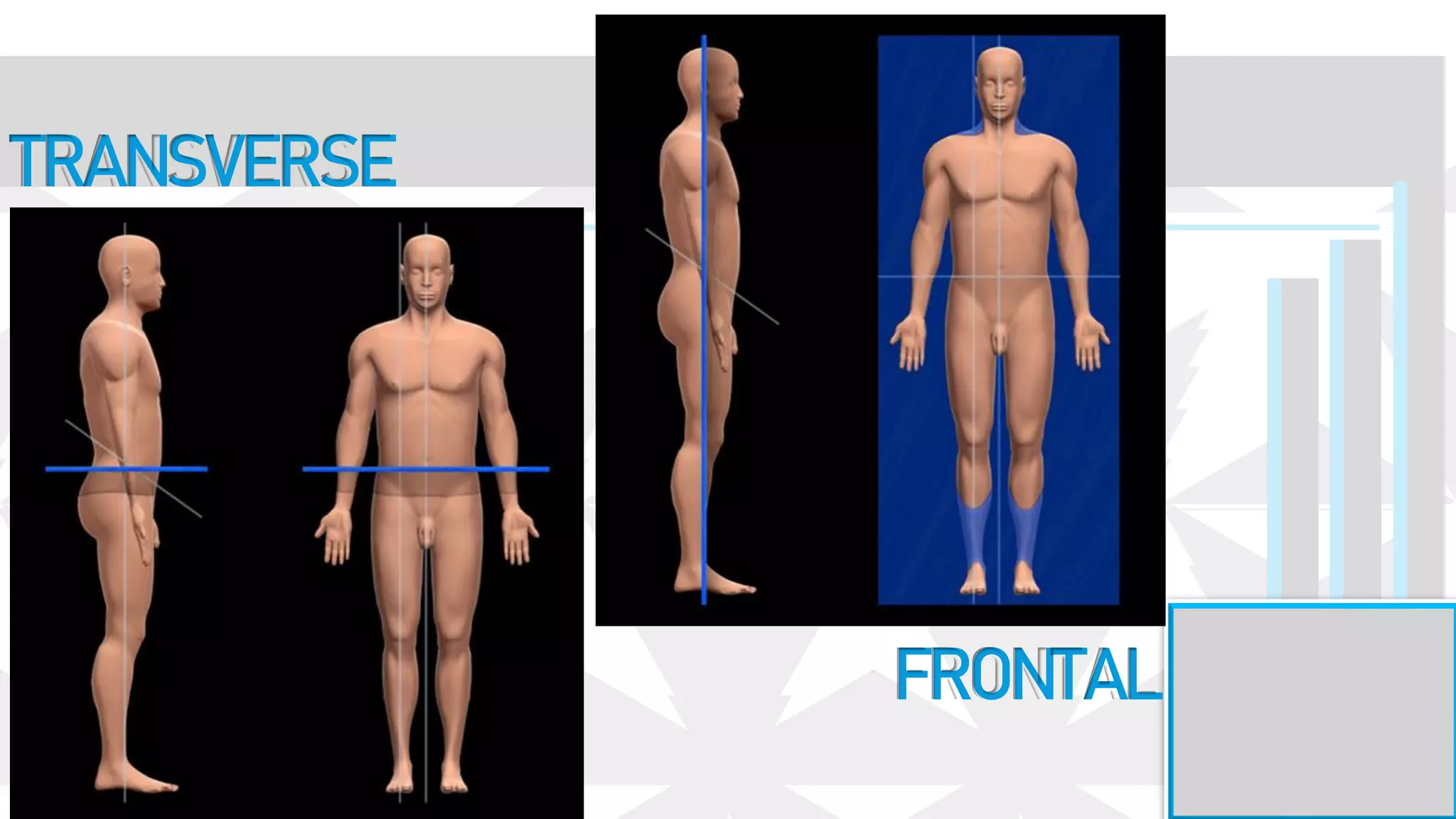
Transverse: Horizontal plane
Frontal: Vertical plane, between lateral
surfaces
46
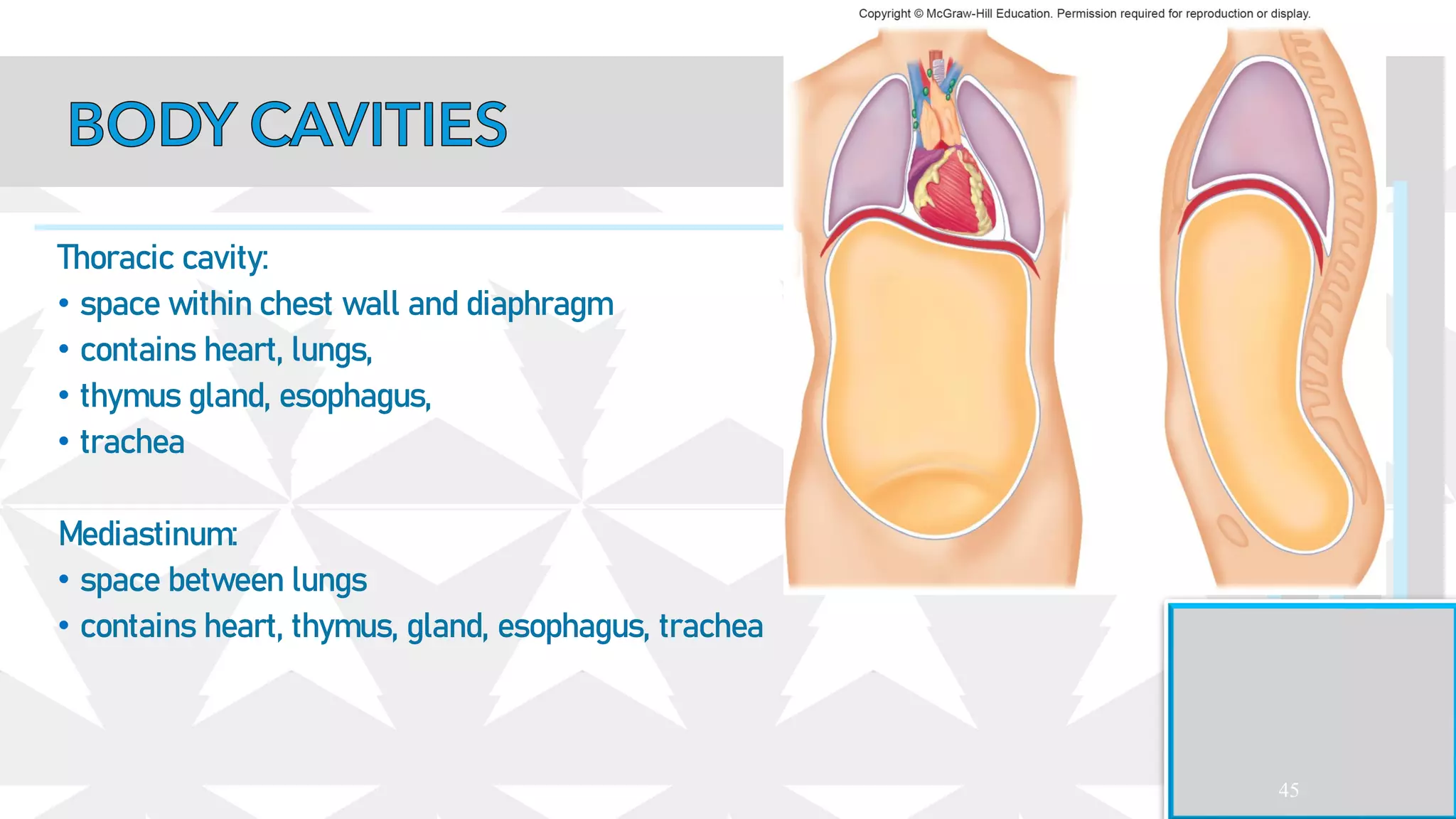
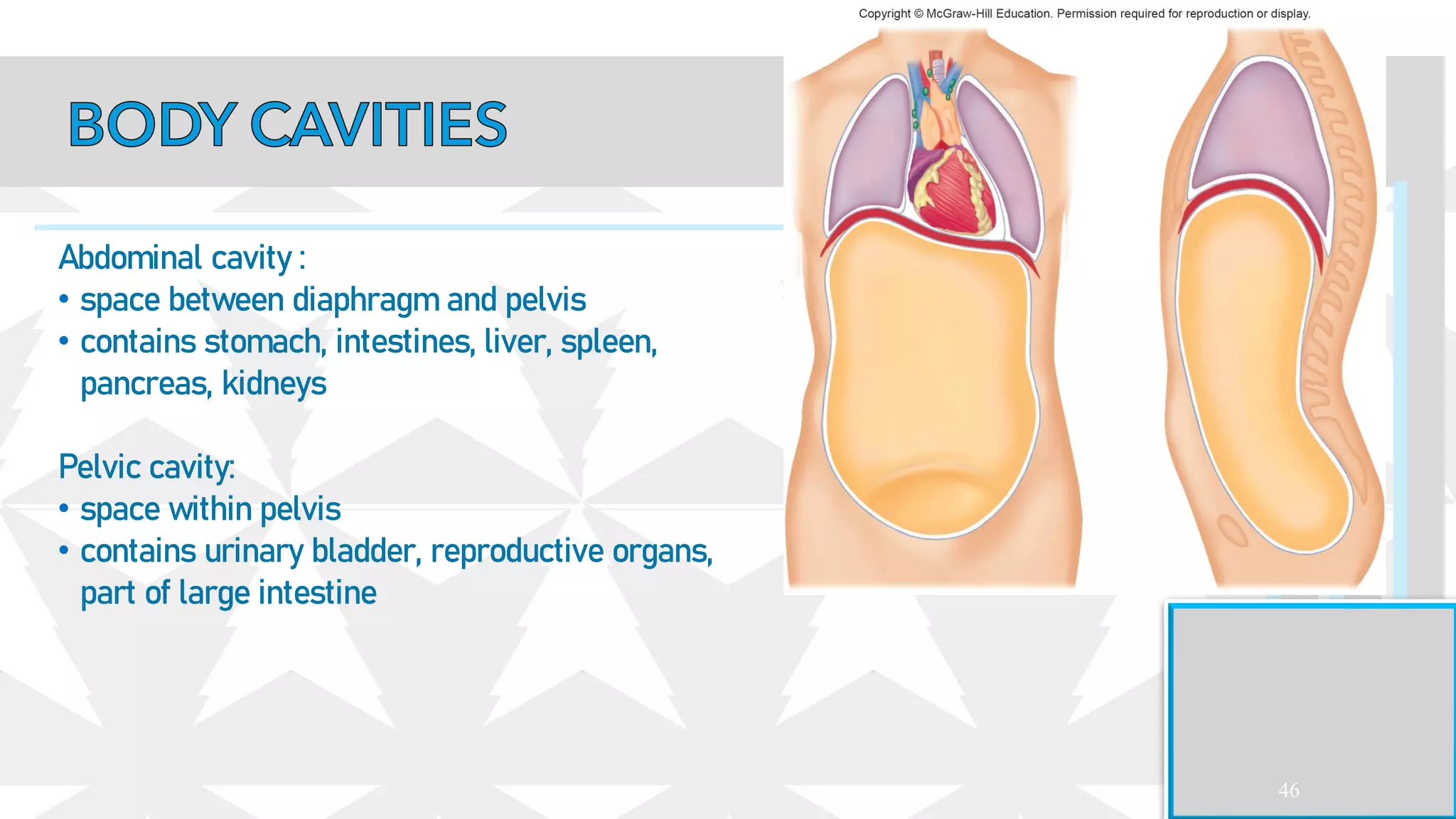
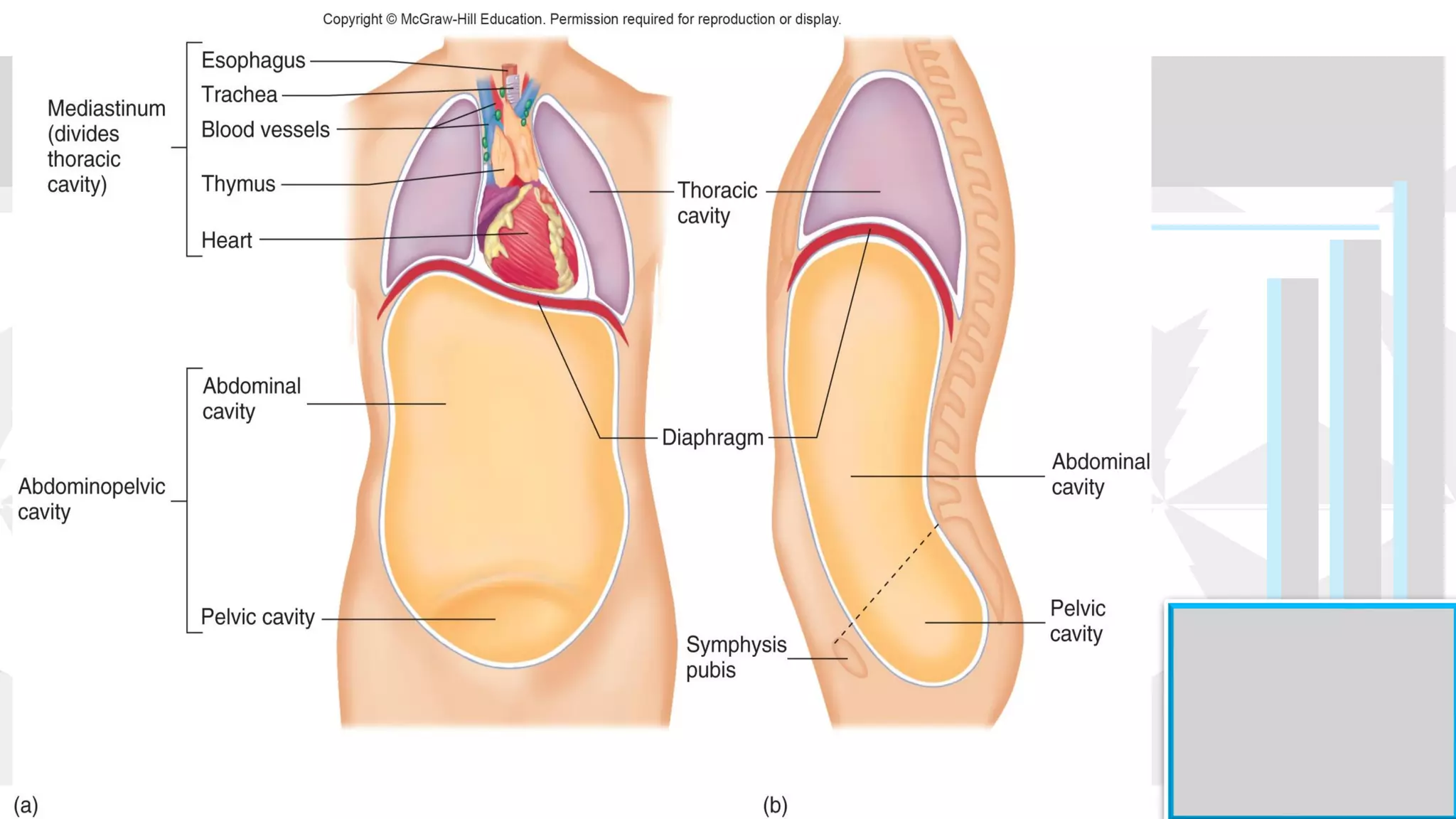
Abdominal cavity :
•space between diaphragm and pelvis
• contains stomach, intestines, liver, spleen,
pancreas, kidneys
Pelvic cavity:
• space within pelvis
• contains urinary bladder, reproductive organs,
part of large intestine