Human Anatomy & Physiology-I
Cell Structure and its Functions
Presented By: Lovekesh Singh
Assistant Professor
ISF College Of Pharmacy
Moga, Punjab
CONTENTS
 Introduction
 Cell structure
 Plasma membrane
 Various organelles of cell
INTRODUCTION
 Cells are the smallest functional units of the body. They are
grouped together to form tissues, each of which has a
specialised function, e.g. blood, muscle, bone.
 Different tissues are grouped together to form organs, e.g.
heart, stomach, brain.
 Organs are grouped together to form systems, each of
which performs a particular function that maintains
homeostasis and contributes to the health of the individual.
 For example, the digestive system is responsible for taking
in, digesting and absorbing food and involves a number of
organs, including the stomach and intestines.
COMPOSITION OF CELL
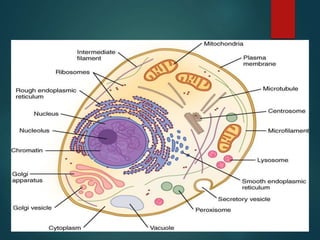
 A cell consists of a plasma membrane inside which
there are a number of organelles floating in a watery
fluid called cytosol.
 Cell Organelles are small structures with highly
specialized functions, many of which are contained
within a membrane. They include:
1. The nucleus 6. lysosomes
2. Mitochondria 7. microfilaments
3. Ribosomes 8. microtubules
4. endoplasmic reticulum
5. Golgi apparatus
PLASMA MEMBRANE
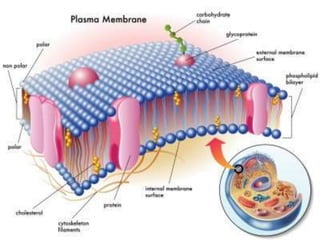
 The plasma membrane consists of two layers of
phospholipids with some protein molecules embedded
in them.
 The membrane may provide channels that allow the
passage of, for example, electrolytes and non-lipid-
soluble substances.
 The phospholipid molecules have a head which is
electrically charged and hydrophilic (meaning 'water
loving') and a tail which has no charge and is
hydrophobic (meaning 'water hating').
FUNCTIONS OF PLASMA
MEMBRANE
 It forms the protective outermost covering of the
cell.
 It helps in the transport of molecules through
channels and pumps.
 It provides point of attachment to other cells.
 It helps in cell to cell communication due to the
presence of carbohydrates.
 It allows some flexibility in the structure of the cells.
 Cell membrane gives shape to the cell.
CELL ORGENELLES- 1. THE NUCLEUS
 Every cell in the body has a nucleus.
 The nucleus is the largest organelle and is contained within a
membrane similar to the plasma membrane but it has tiny pores
through which some substances can pass between It.
 The nucleus contains the body's genetic material, which directs the
activities of the cell. This is built from DNA and proteins called
histones coiled together forming a fine network of threads called
chromatin.
 Chromatin resembles tiny strings of beads.
 During cell division the chromatin replicates and becomes more
tightly coiled forming chromosomes.
FUNCTIONS OF NUCLEUS
 Nucleus stores the genetic information in the
form of DNA and RNA.
 Controls all the cellular functions.
 Controls the synthesis of structural proteins.
 Nucleus contains the genetic information for
reproduction, development and behavior.
 It controls and coordinate the activities of cell
organelles.
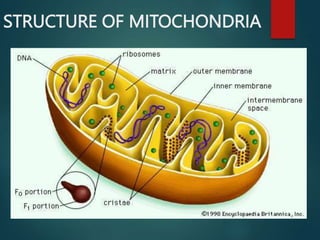
2. Mitochondria
 Mitochondria are sausage-shaped structures in the cytoplasm,
sometimes described as the 'power house' of the cell.
 They are involved in aerobic respiration, the processes by which
chemical energy is made available in the cell. This is in the form of
ATP, which releases energy when the cell breaks it down.
 Synthesis of ATP is most efficient in the final stages of aerobic
respiration, a process requiring oxygen.
 MITOCHONDRIA help the cells to maintain proper concentration of
calcium ions with in the compartments of cell.
 It also help n building certain parts of blood and hormones .
STRUCTURE OF MITOCHONDRIA
3. Ribosomes
 These are tiny granules composed of RNA and protein.
 They synthesize proteins from amino acids, using RNA as the
template.
 When present in free units or in small clusters in the cytoplasm, the
ribosomes make proteins for use within the cell.
 Ribosomes are also found on the outer surface of rough endoplasmic
reticulum.
 They are also known as protein factories.
 Protein is needed for many cell functions such as repairing in
damage or directing chemical processes.
 Ribosomes can be found floating inside the cytoplasm or attached to
the endoplasmic reticulumn.
4. Endoplasmic reticulum (ER)
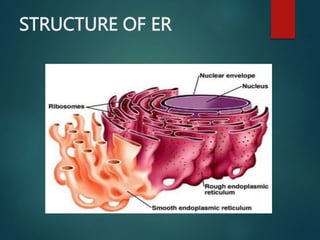
Endoplasmic reticulum (ER) is a series of interconnecting
membranous canals in the cytoplasm. . ER is the only organelle that
has direct physical connection with the nucleus, the nuclear
membrane.
There are two types:
1. Smooth endoplasmic reticulum
2. Rough endoplasmic reticulum
1. Smooth ER synthesizes lipids and steroid hormones, and is also
associated with the detoxification of some drugs.
2. Rough ER is studded with ribosomes. These are the site of
synthesis of proteins that are 'exported' (extruded) from cells, i.e.
enzymes and hormones that pass out of their parent cell to be
used by other cells in the body.
STRUCTURE OF ER
5. GOLGI APPARATUS
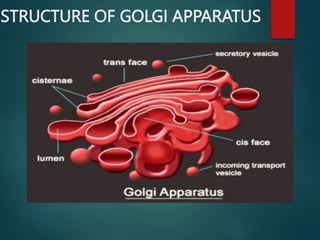
 The Golgi apparatus consists of stacks of closely folded
flattened membranous sacs.
 The organelle is also called the Golgi complex or Golgi
body.
 It is present in all cells but is larger in those that
synthesize and export proteins.
 The proteins move from the endoplasmic reticulum to
the Golgi apparatus where more modifications are made
and then 'packaged' into mem-brane-bound vesicles
called secretory granules.
 The vesicles are stored and, when needed, move to the
plasma membrane, through which the proteins are
exported.
STRUCTURE OF GOLGI APPARATUS
6. LYSOSOMES
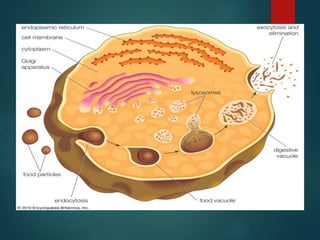
 Lysosomes are one type of secretory vesicle formed by the Golgi
apparatus.
 The word “lysosome” is made up of two words “lysis” meaning
breakdown and “soma” meaning body.
 It is an important cell organelle responsible for the inter and
extracellular breakdown of substances.
 They contain a variety of enzymes involved in breaking down
fragments of organelles and large molecules (e.g. RNA, DNA,
carbohydrates, proteins) inside the cell into smaller particles that
are either recycled, or extruded from the cell as waste material.
 Lysosomes in white blood cells contain enzymes that digest foreign
material such as microbes.
7. MICROFILAMENTS AND
MICROTUBULES
Microfilaments are tiny strands of protein that provide
structural support and maintain the characteristic
shape of the cell.
Microtubules are contractile protein structures in the
cytoplasm involved in the movement of the cell and
of organelles within the cell, the movement of cilia
(small projections from the free border of some cells)
and possibly the organisation of proteins in the
plasma membrane.
REFERENCES
 Essentials of Medical Physiology by K. Sembulingam and P.
Sembulingam. Jaypee Brothers Medical Publishers, New Delhi.
 Anatomy and Physiology in Health and Illness by Kathleen J.W.
Wilson, Churchill Livingstone, New York.
 Physiological basis of Medical Practice-Best and Tailor. Williams and
Wilkin Co, Riverview, MI USA.
 Text book of Medical Physiology- Arthur C, Guyton and John.E. Hall.
Miamisburg, OH, U.S.A.
 Principles of Anatomy and Physiology by Tortora Grabowski.
Palmetto, GA, U.S.A.
 Human Physiology (vol 1 and 2) by Dr. C.C. Chatterrje, Academic
Publishers Kolkata.
QUESTIONS
 Write the functions of mitochondria.
 Enlist the name of cell organelles.
 Draw a neat and clean diagram of cell and label
it.
 Draw the structure of cell membrane and also
explain the functions.
 What do you know about ribosomes?
 Which cell organelle is known as power house of
cell?
THANKS

6. cell structure and functions.ppt

  • 1.
    Human Anatomy &Physiology-I Cell Structure and its Functions Presented By: Lovekesh Singh Assistant Professor ISF College Of Pharmacy Moga, Punjab
  • 2.
    CONTENTS  Introduction  Cellstructure  Plasma membrane  Various organelles of cell
  • 3.
    INTRODUCTION  Cells arethe smallest functional units of the body. They are grouped together to form tissues, each of which has a specialised function, e.g. blood, muscle, bone.  Different tissues are grouped together to form organs, e.g. heart, stomach, brain.  Organs are grouped together to form systems, each of which performs a particular function that maintains homeostasis and contributes to the health of the individual.  For example, the digestive system is responsible for taking in, digesting and absorbing food and involves a number of organs, including the stomach and intestines.
  • 5.
    COMPOSITION OF CELL A cell consists of a plasma membrane inside which there are a number of organelles floating in a watery fluid called cytosol.  Cell Organelles are small structures with highly specialized functions, many of which are contained within a membrane. They include: 1. The nucleus 6. lysosomes 2. Mitochondria 7. microfilaments 3. Ribosomes 8. microtubules 4. endoplasmic reticulum 5. Golgi apparatus
  • 6.
    PLASMA MEMBRANE  Theplasma membrane consists of two layers of phospholipids with some protein molecules embedded in them.  The membrane may provide channels that allow the passage of, for example, electrolytes and non-lipid- soluble substances.  The phospholipid molecules have a head which is electrically charged and hydrophilic (meaning 'water loving') and a tail which has no charge and is hydrophobic (meaning 'water hating').
  • 8.
    FUNCTIONS OF PLASMA MEMBRANE It forms the protective outermost covering of the cell.  It helps in the transport of molecules through channels and pumps.  It provides point of attachment to other cells.  It helps in cell to cell communication due to the presence of carbohydrates.  It allows some flexibility in the structure of the cells.  Cell membrane gives shape to the cell.
  • 9.
    CELL ORGENELLES- 1.THE NUCLEUS  Every cell in the body has a nucleus.  The nucleus is the largest organelle and is contained within a membrane similar to the plasma membrane but it has tiny pores through which some substances can pass between It.  The nucleus contains the body's genetic material, which directs the activities of the cell. This is built from DNA and proteins called histones coiled together forming a fine network of threads called chromatin.  Chromatin resembles tiny strings of beads.  During cell division the chromatin replicates and becomes more tightly coiled forming chromosomes.
  • 10.
    FUNCTIONS OF NUCLEUS Nucleus stores the genetic information in the form of DNA and RNA.  Controls all the cellular functions.  Controls the synthesis of structural proteins.  Nucleus contains the genetic information for reproduction, development and behavior.  It controls and coordinate the activities of cell organelles.
  • 11.
    2. Mitochondria  Mitochondriaare sausage-shaped structures in the cytoplasm, sometimes described as the 'power house' of the cell.  They are involved in aerobic respiration, the processes by which chemical energy is made available in the cell. This is in the form of ATP, which releases energy when the cell breaks it down.  Synthesis of ATP is most efficient in the final stages of aerobic respiration, a process requiring oxygen.  MITOCHONDRIA help the cells to maintain proper concentration of calcium ions with in the compartments of cell.  It also help n building certain parts of blood and hormones .
  • 12.
  • 13.
    3. Ribosomes  Theseare tiny granules composed of RNA and protein.  They synthesize proteins from amino acids, using RNA as the template.  When present in free units or in small clusters in the cytoplasm, the ribosomes make proteins for use within the cell.  Ribosomes are also found on the outer surface of rough endoplasmic reticulum.  They are also known as protein factories.  Protein is needed for many cell functions such as repairing in damage or directing chemical processes.  Ribosomes can be found floating inside the cytoplasm or attached to the endoplasmic reticulumn.
  • 14.
    4. Endoplasmic reticulum(ER) Endoplasmic reticulum (ER) is a series of interconnecting membranous canals in the cytoplasm. . ER is the only organelle that has direct physical connection with the nucleus, the nuclear membrane. There are two types: 1. Smooth endoplasmic reticulum 2. Rough endoplasmic reticulum 1. Smooth ER synthesizes lipids and steroid hormones, and is also associated with the detoxification of some drugs. 2. Rough ER is studded with ribosomes. These are the site of synthesis of proteins that are 'exported' (extruded) from cells, i.e. enzymes and hormones that pass out of their parent cell to be used by other cells in the body.
  • 15.
  • 16.
    5. GOLGI APPARATUS The Golgi apparatus consists of stacks of closely folded flattened membranous sacs.  The organelle is also called the Golgi complex or Golgi body.  It is present in all cells but is larger in those that synthesize and export proteins.  The proteins move from the endoplasmic reticulum to the Golgi apparatus where more modifications are made and then 'packaged' into mem-brane-bound vesicles called secretory granules.  The vesicles are stored and, when needed, move to the plasma membrane, through which the proteins are exported.
  • 17.
  • 18.
    6. LYSOSOMES  Lysosomesare one type of secretory vesicle formed by the Golgi apparatus.  The word “lysosome” is made up of two words “lysis” meaning breakdown and “soma” meaning body.  It is an important cell organelle responsible for the inter and extracellular breakdown of substances.  They contain a variety of enzymes involved in breaking down fragments of organelles and large molecules (e.g. RNA, DNA, carbohydrates, proteins) inside the cell into smaller particles that are either recycled, or extruded from the cell as waste material.  Lysosomes in white blood cells contain enzymes that digest foreign material such as microbes.
  • 20.
    7. MICROFILAMENTS AND MICROTUBULES Microfilamentsare tiny strands of protein that provide structural support and maintain the characteristic shape of the cell. Microtubules are contractile protein structures in the cytoplasm involved in the movement of the cell and of organelles within the cell, the movement of cilia (small projections from the free border of some cells) and possibly the organisation of proteins in the plasma membrane.
  • 21.
    REFERENCES  Essentials ofMedical Physiology by K. Sembulingam and P. Sembulingam. Jaypee Brothers Medical Publishers, New Delhi.  Anatomy and Physiology in Health and Illness by Kathleen J.W. Wilson, Churchill Livingstone, New York.  Physiological basis of Medical Practice-Best and Tailor. Williams and Wilkin Co, Riverview, MI USA.  Text book of Medical Physiology- Arthur C, Guyton and John.E. Hall. Miamisburg, OH, U.S.A.  Principles of Anatomy and Physiology by Tortora Grabowski. Palmetto, GA, U.S.A.  Human Physiology (vol 1 and 2) by Dr. C.C. Chatterrje, Academic Publishers Kolkata.
  • 22.
    QUESTIONS  Write thefunctions of mitochondria.  Enlist the name of cell organelles.  Draw a neat and clean diagram of cell and label it.  Draw the structure of cell membrane and also explain the functions.  What do you know about ribosomes?  Which cell organelle is known as power house of cell?
  • 23.