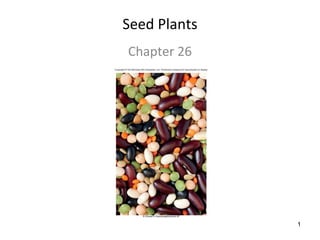
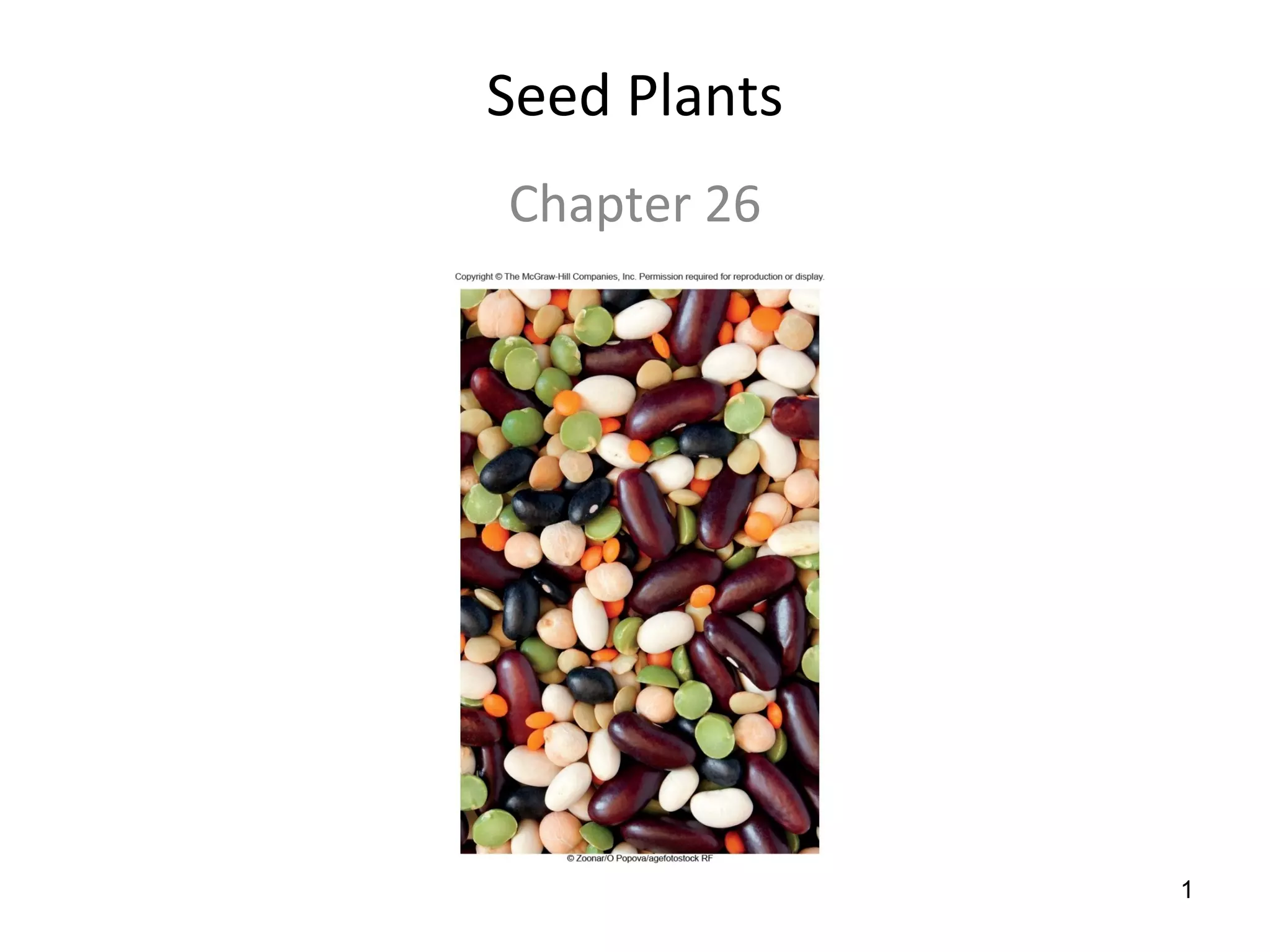
Seed Plants
Chapter 26
1
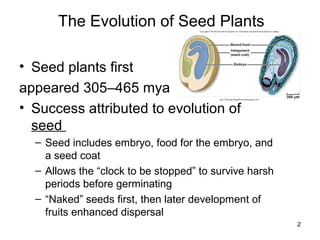
The Evolution of Seed Plants
• Seed plants first
appeared 305–465 mya
• Success attributed to evolution of
seed
– Seed includes embryo, food for the embryo, and
a seed coat
– Allows the “clock to be stopped” to survive harsh
periods before germinating
– “Naked” seeds first, then later development of
fruits enhanced dispersal
2
• Seed plants produce 2 kinds of
gametophytes
• Male gametophytes
– Pollen grains
– Dispersed by wind or a pollinator
– No need for water
• Female gametophytes
– Develop within an ovule
– Enclosed within diploid sporophyte tissue in
angiosperms
3
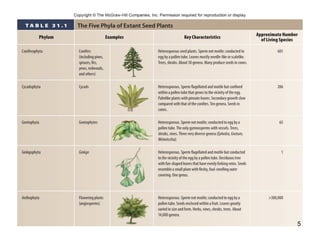
Five Phyla of Extant Seed Plants
• Coniferophyta
• Cycadophyta
• Gnetophyta
• Ginkophyta
• Anthophyta
4
5
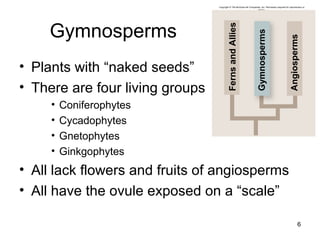
Gymnosperms
• Plants with “naked seeds”
• There are four living groups
• Coniferophytes
• Cycadophytes
• Gnetophytes
• Ginkgophytes
• All lack flowers and fruits of angiosperms
• All have the ovule exposed on a “scale”
6
Copyright © The McGraw-Hill Companies, Inc. Permission required for reproduction or
display.
Angiosperms
Gymnosperms
FernsandAllies
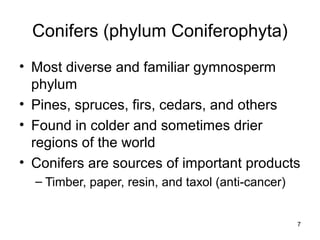
Conifers (phylum Coniferophyta)
• Most diverse and familiar gymnosperm
phylum
• Pines, spruces, firs, cedars, and others
• Found in colder and sometimes drier
regions of the world
• Conifers are sources of important products
– Timber, paper, resin, and taxol (anti-cancer)
7
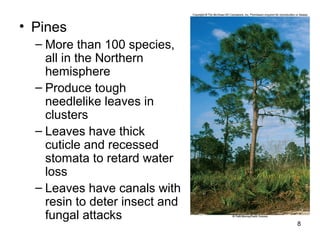
• Pines
– More than 100 species,
all in the Northern
hemisphere
– Produce tough
needlelike leaves in
clusters
– Leaves have thick
cuticle and recessed
stomata to retard water
loss
– Leaves have canals with
resin to deter insect and
fungal attacks
8
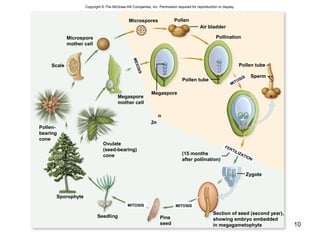
• Pine reproduction
• Male gametophytes (pollen grains)
– Develop from microspores in male cones by
meiosis
• Female pine cones form on the upper
branches of the same tree
– Female cones are larger, and have woody
scales
– Two ovules develop on each scale
– Each contains a megasporangium
• Each will become a female gametophyte
9
10
Copyright © The McGraw-Hill Companies, Inc. Permission required for reproduction or display.
Microspore
mother cell
Microspores Pollen
Air bladder
Pollination
Pollen tube
Sperm
MITOSIS
Zygote
Section of seed (second year),
showing embryo embedded
in megagametophyte
MITOSIS
Pine
seed
MITOSIS
Seedling
Sporophyte
Pollen-
bearing
cone
Scale
Megaspore
mother cell
Ovulate
(seed-bearing)
cone
Megaspore
Pollen tube
n
2n
(15 months
after pollination)
MEIOSIS
FERTILIZATION
• Female cones usually take 2 or more seasons to
mature
• During the first spring, pollen grains drift down
between open scales
– Pollen grains drawn down into micropyle
– Scales close
• A year later, female gametophyte matures
– Pollen tube is digesting its way through
– Mature male gametophyte has 2 sperm
• 15 months after pollination, pollen tube reaches
archegonium and discharges contents
– One sperm unites with egg = zygote
– Other sperm degenerates 11
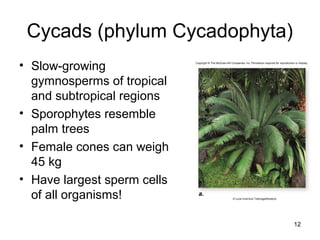
Cycads (phylum Cycadophyta)
• Slow-growing
gymnosperms of tropical
and subtropical regions
• Sporophytes resemble
palm trees
• Female cones can weigh
45 kg
• Have largest sperm cells
of all organisms!
12
a.
© Luca Invernizzi Tetto/agefotostock
Copyright © The McGraw-Hill Companies, Inc. Permission required for reproduction or display.
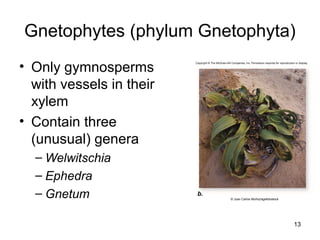
Gnetophytes (phylum Gnetophyta)
• Only gymnosperms
with vessels in their
xylem
• Contain three
(unusual) genera
– Welwitschia
– Ephedra
– Gnetum
13
b.
© Juan Carlos Muñoz/agefotostock
Copyright © The McGraw-Hill Companies, Inc. Permission required for reproduction or display.
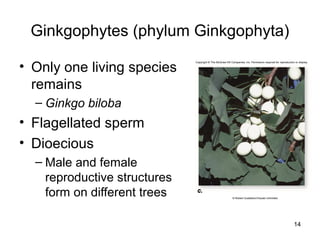
Ginkgophytes (phylum Ginkgophyta)
• Only one living species
remains
– Ginkgo biloba
• Flagellated sperm
• Dioecious
– Male and female
reproductive structures
form on different trees
14
c.
© Robert Gustafson/Visuals Unlimited
Copyright © The McGraw-Hill Companies, Inc. Permission required for reproduction or display.
c.c.
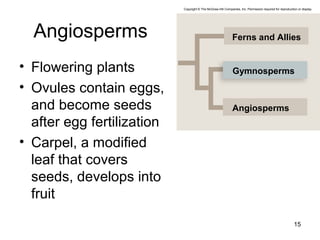
Angiosperms
• Flowering plants
• Ovules contain eggs,
and become seeds
after egg fertilization
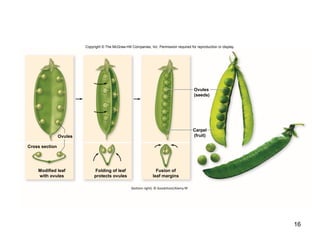
• Carpel, a modified
leaf that covers
seeds, develops into
fruit
15
Ferns and Allies
Angiosperms
Gymnosperms
Copyright © The McGraw-Hill Companies, Inc. Permission required for reproduction or display.
16
Copyright © The McGraw-Hill Companies, Inc. Permission required for reproduction or display.
(bottom right): © Goodshoot/Alamy RF
Fusion of
leaf margins
Modified leaf
with ovules
Cross section
Ovules
(seeds)
Carpel
(fruit)
Folding of leaf
protects ovules
Ovules
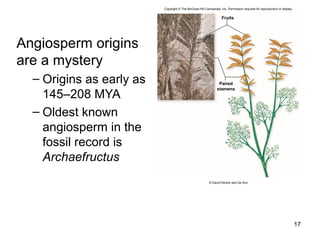
Angiosperm origins
are a mystery
– Origins as early as
145–208 MYA
– Oldest known
angiosperm in the
fossil record is
Archaefructus
17
Copyright © The McGraw-Hill Companies, Inc. Permission required for reproduction or display.
Fruits
© David Dilcher and Ge Sun
Paired
stamens
18
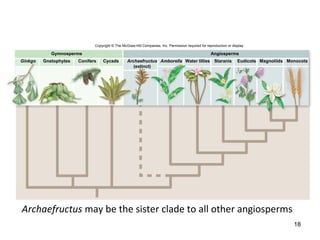
Archaefructus may be the sister clade to all other angiosperms
Gymnosperms Angiosperms
Ginkgo Gnetophytes Conifers Cycads Archaefructus
(extinct)
Amborella Water lillies MonocotsMagnoliidsEudicotsStaranis
Copyright © The McGraw-Hill Companies, Inc. Permission required for reproduction or display.
Flowers contain the
gametophyte generation
• Flower morphology
– All flower parts have evolved either from
stems or leaves
– Flower parts are organized in circles called
whorls
19
• Flower whorls
– Outermost whorl – sepals
– Second whorl – petals
– Third whorl – stamens (androecium)
• Each stamen has an anther (where the pollen is)
and a filament (stalk)
• Pollen is the male gametophyte
– Fourth whorl - gynoecium
• Consists of one or more carpels
• Contain the female gametophyte
20
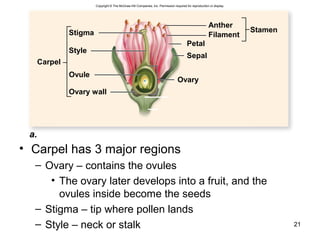
• Carpel has 3 major regions
– Ovary – contains the ovules
• The ovary later develops into a fruit, and the
ovules inside become the seeds
– Stigma – tip where pollen lands
– Style – neck or stalk 21
Carpel
Stigma
Style
Ovule
Ovary wall
Stamen
Anther
Filament
Petal
Sepal
Ovary
a.
Copyright © The McGraw-Hill Companies, Inc. Permission required for reproduction or display.
Megaspore (n)
Generative
cell
Tube
nucleus
Pollen tube
Sperm
Tube
nucleus
Style
Pollen (n)
Formation of
pollen tube (n)
Polar
nuclei
Sperm
Egg
Polar
nuclei
Egg
MITOSIS
MITOSIS
Zygote
Embryo (2n)
Cotyledons
Seed (2n)
Endosperm (3n)
Endosperm
Anther
Ovary
Stigma
Anther (2n)
Ovule
2n
DOUBLE
FERTILIZATION
MITOSIS
G
ERM
INATIO
N
Microspore
mother cells (2n)
Megaspore
mother cell (2n)
Adult sporophyte
with flower (2n)
Young
sporophyte (2n)
Seed
coat
MITOSIS
Copyright © The McGraw-Hill Companies, Inc. Permission required for reproduction or display.
22
• Pollination
– Mechanical transfer of pollen from anther to
stigma
– May or may not be followed by fertilization
– Pollen grains develop a pollen tube that is
guided to the embryo sac
– The “generative cell” divides to produce two
sperm cells
• No flagella on sperm
23
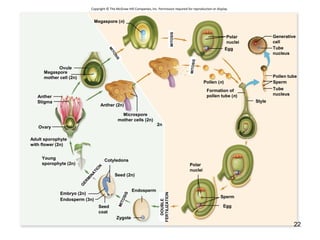
• Double fertilization
– One sperm unites with egg to form the diploid
zygote (which becomes the new sporophyte embryo)
– Other sperm unites with the two polar nuclei
to form the triploid endosperm
• Provides nutrients to new sporophyte embryo
• Seed may remain dormant for many years
– Germinate (grow by mitosis) when conditions
are favorable
24
Seeds
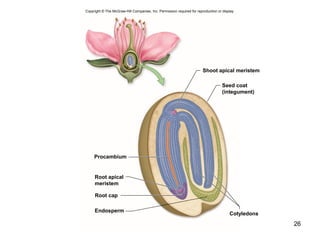
• In many angiosperms, development of the
embryo stops soon after meristems and
cotyledons differentiate
• Integuments develop into a relatively
impermeable seed coat
• Encloses the seed with its dormant
embryo and stored food
25
26
Copyright © The McGraw-Hill Companies, Inc. Permission required for reproduction or display.
Shoot apical meristem
Root apical
meristem
Root cap
Endosperm
Procambium
Seed coat
(integument)
Cotyledons
• Seeds are an important adaptation
1. They maintain dormancy under unfavorable
conditions
2. They protect the young plant when it is most
vulnerable
3. They provide food for the embryo until it can
produce its own food
4. They facilitate dispersal of the embryo
27
• Once a seed coat forms, most of the
embryo’s metabolic activities cease
• Germination cannot take place until water
and oxygen reach the embryo
• Seeds of some plants have been known to
remain viable for thousands of years
28
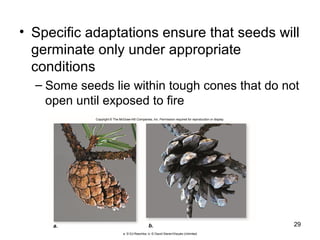
• Specific adaptations ensure that seeds will
germinate only under appropriate
conditions
– Some seeds lie within tough cones that do not
open until exposed to fire
29a. b.
Copyright © The McGraw-Hill Companies, Inc. Permission required for reproduction or display.
a: © Ed Reschke; b: © David Sieren/Visuals Unlimited
Fruits
• Most are simply defined as “mature
ovaries” (carpels)
• At the same time seeds are forming, the
flower ovary begins to develop into a “fruit”
• However, it is also possible for fruits to
develop without seed development
– Bananas are propagated asexually
• Not all fruits are something you would
want to eat! 30
31
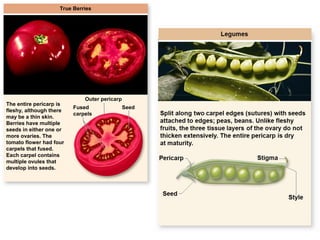
True Berries
The entire pericarp is
fleshy, although there
may be a thin skin.
Berries have multiple
seeds in either one or
more ovaries. The
tomato flower had four
carpels that fused.
Each carpel contains
multiple ovules that
develop into seeds.
Outer pericarp
SeedFused
carpels
32
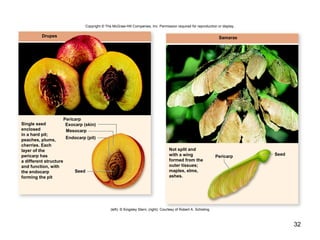
Drupes
Seed
Pericarp
Exocarp (skin)
Mesocarp
Endocarp (pit)
Single seed
enclosed
in a hard pit;
peaches, plums,
cherries. Each
layer of the
pericarp has
a different structure
and function, with
the endocarp
forming the pit
Samaras
Pericarp
Not split and
with a wing
formed from the
outer tissues;
maples, elms,
ashes.
Seed
(left): © Kingsley Stern; (right): Courtesy of Robert A. Schisling
Copyright © The McGraw-Hill Companies, Inc. Permission required for reproduction or display.
33
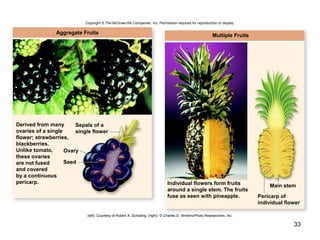
Aggregate Fruits
Sepals of a
single flower
Ovary
Seed
Derived from many
ovaries of a single
flower; strawberries,
blackberries.
Unlike tomato,
these ovaries
are not fused
and covered
by a continuous
pericarp.
Multiple Fruits
Individual flowers form fruits
around a single stem. The fruits
fuse as seen with pineapple. Pericarp of
individual flower
Main stem
(left): Courtesy of Robert A. Schisling; (right): © Charles D. Winters/Photo Researchers, Inc.
Copyright © The McGraw-Hill Companies, Inc. Permission required for reproduction or display.
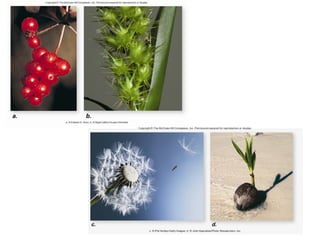
Fruit Dispersal
• Occurs through a wide array of methods
– Ingestion and transportation by birds or other
vertebrates
– Hitching a ride with hooked spines on birds
and mammals
– Burial in caches by herbivores
– Blowing in the wind
– Floating and drifting on water
34
35

Chapter 26 lecture presentation

  • 1.
  • 2.
    The Evolution ofSeed Plants • Seed plants first appeared 305–465 mya • Success attributed to evolution of seed – Seed includes embryo, food for the embryo, and a seed coat – Allows the “clock to be stopped” to survive harsh periods before germinating – “Naked” seeds first, then later development of fruits enhanced dispersal 2
  • 3.
    • Seed plantsproduce 2 kinds of gametophytes • Male gametophytes – Pollen grains – Dispersed by wind or a pollinator – No need for water • Female gametophytes – Develop within an ovule – Enclosed within diploid sporophyte tissue in angiosperms 3
  • 4.
    Five Phyla ofExtant Seed Plants • Coniferophyta • Cycadophyta • Gnetophyta • Ginkophyta • Anthophyta 4
  • 5.
  • 6.
    Gymnosperms • Plants with“naked seeds” • There are four living groups • Coniferophytes • Cycadophytes • Gnetophytes • Ginkgophytes • All lack flowers and fruits of angiosperms • All have the ovule exposed on a “scale” 6 Copyright © The McGraw-Hill Companies, Inc. Permission required for reproduction or display. Angiosperms Gymnosperms FernsandAllies
  • 7.
    Conifers (phylum Coniferophyta) •Most diverse and familiar gymnosperm phylum • Pines, spruces, firs, cedars, and others • Found in colder and sometimes drier regions of the world • Conifers are sources of important products – Timber, paper, resin, and taxol (anti-cancer) 7
  • 8.
    • Pines – Morethan 100 species, all in the Northern hemisphere – Produce tough needlelike leaves in clusters – Leaves have thick cuticle and recessed stomata to retard water loss – Leaves have canals with resin to deter insect and fungal attacks 8
  • 9.
    • Pine reproduction •Male gametophytes (pollen grains) – Develop from microspores in male cones by meiosis • Female pine cones form on the upper branches of the same tree – Female cones are larger, and have woody scales – Two ovules develop on each scale – Each contains a megasporangium • Each will become a female gametophyte 9
  • 10.
    10 Copyright © TheMcGraw-Hill Companies, Inc. Permission required for reproduction or display. Microspore mother cell Microspores Pollen Air bladder Pollination Pollen tube Sperm MITOSIS Zygote Section of seed (second year), showing embryo embedded in megagametophyte MITOSIS Pine seed MITOSIS Seedling Sporophyte Pollen- bearing cone Scale Megaspore mother cell Ovulate (seed-bearing) cone Megaspore Pollen tube n 2n (15 months after pollination) MEIOSIS FERTILIZATION
  • 11.
    • Female conesusually take 2 or more seasons to mature • During the first spring, pollen grains drift down between open scales – Pollen grains drawn down into micropyle – Scales close • A year later, female gametophyte matures – Pollen tube is digesting its way through – Mature male gametophyte has 2 sperm • 15 months after pollination, pollen tube reaches archegonium and discharges contents – One sperm unites with egg = zygote – Other sperm degenerates 11
  • 12.
    Cycads (phylum Cycadophyta) •Slow-growing gymnosperms of tropical and subtropical regions • Sporophytes resemble palm trees • Female cones can weigh 45 kg • Have largest sperm cells of all organisms! 12 a. © Luca Invernizzi Tetto/agefotostock Copyright © The McGraw-Hill Companies, Inc. Permission required for reproduction or display.
  • 13.
    Gnetophytes (phylum Gnetophyta) •Only gymnosperms with vessels in their xylem • Contain three (unusual) genera – Welwitschia – Ephedra – Gnetum 13 b. © Juan Carlos Muñoz/agefotostock Copyright © The McGraw-Hill Companies, Inc. Permission required for reproduction or display.
  • 14.
    Ginkgophytes (phylum Ginkgophyta) •Only one living species remains – Ginkgo biloba • Flagellated sperm • Dioecious – Male and female reproductive structures form on different trees 14 c. © Robert Gustafson/Visuals Unlimited Copyright © The McGraw-Hill Companies, Inc. Permission required for reproduction or display. c.c.
  • 15.
    Angiosperms • Flowering plants •Ovules contain eggs, and become seeds after egg fertilization • Carpel, a modified leaf that covers seeds, develops into fruit 15 Ferns and Allies Angiosperms Gymnosperms Copyright © The McGraw-Hill Companies, Inc. Permission required for reproduction or display.
  • 16.
    16 Copyright © TheMcGraw-Hill Companies, Inc. Permission required for reproduction or display. (bottom right): © Goodshoot/Alamy RF Fusion of leaf margins Modified leaf with ovules Cross section Ovules (seeds) Carpel (fruit) Folding of leaf protects ovules Ovules
  • 17.
    Angiosperm origins are amystery – Origins as early as 145–208 MYA – Oldest known angiosperm in the fossil record is Archaefructus 17 Copyright © The McGraw-Hill Companies, Inc. Permission required for reproduction or display. Fruits © David Dilcher and Ge Sun Paired stamens
  • 18.
    18 Archaefructus may bethe sister clade to all other angiosperms Gymnosperms Angiosperms Ginkgo Gnetophytes Conifers Cycads Archaefructus (extinct) Amborella Water lillies MonocotsMagnoliidsEudicotsStaranis Copyright © The McGraw-Hill Companies, Inc. Permission required for reproduction or display.
  • 19.
    Flowers contain the gametophytegeneration • Flower morphology – All flower parts have evolved either from stems or leaves – Flower parts are organized in circles called whorls 19
  • 20.
    • Flower whorls –Outermost whorl – sepals – Second whorl – petals – Third whorl – stamens (androecium) • Each stamen has an anther (where the pollen is) and a filament (stalk) • Pollen is the male gametophyte – Fourth whorl - gynoecium • Consists of one or more carpels • Contain the female gametophyte 20
  • 21.
    • Carpel has3 major regions – Ovary – contains the ovules • The ovary later develops into a fruit, and the ovules inside become the seeds – Stigma – tip where pollen lands – Style – neck or stalk 21 Carpel Stigma Style Ovule Ovary wall Stamen Anther Filament Petal Sepal Ovary a. Copyright © The McGraw-Hill Companies, Inc. Permission required for reproduction or display.
  • 22.
    Megaspore (n) Generative cell Tube nucleus Pollen tube Sperm Tube nucleus Style Pollen(n) Formation of pollen tube (n) Polar nuclei Sperm Egg Polar nuclei Egg MITOSIS MITOSIS Zygote Embryo (2n) Cotyledons Seed (2n) Endosperm (3n) Endosperm Anther Ovary Stigma Anther (2n) Ovule 2n DOUBLE FERTILIZATION MITOSIS G ERM INATIO N Microspore mother cells (2n) Megaspore mother cell (2n) Adult sporophyte with flower (2n) Young sporophyte (2n) Seed coat MITOSIS Copyright © The McGraw-Hill Companies, Inc. Permission required for reproduction or display. 22
  • 23.
    • Pollination – Mechanicaltransfer of pollen from anther to stigma – May or may not be followed by fertilization – Pollen grains develop a pollen tube that is guided to the embryo sac – The “generative cell” divides to produce two sperm cells • No flagella on sperm 23
  • 24.
    • Double fertilization –One sperm unites with egg to form the diploid zygote (which becomes the new sporophyte embryo) – Other sperm unites with the two polar nuclei to form the triploid endosperm • Provides nutrients to new sporophyte embryo • Seed may remain dormant for many years – Germinate (grow by mitosis) when conditions are favorable 24
  • 25.
    Seeds • In manyangiosperms, development of the embryo stops soon after meristems and cotyledons differentiate • Integuments develop into a relatively impermeable seed coat • Encloses the seed with its dormant embryo and stored food 25
  • 26.
    26 Copyright © TheMcGraw-Hill Companies, Inc. Permission required for reproduction or display. Shoot apical meristem Root apical meristem Root cap Endosperm Procambium Seed coat (integument) Cotyledons
  • 27.
    • Seeds arean important adaptation 1. They maintain dormancy under unfavorable conditions 2. They protect the young plant when it is most vulnerable 3. They provide food for the embryo until it can produce its own food 4. They facilitate dispersal of the embryo 27
  • 28.
    • Once aseed coat forms, most of the embryo’s metabolic activities cease • Germination cannot take place until water and oxygen reach the embryo • Seeds of some plants have been known to remain viable for thousands of years 28
  • 29.
    • Specific adaptationsensure that seeds will germinate only under appropriate conditions – Some seeds lie within tough cones that do not open until exposed to fire 29a. b. Copyright © The McGraw-Hill Companies, Inc. Permission required for reproduction or display. a: © Ed Reschke; b: © David Sieren/Visuals Unlimited
  • 30.
    Fruits • Most aresimply defined as “mature ovaries” (carpels) • At the same time seeds are forming, the flower ovary begins to develop into a “fruit” • However, it is also possible for fruits to develop without seed development – Bananas are propagated asexually • Not all fruits are something you would want to eat! 30
  • 31.
    31 True Berries The entirepericarp is fleshy, although there may be a thin skin. Berries have multiple seeds in either one or more ovaries. The tomato flower had four carpels that fused. Each carpel contains multiple ovules that develop into seeds. Outer pericarp SeedFused carpels
  • 32.
    32 Drupes Seed Pericarp Exocarp (skin) Mesocarp Endocarp (pit) Singleseed enclosed in a hard pit; peaches, plums, cherries. Each layer of the pericarp has a different structure and function, with the endocarp forming the pit Samaras Pericarp Not split and with a wing formed from the outer tissues; maples, elms, ashes. Seed (left): © Kingsley Stern; (right): Courtesy of Robert A. Schisling Copyright © The McGraw-Hill Companies, Inc. Permission required for reproduction or display.
  • 33.
    33 Aggregate Fruits Sepals ofa single flower Ovary Seed Derived from many ovaries of a single flower; strawberries, blackberries. Unlike tomato, these ovaries are not fused and covered by a continuous pericarp. Multiple Fruits Individual flowers form fruits around a single stem. The fruits fuse as seen with pineapple. Pericarp of individual flower Main stem (left): Courtesy of Robert A. Schisling; (right): © Charles D. Winters/Photo Researchers, Inc. Copyright © The McGraw-Hill Companies, Inc. Permission required for reproduction or display.
  • 34.
    Fruit Dispersal • Occursthrough a wide array of methods – Ingestion and transportation by birds or other vertebrates – Hitching a ride with hooked spines on birds and mammals – Burial in caches by herbivores – Blowing in the wind – Floating and drifting on water 34
  • 35.