Copyright © 2008 Pearson Education, Inc., publishing as Pearson Benjamin Cummings
PowerPoint®
Lecture Presentations for
Biology
Eighth Edition
Neil Campbell and Jane Reece
Lectures by Chris Romero, updated by Erin Barley with contributions from Joan Sharp
Chapter 29
Plant Diversity I:
How Plants
Colonized Land
Copyright © 2008 Pearson Education, Inc., publishing as Pearson Benjamin Cummings
Overview: The Greening of Earth
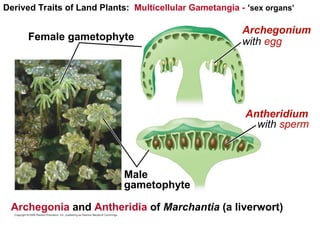
• Since colonizing land at least 475 million years ago,
plants have diversified into roughly 290,000 living
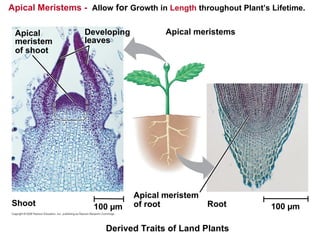
species.
• Plants supply oxygen and are the ultimate source of
most food eaten by land animals.
• Green algae called charophytes are the closest
relatives of land plants.
• Note that land plants are not descended from modern
charophytes, but share a common ancestor with
modern charophytes.
Copyright © 2008 Pearson Education, Inc., publishing as Pearson Benjamin Cummings
Morphological and Molecular Evidence
Land plants share key traits only with green algae
charophytes:
• DNA comparisons of both nuclear and chloroplast
genes.
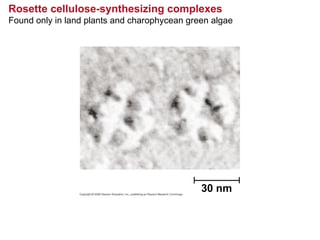
• Rose-shaped complexes for cellulose synthesis.
• Peroxisome enzymes - minimize loss from
photorespiration.
• Structure of flagellated sperm.
• Formation of a phragmoplast - allignment of cytoskeletal
elements and Golgi vesicles for cell plate.
Rosette cellulose-synthesizing complexes
Found only in land plants and charophycean green algae
30 nm
Copyright © 2008 Pearson Education, Inc., publishing as Pearson Benjamin Cummings
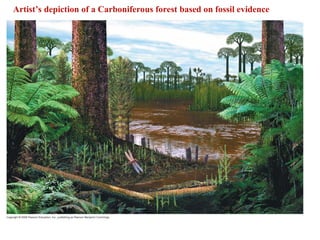
Adaptations Enabling the Move to Land
• In green algae charophytes a layer of a durable
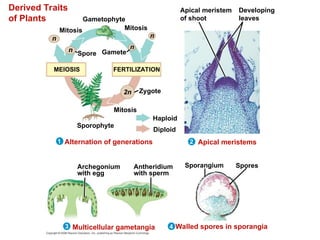
polymer called sporopollenin prevents
dehydration of exposed zygotes.
• The movement onto land by charophyte
ancestors provided advantages: unfiltered sun,
more plentiful CO2, nutrient-rich soil, and few
herbivores or pathogens.
• Land presented challenges: a scarcity of water
and lack of structural support.
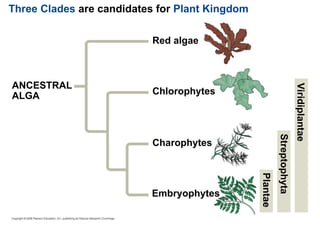
Three Clades are candidates for Plant Kingdom
ANCESTRAL
ALGA
Red algae
Chlorophytes
Charophytes
Embryophytes
Viridiplantae
Streptophyta
Plantae
Copyright © 2008 Pearson Education, Inc., publishing as Pearson Benjamin Cummings
Derived Traits of Plants
• A cuticle and secondary compounds evolved in many
plant species. Symbiotic associations between fungi and
the first land plants may have helped plants without true
roots to obtain nutrients.
• Four key derived traits of plants are absent in the green
algae charophytes:
– Alternation of generations - with multicellular,
dependent embryos.
– Walled spores produced in sporangia
– Multicellular gametangia
– Apical meristems
Copyright © 2008 Pearson Education, Inc., publishing as Pearson Benjamin Cummings
Alternation of Generations and
Multicellular Dependent Embryos
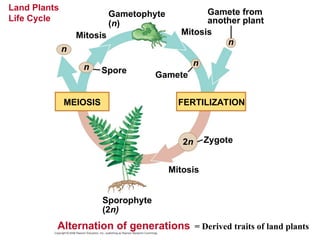
• The multicellular gametophyte is haploid and
produces haploid gametes by mitosis.
• Fusion of the gametes gives rise to the diploid
sporophyte, which produces haploid spores by
meiosis.
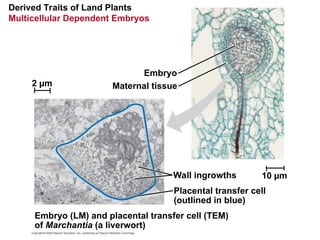
• The diploid embryo is retained within the tissue of the
female gametophyte. Nutrients are transferred from
parent to embryo through placental transfer cells.
• Land plants are called embryophytes because of the
dependency of the embryo on the parent.
Land Plants
Life Cycle Gametophyte
(n)
Gamete from
another plant
n
n
Mitosis
Gamete
FERTILIZATION
MEIOSIS
Mitosis
Spore
n
n
2n Zygote
Mitosis
Sporophyte
(2n)
Alternation of generations = Derived traits of land plants
Derived Traits of Land Plants
Multicellular Dependent Embryos
Embryo
Maternal tissue
Wall ingrowths
Placental transfer cell
(outlined in blue)
Embryo (LM) and placental transfer cell (TEM)
of Marchantia (a liverwort)
2 µm
10 µm
Copyright © 2008 Pearson Education, Inc., publishing as Pearson Benjamin Cummings
Walled Spores Produced in Sporangia
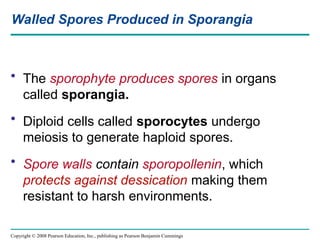
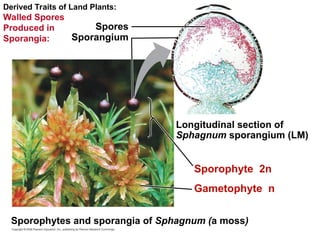
• The sporophyte produces spores in organs
called sporangia.
• Diploid cells called sporocytes undergo
meiosis to generate haploid spores.
• Spore walls contain sporopollenin, which
protects against dessication making them
resistant to harsh environments.
Derived Traits of Land Plants:
Walled Spores
Produced in
Sporangia:
Spores
Sporangium
Sporophyte 2n
Longitudinal section of
Sphagnum sporangium (LM)
Gametophyte n
Sporophytes and sporangia of Sphagnum (a moss)
Copyright © 2008 Pearson Education, Inc., publishing as Pearson Benjamin Cummings
Multicellular Gametangia
• Gametes are produced within ‘sex organs’ called
gametangia.
• Female gametangia, called archegonia, produce
eggs and are the site of fertilization.
• Male gametangia, called antheridia, are the site
of sperm production and release.
Derived Traits of Land Plants: Multicellular Gametangia - ‘sex organs’
Female gametophyte
Male
gametophyte
Antheridium
with sperm
Archegonium
with egg
Archegonia and Antheridia of Marchantia (a liverwort)
Copyright © 2008 Pearson Education, Inc., publishing as Pearson Benjamin Cummings
Apical Meristems
• Apical meristems are growth regions at plant
tips, allowing plants to sustain continual growth
in their length.
• Cells from the apical meristems differentiate
into various tissues.
Apical Meristems - Allow for Growth in Length throughout Plant’s Lifetime.
Apical
meristem
of shoot
Developing
leaves
Apical meristems
Apical meristem
of root Root
100 µm 100 µm
Shoot
Derived Traits of Land Plants
Copyright © 2008 Pearson Education, Inc., publishing as Pearson Benjamin Cummings
• Ancestral species gave rise to land plants
which can be informally grouped based on the
presence or absence of vascular tissue.
• Nonvascular plants are commonly called
bryophytes.
• Most plants have vascular tissue; these
constitute the vascular plants:
seedless vascular and seed plants.
A Vast Diversity of Modern Plants
Copyright © 2008 Pearson Education, Inc., publishing as Pearson Benjamin Cummings
• Seedless vascular plants can be divided into
clades:
– Lycophytes (club mosses and their relatives)
– Pterophytes (ferns and their relatives).
• Seedless vascular plants are paraphyletic, and
are of the same level of biological organization,
or grade.
Copyright © 2008 Pearson Education, Inc., publishing as Pearson Benjamin Cummings
• A seed is an embryo and nutrients surrounded
by a protective coat.
• Seed plants form a clade and can be divided
into further clades:
– Gymnosperms, the “naked seed” plants
including the conifers / cone = sex organ
– Angiosperms, the flowering plants including
monocots and dicots / flower = sex organ
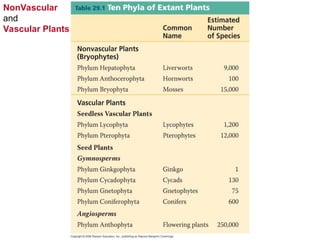
NonVascular
and
Vascular Plants
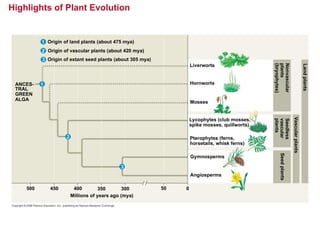
Highlights of Plant Evolution
Origin of land plants (about 475 mya)
1
2
3
1
2
3
Origin of vascular plants (about 420 mya)
Origin of extant seed plants (about 305 mya)
ANCES-
TRAL
GREEN
ALGA
Liverworts
Hornworts
Mosses
Lycophytes (club mosses,
spike mosses, quillworts)
Pterophytes (ferns,
horsetails, whisk ferns)
Gymnosperms
Angiosperms
Seed
plants
Seedless
vascular
plants
Nonvascular
plants
(bryophytes)
Land
plants
Vascular
plants
Millions of years ago (mya)
500 450 400 350 300 50 0
Copyright © 2008 Pearson Education, Inc., publishing as Pearson Benjamin Cummings
NonVascular plants have life cycles dominated by
gametophytes
• Bryophytes are nonvascular and represented today by
three phyla of small herbaceous (nonwoody) plants:
– Liverworts, phylum Hepatophyta
– Hornworts, phylum Anthocerophyta
– Mosses, phylum Bryophyta
• Mosses are most closely related to vascular plants.
• Gametophytes are dominant: larger and longer-living
than sporophytes. Sporophytes are present only part
of the time and dependent on the gametophytes.
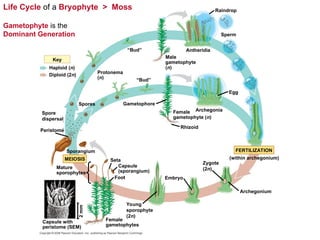
Life Cycle of a Bryophyte > Moss
Gametophyte is the
Dominant Generation
Key
Haploid (n)
Diploid (2n) Protonema
(n)
“Bud”
“Bud”
Male
gametophyte
(n)
Female
gametophyte (n)
Gametophore
Rhizoid
Spores
Spore
dispersal
Peristome
Sporangium
MEIOSIS Seta
Capsule
(sporangium)
Foot
Mature
sporophytes
Capsule with
peristome (SEM)
Female
gametophytes
2
mm
Raindrop
Sperm
Antheridia
Egg
Archegonia
FERTILIZATION
(within archegonium)
Zygote
(2n)
Embryo
Archegonium
Young
sporophyte
(2n)
Copyright © 2008 Pearson Education, Inc., publishing as Pearson Benjamin Cummings
• A spore germinates into a gametophyte
composed of a protonema and gamete-
producing gametophore.
• Rhizoids anchor gametophytes to substrate.
• The height of gametophytes is constrained by
lack of vascular tissues.
• Mature gametophytes produce flagellated sperm
in antheridia and an egg in each archegonium.
• Sperm swim through a film of water to reach and
fertilize the egg.
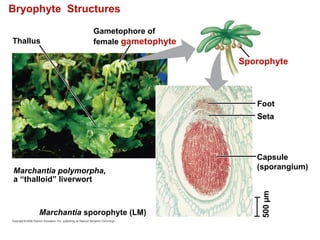
Bryophyte Structures
Thallus
Gametophore of
female gametophyte
Marchantia polymorpha,
a “thalloid” liverwort
Marchantia sporophyte (LM)
Sporophyte
Foot
Seta
Capsule
(sporangium)
500
µm
Copyright © 2008 Pearson Education, Inc., publishing as Pearson Benjamin Cummings
The Ecological and Economic Importance of
Mosses
• Moses are capable of inhabiting diverse and
sometimes extreme environments, but are especially
common in moist forests and wetlands.
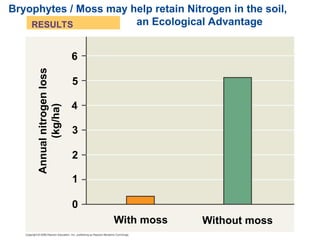
• Some mosses might help retain nitrogen in the soil.
• Sphagnum, or “peat moss,” forms extensive deposits
of partially decayed organic material known as peat.
• Sphagnum is an important global reservoir of organic
carbon.
Bryophytes / Moss may help retain Nitrogen in the soil,
an Ecological Advantage
RESULTS
With moss Without moss
Annual
nitrogen
loss
(kg/ha)
0
1
2
3
4
5
6
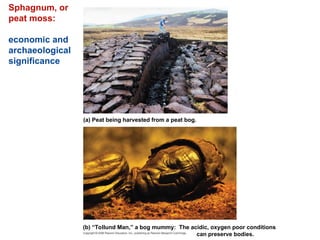
Sphagnum, or
peat moss:
economic and
archaeological
significance
(a) Peat being harvested from a peat bog.
(b) “Tollund Man,” a bog mummy: The acidic, oxygen poor conditions
can preserve bodies.
Copyright © 2008 Pearson Education, Inc., publishing as Pearson Benjamin Cummings
Concept 29.3: Ferns and other seedless vascular
plants were the first plants to grow tall
• Bryophytes and bryophyte-like plants were the
vegetation during the first 100 million years of
plant evolution.
• Vascular plants began to diversify during the
Devonian and Carboniferous periods.
• Vascular tissue allowed vascular plants to grow
tall.
• Seedless vascular plants have flagellated
sperm and are usually restricted to moist
environments.
Copyright © 2008 Pearson Education, Inc., publishing as Pearson Benjamin Cummings
Origins and Traits of Vascular Plants
• Fossils of the forerunners of vascular plants
date back about 420 million years.
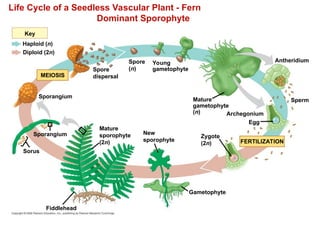
• In contrast with bryophytes, sporophytes of
seedless vascular plants are the larger
generation. The gametophytes are tiny plants
that grow on or below the soil surface.
• Vascular plants are characterized by:
• Life cycles with dominant sporophytes
• Vascular tissues called xylem and phloem.
• Well-developed / true roots and leaves.
Life Cycle of a Seedless Vascular Plant - Fern
Dominant Sporophyte
Key
Haploid (n)
Diploid (2n)
MEIOSIS
Spore
dispersal
Sporangium
Sporangium
Mature
sporophyte
(2n)
Sorus
Fiddlehead
Spore
(n)
Young
gametophyte
Mature
gametophyte
(n) Archegonium
Egg
Antheridium
Sperm
FERTILIZATION
New
sporophyte
Gametophyte
Zygote
(2n)
Copyright © 2008 Pearson Education, Inc., publishing as Pearson Benjamin Cummings
Transport in Vascular Tissue: Xylem and Phloem
• Vascular plants have two types of vascular
tissue: xylem and phloem.
• Xylem conducts most of the water and minerals
and includes dead cells called tracheids.
• Phloem consists of living cells and distributes
nutrients: sugars, amino acids.
• Water-conducting cells are strengthened by
lignin and provide structural support.
• Increased height was an evolutionary advantage.
Copyright © 2008 Pearson Education, Inc., publishing as Pearson Benjamin Cummings
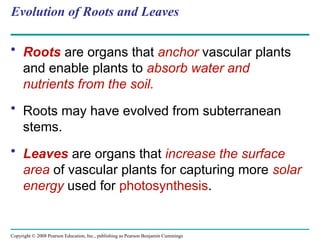
Evolution of Roots and Leaves
• Roots are organs that anchor vascular plants
and enable plants to absorb water and
nutrients from the soil.
• Roots may have evolved from subterranean
stems.
• Leaves are organs that increase the surface
area of vascular plants for capturing more solar
energy used for photosynthesis.
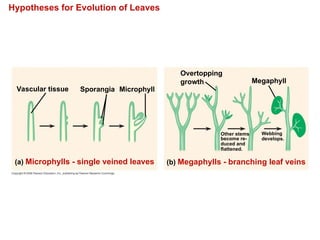
Hypotheses for Evolution of Leaves
Vascular tissue Sporangia Microphyll
(a) Microphylls - single veined leaves (b) Megaphylls - branching leaf veins
Overtopping
growth Megaphyll
Other stems
become re-
duced and
flattened.
Webbing
develops.
Copyright © 2008 Pearson Education, Inc., publishing as Pearson Benjamin Cummings
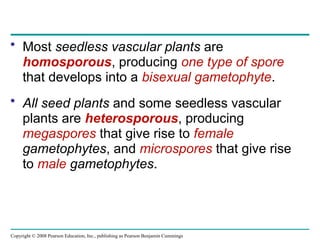
• Most seedless vascular plants are
homosporous, producing one type of spore
that develops into a bisexual gametophyte.
• All seed plants and some seedless vascular
plants are heterosporous, producing
megaspores that give rise to female
gametophytes, and microspores that give rise
to male gametophytes.
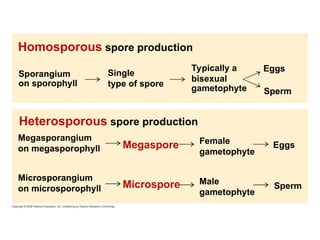
Homosporous spore production
Sporangium
on sporophyll
Single
type of spore
Typically a
bisexual
gametophyte
Eggs
Sperm
Eggs
Sperm
Heterosporous spore production
Megasporangium
on megasporophyll Megaspore Female
gametophyte
Male
gametophyte
Microspore
Microsporangium
on microsporophyll
Seedless Vascular Plants
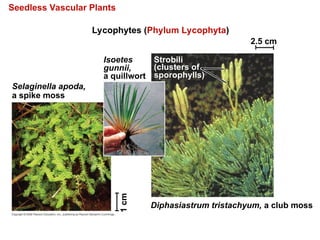
Lycophytes (Phylum Lycophyta)
Selaginella apoda,
a spike moss
Isoetes
gunnii,
a quillwort
Strobili
(clusters of
sporophylls)
2.5 cm
Diphasiastrum tristachyum, a club moss
1
cm
Seedless Vascular Plants
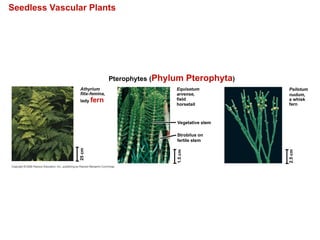
Pterophytes (Phylum Pterophyta)
Athyrium
filix-femina,
lady fern
Vegetative stem
Strobilus on
fertile stem
1.5
cm
25
cm
2.5
cm
Psilotum
nudum,
a whisk
fern
Equisetum
arvense,
field
horsetail
Copyright © 2008 Pearson Education, Inc., publishing as Pearson Benjamin Cummings
The Significance of Seedless Vascular Plants
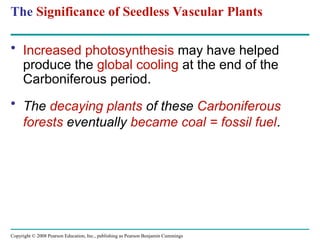
• Increased photosynthesis may have helped
produce the global cooling at the end of the
Carboniferous period.
• The decaying plants of these Carboniferous
forests eventually became coal = fossil fuel.
Artist’s depiction of a Carboniferous forest based on fossil evidence
Derived Traits
of Plants Gametophyte
Mitosis Mitosis
Spore Gamete
Mitosis
n
n n
n
2n
MEIOSIS FERTILIZATION
Zygote
Sporophyte
Haploid
Diploid
1 2
3 4
Alternation of generations Apical meristems
Multicellular gametangia Walled spores in sporangia
Archegonium
with egg
Antheridium
with sperm
Sporangium Spores
Apical meristem
of shoot
Developing
leaves
Copyright © 2008 Pearson Education, Inc., publishing as Pearson Benjamin Cummings
You should now be able to:
1. Describe four shared characteristics and four distinct
characteristics between charophytes and land plants.
2. Diagram and label the life cycle of a bryophyte
3. Explain why most bryophytes grow close to the
ground and are restricted to periodically moist
environments.
4. Describe three traits that characterize modern
vascular plants and explain how these traits have
contributed to success on land.
Copyright © 2008 Pearson Education, Inc., publishing as Pearson Benjamin Cummings
5. Explain how vascular plants differ from
bryophytes.
6. Distinguish between the following pairs of
terms: homosporous and heterosporous.
7. Diagram and label the life cycle of a seedless
vascular plant.

Botany Plant Diversity and Evolution BSc

  • 1.
    Copyright © 2008Pearson Education, Inc., publishing as Pearson Benjamin Cummings PowerPoint® Lecture Presentations for Biology Eighth Edition Neil Campbell and Jane Reece Lectures by Chris Romero, updated by Erin Barley with contributions from Joan Sharp Chapter 29 Plant Diversity I: How Plants Colonized Land
  • 2.
    Copyright © 2008Pearson Education, Inc., publishing as Pearson Benjamin Cummings Overview: The Greening of Earth • Since colonizing land at least 475 million years ago, plants have diversified into roughly 290,000 living species. • Plants supply oxygen and are the ultimate source of most food eaten by land animals. • Green algae called charophytes are the closest relatives of land plants. • Note that land plants are not descended from modern charophytes, but share a common ancestor with modern charophytes.
  • 3.
    Copyright © 2008Pearson Education, Inc., publishing as Pearson Benjamin Cummings Morphological and Molecular Evidence Land plants share key traits only with green algae charophytes: • DNA comparisons of both nuclear and chloroplast genes. • Rose-shaped complexes for cellulose synthesis. • Peroxisome enzymes - minimize loss from photorespiration. • Structure of flagellated sperm. • Formation of a phragmoplast - allignment of cytoskeletal elements and Golgi vesicles for cell plate.
  • 4.
    Rosette cellulose-synthesizing complexes Foundonly in land plants and charophycean green algae 30 nm
  • 5.
    Copyright © 2008Pearson Education, Inc., publishing as Pearson Benjamin Cummings Adaptations Enabling the Move to Land • In green algae charophytes a layer of a durable polymer called sporopollenin prevents dehydration of exposed zygotes. • The movement onto land by charophyte ancestors provided advantages: unfiltered sun, more plentiful CO2, nutrient-rich soil, and few herbivores or pathogens. • Land presented challenges: a scarcity of water and lack of structural support.
  • 6.
    Three Clades arecandidates for Plant Kingdom ANCESTRAL ALGA Red algae Chlorophytes Charophytes Embryophytes Viridiplantae Streptophyta Plantae
  • 7.
    Copyright © 2008Pearson Education, Inc., publishing as Pearson Benjamin Cummings Derived Traits of Plants • A cuticle and secondary compounds evolved in many plant species. Symbiotic associations between fungi and the first land plants may have helped plants without true roots to obtain nutrients. • Four key derived traits of plants are absent in the green algae charophytes: – Alternation of generations - with multicellular, dependent embryos. – Walled spores produced in sporangia – Multicellular gametangia – Apical meristems
  • 8.
    Copyright © 2008Pearson Education, Inc., publishing as Pearson Benjamin Cummings Alternation of Generations and Multicellular Dependent Embryos • The multicellular gametophyte is haploid and produces haploid gametes by mitosis. • Fusion of the gametes gives rise to the diploid sporophyte, which produces haploid spores by meiosis. • The diploid embryo is retained within the tissue of the female gametophyte. Nutrients are transferred from parent to embryo through placental transfer cells. • Land plants are called embryophytes because of the dependency of the embryo on the parent.
  • 9.
    Land Plants Life CycleGametophyte (n) Gamete from another plant n n Mitosis Gamete FERTILIZATION MEIOSIS Mitosis Spore n n 2n Zygote Mitosis Sporophyte (2n) Alternation of generations = Derived traits of land plants
  • 10.
    Derived Traits ofLand Plants Multicellular Dependent Embryos Embryo Maternal tissue Wall ingrowths Placental transfer cell (outlined in blue) Embryo (LM) and placental transfer cell (TEM) of Marchantia (a liverwort) 2 µm 10 µm
  • 11.
    Copyright © 2008Pearson Education, Inc., publishing as Pearson Benjamin Cummings Walled Spores Produced in Sporangia • The sporophyte produces spores in organs called sporangia. • Diploid cells called sporocytes undergo meiosis to generate haploid spores. • Spore walls contain sporopollenin, which protects against dessication making them resistant to harsh environments.
  • 12.
    Derived Traits ofLand Plants: Walled Spores Produced in Sporangia: Spores Sporangium Sporophyte 2n Longitudinal section of Sphagnum sporangium (LM) Gametophyte n Sporophytes and sporangia of Sphagnum (a moss)
  • 13.
    Copyright © 2008Pearson Education, Inc., publishing as Pearson Benjamin Cummings Multicellular Gametangia • Gametes are produced within ‘sex organs’ called gametangia. • Female gametangia, called archegonia, produce eggs and are the site of fertilization. • Male gametangia, called antheridia, are the site of sperm production and release.
  • 14.
    Derived Traits ofLand Plants: Multicellular Gametangia - ‘sex organs’ Female gametophyte Male gametophyte Antheridium with sperm Archegonium with egg Archegonia and Antheridia of Marchantia (a liverwort)
  • 15.
    Copyright © 2008Pearson Education, Inc., publishing as Pearson Benjamin Cummings Apical Meristems • Apical meristems are growth regions at plant tips, allowing plants to sustain continual growth in their length. • Cells from the apical meristems differentiate into various tissues.
  • 16.
    Apical Meristems -Allow for Growth in Length throughout Plant’s Lifetime. Apical meristem of shoot Developing leaves Apical meristems Apical meristem of root Root 100 µm 100 µm Shoot Derived Traits of Land Plants
  • 17.
    Copyright © 2008Pearson Education, Inc., publishing as Pearson Benjamin Cummings • Ancestral species gave rise to land plants which can be informally grouped based on the presence or absence of vascular tissue. • Nonvascular plants are commonly called bryophytes. • Most plants have vascular tissue; these constitute the vascular plants: seedless vascular and seed plants. A Vast Diversity of Modern Plants
  • 18.
    Copyright © 2008Pearson Education, Inc., publishing as Pearson Benjamin Cummings • Seedless vascular plants can be divided into clades: – Lycophytes (club mosses and their relatives) – Pterophytes (ferns and their relatives). • Seedless vascular plants are paraphyletic, and are of the same level of biological organization, or grade.
  • 19.
    Copyright © 2008Pearson Education, Inc., publishing as Pearson Benjamin Cummings • A seed is an embryo and nutrients surrounded by a protective coat. • Seed plants form a clade and can be divided into further clades: – Gymnosperms, the “naked seed” plants including the conifers / cone = sex organ – Angiosperms, the flowering plants including monocots and dicots / flower = sex organ
  • 20.
  • 21.
    Highlights of PlantEvolution Origin of land plants (about 475 mya) 1 2 3 1 2 3 Origin of vascular plants (about 420 mya) Origin of extant seed plants (about 305 mya) ANCES- TRAL GREEN ALGA Liverworts Hornworts Mosses Lycophytes (club mosses, spike mosses, quillworts) Pterophytes (ferns, horsetails, whisk ferns) Gymnosperms Angiosperms Seed plants Seedless vascular plants Nonvascular plants (bryophytes) Land plants Vascular plants Millions of years ago (mya) 500 450 400 350 300 50 0
  • 22.
    Copyright © 2008Pearson Education, Inc., publishing as Pearson Benjamin Cummings NonVascular plants have life cycles dominated by gametophytes • Bryophytes are nonvascular and represented today by three phyla of small herbaceous (nonwoody) plants: – Liverworts, phylum Hepatophyta – Hornworts, phylum Anthocerophyta – Mosses, phylum Bryophyta • Mosses are most closely related to vascular plants. • Gametophytes are dominant: larger and longer-living than sporophytes. Sporophytes are present only part of the time and dependent on the gametophytes.
  • 23.
    Life Cycle ofa Bryophyte > Moss Gametophyte is the Dominant Generation Key Haploid (n) Diploid (2n) Protonema (n) “Bud” “Bud” Male gametophyte (n) Female gametophyte (n) Gametophore Rhizoid Spores Spore dispersal Peristome Sporangium MEIOSIS Seta Capsule (sporangium) Foot Mature sporophytes Capsule with peristome (SEM) Female gametophytes 2 mm Raindrop Sperm Antheridia Egg Archegonia FERTILIZATION (within archegonium) Zygote (2n) Embryo Archegonium Young sporophyte (2n)
  • 24.
    Copyright © 2008Pearson Education, Inc., publishing as Pearson Benjamin Cummings • A spore germinates into a gametophyte composed of a protonema and gamete- producing gametophore. • Rhizoids anchor gametophytes to substrate. • The height of gametophytes is constrained by lack of vascular tissues. • Mature gametophytes produce flagellated sperm in antheridia and an egg in each archegonium. • Sperm swim through a film of water to reach and fertilize the egg.
  • 25.
    Bryophyte Structures Thallus Gametophore of femalegametophyte Marchantia polymorpha, a “thalloid” liverwort Marchantia sporophyte (LM) Sporophyte Foot Seta Capsule (sporangium) 500 µm
  • 26.
    Copyright © 2008Pearson Education, Inc., publishing as Pearson Benjamin Cummings The Ecological and Economic Importance of Mosses • Moses are capable of inhabiting diverse and sometimes extreme environments, but are especially common in moist forests and wetlands. • Some mosses might help retain nitrogen in the soil. • Sphagnum, or “peat moss,” forms extensive deposits of partially decayed organic material known as peat. • Sphagnum is an important global reservoir of organic carbon.
  • 27.
    Bryophytes / Mossmay help retain Nitrogen in the soil, an Ecological Advantage RESULTS With moss Without moss Annual nitrogen loss (kg/ha) 0 1 2 3 4 5 6
  • 28.
    Sphagnum, or peat moss: economicand archaeological significance (a) Peat being harvested from a peat bog. (b) “Tollund Man,” a bog mummy: The acidic, oxygen poor conditions can preserve bodies.
  • 29.
    Copyright © 2008Pearson Education, Inc., publishing as Pearson Benjamin Cummings Concept 29.3: Ferns and other seedless vascular plants were the first plants to grow tall • Bryophytes and bryophyte-like plants were the vegetation during the first 100 million years of plant evolution. • Vascular plants began to diversify during the Devonian and Carboniferous periods. • Vascular tissue allowed vascular plants to grow tall. • Seedless vascular plants have flagellated sperm and are usually restricted to moist environments.
  • 30.
    Copyright © 2008Pearson Education, Inc., publishing as Pearson Benjamin Cummings Origins and Traits of Vascular Plants • Fossils of the forerunners of vascular plants date back about 420 million years. • In contrast with bryophytes, sporophytes of seedless vascular plants are the larger generation. The gametophytes are tiny plants that grow on or below the soil surface. • Vascular plants are characterized by: • Life cycles with dominant sporophytes • Vascular tissues called xylem and phloem. • Well-developed / true roots and leaves.
  • 31.
    Life Cycle ofa Seedless Vascular Plant - Fern Dominant Sporophyte Key Haploid (n) Diploid (2n) MEIOSIS Spore dispersal Sporangium Sporangium Mature sporophyte (2n) Sorus Fiddlehead Spore (n) Young gametophyte Mature gametophyte (n) Archegonium Egg Antheridium Sperm FERTILIZATION New sporophyte Gametophyte Zygote (2n)
  • 32.
    Copyright © 2008Pearson Education, Inc., publishing as Pearson Benjamin Cummings Transport in Vascular Tissue: Xylem and Phloem • Vascular plants have two types of vascular tissue: xylem and phloem. • Xylem conducts most of the water and minerals and includes dead cells called tracheids. • Phloem consists of living cells and distributes nutrients: sugars, amino acids. • Water-conducting cells are strengthened by lignin and provide structural support. • Increased height was an evolutionary advantage.
  • 33.
    Copyright © 2008Pearson Education, Inc., publishing as Pearson Benjamin Cummings Evolution of Roots and Leaves • Roots are organs that anchor vascular plants and enable plants to absorb water and nutrients from the soil. • Roots may have evolved from subterranean stems. • Leaves are organs that increase the surface area of vascular plants for capturing more solar energy used for photosynthesis.
  • 34.
    Hypotheses for Evolutionof Leaves Vascular tissue Sporangia Microphyll (a) Microphylls - single veined leaves (b) Megaphylls - branching leaf veins Overtopping growth Megaphyll Other stems become re- duced and flattened. Webbing develops.
  • 35.
    Copyright © 2008Pearson Education, Inc., publishing as Pearson Benjamin Cummings • Most seedless vascular plants are homosporous, producing one type of spore that develops into a bisexual gametophyte. • All seed plants and some seedless vascular plants are heterosporous, producing megaspores that give rise to female gametophytes, and microspores that give rise to male gametophytes.
  • 36.
    Homosporous spore production Sporangium onsporophyll Single type of spore Typically a bisexual gametophyte Eggs Sperm Eggs Sperm Heterosporous spore production Megasporangium on megasporophyll Megaspore Female gametophyte Male gametophyte Microspore Microsporangium on microsporophyll
  • 37.
    Seedless Vascular Plants Lycophytes(Phylum Lycophyta) Selaginella apoda, a spike moss Isoetes gunnii, a quillwort Strobili (clusters of sporophylls) 2.5 cm Diphasiastrum tristachyum, a club moss 1 cm
  • 38.
    Seedless Vascular Plants Pterophytes(Phylum Pterophyta) Athyrium filix-femina, lady fern Vegetative stem Strobilus on fertile stem 1.5 cm 25 cm 2.5 cm Psilotum nudum, a whisk fern Equisetum arvense, field horsetail
  • 39.
    Copyright © 2008Pearson Education, Inc., publishing as Pearson Benjamin Cummings The Significance of Seedless Vascular Plants • Increased photosynthesis may have helped produce the global cooling at the end of the Carboniferous period. • The decaying plants of these Carboniferous forests eventually became coal = fossil fuel.
  • 40.
    Artist’s depiction ofa Carboniferous forest based on fossil evidence
  • 41.
    Derived Traits of PlantsGametophyte Mitosis Mitosis Spore Gamete Mitosis n n n n 2n MEIOSIS FERTILIZATION Zygote Sporophyte Haploid Diploid 1 2 3 4 Alternation of generations Apical meristems Multicellular gametangia Walled spores in sporangia Archegonium with egg Antheridium with sperm Sporangium Spores Apical meristem of shoot Developing leaves
  • 42.
    Copyright © 2008Pearson Education, Inc., publishing as Pearson Benjamin Cummings You should now be able to: 1. Describe four shared characteristics and four distinct characteristics between charophytes and land plants. 2. Diagram and label the life cycle of a bryophyte 3. Explain why most bryophytes grow close to the ground and are restricted to periodically moist environments. 4. Describe three traits that characterize modern vascular plants and explain how these traits have contributed to success on land.
  • 43.
    Copyright © 2008Pearson Education, Inc., publishing as Pearson Benjamin Cummings 5. Explain how vascular plants differ from bryophytes. 6. Distinguish between the following pairs of terms: homosporous and heterosporous. 7. Diagram and label the life cycle of a seedless vascular plant.

Editor's Notes

  • #4 Figure 29.2 Rosette cellulose-synthesizing complexes
  • #6 Figure 29.4 Three possible “plant” kingdoms
  • #9 Figure 29.5 Derived traits of land plants
  • #10 Figure 29.5 Derived traits of land plants
  • #12 Figure 29.5 Derived traits of land plants
  • #14 Figure 29.5 Derived traits of land plants
  • #16 Figure 29.5 Derived traits of land plants
  • #20 Table 29.1
  • #21 Figure 29.7 Highlights of plant evolution
  • #23 Figure 29.8 The life cycle of a moss
  • #25 Figure 29.9 Bryophyte diversity
  • #27 Figure 29.10 Can bryophytes reduce the rate at which key nutrients are lost from soils?
  • #28 Figure 29.11 Sphagnum, or peat moss: a bryophyte with economic, ecological, and archaeological significance
  • #31 Figure 29.13 The life cycle of a fern
  • #34 Figure 29.14 Hypotheses for the evolution of leaves
  • #37 Figure 29.15 Seedless vascular plant diversity
  • #38 Figure 29.15 Seedless vascular plant diversity
  • #40 Figure 29.16 Artist’s conception of a Carboniferous forest based on fossil evidence