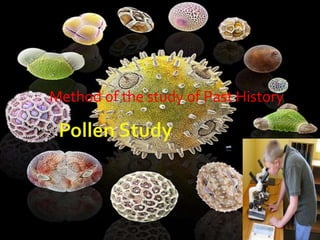
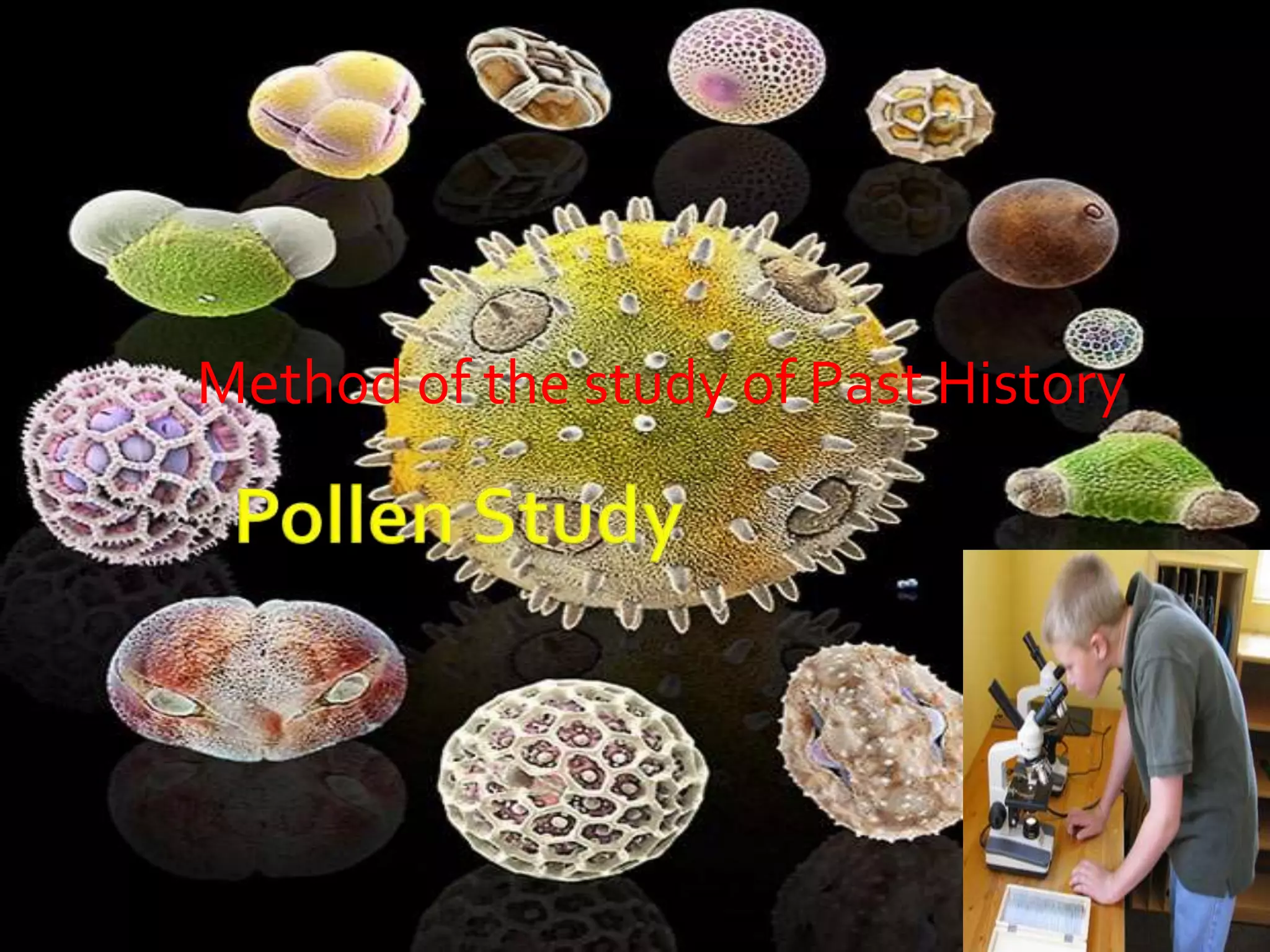
Method of the study of Past History
Palaeoclimatology is the study of past climates. It is a fascinating,
multidisciplinary field, combining history, anthropology, archaeology,
chemistry, physics, geology, atmospheric, and ocean sciences. Clues about
past climate conditions are obtained from proxy indicators (a proxy is a
"substitute"), which are indirect forms of evidence that can be used to infer
climate.These include:
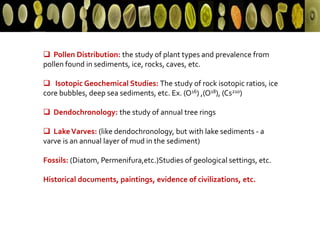
 Pollen Distribution: the study of plant types and prevalence from
pollen found in sediments, ice, rocks, caves, etc.
 Isotopic Geochemical Studies: The study of rock isotopic ratios, ice
core bubbles, deep sea sediments, etc. Ex. (O16) ,(O18), (Cs210)
 Dendochronology: the study of annual tree rings
 LakeVarves: (like dendochronology, but with lake sediments - a
varve is an annual layer of mud in the sediment)
Fossils: (Diatom, Permenifura,etc.)Studies of geological settings, etc.
Historical documents, paintings, evidence of civilizations, etc.
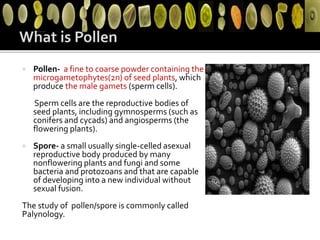
 Pollen- a fine to coarse powder containing the
microgametophytes(2n) of seed plants, which
produce the male gamets (sperm cells).
Sperm cells are the reproductive bodies of
seed plants, including gymnosperms (such as
conifers and cycads) and angiosperms (the
flowering plants).
 Spore- a small usually single-celled asexual
reproductive body produced by many
nonflowering plants and fungi and some
bacteria and protozoans and that are capable
of developing into a new individual without
sexual fusion.
The study of pollen/spore is commonly called
Palynology.
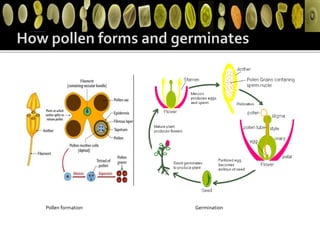
Pollen formation Germination
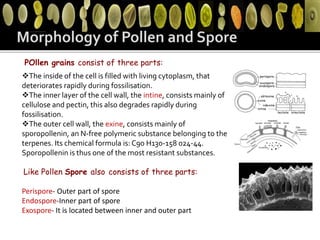
POllen grains consist of three parts:
The inside of the cell is filled with living cytoplasm, that
deteriorates rapidly during fossilisation.
The inner layer of the cell wall, the intine, consists mainly of
cellulose and pectin, this also degrades rapidly during
fossilisation.
The outer cell wall, the exine, consists mainly of
sporopollenin, an N-free polymeric substance belonging to the
terpenes. Its chemical formula is: C90 H130-158 024-44.
Sporopollenin is thus one of the most resistant substances.
Like Pollen Spore also consists of three parts:
Perispore- Outer part of spore
Endospore-Inner part of spore
Exospore- It is located between inner and outer part
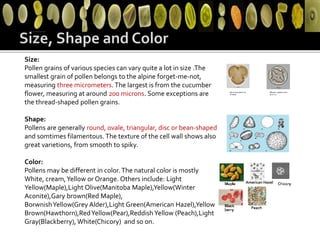
Size:
Pollen grains of various species can vary quite a lot in size .The
smallest grain of pollen belongs to the alpine forget-me-not,
measuring three micrometers. The largest is from the cucumber
flower, measuring at around 200 microns. Some exceptions are
the thread-shaped pollen grains.
Shape:
Pollens are generally round, ovale, triangular, disc or bean-shaped
and somtimes filamentous. The texture of the cell wall shows also
great varietions, from smooth to spiky.
Color:
Pollens may be different in color.The natural color is mostly
White, cream,Yellow or Orange. Others include: Light
Yellow(Maple),Light Olive(Manitoba Maple),Yellow(Winter
Aconite),Gary brown(Red Maple),
BorwnishYellow(Grey Alder),Light Green(American Hazel),Yellow
Brown(Hawthorn),RedYellow(Pear),ReddishYellow (Peach),Light
Gray(Blackberry), White(Chicory) and so on.
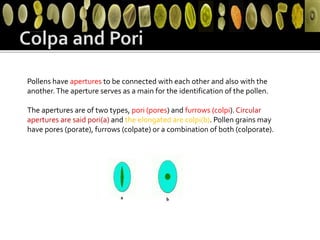
Pollens have apertures to be connected with each other and also with the
another.The aperture serves as a main for the identification of the pollen.
The apertures are of two types, pori (pores) and furrows (colpi).Circular
apertures are said pori(a) and the elongated are colpi(b). Pollen grains may
have pores (porate), furrows (colpate) or a combination of both (colporate).
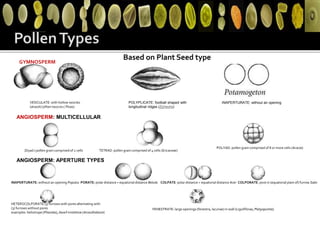
INAPERTURATE: without an openingPOLYPLICATE: football shaped with
longitudinal ridges (Ephedra)
VESICULATE: with hollow vesicles
(alveoli) (often two) ex:( Pinas)
GYMNOSPERM
ANGIOSPERM: MULTICELLULAR
(Dyad:) pollen grain comprised of 2 cells TETRAD: pollen grain comprised of 4 cells (Ericaceae)
POLYAD: pollen grain comprised of 8 or more cells (Acacia)
ANGIOSPERM: APERTURE TYPES
INAPERTURATE: without an opening Populus PORATE: polar distance = equatorial distance Betula COLPATE: polar distance > equatorial distance Acer COLPORATE: pore in (equatorial plain of) furrow Salix
HETEROCOLPORATE (3) furrows with pores alternating with
(3) furrows without pores
examples: heliotrope (Phacelia), dwarf mistletoe (Arceuthobium)
FENESTRATE: large openings (fenestra, lacunae) in wall (Liguliflorae, Platyopuntia)
Based on Plant Seed type
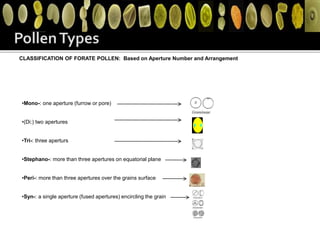
CLASSIFICATION OF FORATE POLLEN: Based on Aperture Number and Arrangement
•Mono-: one aperture (furrow or pore)
•(Di:) two apertures
•Tri-: three aperturs
•Stephano-: more than three apertures on equatorial plane
•Peri-: more than three apertures over the grains surface
•Syn-: a single aperture (fused apertures) encircling the grain
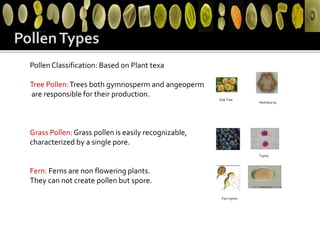
Pollen Classification: Based on Plant texa
Tree Pollen:Trees both gymnosperm and angeoperm
are responsible for their production.
Grass Pollen: Grass pollen is easily recognizable,
characterized by a single pore.
Fern: Ferns are non flowering plants.
They can not create pollen but spore.
Oak Tree
Heritiera sp.
Fern spore
Typha
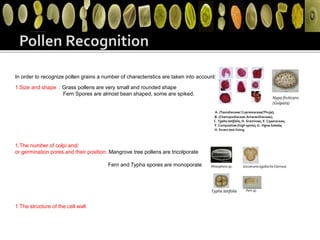
In order to recognize pollen grains a number of characteristics are taken into account:
1.Size and shape : Grass pollens are very small and rounded shape
Fern Spores are almost bean shaped, some are spiked.
1.The number of colpi and/
or germination pores and their position: Mangrove tree pollens are tricolporate
Fern and Typha spores are monoporate
1.The structure of the cell wall
A. (Taxodiaceae/ Cupressaceae/Thuja);
B. (Chenopodiaceae-Amaranthaceae);
C. Typha latifolia; D. Graminea; E. Cyperaceae;
F. Compositae (high spine); G. Vigna luteola;
H. foram test lining.
Nypa fruticans
(Golpata)
Excoecaria agallocha (Genwa)
Typha latifolia Fern sp.
Rhizophora sp.
Pollination is the process by which pollen is
transferred in the reproduction of plants,
thereby enabling fertilisation and sexual
reproduction.
pollination is a phase in the alternation of
generations: each pollen grain is a male
[haploid] plant, a gametophyte, adapted to
being transported to the female
gametophyte, where it can achieve
fertilization by producing the male gamete (or
gametes, in the process of double
fertilization).
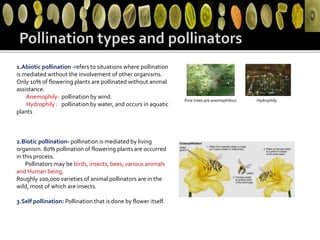
1.Abiotic pollination -refers to situations where pollination
is mediated without the involvement of other organisms.
Only 10% of flowering plants are pollinated without animal
assistance.
Anemophily: pollination by wind.
Hydrophily : pollination by water, and occurs in aquatic
plants
2.Biotic pollination- pollination is mediated by living
organism. 80% pollination of flowering plants are occurred
in this process.
Pollinators may be birds, insects, bees, various animals
and Human being.
Roughly 200,000 varieties of animal pollinators are in the
wild, most of which are insects.
3.Self pollination: Pollination that is done by flower itself.
Pine trees are anemophilous Hydrophily
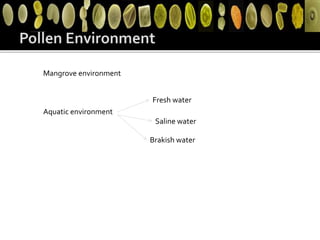
Mangrove environment
Aquatic environment
Fresh water
Brakish water
Saline water
Palynology has numerous applications. It is widely used in the study of past
climate(Palaeoclimate). Fossil pollen analysis (palaeopalynology) is also used to
identify the plant taxa, from which, can be deduced :
• vegetation variations with time
• climate and its temporal variation
• evidence of human activities including
• land clearing
• burning
• atmospheric pollution (also natural, e.g. volcanic)
• salinity
• soil degradation and changes
• archaeological information
• dating of sediment levels and ages of artifacts found
• what people may have eaten
• what was buried with them – flowers etc.
Pollen study-Geomorhology Chapter

Pollen study-Geomorhology Chapter

  • 1.
    Method of thestudy of Past History
  • 2.
    Palaeoclimatology is thestudy of past climates. It is a fascinating, multidisciplinary field, combining history, anthropology, archaeology, chemistry, physics, geology, atmospheric, and ocean sciences. Clues about past climate conditions are obtained from proxy indicators (a proxy is a "substitute"), which are indirect forms of evidence that can be used to infer climate.These include:
  • 3.
     Pollen Distribution:the study of plant types and prevalence from pollen found in sediments, ice, rocks, caves, etc.  Isotopic Geochemical Studies: The study of rock isotopic ratios, ice core bubbles, deep sea sediments, etc. Ex. (O16) ,(O18), (Cs210)  Dendochronology: the study of annual tree rings  LakeVarves: (like dendochronology, but with lake sediments - a varve is an annual layer of mud in the sediment) Fossils: (Diatom, Permenifura,etc.)Studies of geological settings, etc. Historical documents, paintings, evidence of civilizations, etc.
  • 4.
     Pollen- afine to coarse powder containing the microgametophytes(2n) of seed plants, which produce the male gamets (sperm cells). Sperm cells are the reproductive bodies of seed plants, including gymnosperms (such as conifers and cycads) and angiosperms (the flowering plants).  Spore- a small usually single-celled asexual reproductive body produced by many nonflowering plants and fungi and some bacteria and protozoans and that are capable of developing into a new individual without sexual fusion. The study of pollen/spore is commonly called Palynology.
  • 5.
  • 6.
    POllen grains consistof three parts: The inside of the cell is filled with living cytoplasm, that deteriorates rapidly during fossilisation. The inner layer of the cell wall, the intine, consists mainly of cellulose and pectin, this also degrades rapidly during fossilisation. The outer cell wall, the exine, consists mainly of sporopollenin, an N-free polymeric substance belonging to the terpenes. Its chemical formula is: C90 H130-158 024-44. Sporopollenin is thus one of the most resistant substances. Like Pollen Spore also consists of three parts: Perispore- Outer part of spore Endospore-Inner part of spore Exospore- It is located between inner and outer part
  • 7.
    Size: Pollen grains ofvarious species can vary quite a lot in size .The smallest grain of pollen belongs to the alpine forget-me-not, measuring three micrometers. The largest is from the cucumber flower, measuring at around 200 microns. Some exceptions are the thread-shaped pollen grains. Shape: Pollens are generally round, ovale, triangular, disc or bean-shaped and somtimes filamentous. The texture of the cell wall shows also great varietions, from smooth to spiky. Color: Pollens may be different in color.The natural color is mostly White, cream,Yellow or Orange. Others include: Light Yellow(Maple),Light Olive(Manitoba Maple),Yellow(Winter Aconite),Gary brown(Red Maple), BorwnishYellow(Grey Alder),Light Green(American Hazel),Yellow Brown(Hawthorn),RedYellow(Pear),ReddishYellow (Peach),Light Gray(Blackberry), White(Chicory) and so on.
  • 8.
    Pollens have aperturesto be connected with each other and also with the another.The aperture serves as a main for the identification of the pollen. The apertures are of two types, pori (pores) and furrows (colpi).Circular apertures are said pori(a) and the elongated are colpi(b). Pollen grains may have pores (porate), furrows (colpate) or a combination of both (colporate).
  • 9.
    INAPERTURATE: without anopeningPOLYPLICATE: football shaped with longitudinal ridges (Ephedra) VESICULATE: with hollow vesicles (alveoli) (often two) ex:( Pinas) GYMNOSPERM ANGIOSPERM: MULTICELLULAR (Dyad:) pollen grain comprised of 2 cells TETRAD: pollen grain comprised of 4 cells (Ericaceae) POLYAD: pollen grain comprised of 8 or more cells (Acacia) ANGIOSPERM: APERTURE TYPES INAPERTURATE: without an opening Populus PORATE: polar distance = equatorial distance Betula COLPATE: polar distance > equatorial distance Acer COLPORATE: pore in (equatorial plain of) furrow Salix HETEROCOLPORATE (3) furrows with pores alternating with (3) furrows without pores examples: heliotrope (Phacelia), dwarf mistletoe (Arceuthobium) FENESTRATE: large openings (fenestra, lacunae) in wall (Liguliflorae, Platyopuntia) Based on Plant Seed type
  • 10.
    CLASSIFICATION OF FORATEPOLLEN: Based on Aperture Number and Arrangement •Mono-: one aperture (furrow or pore) •(Di:) two apertures •Tri-: three aperturs •Stephano-: more than three apertures on equatorial plane •Peri-: more than three apertures over the grains surface •Syn-: a single aperture (fused apertures) encircling the grain
  • 11.
    Pollen Classification: Basedon Plant texa Tree Pollen:Trees both gymnosperm and angeoperm are responsible for their production. Grass Pollen: Grass pollen is easily recognizable, characterized by a single pore. Fern: Ferns are non flowering plants. They can not create pollen but spore. Oak Tree Heritiera sp. Fern spore Typha
  • 12.
    In order torecognize pollen grains a number of characteristics are taken into account: 1.Size and shape : Grass pollens are very small and rounded shape Fern Spores are almost bean shaped, some are spiked. 1.The number of colpi and/ or germination pores and their position: Mangrove tree pollens are tricolporate Fern and Typha spores are monoporate 1.The structure of the cell wall A. (Taxodiaceae/ Cupressaceae/Thuja); B. (Chenopodiaceae-Amaranthaceae); C. Typha latifolia; D. Graminea; E. Cyperaceae; F. Compositae (high spine); G. Vigna luteola; H. foram test lining. Nypa fruticans (Golpata) Excoecaria agallocha (Genwa) Typha latifolia Fern sp. Rhizophora sp.
  • 13.
    Pollination is theprocess by which pollen is transferred in the reproduction of plants, thereby enabling fertilisation and sexual reproduction. pollination is a phase in the alternation of generations: each pollen grain is a male [haploid] plant, a gametophyte, adapted to being transported to the female gametophyte, where it can achieve fertilization by producing the male gamete (or gametes, in the process of double fertilization).
  • 14.
    1.Abiotic pollination -refersto situations where pollination is mediated without the involvement of other organisms. Only 10% of flowering plants are pollinated without animal assistance. Anemophily: pollination by wind. Hydrophily : pollination by water, and occurs in aquatic plants 2.Biotic pollination- pollination is mediated by living organism. 80% pollination of flowering plants are occurred in this process. Pollinators may be birds, insects, bees, various animals and Human being. Roughly 200,000 varieties of animal pollinators are in the wild, most of which are insects. 3.Self pollination: Pollination that is done by flower itself. Pine trees are anemophilous Hydrophily
  • 15.
    Mangrove environment Aquatic environment Freshwater Brakish water Saline water
  • 16.
    Palynology has numerousapplications. It is widely used in the study of past climate(Palaeoclimate). Fossil pollen analysis (palaeopalynology) is also used to identify the plant taxa, from which, can be deduced : • vegetation variations with time • climate and its temporal variation • evidence of human activities including • land clearing • burning • atmospheric pollution (also natural, e.g. volcanic) • salinity • soil degradation and changes • archaeological information • dating of sediment levels and ages of artifacts found • what people may have eaten • what was buried with them – flowers etc.