The Four Stages of Mitosis
Revised by : Mary Jane M. Simblante
BSED-301 student major in Biological Sciences of
Southern Leyte State University- Tomas Oppus
Campus
PRAYER
(Our Father)
Our Father who art in heaven,
Holy be your name, your kingdom come,
your will be done on Earth at is in
heaven…..
Give us these day our daily bread and
forgive us our sins, as we forgive those
who sinned against us,
Do not bring us to the test, but deliver us
from evil….
Amen…..
Good Morning
Class !
Just stay tune and
learn a lot
today……
Is everybody
Present ???
Let’s watch a short video
clip for you to motivate
what is our lesson all
about today……..
The Four
Stages Of
Mitosis
What is Mitosis?
Mitosis is a form of nuclear division
that produces daughter nuclei
containing the same number of
chromosomes as the parent
nucleus. The daughter nuclei are
genetically identical.
Chromosomes
Chromosomes are made up of the
molecule deoxyribonucleic acid (DNA).
DNA stores all the information that a cell
needs in order to grow and to carry out
vital activities. This information is stored as
sections of DNA or genes. The daughter
cells produced by mitosis are genetically
identical to the parent cell.
Stages Of Mitosis
Process of mitosis can be divided into 4
stages:
1. Prophase
2. Metaphase
3. Anaphase
4. Telophase
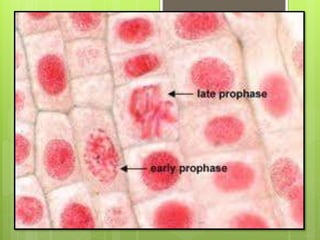
Prophase
Chromatin threads
condense, coil and shorten
to become chromosomes.
Each chromosome consists
of two sister chromatids
attached at the
centromere. The
chromosomes are now
visible under a microscope
as x-shaped structures.
Metaphase
Chromosome line up
along the equatorial
plane of the spindle.
The centromere of
each chromosome is
attached on both
sides to a spindle
fiber.
Anaphase
Each centromere
divides. The spindle fibers
shorten and pull the
chromatids apart to
opposite poles of the
cell. One the chromatids
are separated, they are
called daughter
chromosomes.
Daughter
chromosomes
Telophase
Spindle fibers break
down. A nuclear
envelope forms around
the chromosomes at
each pole of the cell. A
nucleolus reforms in
each nucleus and the
chromosomes uncoil
and lengthen to
become thin chromatin
threads.
Chromatin threads
Nuclear envelope
Nucleolus
19
Prophase
Metaphase
Anaphase
Telophase
Question and Answer:
1. How can you distinguish each
stages of mitosis?
2. In your own idea, what is the
significance of these four
stages of mitosis in our lives?
Assignment:
In a ½ crosswise sheet of paper,
write a learning insight about the
four stages of mitosis, at least
three (3) paragraphs. Then, have
an advance study for our next
topic.
Goodbye class!
Thank you for
coming…
Class dismissed.
References:
I would express my heartfelt thanks and
gratitude to the following references whom I
got informative and reliable information:
cellcyclecelldivision-110213145759-
phpapp02
http://image.sliesharecdn.com/biolog
yf4c5n7-131006101209-phpap
Teacher’s Profile
Name: Ms. Mary Jane M.
Simblante
Educational Background
Elementary Education:
School: San Roque
Elementary School
S.Y.: 2007-2008
Award: Most Helpful
Student
Secondary Education:
School: San Roque
National High School
S.Y.: 2011-2012
- Salutatorian
Tertiary Education:
School: SLSU-Tomas Oppus
Degree: BSEd-Biological
Sciences

FINAL DEMO.

  • 1.
    The Four Stagesof Mitosis Revised by : Mary Jane M. Simblante BSED-301 student major in Biological Sciences of Southern Leyte State University- Tomas Oppus Campus
  • 2.
    PRAYER (Our Father) Our Fatherwho art in heaven, Holy be your name, your kingdom come, your will be done on Earth at is in heaven….. Give us these day our daily bread and forgive us our sins, as we forgive those who sinned against us, Do not bring us to the test, but deliver us from evil…. Amen…..
  • 3.
    Good Morning Class ! Juststay tune and learn a lot today……
  • 4.
  • 5.
    Let’s watch ashort video clip for you to motivate what is our lesson all about today……..
  • 6.
  • 7.
    What is Mitosis? Mitosisis a form of nuclear division that produces daughter nuclei containing the same number of chromosomes as the parent nucleus. The daughter nuclei are genetically identical.
  • 8.
    Chromosomes Chromosomes are madeup of the molecule deoxyribonucleic acid (DNA). DNA stores all the information that a cell needs in order to grow and to carry out vital activities. This information is stored as sections of DNA or genes. The daughter cells produced by mitosis are genetically identical to the parent cell.
  • 9.
    Stages Of Mitosis Processof mitosis can be divided into 4 stages: 1. Prophase 2. Metaphase 3. Anaphase 4. Telophase
  • 10.
    Prophase Chromatin threads condense, coiland shorten to become chromosomes. Each chromosome consists of two sister chromatids attached at the centromere. The chromosomes are now visible under a microscope as x-shaped structures.
  • 12.
    Metaphase Chromosome line up alongthe equatorial plane of the spindle. The centromere of each chromosome is attached on both sides to a spindle fiber.
  • 14.
    Anaphase Each centromere divides. Thespindle fibers shorten and pull the chromatids apart to opposite poles of the cell. One the chromatids are separated, they are called daughter chromosomes. Daughter chromosomes
  • 16.
    Telophase Spindle fibers break down.A nuclear envelope forms around the chromosomes at each pole of the cell. A nucleolus reforms in each nucleus and the chromosomes uncoil and lengthen to become thin chromatin threads. Chromatin threads Nuclear envelope Nucleolus
  • 19.
  • 20.
    Question and Answer: 1.How can you distinguish each stages of mitosis? 2. In your own idea, what is the significance of these four stages of mitosis in our lives?
  • 21.
    Assignment: In a ½crosswise sheet of paper, write a learning insight about the four stages of mitosis, at least three (3) paragraphs. Then, have an advance study for our next topic.
  • 22.
    Goodbye class! Thank youfor coming… Class dismissed.
  • 23.
    References: I would expressmy heartfelt thanks and gratitude to the following references whom I got informative and reliable information: cellcyclecelldivision-110213145759- phpapp02 http://image.sliesharecdn.com/biolog yf4c5n7-131006101209-phpap
  • 24.
    Teacher’s Profile Name: Ms.Mary Jane M. Simblante Educational Background Elementary Education: School: San Roque Elementary School S.Y.: 2007-2008 Award: Most Helpful Student Secondary Education: School: San Roque National High School S.Y.: 2011-2012 - Salutatorian Tertiary Education: School: SLSU-Tomas Oppus Degree: BSEd-Biological Sciences