FUNARIA
SYSTEMATIC POSITION OF FUNARIA
Kingdom : Plantae
Division : Bryophyta
Class : Bryopsida
Subclass : Funariidae
Order : Funariales
Family : Funariaceae
Genus : Funaria
GENERAL CHARACTERS
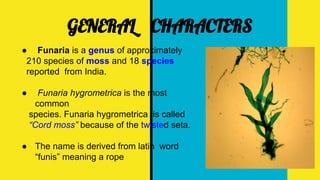
● Funaria is a genus of approximately
210 species of moss and 18 species
reported from India.
● Funaria hygrometrica is the most
common
species. Funaria hygrometrica is called
“Cord moss” because of the twisted seta.
● The name is derived from latin word
“funis” meaning a rope
➢ Moss plant funaria grows in dense
patches or cushions in moist shady and
cool places during the rainy seasons.
➢ It has a height 3-5 cm, a radial symmetry
with a differentiation of an axis or stem,
leaves or phylloids and multicellular
colorless branched rhizoids.
➢ These are primitive multicellular,
autotrophic,shade loving, amphibious
plants.
➢ They reproduce by spore formation.
➢ They have no vascular system.
➢ Root like structures called rhiziods are
present.
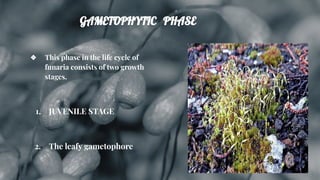
GAMETOPHYTIC PHASE
❖ This phase in the life cycle of
funaria consists of two growth
stages.
1. JUVENILE STAGE
2. The leafy gametophore
JUVENILE STAGE
● It results from the germinting meiospore.
● It consists of a slender, green, branching system of filaments called
protonema.
PROTONEMA
CHLORONEMAL BRANCH
Green and branched spread
over the moist oil
RHIZOIDAL BRANCH
Colourless/Brown branches with
oblique septa, penetrate in the soil
GAMETOPHORE STAGE
● Gametophore is the dominant stage in the life cycle.
● It is erect, leafy structure that reaches upto 3 cm height.
● It has slender, cylindrical upright central axis known as
cauliod on which the flat green lateral expansions
phylloids are present.
● Cauliod and phylliods are structurally not similar to stem
and leaves because these are without vascular tissues
and gametophytic in origin.
MATURE GAMETOPHORE
● Plant is small about 1-3 cm long, stem is
erect and branched.
● It is differentiated into rhizoids and
multicellular and branched.
● The axis is aerial,erect and branched.
● The leaves are simple small and spirally
arranged.
● The upper leaves are large and lower
leaves are crowded.
INTERNAL STRUCTURE
Stem:
● Epidermis: It is outermost single layered. It is
made up of thick walled cells.
● Cortex: It is multilayered zone situated just
below the epidermis and consists of
parenchymatous cells.
● Central cylinder: It forms the central core of
the axis and consists of vertically elongated,
thin wall of cell. The central cylinder provides
mechanical strength to the plant and help in
conduction of water and mineral.
LEAVES
Leaves are arranged on the axis
in spiral fashion. The leaves are
sessile, simple, green and
distinct mid rib.
The leaf is single layered thick
expect for the mid-rib. The
central part is similar to the
central cylinder of the axis.
REPRODUCTION
VEGETATIVE
● Fragmentation
● Secondary protonema
● Gemale
● Bulbils
● apospory
SEXUAL
MALE BRANCH FEMALE BRANCH
ANTHERIDIUM ARCHEGONIUM
ANTHEROZOID EGG
VEGETATIVE REPRODUCTION
1. FRAGMENTATION (PRIMARY PROTONEMA)
The primary protonema is developed through the
germination of the spore. Under certain circumstances, it
breaks into several fragments. Each detached fragment
bearing buds may grow into a new plant.
2. SECONDARY PROTONEMA
In secondary protonema, a lateral bud is produced which
develops into a leafy stage. Funaria is an amphibious plant
and sexual reproduction takes place through the water.
They show alternation of generation i.e. gametophyte
alternates with sporophytes.
VEGETATIVE REPRODUCTION
3. GEMAE:
Gemmae are multicellular green bodies formed from the terminal cells of the
protonema. They remain dormant throughout the unfavourable condition. However, on return
of favourable condition, a gemma detaches from the parent plant body and later germinates
into a new plant.
4. BULBILS:
The bulbils are multicellular, brown, bud-like structures that develop on the
rhizoidal branches. The bulbils are useful for propagation during unfavourable environmental
conditions by detaching them from the parent plants.
5. APOSPORY:
Apospory is the condition in which the haploid (n) gametophyte is developed
from the diploid (2n) sporophyte without the formation of spores. In case of Funaria, gametophytic
protonema may develop from any unspecialised cells of the sporophyte.
SEXUAL REPRODUCTION
● Funaria is monoecious, autoicous, protandrous.
● Sex organs are developed in groups at the apex of
stem (male branch) and branch (female branch).
● The male sex organs are called as Antheridia and
females are archegonia.
● The lateral female branch eventually grows taller the
the male branch.
AN ANTHERIDIUM
● The mature antheridium of funaria may be 0.25
mm in length.
● It has an elongate, club shaped, orange-coloured
body raised on a short, multicellular stalk.
● The body has a jacket layer of polyhedral,
flattened cells.
● With an antheridial wall is a dense mass of small
cells. They are known as androcytes.
● Each androcyte produces a single, bifagellate
sperm
FEMALE BRANCH
● The archegonial branch springs from the base of the male shoot.
● The archegonia are aggregated into a terminal cluster, stand erect and project
from the surface of the female receptacle.
● The leaves surrounding the archegonial cluster are called perichaetial leaves
AN ARCHEGONIUM
● The archegonia are typically flask-shaped,
each consisting of two usual parts, the venter
and the neck.
● The archegonium is borne on a distinct,
multicellular stalk which is long and massive.
● The venter consists of a double layer of sterile
cells. In it lie the egg cell below and the ventral
canal cell above it.
● The long, tubular slightly twisted neck
consists of six rows of neck cells.
FERTILIZATION
● Rain or dew water , usually accumulated in
antheridial and archegonial clusters, helps in
fertilization.
● The transfer of antherozoids from the
antheridial head to the archegonial head is
brought about rain drops.
● Entry of antherozoids into the archegonium
is due to chemotactic influence of the
mucilaginous substances present in the neck.
SPOROPHYTIC PHASE
● The diploid zygote formed by the fusion of the
antherozoid with the egg is the first cell of the
sporophytic generation.
● The zygote soon secretes a wall around itself
and increase in size before dividing.
● The mature sporophyte of funaria is
differentiated into foot, seta and capsule.
MATURE SPOROPHYTE
FOOT SETA CAPSULE
Small, dagger
shaped conical
structure
embedded in the
archegonial
branch.
Long, slender, more
or less twisted and
stalk like structure
which supports the
capsule.
Slightly oblique,
erect green when
young, but become
bright orange and
curved at maturity
APOPHYSIS THECA PROPER APICAL REGION
CAPSULE
L.S OF CAPSULE
PERISTOME
SPORE DISPERSAL
● As the sporophyte matures, the water supply of capsule is cut off.
● As a result , all tissues of the capsules, except spores, dry up.
● The thin walled cells of the annulus break and the operculum is
thrown away.
● The outer peristomial teeth are hygroscopic and in dry atmosphere
they bend outwards with jerky movements, but the inner peristomial
teeth remain in their position.
● Due to outward movements of the outer peristomial teeth, slits
between the inner thin walled peristomial teeth become wider and
spores escape through these slits gradually.
THANK YOU
SO MUCH

Furneria

  • 1.
  • 2.
    SYSTEMATIC POSITION OFFUNARIA Kingdom : Plantae Division : Bryophyta Class : Bryopsida Subclass : Funariidae Order : Funariales Family : Funariaceae Genus : Funaria
  • 3.
    GENERAL CHARACTERS ● Funariais a genus of approximately 210 species of moss and 18 species reported from India. ● Funaria hygrometrica is the most common species. Funaria hygrometrica is called “Cord moss” because of the twisted seta. ● The name is derived from latin word “funis” meaning a rope
  • 4.
    ➢ Moss plantfunaria grows in dense patches or cushions in moist shady and cool places during the rainy seasons. ➢ It has a height 3-5 cm, a radial symmetry with a differentiation of an axis or stem, leaves or phylloids and multicellular colorless branched rhizoids. ➢ These are primitive multicellular, autotrophic,shade loving, amphibious plants. ➢ They reproduce by spore formation. ➢ They have no vascular system. ➢ Root like structures called rhiziods are present.
  • 5.
    GAMETOPHYTIC PHASE ❖ Thisphase in the life cycle of funaria consists of two growth stages. 1. JUVENILE STAGE 2. The leafy gametophore
  • 6.
    JUVENILE STAGE ● Itresults from the germinting meiospore. ● It consists of a slender, green, branching system of filaments called protonema. PROTONEMA CHLORONEMAL BRANCH Green and branched spread over the moist oil RHIZOIDAL BRANCH Colourless/Brown branches with oblique septa, penetrate in the soil
  • 7.
    GAMETOPHORE STAGE ● Gametophoreis the dominant stage in the life cycle. ● It is erect, leafy structure that reaches upto 3 cm height. ● It has slender, cylindrical upright central axis known as cauliod on which the flat green lateral expansions phylloids are present. ● Cauliod and phylliods are structurally not similar to stem and leaves because these are without vascular tissues and gametophytic in origin.
  • 8.
    MATURE GAMETOPHORE ● Plantis small about 1-3 cm long, stem is erect and branched. ● It is differentiated into rhizoids and multicellular and branched. ● The axis is aerial,erect and branched. ● The leaves are simple small and spirally arranged. ● The upper leaves are large and lower leaves are crowded.
  • 9.
    INTERNAL STRUCTURE Stem: ● Epidermis:It is outermost single layered. It is made up of thick walled cells. ● Cortex: It is multilayered zone situated just below the epidermis and consists of parenchymatous cells. ● Central cylinder: It forms the central core of the axis and consists of vertically elongated, thin wall of cell. The central cylinder provides mechanical strength to the plant and help in conduction of water and mineral.
  • 10.
    LEAVES Leaves are arrangedon the axis in spiral fashion. The leaves are sessile, simple, green and distinct mid rib. The leaf is single layered thick expect for the mid-rib. The central part is similar to the central cylinder of the axis.
  • 11.
    REPRODUCTION VEGETATIVE ● Fragmentation ● Secondaryprotonema ● Gemale ● Bulbils ● apospory SEXUAL MALE BRANCH FEMALE BRANCH ANTHERIDIUM ARCHEGONIUM ANTHEROZOID EGG
  • 12.
    VEGETATIVE REPRODUCTION 1. FRAGMENTATION(PRIMARY PROTONEMA) The primary protonema is developed through the germination of the spore. Under certain circumstances, it breaks into several fragments. Each detached fragment bearing buds may grow into a new plant. 2. SECONDARY PROTONEMA In secondary protonema, a lateral bud is produced which develops into a leafy stage. Funaria is an amphibious plant and sexual reproduction takes place through the water. They show alternation of generation i.e. gametophyte alternates with sporophytes.
  • 13.
    VEGETATIVE REPRODUCTION 3. GEMAE: Gemmaeare multicellular green bodies formed from the terminal cells of the protonema. They remain dormant throughout the unfavourable condition. However, on return of favourable condition, a gemma detaches from the parent plant body and later germinates into a new plant. 4. BULBILS: The bulbils are multicellular, brown, bud-like structures that develop on the rhizoidal branches. The bulbils are useful for propagation during unfavourable environmental conditions by detaching them from the parent plants. 5. APOSPORY: Apospory is the condition in which the haploid (n) gametophyte is developed from the diploid (2n) sporophyte without the formation of spores. In case of Funaria, gametophytic protonema may develop from any unspecialised cells of the sporophyte.
  • 14.
    SEXUAL REPRODUCTION ● Funariais monoecious, autoicous, protandrous. ● Sex organs are developed in groups at the apex of stem (male branch) and branch (female branch). ● The male sex organs are called as Antheridia and females are archegonia. ● The lateral female branch eventually grows taller the the male branch.
  • 15.
    AN ANTHERIDIUM ● Themature antheridium of funaria may be 0.25 mm in length. ● It has an elongate, club shaped, orange-coloured body raised on a short, multicellular stalk. ● The body has a jacket layer of polyhedral, flattened cells. ● With an antheridial wall is a dense mass of small cells. They are known as androcytes. ● Each androcyte produces a single, bifagellate sperm
  • 16.
    FEMALE BRANCH ● Thearchegonial branch springs from the base of the male shoot. ● The archegonia are aggregated into a terminal cluster, stand erect and project from the surface of the female receptacle. ● The leaves surrounding the archegonial cluster are called perichaetial leaves
  • 17.
    AN ARCHEGONIUM ● Thearchegonia are typically flask-shaped, each consisting of two usual parts, the venter and the neck. ● The archegonium is borne on a distinct, multicellular stalk which is long and massive. ● The venter consists of a double layer of sterile cells. In it lie the egg cell below and the ventral canal cell above it. ● The long, tubular slightly twisted neck consists of six rows of neck cells.
  • 18.
    FERTILIZATION ● Rain ordew water , usually accumulated in antheridial and archegonial clusters, helps in fertilization. ● The transfer of antherozoids from the antheridial head to the archegonial head is brought about rain drops. ● Entry of antherozoids into the archegonium is due to chemotactic influence of the mucilaginous substances present in the neck.
  • 19.
    SPOROPHYTIC PHASE ● Thediploid zygote formed by the fusion of the antherozoid with the egg is the first cell of the sporophytic generation. ● The zygote soon secretes a wall around itself and increase in size before dividing. ● The mature sporophyte of funaria is differentiated into foot, seta and capsule.
  • 20.
    MATURE SPOROPHYTE FOOT SETACAPSULE Small, dagger shaped conical structure embedded in the archegonial branch. Long, slender, more or less twisted and stalk like structure which supports the capsule. Slightly oblique, erect green when young, but become bright orange and curved at maturity APOPHYSIS THECA PROPER APICAL REGION
  • 21.
  • 22.
  • 23.
  • 24.
    SPORE DISPERSAL ● Asthe sporophyte matures, the water supply of capsule is cut off. ● As a result , all tissues of the capsules, except spores, dry up. ● The thin walled cells of the annulus break and the operculum is thrown away. ● The outer peristomial teeth are hygroscopic and in dry atmosphere they bend outwards with jerky movements, but the inner peristomial teeth remain in their position. ● Due to outward movements of the outer peristomial teeth, slits between the inner thin walled peristomial teeth become wider and spores escape through these slits gradually.
  • 25.