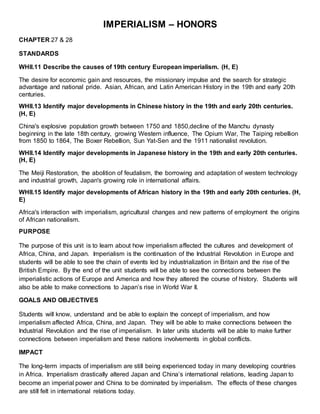
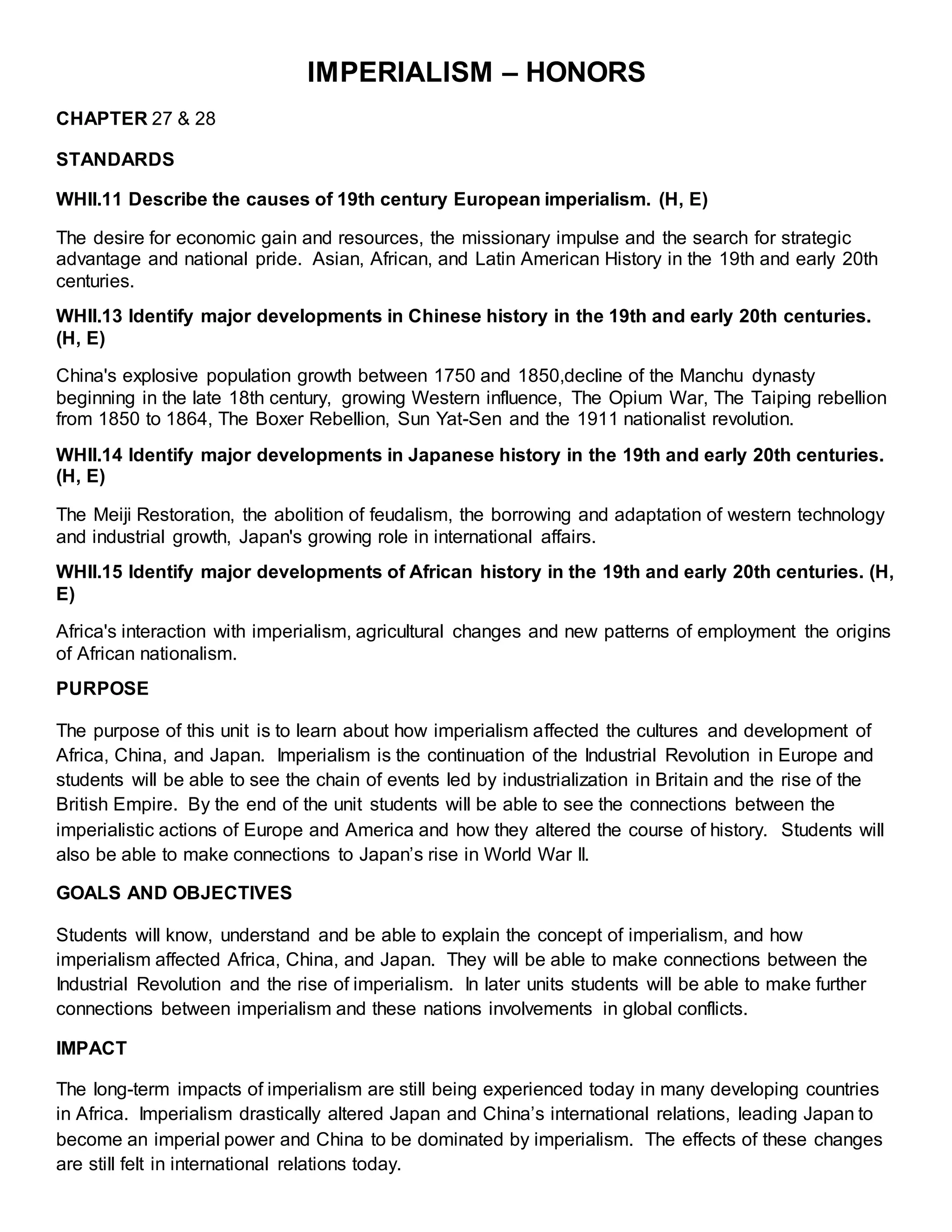
IMPERIALISM – HONORS
CHAPTER 27 & 28
STANDARDS
WHII.11 Describe the causes of 19th century European imperialism. (H, E)
The desire for economic gain and resources, the missionary impulse and the search for strategic
advantage and national pride. Asian, African, and Latin American History in the 19th and early 20th
centuries.
WHII.13 Identify major developments in Chinese history in the 19th and early 20th centuries.
(H, E)
China's explosive population growth between 1750 and 1850,decline of the Manchu dynasty
beginning in the late 18th century, growing Western influence, The Opium War, The Taiping rebellion
from 1850 to 1864, The Boxer Rebellion, Sun Yat-Sen and the 1911 nationalist revolution.
WHII.14 Identify major developments in Japanese history in the 19th and early 20th centuries.
(H, E)
The Meiji Restoration, the abolition of feudalism, the borrowing and adaptation of western technology
and industrial growth, Japan's growing role in international affairs.
WHII.15 Identify major developments of African history in the 19th and early 20th centuries. (H,
E)
Africa's interaction with imperialism, agricultural changes and new patterns of employment the origins
of African nationalism.
PURPOSE
The purpose of this unit is to learn about how imperialism affected the cultures and development of
Africa, China, and Japan. Imperialism is the continuation of the Industrial Revolution in Europe and
students will be able to see the chain of events led by industrialization in Britain and the rise of the
British Empire. By the end of the unit students will be able to see the connections between the
imperialistic actions of Europe and America and how they altered the course of history. Students will
also be able to make connections to Japan’s rise in World War II.
GOALS AND OBJECTIVES
Students will know, understand and be able to explain the concept of imperialism, and how
imperialism affected Africa, China, and Japan. They will be able to make connections between the
Industrial Revolution and the rise of imperialism. In later units students will be able to make further
connections between imperialism and these nations involvements in global conflicts.
IMPACT
The long-term impacts of imperialism are still being experienced today in many developing countries
in Africa. Imperialism drastically altered Japan and China’s international relations, leading Japan to
become an imperial power and China to be dominated by imperialism. The effects of these changes
are still felt in international relations today.
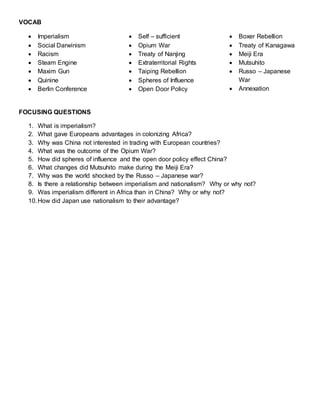
VOCAB
 Imperialism
 Social Darwinism
 Racism
 Steam Engine
 Maxim Gun
 Quinine
 Berlin Conference
 Self – sufficient
 Opium War
 Treaty of Nanjing
 Extraterritorial Rights
 Taiping Rebellion
 Spheres of Influence
 Open Door Policy
 Boxer Rebellion
 Treaty of Kanagawa
 Meiji Era
 Mutsuhito
 Russo – Japanese
War
 Annexation
FOCUSING QUESTIONS
1. What is imperialism?
2. What gave Europeans advantages in colonizing Africa?
3. Why was China not interested in trading with European countries?
4. What was the outcome of the Opium War?
5. How did spheres of influence and the open door policy effect China?
6. What changes did Mutsuhito make during the Meiji Era?
7. Why was the world shocked by the Russo – Japanese war?
8. Is there a relationship between imperialism and nationalism? Why or why not?
9. Was imperialism different in Africa than in China? Why or why not?
10.How did Japan use nationalism to their advantage?
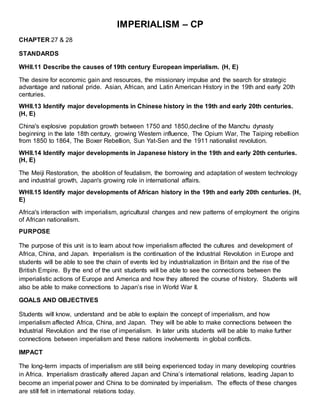
IMPERIALISM – CP
CHAPTER 27 & 28
STANDARDS
WHII.11 Describe the causes of 19th century European imperialism. (H, E)
The desire for economic gain and resources, the missionary impulse and the search for strategic
advantage and national pride. Asian, African, and Latin American History in the 19th and early 20th
centuries.
WHII.13 Identify major developments in Chinese history in the 19th and early 20th centuries.
(H, E)
China's explosive population growth between 1750 and 1850,decline of the Manchu dynasty
beginning in the late 18th century, growing Western influence, The Opium War, The Taiping rebellion
from 1850 to 1864, The Boxer Rebellion, Sun Yat-Sen and the 1911 nationalist revolution.
WHII.14 Identify major developments in Japanese history in the 19th and early 20th centuries.
(H, E)
The Meiji Restoration, the abolition of feudalism, the borrowing and adaptation of western technology
and industrial growth, Japan's growing role in international affairs.
WHII.15 Identify major developments of African history in the 19th and early 20th centuries. (H,
E)
Africa's interaction with imperialism, agricultural changes and new patterns of employment the origins
of African nationalism.
PURPOSE
The purpose of this unit is to learn about how imperialism affected the cultures and development of
Africa, China, and Japan. Imperialism is the continuation of the Industrial Revolution in Europe and
students will be able to see the chain of events led by industrialization in Britain and the rise of the
British Empire. By the end of the unit students will be able to see the connections between the
imperialistic actions of Europe and America and how they altered the course of history. Students will
also be able to make connections to Japan’s rise in World War II.
GOALS AND OBJECTIVES
Students will know, understand and be able to explain the concept of imperialism, and how
imperialism affected Africa, China, and Japan. They will be able to make connections between the
Industrial Revolution and the rise of imperialism. In later units students will be able to make further
connections between imperialism and these nations involvements in global conflicts.
IMPACT
The long-term impacts of imperialism are still being experienced today in many developing countries
in Africa. Imperialism drastically altered Japan and China’s international relations, leading Japan to
become an imperial power and China to be dominated by imperialism. The effects of these changes
are still felt in international relations today.
VOCAB
Imperialism -
Social Darwinism –
Racism –
Steam Engine –
Maxim Gun –
Quinine –
Berlin Conference –
Self – sufficient –
Opium War –
Treaty of Nanjing –
Extraterritorial Rights –
Taiping Rebellion –
Spheres of Influence –
Open Door Policy –
Boxer Rebellion –
Treaty of Kanagawa –
Meiji Era –
Mutsuhito –
Russo – Japanese War –
Annexation –
FOCUSING QUESTIONS
1. What is imperialism?
2. What gave Europeans advantages in colonizing Africa?
3. Why was China not interested in trading with European countries?
4. What was the outcome of the Opium War?
5. How did spheres of influence and the open door policy effect China?
6. What changes did Mutsuhito make during the Meiji Era?
7. Why was the world shocked by the Russo – Japanese war?
8. Is there a relationship between imperialism and nationalism? Why or why not?
9. Was imperialism different in Africa than in China? Why or why not?
10.How did Japan use nationalism to their advantage?

Imperialism unit outline 2010

  • 1.
    IMPERIALISM – HONORS CHAPTER27 & 28 STANDARDS WHII.11 Describe the causes of 19th century European imperialism. (H, E) The desire for economic gain and resources, the missionary impulse and the search for strategic advantage and national pride. Asian, African, and Latin American History in the 19th and early 20th centuries. WHII.13 Identify major developments in Chinese history in the 19th and early 20th centuries. (H, E) China's explosive population growth between 1750 and 1850,decline of the Manchu dynasty beginning in the late 18th century, growing Western influence, The Opium War, The Taiping rebellion from 1850 to 1864, The Boxer Rebellion, Sun Yat-Sen and the 1911 nationalist revolution. WHII.14 Identify major developments in Japanese history in the 19th and early 20th centuries. (H, E) The Meiji Restoration, the abolition of feudalism, the borrowing and adaptation of western technology and industrial growth, Japan's growing role in international affairs. WHII.15 Identify major developments of African history in the 19th and early 20th centuries. (H, E) Africa's interaction with imperialism, agricultural changes and new patterns of employment the origins of African nationalism. PURPOSE The purpose of this unit is to learn about how imperialism affected the cultures and development of Africa, China, and Japan. Imperialism is the continuation of the Industrial Revolution in Europe and students will be able to see the chain of events led by industrialization in Britain and the rise of the British Empire. By the end of the unit students will be able to see the connections between the imperialistic actions of Europe and America and how they altered the course of history. Students will also be able to make connections to Japan’s rise in World War II. GOALS AND OBJECTIVES Students will know, understand and be able to explain the concept of imperialism, and how imperialism affected Africa, China, and Japan. They will be able to make connections between the Industrial Revolution and the rise of imperialism. In later units students will be able to make further connections between imperialism and these nations involvements in global conflicts. IMPACT The long-term impacts of imperialism are still being experienced today in many developing countries in Africa. Imperialism drastically altered Japan and China’s international relations, leading Japan to become an imperial power and China to be dominated by imperialism. The effects of these changes are still felt in international relations today.
  • 2.
    VOCAB  Imperialism  SocialDarwinism  Racism  Steam Engine  Maxim Gun  Quinine  Berlin Conference  Self – sufficient  Opium War  Treaty of Nanjing  Extraterritorial Rights  Taiping Rebellion  Spheres of Influence  Open Door Policy  Boxer Rebellion  Treaty of Kanagawa  Meiji Era  Mutsuhito  Russo – Japanese War  Annexation FOCUSING QUESTIONS 1. What is imperialism? 2. What gave Europeans advantages in colonizing Africa? 3. Why was China not interested in trading with European countries? 4. What was the outcome of the Opium War? 5. How did spheres of influence and the open door policy effect China? 6. What changes did Mutsuhito make during the Meiji Era? 7. Why was the world shocked by the Russo – Japanese war? 8. Is there a relationship between imperialism and nationalism? Why or why not? 9. Was imperialism different in Africa than in China? Why or why not? 10.How did Japan use nationalism to their advantage?
  • 3.
    IMPERIALISM – CP CHAPTER27 & 28 STANDARDS WHII.11 Describe the causes of 19th century European imperialism. (H, E) The desire for economic gain and resources, the missionary impulse and the search for strategic advantage and national pride. Asian, African, and Latin American History in the 19th and early 20th centuries. WHII.13 Identify major developments in Chinese history in the 19th and early 20th centuries. (H, E) China's explosive population growth between 1750 and 1850,decline of the Manchu dynasty beginning in the late 18th century, growing Western influence, The Opium War, The Taiping rebellion from 1850 to 1864, The Boxer Rebellion, Sun Yat-Sen and the 1911 nationalist revolution. WHII.14 Identify major developments in Japanese history in the 19th and early 20th centuries. (H, E) The Meiji Restoration, the abolition of feudalism, the borrowing and adaptation of western technology and industrial growth, Japan's growing role in international affairs. WHII.15 Identify major developments of African history in the 19th and early 20th centuries. (H, E) Africa's interaction with imperialism, agricultural changes and new patterns of employment the origins of African nationalism. PURPOSE The purpose of this unit is to learn about how imperialism affected the cultures and development of Africa, China, and Japan. Imperialism is the continuation of the Industrial Revolution in Europe and students will be able to see the chain of events led by industrialization in Britain and the rise of the British Empire. By the end of the unit students will be able to see the connections between the imperialistic actions of Europe and America and how they altered the course of history. Students will also be able to make connections to Japan’s rise in World War II. GOALS AND OBJECTIVES Students will know, understand and be able to explain the concept of imperialism, and how imperialism affected Africa, China, and Japan. They will be able to make connections between the Industrial Revolution and the rise of imperialism. In later units students will be able to make further connections between imperialism and these nations involvements in global conflicts. IMPACT The long-term impacts of imperialism are still being experienced today in many developing countries in Africa. Imperialism drastically altered Japan and China’s international relations, leading Japan to become an imperial power and China to be dominated by imperialism. The effects of these changes are still felt in international relations today.
  • 4.
    VOCAB Imperialism - Social Darwinism– Racism – Steam Engine – Maxim Gun – Quinine – Berlin Conference – Self – sufficient – Opium War – Treaty of Nanjing – Extraterritorial Rights – Taiping Rebellion – Spheres of Influence – Open Door Policy –
  • 5.
    Boxer Rebellion – Treatyof Kanagawa – Meiji Era – Mutsuhito – Russo – Japanese War – Annexation – FOCUSING QUESTIONS 1. What is imperialism? 2. What gave Europeans advantages in colonizing Africa? 3. Why was China not interested in trading with European countries? 4. What was the outcome of the Opium War? 5. How did spheres of influence and the open door policy effect China?
  • 6.
    6. What changesdid Mutsuhito make during the Meiji Era? 7. Why was the world shocked by the Russo – Japanese war? 8. Is there a relationship between imperialism and nationalism? Why or why not? 9. Was imperialism different in Africa than in China? Why or why not? 10.How did Japan use nationalism to their advantage?