Ways of the World Presentation Chapters 17-24 By:  Stayce Tate
CHAPTER 17 Atlantic Revolutions North American Revolution 1775-1787 French Revolution 1789-1815 Haitian Revolution 1791-1804 Spanish-American Revolution 1810-1825
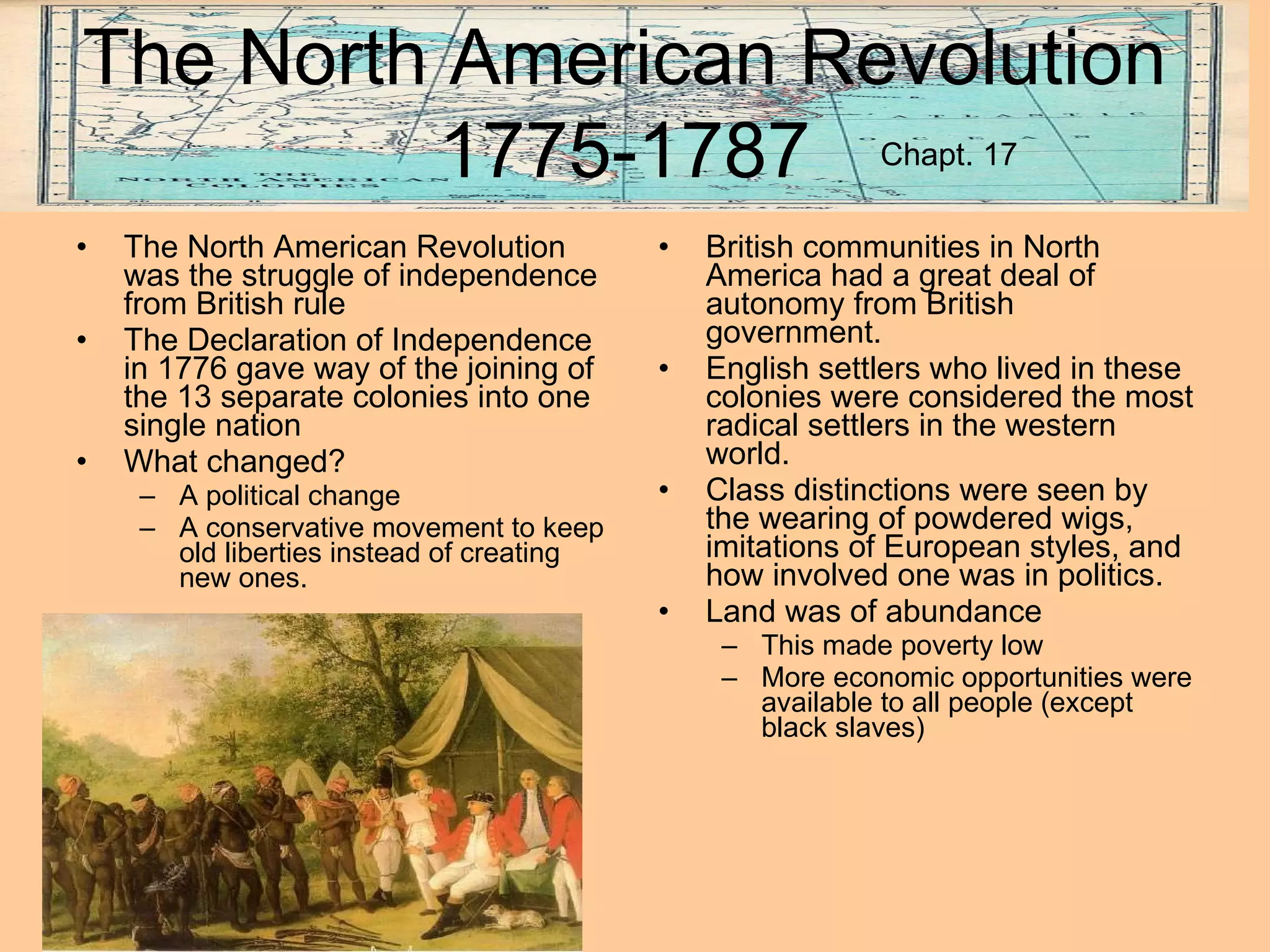
North American Revolution 1775-1787 The North American Revolution was the struggle of independence from British rule The Declaration of Independence in 1776 gave way of the joining of the 13 separate colonies into one single nation What changed? A political change A conservative movement to keep old liberties instead of creating new ones. British communities in North America had a great deal of autonomy from British government. English settlers who lived in these colonies were considered the most radical settlers in the western world. Class distinctions were seen by the wearing of powdered wigs, imitations of European styles, and how involved one was in politics. Land was of abundance This made poverty low More economic opportunities were available to all people (except black slaves) The North American Revolution 1775-1787 Chapt. 17
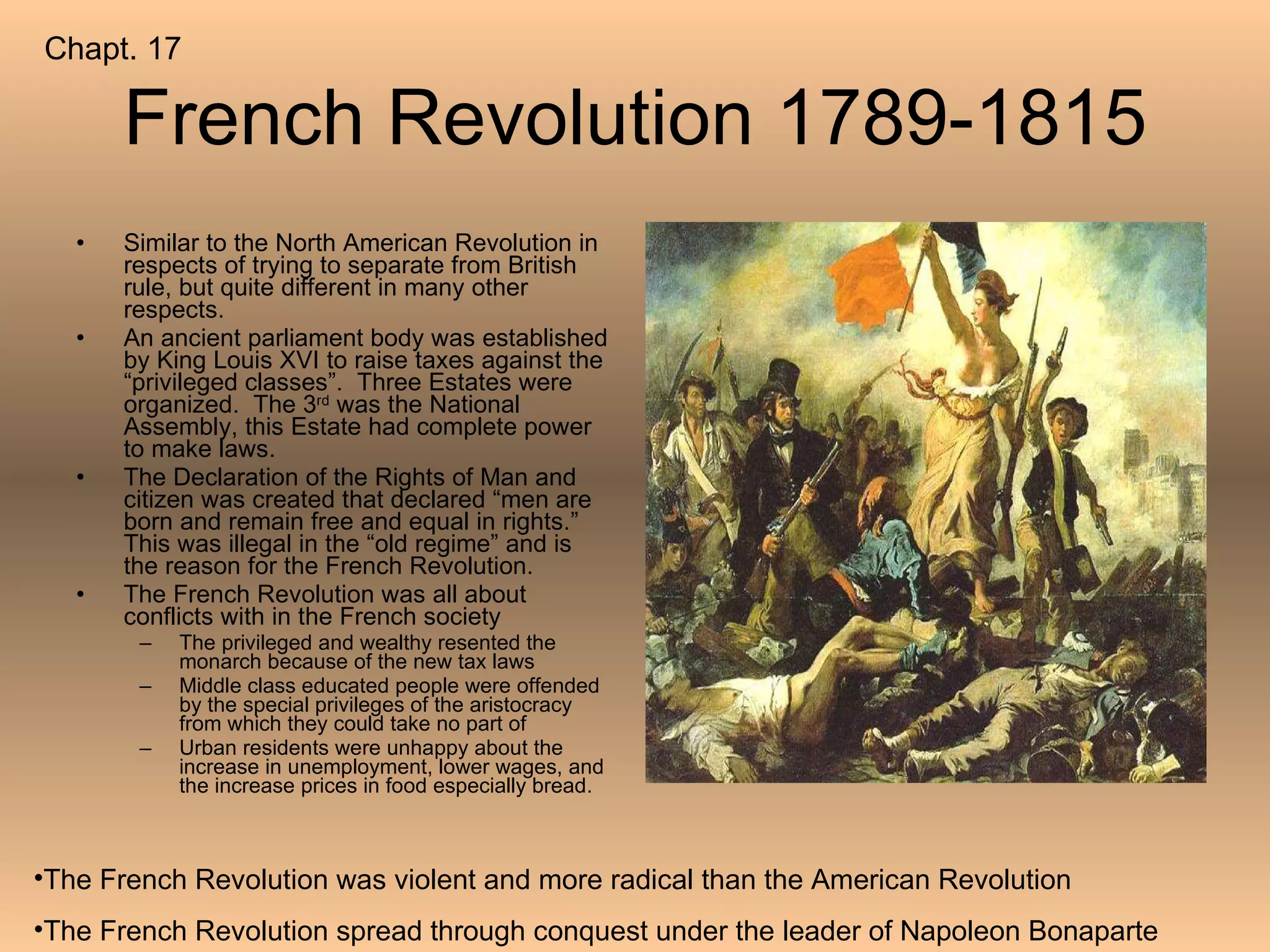
French Revolution 1789-1815 Similar to the North American Revolution in respects of trying to separate from British rule, but quite different in many other respects. An ancient parliament body was established by King Louis XVI to raise taxes against the “privileged classes”.  Three Estates were organized.  The 3 rd  was the National Assembly, this Estate had complete power to make laws. The Declaration of the Rights of Man and citizen was created that declared “men are born and remain free and equal in rights.”  This was illegal in the “old regime” and is the reason for the French Revolution. The French Revolution was all about conflicts with in the French society The privileged and wealthy resented the monarch because of the new tax laws Middle class educated people were offended by the special privileges of the aristocracy from which they could take no part of Urban residents were unhappy about the increase in unemployment, lower wages, and the increase prices in food especially bread. The French Revolution was violent and more radical than the American Revolution The French Revolution spread through conquest under the leader of Napoleon Bonaparte  Chapt. 17
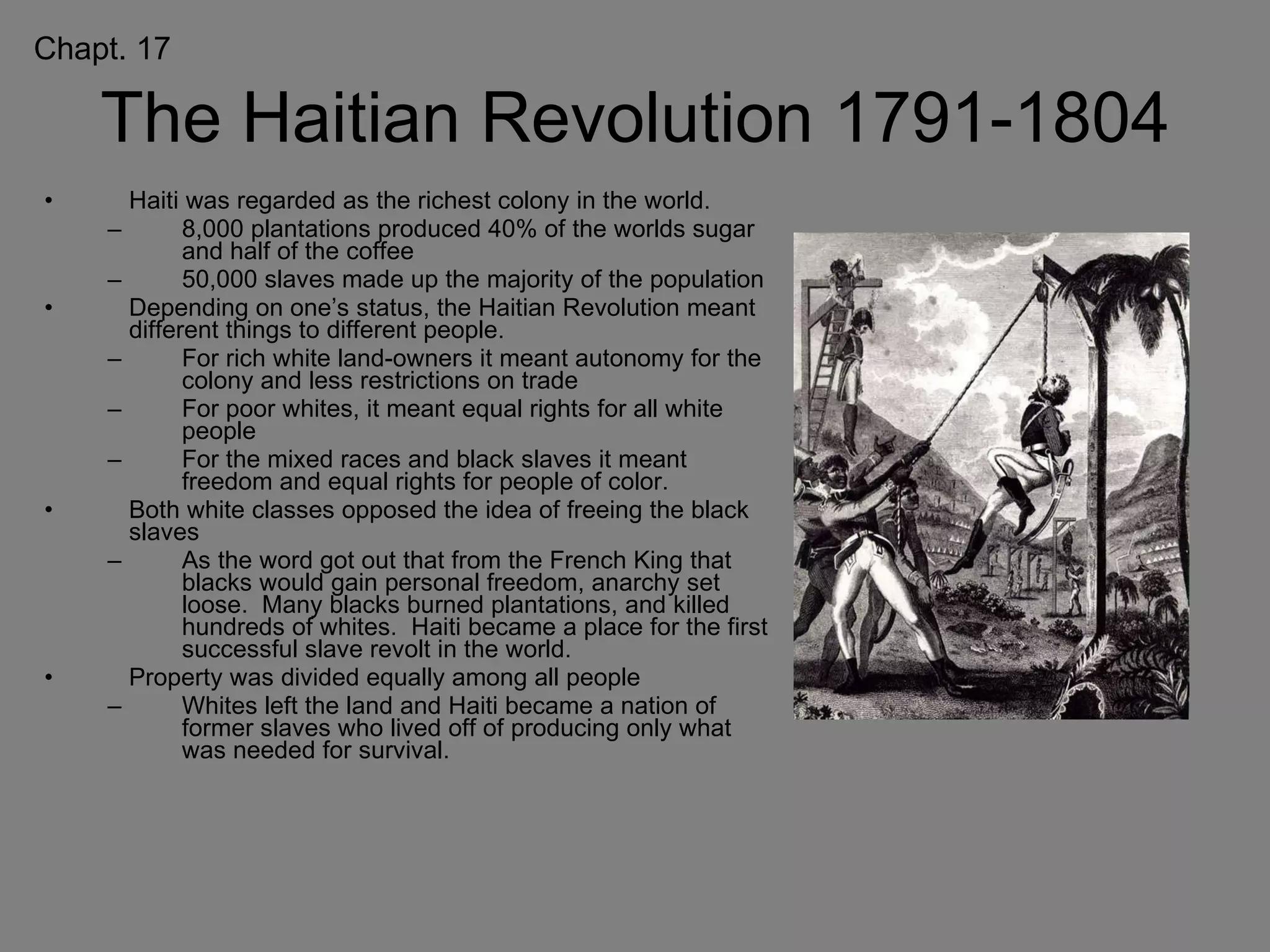
The Haitian Revolution 1791-1804 Haiti was regarded as the richest colony in the world. 8,000 plantations produced 40% of the worlds sugar and half of the coffee 50,000 slaves made up the majority of the population Depending on one’s status, the Haitian Revolution meant different things to different people. For rich white land-owners it meant autonomy for the colony and less restrictions on trade For poor whites, it meant equal rights for all white people For the mixed races and black slaves it meant  freedom and equal rights for people of color. Both white classes opposed the idea of freeing the black slaves As the word got out that from the French King that blacks would gain personal freedom, anarchy set loose.  Many blacks burned plantations, and killed hundreds of whites.  Haiti became a place for the first successful slave revolt in the world. Property was divided equally among all people Whites left the land and Haiti became a nation of former slaves who lived off of producing only what was needed for survival. Chapt. 17
CHAPTER 18 Karl Marx Middle Class Values Latin America After Independence
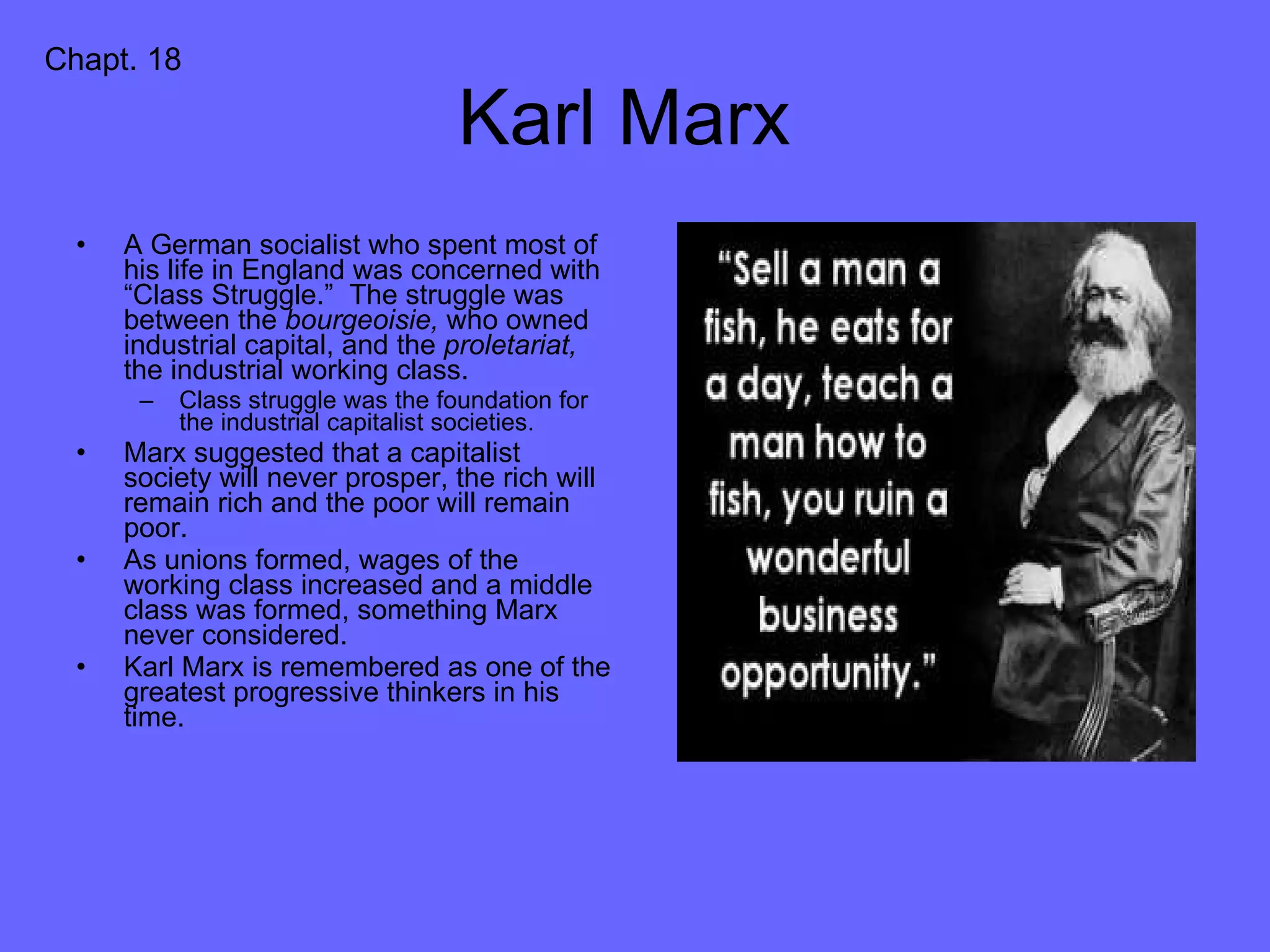
Karl Marx  A German socialist who spent most of his life in England was concerned with “Class Struggle.”  The struggle was between the  bourgeoisie,  who owned industrial capital, and the  proletariat,  the industrial working class. Class struggle was the foundation for the industrial capitalist societies. Marx suggested that a capitalist society will never prosper, the rich will remain rich and the poor will remain poor. As unions formed, wages of the working class increased and a middle class was formed, something Marx never considered. Karl Marx is remembered as one of the greatest progressive thinkers in his time. Chapt. 18
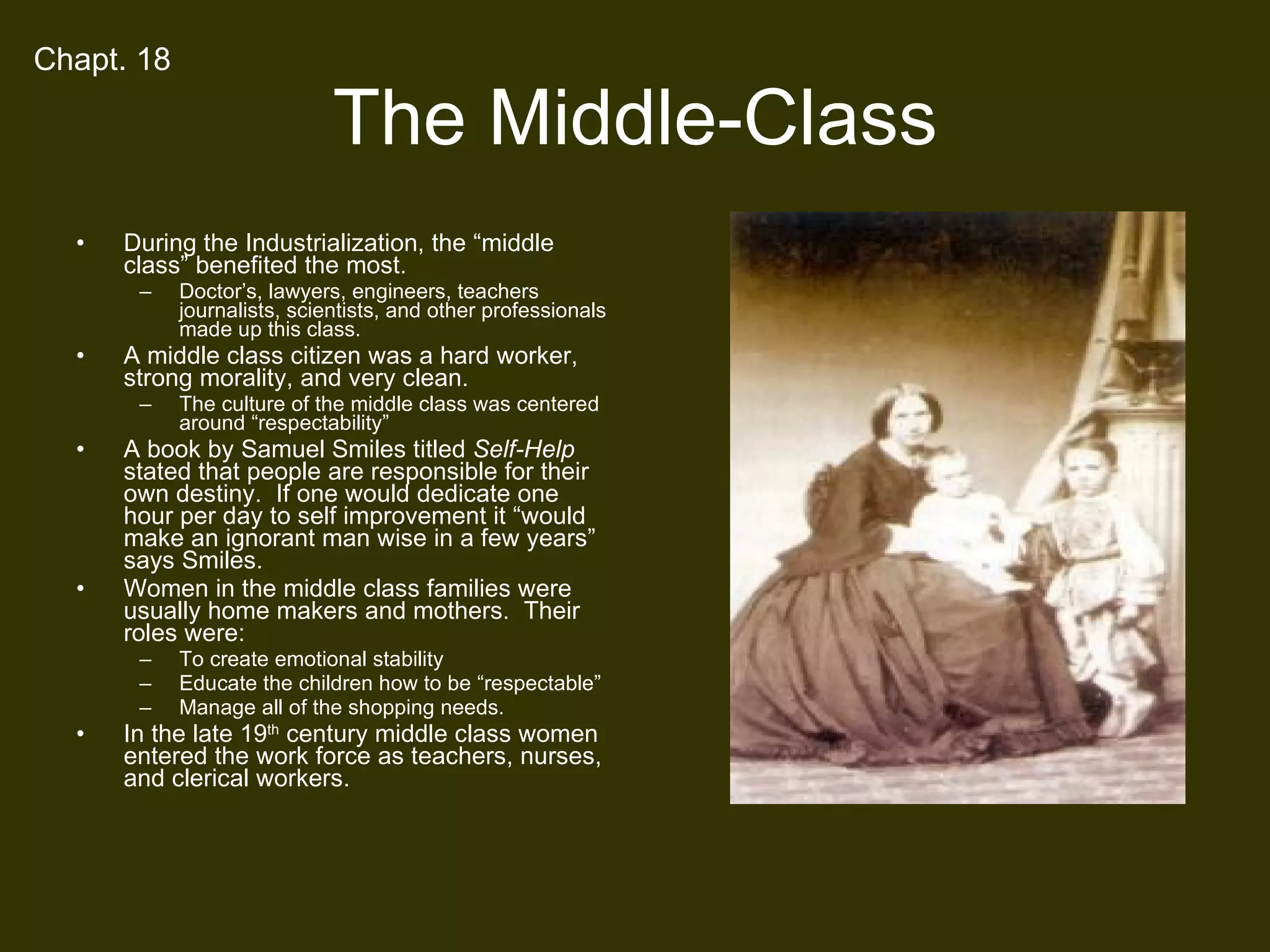
The Middle-Class During the Industrialization, the “middle class” benefited the most. Doctor’s, lawyers, engineers, teachers journalists, scientists, and other professionals made up this class. A middle class citizen was a hard worker, strong morality, and very clean.  The culture of the middle class was centered around “respectability”  A book by Samuel Smiles titled  Self-Help  stated that people are responsible for their own destiny.  If one would dedicate one hour per day to self improvement it “would make an ignorant man wise in a few years” says Smiles. Women in the middle class families were usually home makers and mothers.  Their roles were: To create emotional stability Educate the children how to be “respectable” Manage all of the shopping needs. In the late 19 th  century middle class women entered the work force as teachers, nurses, and clerical workers. Chapt. 18
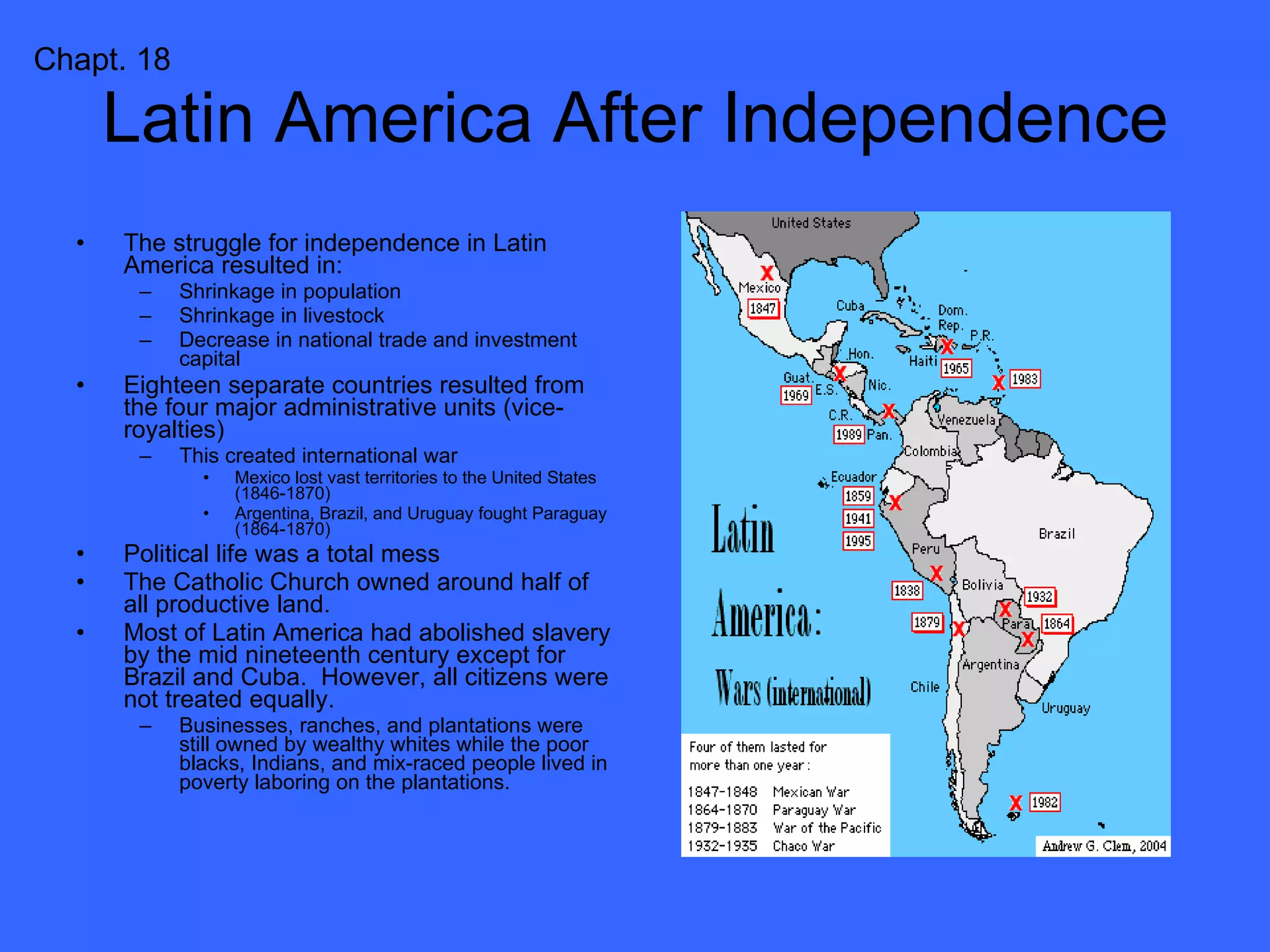
Latin America After Independence The struggle for independence in Latin America resulted in: Shrinkage in population Shrinkage in livestock  Decrease in national trade and investment capital Eighteen separate countries resulted from the four major administrative units (vice-royalties) This created international war Mexico lost vast territories to the United States (1846-1870) Argentina, Brazil, and Uruguay fought Paraguay (1864-1870) Political life was a total mess The Catholic Church owned around half of all productive land. Most of Latin America had abolished slavery by the mid nineteenth century except for Brazil and Cuba.  However, all citizens were not treated equally. Businesses, ranches, and plantations were still owned by wealthy whites while the poor blacks, Indians, and mix-raced people lived in poverty laboring on the plantations. Chapt. 18
CHAPTER 19 Industrialization Changing Views of Asians and Africans in the 19 th  Century British Exports: Opium Japan as a New East Asian Power
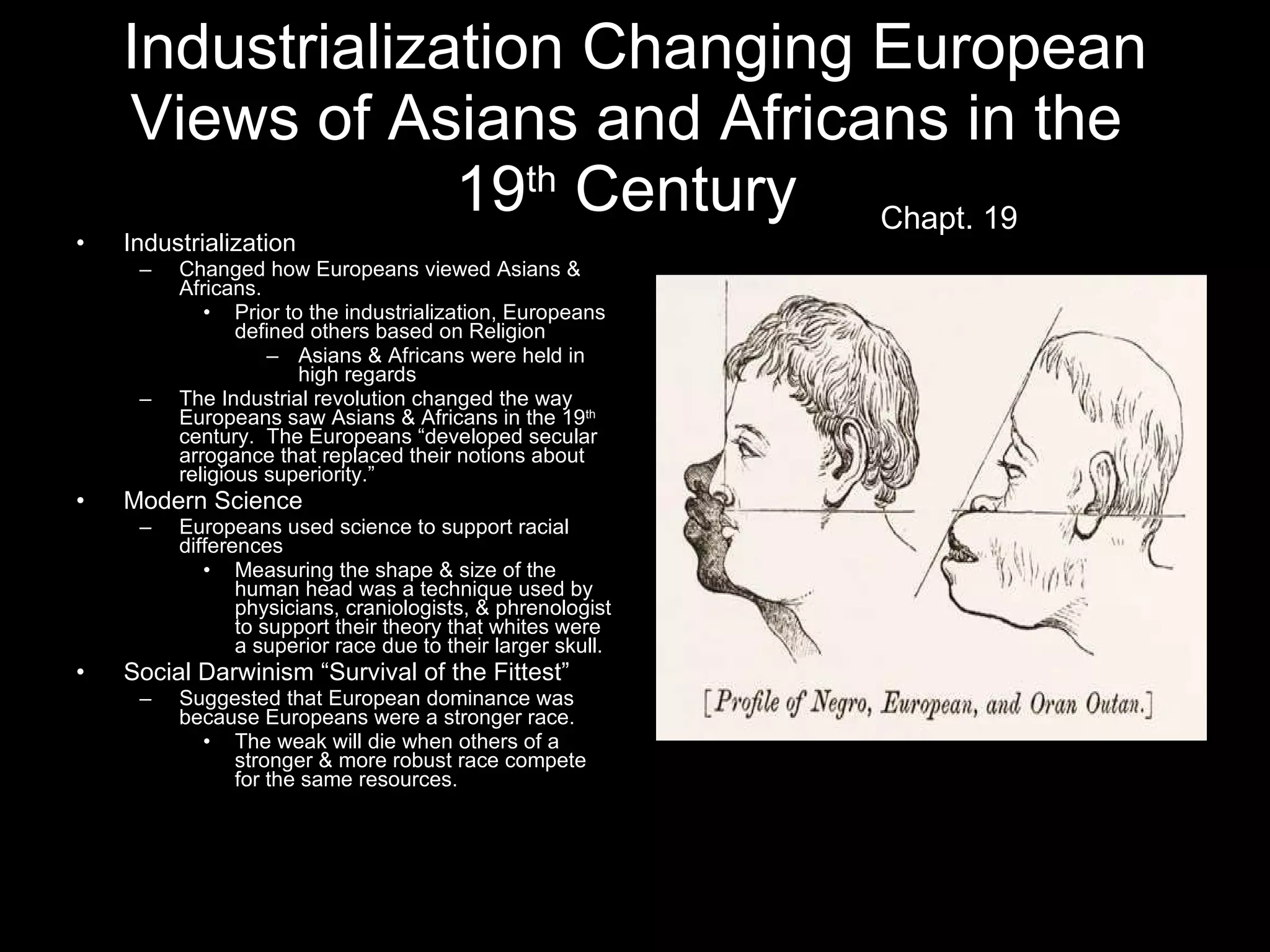
Industrialization Changing European Views of Asians and Africans in the  19 th  Century   Industrialization Changed how Europeans viewed Asians & Africans. Prior to the industrialization, Europeans defined others based on Religion Asians & Africans were held in high regards The Industrial revolution changed the way Europeans saw Asians & Africans in the 19 th  century.  The Europeans “developed secular arrogance that replaced their notions about religious superiority.” Modern Science Europeans used science to support racial differences Measuring the shape & size of the human head was a technique used by physicians, craniologists, & phrenologist to support their theory that whites were a superior race due to their larger skull. Social Darwinism “Survival of the Fittest” Suggested that European dominance was because Europeans were a stronger race. The weak will die when others of a stronger & more robust race compete for the same resources. Chapt. 19
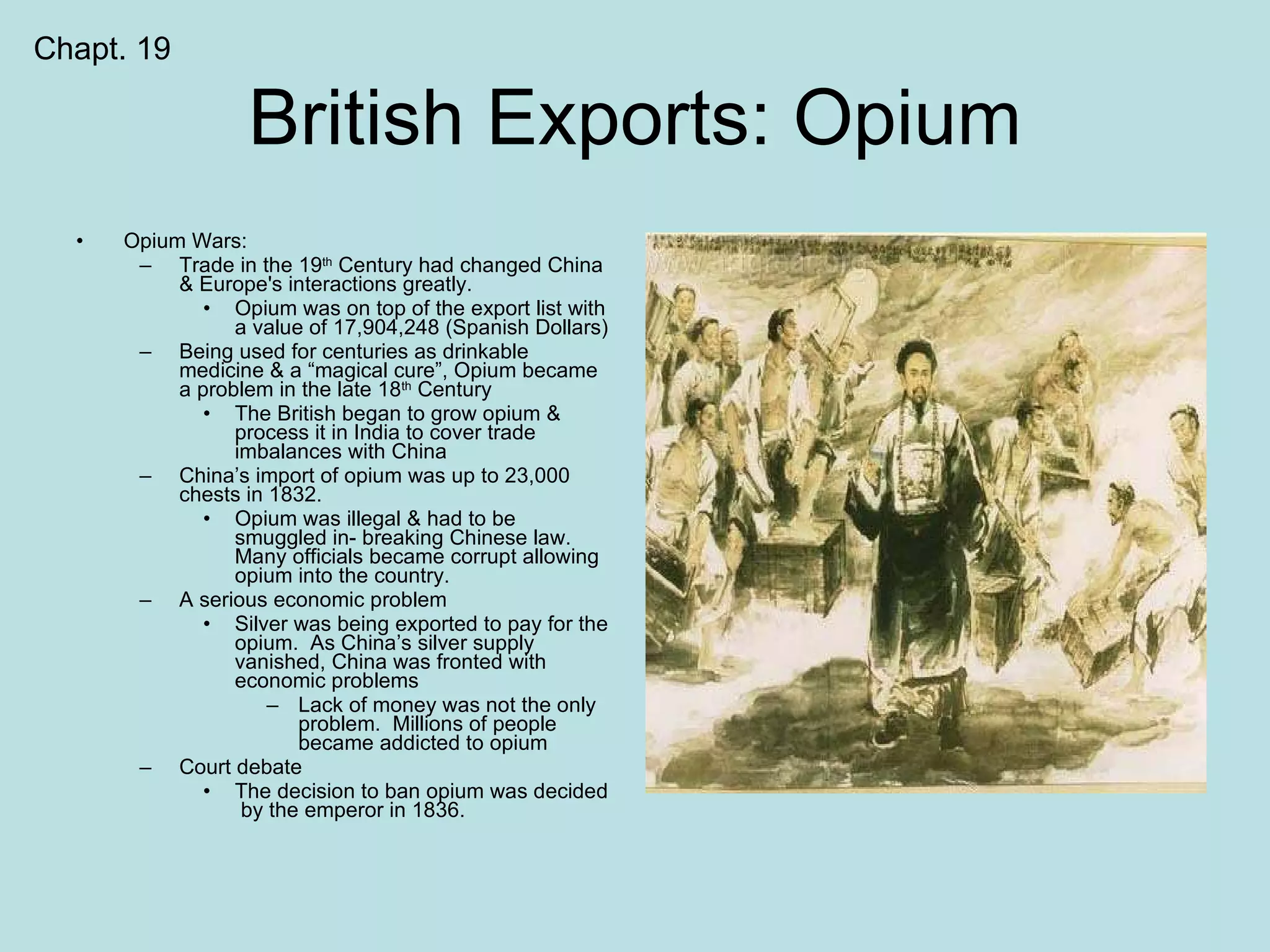
British Exports: Opium Opium Wars: Trade in the 19 th  Century had changed China & Europe's interactions greatly. Opium was on top of the export list with a value of 17,904,248 (Spanish Dollars) Being used for centuries as drinkable medicine & a “magical cure”, Opium became a problem in the late 18 th  Century The British began to grow opium & process it in India to cover trade imbalances with China China’s import of opium was up to 23,000 chests in 1832. Opium was illegal & had to be smuggled in- breaking Chinese law.  Many officials became corrupt allowing opium into the country. A serious economic problem Silver was being exported to pay for the opium.  As China’s silver supply vanished, China was fronted with economic problems Lack of money was not the only problem.  Millions of people became addicted to opium Court debate The decision to ban opium was decided  by the emperor in 1836. Chapt. 19
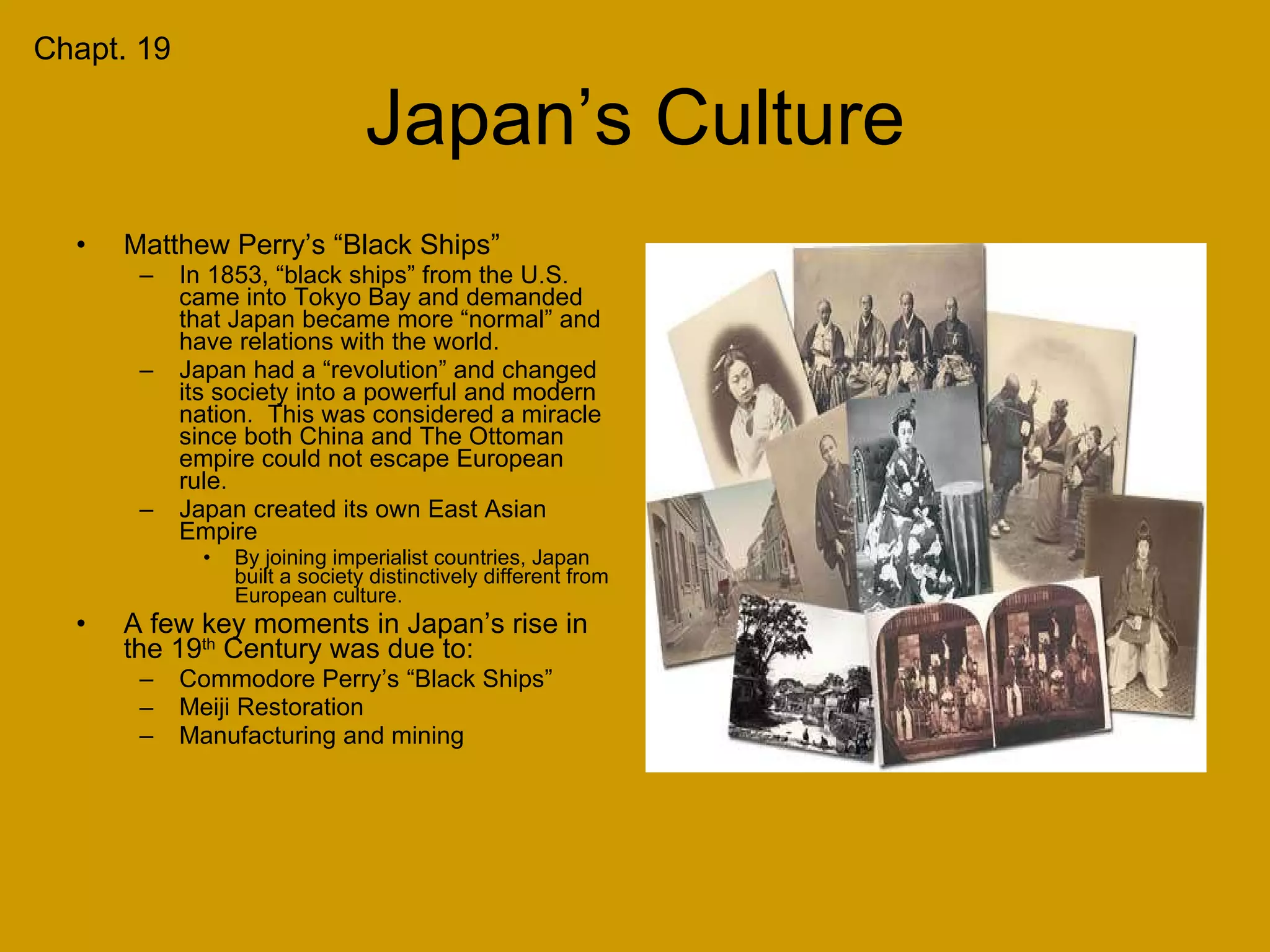
Japan’s Culture Matthew Perry’s “Black Ships” In 1853, “black ships” from the U.S. came into Tokyo Bay and demanded that Japan became more “normal” and have relations with the world. Japan had a “revolution” and changed its society into a powerful and modern nation.  This was considered a miracle since both China and The Ottoman empire could not escape European rule. Japan created its own East Asian Empire By joining imperialist countries, Japan built a society distinctively different from European culture. A few key moments in Japan’s rise in the 19 th  Century was due to: Commodore Perry’s “Black Ships” Meiji Restoration Manufacturing and mining Chapt. 19
CHAPTER 20 Forced Labor Waged Labor Religion
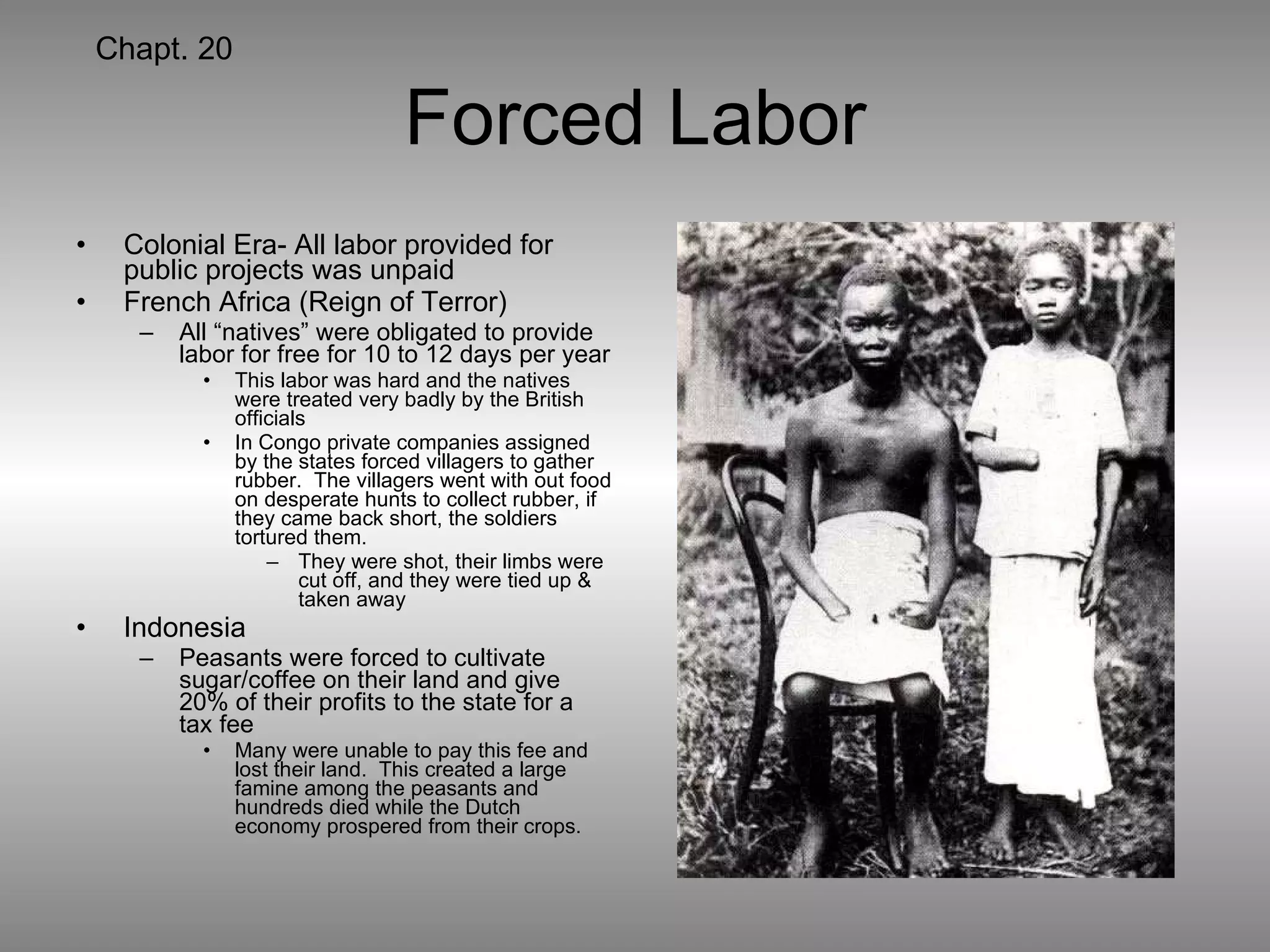
Forced Labor Colonial Era- All labor provided for public projects was unpaid French Africa (Reign of Terror) All “natives” were obligated to provide labor for free for 10 to 12 days per year This labor was hard and the natives were treated very badly by the British officials In Congo private companies assigned by the states forced villagers to gather rubber.  The villagers went with out food on desperate hunts to collect rubber, if they came back short, the soldiers tortured them. They were shot, their limbs were cut off, and they were tied up & taken away Indonesia Peasants were forced to cultivate sugar/coffee on their land and give 20% of their profits to the state for a tax fee Many were unable to pay this fee and lost their land.  This created a large famine among the peasants and hundreds died while the Dutch economy prospered from their crops. Chapt. 20
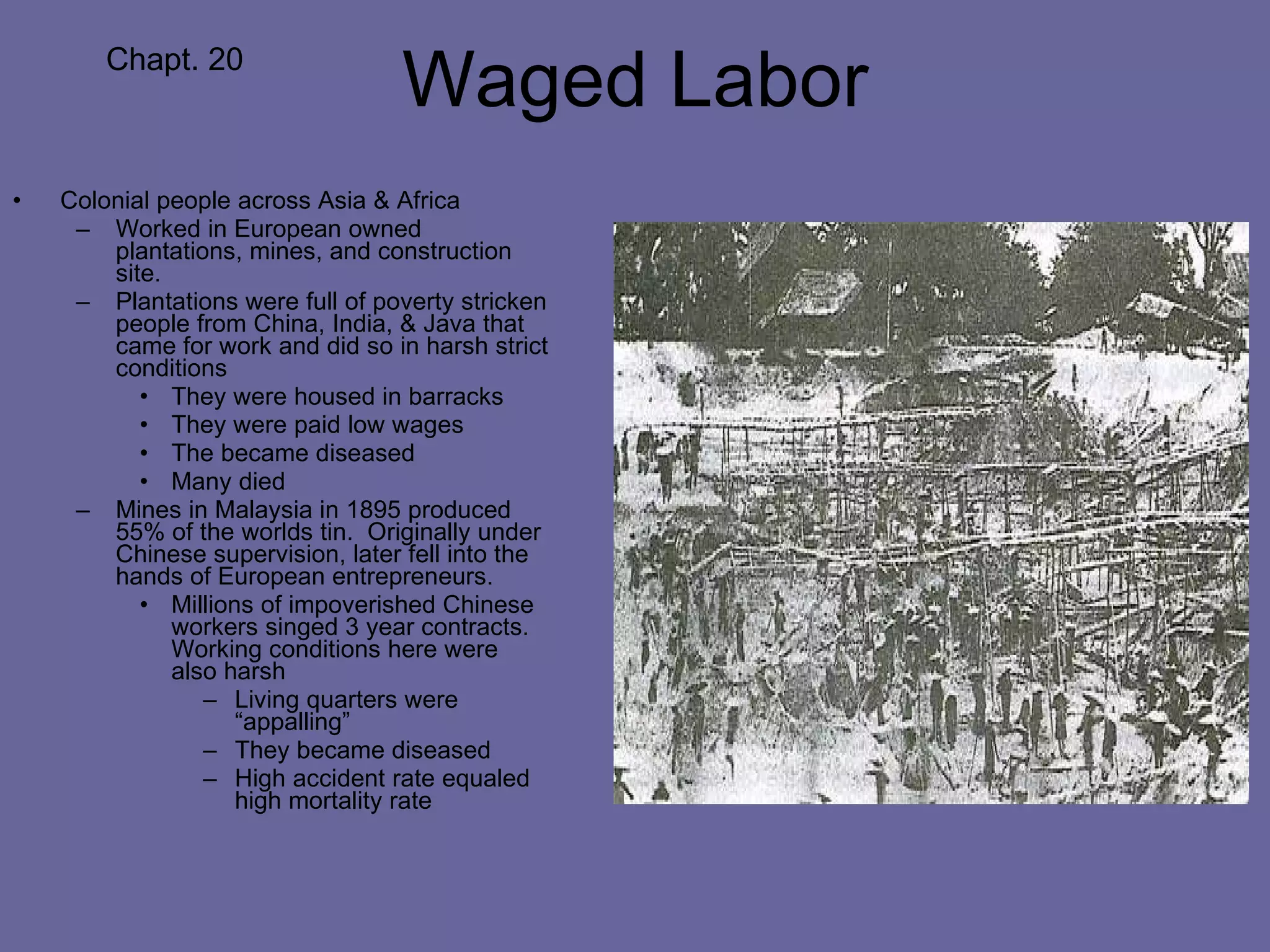
Waged Labor Colonial people across Asia & Africa Worked in European owned plantations, mines, and construction site. Plantations were full of poverty stricken people from China, India, & Java that came for work and did so in harsh strict conditions They were housed in barracks They were paid low wages The became diseased Many died Mines in Malaysia in 1895 produced 55% of the worlds tin.  Originally under Chinese supervision, later fell into the hands of European entrepreneurs. Millions of impoverished Chinese workers singed 3 year contracts.  Working conditions here were also harsh Living quarters were “appalling” They became diseased High accident rate equaled high mortality rate Chapt. 20
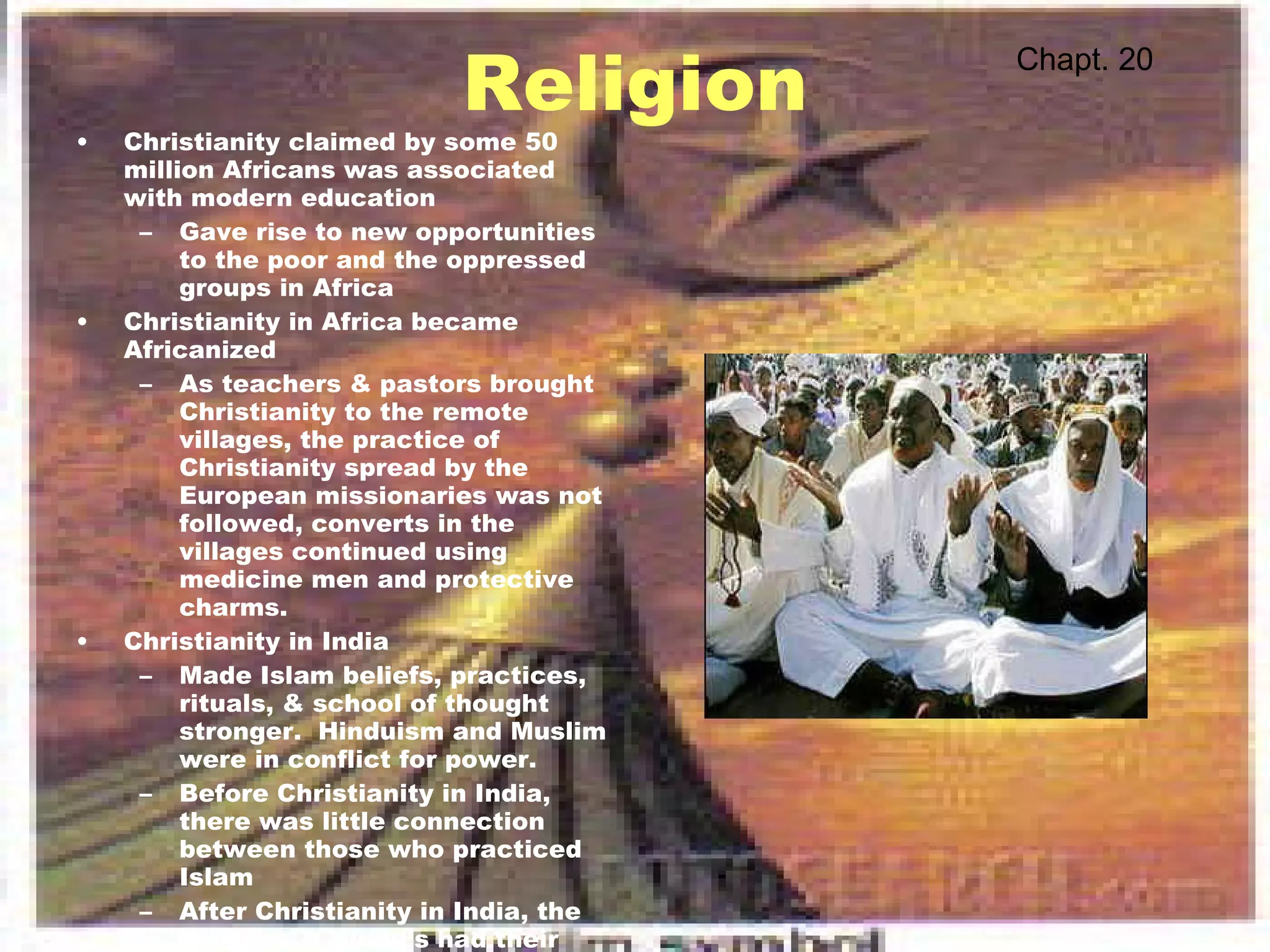
Religion Christianity claimed by some 50 million Africans was associated with modern education Gave rise to new opportunities to the poor and the oppressed groups in Africa Christianity in Africa became Africanized As teachers & pastors brought Christianity to the remote villages, the practice of Christianity spread by the European missionaries was not followed, converts in the villages continued using medicine men and protective charms. Christianity in India Made Islam beliefs, practices, rituals, & school of thought stronger.  Hinduism and Muslim were in conflict for power. Before Christianity in India, there was little connection between those who practiced Islam After Christianity in India, the Muslims & Hindu's had their own identity and separate laws were created for each group by the British. Chapt. 20
CHAPTER 21 Legacies of the Great War After The Great War Hitler
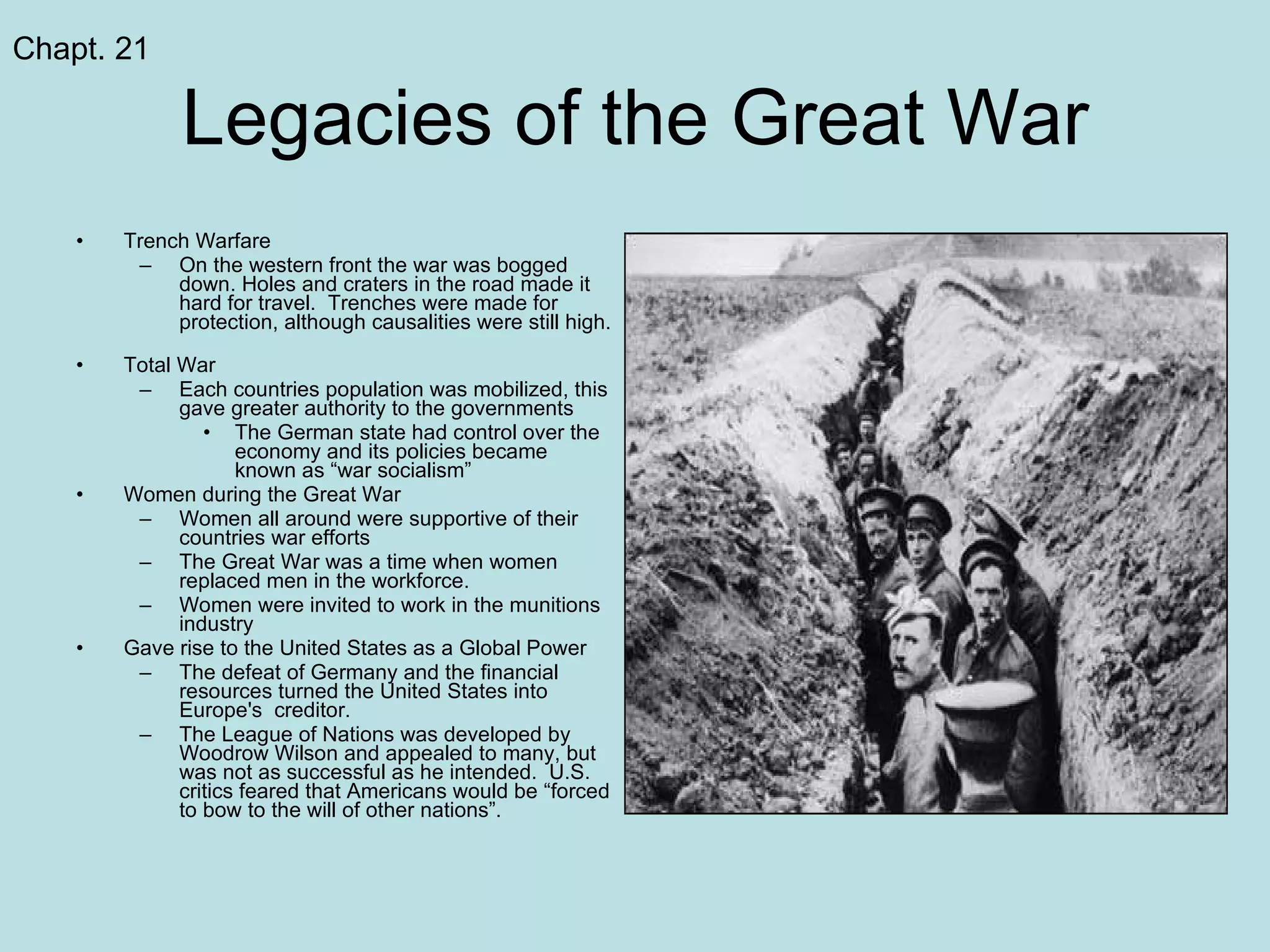
Legacies of the Great War Trench Warfare On the western front the war was bogged down. Holes and craters in the road made it hard for travel.  Trenches were made for protection, although causalities were still high.  Total War Each countries population was mobilized, this gave greater authority to the governments The German state had control over the economy and its policies became known as “war socialism” Women during the Great War Women all around were supportive of their countries war efforts The Great War was a time when women replaced men in the workforce.  Women were invited to work in the munitions industry Gave rise to the United States as a Global Power The defeat of Germany and the financial resources turned the United States into Europe's  creditor.  The League of Nations was developed by Woodrow Wilson and appealed to many, but was not as successful as he intended.  U.S. critics feared that Americans would be “forced to bow to the will of other nations”.  Chapt. 21
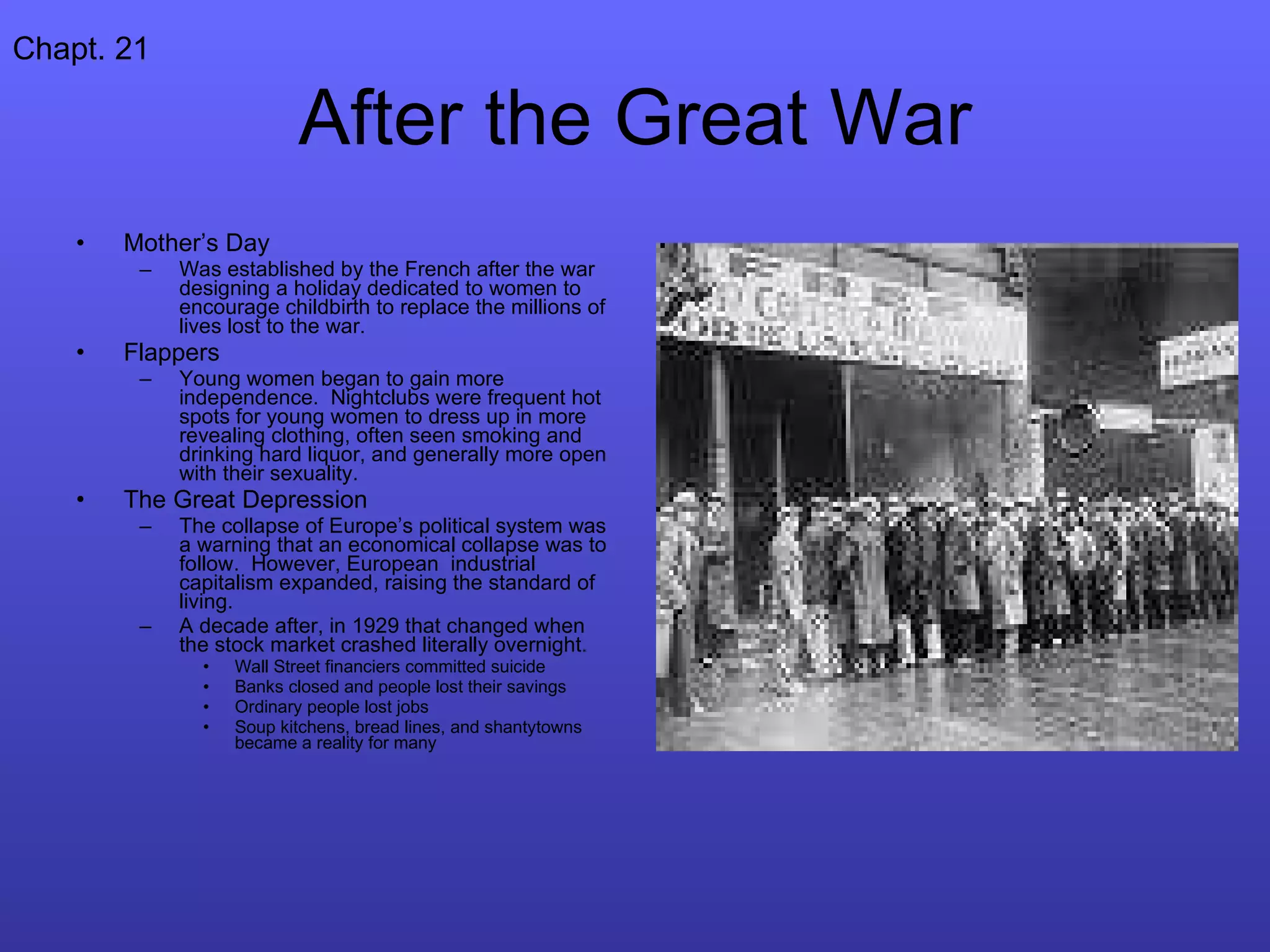
After the Great War Mother’s Day Was established by the French after the war designing a holiday dedicated to women to encourage childbirth to replace the millions of lives lost to the war. Flappers Young women began to gain more independence.  Nightclubs were frequent hot spots for young women to dress up in more revealing clothing, often seen smoking and drinking hard liquor, and generally more open with their sexuality. The Great Depression The collapse of Europe’s political system was a warning that an economical collapse was to follow.  However, European  industrial capitalism expanded, raising the standard of living. A decade after, in 1929 that changed when the stock market crashed literally overnight.  Wall Street financiers committed suicide Banks closed and people lost their savings Ordinary people lost jobs Soup kitchens, bread lines, and shantytowns became a reality for many Chapt. 21
Hitler (1889-1945) Leader of the Nazi Party Hitler generated a single-party dictatorship. He lead under fear with the use of violence as a way to control his people. Nazi’s achieved national power in 1933 The Weimar Republic was created when the German imperial state collapsed and democratic politicians formed a new government. People were fed up and much animosity was spreading through Germany.  Hitler began to receive growing national support. Once in power Hitler suppressed all other political parties He excluded and restricted Jewish life Jews were forced to wear the star of David Chapt. 21
CHAPTER 22 Nuclear Weapons Deng Xiaoping Russia: Revolution in a Single Year
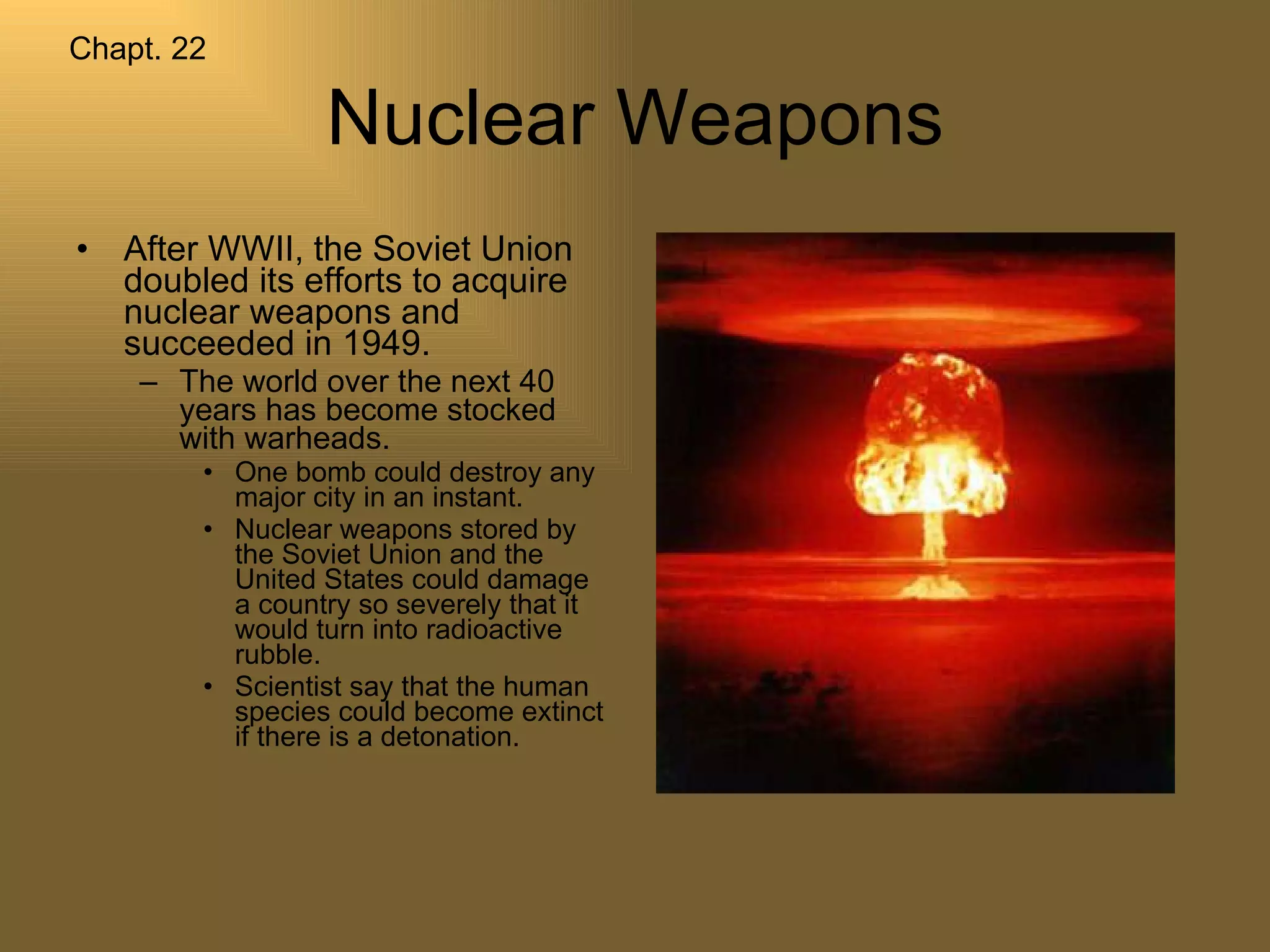
Nuclear Weapons After WWII, the Soviet Union doubled its efforts to acquire nuclear weapons and succeeded in 1949.  The world over the next 40 years has become stocked with warheads.  One bomb could destroy any major city in an instant. Nuclear weapons stored by the Soviet Union and the United States could damage a country so severely that it would turn into radioactive rubble. Scientist say that the human species could become extinct if there is a detonation.  Chapt. 22
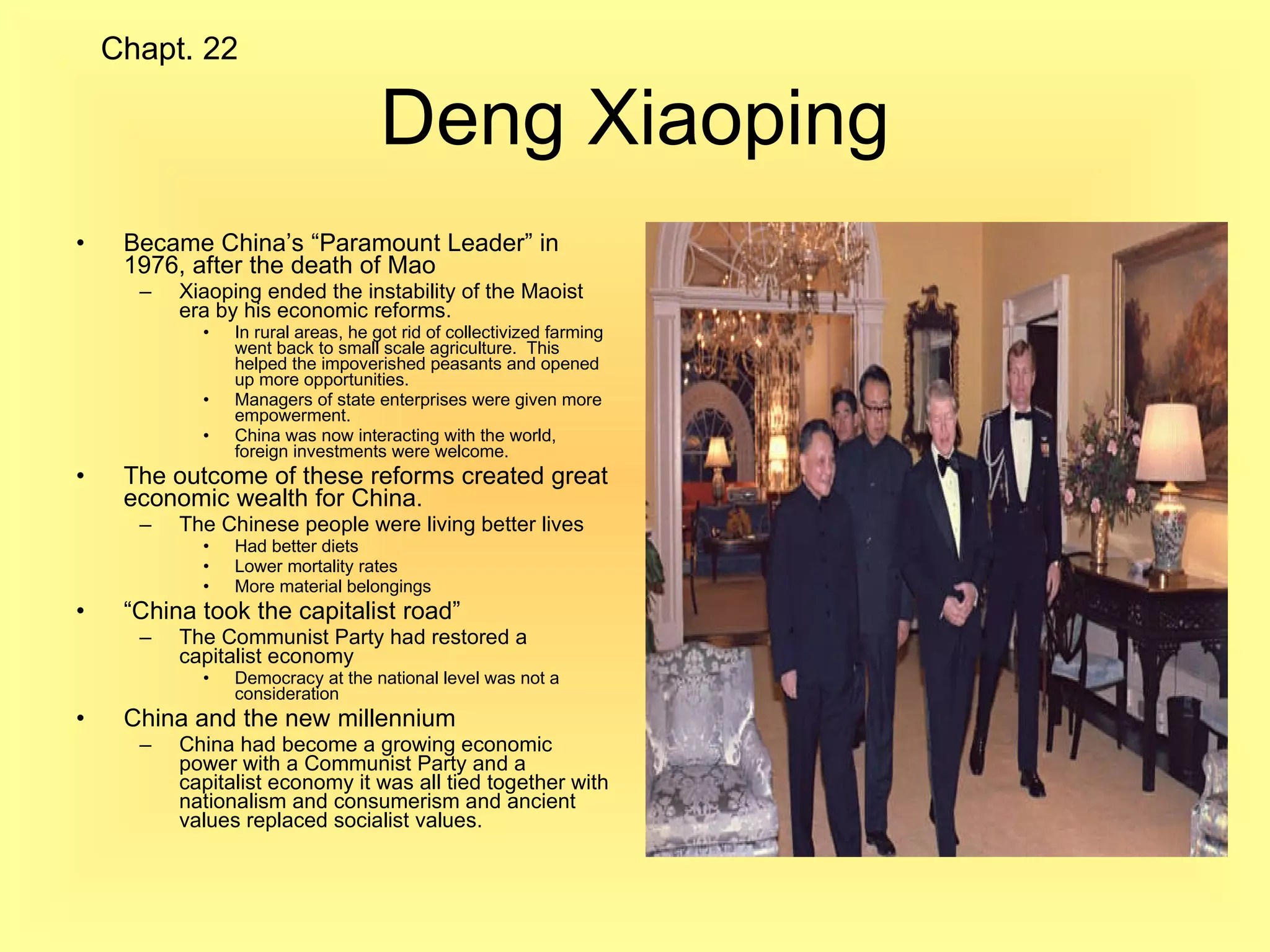
Deng Xiaoping Became China’s “Paramount Leader” in 1976, after the death of Mao Xiaoping ended the instability of the Maoist era by his economic reforms. In rural areas, he got rid of collectivized farming went back to small scale agriculture.  This helped the impoverished peasants and opened up more opportunities. Managers of state enterprises were given more empowerment. China was now interacting with the world, foreign investments were welcome. The outcome of these reforms created great economic wealth for China. The Chinese people were living better lives Had better diets Lower mortality rates More material belongings “ China took the capitalist road” The Communist Party had restored a capitalist economy Democracy at the national level was not a consideration China and the new millennium  China had become a growing economic power with a Communist Party and a capitalist economy it was all tied together with nationalism and consumerism and ancient values replaced socialist values. Chapt. 22
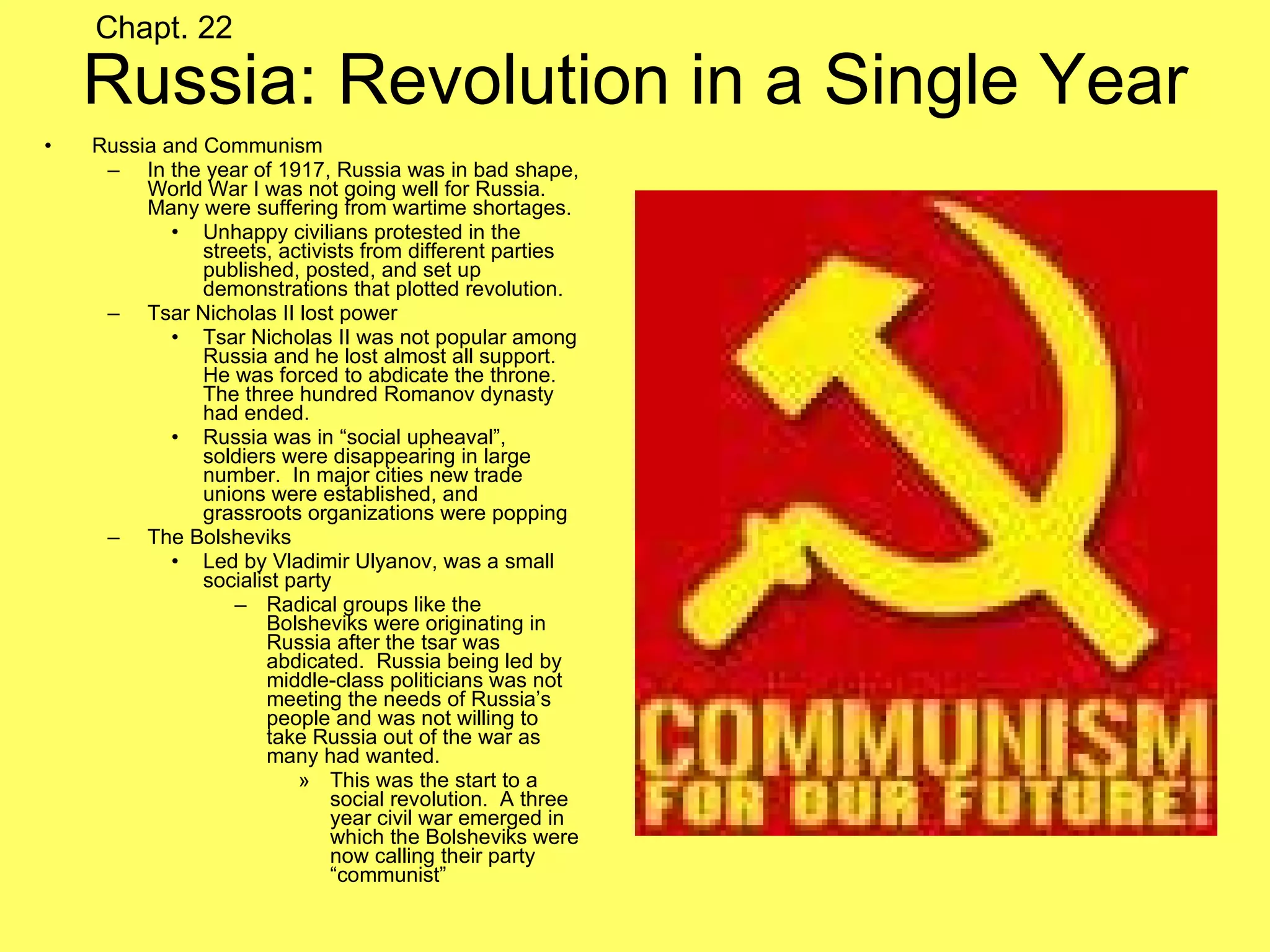
Russia: Revolution in a Single Year Russia and Communism In the year of 1917, Russia was in bad shape, World War I was not going well for Russia.  Many were suffering from wartime shortages.  Unhappy civilians protested in the streets, activists from different parties published, posted, and set up demonstrations that plotted revolution. Tsar Nicholas II lost power Tsar Nicholas II was not popular among Russia and he lost almost all support.  He was forced to abdicate the throne.  The three hundred Romanov dynasty had ended. Russia was in “social upheaval”, soldiers were disappearing in large number.  In major cities new trade unions were established, and grassroots organizations were popping The Bolsheviks Led by Vladimir Ulyanov, was a small socialist party Radical groups like the Bolsheviks were originating in Russia after the tsar was abdicated.  Russia being led by middle-class politicians was not meeting the needs of Russia’s people and was not willing to take Russia out of the war as many had wanted.  This was the start to a social revolution.  A three year civil war emerged in which the Bolsheviks were now calling their party “communist” Chapt. 22
CHAPTER 23 Nelson Mandela Economic Development in Third World Countries Culture:  In the Global South
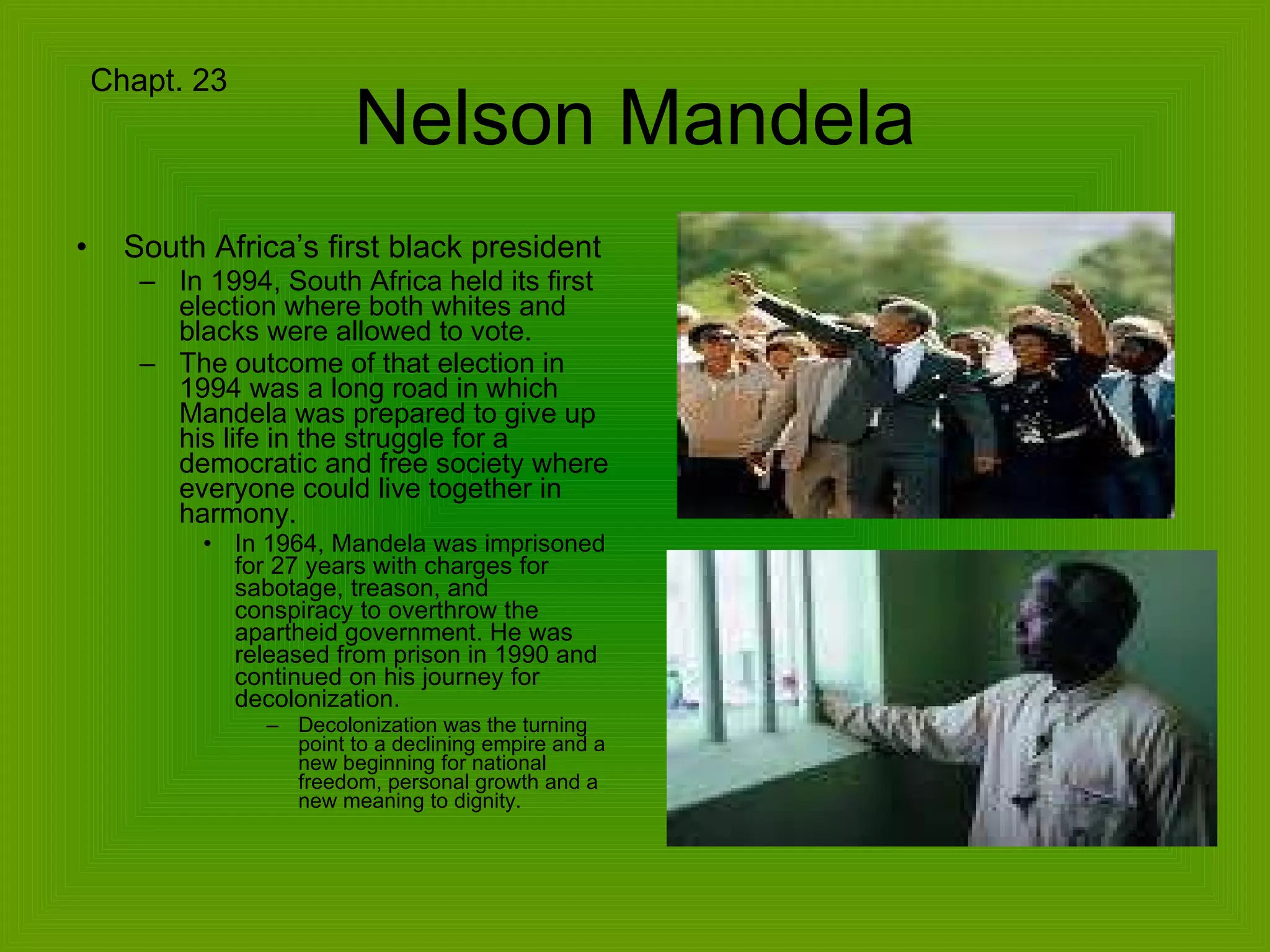
Nelson Mandela South Africa’s first black president In 1994, South Africa held its first election where both whites and blacks were allowed to vote.  The outcome of that election in 1994 was a long road in which Mandela was prepared to give up his life in the struggle for a democratic and free society where everyone could live together in harmony. In 1964, Mandela was imprisoned for 27 years with charges for sabotage, treason, and conspiracy to overthrow the apartheid government. He was released from prison in 1990 and continued on his journey for decolonization. Decolonization was the turning point to a declining empire and a new beginning for national freedom, personal growth and a new meaning to dignity. Chapt. 23
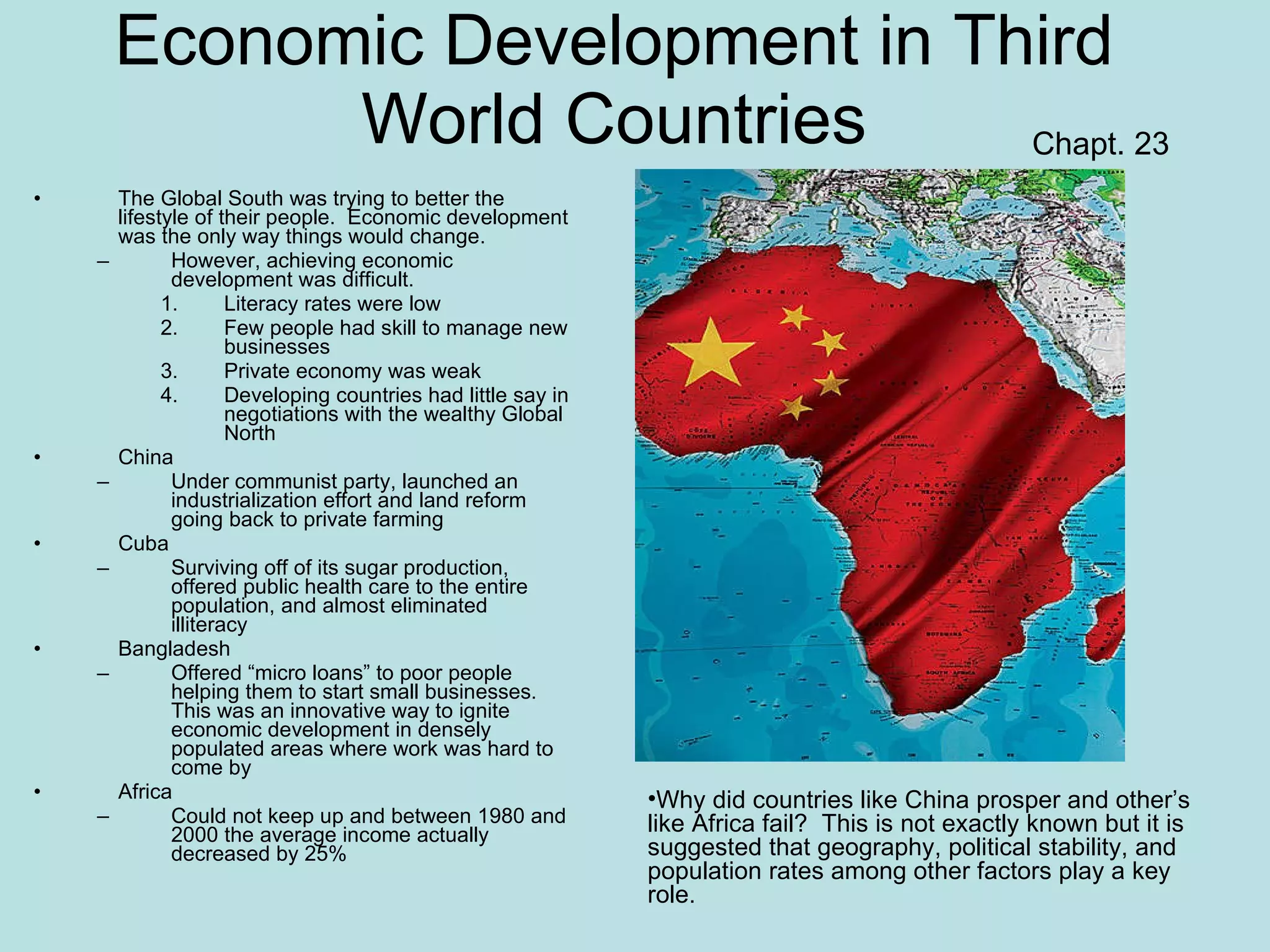
Economic Development in Third World Countries The Global South was trying to better the lifestyle of their people.  Economic development was the only way things would change. However, achieving economic development was difficult. Literacy rates were low Few people had skill to manage new businesses Private economy was weak Developing countries had little say in negotiations with the wealthy Global North China Under communist party, launched an industrialization effort and land reform going back to private farming Cuba Surviving off of its sugar production, offered public health care to the entire population, and almost eliminated illiteracy Bangladesh Offered “micro loans” to poor people helping them to start small businesses.  This was an innovative way to ignite economic development in densely populated areas where work was hard to come by Africa Could not keep up and between 1980 and 2000 the average income actually decreased by 25% Chapt. 23 Why did countries like China prosper and other’s like Africa fail?  This is not exactly known but it is suggested that geography, political stability, and population rates among other factors play a key role.
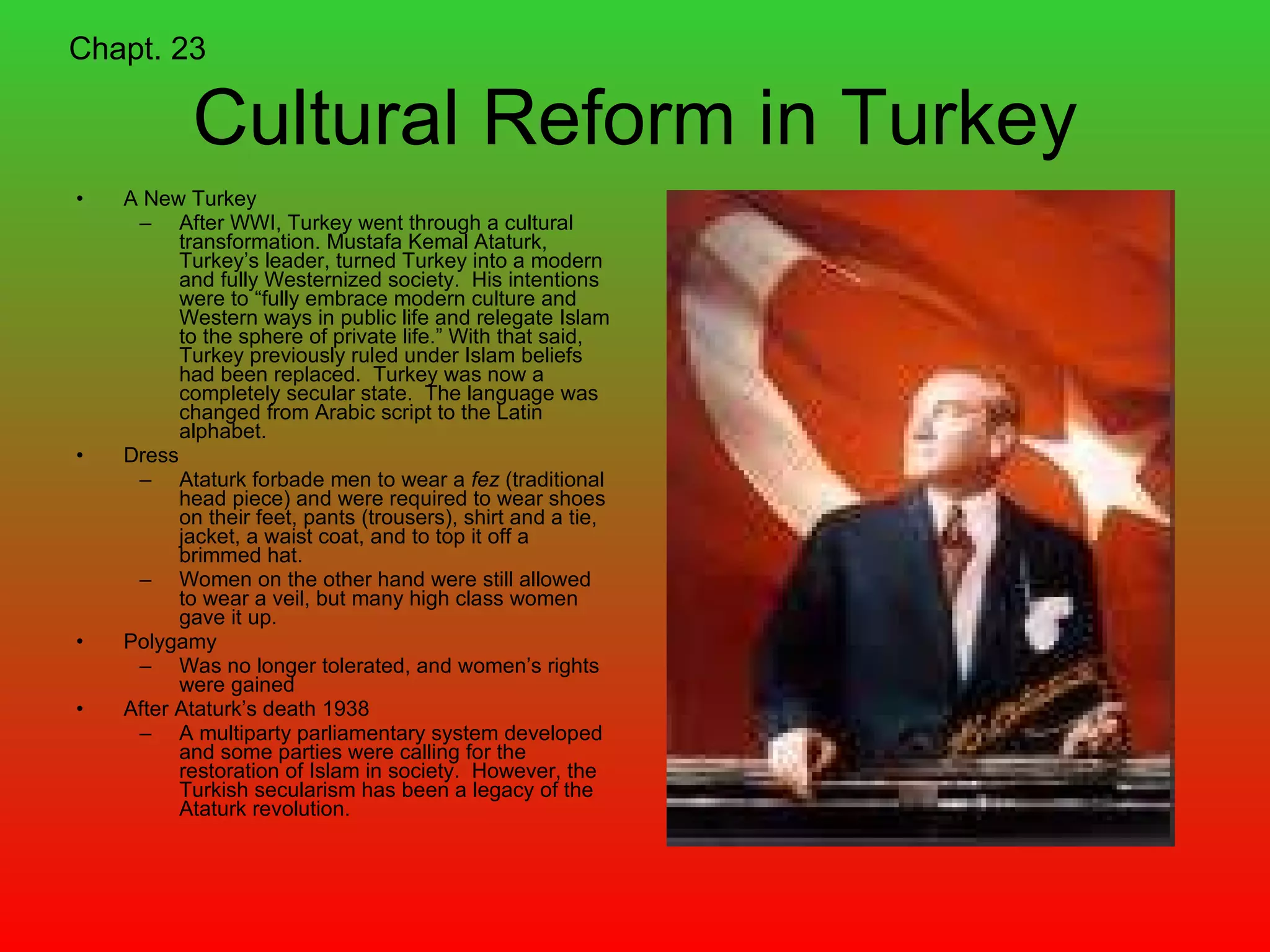
Cultural Reform in Turkey A New Turkey After WWI, Turkey went through a cultural transformation. Mustafa Kemal Ataturk, Turkey’s leader, turned Turkey into a modern and fully Westernized society.  His intentions were to “fully embrace modern culture and Western ways in public life and relegate Islam to the sphere of private life.” With that said, Turkey previously ruled under Islam beliefs had been replaced.  Turkey was now a completely secular state.  The language was changed from Arabic script to the Latin alphabet.  Dress Ataturk forbade men to wear a  fez  (traditional head piece) and were required to wear shoes on their feet, pants (trousers), shirt and a tie, jacket, a waist coat, and to top it off a brimmed hat. Women on the other hand were still allowed to wear a veil, but many high class women gave it up. Polygamy Was no longer tolerated, and women’s rights were gained After Ataturk’s death 1938 A multiparty parliamentary system developed and some parties were calling for the restoration of Islam in society.  However, the Turkish secularism has been a legacy of the Ataturk revolution. Chapt. 23
CHAPTER 24 Globalization Feminism in the West & Global South Religion and Global Modernity
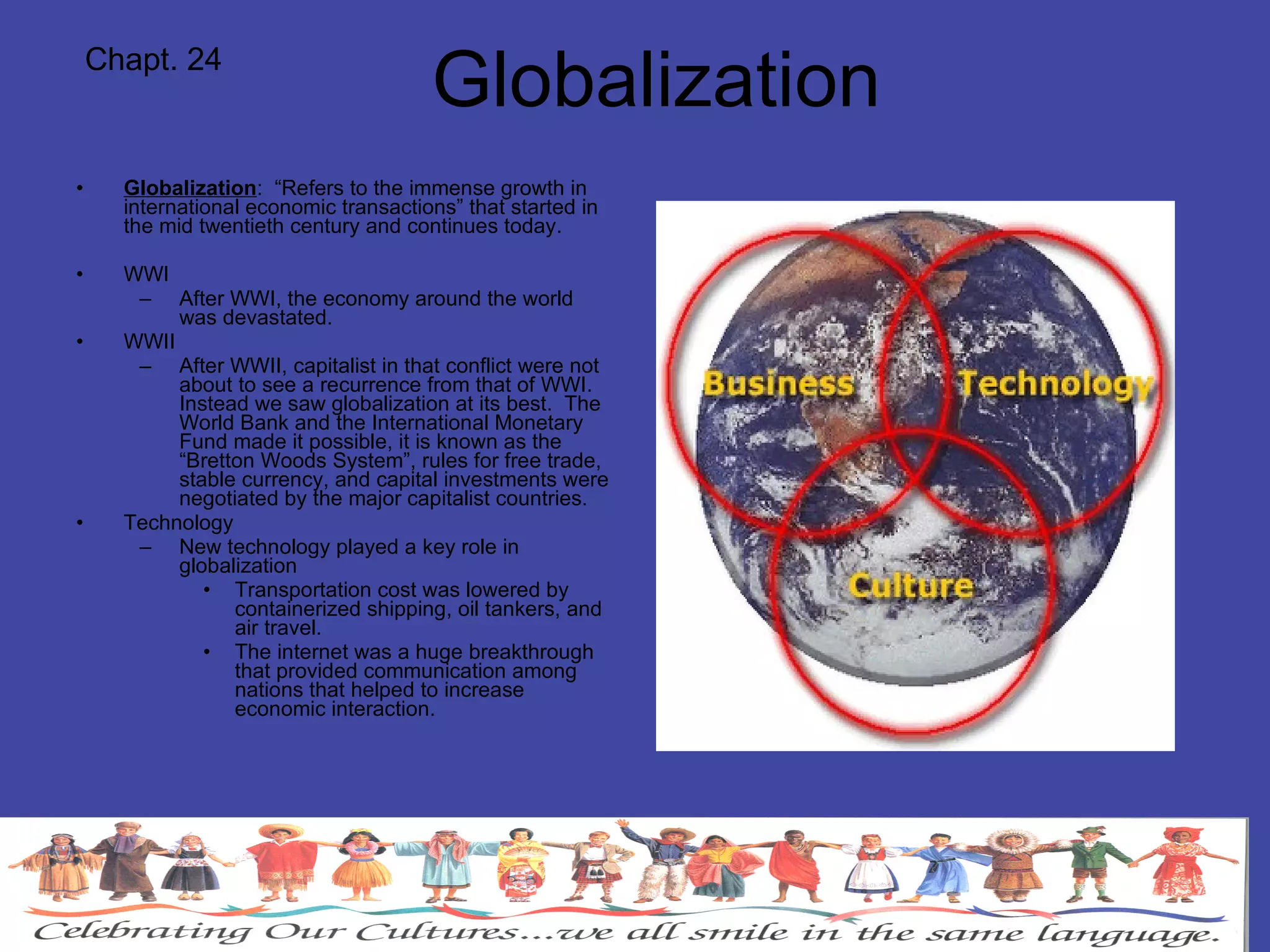
Globalization Globalization :  “Refers to the immense growth in international economic transactions” that started in the mid twentieth century and continues today. WWI After WWI, the economy around the world was devastated. WWII After WWII, capitalist in that conflict were not about to see a recurrence from that of WWI.  Instead we saw globalization at its best.  The World Bank and the International Monetary Fund made it possible, it is known as the “Bretton Woods System”, rules for free trade, stable currency, and capital investments were negotiated by the major capitalist countries. Technology New technology played a key role in globalization Transportation cost was lowered by containerized shipping, oil tankers, and air travel. The internet was a huge breakthrough that provided communication among nations that helped to increase economic interaction. Chapt. 24
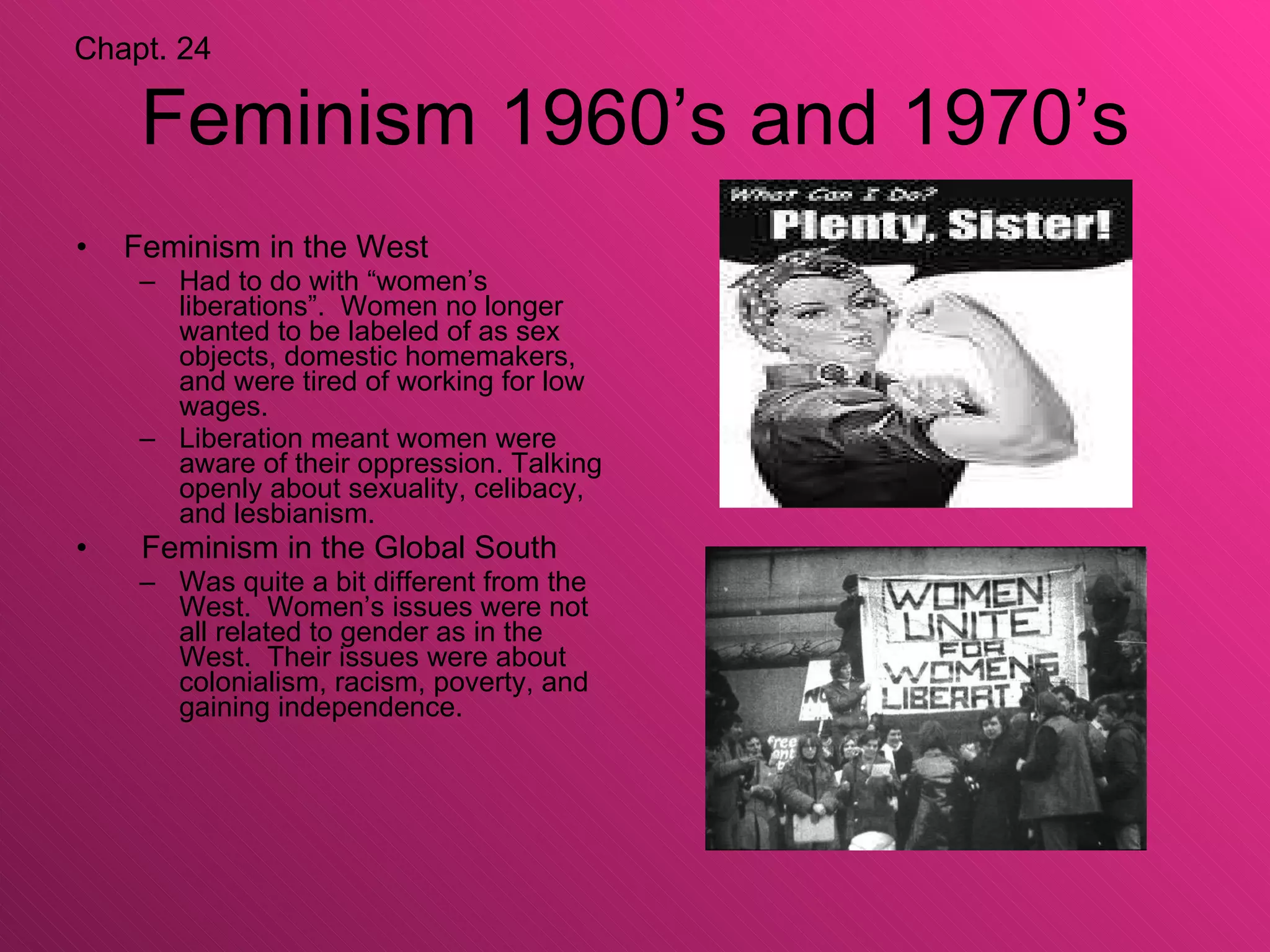
Feminism 1960’s and 1970’s Feminism in the West  Had to do with “women’s liberations”.  Women no longer wanted to be labeled of as sex objects, domestic homemakers, and were tired of working for low wages.  Liberation meant women were aware of their oppression. Talking openly about sexuality, celibacy, and lesbianism.  Feminism in the Global South Was quite a bit different from the West.  Women’s issues were not all related to gender as in the West.  Their issues were about colonialism, racism, poverty, and gaining independence. Chapt. 24
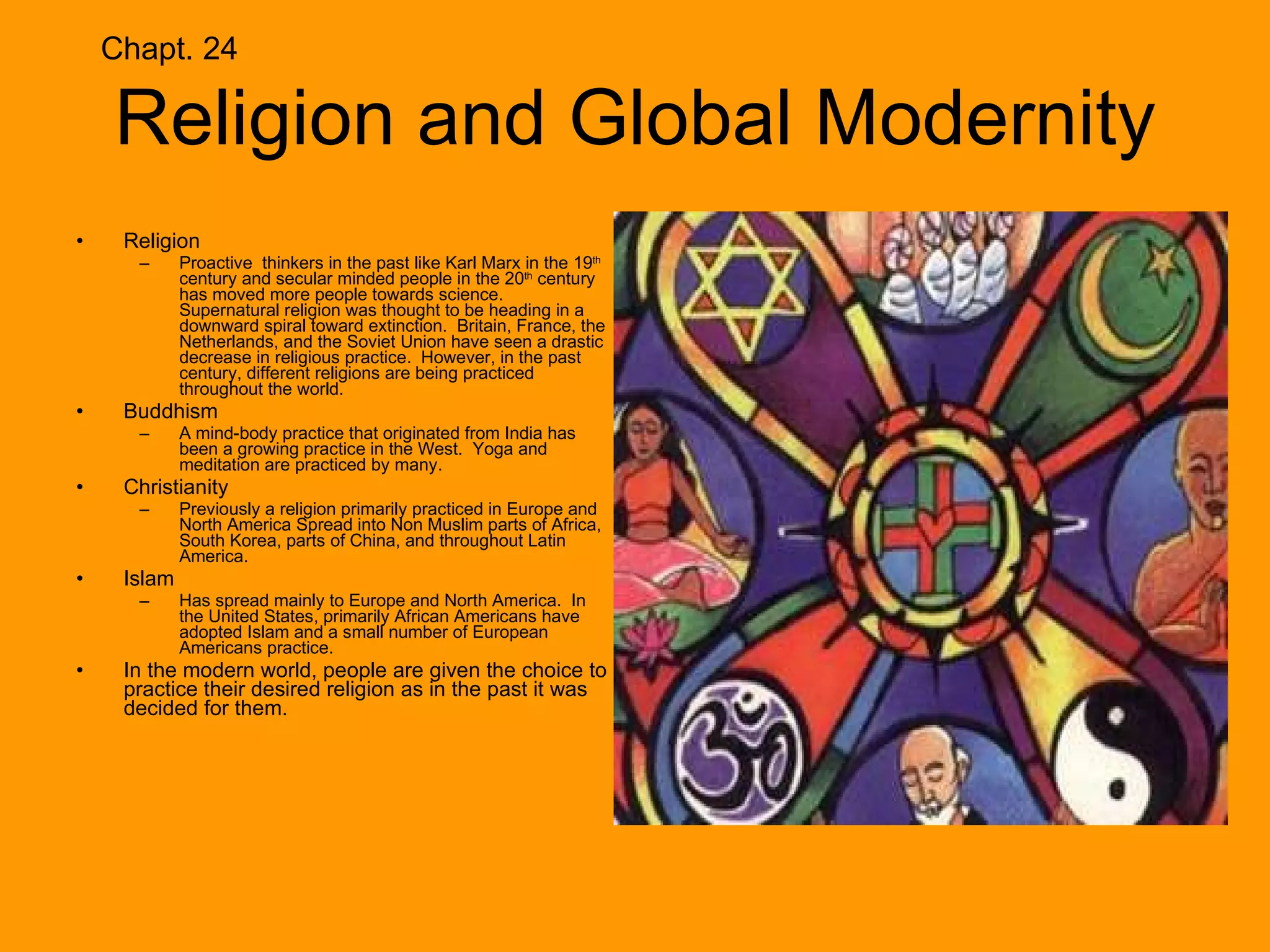
Religion and Global Modernity Religion Proactive  thinkers in the past like Karl Marx in the 19 th  century and secular minded people in the 20 th  century has moved more people towards science.  Supernatural religion was thought to be heading in a downward spiral toward extinction.  Britain, France, the Netherlands, and the Soviet Union have seen a drastic decrease in religious practice.  However, in the past century, different religions are being practiced throughout the world. Buddhism A mind-body practice that originated from India has been a growing practice in the West.  Yoga and meditation are practiced by many. Christianity Previously a religion primarily practiced in Europe and North America Spread into Non Muslim parts of Africa, South Korea, parts of China, and throughout Latin America. Islam Has spread mainly to Europe and North America.  In the United States, primarily African Americans have adopted Islam and a small number of European Americans practice. In the modern world, people are given the choice to practice their desired religion as in the past it was decided for them. Chapt. 24

Ways of the world presentation

  • 1.
    Ways of theWorld Presentation Chapters 17-24 By: Stayce Tate
  • 2.
    CHAPTER 17 AtlanticRevolutions North American Revolution 1775-1787 French Revolution 1789-1815 Haitian Revolution 1791-1804 Spanish-American Revolution 1810-1825
  • 3.
    North American Revolution1775-1787 The North American Revolution was the struggle of independence from British rule The Declaration of Independence in 1776 gave way of the joining of the 13 separate colonies into one single nation What changed? A political change A conservative movement to keep old liberties instead of creating new ones. British communities in North America had a great deal of autonomy from British government. English settlers who lived in these colonies were considered the most radical settlers in the western world. Class distinctions were seen by the wearing of powdered wigs, imitations of European styles, and how involved one was in politics. Land was of abundance This made poverty low More economic opportunities were available to all people (except black slaves) The North American Revolution 1775-1787 Chapt. 17
  • 4.
    French Revolution 1789-1815Similar to the North American Revolution in respects of trying to separate from British rule, but quite different in many other respects. An ancient parliament body was established by King Louis XVI to raise taxes against the “privileged classes”. Three Estates were organized. The 3 rd was the National Assembly, this Estate had complete power to make laws. The Declaration of the Rights of Man and citizen was created that declared “men are born and remain free and equal in rights.” This was illegal in the “old regime” and is the reason for the French Revolution. The French Revolution was all about conflicts with in the French society The privileged and wealthy resented the monarch because of the new tax laws Middle class educated people were offended by the special privileges of the aristocracy from which they could take no part of Urban residents were unhappy about the increase in unemployment, lower wages, and the increase prices in food especially bread. The French Revolution was violent and more radical than the American Revolution The French Revolution spread through conquest under the leader of Napoleon Bonaparte Chapt. 17
  • 5.
    The Haitian Revolution1791-1804 Haiti was regarded as the richest colony in the world. 8,000 plantations produced 40% of the worlds sugar and half of the coffee 50,000 slaves made up the majority of the population Depending on one’s status, the Haitian Revolution meant different things to different people. For rich white land-owners it meant autonomy for the colony and less restrictions on trade For poor whites, it meant equal rights for all white people For the mixed races and black slaves it meant freedom and equal rights for people of color. Both white classes opposed the idea of freeing the black slaves As the word got out that from the French King that blacks would gain personal freedom, anarchy set loose. Many blacks burned plantations, and killed hundreds of whites. Haiti became a place for the first successful slave revolt in the world. Property was divided equally among all people Whites left the land and Haiti became a nation of former slaves who lived off of producing only what was needed for survival. Chapt. 17
  • 6.
    CHAPTER 18 KarlMarx Middle Class Values Latin America After Independence
  • 7.
    Karl Marx A German socialist who spent most of his life in England was concerned with “Class Struggle.” The struggle was between the bourgeoisie, who owned industrial capital, and the proletariat, the industrial working class. Class struggle was the foundation for the industrial capitalist societies. Marx suggested that a capitalist society will never prosper, the rich will remain rich and the poor will remain poor. As unions formed, wages of the working class increased and a middle class was formed, something Marx never considered. Karl Marx is remembered as one of the greatest progressive thinkers in his time. Chapt. 18
  • 8.
    The Middle-Class Duringthe Industrialization, the “middle class” benefited the most. Doctor’s, lawyers, engineers, teachers journalists, scientists, and other professionals made up this class. A middle class citizen was a hard worker, strong morality, and very clean. The culture of the middle class was centered around “respectability” A book by Samuel Smiles titled Self-Help stated that people are responsible for their own destiny. If one would dedicate one hour per day to self improvement it “would make an ignorant man wise in a few years” says Smiles. Women in the middle class families were usually home makers and mothers. Their roles were: To create emotional stability Educate the children how to be “respectable” Manage all of the shopping needs. In the late 19 th century middle class women entered the work force as teachers, nurses, and clerical workers. Chapt. 18
  • 9.
    Latin America AfterIndependence The struggle for independence in Latin America resulted in: Shrinkage in population Shrinkage in livestock Decrease in national trade and investment capital Eighteen separate countries resulted from the four major administrative units (vice-royalties) This created international war Mexico lost vast territories to the United States (1846-1870) Argentina, Brazil, and Uruguay fought Paraguay (1864-1870) Political life was a total mess The Catholic Church owned around half of all productive land. Most of Latin America had abolished slavery by the mid nineteenth century except for Brazil and Cuba. However, all citizens were not treated equally. Businesses, ranches, and plantations were still owned by wealthy whites while the poor blacks, Indians, and mix-raced people lived in poverty laboring on the plantations. Chapt. 18
  • 10.
    CHAPTER 19 IndustrializationChanging Views of Asians and Africans in the 19 th Century British Exports: Opium Japan as a New East Asian Power
  • 11.
    Industrialization Changing EuropeanViews of Asians and Africans in the 19 th Century Industrialization Changed how Europeans viewed Asians & Africans. Prior to the industrialization, Europeans defined others based on Religion Asians & Africans were held in high regards The Industrial revolution changed the way Europeans saw Asians & Africans in the 19 th century. The Europeans “developed secular arrogance that replaced their notions about religious superiority.” Modern Science Europeans used science to support racial differences Measuring the shape & size of the human head was a technique used by physicians, craniologists, & phrenologist to support their theory that whites were a superior race due to their larger skull. Social Darwinism “Survival of the Fittest” Suggested that European dominance was because Europeans were a stronger race. The weak will die when others of a stronger & more robust race compete for the same resources. Chapt. 19
  • 12.
    British Exports: OpiumOpium Wars: Trade in the 19 th Century had changed China & Europe's interactions greatly. Opium was on top of the export list with a value of 17,904,248 (Spanish Dollars) Being used for centuries as drinkable medicine & a “magical cure”, Opium became a problem in the late 18 th Century The British began to grow opium & process it in India to cover trade imbalances with China China’s import of opium was up to 23,000 chests in 1832. Opium was illegal & had to be smuggled in- breaking Chinese law. Many officials became corrupt allowing opium into the country. A serious economic problem Silver was being exported to pay for the opium. As China’s silver supply vanished, China was fronted with economic problems Lack of money was not the only problem. Millions of people became addicted to opium Court debate The decision to ban opium was decided by the emperor in 1836. Chapt. 19
  • 13.
    Japan’s Culture MatthewPerry’s “Black Ships” In 1853, “black ships” from the U.S. came into Tokyo Bay and demanded that Japan became more “normal” and have relations with the world. Japan had a “revolution” and changed its society into a powerful and modern nation. This was considered a miracle since both China and The Ottoman empire could not escape European rule. Japan created its own East Asian Empire By joining imperialist countries, Japan built a society distinctively different from European culture. A few key moments in Japan’s rise in the 19 th Century was due to: Commodore Perry’s “Black Ships” Meiji Restoration Manufacturing and mining Chapt. 19
  • 14.
    CHAPTER 20 ForcedLabor Waged Labor Religion
  • 15.
    Forced Labor ColonialEra- All labor provided for public projects was unpaid French Africa (Reign of Terror) All “natives” were obligated to provide labor for free for 10 to 12 days per year This labor was hard and the natives were treated very badly by the British officials In Congo private companies assigned by the states forced villagers to gather rubber. The villagers went with out food on desperate hunts to collect rubber, if they came back short, the soldiers tortured them. They were shot, their limbs were cut off, and they were tied up & taken away Indonesia Peasants were forced to cultivate sugar/coffee on their land and give 20% of their profits to the state for a tax fee Many were unable to pay this fee and lost their land. This created a large famine among the peasants and hundreds died while the Dutch economy prospered from their crops. Chapt. 20
  • 16.
    Waged Labor Colonialpeople across Asia & Africa Worked in European owned plantations, mines, and construction site. Plantations were full of poverty stricken people from China, India, & Java that came for work and did so in harsh strict conditions They were housed in barracks They were paid low wages The became diseased Many died Mines in Malaysia in 1895 produced 55% of the worlds tin. Originally under Chinese supervision, later fell into the hands of European entrepreneurs. Millions of impoverished Chinese workers singed 3 year contracts. Working conditions here were also harsh Living quarters were “appalling” They became diseased High accident rate equaled high mortality rate Chapt. 20
  • 17.
    Religion Christianity claimedby some 50 million Africans was associated with modern education Gave rise to new opportunities to the poor and the oppressed groups in Africa Christianity in Africa became Africanized As teachers & pastors brought Christianity to the remote villages, the practice of Christianity spread by the European missionaries was not followed, converts in the villages continued using medicine men and protective charms. Christianity in India Made Islam beliefs, practices, rituals, & school of thought stronger. Hinduism and Muslim were in conflict for power. Before Christianity in India, there was little connection between those who practiced Islam After Christianity in India, the Muslims & Hindu's had their own identity and separate laws were created for each group by the British. Chapt. 20
  • 18.
    CHAPTER 21 Legaciesof the Great War After The Great War Hitler
  • 19.
    Legacies of theGreat War Trench Warfare On the western front the war was bogged down. Holes and craters in the road made it hard for travel. Trenches were made for protection, although causalities were still high. Total War Each countries population was mobilized, this gave greater authority to the governments The German state had control over the economy and its policies became known as “war socialism” Women during the Great War Women all around were supportive of their countries war efforts The Great War was a time when women replaced men in the workforce. Women were invited to work in the munitions industry Gave rise to the United States as a Global Power The defeat of Germany and the financial resources turned the United States into Europe's creditor. The League of Nations was developed by Woodrow Wilson and appealed to many, but was not as successful as he intended. U.S. critics feared that Americans would be “forced to bow to the will of other nations”. Chapt. 21
  • 20.
    After the GreatWar Mother’s Day Was established by the French after the war designing a holiday dedicated to women to encourage childbirth to replace the millions of lives lost to the war. Flappers Young women began to gain more independence. Nightclubs were frequent hot spots for young women to dress up in more revealing clothing, often seen smoking and drinking hard liquor, and generally more open with their sexuality. The Great Depression The collapse of Europe’s political system was a warning that an economical collapse was to follow. However, European industrial capitalism expanded, raising the standard of living. A decade after, in 1929 that changed when the stock market crashed literally overnight. Wall Street financiers committed suicide Banks closed and people lost their savings Ordinary people lost jobs Soup kitchens, bread lines, and shantytowns became a reality for many Chapt. 21
  • 21.
    Hitler (1889-1945) Leaderof the Nazi Party Hitler generated a single-party dictatorship. He lead under fear with the use of violence as a way to control his people. Nazi’s achieved national power in 1933 The Weimar Republic was created when the German imperial state collapsed and democratic politicians formed a new government. People were fed up and much animosity was spreading through Germany. Hitler began to receive growing national support. Once in power Hitler suppressed all other political parties He excluded and restricted Jewish life Jews were forced to wear the star of David Chapt. 21
  • 22.
    CHAPTER 22 NuclearWeapons Deng Xiaoping Russia: Revolution in a Single Year
  • 23.
    Nuclear Weapons AfterWWII, the Soviet Union doubled its efforts to acquire nuclear weapons and succeeded in 1949. The world over the next 40 years has become stocked with warheads. One bomb could destroy any major city in an instant. Nuclear weapons stored by the Soviet Union and the United States could damage a country so severely that it would turn into radioactive rubble. Scientist say that the human species could become extinct if there is a detonation. Chapt. 22
  • 24.
    Deng Xiaoping BecameChina’s “Paramount Leader” in 1976, after the death of Mao Xiaoping ended the instability of the Maoist era by his economic reforms. In rural areas, he got rid of collectivized farming went back to small scale agriculture. This helped the impoverished peasants and opened up more opportunities. Managers of state enterprises were given more empowerment. China was now interacting with the world, foreign investments were welcome. The outcome of these reforms created great economic wealth for China. The Chinese people were living better lives Had better diets Lower mortality rates More material belongings “ China took the capitalist road” The Communist Party had restored a capitalist economy Democracy at the national level was not a consideration China and the new millennium China had become a growing economic power with a Communist Party and a capitalist economy it was all tied together with nationalism and consumerism and ancient values replaced socialist values. Chapt. 22
  • 25.
    Russia: Revolution ina Single Year Russia and Communism In the year of 1917, Russia was in bad shape, World War I was not going well for Russia. Many were suffering from wartime shortages. Unhappy civilians protested in the streets, activists from different parties published, posted, and set up demonstrations that plotted revolution. Tsar Nicholas II lost power Tsar Nicholas II was not popular among Russia and he lost almost all support. He was forced to abdicate the throne. The three hundred Romanov dynasty had ended. Russia was in “social upheaval”, soldiers were disappearing in large number. In major cities new trade unions were established, and grassroots organizations were popping The Bolsheviks Led by Vladimir Ulyanov, was a small socialist party Radical groups like the Bolsheviks were originating in Russia after the tsar was abdicated. Russia being led by middle-class politicians was not meeting the needs of Russia’s people and was not willing to take Russia out of the war as many had wanted. This was the start to a social revolution. A three year civil war emerged in which the Bolsheviks were now calling their party “communist” Chapt. 22
  • 26.
    CHAPTER 23 NelsonMandela Economic Development in Third World Countries Culture: In the Global South
  • 27.
    Nelson Mandela SouthAfrica’s first black president In 1994, South Africa held its first election where both whites and blacks were allowed to vote. The outcome of that election in 1994 was a long road in which Mandela was prepared to give up his life in the struggle for a democratic and free society where everyone could live together in harmony. In 1964, Mandela was imprisoned for 27 years with charges for sabotage, treason, and conspiracy to overthrow the apartheid government. He was released from prison in 1990 and continued on his journey for decolonization. Decolonization was the turning point to a declining empire and a new beginning for national freedom, personal growth and a new meaning to dignity. Chapt. 23
  • 28.
    Economic Development inThird World Countries The Global South was trying to better the lifestyle of their people. Economic development was the only way things would change. However, achieving economic development was difficult. Literacy rates were low Few people had skill to manage new businesses Private economy was weak Developing countries had little say in negotiations with the wealthy Global North China Under communist party, launched an industrialization effort and land reform going back to private farming Cuba Surviving off of its sugar production, offered public health care to the entire population, and almost eliminated illiteracy Bangladesh Offered “micro loans” to poor people helping them to start small businesses. This was an innovative way to ignite economic development in densely populated areas where work was hard to come by Africa Could not keep up and between 1980 and 2000 the average income actually decreased by 25% Chapt. 23 Why did countries like China prosper and other’s like Africa fail? This is not exactly known but it is suggested that geography, political stability, and population rates among other factors play a key role.
  • 29.
    Cultural Reform inTurkey A New Turkey After WWI, Turkey went through a cultural transformation. Mustafa Kemal Ataturk, Turkey’s leader, turned Turkey into a modern and fully Westernized society. His intentions were to “fully embrace modern culture and Western ways in public life and relegate Islam to the sphere of private life.” With that said, Turkey previously ruled under Islam beliefs had been replaced. Turkey was now a completely secular state. The language was changed from Arabic script to the Latin alphabet. Dress Ataturk forbade men to wear a fez (traditional head piece) and were required to wear shoes on their feet, pants (trousers), shirt and a tie, jacket, a waist coat, and to top it off a brimmed hat. Women on the other hand were still allowed to wear a veil, but many high class women gave it up. Polygamy Was no longer tolerated, and women’s rights were gained After Ataturk’s death 1938 A multiparty parliamentary system developed and some parties were calling for the restoration of Islam in society. However, the Turkish secularism has been a legacy of the Ataturk revolution. Chapt. 23
  • 30.
    CHAPTER 24 GlobalizationFeminism in the West & Global South Religion and Global Modernity
  • 31.
    Globalization Globalization : “Refers to the immense growth in international economic transactions” that started in the mid twentieth century and continues today. WWI After WWI, the economy around the world was devastated. WWII After WWII, capitalist in that conflict were not about to see a recurrence from that of WWI. Instead we saw globalization at its best. The World Bank and the International Monetary Fund made it possible, it is known as the “Bretton Woods System”, rules for free trade, stable currency, and capital investments were negotiated by the major capitalist countries. Technology New technology played a key role in globalization Transportation cost was lowered by containerized shipping, oil tankers, and air travel. The internet was a huge breakthrough that provided communication among nations that helped to increase economic interaction. Chapt. 24
  • 32.
    Feminism 1960’s and1970’s Feminism in the West Had to do with “women’s liberations”. Women no longer wanted to be labeled of as sex objects, domestic homemakers, and were tired of working for low wages. Liberation meant women were aware of their oppression. Talking openly about sexuality, celibacy, and lesbianism. Feminism in the Global South Was quite a bit different from the West. Women’s issues were not all related to gender as in the West. Their issues were about colonialism, racism, poverty, and gaining independence. Chapt. 24
  • 33.
    Religion and GlobalModernity Religion Proactive thinkers in the past like Karl Marx in the 19 th century and secular minded people in the 20 th century has moved more people towards science. Supernatural religion was thought to be heading in a downward spiral toward extinction. Britain, France, the Netherlands, and the Soviet Union have seen a drastic decrease in religious practice. However, in the past century, different religions are being practiced throughout the world. Buddhism A mind-body practice that originated from India has been a growing practice in the West. Yoga and meditation are practiced by many. Christianity Previously a religion primarily practiced in Europe and North America Spread into Non Muslim parts of Africa, South Korea, parts of China, and throughout Latin America. Islam Has spread mainly to Europe and North America. In the United States, primarily African Americans have adopted Islam and a small number of European Americans practice. In the modern world, people are given the choice to practice their desired religion as in the past it was decided for them. Chapt. 24