Imperialism, Colonialism,
and Resistance (1871-1914)
Imperialism
■“Imperialism” generally refers to the quest
for rights and possessions in other peoples’
lands.
■19th century imperialism meant control by
the West of areas in Africa as well as the
Middle East and Far East, with no
intention of establishing any Western
settlements.
■Europeans brought with them
Westernization and industrialization.
■Imperialism involved the extension
of sovereignty, the opening of
markets, and work of Christian
missionaries.
■For Westerners, imperial success
gave a nation prestige and power.
■Associated with developments in
industrial capitalism.
■Europeans were competing for markets,
new raw materials, and profitable
investments.
■1902, English reformer J. A. Hobson
coined the term “the scramble for Africa.”
New Imperialism
Before European Colonization of Africa in 1880
6
■Hobson believed that
imperialism benefited only the
wealthy class of Western
Europe, who realized high
returns on their investments.
New Imperialism
■The scramble for territory and
authority abroad was an extension
of diplomatic and national rivalries
at home.
■Territories were acquired abroad to
prevent others from gaining an
advantage.
New Imperialism
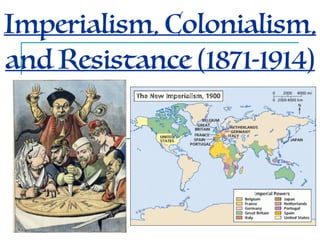
What conclusion can you make from looking at the political cartoon?
■Britain saw rivals abroad,
especially Germany, as threats to
the balance of power in Europe.
■Imperialism was about power and
sovereign states saw imperial power
as a supplement/addition to
national sovereignty.
New Imperialism
Put yourself in the time…
■Read Rudyard Kipling’s “White Man’s Burden”…,
and compare it to Henri Labouchere’s “Brown
Man’s Burden.”
■China turned to reform, adopting
Western diplomacy and aiming to
modernize Chinese armed forces in the
mid 19th century.
■A small number of government schools
taught Western languages, international
law, mathematics, science, and
engineering.
China
■The influence of foreigners,
especially missionaries, provoked a
revolt in 1900.
■Chinese Christians attempted to
use foreign pressure to prohibit
traditional religious celebrations and
favour themselves in land disputes.
China
■This angered farmers and
agricultural labourers in the north.
■Men in this region formed a secret
society called “Boxers,” after a form
of martial arts they practiced.
■Began to kill missionaries and
Chinese converts.
China
■Hundreds of foreigners were
killed in Beijing before an
international military force
reached the capital.
■Known as the Boxer Rebellion.
China
16
■Opium War, Great Britain forced
China to accept trade on its
terms.
■A number of European nations
and the United States established
“treaty ports” in China.
China
18
■The United States, supported by
Britain, proclaimed an “Open Door”
policy in 1899.
■Designed to keep the territorial
integrity of China, while maintaining
concessions; used to prevent Japan and
Russia from annexing Chinese territory.
China
■Chinese were able to maintain their
independence despite Western influence.
■They created their own steamship lines
to compete with British and other
Europeans.
■Introduced Western spinning and
weaving technology and shipped cotton
textiles to the West.
China
■China faced an imperialist
threat from a rapidly
industrializing Japan.
■1894, Japan went to war with
China over disputes regarding
Korea.
China
■Japanese army, trained and supplied in
the Western manner, won easily!
■Known as the Sino-Japanese War
(1894-1895).
■Signed Treaty of Shimoneseki (1895), in
which Japan forced China to cede
Formosa and the Liaotung Peninsula and
recognize Korea as a sovereign state.
China
■Harshness of this treaty
worried Western powers and
made them realize that a new
important rival, and possible
enemy or ally, was on the
scene!
China
■Until the arrival of
Commodore
Matthew Perry in
1853, Japan was
relatively isolated
from the rest of the
world.
Japan
■Using the threat of force, Perry
successfully demanded that the Japanese
government open two ports.
■1854, Americans forces “unequal treaties”
on Japan, which under the Tokugawa
shogunate (military government) was a
decentralized state, unprepared to deal
with the new circumstances.
Japan
26
■Many Japanese demanded the real
government authority be returned to the
emperor.
■Resulted in the Meiji Restoration in 1868.
■Involved rebuilding the Japanese state,
following Western model of centralized,
unitary government.
Japan
■From 1870s to 1890s, the old samurai
military forces of the shogun and daimyo
gave way to European-style imperial army.
■Imperial navy was also created.
■Samurai were replaced in the civil service
by men from new modern schools.
■Education became compulsory for girls
and boys.
Japan
■Japan had a
constitution and
had transformed
itself into an
industrial and
military power.
Japan
■Rather than fall victim to
imperialism, Japan joined the
Western powers as an imperial state.
■After renegotiating the “unequal
treaties” and defeating China in
1894, Japan was recognized by the
West as a major power.
Japan
■Japan became Britain’s ally and defeated
Russia in 1905 in the Russo-Japanese War.
Japan
■Japan also had ambitions on
Manchuria - which clashes with Russia.
■Russia wanted to build railways into
Manchuria and gain concessions in
Korea - Japan considered this part of its
sphere of influence.
■Tried to negotiate, unsuccessfully!
Russo-Japanese War
33
■In 1904, Japan attacked Port
Arthur, Russian base in
Manchuria.
Russo-Japanese War
■Russo Japanese War lasted 16
months (1904-1905).
■Japanese were successful in part
because Russia could not supply
its navy and troops, and because of
Russian military incompetence.
Russo-Japanese War
■Treaty of Portsmouth gave Port
Arthur to Japan and confirmed Japan’s
interests in Korea.
■Marked the first time since the
Renaissance that a non-European state
had defeated a major European power.
■Balance of power had changed!
Russo-Japanese War
■1857-1858, India experienced a large uprising
against the British, led by Muslim and Hindu
sepoys - soldiers trained in European military
tradition - joined by several Indian princes.
■Rebellion was quashed by British, aided by
loyal Indian troops.
■Known as the Sepoy Mutiny by the British.
■Indians call it the Great Rebellion.
India
■Led to India losing its independence.
■The British East India Company no
longer administered the subcontinent,
and India came under control of the
British parliament.
India
■British governed India with a civil
service composed of a small European
elite of about 3500 persons in 1900.
India
■They administered a subcontinent of 300
million people!
■Spoke many different languages.
■Composed of Hindus, Muslims, and
other religions.
■Native princes continued to rule in
accordance with British policy in local
areas.
India
■In 1876, parliament proclaimed Queen
Victoria Empress of India.
■She promised her Indian subjects that all
treaties would be respected, the government
would cease further annexation of territories,
and allow the remaining princes to continue
to choose their heirs (as long as they
acknowledged her as the Empress of India).
India
A British Merchant's Home in Colonial India
■Between 1858 and 1914,
British Raj (means
“rule” in Hindi) became
entrenched in India.
■Goal was to create a
class of Westernized
Indians, through
education.
India
■1885, the Indian National Congress
was formed.
■Concerned with Indianization of the
administration.
■By the mid 1890s, some nationalists
began to criticize the modernization
of the Congress.
India
B.G. Tilak (1856-1920). At
his own life, Tilak
championed the freedom of
the press and demanded
independence from British
rule.
By 1905, Indian Congress
committed itself to the goal
of Indian self-government.
Indian nationalism
challenged both Britain and
the local princes who co-
operated with the British.
■Suez Canal opened in
1869 by the French.
■Came under control
of the English in 1875.
■Control of canal cut
travel time in half!
Partition of Africa
■European’s began to explore further into the
African continent and realized the numerous
economic possibilities of areas like the
Congo.
■To exploit the area, King Leopold II of
Belgium (1865-1909) founded a private
company that gained international
recognition of its sovereignty over the Congo.
Partition of Africa
■France moved into Tunisia,
Morocco, and the area west of the
Belgian Congo.
■Italy moved into the east.
■Germany began to press into areas
in central and southwest Africa in
1884.
Partition of Africa
A Map of Africa (1914), showing the extent of colonization
■1885, Congress of Berlin was called to
deal with the partition and development
of Africa.
■By 1914, ALL of Africa, except Ethiopia
and Liberia, was part of the imperial
spheres of Belgium, England, France,
Germany, Italy, Portugal, or Spain!!!
Partition of Africa
A Map of Africa (1914), showing the extent of colonization
■European states viewed the African
continent as open for business and
exploitation and ripe for missionary activity.
■They had little regard for African society
and culture.
■Strong racial element as European
countries viewed themselves as models for
all civilizations.
Partition of Africa
■Tensions developed not only between
Europeans and Africans, but also
between European nations themselves.
■The area around the Cape of Good
Hope (South Africa) had been colonized
by the Dutch in the 17th century, but
came under British control in 1806.
Partition of Africa
■Dutch settlers, known as Boers
(meaning farmer in Dutch), moved
out of the area when the British
outlawed slavery.
■They established two independent
republics, the Transvaal and the
Orange Free State.
Partition of Africa
■When diamonds were discovered in
these areas in the 1870s and gold in
the 1880s, a large number of British
entered the areas.
■Boers deeply resented new
immigrants and prevented them from
taking part in political life of the area.
Partition of Africa
■1899, British declared war on the
Boers.
■Lasted 3 years and they had to commit
over half a million men to the conflict.
■Ultimately, the Boers were defeated
and the two republics became part of
the British Empire.
Partition of Africa
Boer piquet near Spion Kop, Jan 1900
British dead after the Battle of Spion Kop, 1900

Imperialism

  • 1.
  • 2.
    Imperialism ■“Imperialism” generally refersto the quest for rights and possessions in other peoples’ lands. ■19th century imperialism meant control by the West of areas in Africa as well as the Middle East and Far East, with no intention of establishing any Western settlements.
  • 3.
    ■Europeans brought withthem Westernization and industrialization. ■Imperialism involved the extension of sovereignty, the opening of markets, and work of Christian missionaries. ■For Westerners, imperial success gave a nation prestige and power.
  • 4.
    ■Associated with developmentsin industrial capitalism. ■Europeans were competing for markets, new raw materials, and profitable investments. ■1902, English reformer J. A. Hobson coined the term “the scramble for Africa.” New Imperialism
  • 5.
  • 6.
  • 7.
    ■Hobson believed that imperialismbenefited only the wealthy class of Western Europe, who realized high returns on their investments. New Imperialism
  • 8.
    ■The scramble forterritory and authority abroad was an extension of diplomatic and national rivalries at home. ■Territories were acquired abroad to prevent others from gaining an advantage. New Imperialism
  • 9.
    What conclusion canyou make from looking at the political cartoon?
  • 10.
    ■Britain saw rivalsabroad, especially Germany, as threats to the balance of power in Europe. ■Imperialism was about power and sovereign states saw imperial power as a supplement/addition to national sovereignty. New Imperialism
  • 11.
    Put yourself inthe time… ■Read Rudyard Kipling’s “White Man’s Burden”…, and compare it to Henri Labouchere’s “Brown Man’s Burden.”
  • 12.
    ■China turned toreform, adopting Western diplomacy and aiming to modernize Chinese armed forces in the mid 19th century. ■A small number of government schools taught Western languages, international law, mathematics, science, and engineering. China
  • 13.
    ■The influence offoreigners, especially missionaries, provoked a revolt in 1900. ■Chinese Christians attempted to use foreign pressure to prohibit traditional religious celebrations and favour themselves in land disputes. China
  • 14.
    ■This angered farmersand agricultural labourers in the north. ■Men in this region formed a secret society called “Boxers,” after a form of martial arts they practiced. ■Began to kill missionaries and Chinese converts. China
  • 15.
    ■Hundreds of foreignerswere killed in Beijing before an international military force reached the capital. ■Known as the Boxer Rebellion. China
  • 16.
  • 17.
    ■Opium War, GreatBritain forced China to accept trade on its terms. ■A number of European nations and the United States established “treaty ports” in China. China
  • 18.
  • 19.
    ■The United States,supported by Britain, proclaimed an “Open Door” policy in 1899. ■Designed to keep the territorial integrity of China, while maintaining concessions; used to prevent Japan and Russia from annexing Chinese territory. China
  • 20.
    ■Chinese were ableto maintain their independence despite Western influence. ■They created their own steamship lines to compete with British and other Europeans. ■Introduced Western spinning and weaving technology and shipped cotton textiles to the West. China
  • 21.
    ■China faced animperialist threat from a rapidly industrializing Japan. ■1894, Japan went to war with China over disputes regarding Korea. China
  • 22.
    ■Japanese army, trainedand supplied in the Western manner, won easily! ■Known as the Sino-Japanese War (1894-1895). ■Signed Treaty of Shimoneseki (1895), in which Japan forced China to cede Formosa and the Liaotung Peninsula and recognize Korea as a sovereign state. China
  • 23.
    ■Harshness of thistreaty worried Western powers and made them realize that a new important rival, and possible enemy or ally, was on the scene! China
  • 24.
    ■Until the arrivalof Commodore Matthew Perry in 1853, Japan was relatively isolated from the rest of the world. Japan
  • 25.
    ■Using the threatof force, Perry successfully demanded that the Japanese government open two ports. ■1854, Americans forces “unequal treaties” on Japan, which under the Tokugawa shogunate (military government) was a decentralized state, unprepared to deal with the new circumstances. Japan
  • 26.
  • 27.
    ■Many Japanese demandedthe real government authority be returned to the emperor. ■Resulted in the Meiji Restoration in 1868. ■Involved rebuilding the Japanese state, following Western model of centralized, unitary government. Japan
  • 28.
    ■From 1870s to1890s, the old samurai military forces of the shogun and daimyo gave way to European-style imperial army. ■Imperial navy was also created. ■Samurai were replaced in the civil service by men from new modern schools. ■Education became compulsory for girls and boys. Japan
  • 29.
    ■Japan had a constitutionand had transformed itself into an industrial and military power. Japan
  • 30.
    ■Rather than fallvictim to imperialism, Japan joined the Western powers as an imperial state. ■After renegotiating the “unequal treaties” and defeating China in 1894, Japan was recognized by the West as a major power. Japan
  • 31.
    ■Japan became Britain’sally and defeated Russia in 1905 in the Russo-Japanese War. Japan
  • 32.
    ■Japan also hadambitions on Manchuria - which clashes with Russia. ■Russia wanted to build railways into Manchuria and gain concessions in Korea - Japan considered this part of its sphere of influence. ■Tried to negotiate, unsuccessfully! Russo-Japanese War
  • 33.
  • 34.
    ■In 1904, Japanattacked Port Arthur, Russian base in Manchuria. Russo-Japanese War
  • 35.
    ■Russo Japanese Warlasted 16 months (1904-1905). ■Japanese were successful in part because Russia could not supply its navy and troops, and because of Russian military incompetence. Russo-Japanese War
  • 36.
    ■Treaty of Portsmouthgave Port Arthur to Japan and confirmed Japan’s interests in Korea. ■Marked the first time since the Renaissance that a non-European state had defeated a major European power. ■Balance of power had changed! Russo-Japanese War
  • 37.
    ■1857-1858, India experienceda large uprising against the British, led by Muslim and Hindu sepoys - soldiers trained in European military tradition - joined by several Indian princes. ■Rebellion was quashed by British, aided by loyal Indian troops. ■Known as the Sepoy Mutiny by the British. ■Indians call it the Great Rebellion. India
  • 38.
    ■Led to Indialosing its independence. ■The British East India Company no longer administered the subcontinent, and India came under control of the British parliament. India
  • 39.
    ■British governed Indiawith a civil service composed of a small European elite of about 3500 persons in 1900. India
  • 40.
    ■They administered asubcontinent of 300 million people! ■Spoke many different languages. ■Composed of Hindus, Muslims, and other religions. ■Native princes continued to rule in accordance with British policy in local areas. India
  • 41.
    ■In 1876, parliamentproclaimed Queen Victoria Empress of India. ■She promised her Indian subjects that all treaties would be respected, the government would cease further annexation of territories, and allow the remaining princes to continue to choose their heirs (as long as they acknowledged her as the Empress of India). India
  • 42.
    A British Merchant'sHome in Colonial India
  • 43.
    ■Between 1858 and1914, British Raj (means “rule” in Hindi) became entrenched in India. ■Goal was to create a class of Westernized Indians, through education. India
  • 44.
    ■1885, the IndianNational Congress was formed. ■Concerned with Indianization of the administration. ■By the mid 1890s, some nationalists began to criticize the modernization of the Congress. India
  • 45.
    B.G. Tilak (1856-1920).At his own life, Tilak championed the freedom of the press and demanded independence from British rule. By 1905, Indian Congress committed itself to the goal of Indian self-government. Indian nationalism challenged both Britain and the local princes who co- operated with the British.
  • 46.
    ■Suez Canal openedin 1869 by the French. ■Came under control of the English in 1875. ■Control of canal cut travel time in half! Partition of Africa
  • 47.
    ■European’s began toexplore further into the African continent and realized the numerous economic possibilities of areas like the Congo. ■To exploit the area, King Leopold II of Belgium (1865-1909) founded a private company that gained international recognition of its sovereignty over the Congo. Partition of Africa
  • 48.
    ■France moved intoTunisia, Morocco, and the area west of the Belgian Congo. ■Italy moved into the east. ■Germany began to press into areas in central and southwest Africa in 1884. Partition of Africa
  • 49.
    A Map ofAfrica (1914), showing the extent of colonization
  • 50.
    ■1885, Congress ofBerlin was called to deal with the partition and development of Africa. ■By 1914, ALL of Africa, except Ethiopia and Liberia, was part of the imperial spheres of Belgium, England, France, Germany, Italy, Portugal, or Spain!!! Partition of Africa
  • 51.
    A Map ofAfrica (1914), showing the extent of colonization
  • 52.
    ■European states viewedthe African continent as open for business and exploitation and ripe for missionary activity. ■They had little regard for African society and culture. ■Strong racial element as European countries viewed themselves as models for all civilizations. Partition of Africa
  • 53.
    ■Tensions developed notonly between Europeans and Africans, but also between European nations themselves. ■The area around the Cape of Good Hope (South Africa) had been colonized by the Dutch in the 17th century, but came under British control in 1806. Partition of Africa
  • 54.
    ■Dutch settlers, knownas Boers (meaning farmer in Dutch), moved out of the area when the British outlawed slavery. ■They established two independent republics, the Transvaal and the Orange Free State. Partition of Africa
  • 55.
    ■When diamonds werediscovered in these areas in the 1870s and gold in the 1880s, a large number of British entered the areas. ■Boers deeply resented new immigrants and prevented them from taking part in political life of the area. Partition of Africa
  • 56.
    ■1899, British declaredwar on the Boers. ■Lasted 3 years and they had to commit over half a million men to the conflict. ■Ultimately, the Boers were defeated and the two republics became part of the British Empire. Partition of Africa
  • 57.
    Boer piquet nearSpion Kop, Jan 1900
  • 58.
    British dead afterthe Battle of Spion Kop, 1900