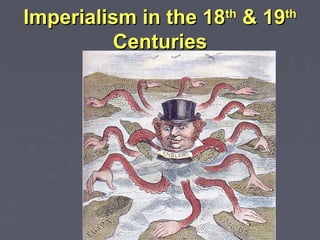
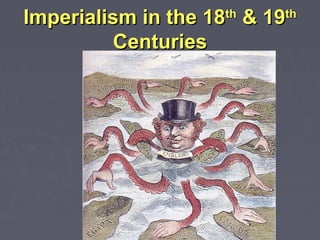
Imperialism in the 18Imperialism in the 18thth
& 19& 19thth
CenturiesCenturies
IMPERIALISM (1770s-1914)IMPERIALISM (1770s-1914)
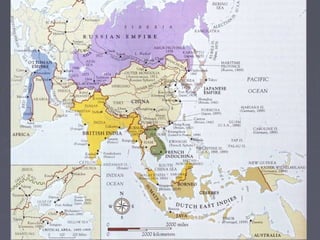
Industrialized nations (nation-Industrialized nations (nation-
states of Europe, U.S., Russia, andstates of Europe, U.S., Russia, and
later Japan) strengthened theirlater Japan) strengthened their
control over their colonies ANDcontrol over their colonies AND
established transoceanic empiresestablished transoceanic empires
throughout Asia, the Pacific, andthroughout Asia, the Pacific, and
Africa.Africa.
Imperialism is this extension ofImperialism is this extension of
political and economic control.political and economic control.
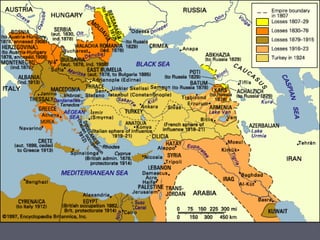
European Colonies - 1700European Colonies - 1700
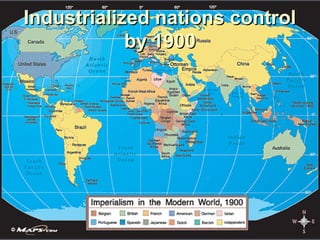
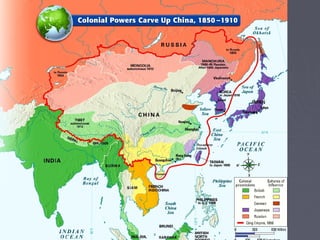
Industrialized nations controlIndustrialized nations control
by 1900by 1900
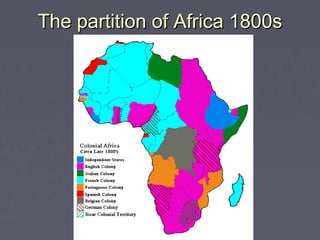
The partition of Africa 1800sThe partition of Africa 1800s
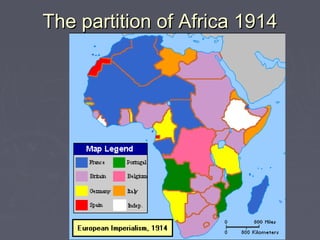
The partition of Africa 1914The partition of Africa 1914
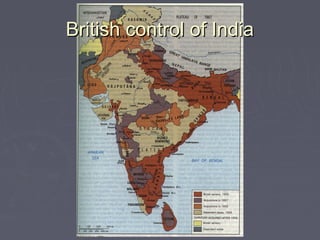
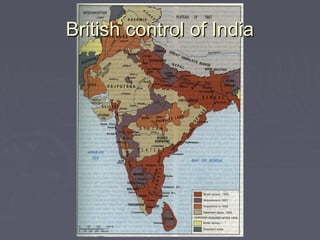
British control of IndiaBritish control of India
The British Empire 19The British Empire 19thth
centurycentury
Imperialism in the 18Imperialism in the 18thth
& 19& 19thth
CenturiesCenturies
WHY did industrializedWHY did industrialized
nations seek to controlnations seek to control
other areas of the world inother areas of the world in
the 18the 18thth
and 19and 19thth
centuries?centuries?
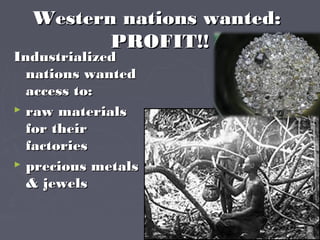
Western nations wanted:Western nations wanted:
PROFIT!!PROFIT!!
IndustrializedIndustrialized
nations wantednations wanted
access to:access to:
 raw materialsraw materials
for theirfor their
factoriesfactories
 precious metalsprecious metals
& jewels& jewels
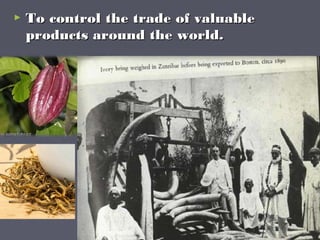
 To control the trade of valuableTo control the trade of valuable
products around the world.products around the world.
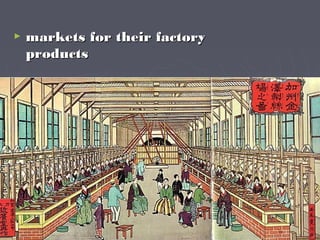
 markets for their factorymarkets for their factory
productsproducts
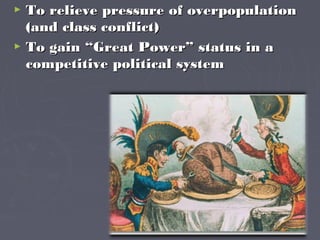
 To relieve pressure of overpopulationTo relieve pressure of overpopulation
(and class conflict)(and class conflict)
 To gain “Great Power” status in aTo gain “Great Power” status in a
competitive political systemcompetitive political system
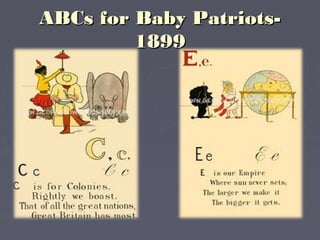
ABCs for Baby Patriots-ABCs for Baby Patriots-
18991899
JUSTIFICATION forJUSTIFICATION for
ImperialismImperialism
 New belief among imperialNew belief among imperial
powers that European (orpowers that European (or
Japanese) races were superiorJapanese) races were superior
(proved by science, progress, &(proved by science, progress, &
religion).religion).
SOCIAL DARWINISMSOCIAL DARWINISM – efforts– efforts
to apply evolution to humanto apply evolution to human
historyhistory
 Missionaries, aid societies, andMissionaries, aid societies, and
others wanted to “Christianize”others wanted to “Christianize”
and/or “civilize” people in “lessand/or “civilize” people in “less
developed” regions.developed” regions.
HOW did Western nations gainHOW did Western nations gain
control over other regions of thecontrol over other regions of the
world?world?
Industrialized nations:Industrialized nations:
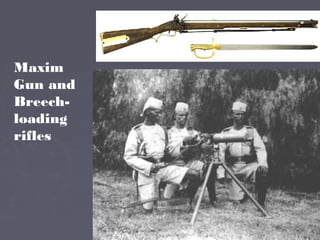
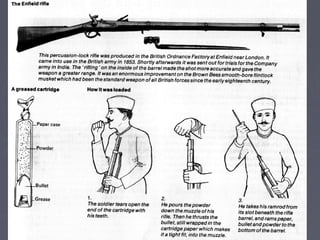
 Used their stronger militariesUsed their stronger militaries
(using superior firepower,(using superior firepower,
military technology, & navies)military technology, & navies)
Maxim
Gun and
Breech-
loading
rifles
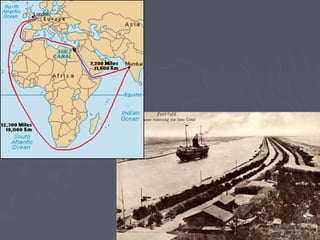
SteamSteam
PoweredPowered
TransportationTransportation
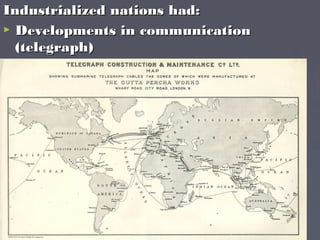
Industrialized nations had:Industrialized nations had:
 Developments in communicationDevelopments in communication
(telegraph)(telegraph)
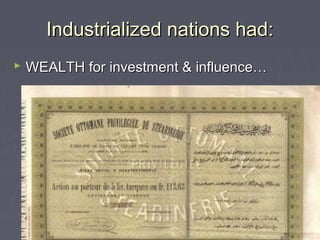
Industrialized nations had:Industrialized nations had:
 WEALTH for investment & influence…WEALTH for investment & influence…
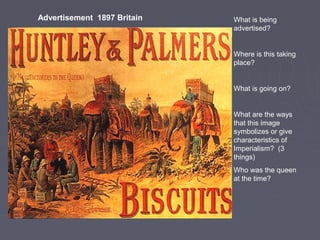
What is being
advertised?
Where is this taking
place?
What is going on?
What are the ways
that this image
symbolizes or give
characteristics of
Imperialism? (3
things)
Who was the queen
at the time?
Advertisement 1897 Britain
Scramble for AfricaScramble for Africa
 By 1914, 90% of Africa was underBy 1914, 90% of Africa was under
European controlEuropean control
 Berlin Conference in 1885 set theBerlin Conference in 1885 set the
ground rules for Europeanground rules for European
colonization of Africacolonization of Africa
 Africans in decentralized societies w/Africans in decentralized societies w/
no formal state structure held out theno formal state structure held out the
longest against European conquestlongest against European conquest
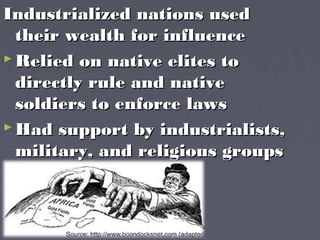
Industrialized nations usedIndustrialized nations used
their wealth for influencetheir wealth for influence
 Relied on native elites toRelied on native elites to
directly rule and nativedirectly rule and native
soldiers to enforce lawssoldiers to enforce laws
 Had support by industrialists,Had support by industrialists,
military, and religious groupsmilitary, and religious groups
Industrialized nations had:Industrialized nations had:
 Medicines and medical technologyMedicines and medical technology
 Quinine protected from malariaQuinine protected from malaria
•By 1910, 10,000
missionaries in
Africa
•By the 1960s, 50
million Africans
were Christian
The partition of Africa 1800sThe partition of Africa 1800s
The partition of Africa 1914The partition of Africa 1914
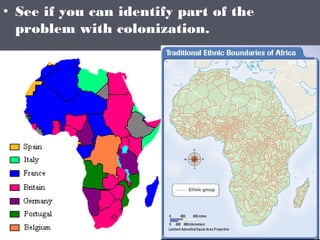
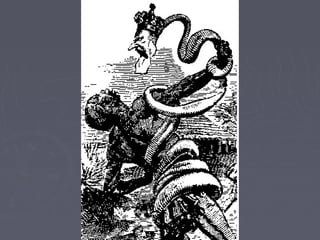
• See if you can identify part of the
problem with colonization.
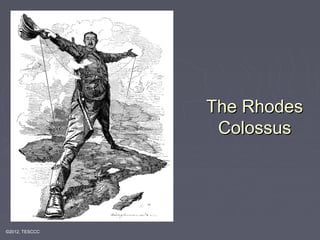
The RhodesThe Rhodes
ColossusColossus
©2012, TESCCC
Consequences of the ScrambleConsequences of the Scramble
for Africafor Africa
 Traditional way of life disruptedTraditional way of life disrupted
 Economic exploitation of AfricansEconomic exploitation of Africans
 European racism imported intoEuropean racism imported into
AfricaAfrica
 Spread of European cultureSpread of European culture
(education and religion)(education and religion)
 Spread of Western technologySpread of Western technology
 Change in women’s rolesChange in women’s roles
Largest colonial empireLargest colonial empire
Great Britain (UnitedGreat Britain (United
Kingdom)Kingdom)
Includes England, Scotland, Wales, IrelandIncludes England, Scotland, Wales, Ireland
““White” ColoniesWhite” Colonies
Canada, Australia, New Zealand, SouthCanada, Australia, New Zealand, South
AfricaAfrica
 Populated mainly by people that movedPopulated mainly by people that moved
there from Britainthere from Britain
 Given self-ruleGiven self-rule
Largest colonial empireLargest colonial empire
Great Britain (UnitedGreat Britain (United
Kingdom)Kingdom)
Includes England, Scotland, Wales, IrelandIncludes England, Scotland, Wales, Ireland
““Non-white” Colonies in India & AfricaNon-white” Colonies in India & Africa
 Under indirect ruleUnder indirect rule
 Populated mainly by people who are native toPopulated mainly by people who are native to
the areathe area
 Few people from Britain actually live there – butFew people from Britain actually live there – but
control the governmentcontrol the government
British control of IndiaBritish control of India
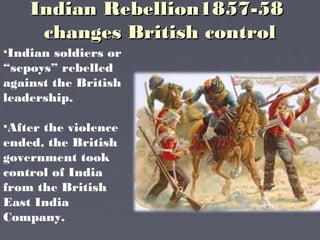
Indian Rebellion1857-58Indian Rebellion1857-58
changes British controlchanges British control
•Indian soldiers or
“sepoys” rebelled
against the British
leadership.
•After the violence
ended, the British
government took
control of India
from the British
East India
Company.
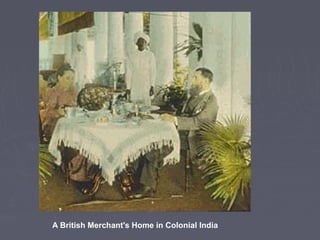
A British Merchant's Home in Colonial India
Consequences of BritishConsequences of British
Imperialism in IndiaImperialism in India
 British educational system establishedBritish educational system established
 Rise of educated Indian middle classRise of educated Indian middle class
-eventually politically active-eventually politically active
 Hinduism more “defined”Hinduism more “defined”
 Spread of English languageSpread of English language
 Railroads tied India togetherRailroads tied India together
Question of the DayQuestion of the Day
 What was distinctive about EuropeanWhat was distinctive about European
colonial empires of the nineteenth centurycolonial empires of the nineteenth century
(as opposed to earlier empires in history)?(as opposed to earlier empires in history)?

Imperialism 1750-1900

  • 1.
    Imperialism in the18Imperialism in the 18thth & 19& 19thth CenturiesCenturies
  • 2.
    IMPERIALISM (1770s-1914)IMPERIALISM (1770s-1914) Industrializednations (nation-Industrialized nations (nation- states of Europe, U.S., Russia, andstates of Europe, U.S., Russia, and later Japan) strengthened theirlater Japan) strengthened their control over their colonies ANDcontrol over their colonies AND established transoceanic empiresestablished transoceanic empires throughout Asia, the Pacific, andthroughout Asia, the Pacific, and Africa.Africa. Imperialism is this extension ofImperialism is this extension of political and economic control.political and economic control.
  • 3.
    European Colonies -1700European Colonies - 1700
  • 4.
    Industrialized nations controlIndustrializednations control by 1900by 1900
  • 7.
    The partition ofAfrica 1800sThe partition of Africa 1800s
  • 8.
    The partition ofAfrica 1914The partition of Africa 1914
  • 9.
    British control ofIndiaBritish control of India
  • 10.
    The British Empire19The British Empire 19thth centurycentury
  • 11.
    Imperialism in the18Imperialism in the 18thth & 19& 19thth CenturiesCenturies
  • 12.
    WHY did industrializedWHYdid industrialized nations seek to controlnations seek to control other areas of the world inother areas of the world in the 18the 18thth and 19and 19thth centuries?centuries?
  • 13.
    Western nations wanted:Westernnations wanted: PROFIT!!PROFIT!! IndustrializedIndustrialized nations wantednations wanted access to:access to:  raw materialsraw materials for theirfor their factoriesfactories  precious metalsprecious metals & jewels& jewels
  • 14.
     To controlthe trade of valuableTo control the trade of valuable products around the world.products around the world.
  • 15.
     markets fortheir factorymarkets for their factory productsproducts
  • 16.
     To relievepressure of overpopulationTo relieve pressure of overpopulation (and class conflict)(and class conflict)  To gain “Great Power” status in aTo gain “Great Power” status in a competitive political systemcompetitive political system
  • 17.
    ABCs for BabyPatriots-ABCs for Baby Patriots- 18991899
  • 18.
    JUSTIFICATION forJUSTIFICATION for ImperialismImperialism New belief among imperialNew belief among imperial powers that European (orpowers that European (or Japanese) races were superiorJapanese) races were superior (proved by science, progress, &(proved by science, progress, & religion).religion).
  • 19.
    SOCIAL DARWINISMSOCIAL DARWINISM– efforts– efforts to apply evolution to humanto apply evolution to human historyhistory
  • 20.
     Missionaries, aidsocieties, andMissionaries, aid societies, and others wanted to “Christianize”others wanted to “Christianize” and/or “civilize” people in “lessand/or “civilize” people in “less developed” regions.developed” regions.
  • 22.
    HOW did Westernnations gainHOW did Western nations gain control over other regions of thecontrol over other regions of the world?world? Industrialized nations:Industrialized nations:  Used their stronger militariesUsed their stronger militaries (using superior firepower,(using superior firepower, military technology, & navies)military technology, & navies)
  • 23.
  • 24.
  • 26.
    Industrialized nations had:Industrializednations had:  Developments in communicationDevelopments in communication (telegraph)(telegraph)
  • 27.
    Industrialized nations had:Industrializednations had:  WEALTH for investment & influence…WEALTH for investment & influence…
  • 30.
    What is being advertised? Whereis this taking place? What is going on? What are the ways that this image symbolizes or give characteristics of Imperialism? (3 things) Who was the queen at the time? Advertisement 1897 Britain
  • 31.
    Scramble for AfricaScramblefor Africa  By 1914, 90% of Africa was underBy 1914, 90% of Africa was under European controlEuropean control  Berlin Conference in 1885 set theBerlin Conference in 1885 set the ground rules for Europeanground rules for European colonization of Africacolonization of Africa  Africans in decentralized societies w/Africans in decentralized societies w/ no formal state structure held out theno formal state structure held out the longest against European conquestlongest against European conquest
  • 32.
    Industrialized nations usedIndustrializednations used their wealth for influencetheir wealth for influence  Relied on native elites toRelied on native elites to directly rule and nativedirectly rule and native soldiers to enforce lawssoldiers to enforce laws  Had support by industrialists,Had support by industrialists, military, and religious groupsmilitary, and religious groups
  • 34.
    Industrialized nations had:Industrializednations had:  Medicines and medical technologyMedicines and medical technology  Quinine protected from malariaQuinine protected from malaria
  • 35.
    •By 1910, 10,000 missionariesin Africa •By the 1960s, 50 million Africans were Christian
  • 36.
    The partition ofAfrica 1800sThe partition of Africa 1800s
  • 37.
    The partition ofAfrica 1914The partition of Africa 1914
  • 38.
    • See ifyou can identify part of the problem with colonization.
  • 39.
  • 41.
    Consequences of theScrambleConsequences of the Scramble for Africafor Africa  Traditional way of life disruptedTraditional way of life disrupted  Economic exploitation of AfricansEconomic exploitation of Africans  European racism imported intoEuropean racism imported into AfricaAfrica  Spread of European cultureSpread of European culture (education and religion)(education and religion)  Spread of Western technologySpread of Western technology  Change in women’s rolesChange in women’s roles
  • 42.
    Largest colonial empireLargestcolonial empire Great Britain (UnitedGreat Britain (United Kingdom)Kingdom) Includes England, Scotland, Wales, IrelandIncludes England, Scotland, Wales, Ireland ““White” ColoniesWhite” Colonies Canada, Australia, New Zealand, SouthCanada, Australia, New Zealand, South AfricaAfrica  Populated mainly by people that movedPopulated mainly by people that moved there from Britainthere from Britain  Given self-ruleGiven self-rule
  • 43.
    Largest colonial empireLargestcolonial empire Great Britain (UnitedGreat Britain (United Kingdom)Kingdom) Includes England, Scotland, Wales, IrelandIncludes England, Scotland, Wales, Ireland ““Non-white” Colonies in India & AfricaNon-white” Colonies in India & Africa  Under indirect ruleUnder indirect rule  Populated mainly by people who are native toPopulated mainly by people who are native to the areathe area  Few people from Britain actually live there – butFew people from Britain actually live there – but control the governmentcontrol the government
  • 44.
    British control ofIndiaBritish control of India
  • 45.
    Indian Rebellion1857-58Indian Rebellion1857-58 changesBritish controlchanges British control •Indian soldiers or “sepoys” rebelled against the British leadership. •After the violence ended, the British government took control of India from the British East India Company.
  • 47.
    A British Merchant'sHome in Colonial India
  • 48.
    Consequences of BritishConsequencesof British Imperialism in IndiaImperialism in India  British educational system establishedBritish educational system established  Rise of educated Indian middle classRise of educated Indian middle class -eventually politically active-eventually politically active  Hinduism more “defined”Hinduism more “defined”  Spread of English languageSpread of English language  Railroads tied India togetherRailroads tied India together
  • 49.
    Question of theDayQuestion of the Day  What was distinctive about EuropeanWhat was distinctive about European colonial empires of the nineteenth centurycolonial empires of the nineteenth century (as opposed to earlier empires in history)?(as opposed to earlier empires in history)?

Editor's Notes

  • #40 The Rhodes Colossus (1892). Caricature of Cecil John Rhodes, after he announced plans for a telegraph line and railroad from Cape Town to Cairo.