Imperialism 1800-1914
AP Euro Bellringer Define… Imperialism New Imperialism (Chapter 25)
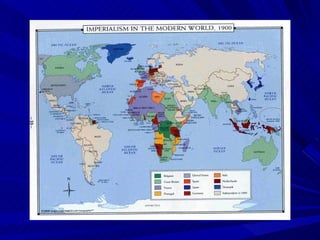
New Imperialism and Its Causes Domination by one country of the political, economic, or cultural life of another country or region. Economic interests Manufacturers need access to natural resources (petroleum, rubber, manganese for steel, palm oil for machinery) Need market to sell factory goods
Rationale for Imperialism Political and military interests Rise of nationalism  “ we’re SO better than YOU”  land = prestige
Rationale for Imperialism Humanitarian Goals Westerners feel concern for the “savages” beyond the seas Missionaries, doctors, colonial officials, etc,  want to spread blessings of Western civilization; including medicine, law, and Christian religion
Rationale for Imperialism Social Darwinism Racial superiority European races are superior imperial conquest and destruction of weaker races were nature’s way of improving the human species
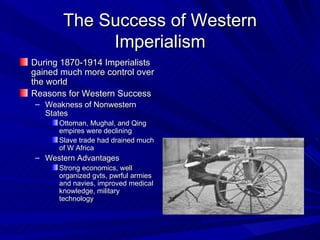
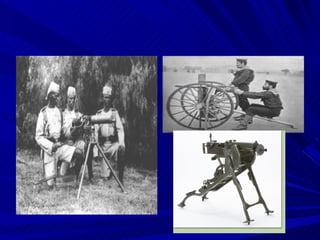
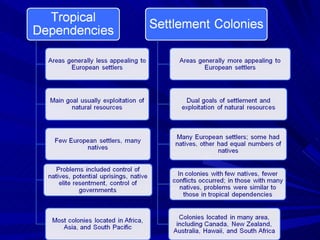
The Success of Western Imperialism During 1870-1914 Imperialists gained much more control over the world Reasons for Western Success Weakness of Nonwestern States Ottoman, Mughal, and Qing empires were declining Slave trade had drained much of W Africa Western Advantages Strong economics, well organized gvts, pwrful armies and navies, improved medical knowledge, military technology
 
Resistance Asians and Africans often resisted domination and fought back Criticism at Home Imperialism immoral? Imperialism hypocritical?  Democracy v. imposition of power
Forms of Imperial Rule Colonies France – use direct rule Sends officials and soldiers from France to administer Goal?  Impose French culture on colonies and then into French provinces Britain – use indirect rule Use sultans, chiefs/local rulers, etc Encourage children of rulers to get education in Britain (to groom a new Westernized generation of leaders)
Protectorates Local rulers were left in place, but were expected to follow the advice of European advisers  (Puppet and satellite relationship) Spheres of Influence Outside power claims exclusive investment/trading privileges with an area (US claims Latin Am.)
 
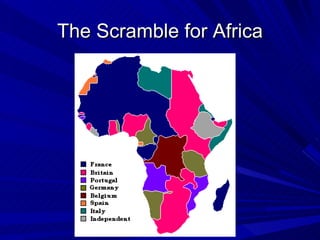
http://www.historydudes.com/news/wp-content/uploads/2008/10/scramble_for_africa.jpg
The Scramble for Africa
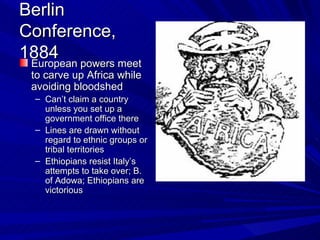
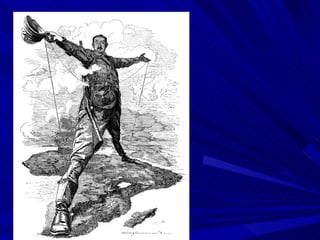
Berlin Conference, 1884 European powers meet to carve up Africa while avoiding bloodshed Can’t claim a country unless you set up a government office there Lines are drawn without regard to ethnic groups or tribal territories Ethiopians resist Italy’s attempts to take over; B. of Adowa; Ethiopians are victorious
 
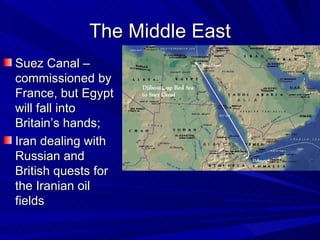
The Middle East Suez Canal – commissioned by France, but Egypt will fall into Britain’s hands;  Iran dealing with Russian and British quests for the Iranian oil fields
 
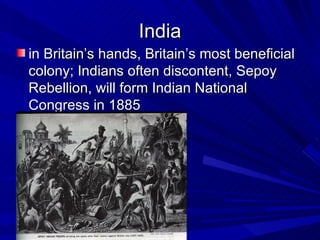
India in Britain’s hands, Britain’s most beneficial colony; Indians often discontent, Sepoy Rebellion, will form Indian National Congress in 1885
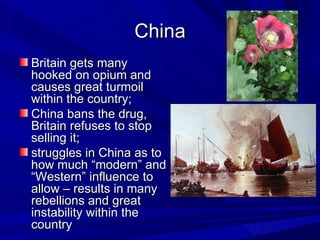
China Britain gets many hooked on opium and causes great turmoil within the country;  China bans the drug, Britain refuses to stop selling it;  struggles in China as to how much “modern” and “Western” influence to allow – results in many rebellions and great instability within the country
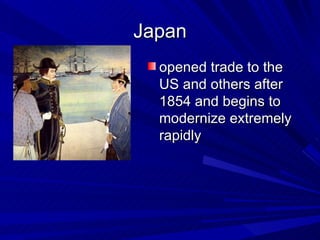
Japan opened trade to the US and others after 1854 and begins to modernize extremely rapidly
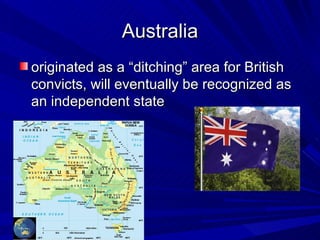
Australia originated as a “ditching” area for British convicts, will eventually be recognized as an independent state
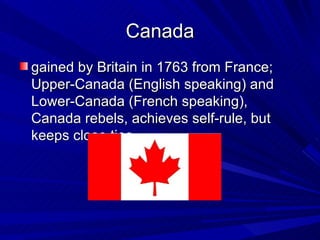
Canada gained by Britain in 1763 from France; Upper-Canada (English speaking) and Lower-Canada (French speaking), Canada rebels, achieves self-rule, but keeps close ties
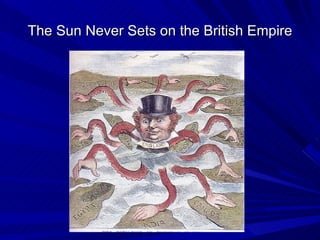
The Sun Never Sets on the British Empire
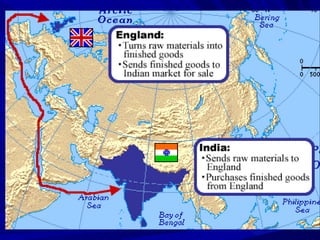
Long Term Effects of Imperialism Age of Imperialism = emergence of a global economy Industrial nations benefit (US, Germ. Brit, and Fr.) Less-developed nations provide agricultural goods, raw materials, and cheap labor (Asia, Africa, Latin Am)
New Economic Patterns Money Economy  Barter system replaced by money economy Economic Dependency (depend on industrial nations products) Also known as – economic subjugation Modernization Modern banking system Transportation networks Railroads! Canals!
Cultural Impact Westernization – gvt, ideas, technology, and culture Resented or embraced?  Schools and Hospitals –  Built by missionaries Taught literacy Introduced vaccines and hygiene  Religion Missionaries and Christian faith Impact on Western Culture  New foods, art, architecture, sculptors, etc
Political Effects Early 1900’s – Africa and Asia – Western educated elites begin organizing nationalist movements to end colonial rule Competition between industrial nations=extra tension
 

Imperialism

  • 1.
  • 2.
    AP Euro BellringerDefine… Imperialism New Imperialism (Chapter 25)
  • 3.
    New Imperialism andIts Causes Domination by one country of the political, economic, or cultural life of another country or region. Economic interests Manufacturers need access to natural resources (petroleum, rubber, manganese for steel, palm oil for machinery) Need market to sell factory goods
  • 4.
    Rationale for ImperialismPolitical and military interests Rise of nationalism “ we’re SO better than YOU” land = prestige
  • 5.
    Rationale for ImperialismHumanitarian Goals Westerners feel concern for the “savages” beyond the seas Missionaries, doctors, colonial officials, etc, want to spread blessings of Western civilization; including medicine, law, and Christian religion
  • 6.
    Rationale for ImperialismSocial Darwinism Racial superiority European races are superior imperial conquest and destruction of weaker races were nature’s way of improving the human species
  • 7.
    The Success ofWestern Imperialism During 1870-1914 Imperialists gained much more control over the world Reasons for Western Success Weakness of Nonwestern States Ottoman, Mughal, and Qing empires were declining Slave trade had drained much of W Africa Western Advantages Strong economics, well organized gvts, pwrful armies and navies, improved medical knowledge, military technology
  • 8.
  • 9.
    Resistance Asians andAfricans often resisted domination and fought back Criticism at Home Imperialism immoral? Imperialism hypocritical? Democracy v. imposition of power
  • 10.
    Forms of ImperialRule Colonies France – use direct rule Sends officials and soldiers from France to administer Goal? Impose French culture on colonies and then into French provinces Britain – use indirect rule Use sultans, chiefs/local rulers, etc Encourage children of rulers to get education in Britain (to groom a new Westernized generation of leaders)
  • 11.
    Protectorates Local rulerswere left in place, but were expected to follow the advice of European advisers (Puppet and satellite relationship) Spheres of Influence Outside power claims exclusive investment/trading privileges with an area (US claims Latin Am.)
  • 12.
  • 13.
  • 14.
  • 15.
    Berlin Conference, 1884European powers meet to carve up Africa while avoiding bloodshed Can’t claim a country unless you set up a government office there Lines are drawn without regard to ethnic groups or tribal territories Ethiopians resist Italy’s attempts to take over; B. of Adowa; Ethiopians are victorious
  • 16.
  • 17.
    The Middle EastSuez Canal – commissioned by France, but Egypt will fall into Britain’s hands; Iran dealing with Russian and British quests for the Iranian oil fields
  • 18.
  • 19.
    India in Britain’shands, Britain’s most beneficial colony; Indians often discontent, Sepoy Rebellion, will form Indian National Congress in 1885
  • 20.
    China Britain getsmany hooked on opium and causes great turmoil within the country; China bans the drug, Britain refuses to stop selling it; struggles in China as to how much “modern” and “Western” influence to allow – results in many rebellions and great instability within the country
  • 21.
    Japan opened tradeto the US and others after 1854 and begins to modernize extremely rapidly
  • 22.
    Australia originated asa “ditching” area for British convicts, will eventually be recognized as an independent state
  • 23.
    Canada gained byBritain in 1763 from France; Upper-Canada (English speaking) and Lower-Canada (French speaking), Canada rebels, achieves self-rule, but keeps close ties
  • 24.
    The Sun NeverSets on the British Empire
  • 25.
    Long Term Effectsof Imperialism Age of Imperialism = emergence of a global economy Industrial nations benefit (US, Germ. Brit, and Fr.) Less-developed nations provide agricultural goods, raw materials, and cheap labor (Asia, Africa, Latin Am)
  • 26.
    New Economic PatternsMoney Economy Barter system replaced by money economy Economic Dependency (depend on industrial nations products) Also known as – economic subjugation Modernization Modern banking system Transportation networks Railroads! Canals!
  • 27.
    Cultural Impact Westernization– gvt, ideas, technology, and culture Resented or embraced? Schools and Hospitals – Built by missionaries Taught literacy Introduced vaccines and hygiene Religion Missionaries and Christian faith Impact on Western Culture New foods, art, architecture, sculptors, etc
  • 28.
    Political Effects Early1900’s – Africa and Asia – Western educated elites begin organizing nationalist movements to end colonial rule Competition between industrial nations=extra tension
  • 29.