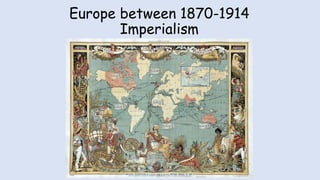
Europe between 1870-1914
Imperialism
Politics and international relations
between 1870-1914
The world in the third half
of the 19th century
• In 1871, Germany had completed its
unification. William I was the emperor,
and Otto von Bismarck his chancellor.
With William II (1888-1918), Germany
became a leading country in Europe.
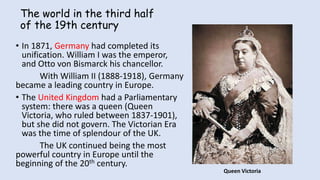
• The United Kingdom had a Parliamentary
system: there was a queen (Queen
Victoria, who ruled between 1837-1901),
but she did not govern. The Victorian Era
was the time of splendour of the UK.
The UK continued being the most
powerful country in Europe until the
beginning of the 20th century.
Queen Victoria
• France remained as a strong country
even after its defeat against Prussia in
Sedan (1870). It was a republic after
1871, and it had a democratic
Parliamentary system.
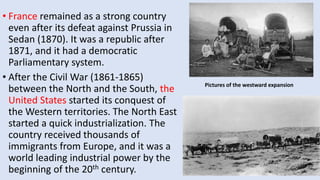
• After the Civil War (1861-1865)
between the North and the South, the
United States started its conquest of
the Western territories. The North East
started a quick industrialization. The
country received thousands of
immigrants from Europe, and it was a
world leading industrial power by the
beginning of the 20th century.
Pictures of the westward expansion
The autocratic systems
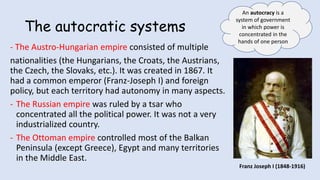
- The Austro-Hungarian empire consisted of multiple
nationalities (the Hungarians, the Croats, the Austrians,
the Czech, the Slovaks, etc.). It was created in 1867. It
had a common emperor (Franz-Joseph I) and foreign
policy, but each territory had autonomy in many aspects.
- The Russian empire was ruled by a tsar who
concentrated all the political power. It was not a very
industrialized country.
- The Ottoman empire controlled most of the Balkan
Peninsula (except Greece), Egypt and many territories
in the Middle East.
An autocracy is a
system of government
in which power is
concentrated in the
hands of one person
Franz Joseph I (1848-1916)
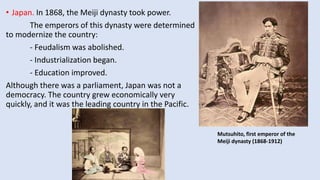
• Japan. In 1868, the Meiji dynasty took power.
The emperors of this dynasty were determined
to modernize the country:
- Feudalism was abolished.
- Industrialization began.
- Education improved.
Although there was a parliament, Japan was not a
democracy. The country grew economically very
quickly, and it was the leading country in the Pacific.
Mutsuhito, first emperor of the
Meiji dynasty (1868-1912)
The European alliance system
• European countries were competing with each other economically,
and this created tensions between them.
• Germany and France were big enemies after the defeat of France in
Sedan (1870).
• Bismarck was determined to establish an alliance system based on
secret diplomacy.
Germany’s main objective was to isolate France, and avoid an
alliance between France and Russia against Germany.
Germany allied with Austria-Hungary and Italy (the Triple
Alliance). Russia assured Germany that they would not ally with France.
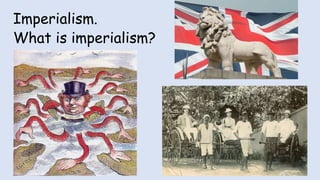
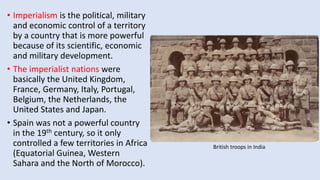
Imperialism.
What is imperialism?
• Imperialism is the political, military
and economic control of a territory
by a country that is more powerful
because of its scientific, economic
and military development.
• The imperialist nations were
basically the United Kingdom,
France, Germany, Italy, Portugal,
Belgium, the Netherlands, the
United States and Japan.
• Spain was not a powerful country
in the 19th century, so it only
controlled a few territories in Africa
(Equatorial Guinea, Western
Sahara and the North of Morocco).
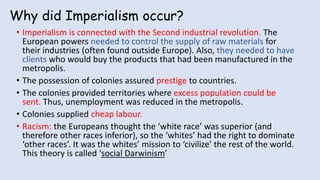
British troops in India
Why did Imperialism occur?
• Imperialism is connected with the Second industrial revolution. The
European powers needed to control the supply of raw materials for
their industries (often found outside Europe). Also, they needed to have
clients who would buy the products that had been manufactured in the
metropolis.
• The possession of colonies assured prestige to countries.
• The colonies provided territories where excess population could be
sent. Thus, unemployment was reduced in the metropolis.
• Colonies supplied cheap labour.
• Racism: the Europeans thought the ‘white race’ was superior (and
therefore other races inferior), so the ‘whites’ had the right to dominate
‘other races’. It was the whites’ mission to ‘civilize’ the rest of the world.
This theory is called ‘social Darwinism’
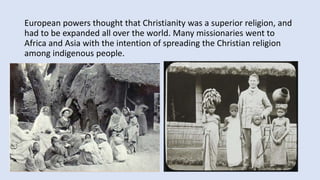
European powers thought that Christianity was a superior religion, and
had to be expanded all over the world. Many missionaries went to
Africa and Asia with the intention of spreading the Christian religion
among indigenous people.
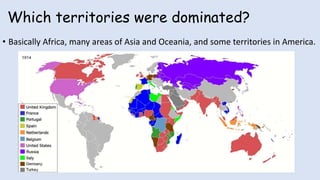
Which territories were dominated?
• Basically Africa, many areas of Asia and Oceania, and some territories in America.
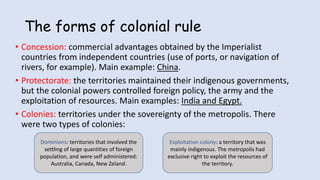
The forms of colonial rule
• Concession: commercial advantages obtained by the Imperialist
countries from independent countries (use of ports, or navigation of
rivers, for example). Main example: China.
• Protectorate: the territories maintained their indigenous governments,
but the colonial powers controlled foreign policy, the army and the
exploitation of resources. Main examples: India and Egypt.
• Colonies: territories under the sovereignty of the metropolis. There
were two types of colonies:
Dominions: territories that involved the
settling of large quantities of foreign
population, and were self administered:
Australia, Canada, New Zeland.
Exploitation colony: a territory that was
mainly indigenous. The metropolis had
exclusive right to exploit the resources of
the territory.
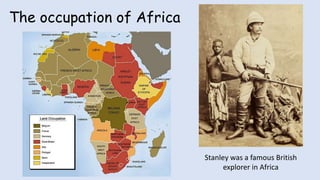
The colonial expansion in Africa
• Before 1870, very few territories had been controlled by the
Europeans (most of them were territories near the coast).
• However, (due to the development of the Second Industrial
Revolution) European countries started to conquer the continent.
Countries competed with each other, and this increased the
tension between the powers.
• In order to prevent possible military conflicts, the European
countries met at Berlin, and they established the rules for the
occupation of Africa.
The Berlin conference (1884)
These rules were established for the
occupation of Africa:
- If a country occupies a coastal area,
that country has the right to occupy the
interior only if this occupation is effective
(that is, if the country sends troops and
settlers).
- River Niger and River Congo can be
freely navigated. Free trade in the interior
was granted.
- Slavery was abolished.
The occupation of Africa
Stanley was a famous British
explorer in Africa
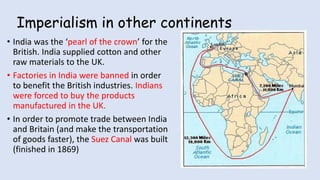
Imperialism in other continents
• India was the ‘pearl of the crown’ for the
British. India supplied cotton and other
raw materials to the UK.
• Factories in India were banned in order
to benefit the British industries. Indians
were forced to buy the products
manufactured in the UK.
• In order to promote trade between India
and Britain (and make the transportation
of goods faster), the Suez Canal was built
(finished in 1869)
• Russia expanded to the East, and conquered
Siberia.
• France occupied nowadays Cambodia, Laos and
Vietnam.
• Japan annexed Korea and Manchuria.
• The Netherlands occupied nowadays Indonesia.
• The United Kingdom incorporated Australia, New
Zealand and Canada.
• Also, the UK occupied Burma (Myanmar) and
Malaysia.
• The United States expelled Spain from Cuba,
Puerto Rico and Philippines. They also controlled
the Panama Canal.
• Belgium occupied Congo.
The result of
this expansion
was the
increase of
tensions
between
countries.
The consequences of Imperialism
• Imperialism benefited the economies of the European powers.
• For the dominated nations, imperialism was negative:
- traditional economies were altered. Many traditional cultures
disappeared.
- agriculture in the colony was destined for export, and local
people started to die from starvation.
- the local industries were destroyed.
- differences in society were more important: a minority
controlled wealth and lived well, whereas the indigenous minority
suffered terrible working conditions.

2. Europe between 1870 1914

  • 1.
  • 2.
    Politics and internationalrelations between 1870-1914
  • 4.
    The world inthe third half of the 19th century • In 1871, Germany had completed its unification. William I was the emperor, and Otto von Bismarck his chancellor. With William II (1888-1918), Germany became a leading country in Europe. • The United Kingdom had a Parliamentary system: there was a queen (Queen Victoria, who ruled between 1837-1901), but she did not govern. The Victorian Era was the time of splendour of the UK. The UK continued being the most powerful country in Europe until the beginning of the 20th century. Queen Victoria
  • 5.
    • France remainedas a strong country even after its defeat against Prussia in Sedan (1870). It was a republic after 1871, and it had a democratic Parliamentary system. • After the Civil War (1861-1865) between the North and the South, the United States started its conquest of the Western territories. The North East started a quick industrialization. The country received thousands of immigrants from Europe, and it was a world leading industrial power by the beginning of the 20th century. Pictures of the westward expansion
  • 6.
    The autocratic systems -The Austro-Hungarian empire consisted of multiple nationalities (the Hungarians, the Croats, the Austrians, the Czech, the Slovaks, etc.). It was created in 1867. It had a common emperor (Franz-Joseph I) and foreign policy, but each territory had autonomy in many aspects. - The Russian empire was ruled by a tsar who concentrated all the political power. It was not a very industrialized country. - The Ottoman empire controlled most of the Balkan Peninsula (except Greece), Egypt and many territories in the Middle East. An autocracy is a system of government in which power is concentrated in the hands of one person Franz Joseph I (1848-1916)
  • 7.
    • Japan. In1868, the Meiji dynasty took power. The emperors of this dynasty were determined to modernize the country: - Feudalism was abolished. - Industrialization began. - Education improved. Although there was a parliament, Japan was not a democracy. The country grew economically very quickly, and it was the leading country in the Pacific. Mutsuhito, first emperor of the Meiji dynasty (1868-1912)
  • 8.
    The European alliancesystem • European countries were competing with each other economically, and this created tensions between them. • Germany and France were big enemies after the defeat of France in Sedan (1870). • Bismarck was determined to establish an alliance system based on secret diplomacy. Germany’s main objective was to isolate France, and avoid an alliance between France and Russia against Germany. Germany allied with Austria-Hungary and Italy (the Triple Alliance). Russia assured Germany that they would not ally with France.
  • 9.
  • 10.
    • Imperialism isthe political, military and economic control of a territory by a country that is more powerful because of its scientific, economic and military development. • The imperialist nations were basically the United Kingdom, France, Germany, Italy, Portugal, Belgium, the Netherlands, the United States and Japan. • Spain was not a powerful country in the 19th century, so it only controlled a few territories in Africa (Equatorial Guinea, Western Sahara and the North of Morocco). British troops in India
  • 11.
    Why did Imperialismoccur? • Imperialism is connected with the Second industrial revolution. The European powers needed to control the supply of raw materials for their industries (often found outside Europe). Also, they needed to have clients who would buy the products that had been manufactured in the metropolis. • The possession of colonies assured prestige to countries. • The colonies provided territories where excess population could be sent. Thus, unemployment was reduced in the metropolis. • Colonies supplied cheap labour. • Racism: the Europeans thought the ‘white race’ was superior (and therefore other races inferior), so the ‘whites’ had the right to dominate ‘other races’. It was the whites’ mission to ‘civilize’ the rest of the world. This theory is called ‘social Darwinism’
  • 12.
    European powers thoughtthat Christianity was a superior religion, and had to be expanded all over the world. Many missionaries went to Africa and Asia with the intention of spreading the Christian religion among indigenous people.
  • 13.
    Which territories weredominated? • Basically Africa, many areas of Asia and Oceania, and some territories in America.
  • 14.
    The forms ofcolonial rule • Concession: commercial advantages obtained by the Imperialist countries from independent countries (use of ports, or navigation of rivers, for example). Main example: China. • Protectorate: the territories maintained their indigenous governments, but the colonial powers controlled foreign policy, the army and the exploitation of resources. Main examples: India and Egypt. • Colonies: territories under the sovereignty of the metropolis. There were two types of colonies: Dominions: territories that involved the settling of large quantities of foreign population, and were self administered: Australia, Canada, New Zeland. Exploitation colony: a territory that was mainly indigenous. The metropolis had exclusive right to exploit the resources of the territory.
  • 15.
    The colonial expansionin Africa • Before 1870, very few territories had been controlled by the Europeans (most of them were territories near the coast). • However, (due to the development of the Second Industrial Revolution) European countries started to conquer the continent. Countries competed with each other, and this increased the tension between the powers. • In order to prevent possible military conflicts, the European countries met at Berlin, and they established the rules for the occupation of Africa.
  • 16.
    The Berlin conference(1884) These rules were established for the occupation of Africa: - If a country occupies a coastal area, that country has the right to occupy the interior only if this occupation is effective (that is, if the country sends troops and settlers). - River Niger and River Congo can be freely navigated. Free trade in the interior was granted. - Slavery was abolished.
  • 17.
    The occupation ofAfrica Stanley was a famous British explorer in Africa
  • 18.
    Imperialism in othercontinents • India was the ‘pearl of the crown’ for the British. India supplied cotton and other raw materials to the UK. • Factories in India were banned in order to benefit the British industries. Indians were forced to buy the products manufactured in the UK. • In order to promote trade between India and Britain (and make the transportation of goods faster), the Suez Canal was built (finished in 1869)
  • 19.
    • Russia expandedto the East, and conquered Siberia. • France occupied nowadays Cambodia, Laos and Vietnam. • Japan annexed Korea and Manchuria. • The Netherlands occupied nowadays Indonesia. • The United Kingdom incorporated Australia, New Zealand and Canada. • Also, the UK occupied Burma (Myanmar) and Malaysia. • The United States expelled Spain from Cuba, Puerto Rico and Philippines. They also controlled the Panama Canal. • Belgium occupied Congo. The result of this expansion was the increase of tensions between countries.
  • 20.
    The consequences ofImperialism • Imperialism benefited the economies of the European powers. • For the dominated nations, imperialism was negative: - traditional economies were altered. Many traditional cultures disappeared. - agriculture in the colony was destined for export, and local people started to die from starvation. - the local industries were destroyed. - differences in society were more important: a minority controlled wealth and lived well, whereas the indigenous minority suffered terrible working conditions.