





COMMUNICATION
& CULTURE
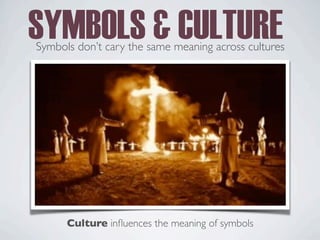
SYMBOLS & CULTURE
Symbols don’t cary the same meaning across cultures
Culture influences the meaning of symbols
?
Communication is symbolic
• Words have no inherent meaning
• Symbol: arbitrary signals created by humans to represent
experiences, objects, or concepts
• Referent: the object or experience to which a symbol refers
Communication is personal
• Meaning is in the people, not in the words
REASONS FOR AMBIGUITY
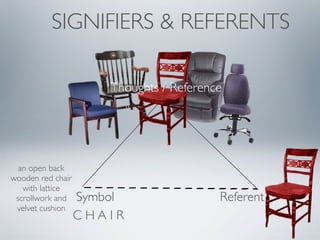
SIGNIFIERS & REFERENTS
Thoughts / Reference
Symbol Referent
C H A I R
an open back
wooden red chair
with lattice
scrollwork and
velvet cushion
Symbol
Thoughts / Reference
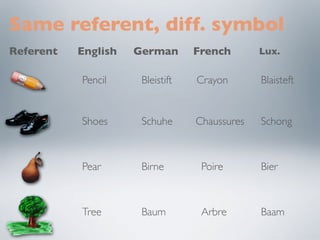
Referent English German French Lux.
Pencil Bleistift Crayon Blaisteft
Shoes Schuhe Chaussures Schong
Pear Birne Poire Bier
Tree Baum Arbre Baam
Same referent, diff. symbol
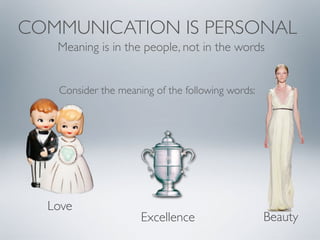
Love
Consider the meaning of the following words:
COMMUNICATION IS PERSONAL
Meaning is in the people, not in the words
Beauty
Excellence
Arbitrary
yet powerful
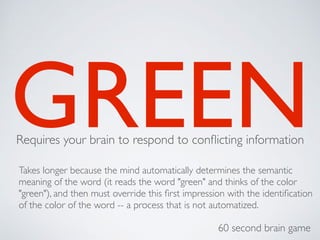
GREEN
Requires your brain to respond to conflicting information
Takes longer because the mind automatically determines the semantic
meaning of the word (it reads the word "green" and thinks of the color
"green"), and then must override this first impression with the identification
of the color of the word -- a process that is not automatized.
60 second brain game
What is your
doctor’s job?
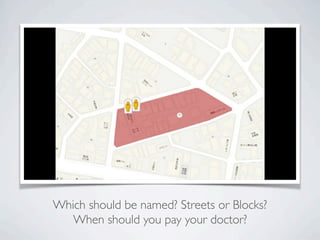
Which should be named? Streets or Blocks?
When should you pay your doctor?
JAPAN
Naming the block
or the space in
between blocks?
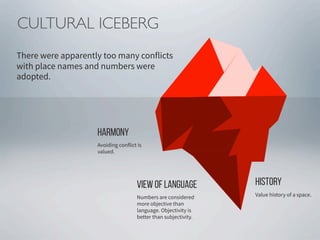
CULTURAL ICEBERG
HARMONY
Avoiding conflict is
valued.
There were apparently too many conflicts
with place names and numbers were
adopted.
View of Language
Numbers are considered
more objective than
language. Objectivity is
better than subjectivity.
HISTORY
Value history of a space.
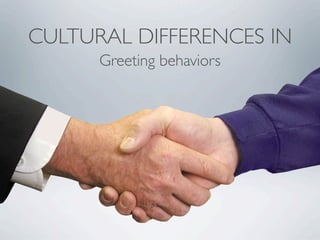
CULTURAL DIFFERENCES IN
Greeting behaviors
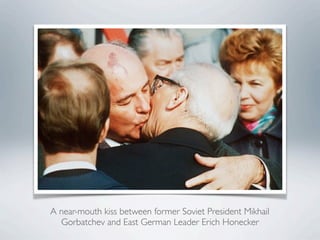
A near-mouth kiss between former Soviet President Mikhail
Gorbatchev and East German Leader Erich Honecker
A cheek kiss between the Iraqi President and the U.S.
ambassador to Iraq
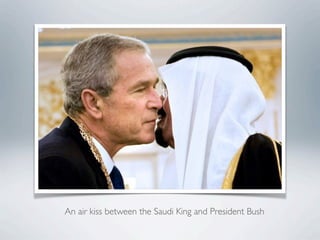
An air kiss between the Saudi King and President Bush
A facial touch between Nancy Pelosi and Chuck Schumer
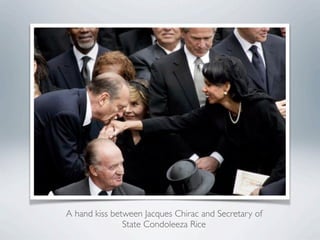
A hand kiss between Jacques Chirac and Secretary of
State Condoleeza Rice
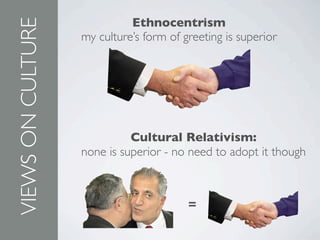
Cultural Relativism:
none is superior - no need to adopt it though
VIEWS
ON
CULTURE Ethnocentrism
my culture’s form of greeting is superior
=
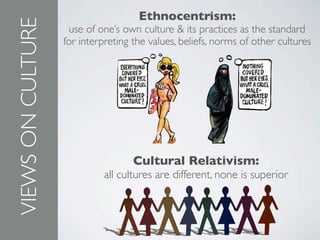
Cultural Relativism:
all cultures are different, none is superior
VIEWS
ON
CULTURE
Ethnocentrism:
use of one’s own culture & its practices as the standard
for interpreting the values, beliefs, norms of other cultures
CULTURE
What is
?
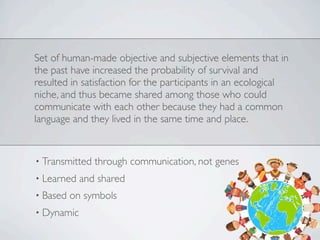
Set of human-made objective and subjective elements that in
the past have increased the probability of survival and
resulted in satisfaction for the participants in an ecological
niche, and thus became shared among those who could
communicate with each other because they had a common
language and they lived in the same time and place.
• Transmitted through communication, not genes
• Learned and shared
• Based on symbols
• Dynamic
Communication is a
systematic process in which
people interact with and
through symbols to create
and interpret meanings.
ENCULTURATION VS.
ACCULTURATION
National GeographicTV Report
How is culture passed on?
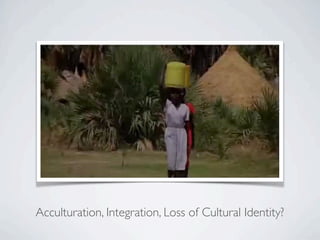
Acculturation, Integration, Loss of Cultural Identity?
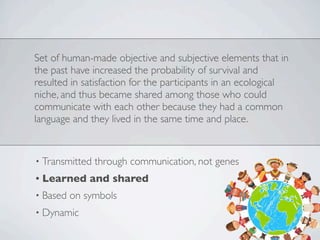
Set of human-made objective and subjective elements that in
the past have increased the probability of survival and
resulted in satisfaction for the participants in an ecological
niche, and thus became shared among those who could
communicate with each other because they had a common
language and they lived in the same time and place.
• Transmitted through communication, not genes
• Learned and shared
• Based on symbols
• Dynamic
Class is about what members
of particular cultures have
learned and how that
“learning” might influence
intercultural comm.
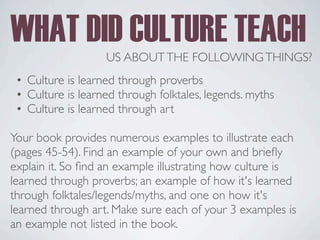
• Culture is learned through proverbs
• Culture is learned through folktales, legends. myths
• Culture is learned through art 
Your book provides numerous examples to illustrate each
(pages 45-54). Find an example of your own and briefly
explain it. So find an example illustrating how culture is
learned through proverbs; an example of how it's learned
through folktales/legends/myths, and one on how it's
learned through art. Make sure each of your 3 examples is
an example not listed in the book. 
WHAT DID CULTURE TEACH
US ABOUTTHE FOLLOWINGTHINGS?
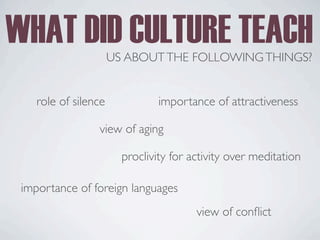
WHAT DID CULTURE TEACH
US ABOUTTHE FOLLOWINGTHINGS?
role of silence importance of attractiveness
view of aging
proclivity for activity over meditation
importance of foreign languages
view of conflict

Chapter 2 : Culture & Comm

  • 1.
  • 2.
    SYMBOLS & CULTURE Symbolsdon’t cary the same meaning across cultures Culture influences the meaning of symbols
  • 3.
    ? Communication is symbolic •Words have no inherent meaning • Symbol: arbitrary signals created by humans to represent experiences, objects, or concepts • Referent: the object or experience to which a symbol refers Communication is personal • Meaning is in the people, not in the words REASONS FOR AMBIGUITY
  • 4.
    SIGNIFIERS & REFERENTS Thoughts/ Reference Symbol Referent C H A I R an open back wooden red chair with lattice scrollwork and velvet cushion Symbol Thoughts / Reference
  • 5.
    Referent English GermanFrench Lux. Pencil Bleistift Crayon Blaisteft Shoes Schuhe Chaussures Schong Pear Birne Poire Bier Tree Baum Arbre Baam Same referent, diff. symbol
  • 6.
    Love Consider the meaningof the following words: COMMUNICATION IS PERSONAL Meaning is in the people, not in the words Beauty Excellence
  • 7.
  • 8.
    GREEN Requires your brainto respond to conflicting information Takes longer because the mind automatically determines the semantic meaning of the word (it reads the word "green" and thinks of the color "green"), and then must override this first impression with the identification of the color of the word -- a process that is not automatized. 60 second brain game
  • 9.
  • 10.
    Which should benamed? Streets or Blocks? When should you pay your doctor?
  • 11.
    JAPAN Naming the block orthe space in between blocks?
  • 12.
    CULTURAL ICEBERG HARMONY Avoiding conflictis valued. There were apparently too many conflicts with place names and numbers were adopted. View of Language Numbers are considered more objective than language. Objectivity is better than subjectivity. HISTORY Value history of a space.
  • 13.
  • 14.
    A near-mouth kissbetween former Soviet President Mikhail Gorbatchev and East German Leader Erich Honecker
  • 15.
    A cheek kissbetween the Iraqi President and the U.S. ambassador to Iraq
  • 16.
    An air kissbetween the Saudi King and President Bush
  • 17.
    A facial touchbetween Nancy Pelosi and Chuck Schumer
  • 18.
    A hand kissbetween Jacques Chirac and Secretary of State Condoleeza Rice
  • 19.
    Cultural Relativism: none issuperior - no need to adopt it though VIEWS ON CULTURE Ethnocentrism my culture’s form of greeting is superior =
  • 20.
    Cultural Relativism: all culturesare different, none is superior VIEWS ON CULTURE Ethnocentrism: use of one’s own culture & its practices as the standard for interpreting the values, beliefs, norms of other cultures
  • 21.
  • 22.
    Set of human-madeobjective and subjective elements that in the past have increased the probability of survival and resulted in satisfaction for the participants in an ecological niche, and thus became shared among those who could communicate with each other because they had a common language and they lived in the same time and place. • Transmitted through communication, not genes • Learned and shared • Based on symbols • Dynamic
  • 23.
    Communication is a systematicprocess in which people interact with and through symbols to create and interpret meanings.
  • 24.
  • 25.
    Acculturation, Integration, Lossof Cultural Identity?
  • 26.
    Set of human-madeobjective and subjective elements that in the past have increased the probability of survival and resulted in satisfaction for the participants in an ecological niche, and thus became shared among those who could communicate with each other because they had a common language and they lived in the same time and place. • Transmitted through communication, not genes • Learned and shared • Based on symbols • Dynamic
  • 27.
    Class is aboutwhat members of particular cultures have learned and how that “learning” might influence intercultural comm.
  • 28.
    • Culture islearned through proverbs • Culture is learned through folktales, legends. myths • Culture is learned through art  Your book provides numerous examples to illustrate each (pages 45-54). Find an example of your own and briefly explain it. So find an example illustrating how culture is learned through proverbs; an example of how it's learned through folktales/legends/myths, and one on how it's learned through art. Make sure each of your 3 examples is an example not listed in the book.  WHAT DID CULTURE TEACH US ABOUTTHE FOLLOWINGTHINGS?
  • 29.
    WHAT DID CULTURETEACH US ABOUTTHE FOLLOWINGTHINGS? role of silence importance of attractiveness view of aging proclivity for activity over meditation importance of foreign languages view of conflict