Intercultural
  Dialogue
   Paola Pierri
  14 april 2010
ABOUT
Me
I work as a consultant in an NGO in the
field of social inclusion and immigrant’s
integration
My presentation
I am presenting the concept of
Interculture Communication Competence
ICC INTERCULTURE
COMMUNICATION
COMPETENCE
 Managing increasing cultural diversity has
 become a priority in recent years
 How shall we respond to diversity?
 What is our vision of the society of the
 future?
WHAT IS ICC?
A DEFINITION:
WHAT IS ICC?
A DEFINITION:
“Intercultural dialogue is understood
  as an open and respectful exchange
  of views between individuals, groups
  with different ethnic, cultural,
  religious and linguistic backgrounds
  and heritage on the basis of mutual
  understanding and respect”
WHAT IS ICC?
A DEFINITION:
“Intercultural dialogue is understood
  as an open and respectful exchange
  of views between individuals, groups
  with different ethnic, cultural,
  religious and linguistic backgrounds
  and heritage on the basis of mutual
  understanding and respect”
White Paper on Intercultural dialogue – Council of Europe
HOWEVER
AN AMBIGUOUS
DEFINITION
ICC is composed by 3 ambiguous terms
  ‣ INTERCULTURAL
  ‣ COMMUNICATION
  ‣ COMPETENCE
COMPETENCE

An acquired personal skill that is
demonstrated in an individual's
ability to provide a consistently
adequate or high level of
performance
COMMUNICATION
It is a process of transferring information
from one entity to another which share a
repertoire of signs and semiotic rules.
Communication is commonly defined as
"the interchange of thoughts, opinions, or
information by speech, writing, or signs"
Wikipedia
CULTURE
CULTURE

Culture is…
CULTURE

Culture is…
“Culture or Civilization, taken in its wide
ethnographic sense, is that complex
whole which includes knowledge, belief,
art, morals, law, custom, and any other
capabilities and habits acquired by man
as a member of society.”
CULTURE

Culture is…
“Culture or Civilization, taken in its wide
ethnographic sense, is that complex
whole which includes knowledge, belief,
art, morals, law, custom, and any other
capabilities and habits acquired by man
as a member of society.”
Sir Edward Burnett Tylor – 1871
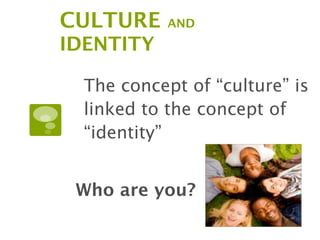
CULTURE     AND
IDENTITY

  The concept of “culture” is
  linked to the concept of
  “identity”


 Who are you?
SOME BASIC PRINCIPLE


The individual is not an
homogeneous social actor.
SOME BASIC PRINCIPLE


The individual is not an
homogeneous social actor.

   Identity as a skin
SOME BASIC PRINCIPLE


The individual is not an
homogeneous social actor.

   Identity as a skin

   Identity as a t-shirt
IDENTITY BUILDING IN A
MULTICULTURAL WORLD
    Freedom to choose your own
    culture is fundamental; it is a
    central aspect of human rights
    Simultaneously or in different
    period of your life, you may
    adopt different cultural
    affiliations.
No one should be confined
against their will within a
particular group, community,
thought system or world view


You should be free to build up
your identity, renounce past
choices and make new ones (as
long as they are consistent with
the universal values of human
rights, democracy and the rule of
..SO, WHY INTERCULTURAL
COMMUNICATION
COMPETENCES?
  To have a new approach to manage the
  diversity
  To establish a positive relation with the
  “others” in your work, your city, your
  building, your’s children class, etc
  To become an inclusive and competitive
  society
  …in many different field we need it!
WHATS THE MATTER?
ICC is about:
 linguistic knowledge
cultural diversity
management capacities
Training on immigration laws
and immigrant’s status
…BUT IS ALSO ABOUT:
 Empathy
 Cooperation
 Open mind
 Dialogue
..are there teachable?
IS ICC AN “OPTION”?

            No!
  The risks of non-dialogue
          is too high
THE RISK IS…
 to develop a stereotypical
perception of the other
 to build up a climate of mutual
suspicion, tension and anxiety
 to use minorities as scapegoats
 to foster intolerance and
discrimination
ICC is difficult to
manage, first of all
because it asks for a
re-consideration
about us, our culture
our identity, our life
THANK YOU FOR YOUR
    ATTENTION
  http://www.interculturaldialogue2008.eu/
   http://www.coe.int/t/dg4/intercultural/

Icc intercultural communication competence

  • 1.
    Intercultural Dialogue Paola Pierri 14 april 2010
  • 2.
    ABOUT Me I work asa consultant in an NGO in the field of social inclusion and immigrant’s integration My presentation I am presenting the concept of Interculture Communication Competence
  • 3.
    ICC INTERCULTURE COMMUNICATION COMPETENCE Managingincreasing cultural diversity has become a priority in recent years How shall we respond to diversity? What is our vision of the society of the future?
  • 4.
    WHAT IS ICC? ADEFINITION:
  • 5.
    WHAT IS ICC? ADEFINITION: “Intercultural dialogue is understood as an open and respectful exchange of views between individuals, groups with different ethnic, cultural, religious and linguistic backgrounds and heritage on the basis of mutual understanding and respect”
  • 6.
    WHAT IS ICC? ADEFINITION: “Intercultural dialogue is understood as an open and respectful exchange of views between individuals, groups with different ethnic, cultural, religious and linguistic backgrounds and heritage on the basis of mutual understanding and respect” White Paper on Intercultural dialogue – Council of Europe
  • 7.
    HOWEVER AN AMBIGUOUS DEFINITION ICC iscomposed by 3 ambiguous terms ‣ INTERCULTURAL ‣ COMMUNICATION ‣ COMPETENCE
  • 8.
    COMPETENCE An acquired personalskill that is demonstrated in an individual's ability to provide a consistently adequate or high level of performance
  • 9.
    COMMUNICATION It is aprocess of transferring information from one entity to another which share a repertoire of signs and semiotic rules. Communication is commonly defined as "the interchange of thoughts, opinions, or information by speech, writing, or signs" Wikipedia
  • 10.
  • 11.
  • 12.
    CULTURE Culture is… “Culture orCivilization, taken in its wide ethnographic sense, is that complex whole which includes knowledge, belief, art, morals, law, custom, and any other capabilities and habits acquired by man as a member of society.”
  • 13.
    CULTURE Culture is… “Culture orCivilization, taken in its wide ethnographic sense, is that complex whole which includes knowledge, belief, art, morals, law, custom, and any other capabilities and habits acquired by man as a member of society.” Sir Edward Burnett Tylor – 1871
  • 14.
    CULTURE AND IDENTITY The concept of “culture” is linked to the concept of “identity” Who are you?
  • 17.
  • 18.
  • 19.
  • 20.
    SOME BASIC PRINCIPLE Theindividual is not an homogeneous social actor.
  • 21.
    SOME BASIC PRINCIPLE Theindividual is not an homogeneous social actor. Identity as a skin
  • 22.
    SOME BASIC PRINCIPLE Theindividual is not an homogeneous social actor. Identity as a skin Identity as a t-shirt
  • 23.
    IDENTITY BUILDING INA MULTICULTURAL WORLD Freedom to choose your own culture is fundamental; it is a central aspect of human rights Simultaneously or in different period of your life, you may adopt different cultural affiliations.
  • 24.
    No one shouldbe confined against their will within a particular group, community, thought system or world view You should be free to build up your identity, renounce past choices and make new ones (as long as they are consistent with the universal values of human rights, democracy and the rule of
  • 25.
    ..SO, WHY INTERCULTURAL COMMUNICATION COMPETENCES? To have a new approach to manage the diversity To establish a positive relation with the “others” in your work, your city, your building, your’s children class, etc To become an inclusive and competitive society …in many different field we need it!
  • 26.
    WHATS THE MATTER? ICCis about:  linguistic knowledge cultural diversity management capacities Training on immigration laws and immigrant’s status
  • 27.
    …BUT IS ALSOABOUT:  Empathy  Cooperation  Open mind  Dialogue ..are there teachable?
  • 28.
    IS ICC AN“OPTION”? No! The risks of non-dialogue is too high
  • 29.
    THE RISK IS… to develop a stereotypical perception of the other  to build up a climate of mutual suspicion, tension and anxiety  to use minorities as scapegoats  to foster intolerance and discrimination
  • 30.
    ICC is difficultto manage, first of all because it asks for a re-consideration about us, our culture our identity, our life
  • 31.
    THANK YOU FORYOUR ATTENTION http://www.interculturaldialogue2008.eu/ http://www.coe.int/t/dg4/intercultural/