CONVERSATIONAL MESSAGES
Disclosure • Conv. Management • Conv. Process • Repair Strategies
the things about oneself a person
voluntarily tells another person and
which the latter one would be unlikely
to know or discover from other
sources
- Pearce & Sharp, 1973, p. 414
“
“
SELF-DISCLOSURE:
Communicating the self
SOCIAL PENETRATIONTHEORY
The “Onion Model” (Altman &Taylor, 1973)
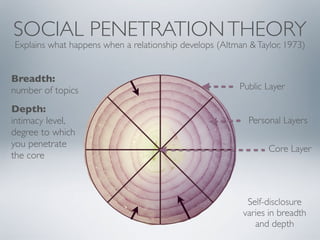
SOCIAL PENETRATIONTHEORY
Breadth:
number of topics
Depth:
intimacy level,
degree to which
you penetrate
the core
Explains what happens when a relationship develops (Altman &Taylor, 1973)
Self-disclosure
varies in breadth
and depth
Public Layer
Personal Layers
Core Layer
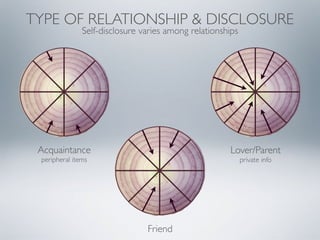
Acquaintance
peripheral items
Friend
Lover/Parent
private info
TYPE OF RELATIONSHIP & DISCLOSURE
Self-disclosure varies among relationships
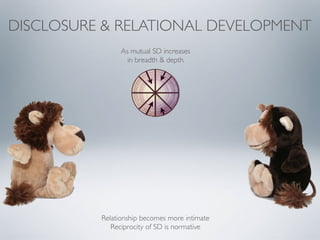
DISCLOSURE & RELATIONAL DEVELOPMENT
As mutual SD increases
in breadth & depth
Relationship becomes more intimate
Reciprocity of SD is normative
FACEBOOK
ACTIVITY
Discussion&
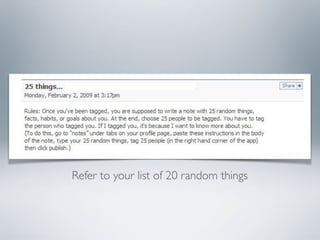
Refer to your list of 20 random things
Map your disclosures onto the onion.
Mostly positive/negative?
How many breadth areas?
How intimate?
“The trajectory for most
relationships is to non-intimacy”
- Steve Duck in Relating to Others
Non-intimacy
?
SELF-DISCLOSURE LEADS TO LIKING
LIKING CAUSES SELF-DISCLOSURE
LIKING RESULTS FROM SELF-DISCLOSURE
1.We like people who disclose to us
• Self-disclosure causes liking, but not as much as we think
• relationship between actual s-d and liking is not as strong as that
between perceived s-d and liking
2.We disclose more to people we like
3.We like others because we disclose to them
• Higher levels of voluntary s-d lead to greater liking of target
- HeraldTribune, Sept. 08, 2008
Many of the avidTwitterers, Flickrers and Facebook users I
interviewed described an unexpected side-effect of constant
self-disclosure.The act of stopping several times a day to
observe what you're feeling or thinking can become, after
weeks and weeks, a sort of philosophical act. It's like the Greek
dictum to "know thyself," or the therapeutic concept of
mindfulness. (Indeed, the question that floats eternally at the
top ofTwitter's Web site — "What are you doing?" — can
come to seem existentially freighted.What are you doing?)
Having an audience can make the self-reflection even more
acute, since, as my interviewees noted, they're trying to
describe their activities in a way that is not only accurate but
also interesting to others: the status update as a literary form.
REWARDS OF SD:
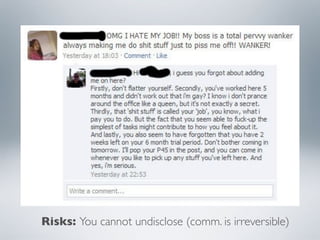
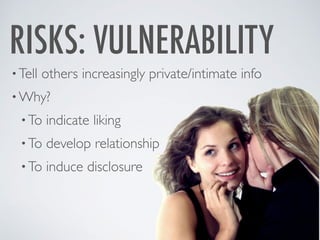
Risks: You cannot undisclose (comm. is irreversible)
•Tell others increasingly private/intimate info
•Why?
•To indicate liking
•To develop relationship
•To induce disclosure
RISKS: VULNERABILITY
ONLINE RELATIONSHIPS
Theories of Relational Development
Social PresenceTheory • Social Information ProcessingTheory
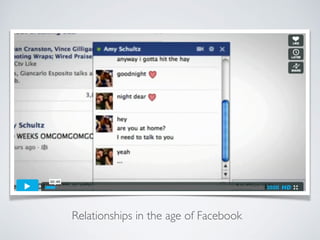
Relationships in the age of Facebook
Ch. 6 of Digital Nation
Relational Development in the Digital Age
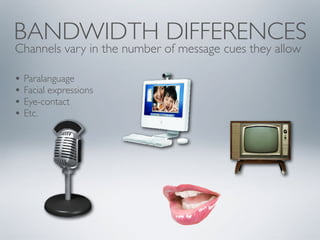
BANDWIDTH DIFFERENCES
Channels vary in the number of message cues they allow
• Paralanguage
• Facial expressions
• Eye-contact
• Etc.
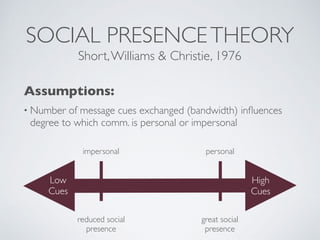
SOCIAL PRESENCETHEORY
• Number of message cues exchanged (bandwidth) influences
degree to which comm. is personal or impersonal
Short,Williams & Christie, 1976
Assumptions:
impersonal
reduced social
presence
High
Cues
Low
Cues
personal
great social
presence
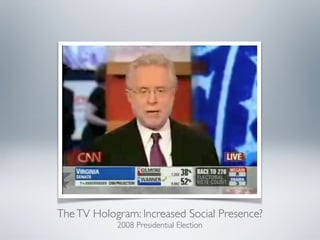
TheTV Hologram: Increased Social Presence?
2008 Presidential Election
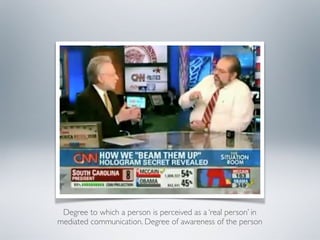
Degree to which a person is perceived as a ‘real person’ in
mediated communication. Degree of awareness of the person
SOCIAL INFO. PROCESSING
• Communicators attempt to reduce uncertainty
• They use available cues to do so
• Media capacity affect rate of social info exchange
• Social info processing takes longer in CMC
Walther, 1992
Assumptions:
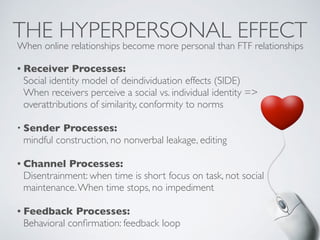
THE HYPERPERSONAL EFFECT
• Receiver Processes:
Social identity model of deindividuation effects (SIDE)
When receivers perceive a social vs. individual identity =>
overattributions of similarity, conformity to norms
• Sender Processes:
mindful construction, no nonverbal leakage, editing
• Channel Processes:
Disentrainment: when time is short focus on task, not social
maintenance.When time stops, no impediment
• Feedback Processes:
Behavioral confirmation: feedback loop
When online relationships become more personal than FTF relationships
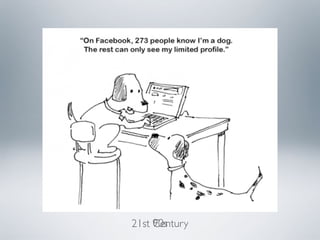
90s
21st Century
?
SELF-PRESENTATION ONLINE
WHICH ISTHE REAL SELF
ONLINE SELF OR REAL LIFE SELF
Ch. 3 & 5 of Growing up Online
Expression of Self - Relationships built on true self?
TRANSCRIPT
ACTIVITY
Discussion &
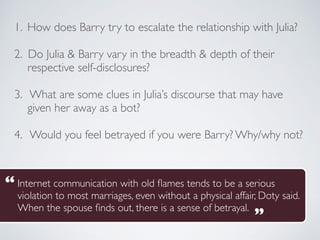
1. How does Barry try to escalate the relationship with Julia?
2. Do Julia & Barry vary in the breadth & depth of their
respective self-disclosures?
3. What are some clues in Julia’s discourse that may have
given her away as a bot?
4. Would you feel betrayed if you were Barry? Why/why not?
Internet communication with old flames tends to be a serious
violation to most marriages, even without a physical affair, Doty said.
When the spouse finds out, there is a sense of betrayal.
“
“
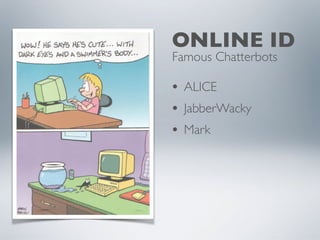
ONLINE ID
• ALICE
• JabberWacky
• Mark
Famous Chatterbots
CONVERSATIONAL PROBLEMS
Prevention • Repair
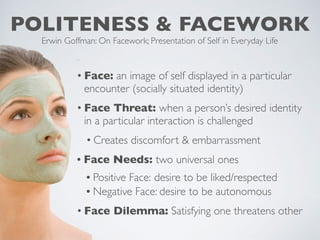
POLITENESS & FACEWORK
Erwin Goffman: On Facework; Presentation of Self in Everyday Life
• Face: an image of self displayed in a particular
encounter (socially situated identity)
• Face Threat: when a person’s desired identity
in a particular interaction is challenged
• Creates discomfort & embarrassment
• Face Needs: two universal ones
• Positive Face: desire to be liked/respected
• Negative Face: desire to be autonomous
• Face Dilemma: Satisfying one threatens other
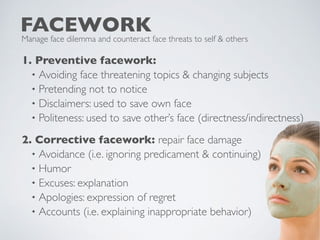
1. Preventive facework:
• Avoiding face threatening topics & changing subjects
• Pretending not to notice
• Disclaimers: used to save own face
• Politeness: used to save other’s face (directness/indirectness)
2. Corrective facework: repair face damage
• Avoidance (i.e. ignoring predicament & continuing)
• Humor
• Excuses: explanation
• Apologies: expression of regret
• Accounts (i.e. explaining inappropriate behavior)
FACEWORK
Manage face dilemma and counteract face threats to self & others
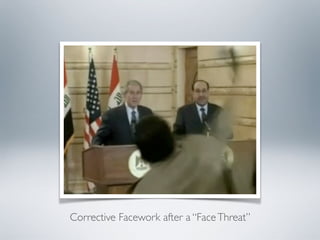
Corrective Facework after a “FaceThreat”
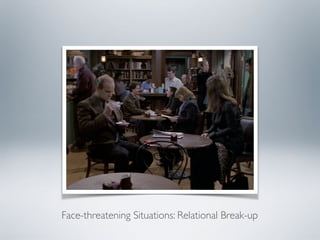
Face-threatening Situations: Relational Break-up
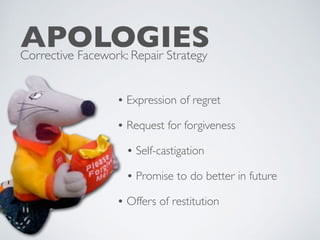
• Expression of regret
• Request for forgiveness
• Self-castigation
• Promise to do better in future
• Offers of restitution
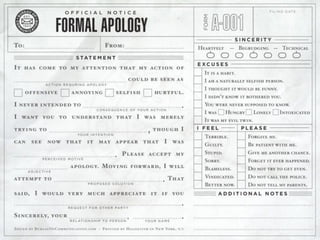
APOLOGIES
Corrective Facework: Repair Strategy
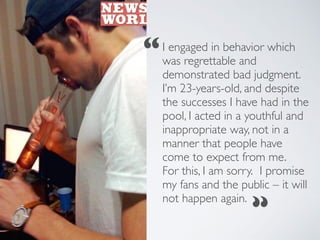
I engaged in behavior which
was regrettable and
demonstrated bad judgment.
I’m 23-years-old, and despite
the successes I have had in the
pool, I acted in a youthful and
inappropriate way, not in a
manner that people have
come to expect from me.
For this, I am sorry. I promise
my fans and the public – it will
not happen again.
“
“
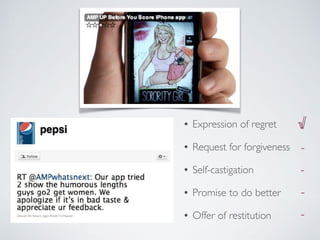
• Expression of regret
• Request for forgiveness
• Self-castigation
• Promise to do better
• Offer of restitution
√
√
-
-
-
-
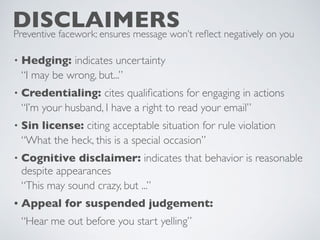
DISCLAIMERS
• Hedging: indicates uncertainty
“I may be wrong, but...”
• Credentialing: cites qualifications for engaging in actions
“I’m your husband, I have a right to read your email”
• Sin license: citing acceptable situation for rule violation
“What the heck, this is a special occasion”
• Cognitive disclaimer: indicates that behavior is reasonable
despite appearances
“This may sound crazy, but ...”
• Appeal for suspended judgement:
“Hear me out before you start yelling”
Preventive facework: ensures message won’t reflect negatively on you
CONVERSATION MANAGEMENT
Initiating • Maintaining • Closing
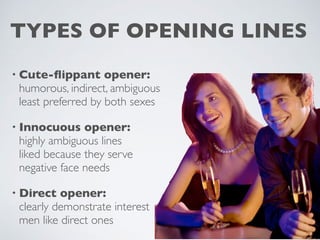
• Cute-flippant opener:
humorous, indirect, ambiguous
least preferred by both sexes
• Innocuous opener:
highly ambiguous lines
liked because they serve
negative face needs
• Direct opener:
clearly demonstrate interest
men like direct ones
TYPES OF OPENING LINES
SAMPLE PICK-UP LINES
• Apart from being sexy, what do you do for a living?
• Hello.Are you taking any applications for a boy/girlfriend?
• Somebody better call God, cuz he's missing an angel!
• Do you have the time? [Gives the time] No, the time
to write down my number?
• Excuse me, I don't want you to think I'm
ridiculous or anything, but you are the most
gorgeous girl/guy I have ever seen. I just felt like
I had to tell you.
• Excuse me, I'm looking for a friend...do you
want to be my friend?
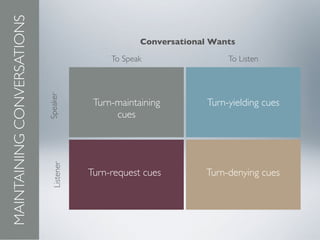
Turn-maintaining
cues
Turn-yielding cues
Turn-request cues Turn-denying cues
To Speak To Listen
Listener
Speaker
Conversational Wants
MAINTAINING
CONVERSATIONS
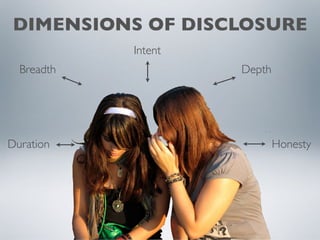
Breadth Depth
Intent
Honesty
Duration
DIMENSIONS OF DISCLOSURE
CLOSING CONVERSATIONS
• Reflecting back & summarizing
• Directly stating desire to end
• Asking for closure
• Stating that you enjoyed the
interaction
• Refering to future interaction

Conversational Messages in Interpersonal Communication

  • 1.
    CONVERSATIONAL MESSAGES Disclosure •Conv. Management • Conv. Process • Repair Strategies
  • 2.
    the things aboutoneself a person voluntarily tells another person and which the latter one would be unlikely to know or discover from other sources - Pearce & Sharp, 1973, p. 414 “ “ SELF-DISCLOSURE: Communicating the self
  • 3.
    SOCIAL PENETRATIONTHEORY The “OnionModel” (Altman &Taylor, 1973)
  • 4.
    SOCIAL PENETRATIONTHEORY Breadth: number oftopics Depth: intimacy level, degree to which you penetrate the core Explains what happens when a relationship develops (Altman &Taylor, 1973) Self-disclosure varies in breadth and depth Public Layer Personal Layers Core Layer
  • 5.
    Acquaintance peripheral items Friend Lover/Parent private info TYPEOF RELATIONSHIP & DISCLOSURE Self-disclosure varies among relationships
  • 6.
    DISCLOSURE & RELATIONALDEVELOPMENT As mutual SD increases in breadth & depth Relationship becomes more intimate Reciprocity of SD is normative
  • 7.
  • 8.
    Refer to yourlist of 20 random things
  • 9.
    Map your disclosuresonto the onion. Mostly positive/negative? How many breadth areas? How intimate?
  • 10.
    “The trajectory formost relationships is to non-intimacy” - Steve Duck in Relating to Others Non-intimacy
  • 11.
    ? SELF-DISCLOSURE LEADS TOLIKING LIKING CAUSES SELF-DISCLOSURE LIKING RESULTS FROM SELF-DISCLOSURE
  • 12.
    1.We like peoplewho disclose to us • Self-disclosure causes liking, but not as much as we think • relationship between actual s-d and liking is not as strong as that between perceived s-d and liking 2.We disclose more to people we like 3.We like others because we disclose to them • Higher levels of voluntary s-d lead to greater liking of target
  • 13.
    - HeraldTribune, Sept.08, 2008 Many of the avidTwitterers, Flickrers and Facebook users I interviewed described an unexpected side-effect of constant self-disclosure.The act of stopping several times a day to observe what you're feeling or thinking can become, after weeks and weeks, a sort of philosophical act. It's like the Greek dictum to "know thyself," or the therapeutic concept of mindfulness. (Indeed, the question that floats eternally at the top ofTwitter's Web site — "What are you doing?" — can come to seem existentially freighted.What are you doing?) Having an audience can make the self-reflection even more acute, since, as my interviewees noted, they're trying to describe their activities in a way that is not only accurate but also interesting to others: the status update as a literary form. REWARDS OF SD:
  • 14.
    Risks: You cannotundisclose (comm. is irreversible)
  • 15.
    •Tell others increasinglyprivate/intimate info •Why? •To indicate liking •To develop relationship •To induce disclosure RISKS: VULNERABILITY
  • 16.
    ONLINE RELATIONSHIPS Theories ofRelational Development Social PresenceTheory • Social Information ProcessingTheory
  • 17.
    Relationships in theage of Facebook
  • 18.
    Ch. 6 ofDigital Nation Relational Development in the Digital Age
  • 19.
    BANDWIDTH DIFFERENCES Channels varyin the number of message cues they allow • Paralanguage • Facial expressions • Eye-contact • Etc.
  • 20.
    SOCIAL PRESENCETHEORY • Numberof message cues exchanged (bandwidth) influences degree to which comm. is personal or impersonal Short,Williams & Christie, 1976 Assumptions: impersonal reduced social presence High Cues Low Cues personal great social presence
  • 21.
    TheTV Hologram: IncreasedSocial Presence? 2008 Presidential Election
  • 22.
    Degree to whicha person is perceived as a ‘real person’ in mediated communication. Degree of awareness of the person
  • 23.
    SOCIAL INFO. PROCESSING •Communicators attempt to reduce uncertainty • They use available cues to do so • Media capacity affect rate of social info exchange • Social info processing takes longer in CMC Walther, 1992 Assumptions:
  • 24.
    THE HYPERPERSONAL EFFECT •Receiver Processes: Social identity model of deindividuation effects (SIDE) When receivers perceive a social vs. individual identity => overattributions of similarity, conformity to norms • Sender Processes: mindful construction, no nonverbal leakage, editing • Channel Processes: Disentrainment: when time is short focus on task, not social maintenance.When time stops, no impediment • Feedback Processes: Behavioral confirmation: feedback loop When online relationships become more personal than FTF relationships
  • 25.
  • 26.
    ? SELF-PRESENTATION ONLINE WHICH ISTHEREAL SELF ONLINE SELF OR REAL LIFE SELF
  • 27.
    Ch. 3 &5 of Growing up Online Expression of Self - Relationships built on true self?
  • 28.
  • 29.
    1. How doesBarry try to escalate the relationship with Julia? 2. Do Julia & Barry vary in the breadth & depth of their respective self-disclosures? 3. What are some clues in Julia’s discourse that may have given her away as a bot? 4. Would you feel betrayed if you were Barry? Why/why not? Internet communication with old flames tends to be a serious violation to most marriages, even without a physical affair, Doty said. When the spouse finds out, there is a sense of betrayal. “ “
  • 30.
    ONLINE ID • ALICE •JabberWacky • Mark Famous Chatterbots
  • 31.
  • 32.
    POLITENESS & FACEWORK ErwinGoffman: On Facework; Presentation of Self in Everyday Life • Face: an image of self displayed in a particular encounter (socially situated identity) • Face Threat: when a person’s desired identity in a particular interaction is challenged • Creates discomfort & embarrassment • Face Needs: two universal ones • Positive Face: desire to be liked/respected • Negative Face: desire to be autonomous • Face Dilemma: Satisfying one threatens other
  • 33.
    1. Preventive facework: •Avoiding face threatening topics & changing subjects • Pretending not to notice • Disclaimers: used to save own face • Politeness: used to save other’s face (directness/indirectness) 2. Corrective facework: repair face damage • Avoidance (i.e. ignoring predicament & continuing) • Humor • Excuses: explanation • Apologies: expression of regret • Accounts (i.e. explaining inappropriate behavior) FACEWORK Manage face dilemma and counteract face threats to self & others
  • 34.
    Corrective Facework aftera “FaceThreat”
  • 35.
  • 36.
    • Expression ofregret • Request for forgiveness • Self-castigation • Promise to do better in future • Offers of restitution APOLOGIES Corrective Facework: Repair Strategy
  • 38.
    I engaged inbehavior which was regrettable and demonstrated bad judgment. I’m 23-years-old, and despite the successes I have had in the pool, I acted in a youthful and inappropriate way, not in a manner that people have come to expect from me. For this, I am sorry. I promise my fans and the public – it will not happen again. “ “
  • 39.
    • Expression ofregret • Request for forgiveness • Self-castigation • Promise to do better • Offer of restitution √ √ - - - -
  • 40.
    DISCLAIMERS • Hedging: indicatesuncertainty “I may be wrong, but...” • Credentialing: cites qualifications for engaging in actions “I’m your husband, I have a right to read your email” • Sin license: citing acceptable situation for rule violation “What the heck, this is a special occasion” • Cognitive disclaimer: indicates that behavior is reasonable despite appearances “This may sound crazy, but ...” • Appeal for suspended judgement: “Hear me out before you start yelling” Preventive facework: ensures message won’t reflect negatively on you
  • 41.
  • 42.
    • Cute-flippant opener: humorous,indirect, ambiguous least preferred by both sexes • Innocuous opener: highly ambiguous lines liked because they serve negative face needs • Direct opener: clearly demonstrate interest men like direct ones TYPES OF OPENING LINES
  • 43.
    SAMPLE PICK-UP LINES •Apart from being sexy, what do you do for a living? • Hello.Are you taking any applications for a boy/girlfriend? • Somebody better call God, cuz he's missing an angel! • Do you have the time? [Gives the time] No, the time to write down my number? • Excuse me, I don't want you to think I'm ridiculous or anything, but you are the most gorgeous girl/guy I have ever seen. I just felt like I had to tell you. • Excuse me, I'm looking for a friend...do you want to be my friend?
  • 44.
    Turn-maintaining cues Turn-yielding cues Turn-request cuesTurn-denying cues To Speak To Listen Listener Speaker Conversational Wants MAINTAINING CONVERSATIONS
  • 45.
  • 46.
    CLOSING CONVERSATIONS • Reflectingback & summarizing • Directly stating desire to end • Asking for closure • Stating that you enjoyed the interaction • Refering to future interaction