









COMMUNICATION
& CULTURE
flag
death & mourning
etiquette
dress
ethics
aging
freedom
immigration
work
play
individualism
taboos
courtship
formality
HOW DID YOU ACQUIRE
YOUR BELIEFS & VALUES?
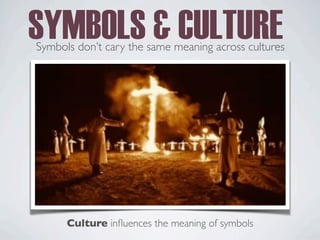
SYMBOLS & CULTURE
Symbols don’t cary the same meaning across cultures
Culture influences the meaning of symbols
?
Communication is symbolic
• Words have no inherent meaning
• Symbol: arbitrary signals created by humans to
represent experiences, objects, or concepts
• Referent: the object or experience to which a
symbol refers
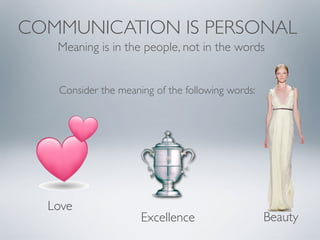
Communication is personal
• Meaning is in the people, not in the words
REASONS FOR AMBIGUITY
Communication is a
systematic process in which
people interact with and
through symbols to create
and interpret meanings.
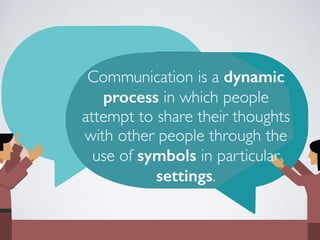
Communication is a dynamic
process in which people
attempt to share their thoughts
with other people through the
use of symbols in particular
settings.
SIGNIFIERS & REFERENTS
Thoughts / Reference
Symbol Referent
C H A I R
an open back
wooden red chair
with lattice
scrollwork and
velvet cushion
Symbol
Thoughts / Reference
Consider the meaning of the following words:
COMMUNICATION IS PERSONAL
Meaning is in the people, not in the words
Beauty
Excellence
Love
Arbitrary
yet powerful
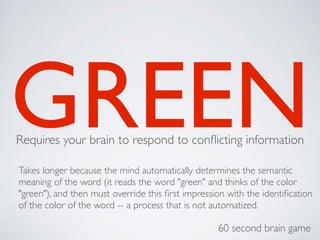
GREEN
Requires your brain to respond to conflicting information
Takes longer because the mind automatically determines the semantic
meaning of the word (it reads the word "green" and thinks of the color
"green"), and then must override this first impression with the identification
of the color of the word -- a process that is not automatized.
60 second brain game
What is your
doctor’s job?
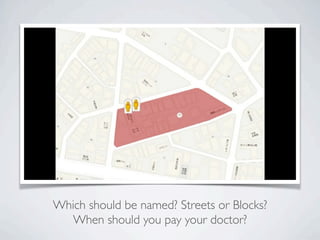
Which should be named? Streets or Blocks?
When should you pay your doctor?
JAPAN
Naming the block
or the space in
between blocks?
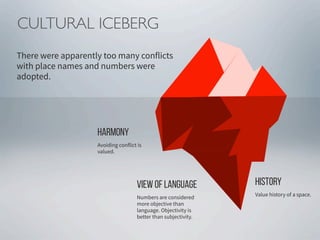
CULTURAL ICEBERG
HARMONY
Avoiding conflict is
valued.
There were apparently too many conflicts
with place names and numbers were
adopted.
View of Language
Numbers are considered
more objective than
language. Objectivity is
better than subjectivity.
HISTORY
Value history of a space.
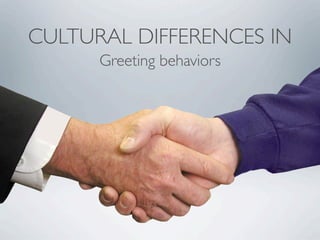
CULTURAL DIFFERENCES IN
Greeting behaviors
A near-mouth kiss between former Soviet President Mikhail
Gorbatchev and East German Leader Erich Honecker
A cheek kiss between the Iraqi President and the U.S.
ambassador to Iraq
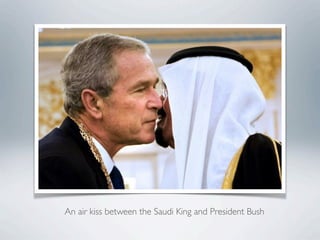
An air kiss between the Saudi King and President Bush
A facial touch between Nancy Pelosi and Chuck Schumer
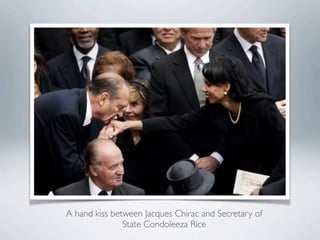
A hand kiss between Jacques Chirac and Secretary of
State Condoleeza Rice
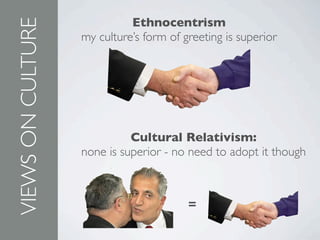
Cultural Relativism:
none is superior - no need to adopt it though
VIEWS
ON
CULTURE Ethnocentrism
my culture’s form of greeting is superior
=
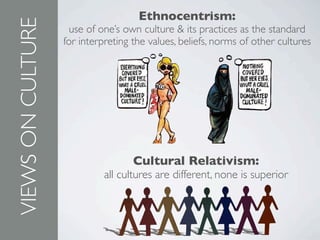
Cultural Relativism:
all cultures are different, none is superior
VIEWS
ON
CULTURE
Ethnocentrism:
use of one’s own culture & its practices as the standard
for interpreting the values, beliefs, norms of other cultures
CULTURE
What is
?
and what is its relationship to communication
You learn your culture via
communication and at the
same time, communication
is a reflection of your
culture.
Set of human-made objective and subjective elements that in
the past have increased the probability of survival and
resulted in satisfaction for the participants in an ecological
niche, and thus became shared among those who could
communicate with each other because they had a
common language and they lived in the same time and place.
• Transmitted through communication, not genes
• Learned and shared
• Based on symbols
• Dynamic
ENCULTURATION VS.
ACCULTURATION
National GeographicTV Report
How is culture passed on?
Set of human-made objective and subjective elements that in
the past have increased the probability of survival and
resulted in satisfaction for the participants in an ecological
niche, and thus became shared among those who could
communicate with each other because they had a common
language and they lived in the same time and place.
• Transmitted through communication, not genes
• Learned and shared
• Based on symbols
• Dynamic
Class is about what members
of particular cultures have
learned and how that
“learning” might influence
intercultural comm.
• Culture is learned through proverbs
• Culture is learned through folktales, legends. myths
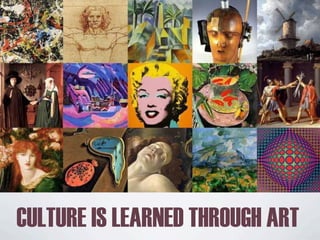
• Culture is learned through art
Your book provides numerous examples to illustrate each
(pages 45-54). Find an example of your own and briefly
explain it. So find an example illustrating how culture is
learned through proverbs; an example of how it's learned
through folktales/legends/myths, and one on how it's
learned through art. Make sure each of your 3 examples is
an example not listed in the book.
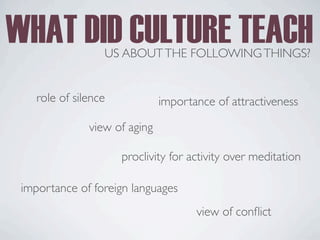
WHAT DID CULTURE TEACH
US ABOUTTHE FOLLOWINGTHINGS?
CULTURE IS LEARNED THROUGH ART
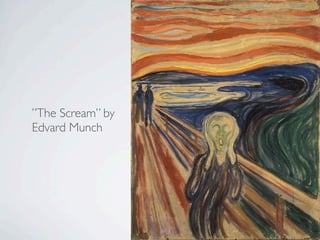
”The Scream” by
Edvard Munch
Social and Political Structures:
Isolation and Alienation:The lone, anguished figure against
the swirling, chaotic backdrop emphasizes the individual's
isolation and disconnect from society.This reflects anxieties
about modern life, characterized by rapid industrialization,
urbanization, and the breakdown of traditional social
structures.
Existential Dread:The scream itself represents a universal
human experience – the fear of the unknown, the fragility of
life, and the anxieties of modern existence.This resonated
with a growing sense of societal and individual uncertainty in
the late 19th century.
Religious Beliefs and Practices:
Subjective Experience:While not explicitly religious, the
painting delves into the realm of the psychological and
spiritual.The figure's torment suggests a spiritual crisis, a
grappling with existential questions about life, death, and the
meaning of existence.
Expressionism: "The Scream" is a key work of Expressionism,
an artistic movement that emphasized subjective emotions
and inner experiences over objective reality.This aligns with a
shift away from traditional religious dogma towards a more
introspective and individualistic approach to spirituality.
Social Values and Norms:
Beauty Standards:Traditional notions of beauty and harmony
are subverted.The distorted figures and unsettling colors
challenge conventional aesthetics, reflecting a growing
interest in exploring the darker aspects of the human
condition.
Mental Health: "The Scream" can be seen as an early
representation of mental health struggles, such as anxiety and
depression.This reflects a growing awareness of psychological
states and a shift towards greater openness in discussing
mental health (though still nascent in the late 19th century).
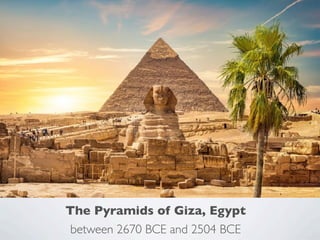
The Pyramids of Giza, Egypt
between 2670 BCE and 2504 BCE
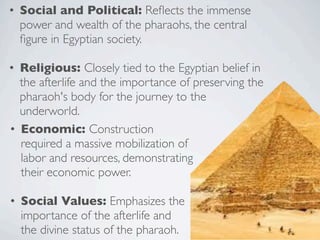
• Social and Political: Reflects the immense
power and wealth of the pharaohs, the central
figure in Egyptian society.
• Religious: Closely tied to the Egyptian belief in
the afterlife and the importance of preserving the
pharaoh's body for the journey to the
underworld.
• Economic: Construction
required a massive mobilization of
labor and resources, demonstrating
their economic power.
• Social Values: Emphasizes the
importance of the afterlife and
the divine status of the pharaoh.
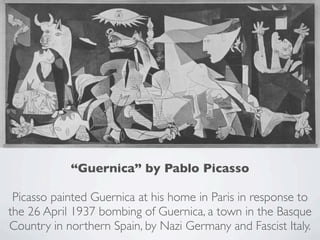
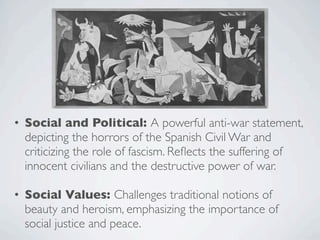
“Guernica” by Pablo Picasso
Picasso painted Guernica at his home in Paris in response to
the 26 April 1937 bombing of Guernica, a town in the Basque
Country in northern Spain, by Nazi Germany and Fascist Italy.
• Social and Political: A powerful anti-war statement,
depicting the horrors of the Spanish Civil War and
criticizing the role of fascism. Reflects the suffering of
innocent civilians and the destructive power of war.
• Social Values: Challenges traditional notions of
beauty and heroism, emphasizing the importance of
social justice and peace.
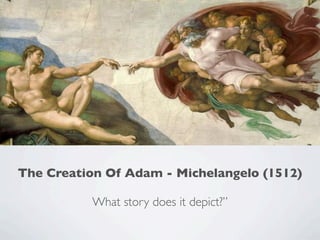
The Creation Of Adam - Michelangelo (1512)
What story does it depict?”
Social and Political Structures:
Patronage: Commissioned by the Pope for the Sistine Chapel.
Highlights the power of the Papacy and its patronage of the
arts during the Renaissance.
Religious Beliefs and Practices:
Biblical Narrative: Serves as a visual interpretation of a core
Christian belief and reinforces the importance of the Bible as
a source of truth and authority.
Social Values and Norms:
Divine Power: Depicts the awe-inspiring power of God,
reinforcing the belief in a divine creator and the importance of
faith and obedience.
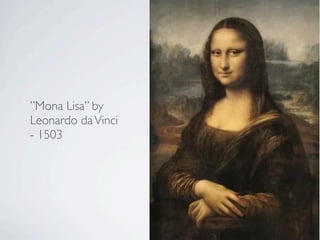
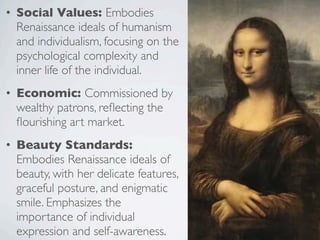
”Mona Lisa” by
Leonardo daVinci
- 1503
• Social Values: Embodies
Renaissance ideals of humanism
and individualism, focusing on the
psychological complexity and
inner life of the individual.
• Economic: Commissioned by
wealthy patrons, reflecting the
flourishing art market.
• Beauty Standards:
Embodies Renaissance ideals of
beauty, with her delicate features,
graceful posture, and enigmatic
smile. Emphasizes the
importance of individual
expression and self-awareness.
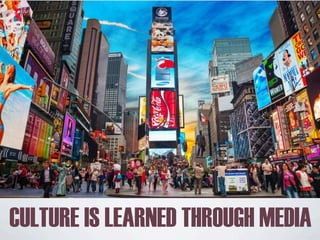
CULTURE IS LEARNED THROUGH MEDIA
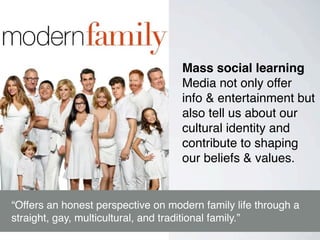
Mass social learning
Media not only offer
info & entertainment but
also tell us about our
cultural identity and
contribute to shaping
our beliefs & values.
“Offers an honest perspective on modern family life through a
straight, gay, multicultural, and traditional family.”
Culture is learned through media
Think of popularTV or streaming shows. Pick one or two
that all of you are familiar with and explain what this show
teaches us about culture. Make sure your example is an
example not listed in the book.
WHAT DID CULTURE TEACH
US ABOUTTHE FOLLOWINGTHINGS?
role of silence importance of attractiveness
view of aging
proclivity for activity over meditation
importance of foreign languages
view of conflict
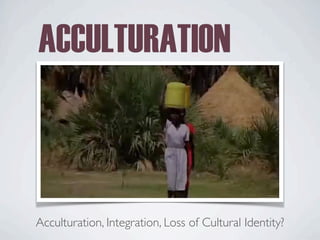
Acculturation, Integration, Loss of Cultural Identity?
ACCULTURATION
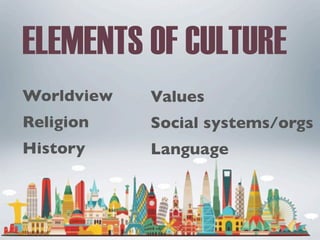
ELEMENTS OF CULTURE
Worldview
Religion
History
Values
Social systems/orgs
Language

Chapter 2 Slides Culture and Communication

  • 1.
  • 2.
  • 3.
    SYMBOLS & CULTURE Symbolsdon’t cary the same meaning across cultures Culture influences the meaning of symbols
  • 4.
    ? Communication is symbolic •Words have no inherent meaning • Symbol: arbitrary signals created by humans to represent experiences, objects, or concepts • Referent: the object or experience to which a symbol refers Communication is personal • Meaning is in the people, not in the words REASONS FOR AMBIGUITY
  • 5.
    Communication is a systematicprocess in which people interact with and through symbols to create and interpret meanings.
  • 6.
    Communication is adynamic process in which people attempt to share their thoughts with other people through the use of symbols in particular settings.
  • 7.
    SIGNIFIERS & REFERENTS Thoughts/ Reference Symbol Referent C H A I R an open back wooden red chair with lattice scrollwork and velvet cushion Symbol Thoughts / Reference
  • 8.
    Consider the meaningof the following words: COMMUNICATION IS PERSONAL Meaning is in the people, not in the words Beauty Excellence Love
  • 9.
  • 10.
    GREEN Requires your brainto respond to conflicting information Takes longer because the mind automatically determines the semantic meaning of the word (it reads the word "green" and thinks of the color "green"), and then must override this first impression with the identification of the color of the word -- a process that is not automatized. 60 second brain game
  • 11.
  • 12.
    Which should benamed? Streets or Blocks? When should you pay your doctor?
  • 13.
    JAPAN Naming the block orthe space in between blocks?
  • 14.
    CULTURAL ICEBERG HARMONY Avoiding conflictis valued. There were apparently too many conflicts with place names and numbers were adopted. View of Language Numbers are considered more objective than language. Objectivity is better than subjectivity. HISTORY Value history of a space.
  • 15.
  • 16.
    A near-mouth kissbetween former Soviet President Mikhail Gorbatchev and East German Leader Erich Honecker
  • 17.
    A cheek kissbetween the Iraqi President and the U.S. ambassador to Iraq
  • 18.
    An air kissbetween the Saudi King and President Bush
  • 19.
    A facial touchbetween Nancy Pelosi and Chuck Schumer
  • 20.
    A hand kissbetween Jacques Chirac and Secretary of State Condoleeza Rice
  • 21.
    Cultural Relativism: none issuperior - no need to adopt it though VIEWS ON CULTURE Ethnocentrism my culture’s form of greeting is superior =
  • 22.
    Cultural Relativism: all culturesare different, none is superior VIEWS ON CULTURE Ethnocentrism: use of one’s own culture & its practices as the standard for interpreting the values, beliefs, norms of other cultures
  • 23.
    CULTURE What is ? and whatis its relationship to communication
  • 24.
    You learn yourculture via communication and at the same time, communication is a reflection of your culture.
  • 25.
    Set of human-madeobjective and subjective elements that in the past have increased the probability of survival and resulted in satisfaction for the participants in an ecological niche, and thus became shared among those who could communicate with each other because they had a common language and they lived in the same time and place. • Transmitted through communication, not genes • Learned and shared • Based on symbols • Dynamic
  • 26.
  • 27.
    Set of human-madeobjective and subjective elements that in the past have increased the probability of survival and resulted in satisfaction for the participants in an ecological niche, and thus became shared among those who could communicate with each other because they had a common language and they lived in the same time and place. • Transmitted through communication, not genes • Learned and shared • Based on symbols • Dynamic
  • 28.
    Class is aboutwhat members of particular cultures have learned and how that “learning” might influence intercultural comm.
  • 29.
    • Culture islearned through proverbs • Culture is learned through folktales, legends. myths • Culture is learned through art Your book provides numerous examples to illustrate each (pages 45-54). Find an example of your own and briefly explain it. So find an example illustrating how culture is learned through proverbs; an example of how it's learned through folktales/legends/myths, and one on how it's learned through art. Make sure each of your 3 examples is an example not listed in the book. WHAT DID CULTURE TEACH US ABOUTTHE FOLLOWINGTHINGS?
  • 31.
    CULTURE IS LEARNEDTHROUGH ART
  • 32.
  • 33.
    Social and PoliticalStructures: Isolation and Alienation:The lone, anguished figure against the swirling, chaotic backdrop emphasizes the individual's isolation and disconnect from society.This reflects anxieties about modern life, characterized by rapid industrialization, urbanization, and the breakdown of traditional social structures. Existential Dread:The scream itself represents a universal human experience – the fear of the unknown, the fragility of life, and the anxieties of modern existence.This resonated with a growing sense of societal and individual uncertainty in the late 19th century.
  • 34.
    Religious Beliefs andPractices: Subjective Experience:While not explicitly religious, the painting delves into the realm of the psychological and spiritual.The figure's torment suggests a spiritual crisis, a grappling with existential questions about life, death, and the meaning of existence. Expressionism: "The Scream" is a key work of Expressionism, an artistic movement that emphasized subjective emotions and inner experiences over objective reality.This aligns with a shift away from traditional religious dogma towards a more introspective and individualistic approach to spirituality.
  • 35.
    Social Values andNorms: Beauty Standards:Traditional notions of beauty and harmony are subverted.The distorted figures and unsettling colors challenge conventional aesthetics, reflecting a growing interest in exploring the darker aspects of the human condition. Mental Health: "The Scream" can be seen as an early representation of mental health struggles, such as anxiety and depression.This reflects a growing awareness of psychological states and a shift towards greater openness in discussing mental health (though still nascent in the late 19th century).
  • 36.
    The Pyramids ofGiza, Egypt between 2670 BCE and 2504 BCE
  • 37.
    • Social andPolitical: Reflects the immense power and wealth of the pharaohs, the central figure in Egyptian society. • Religious: Closely tied to the Egyptian belief in the afterlife and the importance of preserving the pharaoh's body for the journey to the underworld. • Economic: Construction required a massive mobilization of labor and resources, demonstrating their economic power. • Social Values: Emphasizes the importance of the afterlife and the divine status of the pharaoh.
  • 38.
    “Guernica” by PabloPicasso Picasso painted Guernica at his home in Paris in response to the 26 April 1937 bombing of Guernica, a town in the Basque Country in northern Spain, by Nazi Germany and Fascist Italy.
  • 39.
    • Social andPolitical: A powerful anti-war statement, depicting the horrors of the Spanish Civil War and criticizing the role of fascism. Reflects the suffering of innocent civilians and the destructive power of war. • Social Values: Challenges traditional notions of beauty and heroism, emphasizing the importance of social justice and peace.
  • 40.
    The Creation OfAdam - Michelangelo (1512) What story does it depict?”
  • 41.
    Social and PoliticalStructures: Patronage: Commissioned by the Pope for the Sistine Chapel. Highlights the power of the Papacy and its patronage of the arts during the Renaissance. Religious Beliefs and Practices: Biblical Narrative: Serves as a visual interpretation of a core Christian belief and reinforces the importance of the Bible as a source of truth and authority. Social Values and Norms: Divine Power: Depicts the awe-inspiring power of God, reinforcing the belief in a divine creator and the importance of faith and obedience.
  • 42.
  • 43.
    • Social Values:Embodies Renaissance ideals of humanism and individualism, focusing on the psychological complexity and inner life of the individual. • Economic: Commissioned by wealthy patrons, reflecting the flourishing art market. • Beauty Standards: Embodies Renaissance ideals of beauty, with her delicate features, graceful posture, and enigmatic smile. Emphasizes the importance of individual expression and self-awareness.
  • 44.
    CULTURE IS LEARNEDTHROUGH MEDIA
  • 45.
    Mass social learning Medianot only offer info & entertainment but also tell us about our cultural identity and contribute to shaping our beliefs & values. “Offers an honest perspective on modern family life through a straight, gay, multicultural, and traditional family.”
  • 46.
    Culture is learnedthrough media Think of popularTV or streaming shows. Pick one or two that all of you are familiar with and explain what this show teaches us about culture. Make sure your example is an example not listed in the book.
  • 47.
    WHAT DID CULTURETEACH US ABOUTTHE FOLLOWINGTHINGS? role of silence importance of attractiveness view of aging proclivity for activity over meditation importance of foreign languages view of conflict
  • 48.
    Acculturation, Integration, Lossof Cultural Identity? ACCULTURATION
  • 49.