Jak narody porozumiewają się ze sobą w komunikacji
   międzykulturowej i komunikowaniu medialnym
[Intercultural communication and media communication between nations]
                    Jerzy Mikułowski Pomorski
                       Kraków: Universitas, 2007


   Selected chapters abridged and summarised by
    Intercultural Communication Course students,
                 English Studies Jagiellonian University
                                2012/13
Intercultural Communication
      by Anna Sudoł and Natalia Sas
Outline of the presentation
1. Origins

2. Definition

3. Interdisciplinary Orientation

4. Benefits of Intercultural Communication

5. Discussion
Origins
•   Intercultural communication stretches back into antiquity. It all began when
    people from different cultures started to meet together and communicate
    with each other. First, it was promoted by missionaries, merchants or
    diplomats.
•   As an academic field of study and research it has been popular since
    1950s. The term ‘intercultural communication’ was first used when the
    American anthropologists Edward T. Hall, Ruth and John Useem began
    to explore how people from different cultures can successfully
    communicate.
•   During the past decades the growth of globalization, immigration and
    international tourism has involved large numbers of people in intercultural
    interaction. This has led to an increased desire and need for knowledge
    regarding how people from different cultures, beliefs and religions come
    together to work and communicate with each other.
Definition
   Interactions with people from different cultural backgrounds;
a process of exchanging, negotiating, and mediating one's cultural
         differences through language, non-verbal gestures,
                      and space relationships
• Cross-cultural Communication - implies a
  comparison of and contrast between particular
  aspects of communication between cultures


• Intercultural Communication - the
  communication between people from
  different cultures (it refers to what happens
  when these culturally-different groups
  come together, interact and communicate)
Interdisciplinary orientation
•   cultural anthropology
•   psychology
•   social psychology
•   sociology
•   linguistics and semiotics
•   cultural studies
•   rhetoric
Benefits of studying Intercultural Communication
                         according to F.E. Jandt1
 improving verbal and nonverbal communication;
 becoming better in recognizing and undertaking communication
  behaviours in various contexts;
 better adaptation to a new environment;
 learning how to understand, reduce and overcome stress;
 better understanding of one’s own culture and finding one’s place in
  a society;
 reduced feeling of anxiety in contacts with members of other
  cultures;
 learning about customs and habitual behaviours of members of
  other cultures.
1Jandt,   F. E. (1995) Intercultural Communication. Sage Thousand Oaks.
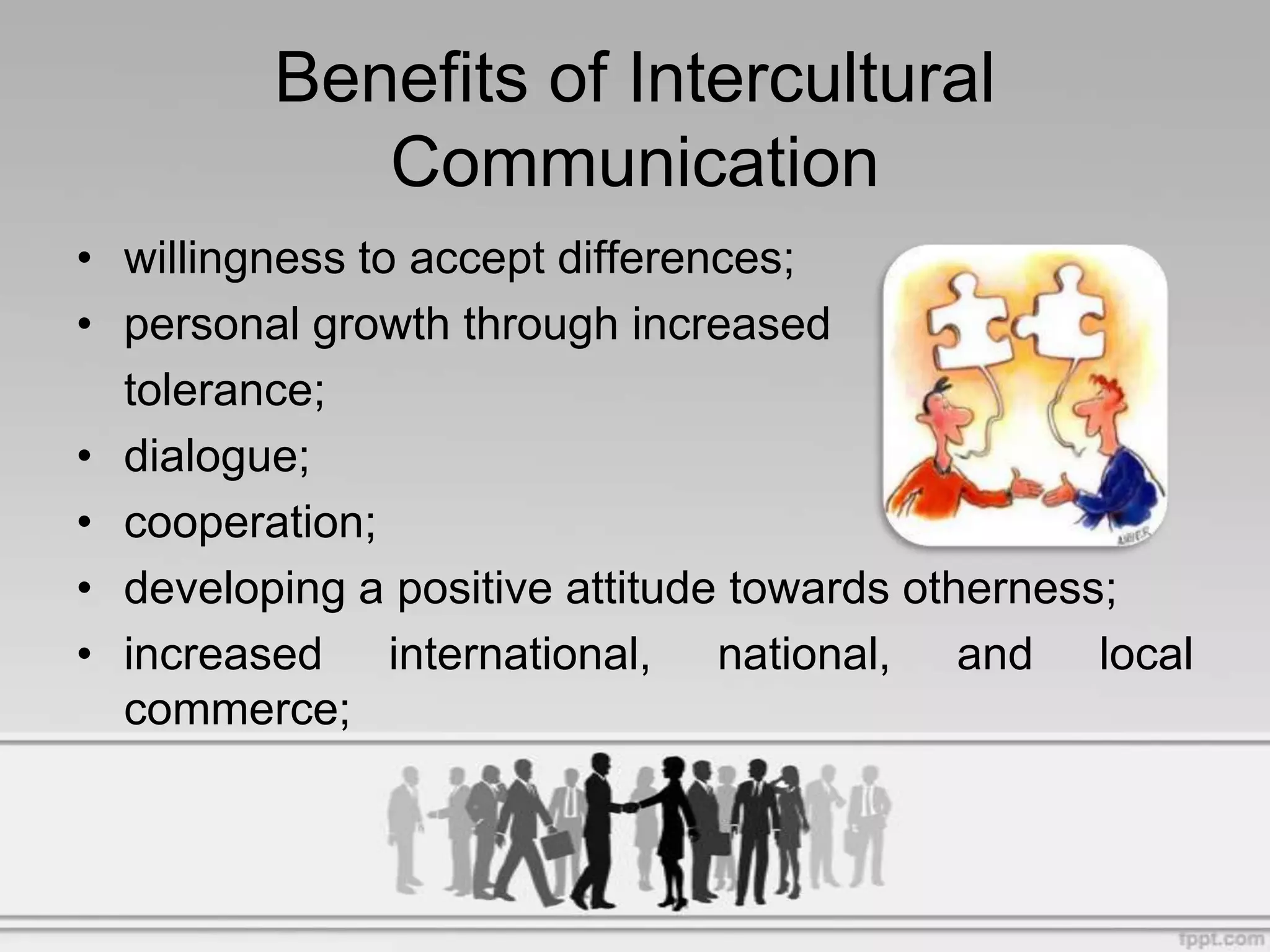
Benefits of Intercultural
            Communication
• willingness to accept differences;
• personal growth through increased
  tolerance;
• dialogue;
• cooperation;
• developing a positive attitude towards otherness;
• increased international, national, and local
  commerce;
The importance of IC
The theories developed by the researchers and academics can and
has been applied to many fields such as business, management,
marketing, advertising and website design.

As business becomes more and more international, many companies
need to know how best to structure their companies, manage staff and
communicate with customers. Intercultural communication gives them
an insight into the areas they need to address or understand.
Intercultural communication theories are now also used within the
education, health care and other public services due to growing
multicultural populations.
Cross-cultural communication
• As our world becomes increasingly
  interconnected,        people increasingly
  encounter problems when communicating
  with people from other cultures. This can
  lead to problems ranging from employee
  frustration and decreased efficiency, to
  losing billion dollar deals.
Cross-cultural communication in
         the business context
•   Watch the short video (link below) and try to answer the questions.

                        http://youtu.be/BrJTf97Ev8o

1. Try to identify the main problems in the video. What are the possible
    sources of misunderstanding?
2. What issues does Terry face with Carlos and Miguel?
3. What issues does Carlos and Miguel face with Terry?
4. How can they bridge their differences?
5. Why is successful intercultural communication so important in the
    business context?
Discussion
1. What does intercultural communication
   mean to you?
2. What are, in your opinion, the benefits of
   developing intercultural awareness?
3. Can intercultural communication be
   dangerous in any way?

Intercultural communication

  • 1.
    Jak narody porozumiewająsię ze sobą w komunikacji międzykulturowej i komunikowaniu medialnym [Intercultural communication and media communication between nations] Jerzy Mikułowski Pomorski Kraków: Universitas, 2007 Selected chapters abridged and summarised by Intercultural Communication Course students, English Studies Jagiellonian University 2012/13
  • 2.
    Intercultural Communication by Anna Sudoł and Natalia Sas
  • 3.
    Outline of thepresentation 1. Origins 2. Definition 3. Interdisciplinary Orientation 4. Benefits of Intercultural Communication 5. Discussion
  • 4.
    Origins • Intercultural communication stretches back into antiquity. It all began when people from different cultures started to meet together and communicate with each other. First, it was promoted by missionaries, merchants or diplomats. • As an academic field of study and research it has been popular since 1950s. The term ‘intercultural communication’ was first used when the American anthropologists Edward T. Hall, Ruth and John Useem began to explore how people from different cultures can successfully communicate. • During the past decades the growth of globalization, immigration and international tourism has involved large numbers of people in intercultural interaction. This has led to an increased desire and need for knowledge regarding how people from different cultures, beliefs and religions come together to work and communicate with each other.
  • 5.
    Definition Interactions with people from different cultural backgrounds; a process of exchanging, negotiating, and mediating one's cultural differences through language, non-verbal gestures, and space relationships
  • 6.
    • Cross-cultural Communication- implies a comparison of and contrast between particular aspects of communication between cultures • Intercultural Communication - the communication between people from different cultures (it refers to what happens when these culturally-different groups come together, interact and communicate)
  • 7.
    Interdisciplinary orientation • cultural anthropology • psychology • social psychology • sociology • linguistics and semiotics • cultural studies • rhetoric
  • 8.
    Benefits of studyingIntercultural Communication according to F.E. Jandt1  improving verbal and nonverbal communication;  becoming better in recognizing and undertaking communication behaviours in various contexts;  better adaptation to a new environment;  learning how to understand, reduce and overcome stress;  better understanding of one’s own culture and finding one’s place in a society;  reduced feeling of anxiety in contacts with members of other cultures;  learning about customs and habitual behaviours of members of other cultures. 1Jandt, F. E. (1995) Intercultural Communication. Sage Thousand Oaks.
  • 9.
    Benefits of Intercultural Communication • willingness to accept differences; • personal growth through increased tolerance; • dialogue; • cooperation; • developing a positive attitude towards otherness; • increased international, national, and local commerce;
  • 10.
    The importance ofIC The theories developed by the researchers and academics can and has been applied to many fields such as business, management, marketing, advertising and website design. As business becomes more and more international, many companies need to know how best to structure their companies, manage staff and communicate with customers. Intercultural communication gives them an insight into the areas they need to address or understand. Intercultural communication theories are now also used within the education, health care and other public services due to growing multicultural populations.
  • 11.
    Cross-cultural communication • Asour world becomes increasingly interconnected, people increasingly encounter problems when communicating with people from other cultures. This can lead to problems ranging from employee frustration and decreased efficiency, to losing billion dollar deals.
  • 12.
    Cross-cultural communication in the business context • Watch the short video (link below) and try to answer the questions. http://youtu.be/BrJTf97Ev8o 1. Try to identify the main problems in the video. What are the possible sources of misunderstanding? 2. What issues does Terry face with Carlos and Miguel? 3. What issues does Carlos and Miguel face with Terry? 4. How can they bridge their differences? 5. Why is successful intercultural communication so important in the business context?
  • 13.
    Discussion 1. What doesintercultural communication mean to you? 2. What are, in your opinion, the benefits of developing intercultural awareness? 3. Can intercultural communication be dangerous in any way?