
















COMS 110
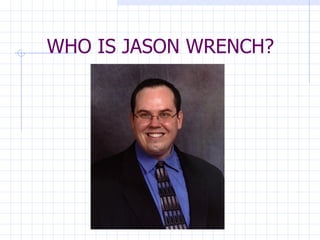
WHO IS JASON WRENCH?
1) Where is Jason’s home town? 2) What kind of car does he drive? 3) How old is he? 4) What political party does he belong?
5) What is his favorite movie? 6) What were his previous jobs? 7) What is his favorite soft drink? 8) What is his preferred religious affiliation?
Basic Information: Professor:  Dr. Jason S. Wrench 357 Shannon Hall (740) 699-2509 (800) 648-3331 ext. 2509 http://www.roadspeakers.com/jwrench/courses/110
COURSE GOALS
1) Provide a working framework for understanding and interacting with other cultures in a new and unique way. 2) Explain how culture influences our norms, values, and beliefs that affect our relationships with other people
3) Describe the obstacles to competent intercultural communication and the numerous ways that these obstacles can be overcome. 4) Provide a greater understanding of research in the field of communication studies through the examination of cultures.
5. Encourage you to gain experience and knowledge about other cultures while, at the same time, learning more about yourself as an “other” through the entire process.  This means that interaction with other cultures will be highly encouraged throughout the entire semester.
General Approach to Intercultural Communication
Two Units Of Study
1. Intercultural Communication Theory 2. Applying Intercultural Communication to the World Around Us
Course Structure
1) Course Readings 2) Course Workbook 3) Streaming Video/DVD Lecture Organization 4) Personal Data Form
Course Assignments
1) 2 Unit Examinations 2) Activity Points 3) 2 Intercultural Interaction Papers 4) Major/Final Project
Syllabus
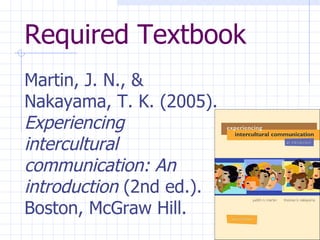
Required Textbook Martin, J. N., & Nakayama, T. K. (2005).  Experiencing intercultural communication: An introduction  (2nd ed.). Boston, McGraw Hill.
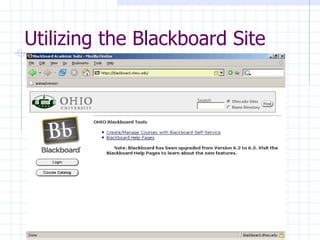
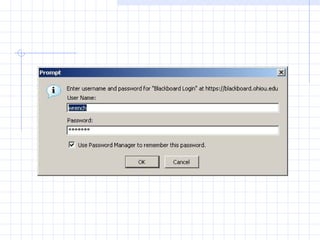
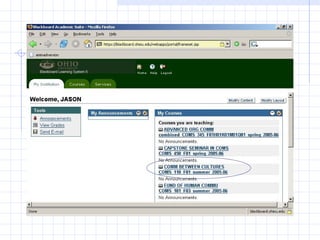
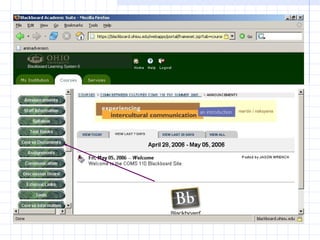
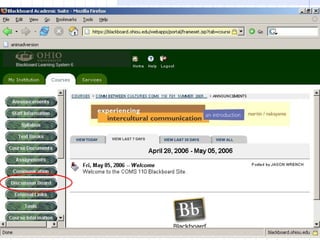
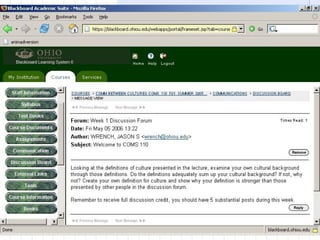
Utilizing the Blackboard Site


UNIT ONE-ONE – Page 5 What is Communication?
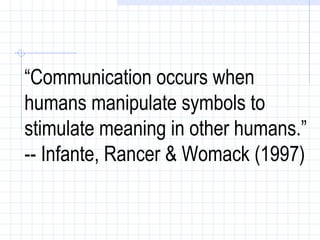
“ Communication occurs when humans manipulate symbols to stimulate meaning in other humans.”  -- Infante, Rancer & Womack (1997)
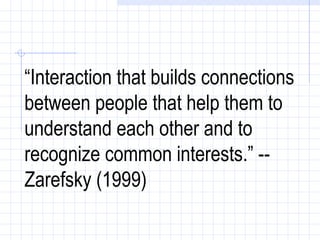
“ Interaction that builds connections between people that help them to understand each other and to recognize common interests.” -- Zarefsky (1999)
“ The process by which one person stimulates meaning in the mind of another through verbal and nonverbal messages.” -- McCroskey (1998)
Nature of Communication
Symbolic Process - We use symbols/rubrics 2) Social Process - We communicate with others  – not ourselves (No  intrapersonal communication) 3) Co-Orientation - Must have a common basis  for communication (e.g.  language systems)
4) Individual Interpretation - Each of interprets words  differently 5) Shared Meaning - We communicate through the  meanings we share - Meanings are in People, NOT  words
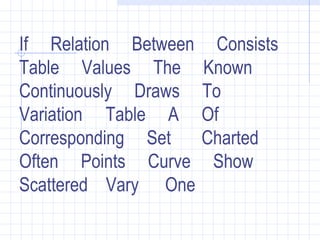
If  Relation  Between  Consists Table  Values  The  Known Continuously  Draws  To  Variation   Table  A   Of Corresponding  Set   Charted  Often  Points  Curve  Show Scattered  Vary   One
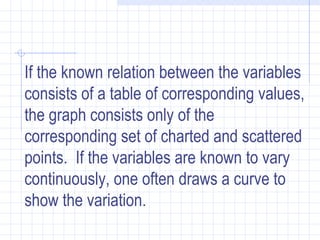
If the known relation between the variables consists of a table of corresponding values, the graph consists only of the corresponding set of charted and scattered points.  If the variables are known to vary continuously, one often draws a curve to show the variation.
Last Serny, Flingledobe and Prinbin were in the Nerd-link tapering gloopy caples and cleaming burly gleps.  Suddenly, a ditty strezzle boofed into Flingledobe’s treak.  Prinbin glaped and glaped.  “Oh Flingledobe.”  He chiffed.  “That ditty strezzle is tunning in your glep.”
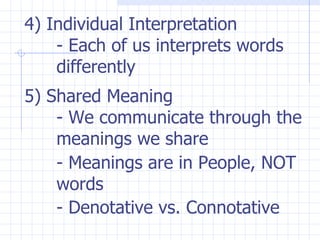
4) Individual Interpretation - Each of us interprets words  differently 5) Shared Meaning - We communicate through the  meanings we share - Meanings are in People, NOT  words - Denotative vs. Connotative
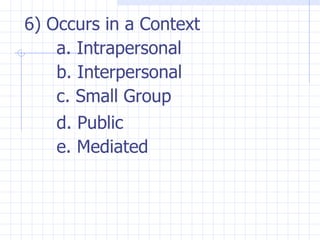
6) Occurs in a Context a. Intrapersonal b. Interpersonal c. Small Group d. Public e. Mediated
Communication Controversies
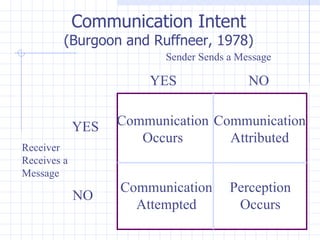
Sender Sends a Message  YES NO Communication Occurs YES NO Receiver Receives a Message Communication Intent (Burgoon and Ruffneer, 1978) Communication Attributed Communication Attempted Perception Occurs
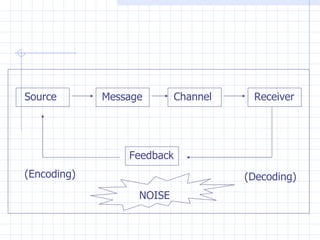
Source Message Channel Receiver (Decoding) Feedback (Encoding) NOISE
What is Culture?
“ Culture is the that complex whole which includes knowledge, belief, art, morals, law, customs, and other capabilities and habits acquired by man as a member of society.”  Sir E.B. Tylor (1871)
Kessing (1974)   Definition of Culture  (page 9 in workbook)
“ Learned systems of meaning, communicated by means of natural language and other symbol systems . . . and capable of creating cultural entities and particular senses of reality.  Through these systems of meaning, groups of people adapt to their environment and structure interpersonal activities . . . . Cultural meaning systems can be treated as a very large diverse pool of knowledge, or partially shared cluster of norms, or as intersubjectively shared, symbolically created realities” – D’Andrade (1984)
A group of people who through a process of learning are able to share perceptions of the world which influences beliefs, values, and norms, which eventually affect behavior.  (Wrench, 2000)
Types of Cultures
Anthropological Definitions Culture is a pattern of thoughts & believes – or behaviors
Psychological Definitions Hofstede “interactive aggregate of communication characteristics that influence a human group’s response to its environment.”   Collective programming of the mind
Ethnographic Definitions Pattern of activity with “symbolic significance” to the people enacting.
The Nature of Culture
Identity Meaning Function  Who Am I?   Cultural beliefs, values, & norms provide anchoring points for life.
Group Inclusion Function  Our need to belong.  (Maslow’s Hierarchy)
Intergroup Boundary Regulation Function  Shapes our in-group and out-group attitudes with people who are culturally dissimilar.
Ecological Adaptation Function  Facilitates our adaptation process among self, the cultural community, and the larger environment (ecological milieu/habitat – Native American vs. New Yorker)
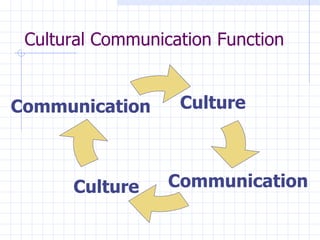
Cultural Communication Function  Culture Culture Communication Communication
Characteristics of Cultural Studies
General vs. Specific approaches to analysis
Cultural practices and power
Contexts within culture  Economic b. Social c. Political
Both the object of study and location of study
Bridges divisional research
Moral evaluation of culture
Radical line of political action
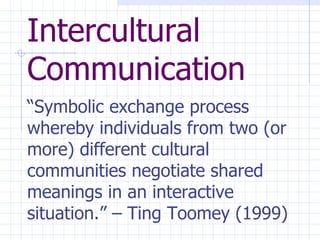
Intercultural Communication “ Symbolic exchange process whereby individuals from two (or more) different cultural communities negotiate shared meanings in an interactive situation.” – Ting Toomey (1999)
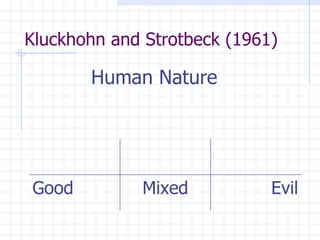
Kluckhohn and Strotbeck (1961)  Human Nature   Evil Mixed Good
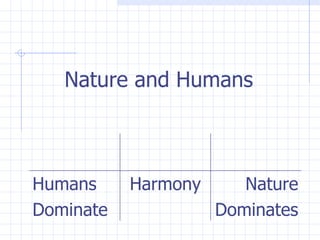
Nature and Humans   Nature Dominates Harmony Humans Dominate
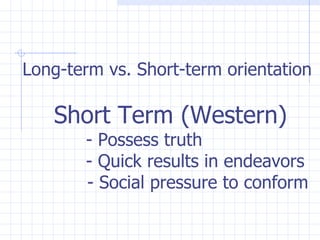
Long-term vs. Short-term orientation   Short Term (Western) - Possess truth - Quick results in endeavors - Social pressure to conform
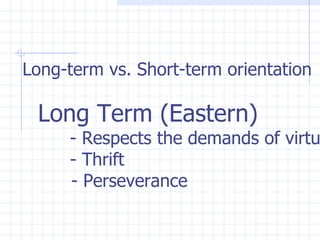
Long-term vs. Short-term orientation   Long Term (Eastern) - Respects the demands of virtue   - Thrift   - Perseverance
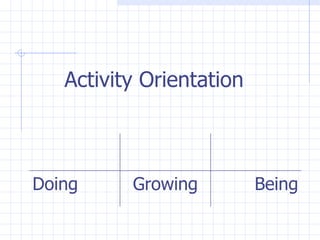
Activity Orientation   Being Growing Doing
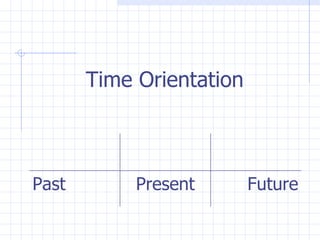
Time Orientation   Future Present Past
Hofstede (1984)
Power Distance  Distance you are from the Top of the hierarchy to the Bottom
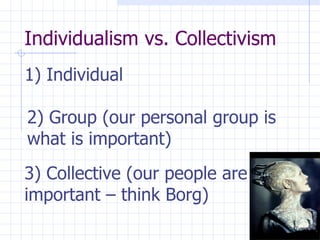
Individualism vs. Collectivism  1) Individual   2) Group (our personal group is what is important)   3) Collective (our people are important – think Borg)
Uncertainty Avoidance  Degree to which people feel apprehensive about unknown situations & the extent they will go to avoid them.   Weak:  reduce rules, accept dissent, & take risks (Britain, US, Hong Kong)  Strong:  extensive rules & seek consensus (Japan, Greece, Portugal)
Masculinity/Femininity (NOT SEX)  Masculine  (Assertiveness): Achievement, ambition, acquisition of material goods   Feminine  (Responsiveness): Quality of life, servitude, nurturing, support for less fortunate
Five Core Assumptions of Intercultural Communication
1) Intercultural communication involves varying degrees of cultural group membership differences.
2) Intercultural communication involves the simultaneous encoding and decoding of verbal and nonverbal messages in the exchange process.
3) Many intercultural encounters involve well-meaning clashes.
4) Intercultural communication always takes place in a context.
5) Intercultural communication always takes place in embedded systems.
History of Intercultural Communication Research
Origin of Cultural Studies
Centre for Contemporary Cultural Studies (1964)
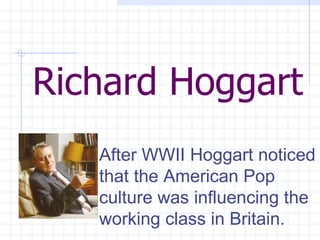
Richard Hoggart After WWII Hoggart noticed that the American Pop culture was influencing the working class in Britain.
Hoggart felt that this Americanized pop culture in Britain had warped the “authentic” working class life.  Hoggart founded the Centre for Contemporary Studies at Birmingham University to study this phenomenon.
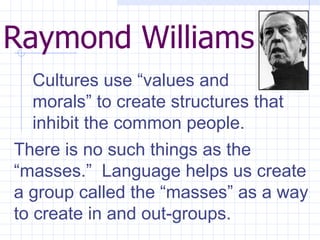
Raymond Williams   Cultures use “values and  morals” to create structures that inhibit the common people.  There is no such things as the “masses.”  Language helps us create a group called the “masses” as a way to create in and out-groups.
The exorcise of declaring what is good and what is bad is not an innocent exercise because often it is very biased and hypocritical of minorities.
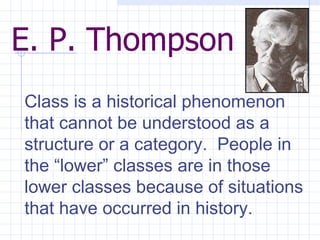
E. P. Thompson Class is a historical phenomenon that cannot be understood as a structure or a category.  People in the “lower” classes are in those lower classes because of situations that have occurred in history.
Class can be seen as “a social and cultural formation arising from processes which can only be studied as they work themselves out over a considerable historical period.”  Culture must be understood through the experiences of both the winners and the losers.
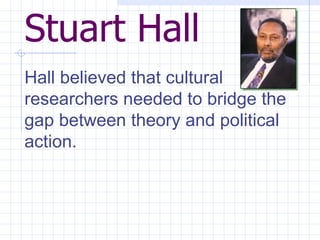
Stuart Hall   Hall believed that cultural researchers needed to bridge the gap between theory and political action.
Hall also strays from Marxist thoughts of the previous three and argues that “society is driven by conflicts based on sex, race, religion, and region, as well as class.  Culture shapes people’s sense of identity just as much as economics.”
History of Intercultural Communication Research (US)
Foreign Service Institute (FSI)   http://www.state.gov/m/fsi/
Nonverbal Communication
Application of theory   Cross Cultural Training Diversity Training
Emphasis on International Settings
Interdisciplinary Focus
Linguists  Helped us understand language.  How learning language helps with intercultural communication competence.
Anthropologists The role culture plays in our lives. The importance of nonverbal communication. The role of researcher’s bias in cultural research.
Psychologists  They started researching stereotyping and prejudice. How variables like nationality, ethnicity, personality, and gender influence our intercultural communication.
Now Centered in Communication Studies
Intercultural Communication Research
Three Approaches to Studying Culture and Communication
Social Scientific Approach
Assumptions Existence of a describable external reality. Human behavior is predictable. Goal is to Predict, Explain, and Control Human Behavior. Uses Quantitative Methods.
Interpretive Approach
Assumptions Reality is constructed by humans. Human experience is subjective. Human behavior is creative and not easily predicted.
Assumptions cont. The goal is to Understand and describe human behavior (not predict). They use both qualitative and Rhetorical Tools. Find a group or artifact and analyze.
Critical  Approach
Assumptions Subjective reality. Contexts in which communication occurs is of the utmost importance.  Historical contexts can be very important.
Assumptions cont. Examine power relations in communication and how they influence  cultural communication relationships. The goal is to Understand and change the lives of everyday communicators.
Why study Intercultural Communication?
The Demographic Imperative
Influence of Immigration   By 2030 half of the US will be minorities. Each wave of immigrants has shaped our society.
Immigration History   First colonists – already 10 million Native Americans were here. Europeans wiped out 500,000 Native Americans through disease
African American Immigrants  Over 10 million Africans were forcibly brought to the US over a 350 year period.
Relationships with New Immigrants   Always creates tension and conflict. Melting Pot Ideology (and problems). Nativistic Movement (late 19th and early 20th Century)
Immigration and Economic Classes   Immigrants have always filled our lowest class denominators.  Often immigrants fill jobs our own people wouldn’t.
Demographic Diversity   Religious Diversity Ethnic/Racial Diversity Age Diversity Socioeconomic Diversity Sexual Diversity Etc…
Economic Imperative Understanding other cultures, and being able to communicate with them, is good business.
Peace Imperative   With understanding comes compromise, with compromise comes peace.
Self-Awareness Imperative   Study about culture helps us understand ourselves in a clearer light.
Ethical Imperative   We have to think about what are the ethical issues of living in an intercultural world.
Three Initial Problems with Studying Other Cultures
Assume Similarity   Assuming people from other cultures are just like people from my culture.
Assume Superiority   Assuming that people from my culture are better than people from another culture.
Ethnocentrism ethnos , meaning nation  kentron , meaning center Originally coined by Sumner (1906)
“ is our defensive attitudinal tendency to view the values and norms of our culture as superior to other cultures, and we perceive our cultural ways of living as the most reasonable and proper ways to conduct our lives” (Ting-Toomey, 1999, p. 157).
Fill Out the Generalized Ethnocentrism (GENE) Scale on pages 21-22 in your workbook. Pause Lecture Here
Interpreting the GENE Score Scores range from 15-75. People who receive a score over 35 are considered highly ethnocentric. People who receive a score under 30 are considered to have low levels of ethnocentrism.
Positive Aspects of Ethnocentrism In-group development  Nationalistic pride  Patriotism
Negative Aspects of Ethnocentrism Verbal & Physical Aggression Authoritarianism  Dogmatism  Narcissism  Nationalism  Religious Fundamentalism Homonegativity Sexism Racism Ageism Just to name a handful.
Basic Cultural Ethics
Self-Reflexivity
Learn About Others
Be Open To  New Ideas

Course Intro&1 1

  • 1.
  • 2.
    WHO IS JASONWRENCH?
  • 3.
    1) Where isJason’s home town? 2) What kind of car does he drive? 3) How old is he? 4) What political party does he belong?
  • 4.
    5) What ishis favorite movie? 6) What were his previous jobs? 7) What is his favorite soft drink? 8) What is his preferred religious affiliation?
  • 5.
    Basic Information: Professor: Dr. Jason S. Wrench 357 Shannon Hall (740) 699-2509 (800) 648-3331 ext. 2509 http://www.roadspeakers.com/jwrench/courses/110
  • 6.
  • 7.
    1) Provide aworking framework for understanding and interacting with other cultures in a new and unique way. 2) Explain how culture influences our norms, values, and beliefs that affect our relationships with other people
  • 8.
    3) Describe theobstacles to competent intercultural communication and the numerous ways that these obstacles can be overcome. 4) Provide a greater understanding of research in the field of communication studies through the examination of cultures.
  • 9.
    5. Encourage youto gain experience and knowledge about other cultures while, at the same time, learning more about yourself as an “other” through the entire process. This means that interaction with other cultures will be highly encouraged throughout the entire semester.
  • 10.
    General Approach toIntercultural Communication
  • 11.
  • 12.
    1. Intercultural CommunicationTheory 2. Applying Intercultural Communication to the World Around Us
  • 13.
  • 14.
    1) Course Readings2) Course Workbook 3) Streaming Video/DVD Lecture Organization 4) Personal Data Form
  • 15.
  • 16.
    1) 2 UnitExaminations 2) Activity Points 3) 2 Intercultural Interaction Papers 4) Major/Final Project
  • 17.
  • 18.
    Required Textbook Martin,J. N., & Nakayama, T. K. (2005). Experiencing intercultural communication: An introduction (2nd ed.). Boston, McGraw Hill.
  • 19.
  • 20.
  • 21.
  • 22.
  • 23.
  • 24.
  • 25.
  • 26.
  • 27.
  • 28.
  • 29.
    UNIT ONE-ONE –Page 5 What is Communication?
  • 30.
    “ Communication occurswhen humans manipulate symbols to stimulate meaning in other humans.” -- Infante, Rancer & Womack (1997)
  • 31.
    “ Interaction thatbuilds connections between people that help them to understand each other and to recognize common interests.” -- Zarefsky (1999)
  • 32.
    “ The processby which one person stimulates meaning in the mind of another through verbal and nonverbal messages.” -- McCroskey (1998)
  • 33.
  • 34.
    Symbolic Process -We use symbols/rubrics 2) Social Process - We communicate with others – not ourselves (No intrapersonal communication) 3) Co-Orientation - Must have a common basis for communication (e.g. language systems)
  • 35.
    4) Individual Interpretation- Each of interprets words differently 5) Shared Meaning - We communicate through the meanings we share - Meanings are in People, NOT words
  • 36.
    If Relation Between Consists Table Values The Known Continuously Draws To Variation Table A Of Corresponding Set Charted Often Points Curve Show Scattered Vary One
  • 37.
    If the knownrelation between the variables consists of a table of corresponding values, the graph consists only of the corresponding set of charted and scattered points. If the variables are known to vary continuously, one often draws a curve to show the variation.
  • 38.
    Last Serny, Flingledobeand Prinbin were in the Nerd-link tapering gloopy caples and cleaming burly gleps. Suddenly, a ditty strezzle boofed into Flingledobe’s treak. Prinbin glaped and glaped. “Oh Flingledobe.” He chiffed. “That ditty strezzle is tunning in your glep.”
  • 39.
    4) Individual Interpretation- Each of us interprets words differently 5) Shared Meaning - We communicate through the meanings we share - Meanings are in People, NOT words - Denotative vs. Connotative
  • 40.
    6) Occurs ina Context a. Intrapersonal b. Interpersonal c. Small Group d. Public e. Mediated
  • 41.
  • 42.
    Sender Sends aMessage YES NO Communication Occurs YES NO Receiver Receives a Message Communication Intent (Burgoon and Ruffneer, 1978) Communication Attributed Communication Attempted Perception Occurs
  • 43.
    Source Message ChannelReceiver (Decoding) Feedback (Encoding) NOISE
  • 44.
  • 45.
    “ Culture isthe that complex whole which includes knowledge, belief, art, morals, law, customs, and other capabilities and habits acquired by man as a member of society.” Sir E.B. Tylor (1871)
  • 46.
    Kessing (1974) Definition of Culture (page 9 in workbook)
  • 47.
    “ Learned systemsof meaning, communicated by means of natural language and other symbol systems . . . and capable of creating cultural entities and particular senses of reality. Through these systems of meaning, groups of people adapt to their environment and structure interpersonal activities . . . . Cultural meaning systems can be treated as a very large diverse pool of knowledge, or partially shared cluster of norms, or as intersubjectively shared, symbolically created realities” – D’Andrade (1984)
  • 48.
    A group ofpeople who through a process of learning are able to share perceptions of the world which influences beliefs, values, and norms, which eventually affect behavior. (Wrench, 2000)
  • 49.
  • 50.
    Anthropological Definitions Cultureis a pattern of thoughts & believes – or behaviors
  • 51.
    Psychological Definitions Hofstede“interactive aggregate of communication characteristics that influence a human group’s response to its environment.” Collective programming of the mind
  • 52.
    Ethnographic Definitions Patternof activity with “symbolic significance” to the people enacting.
  • 53.
  • 54.
    Identity Meaning Function Who Am I? Cultural beliefs, values, & norms provide anchoring points for life.
  • 55.
    Group Inclusion Function Our need to belong. (Maslow’s Hierarchy)
  • 56.
    Intergroup Boundary RegulationFunction Shapes our in-group and out-group attitudes with people who are culturally dissimilar.
  • 57.
    Ecological Adaptation Function Facilitates our adaptation process among self, the cultural community, and the larger environment (ecological milieu/habitat – Native American vs. New Yorker)
  • 58.
    Cultural Communication Function Culture Culture Communication Communication
  • 59.
  • 60.
    General vs. Specificapproaches to analysis
  • 61.
  • 62.
    Contexts within culture Economic b. Social c. Political
  • 63.
    Both the objectof study and location of study
  • 64.
  • 65.
  • 66.
    Radical line ofpolitical action
  • 67.
    Intercultural Communication “Symbolic exchange process whereby individuals from two (or more) different cultural communities negotiate shared meanings in an interactive situation.” – Ting Toomey (1999)
  • 68.
    Kluckhohn and Strotbeck(1961) Human Nature Evil Mixed Good
  • 69.
    Nature and Humans Nature Dominates Harmony Humans Dominate
  • 70.
    Long-term vs. Short-termorientation Short Term (Western) - Possess truth - Quick results in endeavors - Social pressure to conform
  • 71.
    Long-term vs. Short-termorientation Long Term (Eastern) - Respects the demands of virtue - Thrift - Perseverance
  • 72.
    Activity Orientation Being Growing Doing
  • 73.
    Time Orientation Future Present Past
  • 74.
  • 75.
    Power Distance Distance you are from the Top of the hierarchy to the Bottom
  • 76.
    Individualism vs. Collectivism 1) Individual 2) Group (our personal group is what is important) 3) Collective (our people are important – think Borg)
  • 77.
    Uncertainty Avoidance Degree to which people feel apprehensive about unknown situations & the extent they will go to avoid them. Weak: reduce rules, accept dissent, & take risks (Britain, US, Hong Kong) Strong: extensive rules & seek consensus (Japan, Greece, Portugal)
  • 78.
    Masculinity/Femininity (NOT SEX) Masculine (Assertiveness): Achievement, ambition, acquisition of material goods Feminine (Responsiveness): Quality of life, servitude, nurturing, support for less fortunate
  • 79.
    Five Core Assumptionsof Intercultural Communication
  • 80.
    1) Intercultural communicationinvolves varying degrees of cultural group membership differences.
  • 81.
    2) Intercultural communicationinvolves the simultaneous encoding and decoding of verbal and nonverbal messages in the exchange process.
  • 82.
    3) Many interculturalencounters involve well-meaning clashes.
  • 83.
    4) Intercultural communicationalways takes place in a context.
  • 84.
    5) Intercultural communicationalways takes place in embedded systems.
  • 85.
    History of InterculturalCommunication Research
  • 86.
  • 87.
    Centre for ContemporaryCultural Studies (1964)
  • 88.
    Richard Hoggart AfterWWII Hoggart noticed that the American Pop culture was influencing the working class in Britain.
  • 89.
    Hoggart felt thatthis Americanized pop culture in Britain had warped the “authentic” working class life. Hoggart founded the Centre for Contemporary Studies at Birmingham University to study this phenomenon.
  • 90.
    Raymond Williams Cultures use “values and morals” to create structures that inhibit the common people. There is no such things as the “masses.” Language helps us create a group called the “masses” as a way to create in and out-groups.
  • 91.
    The exorcise ofdeclaring what is good and what is bad is not an innocent exercise because often it is very biased and hypocritical of minorities.
  • 92.
    E. P. ThompsonClass is a historical phenomenon that cannot be understood as a structure or a category. People in the “lower” classes are in those lower classes because of situations that have occurred in history.
  • 93.
    Class can beseen as “a social and cultural formation arising from processes which can only be studied as they work themselves out over a considerable historical period.” Culture must be understood through the experiences of both the winners and the losers.
  • 94.
    Stuart Hall Hall believed that cultural researchers needed to bridge the gap between theory and political action.
  • 95.
    Hall also straysfrom Marxist thoughts of the previous three and argues that “society is driven by conflicts based on sex, race, religion, and region, as well as class. Culture shapes people’s sense of identity just as much as economics.”
  • 96.
    History of InterculturalCommunication Research (US)
  • 97.
    Foreign Service Institute(FSI) http://www.state.gov/m/fsi/
  • 98.
  • 99.
    Application of theory Cross Cultural Training Diversity Training
  • 100.
  • 101.
  • 102.
    Linguists Helpedus understand language. How learning language helps with intercultural communication competence.
  • 103.
    Anthropologists The roleculture plays in our lives. The importance of nonverbal communication. The role of researcher’s bias in cultural research.
  • 104.
    Psychologists Theystarted researching stereotyping and prejudice. How variables like nationality, ethnicity, personality, and gender influence our intercultural communication.
  • 105.
    Now Centered inCommunication Studies
  • 106.
  • 107.
    Three Approaches toStudying Culture and Communication
  • 108.
  • 109.
    Assumptions Existence ofa describable external reality. Human behavior is predictable. Goal is to Predict, Explain, and Control Human Behavior. Uses Quantitative Methods.
  • 110.
  • 111.
    Assumptions Reality isconstructed by humans. Human experience is subjective. Human behavior is creative and not easily predicted.
  • 112.
    Assumptions cont. Thegoal is to Understand and describe human behavior (not predict). They use both qualitative and Rhetorical Tools. Find a group or artifact and analyze.
  • 113.
  • 114.
    Assumptions Subjective reality.Contexts in which communication occurs is of the utmost importance. Historical contexts can be very important.
  • 115.
    Assumptions cont. Examinepower relations in communication and how they influence cultural communication relationships. The goal is to Understand and change the lives of everyday communicators.
  • 116.
  • 117.
  • 118.
    Influence of Immigration By 2030 half of the US will be minorities. Each wave of immigrants has shaped our society.
  • 119.
    Immigration History First colonists – already 10 million Native Americans were here. Europeans wiped out 500,000 Native Americans through disease
  • 120.
    African American Immigrants Over 10 million Africans were forcibly brought to the US over a 350 year period.
  • 121.
    Relationships with NewImmigrants Always creates tension and conflict. Melting Pot Ideology (and problems). Nativistic Movement (late 19th and early 20th Century)
  • 122.
    Immigration and EconomicClasses Immigrants have always filled our lowest class denominators. Often immigrants fill jobs our own people wouldn’t.
  • 123.
    Demographic Diversity Religious Diversity Ethnic/Racial Diversity Age Diversity Socioeconomic Diversity Sexual Diversity Etc…
  • 124.
    Economic Imperative Understandingother cultures, and being able to communicate with them, is good business.
  • 125.
    Peace Imperative With understanding comes compromise, with compromise comes peace.
  • 126.
    Self-Awareness Imperative Study about culture helps us understand ourselves in a clearer light.
  • 127.
    Ethical Imperative We have to think about what are the ethical issues of living in an intercultural world.
  • 128.
    Three Initial Problemswith Studying Other Cultures
  • 129.
    Assume Similarity Assuming people from other cultures are just like people from my culture.
  • 130.
    Assume Superiority Assuming that people from my culture are better than people from another culture.
  • 131.
    Ethnocentrism ethnos ,meaning nation kentron , meaning center Originally coined by Sumner (1906)
  • 132.
    “ is ourdefensive attitudinal tendency to view the values and norms of our culture as superior to other cultures, and we perceive our cultural ways of living as the most reasonable and proper ways to conduct our lives” (Ting-Toomey, 1999, p. 157).
  • 133.
    Fill Out theGeneralized Ethnocentrism (GENE) Scale on pages 21-22 in your workbook. Pause Lecture Here
  • 134.
    Interpreting the GENEScore Scores range from 15-75. People who receive a score over 35 are considered highly ethnocentric. People who receive a score under 30 are considered to have low levels of ethnocentrism.
  • 135.
    Positive Aspects ofEthnocentrism In-group development Nationalistic pride Patriotism
  • 136.
    Negative Aspects ofEthnocentrism Verbal & Physical Aggression Authoritarianism Dogmatism Narcissism Nationalism Religious Fundamentalism Homonegativity Sexism Racism Ageism Just to name a handful.
  • 137.
  • 138.
  • 139.
  • 140.
    Be Open To New Ideas