

NAME:RUSHITA BELADIYA
ENROLLEMENT
NO:130210116003
TOPIC:CROSS CULTURAL
COMMUNICATION
WHAT IS THE CULTURE??
 Culture is a way of life of a group of people…
 The stereotyped patterns of learning behaviour , which
are passed on from one generation to the next through
means of language and imitation .
 It is also defined as a set of values, beliefs, norms, rules
and codes that influences people to identify and
define themselves as a distinct group.
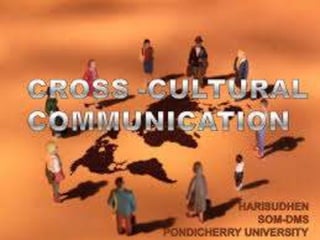
WHAT IS THE CROSS CULTURAL
COMMUNICATION?
 In a simple words, it can be defined as
“MISCOMMUNICATION”.
 This happens when parties engaged in negotiations or any
other form of communication are from different cultural
backgrounds.
 EXAMPLE:
one English man meet to the one Guajarati
man who don’t know about the English
language then the miscommunication is
occur due to different types of the
language.
The characteristic of the cross
cultural communication
1.Evolving and dynamic characteristic
2.Relative advantage
3.Competitility
4.trial-abiliyt
5.Oure value system
6.Cultural integreety
7.Complexity
8.All pervasiveness
1.Evolving and dynamic
charactericteristic
 Culture changes accroding to the situations. It never
stops developing there are no boundary to cultural.
After every decade or sertain period of time culture
changes.
 Example: Indian culture is inclinder towards joint
family system but currently we find many necleare
families the change differs(comes) from culture to
culture.
2.Relative advantage
 This characteristic about the new and
superior type of culture. If the new culture is
superior in comparision with the older one
then it is easily adopted.
3.competibility
 The competibility of the culture means majority of the
people their thinking, behaviour addept the new
culture. They accept changes in certain existing
cultural patterns. I
 If it not competible the changs will be slow.
cross cultural communication..no..130210116003

cross cultural communication..no..130210116003

  • 1.
  • 3.
    WHAT IS THECULTURE??  Culture is a way of life of a group of people…  The stereotyped patterns of learning behaviour , which are passed on from one generation to the next through means of language and imitation .  It is also defined as a set of values, beliefs, norms, rules and codes that influences people to identify and define themselves as a distinct group.
  • 4.
    WHAT IS THECROSS CULTURAL COMMUNICATION?  In a simple words, it can be defined as “MISCOMMUNICATION”.  This happens when parties engaged in negotiations or any other form of communication are from different cultural backgrounds.  EXAMPLE: one English man meet to the one Guajarati man who don’t know about the English language then the miscommunication is occur due to different types of the language.
  • 5.
    The characteristic ofthe cross cultural communication 1.Evolving and dynamic characteristic 2.Relative advantage 3.Competitility 4.trial-abiliyt 5.Oure value system 6.Cultural integreety 7.Complexity 8.All pervasiveness
  • 6.
    1.Evolving and dynamic charactericteristic Culture changes accroding to the situations. It never stops developing there are no boundary to cultural. After every decade or sertain period of time culture changes.  Example: Indian culture is inclinder towards joint family system but currently we find many necleare families the change differs(comes) from culture to culture.
  • 7.
    2.Relative advantage  Thischaracteristic about the new and superior type of culture. If the new culture is superior in comparision with the older one then it is easily adopted.
  • 8.
    3.competibility  The competibilityof the culture means majority of the people their thinking, behaviour addept the new culture. They accept changes in certain existing cultural patterns. I  If it not competible the changs will be slow.