VERBAL
MESSAGES
Written & Spoken Language
The limits of my language mean
the limits of my world
- Philosopher Ludwig Wittgenstein
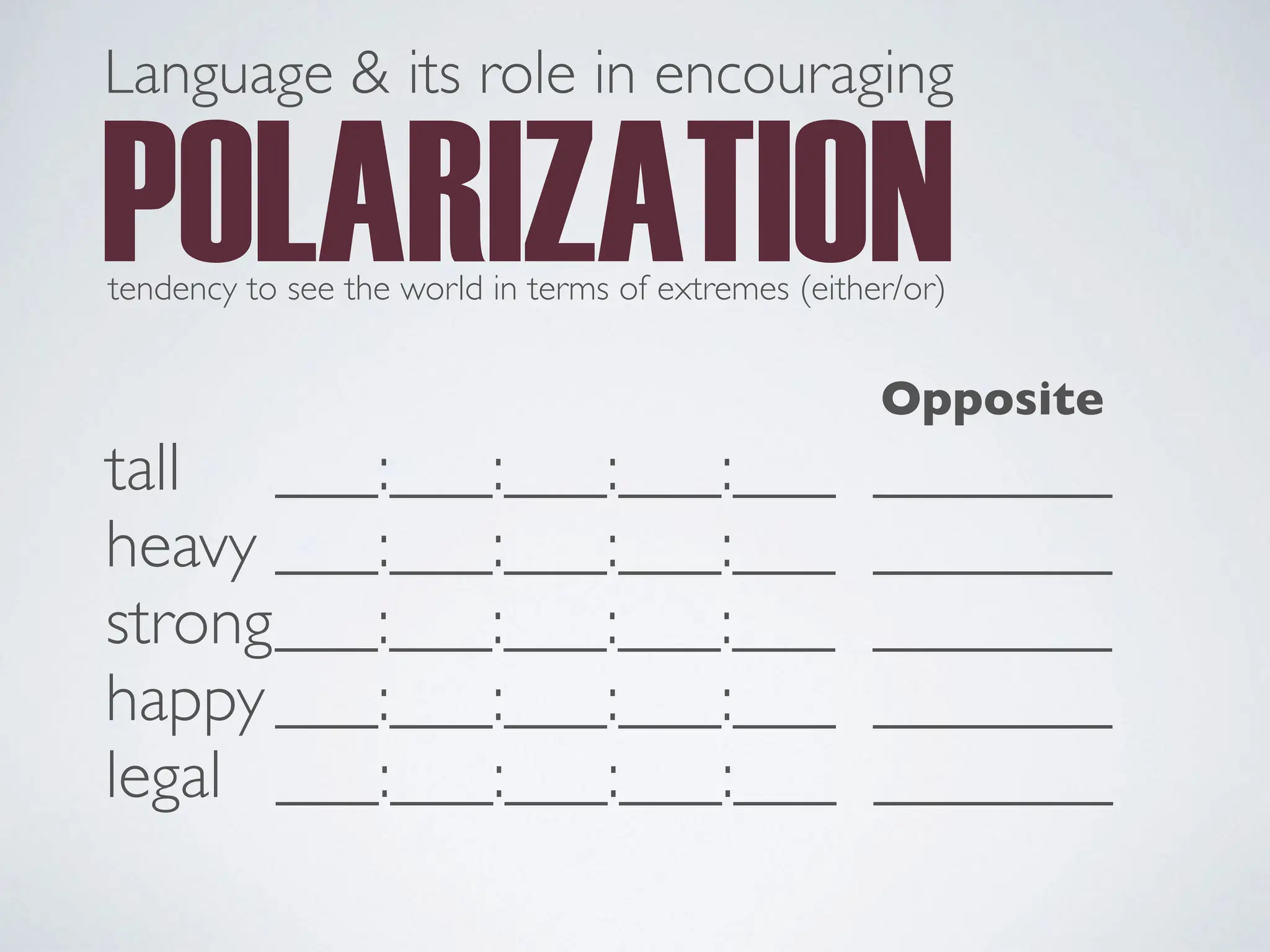
tall ___:___:___:___:___ _______
heavy ___:___:___:___:___ _______
strong___:___:___:___:___ _______
happy ___:___:___:___:___ _______
legal ___:___:___:___:___ _______
Opposite
POLARIZATION
Language & its role in encouraging
tendency to see the world in terms of extremes (either/or)
CAN WE
think outside of language
?
?
Amanda Baggs example
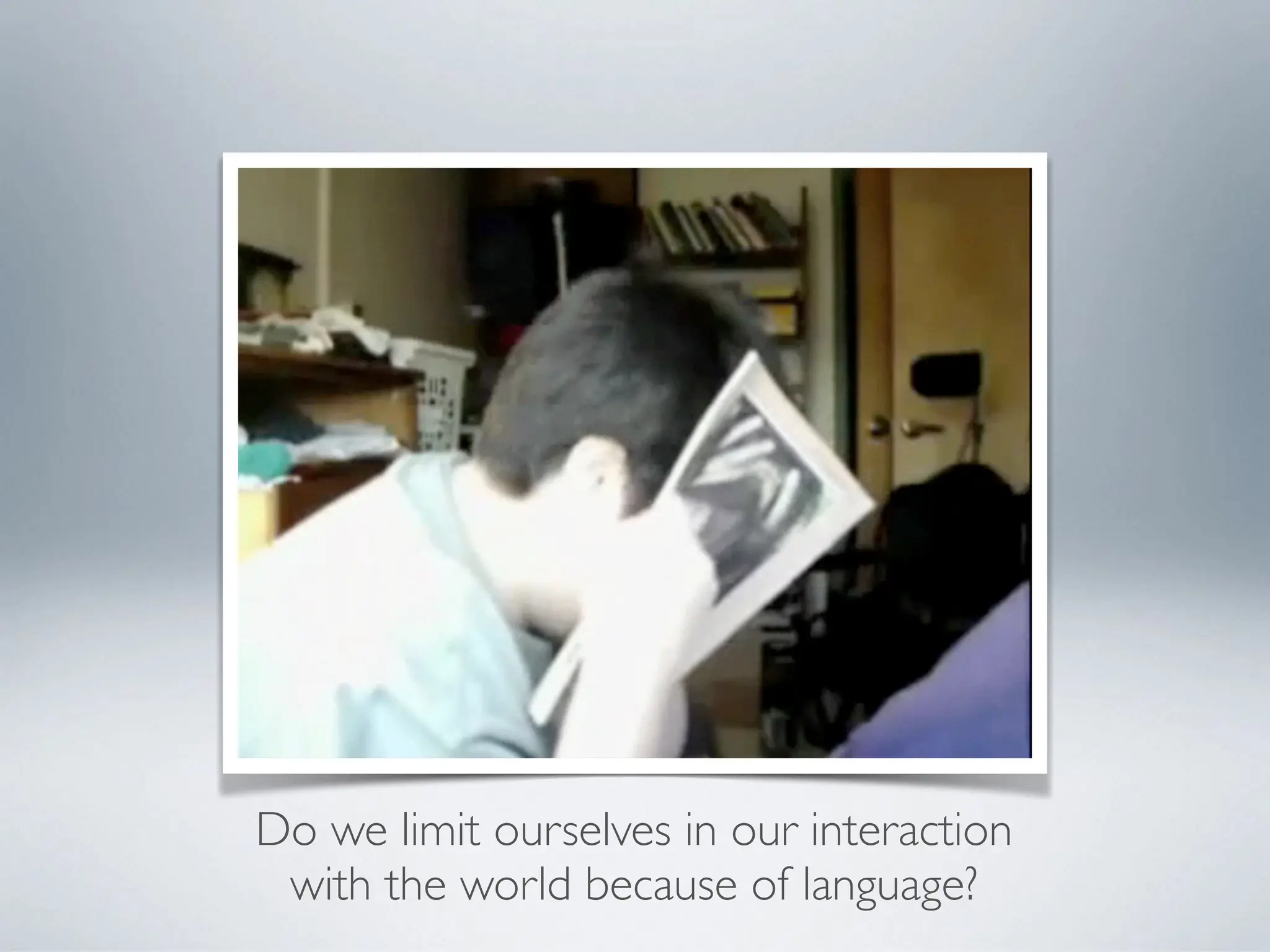
Do we limit ourselves in our interaction
with the world because of language?
• Get into groups of 3
• Designate a person to report back to the class
• Using this clip as an example:
• do you believe that we can think outside of language?
• do you believe that language con
fi
nes the way we
interact with the world?
• what do you think language is/means for Amanda?
GROUP DISCUSSION
The message is about what kinds of
communication and language and
people we consider real and which
ones we do not. It applies to
anybody who gets written off
because their communication is too
unusual.
“
“
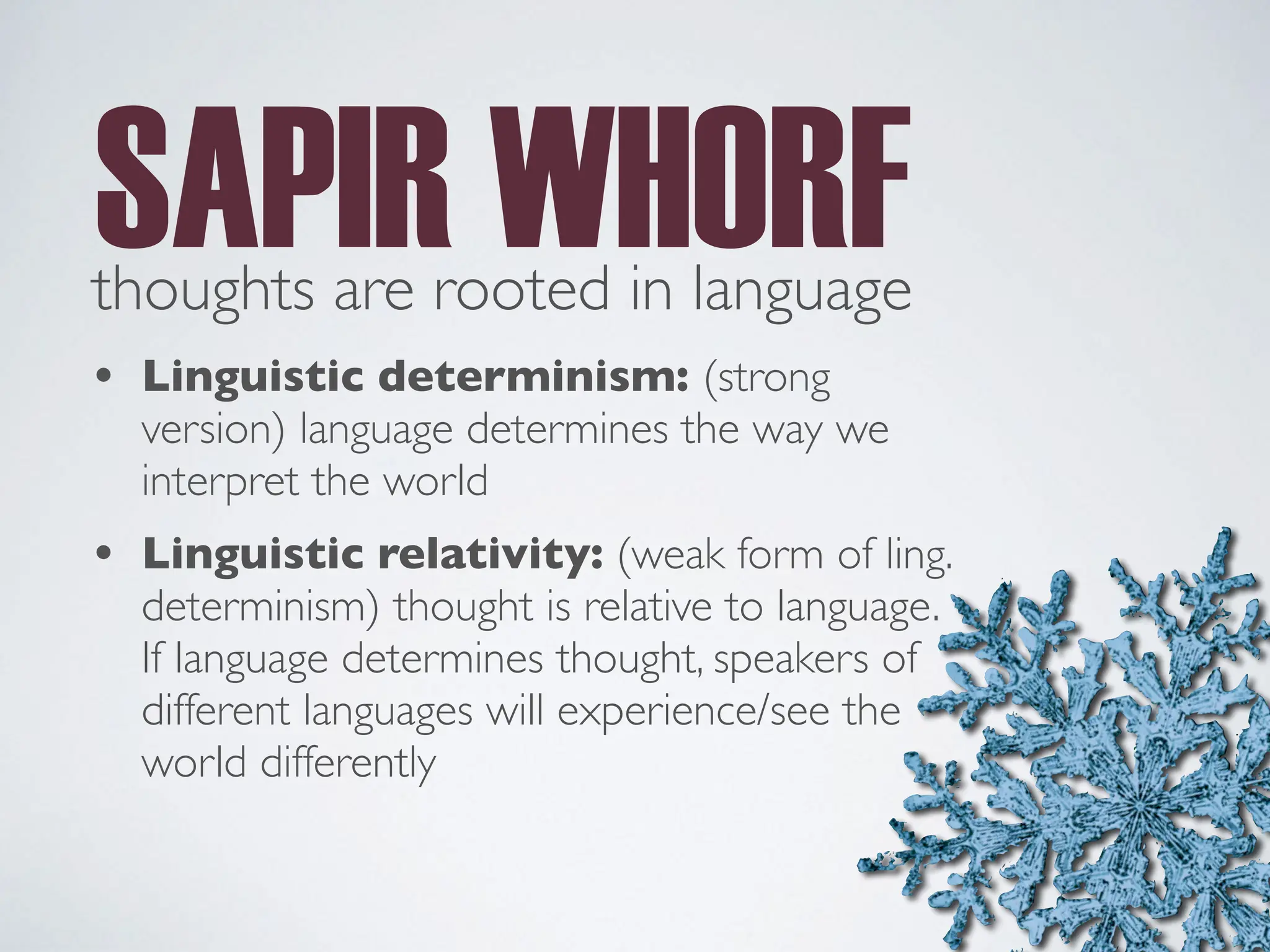
thoughts are rooted in language
SAPIR WHORF
• Linguistic determinism: (strong
version) language determines the way we
interpret the world
• Linguistic relativity: (weak form of ling.
determinism) thought is relative to language.
If language determines thought, speakers of
different languages will experience/see the
world differently
CAN WE
conceive of something
for which we have no words
?
?
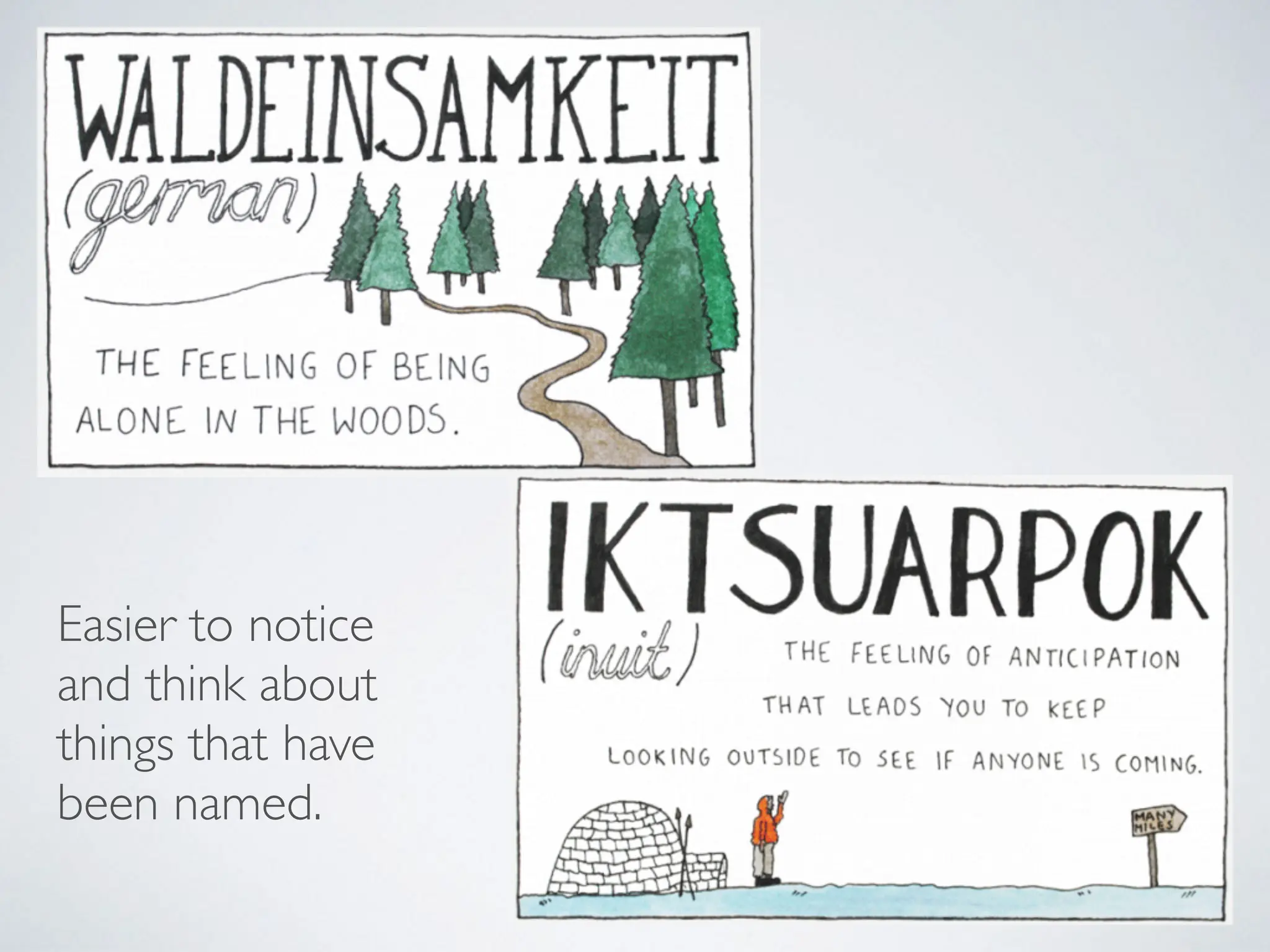
Easier to notice
and think about
things that have
been named.
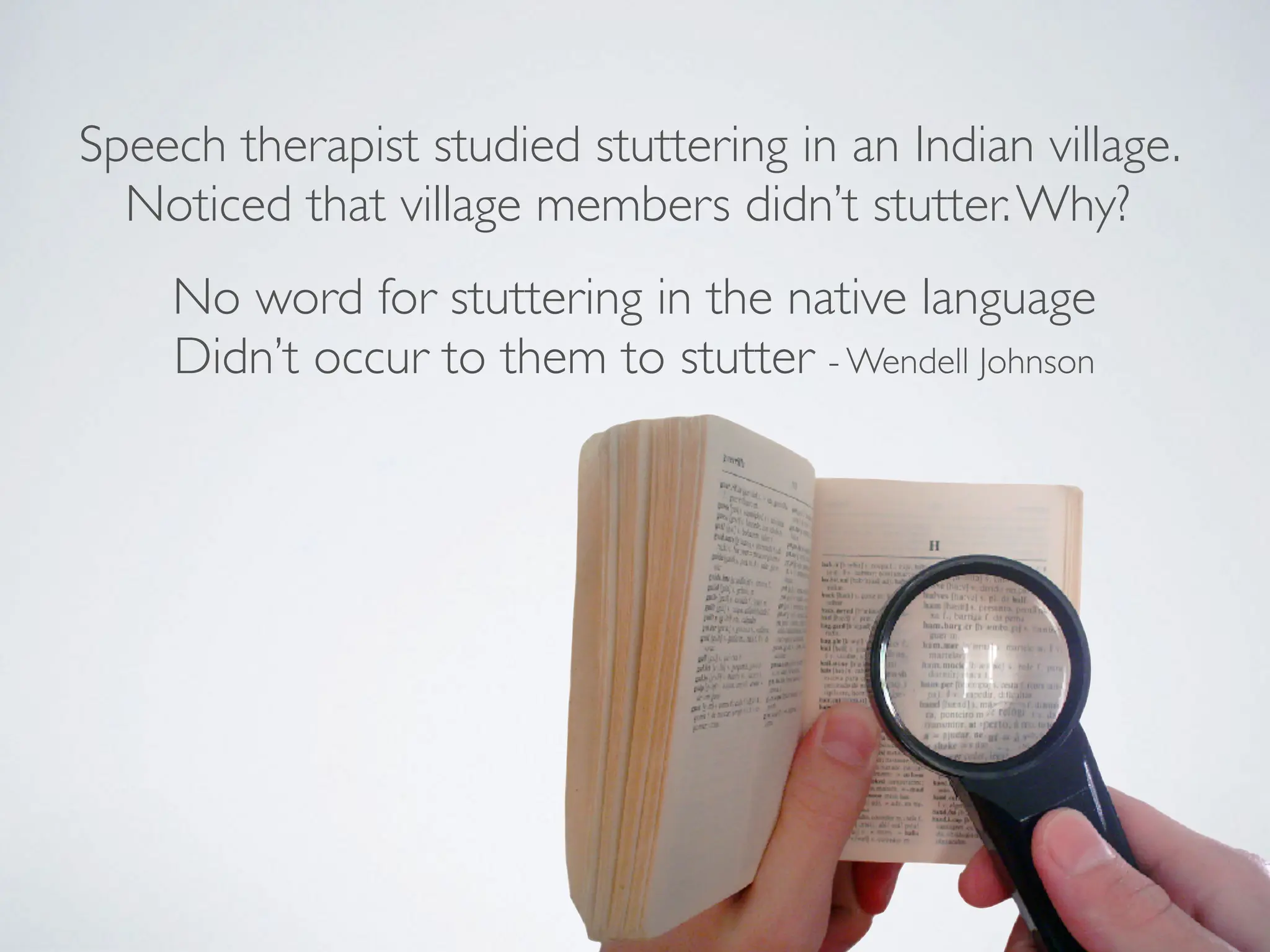
Speech therapist studied stuttering in an Indian village.
Noticed that village members didn’t stutter.Why?
No word for stuttering in the native language
Didn’t occur to them to stutter - Wendell Johnson
CRITICISMS:
• Cause-effect relationship between language & thought
• does language shape/constrain thought or do
thoughts shape/constrain our language?
• Not having a word for experience doesn’t negate
experience
• love
• sleep paralysis
• People who don’t acquire language are able to think
• Amanda’s example
VERBAL
MESSAGES
Social Construction of Reality
REALITY
What is
?
?
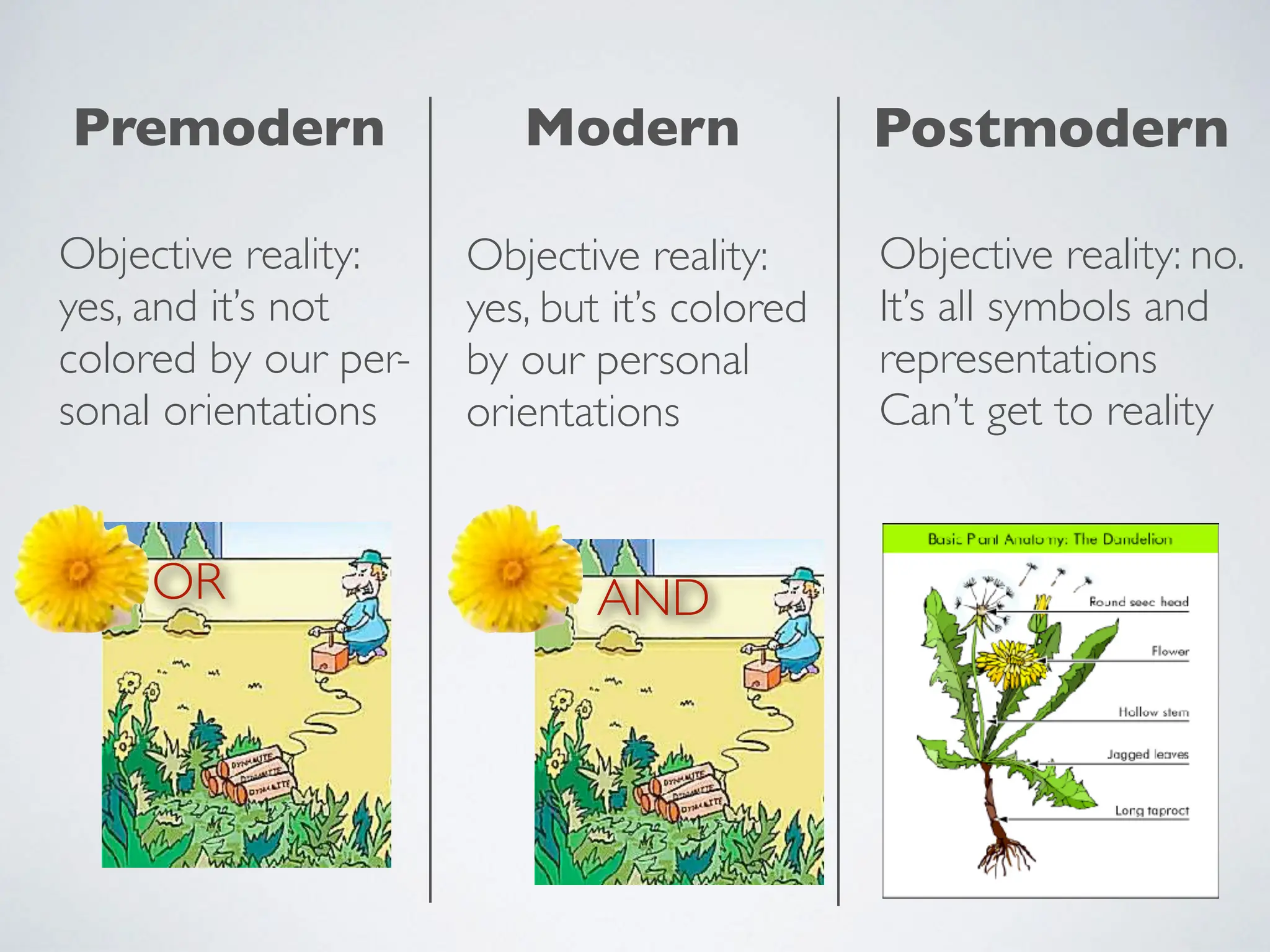
Premodern Modern Postmodern
Objective reality:
yes, but it’s colored
by our personal
orientations
Objective reality: no.
It’s all symbols and
representations
Can’t get to reality
Objective reality:
yes, and it’s not
colored by our per-
sonal orientations
AND
OR
REALITY
is socially constructed
through the symbols we use
SOCIALISM
What does it mean
?
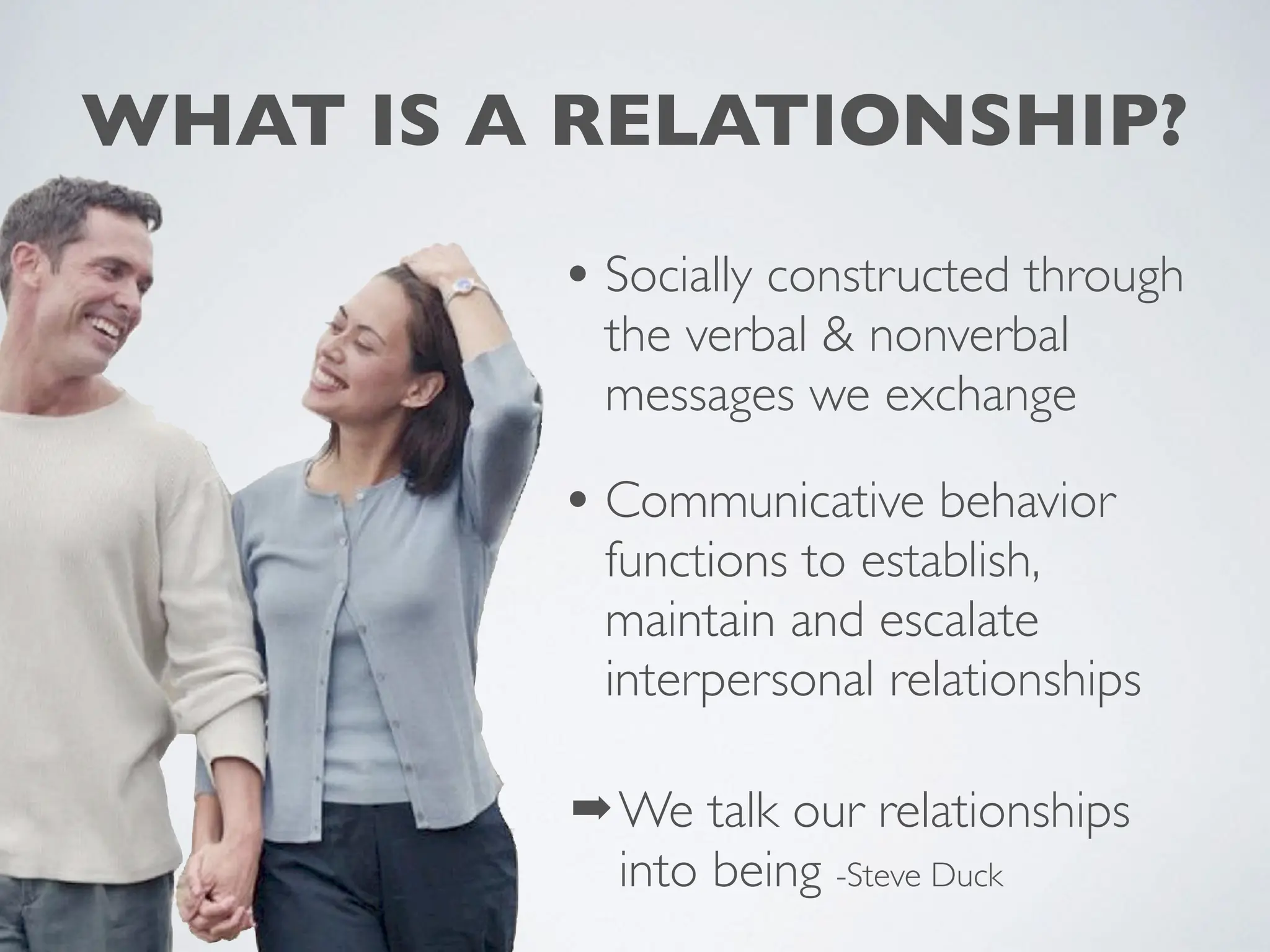
WHAT IS A RELATIONSHIP?
• Socially constructed through
the verbal & nonverbal
messages we exchange
• Communicative behavior
functions to establish,
maintain and escalate
interpersonal relationships
➡We talk our relationships
into being -Steve Duck
Negotiating your relationship status: Facebook example
Feelings are real. Shows that socially constructed relationship is perceived as real
EXAMPLE:
The social construction
of a mysterious medical disorder
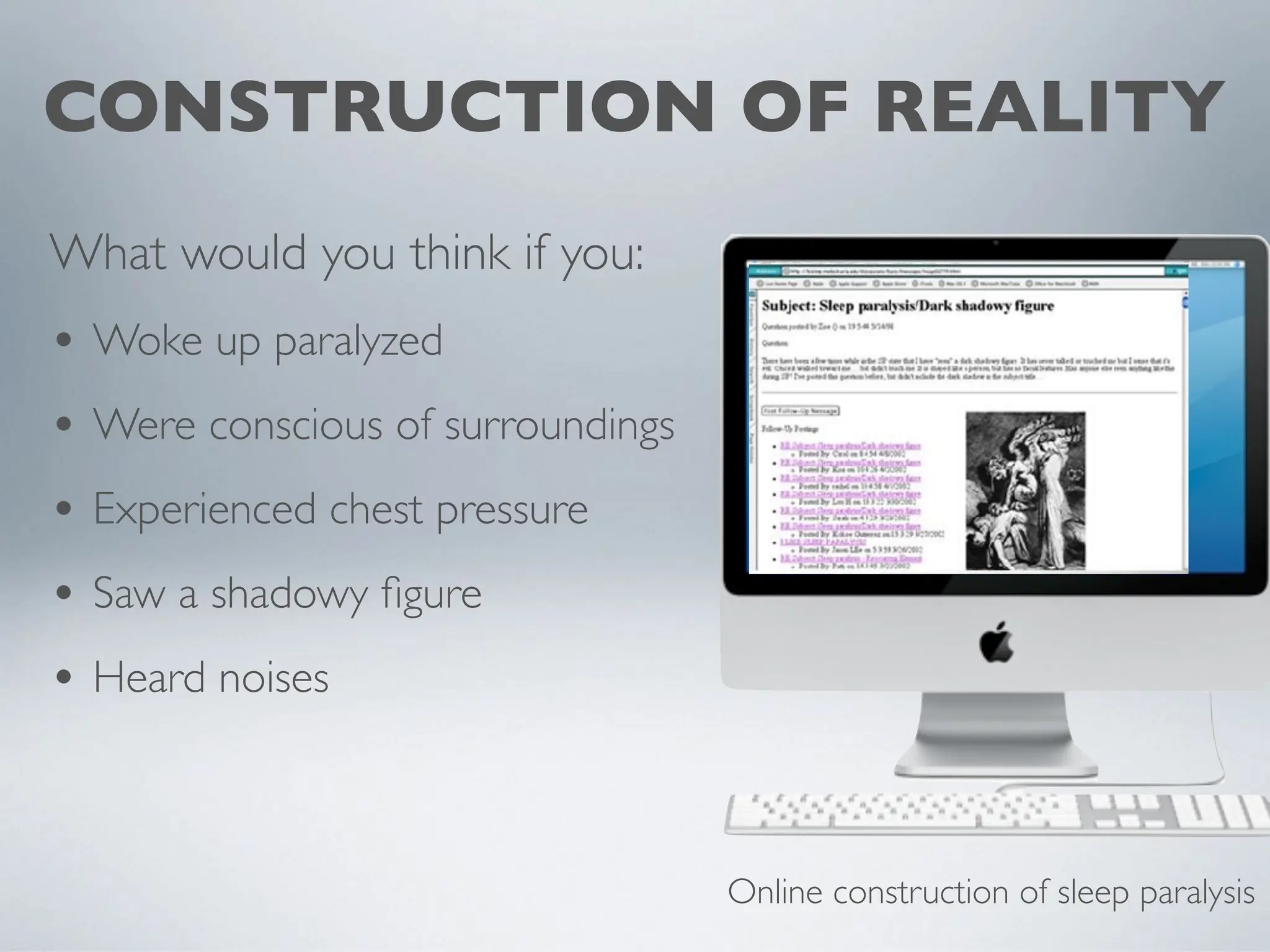
CONSTRUCTION OF REALITY
What would you think if you:
• Woke up paralyzed
• Were conscious of surroundings
• Experienced chest pressure
• Saw a shadowy
fi
gure
• Heard noises
Online construction of sleep paralysis
SP Experience
Paranormal Construction
Religious Construction
No medical help sought
Medical Construction
Spiritual Problem Untreatable Problem
Valuable Gift
Faith, not science is the
solution
Science can’t help
No desire to put an end
to it
Different realities based on how it is constructed
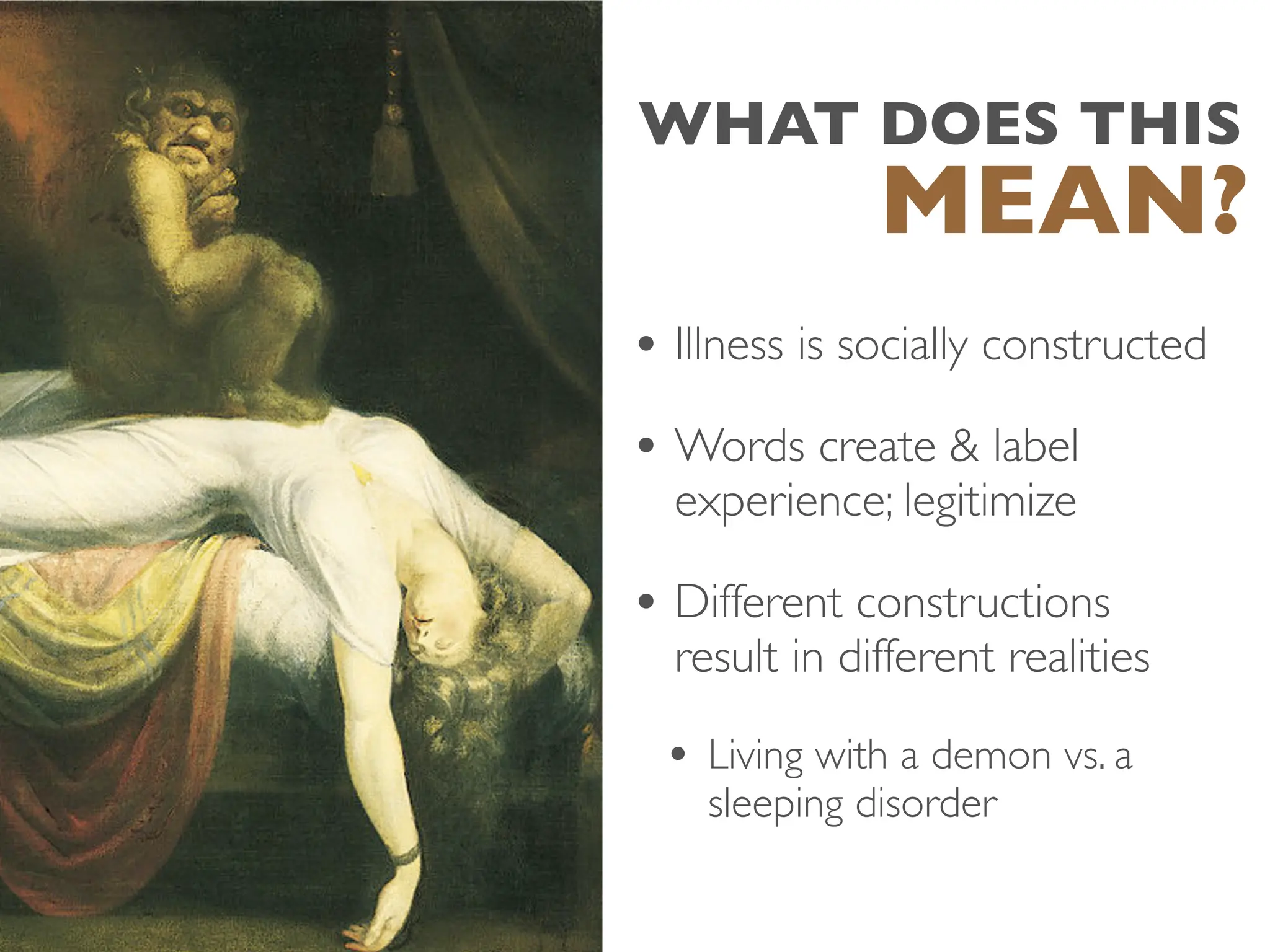
WHAT DOES THIS
• Illness is socially constructed
• Words create & label
experience; legitimize
• Different constructions
result in different realities
• Living with a demon vs. a
sleeping disorder
MEAN?
Labeling: language’s legitimizing function
The Religious Construction & its Relation to
Medical Help Seeking
Spiritual Problem requires spiritual help:
“There is no way to stop them [the demons] except a lot of prayer”
Expert sources turned to: priests, theologians, bishops
“The medical profession does not know how to treat it because it is
something they cannot treat.A Bishop told me that it is a spirit harassing you.
A Bishop can help you.”
Two negative cases (people seeking medical help for what
they believed to be demonic attacks)
Doctor visit resulted in re-af
fi
rmation of religious explanation:
“A medical Dr. referred me to this Bishop who helped me with my sleep
paralysis”
The Paranormal Construction & its Relation to
Medical Help Seeking
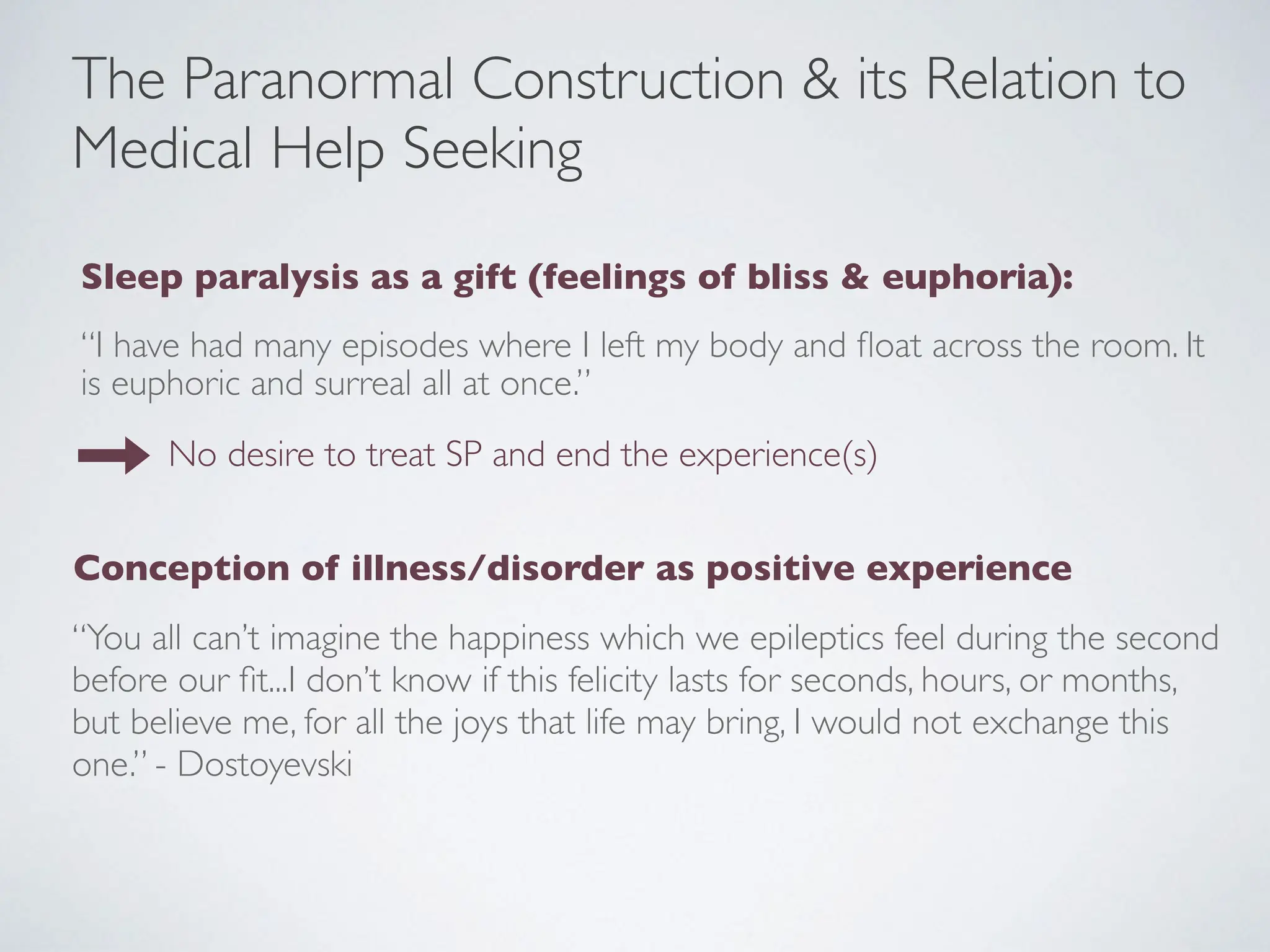
Sleep paralysis as a gift (feelings of bliss & euphoria):
“I have had many episodes where I left my body and
fl
oat across the room. It
is euphoric and surreal all at once.”
“You all can’t imagine the happiness which we epileptics feel during the second
before our
fi
t...I don’t know if this felicity lasts for seconds, hours, or months,
but believe me, for all the joys that life may bring, I would not exchange this
one.” - Dostoyevski
No desire to treat SP and end the experience(s)
Conception of illness/disorder as positive experience
The Medical Construction & its Relation to
Medical Help Seeking
Fatalist mentality (doctors can’t help)
“Now that I know it’s more common (and have a name for it) I may
make an appointment, but not if there is nothing that can be done
about it.”
Fear of receiving an undesirable diagnosis
“I’ve had sleep paralysis for years and thought I was really mentally ill. I
didn’t tell anyone.”
RIDDLE
ME THIS!
A father and his son are in a car accident.The father
dies at the scene and the son is rushed to the
hospital.At the hospital the surgeon looks at the
boy and says,“I can’t operate on this boy, he is my
son.”
How can this be?
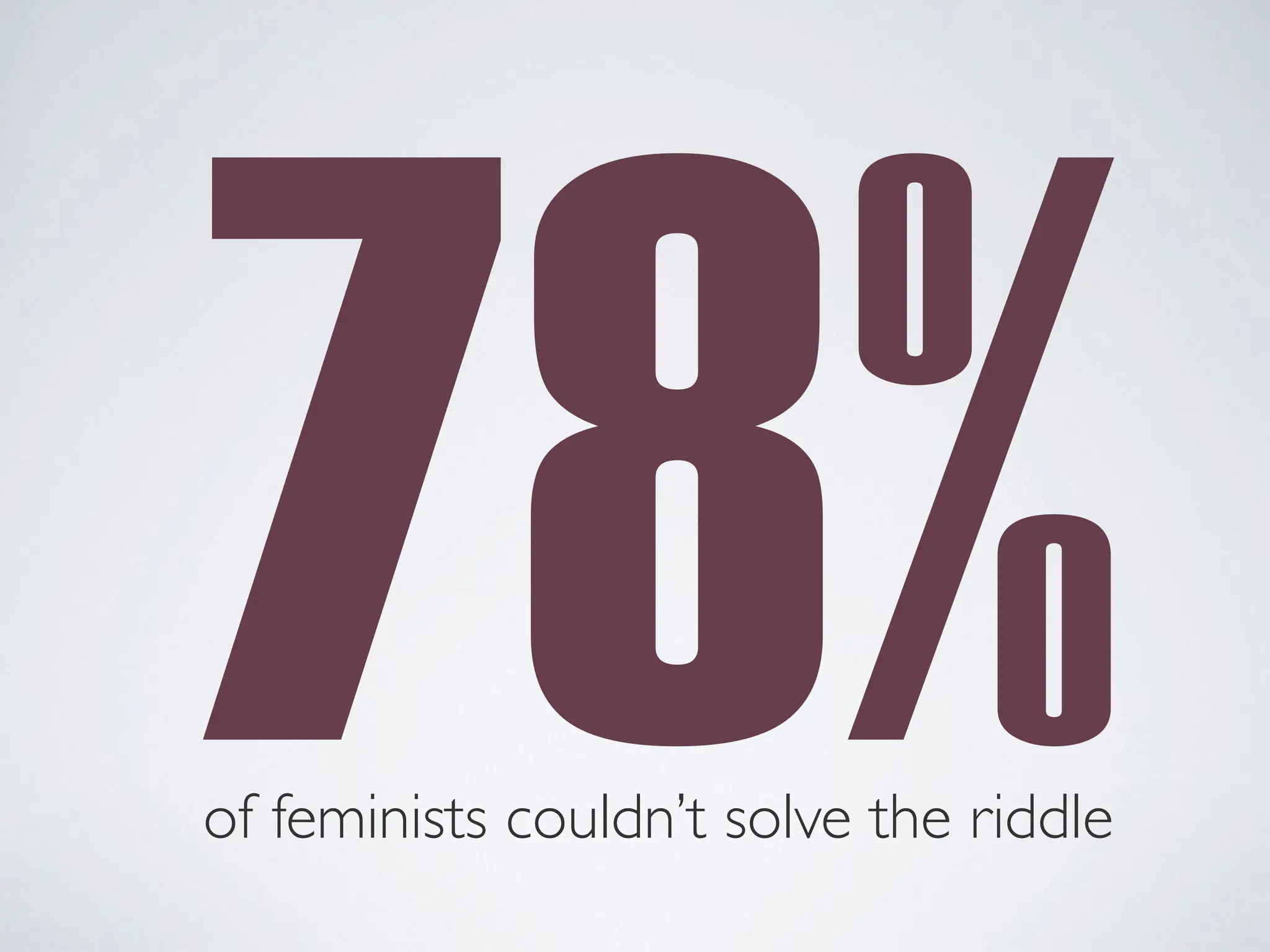
78%
of feminists couldn’t solve the riddle
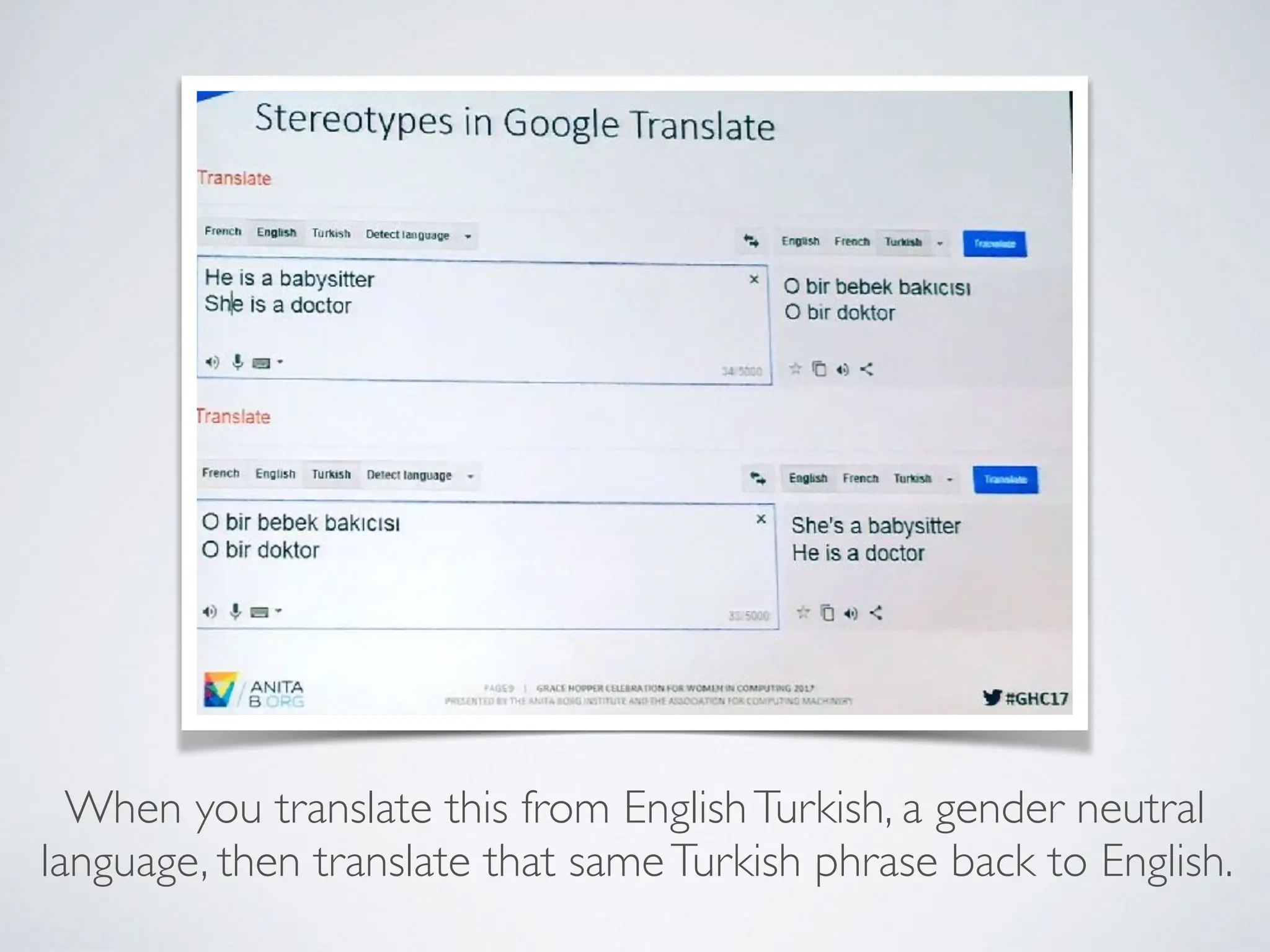
When you translate this from EnglishTurkish, a gender neutral
language, then translate that sameTurkish phrase back to English.
ANGUAGE
How does our
shape the way we think
?
?
If different languages in
fl
uence our
minds in different ways, it is not because
of what our language allows us to think
but rather because of what it habitually
obliges us to think about.
“
“
- Guy Deutscher, NYT 2010
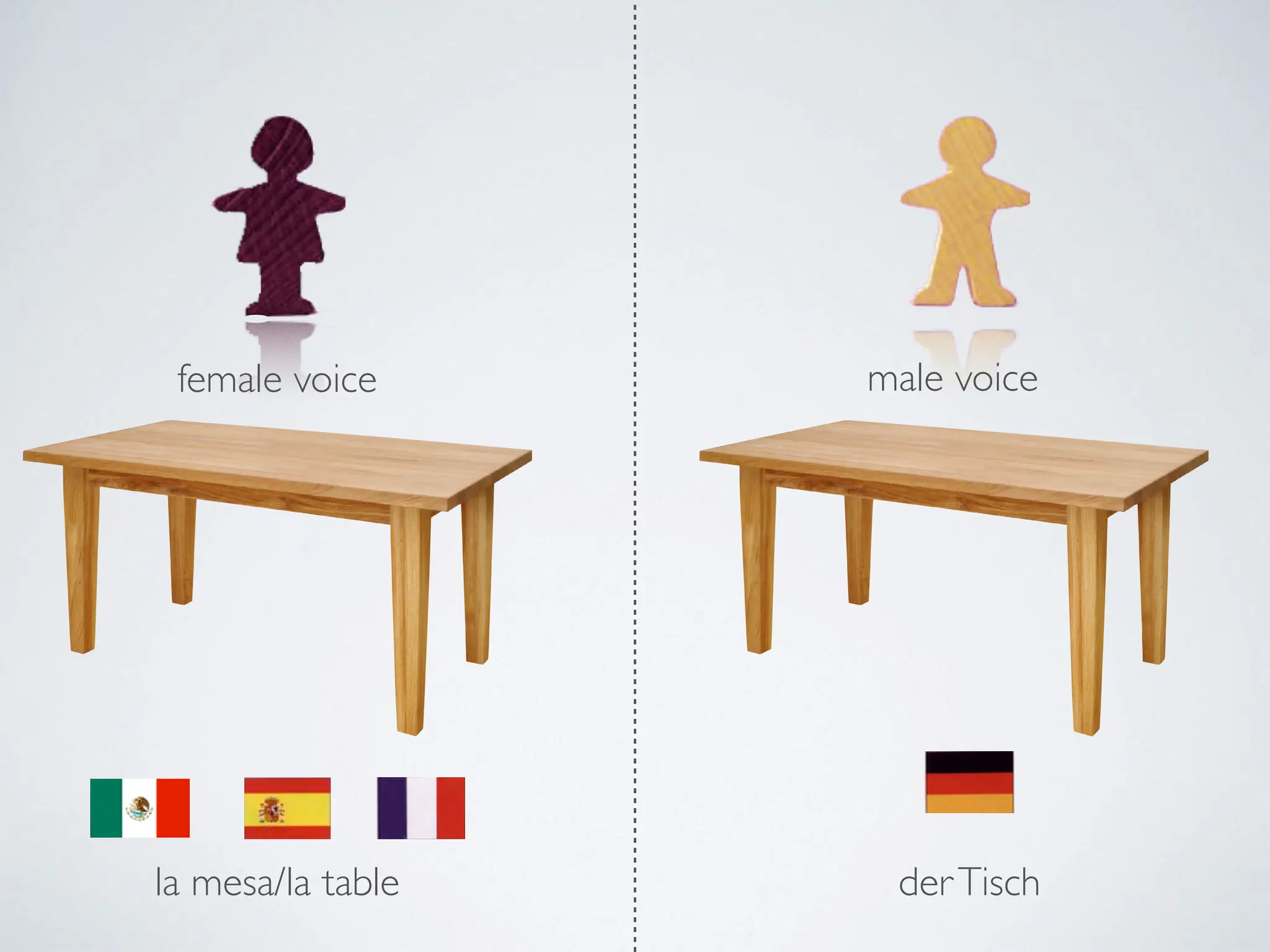
female voice
ANIMATE
this table by choosing a voice male voice
female voice male voice
la mesa/la table derTisch
HOW DO
Gendered languages affect us?
When your language routinely obliges
you to specify certain types of
information, it forces you to be attentive
to certain details in the world & to
certain aspects of experience that
speakers of other languages may not be
required to think about all the time
“
“
- Guy Deutscher, NYT 2010
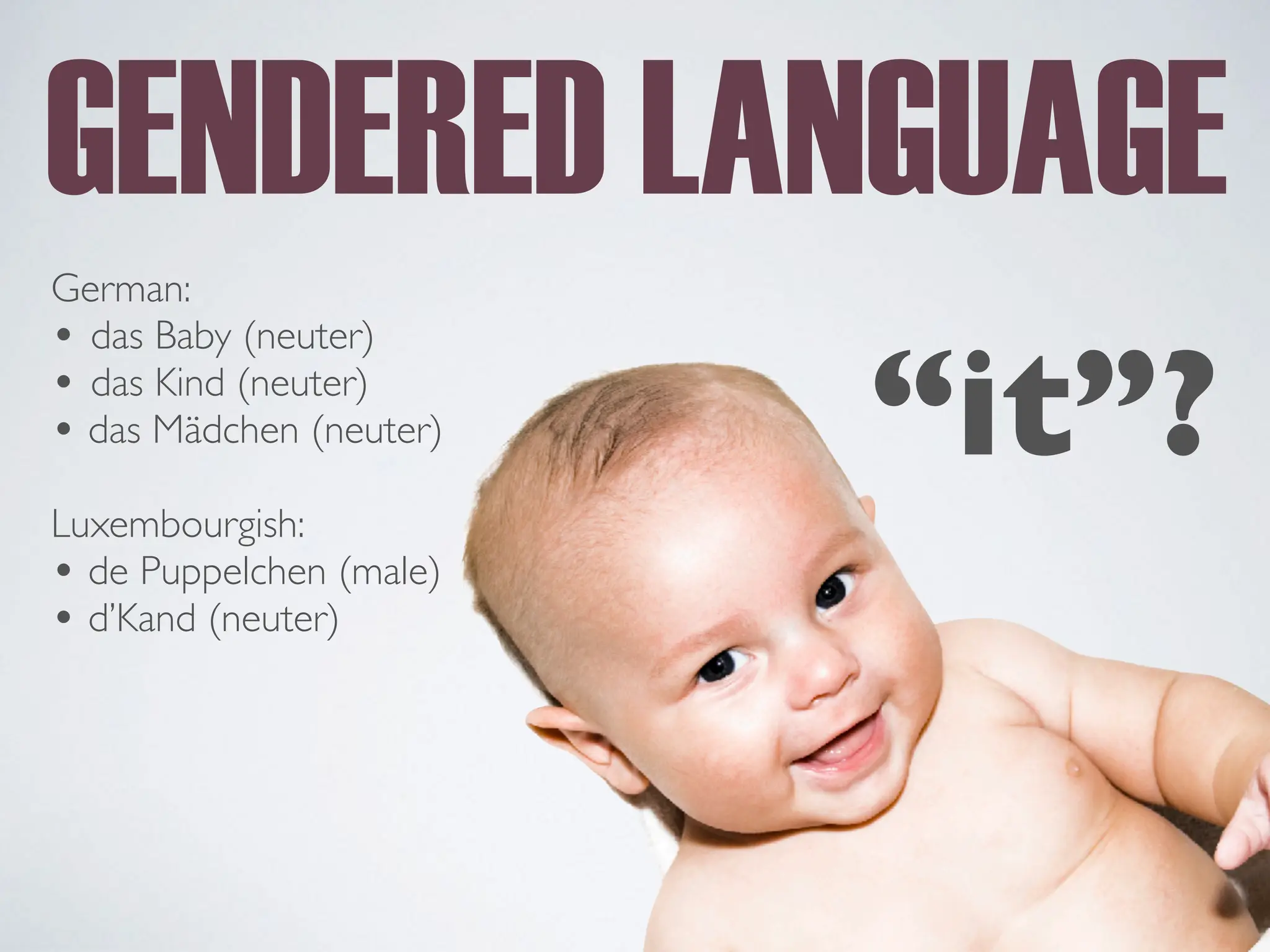
GENDERED LANGUAGE
German:
• das Baby (neuter)
• das Kind (neuter)
• das Mädchen (neuter)
Luxembourgish:
• de Puppelchen (male)
• d’Kand (neuter)
“it”?
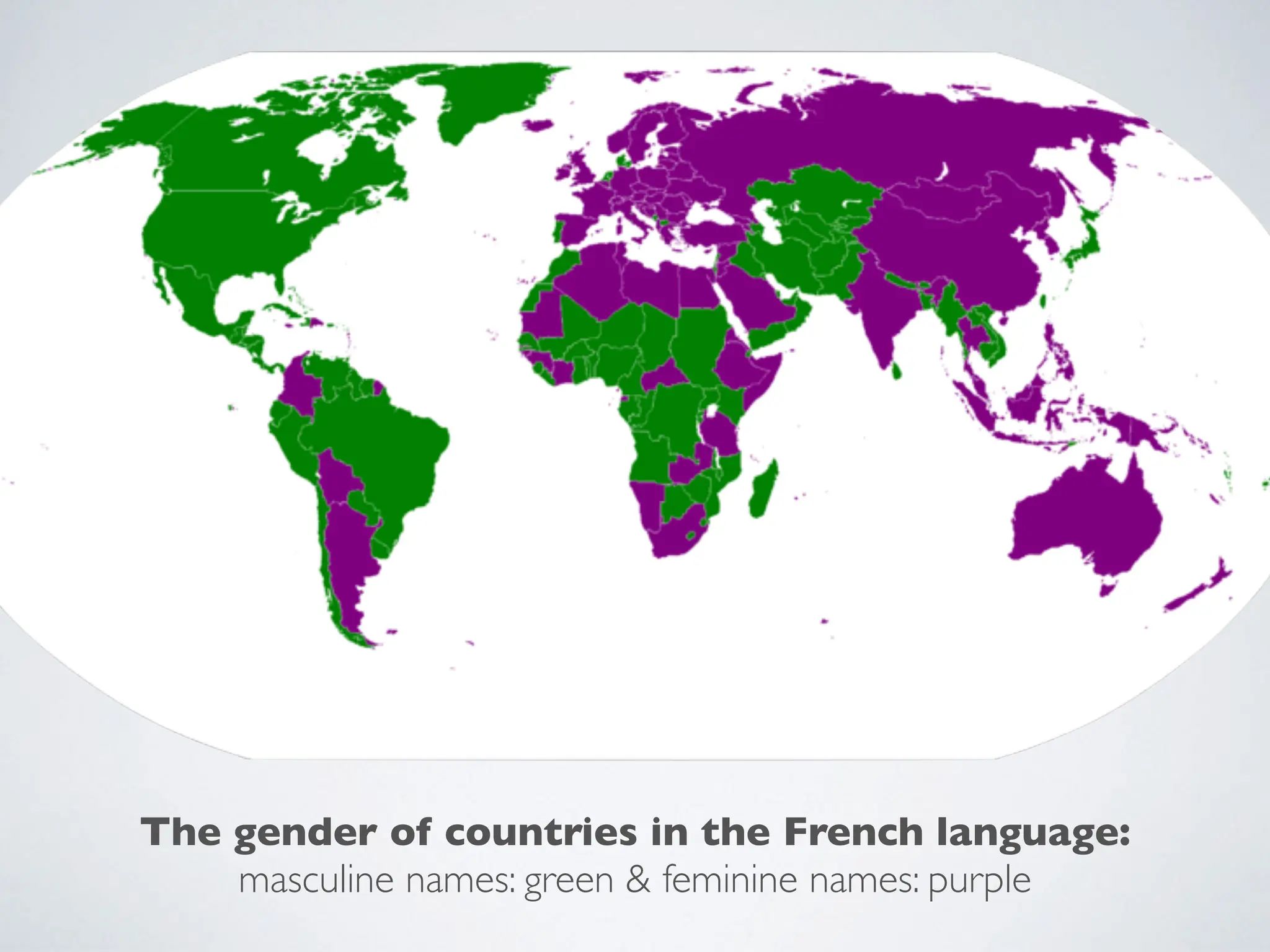
The gender of countries in the French language:
masculine names: green & feminine names: purple
LANGUAGE OF SPACE
Get up! Now raise
your north hand and
move your south leg
eastward!
Egocentric coordinates
(right, left, in front, behind)
versus
fi
xed geographic
directions (North, South,...)
ANGUAGE
How does our
shape the way we think about numbers
?
?
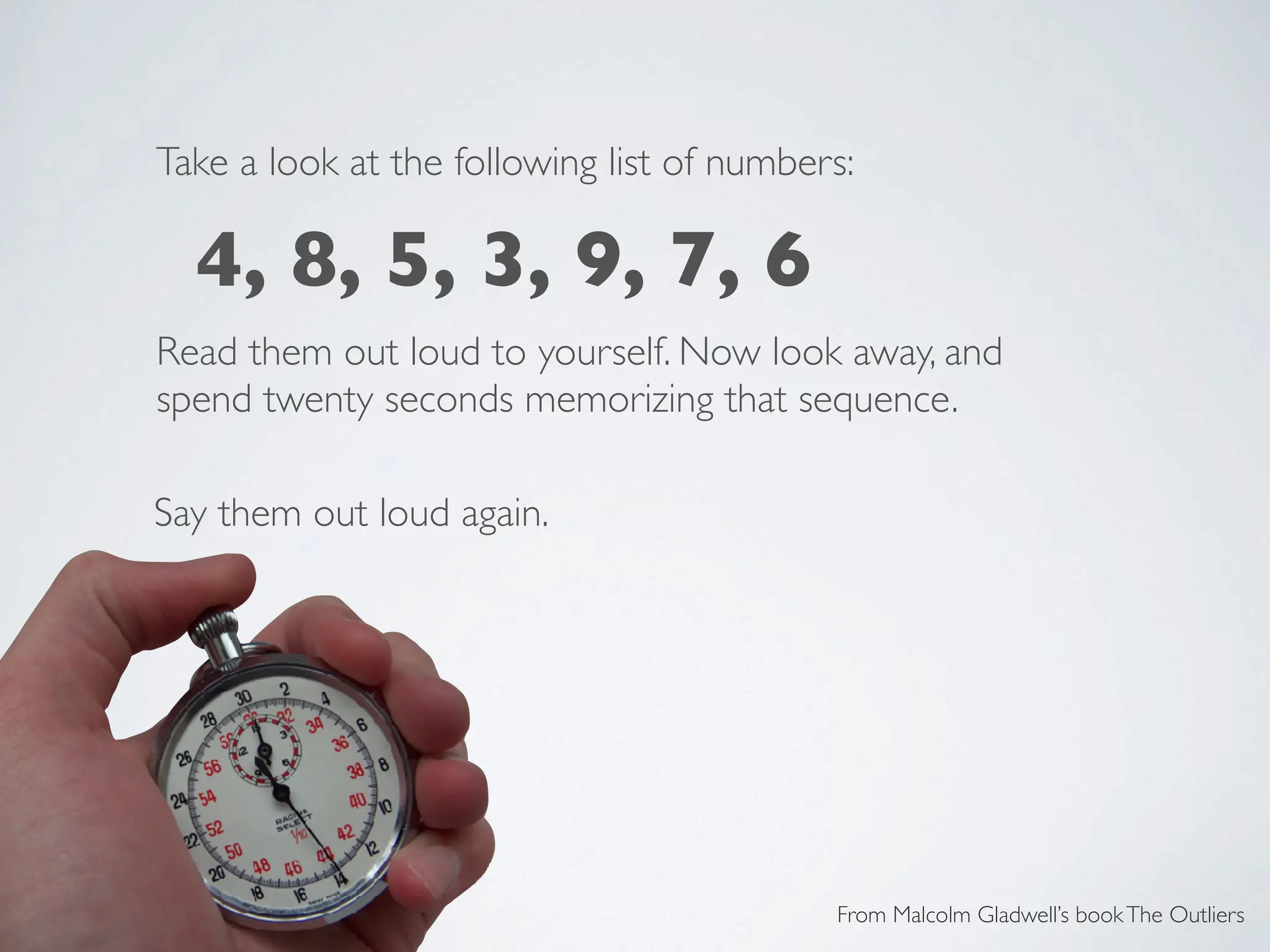
Take a look at the following list of numbers:
Read them out loud to yourself. Now look away, and
spend twenty seconds memorizing that sequence.
Say them out loud again.
From Malcolm Gladwell’s bookThe Outliers
4, 8, 5, 3, 9, 7, 6
50%
of English Speakers
remember it perfectly
100%
of Chinese Speakers
remember it perfectly
ALMOST
We store digits in a memory loop that runs for about two
seconds.We most easily memorize whatever we can say or
read within that two second span.The Chinese language
allows its speakers to
fi
t those 7 numbers into two seconds.
ASIAN
Logical Counting System
11: ten one
12: ten two
24: two ten four
ENGLISH
Irregular Counting System
Fourteen, sixteen but
Eleven (not oneteen)
Twelve (not twoteen)
Add thirty-seven plus twenty
two, in your head!
Need to convert the words
to numbers (37 + 22). Only
then can you do the math:
2 plus 7 is nine and 30 and 20
is 50, which makes 59
Add three-tens-seven and
two tens-two, in your head!
Equation is right there,
embedded in the sentence.
No number translation is
necessary: It's
fi
ve-tens nine
FRENCH
84 = quatre-vingt-quatre
84 = (4 x 20) + 4
98 = quatre-vingt-dix-huit
84 = (4 x 20) + 10 + 8
Mathematical processes & language study
Four year old Chinese
children can count, on
average, up to forty.
American children, at
that age, can only
count to
fi
fteen
We say three
fi
fths. The Chinese is literally, 'out
of
fi
ve parts, take three.'
That's telling you conceptually what a fraction is.
3/5
Look at the language we use for fractions!
ANGUAGE
Do we need
?
?
to think about large numbers
What language does is give you
a means of linking up our small,
exact number abilities with our
large, approximate number
abilities.
“
“
- Daniel Casasanto, Max Planck Institute for Psycholinguistics
ANGUAGE
How does our
affect your ability to save money
?
?
VERBAL MESSAGES
1. Are Packaged
2. Meanings Are in People
3. Meanings Are Denotative
and Connotative
4. Vary in Abstraction
5. Vary in Politeness
6. Can Criticize and Praise
7. Vary in Assertiveness
8. Can Con
fi
rm and Discon
fi
rm
9. Vary in Cultural Sensitivity
VERBAL MESSAGES
1. Are Packaged
2. Meanings Are in People
3. Meanings Are Denotative
and Connotative
4. Vary in Abstraction
5. Vary in Politeness
6. Can Criticize and Praise
7. Vary in Assertiveness
8. Can Con
fi
rm and Discon
fi
rm
9. Vary in Cultural Sensitivity
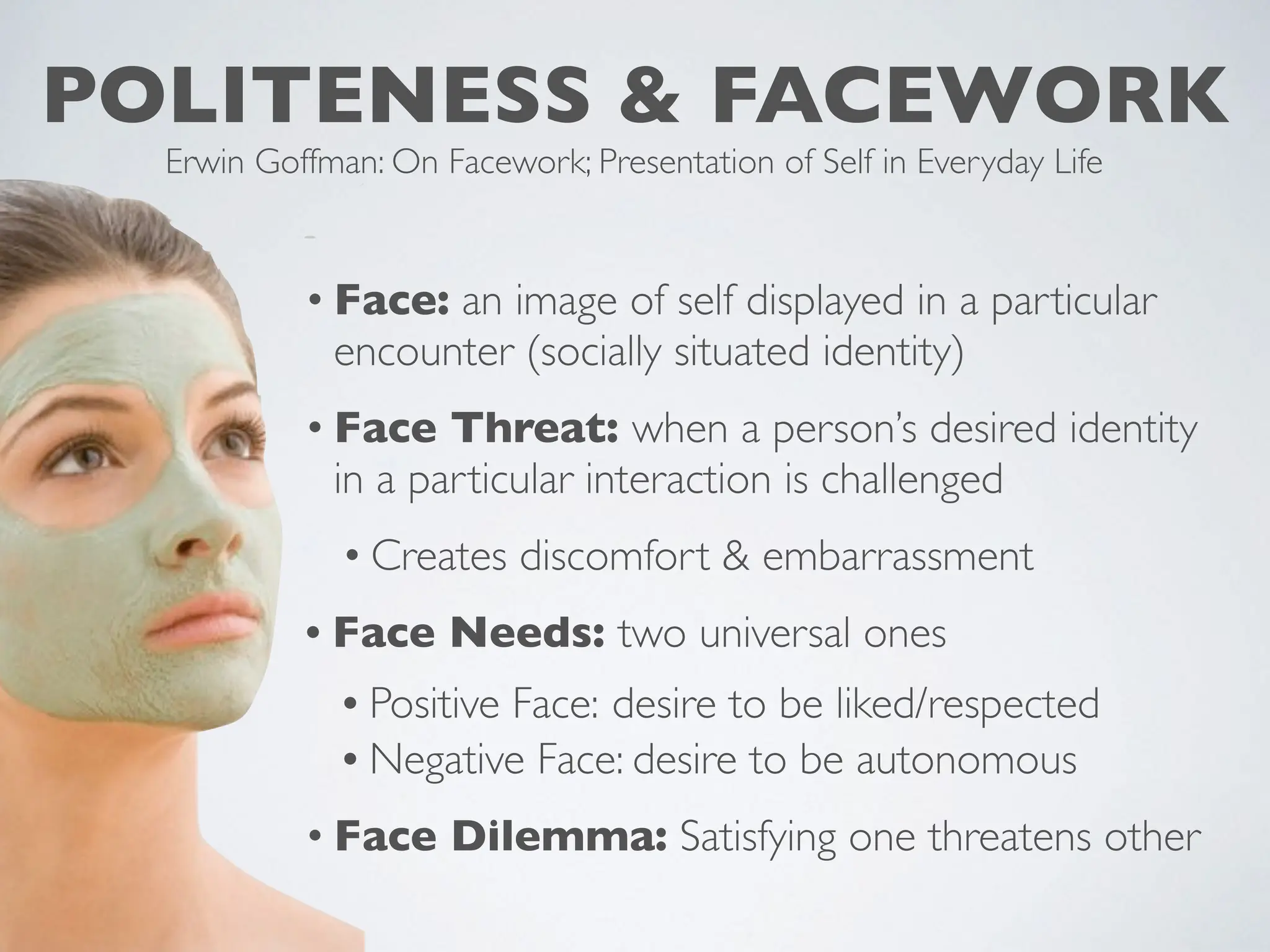
POLITENESS & FACEWORK
Erwin Goffman: On Facework; Presentation of Self in Everyday Life
• Face: an image of self displayed in a particular
encounter (socially situated identity)
• Face Threat: when a person’s desired identity
in a particular interaction is challenged
• Creates discomfort & embarrassment
• Face Needs: two universal ones
• Positive Face: desire to be liked/respected
• Negative Face: desire to be autonomous
• Face Dilemma: Satisfying one threatens other
1. Preventive facework:
• Avoiding face threatening topics & changing subjects
• Pretending not to notice
• Disclaimers: used to save own face
• Politeness: used to save other’s face (directness/indirectness)
2. Corrective facework: repair face damage
• Avoidance (i.e. ignoring predicament & continuing)
• Humor
• Apologies
• Accounts (i.e. explaining inappropriate behavior)
• Physical remediation
FACEWORK
Manage face dilemma and counteract face threats to self & others
Corrective Facework after a FaceThreat
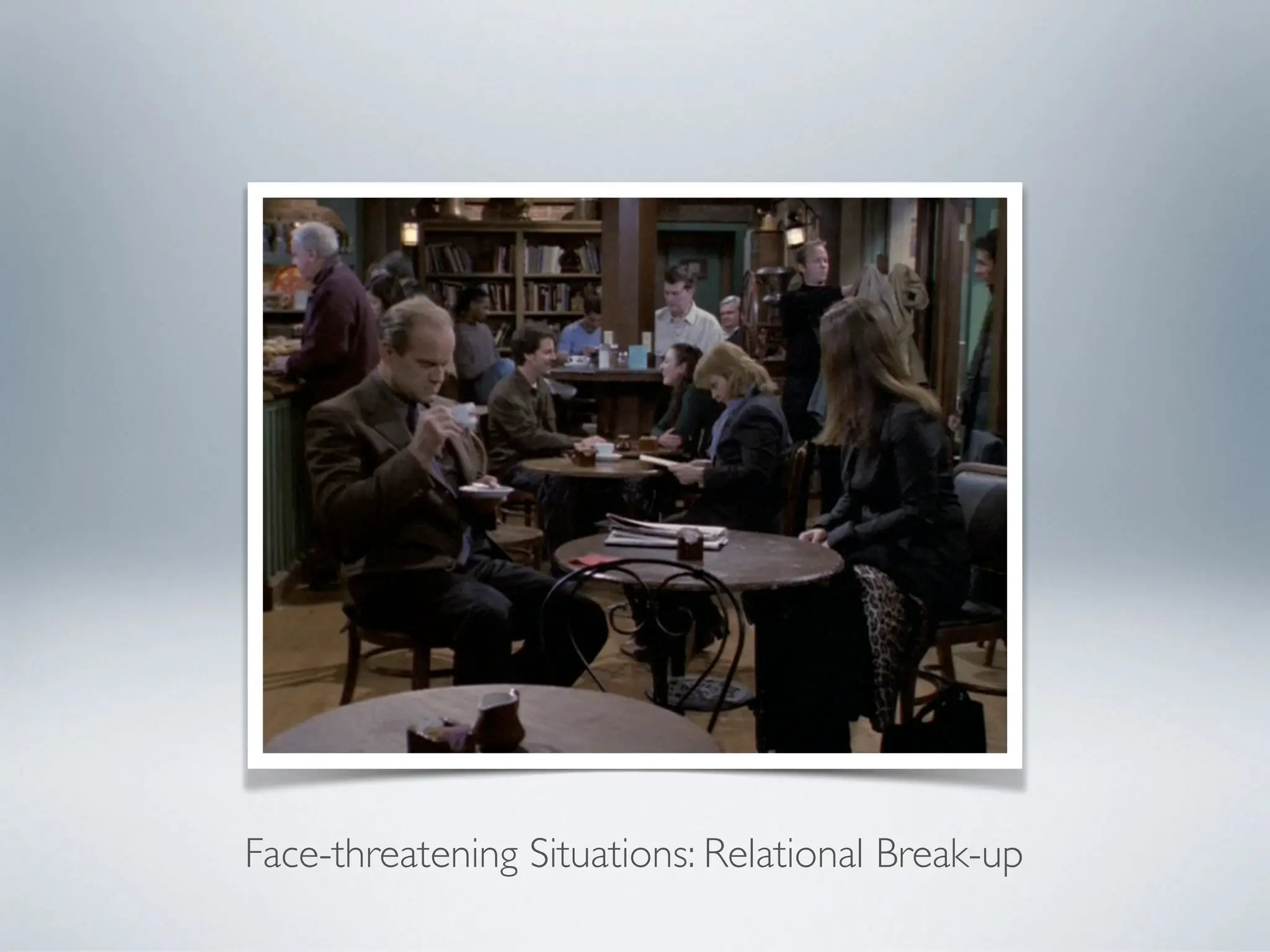
Face-threatening Situations: Relational Break-up
• Expression of regret
• Request for forgiveness
• Self-castigation
• Promise to do better in future
• Offers of restitution
APOLOGIES
A Form of Corrective Facework
I engaged in behavior which
was regrettable and
demonstrated bad judgment.
I’m 23-years-old, and despite
the successes I have had in the
pool, I acted in a youthful and
inappropriate way, not in a
manner that people have
come to expect from me.
For this, I am sorry. I promise
my fans and the public – it will
not happen again.
“
“
TYPES OF DISCLAIMERS
• Hedging: indicates uncertainty
“I may be wrong, but...”
• Credentialing: cites quali
fi
cations for engaging in actions
“I’m your husband, I have a right to read your email”
• Sin license: citing acceptable situation for rule violation
“What the heck, this is a special occasion”
• Cognitive disclaimer: indicates that behavior is reasonable
despite appearances
“This may sound crazy, but ...”
• Appeal for suspended judgement:
“Hear me out before you start yelling”
• Disclosing under the protection
of anonymity
• Disclosing through the use of
disclaimers
• Disclosing only to other sleep
paralysis sufferers
• Disclosing only after
fi
nding a
name for the experience
DISCLOSING HALLUCINATIONS
Different face saving strategies
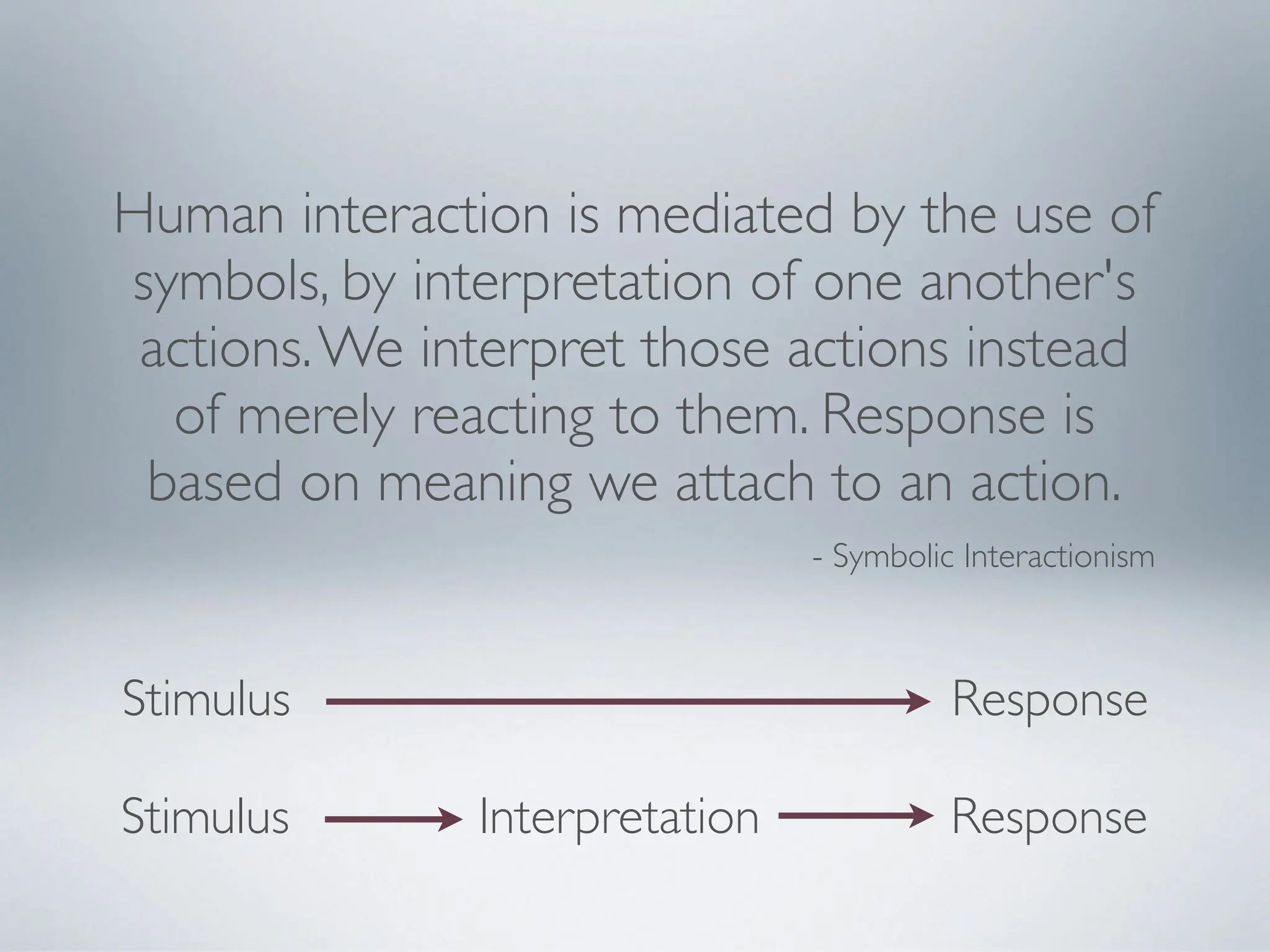
Human interaction is mediated by the use of
symbols, by interpretation of one another's
actions.We interpret those actions instead
of merely reacting to them. Response is
based on meaning we attach to an action.
Stimulus Response
Stimulus Interpretation Response
- Symbolic Interactionism
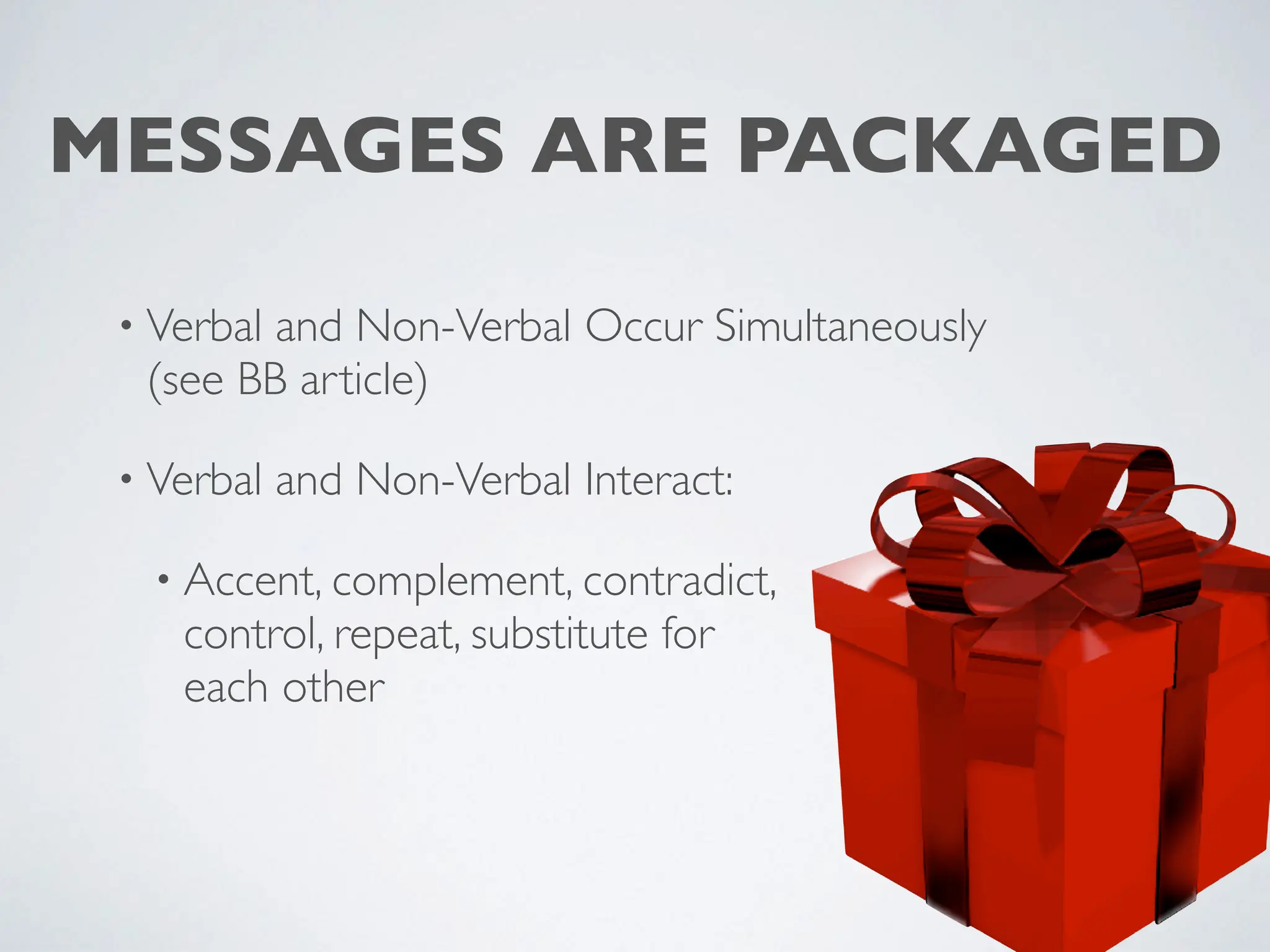
MESSAGES ARE PACKAGED
• Verbal and Non-Verbal Occur Simultaneously
(see BB article)
• Verbal and Non-Verbal Interact:
• Accent, complement, contradict,
control, repeat, substitute for
each other

ASSERTIVENESS LEVELS
• Nonassertiveness
• “You Win, I lose”
• Aggressiveness
• “I Win,You Lose”
• Assertiveness
• “I Win,You Win”
Gender differences
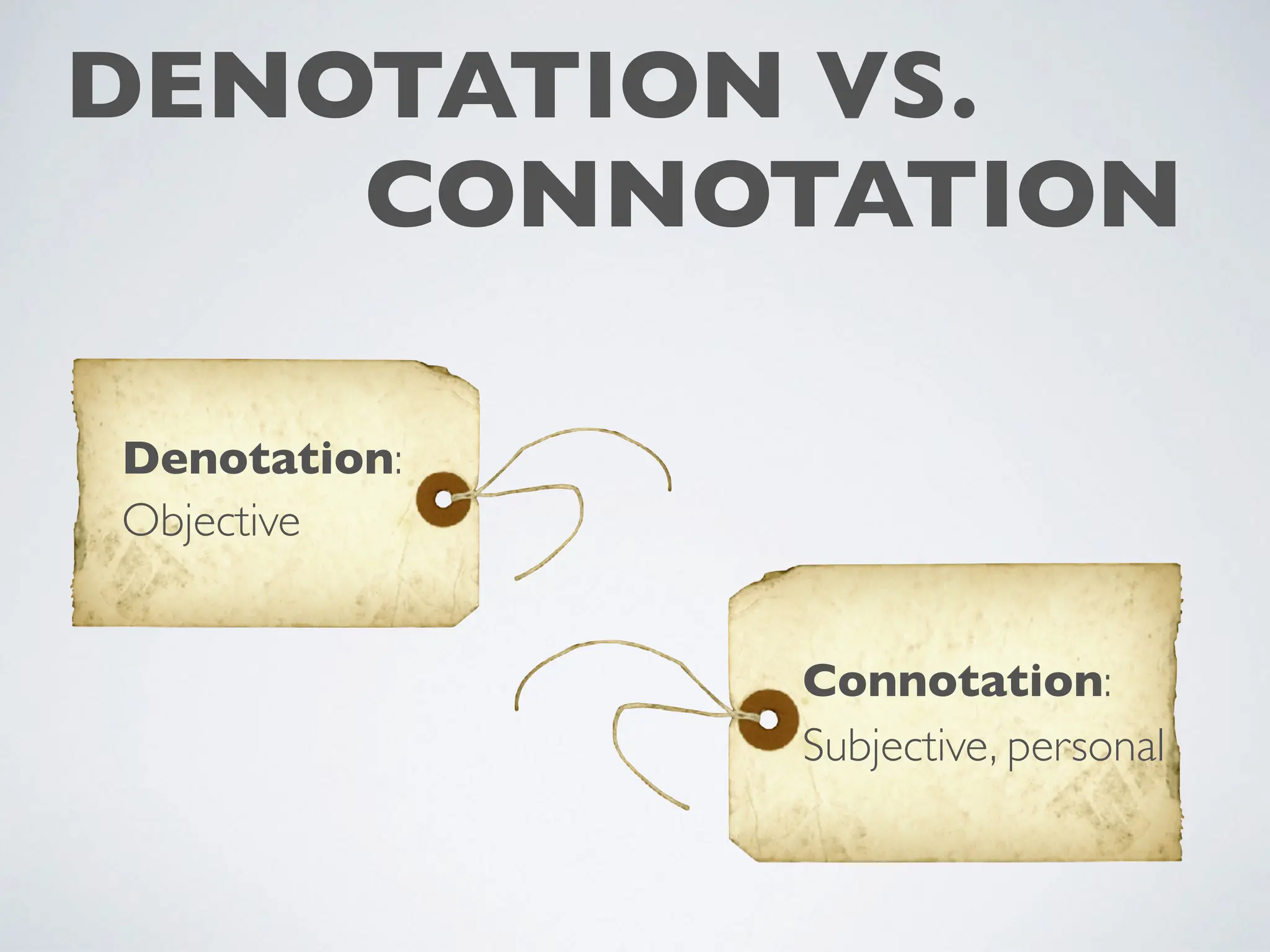
DENOTATION VS.
Denotation:
Objective
Connotation:
Subjective, personal
CONNOTATION
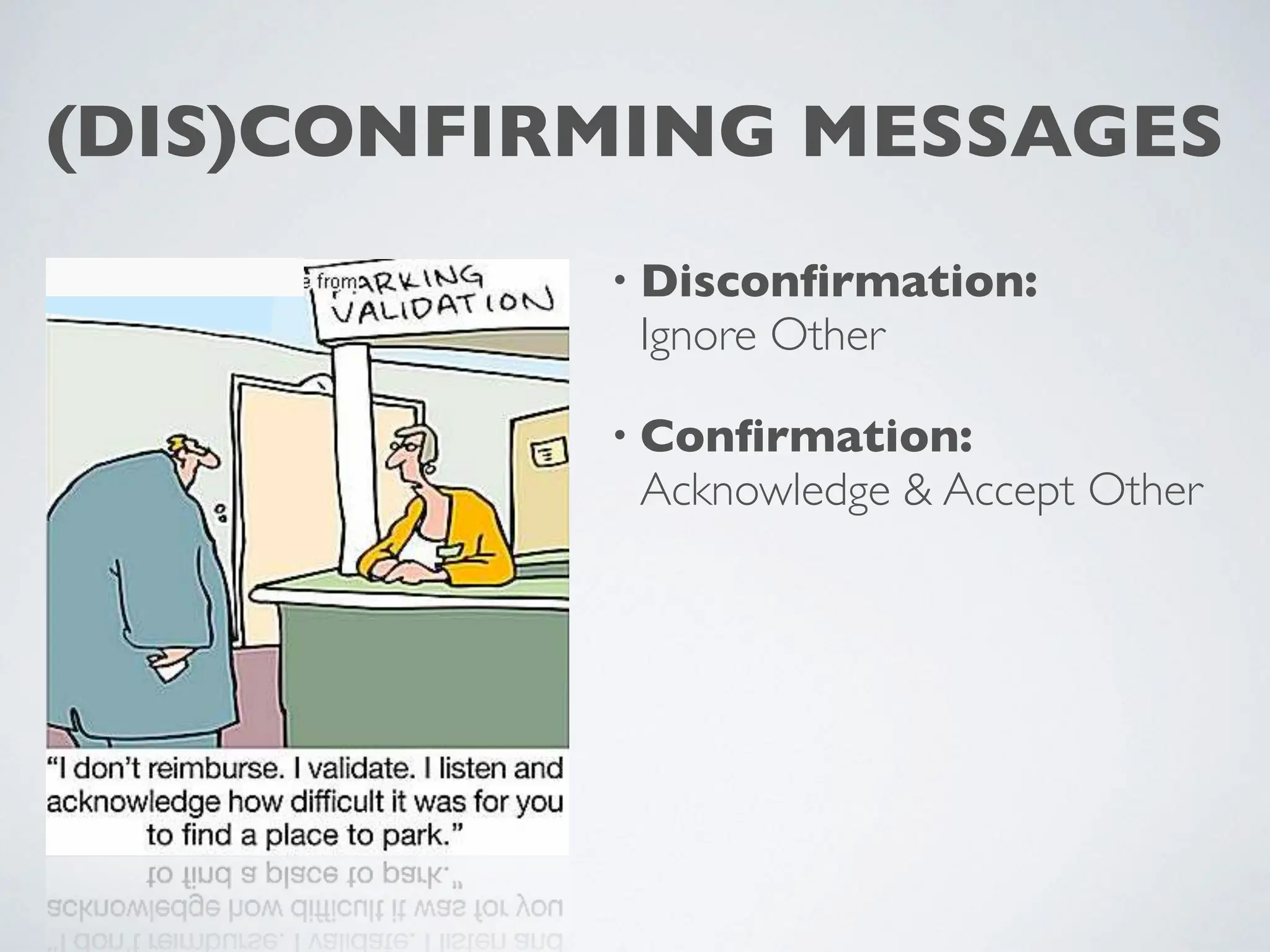
(DIS)CONFIRMING MESSAGES
• Discon
fi
rmation:
Ignore Other
• Con
fi
rmation:
Acknowledge & Accept Other
CULTURAL SENSITIVITY
• Racism: Institutionalized
• Heterosexism: Institutionalized, Language
• Ageism: Individual
• Sexism: Individual, Institutional, Language

Verbal Messages in Interpersonal Communication

  • 1.
  • 2.
    The limits ofmy language mean the limits of my world - Philosopher Ludwig Wittgenstein
  • 3.
    tall ___:___:___:___:___ _______ heavy___:___:___:___:___ _______ strong___:___:___:___:___ _______ happy ___:___:___:___:___ _______ legal ___:___:___:___:___ _______ Opposite POLARIZATION Language & its role in encouraging tendency to see the world in terms of extremes (either/or)
  • 4.
    CAN WE think outsideof language ? ? Amanda Baggs example
  • 5.
    Do we limitourselves in our interaction with the world because of language?
  • 6.
    • Get intogroups of 3 • Designate a person to report back to the class • Using this clip as an example: • do you believe that we can think outside of language? • do you believe that language con fi nes the way we interact with the world? • what do you think language is/means for Amanda? GROUP DISCUSSION
  • 7.
    The message isabout what kinds of communication and language and people we consider real and which ones we do not. It applies to anybody who gets written off because their communication is too unusual. “ “
  • 8.
    thoughts are rootedin language SAPIR WHORF • Linguistic determinism: (strong version) language determines the way we interpret the world • Linguistic relativity: (weak form of ling. determinism) thought is relative to language. If language determines thought, speakers of different languages will experience/see the world differently
  • 9.
    CAN WE conceive ofsomething for which we have no words ? ?
  • 10.
    Easier to notice andthink about things that have been named.
  • 11.
    Speech therapist studiedstuttering in an Indian village. Noticed that village members didn’t stutter.Why? No word for stuttering in the native language Didn’t occur to them to stutter - Wendell Johnson
  • 12.
    CRITICISMS: • Cause-effect relationshipbetween language & thought • does language shape/constrain thought or do thoughts shape/constrain our language? • Not having a word for experience doesn’t negate experience • love • sleep paralysis • People who don’t acquire language are able to think • Amanda’s example
  • 13.
  • 14.
  • 15.
    Premodern Modern Postmodern Objectivereality: yes, but it’s colored by our personal orientations Objective reality: no. It’s all symbols and representations Can’t get to reality Objective reality: yes, and it’s not colored by our per- sonal orientations AND OR
  • 16.
  • 17.
  • 19.
    WHAT IS ARELATIONSHIP? • Socially constructed through the verbal & nonverbal messages we exchange • Communicative behavior functions to establish, maintain and escalate interpersonal relationships ➡We talk our relationships into being -Steve Duck
  • 20.
    Negotiating your relationshipstatus: Facebook example Feelings are real. Shows that socially constructed relationship is perceived as real
  • 21.
    EXAMPLE: The social construction ofa mysterious medical disorder
  • 22.
    CONSTRUCTION OF REALITY Whatwould you think if you: • Woke up paralyzed • Were conscious of surroundings • Experienced chest pressure • Saw a shadowy fi gure • Heard noises Online construction of sleep paralysis
  • 23.
    SP Experience Paranormal Construction ReligiousConstruction No medical help sought Medical Construction Spiritual Problem Untreatable Problem Valuable Gift Faith, not science is the solution Science can’t help No desire to put an end to it Different realities based on how it is constructed
  • 24.
    WHAT DOES THIS •Illness is socially constructed • Words create & label experience; legitimize • Different constructions result in different realities • Living with a demon vs. a sleeping disorder MEAN?
  • 25.
  • 26.
    The Religious Construction& its Relation to Medical Help Seeking Spiritual Problem requires spiritual help: “There is no way to stop them [the demons] except a lot of prayer” Expert sources turned to: priests, theologians, bishops “The medical profession does not know how to treat it because it is something they cannot treat.A Bishop told me that it is a spirit harassing you. A Bishop can help you.” Two negative cases (people seeking medical help for what they believed to be demonic attacks) Doctor visit resulted in re-af fi rmation of religious explanation: “A medical Dr. referred me to this Bishop who helped me with my sleep paralysis”
  • 27.
    The Paranormal Construction& its Relation to Medical Help Seeking Sleep paralysis as a gift (feelings of bliss & euphoria): “I have had many episodes where I left my body and fl oat across the room. It is euphoric and surreal all at once.” “You all can’t imagine the happiness which we epileptics feel during the second before our fi t...I don’t know if this felicity lasts for seconds, hours, or months, but believe me, for all the joys that life may bring, I would not exchange this one.” - Dostoyevski No desire to treat SP and end the experience(s) Conception of illness/disorder as positive experience
  • 28.
    The Medical Construction& its Relation to Medical Help Seeking Fatalist mentality (doctors can’t help) “Now that I know it’s more common (and have a name for it) I may make an appointment, but not if there is nothing that can be done about it.” Fear of receiving an undesirable diagnosis “I’ve had sleep paralysis for years and thought I was really mentally ill. I didn’t tell anyone.”
  • 29.
    RIDDLE ME THIS! A fatherand his son are in a car accident.The father dies at the scene and the son is rushed to the hospital.At the hospital the surgeon looks at the boy and says,“I can’t operate on this boy, he is my son.” How can this be?
  • 30.
  • 31.
    When you translatethis from EnglishTurkish, a gender neutral language, then translate that sameTurkish phrase back to English.
  • 32.
    ANGUAGE How does our shapethe way we think ? ?
  • 33.
    If different languagesin fl uence our minds in different ways, it is not because of what our language allows us to think but rather because of what it habitually obliges us to think about. “ “ - Guy Deutscher, NYT 2010
  • 34.
    female voice ANIMATE this tableby choosing a voice male voice
  • 35.
    female voice malevoice la mesa/la table derTisch
  • 36.
    HOW DO Gendered languagesaffect us? When your language routinely obliges you to specify certain types of information, it forces you to be attentive to certain details in the world & to certain aspects of experience that speakers of other languages may not be required to think about all the time “ “ - Guy Deutscher, NYT 2010
  • 37.
    GENDERED LANGUAGE German: • dasBaby (neuter) • das Kind (neuter) • das Mädchen (neuter) Luxembourgish: • de Puppelchen (male) • d’Kand (neuter) “it”?
  • 38.
    The gender ofcountries in the French language: masculine names: green & feminine names: purple
  • 39.
    LANGUAGE OF SPACE Getup! Now raise your north hand and move your south leg eastward! Egocentric coordinates (right, left, in front, behind) versus fi xed geographic directions (North, South,...)
  • 40.
    ANGUAGE How does our shapethe way we think about numbers ? ?
  • 41.
    Take a lookat the following list of numbers: Read them out loud to yourself. Now look away, and spend twenty seconds memorizing that sequence. Say them out loud again. From Malcolm Gladwell’s bookThe Outliers 4, 8, 5, 3, 9, 7, 6
  • 42.
    50% of English Speakers rememberit perfectly 100% of Chinese Speakers remember it perfectly ALMOST We store digits in a memory loop that runs for about two seconds.We most easily memorize whatever we can say or read within that two second span.The Chinese language allows its speakers to fi t those 7 numbers into two seconds.
  • 43.
    ASIAN Logical Counting System 11:ten one 12: ten two 24: two ten four ENGLISH Irregular Counting System Fourteen, sixteen but Eleven (not oneteen) Twelve (not twoteen) Add thirty-seven plus twenty two, in your head! Need to convert the words to numbers (37 + 22). Only then can you do the math: 2 plus 7 is nine and 30 and 20 is 50, which makes 59 Add three-tens-seven and two tens-two, in your head! Equation is right there, embedded in the sentence. No number translation is necessary: It's fi ve-tens nine
  • 44.
    FRENCH 84 = quatre-vingt-quatre 84= (4 x 20) + 4 98 = quatre-vingt-dix-huit 84 = (4 x 20) + 10 + 8 Mathematical processes & language study
  • 45.
    Four year oldChinese children can count, on average, up to forty. American children, at that age, can only count to fi fteen
  • 46.
    We say three fi fths.The Chinese is literally, 'out of fi ve parts, take three.' That's telling you conceptually what a fraction is. 3/5 Look at the language we use for fractions!
  • 47.
    ANGUAGE Do we need ? ? tothink about large numbers
  • 48.
    What language doesis give you a means of linking up our small, exact number abilities with our large, approximate number abilities. “ “ - Daniel Casasanto, Max Planck Institute for Psycholinguistics
  • 49.
    ANGUAGE How does our affectyour ability to save money ? ?
  • 51.
    VERBAL MESSAGES 1. ArePackaged 2. Meanings Are in People 3. Meanings Are Denotative and Connotative 4. Vary in Abstraction 5. Vary in Politeness 6. Can Criticize and Praise 7. Vary in Assertiveness 8. Can Con fi rm and Discon fi rm 9. Vary in Cultural Sensitivity
  • 52.
    VERBAL MESSAGES 1. ArePackaged 2. Meanings Are in People 3. Meanings Are Denotative and Connotative 4. Vary in Abstraction 5. Vary in Politeness 6. Can Criticize and Praise 7. Vary in Assertiveness 8. Can Con fi rm and Discon fi rm 9. Vary in Cultural Sensitivity
  • 53.
    POLITENESS & FACEWORK ErwinGoffman: On Facework; Presentation of Self in Everyday Life • Face: an image of self displayed in a particular encounter (socially situated identity) • Face Threat: when a person’s desired identity in a particular interaction is challenged • Creates discomfort & embarrassment • Face Needs: two universal ones • Positive Face: desire to be liked/respected • Negative Face: desire to be autonomous • Face Dilemma: Satisfying one threatens other
  • 54.
    1. Preventive facework: •Avoiding face threatening topics & changing subjects • Pretending not to notice • Disclaimers: used to save own face • Politeness: used to save other’s face (directness/indirectness) 2. Corrective facework: repair face damage • Avoidance (i.e. ignoring predicament & continuing) • Humor • Apologies • Accounts (i.e. explaining inappropriate behavior) • Physical remediation FACEWORK Manage face dilemma and counteract face threats to self & others
  • 55.
  • 56.
  • 57.
    • Expression ofregret • Request for forgiveness • Self-castigation • Promise to do better in future • Offers of restitution APOLOGIES A Form of Corrective Facework
  • 58.
    I engaged inbehavior which was regrettable and demonstrated bad judgment. I’m 23-years-old, and despite the successes I have had in the pool, I acted in a youthful and inappropriate way, not in a manner that people have come to expect from me. For this, I am sorry. I promise my fans and the public – it will not happen again. “ “
  • 59.
    TYPES OF DISCLAIMERS •Hedging: indicates uncertainty “I may be wrong, but...” • Credentialing: cites quali fi cations for engaging in actions “I’m your husband, I have a right to read your email” • Sin license: citing acceptable situation for rule violation “What the heck, this is a special occasion” • Cognitive disclaimer: indicates that behavior is reasonable despite appearances “This may sound crazy, but ...” • Appeal for suspended judgement: “Hear me out before you start yelling”
  • 60.
    • Disclosing underthe protection of anonymity • Disclosing through the use of disclaimers • Disclosing only to other sleep paralysis sufferers • Disclosing only after fi nding a name for the experience DISCLOSING HALLUCINATIONS Different face saving strategies
  • 61.
    Human interaction ismediated by the use of symbols, by interpretation of one another's actions.We interpret those actions instead of merely reacting to them. Response is based on meaning we attach to an action. Stimulus Response Stimulus Interpretation Response - Symbolic Interactionism
  • 64.
    MESSAGES ARE PACKAGED •Verbal and Non-Verbal Occur Simultaneously (see BB article) • Verbal and Non-Verbal Interact: • Accent, complement, contradict, control, repeat, substitute for each other
  • 65.
    ASSERTIVENESS LEVELS • Nonassertiveness •“You Win, I lose” • Aggressiveness • “I Win,You Lose” • Assertiveness • “I Win,You Win” Gender differences
  • 66.
  • 67.
    (DIS)CONFIRMING MESSAGES • Discon fi rmation: IgnoreOther • Con fi rmation: Acknowledge & Accept Other
  • 68.
    CULTURAL SENSITIVITY • Racism:Institutionalized • Heterosexism: Institutionalized, Language • Ageism: Individual • Sexism: Individual, Institutional, Language