Reflective Assignment for Intercultural Communication
1.
PAPER
Re
fl
ectio
n
In this assignment,you will reflect on your own
experiences of intercultural communication and how you
can apply the SPACE2 Model of Mindful Inclusion to
manage your biases and improve your interactions with
people from different cultural backgrounds.
2.
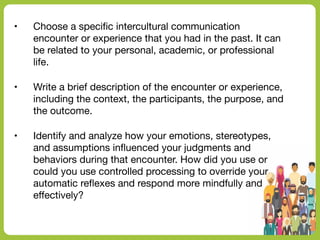
• Choose aspeci
fi
c intercultural communication
encounter or experience that you had in the past. It can
be related to your personal, academic, or professional
life.
• Write a brief description of the encounter or experience,
including the context, the participants, the purpose, and
the outcome.
• Identify and analyze how your emotions, stereotypes,
and assumptions in
fl
uenced your judgments and
behaviors during that encounter. How did you use or
could you use controlled processing to override your
automatic re
fl
exes and respond more mindfully and
e
ff
ectively?
3.
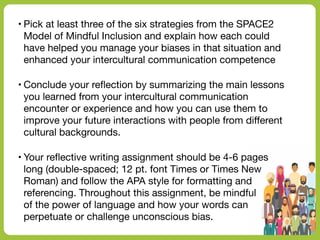
• Pick atleast three of the six strategies from the SPACE2
Model of Mindful Inclusion and explain how each could
have helped you manage your biases in that situation and
enhanced your intercultural communication competence
• Conclude your re
fl
ection by summarizing the main lessons
you learned from your intercultural communication
encounter or experience and how you can use them to
improve your future interactions with people from di
ff
erent
cultural backgrounds.
• Your re
fl
ective writing assignment should be 4-6 pages
long (double-spaced; 12 pt. font Times or Times New
Roman) and follow the APA style for formatting and
referencing. Throughout this assignment, be mindful
of the power of language and how your words can
perpetuate or challenge unconscious bias.
4.
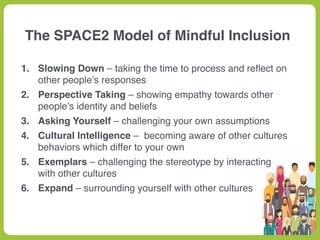
1. Slowing Down– taking the time to process and re
fl
ect on
other people’s responses
2. Perspective Taking – showing empathy towards other
people’s identity and beliefs
3. Asking Yourself – challenging your own assumptions
4. Cultural Intelligence – becoming aware of other cultures
behaviors which differ to your own
5. Exemplars – challenging the stereotype by interacting
with other cultures
6. Expand – surrounding yourself with other cultures
The SPACE2 Model of Mindful Inclusion
5.
SLOWING DOWN
• Re
fl
ecton instances in your life when you may have
experienced automatic processing leading to biased
responses. Consider the impact of time pressure on
decision-making and the importance of slowing down to
avoid re
fl
exive biases. If you are stuck, there's a worksheet
on BB that might be helpful.
• Discuss the role of mental fatigue in in
fl
uencing implicit
biases and the signi
fi
cance of preserving cognitive
resources for controlled processing.
• Share personal strategies for avoiding biased
responses when feeling rushed or mentally taxed.
6.
PERSPECTIVE TAKING
• Exploreyour experiences with perspective-taking in
intergroup interactions. Re
fl
ect on times when you
consciously engaged in contemplating others'
psychological experiences.
• Discuss the positive implications of perspective-taking,
such as increased empathy and reduced prejudiced
attitudes. Re
fl
ect on how blurring social category
boundaries can enhance intergroup relations.
• Share challenges you've encountered in perspective-
taking and strategies for overcoming them.
7.
ASKING YOURSELF
• Re
fl
ecton the e
ff
ectiveness of self-questioning in
challenging assumptions and biases. Share instances
when asking yourself key questions in
fl
uenced your
decision-making.
• Consider the role of conscious intention in overcoming
verbal biases and the challenges associated with
controlling non-verbal behaviors.
• Discuss strategies for mindful monitoring of micro-biases
during interactions with individuals from diverse
backgrounds
8.
CULTURAL INTELLIGENCE
• Exploreyour understanding of the fundamental attribution
error and its impact on attributing behavior to dispositional
in
fl
uences.
• Re
fl
ect on experiences working across cultures and
instances where cultural intelligence played a role in
avoiding misattributions and misunderstandings.
• Discuss the importance of making culturally appropriate
attributions and share examples of how you've applied this
concept in intercultural interactions.
9.
EXEMPLARS
• Re
fl
ect onthe role of counter-stereotypical imagery in
reducing the accessibility of unconscious stereotypes.
Share experiences where engaging in such imagery
in
fl
uenced your perceptions.
• Discuss the potential of using counter-stereotypical
imagery as an unconscious bias intervention in
training environments.
• Explore ways communication channels can celebrate
and acknowledge the successes of individuals from
underrepresented groups to weaken associations
with stereotypes.
10.
EXPAND
• Share insightsfrom studies indicating the positive impact
of intergroup friendships on dismantling social
categorizations and decreasing bias.
• Re
fl
ect on personal experiences with activities that
encourage individuals to share diverse backgrounds,
fostering individuation over broad categorizations.
• Discuss the role of a positive mood state in promoting
inclusive categorizations and strategies for inducing
positive moods in intercultural settings.
11.
• Introduction (1-2paragraphs): Introduce your
intercultural communication encounter or experience
and state the main point or thesis of your re
fl
ection.
• Body: Analyze your intercultural communication
encounter or experience using the concepts of
automatic and controlled processing and the SPACE2
Model of Mindful Inclusion. Provide speci
fi
c examples
and evidence to support your analysis.
• Conclusion (1-2 paragraphs): Summarize the main
lessons you learned from your intercultural
communication encounter or experience and how
you can use them to improve your future interactions
with people from di
ff
erent cultural backgrounds.
SAMPLE PAPER STRUCTURE