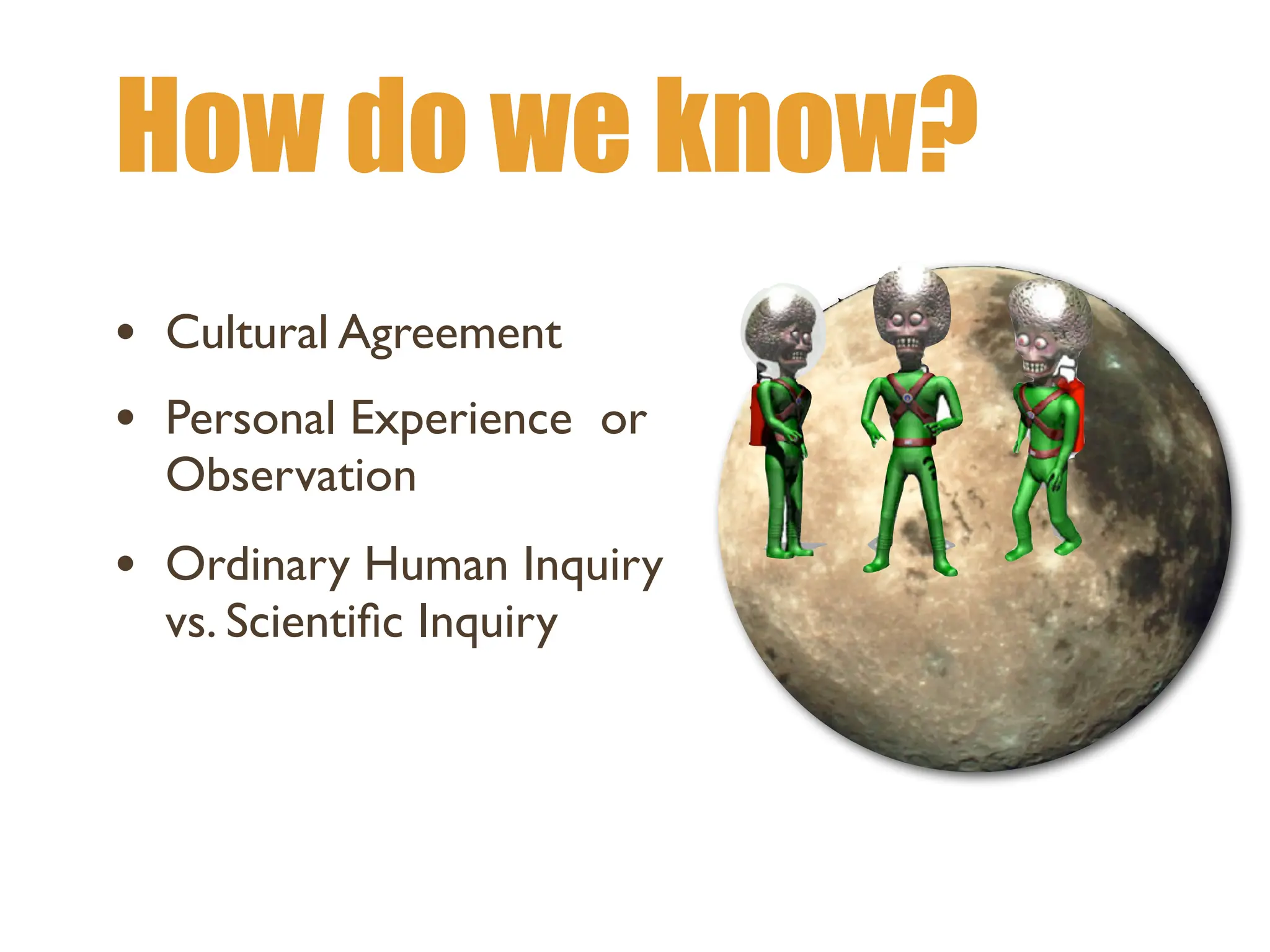
How do we know?
• Cultural Agreement
• Personal Experience or
Observation
• Ordinary Human Inquiry
vs. Scienti
fi
c Inquiry
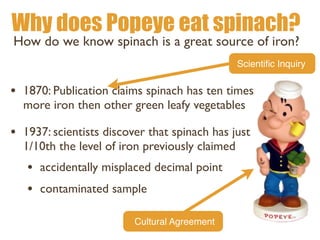
Why does Popeye eat spinach?
• 1870: Publication claims spinach has ten times
more iron then other green leafy vegetables
• 1937: scientists discover that spinach has just
1/10th the level of iron previously claimed
• accidentally misplaced decimal point
• contaminated sample
How do we know spinach is a great source of iron?
Scienti
fi
c Inquiry
Cultural Agreement
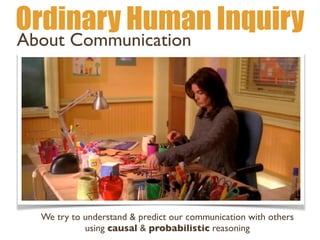
Ordinary Human Inquiry
We try to understand & predict our communication with others
using causal & probabilistic reasoning
About Communication
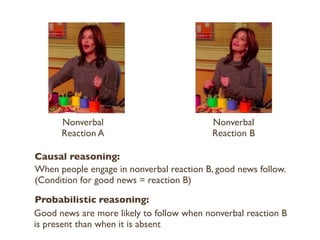
Nonverbal
Reaction A
Nonverbal
Reaction B
Causal reasoning:
Probabilistic reasoning:
When people engage in nonverbal reaction B, good news follow.
(Condition for good news = reaction B)
Good news are more likely to follow when nonverbal reaction B
is present than when it is absent
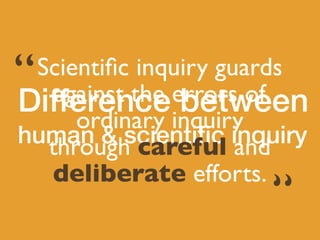
Difference between
human & scienti
fi
c inquiry
Scienti
fi
c inquiry guards
against the errors of
ordinary inquiry
through careful and
deliberate efforts.
“
“
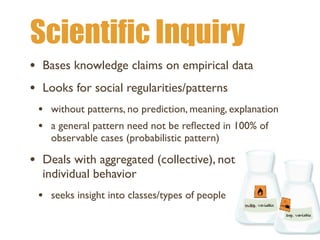
Scientific Inquiry
• Bases knowledge claims on empirical data
• Looks for social regularities/patterns
• without patterns, no prediction, meaning, explanation
• a general pattern need not be re
fl
ected in 100% of
observable cases (probabilistic pattern)
• Deals with aggregated (collective), not
individual behavior
• seeks insight into classes/types of people
What do Communication
Researchers study
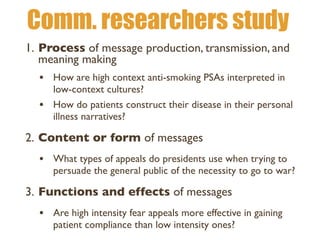
Comm. researchers study
1. Process of message production, transmission, and
meaning making
• How are high context anti-smoking PSAs interpreted in
low-context cultures?
• How do patients construct their disease in their personal
illness narratives?
2. Content or form of messages
• What types of appeals do presidents use when trying to
persuade the general public of the necessity to go to war?
3. Functions and effects of messages
• Are high intensity fear appeals more effective in gaining
patient compliance than low intensity ones?
Mediated vs. non-mediated
verbal vs. non-verbal
MESSAGES
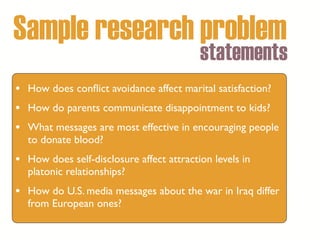
statements
Sample research problem
• How does con
fl
ict avoidance affect marital satisfaction?
• How do parents communicate disappointment to kids?
• What messages are most effective in encouraging people
to donate blood?
• How does self-disclosure affect attraction levels in
platonic relationships?
• How do U.S. media messages about the war in Iraq differ
from European ones?
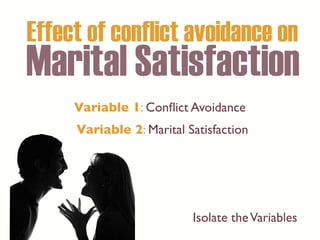
Effect of conflict avoidance on
Variable 1: Con
fl
ict Avoidance
Variable 2: Marital Satisfaction
Isolate theVariables
Marital Satisfaction
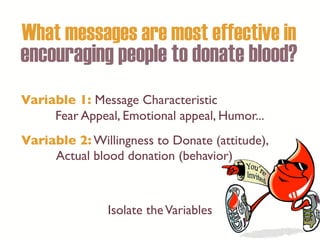
Variable 1: Message Characteristic
Variable 2: Willingness to Donate (attitude),
Actual blood donation (behavior)
Fear Appeal, Emotional appeal, Humor...
What messages are most effective in
encouraging people to donate blood?
Isolate theVariables
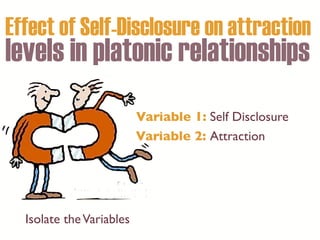
Effect of Self-Disclosure on attraction
levels in platonic relationships
Variable 1: Self Disclosure
Variable 2: Attraction
Isolate theVariables
Dissemination
of Communication Research
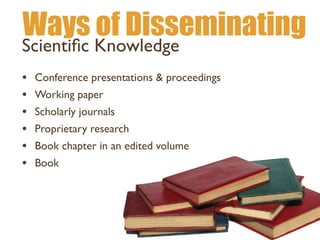
Ways of Disseminating
• Conference presentations & proceedings
• Working paper
• Scholarly journals
• Proprietary research
• Book chapter in an edited volume
• Book
Scienti
fi
c Knowledge
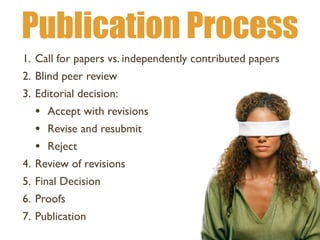
Publication Process
1. Call for papers vs. independently contributed papers
2. Blind peer review
3. Editorial decision:
• Accept with revisions
• Revise and resubmit
• Reject
4. Review of revisions
5. Final Decision
6. Proofs
7. Publication
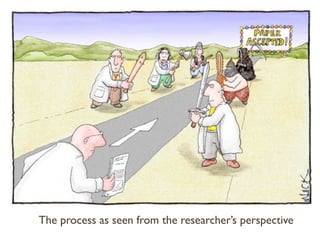
The process as seen from the researcher’s perspective
Problems
with the current dissemination model
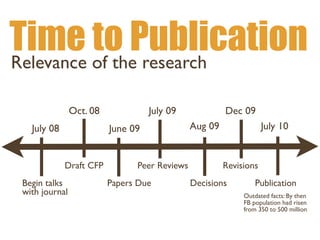
Time to Publication
Relevance of the research
July 08
Begin talks
with journal
Oct. 08
Draft CFP
June 09
Papers Due
July 09
Peer Reviews
Aug 09
Decisions
Dec 09
Revisions
July 10
Publication
Outdated facts: By then
FB population had risen
from 350 to 500 million
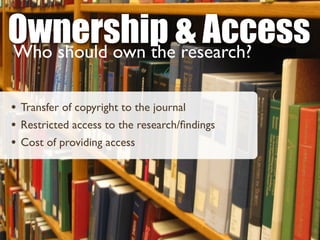
Ownership & Access
Who should own the research?
• Transfer of copyright to the journal
• Restricted access to the research/
fi
ndings
• Cost of providing access

Communication Research Methods - Practicum

  • 1.
    How do weknow? • Cultural Agreement • Personal Experience or Observation • Ordinary Human Inquiry vs. Scienti fi c Inquiry
  • 2.
    Why does Popeyeeat spinach? • 1870: Publication claims spinach has ten times more iron then other green leafy vegetables • 1937: scientists discover that spinach has just 1/10th the level of iron previously claimed • accidentally misplaced decimal point • contaminated sample How do we know spinach is a great source of iron? Scienti fi c Inquiry Cultural Agreement
  • 3.
    Ordinary Human Inquiry Wetry to understand & predict our communication with others using causal & probabilistic reasoning About Communication
  • 4.
    Nonverbal Reaction A Nonverbal Reaction B Causalreasoning: Probabilistic reasoning: When people engage in nonverbal reaction B, good news follow. (Condition for good news = reaction B) Good news are more likely to follow when nonverbal reaction B is present than when it is absent
  • 5.
    Difference between human &scienti fi c inquiry Scienti fi c inquiry guards against the errors of ordinary inquiry through careful and deliberate efforts. “ “
  • 6.
    Scientific Inquiry • Basesknowledge claims on empirical data • Looks for social regularities/patterns • without patterns, no prediction, meaning, explanation • a general pattern need not be re fl ected in 100% of observable cases (probabilistic pattern) • Deals with aggregated (collective), not individual behavior • seeks insight into classes/types of people
  • 7.
  • 8.
    Comm. researchers study 1.Process of message production, transmission, and meaning making • How are high context anti-smoking PSAs interpreted in low-context cultures? • How do patients construct their disease in their personal illness narratives? 2. Content or form of messages • What types of appeals do presidents use when trying to persuade the general public of the necessity to go to war? 3. Functions and effects of messages • Are high intensity fear appeals more effective in gaining patient compliance than low intensity ones?
  • 9.
    Mediated vs. non-mediated verbalvs. non-verbal MESSAGES
  • 10.
    statements Sample research problem •How does con fl ict avoidance affect marital satisfaction? • How do parents communicate disappointment to kids? • What messages are most effective in encouraging people to donate blood? • How does self-disclosure affect attraction levels in platonic relationships? • How do U.S. media messages about the war in Iraq differ from European ones?
  • 11.
    Effect of conflictavoidance on Variable 1: Con fl ict Avoidance Variable 2: Marital Satisfaction Isolate theVariables Marital Satisfaction
  • 12.
    Variable 1: MessageCharacteristic Variable 2: Willingness to Donate (attitude), Actual blood donation (behavior) Fear Appeal, Emotional appeal, Humor... What messages are most effective in encouraging people to donate blood? Isolate theVariables
  • 13.
    Effect of Self-Disclosureon attraction levels in platonic relationships Variable 1: Self Disclosure Variable 2: Attraction Isolate theVariables
  • 14.
  • 15.
    Ways of Disseminating •Conference presentations & proceedings • Working paper • Scholarly journals • Proprietary research • Book chapter in an edited volume • Book Scienti fi c Knowledge
  • 16.
    Publication Process 1. Callfor papers vs. independently contributed papers 2. Blind peer review 3. Editorial decision: • Accept with revisions • Revise and resubmit • Reject 4. Review of revisions 5. Final Decision 6. Proofs 7. Publication
  • 17.
    The process asseen from the researcher’s perspective
  • 18.
    Problems with the currentdissemination model
  • 19.
    Time to Publication Relevanceof the research July 08 Begin talks with journal Oct. 08 Draft CFP June 09 Papers Due July 09 Peer Reviews Aug 09 Decisions Dec 09 Revisions July 10 Publication Outdated facts: By then FB population had risen from 350 to 500 million
  • 20.
    Ownership & Access Whoshould own the research? • Transfer of copyright to the journal • Restricted access to the research/ fi ndings • Cost of providing access