Intercultural
Communication
in a Global world
Mrs E.A. Draffan
Vanissa Wanick
March 2015
Plan for sessions
• Intro - who we are what we have done
• Presentation
• Discussion
• Practical session - groups discussing elements of intercultural
communication - individual needs, language and culture.
• Feedback
• Tea Break
• Explain framework for evaluating culturally different websites
- issues arising
• Look at websites
• Feedback
• Wrap up
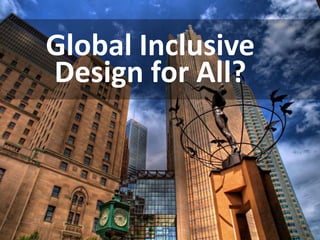
Global Inclusive
Design for All?
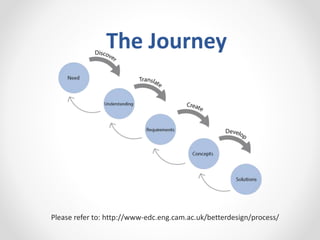
The Journey
Please refer to: http://www-edc.eng.cam.ac.uk/betterdesign/process/
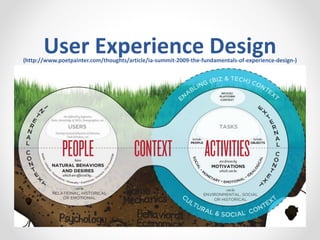
User Experience Design(http://www.poetpainter.com/thoughts/article/ia-summit-2009-the-fundamentals-of-experience-design-)
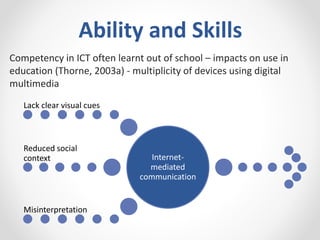
Ability and Skills
Competency in ICT often learnt out of school – impacts on use in
education (Thorne, 2003a) - multiplicity of devices using digital
multimedia
Internet-
mediated
communication
Lack clear visual cues
Reduced social
context
Misinterpretation
Demographics
“People don’t come preassembled but are glued together by
life” (Le Doux, J. 2002)
• Everyday experiences change the way we interact – level of
digital literacy expertise, age, gender, environment, culture …
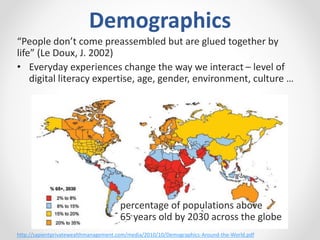
percentage of populations above
65 years old by 2030 across the globe
http://sapientprivatewealthmanagement.com/media/2010/10/Demographics-Around-the-World.pdf
Language
Internet-mediated global English – Netspeak (Crystal, D. 2001)
• Informal and friendly may suit individualistic cultures but
“prove disturbing for unprepared members of a collectivist
culture” (O’Dowd, 2001)
o salutations,
o assertive rather than questioning,
o aggressive but apologetic. (Marcoccia, 2012) but…
• “anonymity can play a positive role in intercultural
communication.” (Marcoccia, 2012) those who hesitate in f2F
may communicate more when online.
Culture
Culture is “essentially elusive, abstract and invisible”
(Furstenberg et al., 2001)
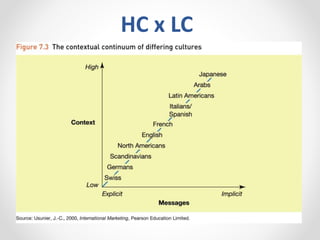
• Low-context (text and speech) v. High-context cultures (visual
cues and silence) e.g. North European v. Far Eastern and Arab
(Würtz, 2005).
• Just because you are connected it does not mean you necessarily
communicate enough to learn about a culture (Marcoccia, 2012)
however…
• Cyberspace shares its own cultural practices within a virtual
community – use English and follow the rules of netiquette?
(Ersoz, 2009) but may mean you reduce cultural understanding.
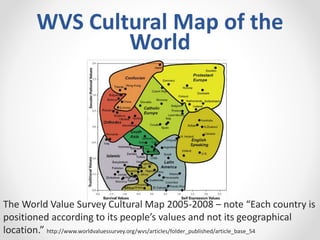
WVS Cultural Map of the
World
The World Value Survey Cultural Map 2005-2008 – note “Each country is
positioned according to its people’s values and not its geographical
location.” http://www.worldvaluessurvey.org/wvs/articles/folder_published/article_base_54
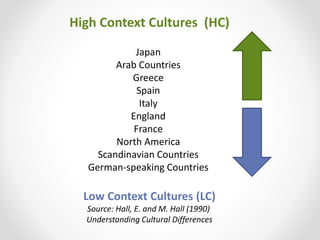
High Context Cultures (HC)
Japan
Arab Countries
Greece
Spain
Italy
England
France
North America
Scandinavian Countries
German-speaking Countries
Low Context Cultures (LC)
Source: Hall, E. and M. Hall (1990)
Understanding Cultural Differences
HC x LC
Hypotheses (Würtz, 2005)
http://jcmc.indiana.edu/vol11/issue1/wuertz.html
1. High Context (HC) cultures will, to a higher degree than Low
Context (LC) culture websites, implement strategies for
assimilating human presence on their websites.
2. HC cultures are likely to use more imagery and less text than
their LC counterparts.
3. The imagery chosen on HC culture websites will reflect
values characteristic of HC cultures, such as family values,
whereas LC culture values will be present on LC culture
websites.
4. The pages making up LC websites are expected to be
consistent in their layout and colour schemes, whereas pages
in HC websites are expected to be diverse.
More Cultural Dimensions:
Geert Hofstede
• Cultures and Organizations: Software of the Mind,
Geert Hofstede, McGraw-Hill, 1991, 1997
• Hofstede examined IBM employees in 50 countries,
1978-83
• Statistically valid data and analysis
• One limitation is that he says that each country has
only one dominate culture
• However research has shown that these dimensions
are still useful today.
Hofstede’s 5 Dimensions of
Culture
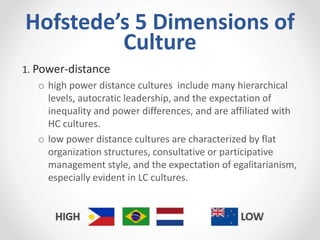
1. Power-distance
o high power distance cultures include many hierarchical
levels, autocratic leadership, and the expectation of
inequality and power differences, and are affiliated with
HC cultures.
o low power distance cultures are characterized by flat
organization structures, consultative or participative
management style, and the expectation of egalitarianism,
especially evident in LC cultures.
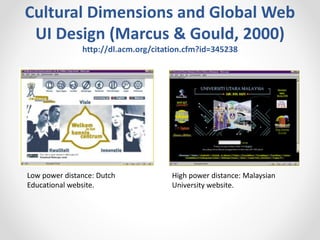
Cultural Dimensions and Global Web
UI Design (Marcus & Gould, 2000)
http://dl.acm.org/citation.cfm?id=345238
High power distance: Malaysian
University website.
Low power distance: Dutch
Educational website.
Hofstede’s 5 Dimensions of
Culture
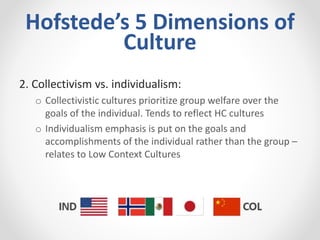
2. Collectivism vs. individualism:
o Collectivistic cultures prioritize group welfare over the
goals of the individual. Tends to reflect HC cultures
o Individualism emphasis is put on the goals and
accomplishments of the individual rather than the group –
relates to Low Context Cultures
Hofstede’s 5 Dimensions of
Culture
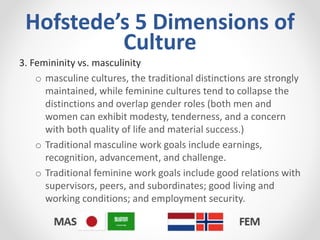
3. Femininity vs. masculinity
o masculine cultures, the traditional distinctions are strongly
maintained, while feminine cultures tend to collapse the
distinctions and overlap gender roles (both men and
women can exhibit modesty, tenderness, and a concern
with both quality of life and material success.)
o Traditional masculine work goals include earnings,
recognition, advancement, and challenge.
o Traditional feminine work goals include good relations with
supervisors, peers, and subordinates; good living and
working conditions; and employment security.
Hofstede’s 5 Dimensions of
Culture
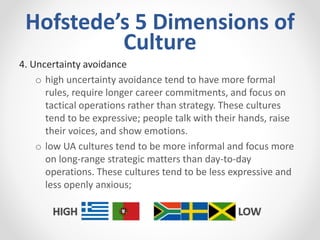
4. Uncertainty avoidance
o high uncertainty avoidance tend to have more formal
rules, require longer career commitments, and focus on
tactical operations rather than strategy. These cultures
tend to be expressive; people talk with their hands, raise
their voices, and show emotions.
o low UA cultures tend to be more informal and focus more
on long-range strategic matters than day-to-day
operations. These cultures tend to be less expressive and
less openly anxious;
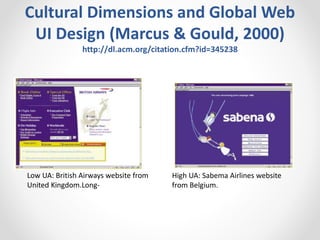
Cultural Dimensions and Global Web
UI Design (Marcus & Gould, 2000)
http://dl.acm.org/citation.cfm?id=345238
High UA: Sabema Airlines website
from Belgium.
Low UA: British Airways website from
United Kingdom.Long-
Hofstede’s 5 Dimensions of
Culture
5. Long- vs. short-term time orientation
o Long-Term Orientation seemed to play an important role in
Asian countries that had been influenced by Confucian
philosophy over many thousands of years.
o Western countries, by contrast, were more likely to
promote equal relationships, emphasize individualism,
focus on treating others as you would like to be treated,
and find fulfilment through creativity and self-actualization
Practical Session
Groups discussing elements
of intercultural
communication such as
individual needs, language
and culture.
Question?
Does cyberspace symbolise
‘cultural standardisation’ or
does it allow for ‘cultural
variations and local
appropriation’?
Feedback
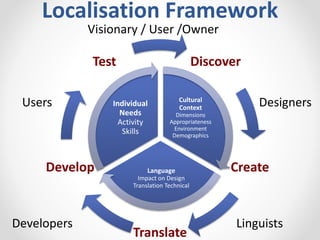
Discover
Create
Translate
Develop
Test
Localisation Framework
Cultural
Context
Dimensions
Appropriateness
Environment
Demographics
Language
Impact on Design
Translation Technical
Individual
Needs
Activity
Skills
Designers
LinguistsDevelopers
Visionary / User /Owner
Users
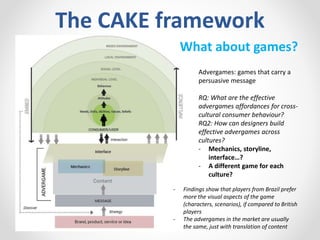
The CAKE framework
Advergames: games that carry a
persuasive message
RQ: What are the effective
advergames affordances for cross-
cultural consumer behaviour?
RQ2: How can designers build
effective advergames across
cultures?
- Mechanics, storyline,
interface…?
- A different game for each
culture?
- Findings show that players from Brazil prefer
more the visual aspects of the game
(characters, scenarios), if compared to British
players
- The advergames in the market are usually
the same, just with translation of content
What about games?
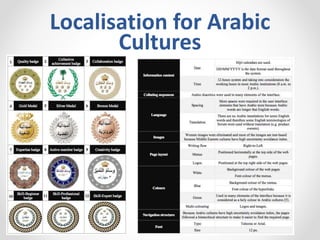
Localisation for Arabic
Cultures
Practical User interfaced design
• Images: Images can easily offend, especially when people are
involved and may also differ in approach to the type of image
shown especially in the degrees of say violence and sexuality.
• Colours: Colour is sometimes used to convey meaning or to help
us focus on part of the page, but colour has a different meaning in
different cultures.
• Flow/Navigation: we look read a web page differently, we start at
different points and then move our eye in different ways (some
up and down across). Similarly navigation is differ not only in flow,
but also what information we want to see first.
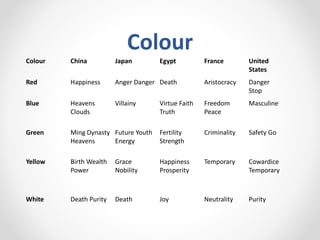
Colour
Colour China Japan Egypt France United
States
Red Happiness Anger Danger Death Aristocracy Danger
Stop
Blue Heavens
Clouds
Villainy Virtue Faith
Truth
Freedom
Peace
Masculine
Green Ming Dynasty
Heavens
Future Youth
Energy
Fertility
Strength
Criminality Safety Go
Yellow Birth Wealth
Power
Grace
Nobility
Happiness
Prosperity
Temporary Cowardice
Temporary
White Death Purity Death Joy Neutrality Purity
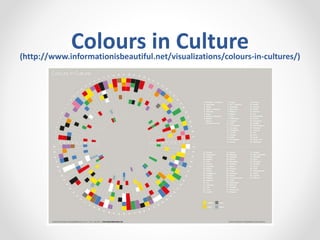
Colours in Culture(http://www.informationisbeautiful.net/visualizations/colours-in-cultures/)
Practical User
interfaced design
• Text: This is not the same in all
cultures in terms of character sets
and the way language is used.
• Number, Dates and Time formats:
not all cultures have the same calendar
or number format.
• Metaphors/ Idioms: we often convey
a new idea using a figure of speech that
is not always understood in the same
way by another culture or in
another language.
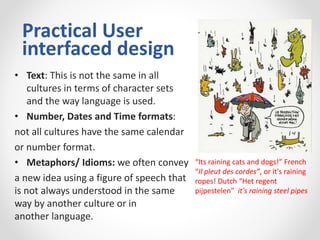
“Its raining cats and dogs!” French
“Il pleut des cordes”, or it's raining
ropes! Dutch “Het regent
pijpestelen” it's raining steel pipes
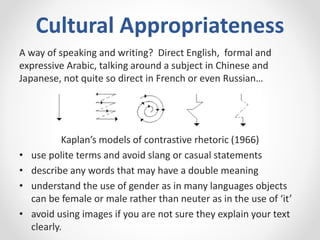
Cultural Appropriateness
A way of speaking and writing? Direct English, formal and
expressive Arabic, talking around a subject in Chinese and
Japanese, not quite so direct in French or even Russian…
Kaplan’s models of contrastive rhetoric (1966)
• use polite terms and avoid slang or casual statements
• describe any words that may have a double meaning
• understand the use of gender as in many languages objects
can be female or male rather than neuter as in the use of ‘it’
• avoid using images if you are not sure they explain your text
clearly.
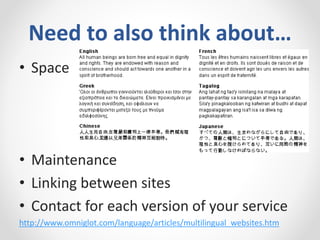
Need to also think about…
• Space
• Maintenance
• Linking between sites
• Contact for each version of your service
http://www.omniglot.com/language/articles/multilingual_websites.htm
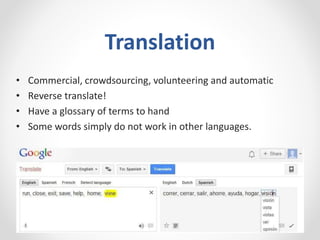
Translation
• Commercial, crowdsourcing, volunteering and automatic
• Reverse translate!
• Have a glossary of terms to hand
• Some words simply do not work in other languages.
Technological Needs
We have just looked at Microsoft Windows, Android and iOS
(Apple) - It is important to:
o Separate resources from code.
o Use Unicode and UTF-8.
o Support string tables for each language, separate icons and
images plus right to left user interface.
o Support localised keyboard shortcuts.
o Make sure keyboards and on-screen keyboards are
supported for the intended languages on the target
platform.
o Make sure appropriate fonts are supported.
o Allow the user to easily change the locale of the software.
Activity and Environment
Multiple means of representation, expression and engagement
to accommodate task, setting as well as ability/skill,
demographics, language and culture.
o representations to cater for individual preferences?
Accessibility and Usability
Business case for time / finance, skills /
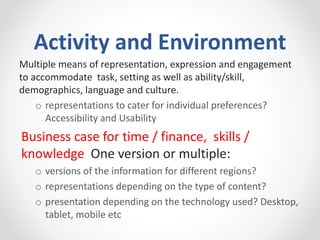
knowledge One version or multiple:
o versions of the information for different regions?
o representations depending on the type of content?
o presentation depending on the technology used? Desktop,
tablet, mobile etc
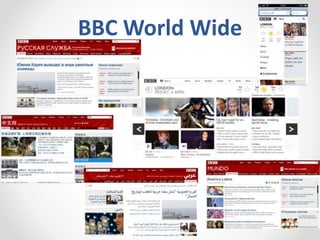
BBC World Wide
News from around the
world
• http://eisamay.indiatimes.com/
• http://www.aljazeera.net/portal
• http://www.pravda.ru/
• http://www.4semanas.com/
• http://www.nhk.or.jp/
• http://www.xinhuanet.com/
• http://www.alithia.com.cy/
• http://www.amx.is/
• http://us.cnn.com/?hpt=ed_US
• http://www.arib.info/
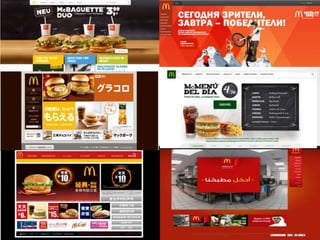
McDonalds global reach
• http://www.mcdonalds.de/
• http://www.mcdonalds.ru/
• http://www.mcdonalds.es
• http://www.mcdonalds.co.uk/ukhome.html
• http://www.mcdonalds.co.jp/
• http://www.mcdonalds.com.cn/
• http://www.mcdonalds.com/us/en/home.html
• http://www.mcdonaldsindia.com/
• http://www.mcdonalds.com.ar/
• http://mcdonalds.co.za/content/index.php
Discuss websites
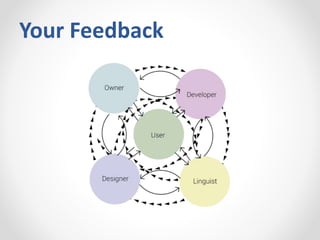
Your Feedback
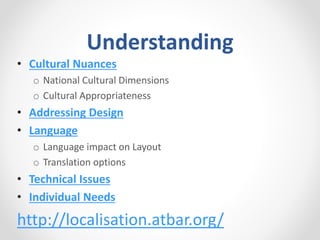
Understanding
• Cultural Nuances
o National Cultural Dimensions
o Cultural Appropriateness
• Addressing Design
• Language
o Language impact on Layout
o Translation options
• Technical Issues
• Individual Needs
http://localisation.atbar.org/
References
• Furstenberg et al., (2001). Giving a virtual voice to the silent language of culture: The
CULTURA project http://llt.msu.edu/vol5num1/furstenberg
• LeDoux, J. (2002). Synaptic self: How our brains become who we are. New York:
Penguin.
• Thorne, S.L., (2003a). Artefacts and cultures-of-use in intercultural communication
http://llt.msu.edu/vol7num2/thorne
• Crystal, D. (2001) Language and the Internet (Cambridge: Cambridge University Press)
• O’Dowd, R. (2001) In search of a truly global network: hhtp://callej.org/journal/3-
1/o_dowd.html
• Marcoccia, M. (2012) The internet, intercultural communication and cultural variation.
Language and Intercultural Communication, 12:4, 353-36
http://dx.doi.org/10.1080/14708477.2012.722101
• Ersoz, S. (2009) Cultures in Cyberspace: Interpersonal communication in a computer-
mediated environment
http://maltepe.academia.edu/SelvaEesoz/Papers/563123/Cultures_in_cyberspace_inte
rpersonal_communication_in_a_computer-mediated_Envrionment
• Würtz, E. (2005). A cross-cultural analysis of websites from high-context cultures and
low-context cultures. Journal of Computer-Mediated Communication, 11(1), article
13.http://jcmc.indiana.edu/vol11/issue1/wuertz.html
• Usunier, J. C. (2000). International marketing. A Cultural Approach, New York.
• Marcus, A., & Gould, E. W. (2000). Crosscurrents: cultural dimensions and global Web
user-interface design. interactions, 7(4), 32-46.
Thank You
E.A. Draffan
ECS Accessibility Team
http://access.ecs.soton.ac.uk
http://localisation.atbar.org/
Vanissa Wanick
PhD candidate and UX/UI designer
Games Design Hub
http://blog.soton.ac.uk/gamesdesignhub/

Intercultural communication in a Global World

  • 1.
    Intercultural Communication in a Globalworld Mrs E.A. Draffan Vanissa Wanick March 2015
  • 2.
    Plan for sessions •Intro - who we are what we have done • Presentation • Discussion • Practical session - groups discussing elements of intercultural communication - individual needs, language and culture. • Feedback • Tea Break • Explain framework for evaluating culturally different websites - issues arising • Look at websites • Feedback • Wrap up
  • 3.
  • 4.
    The Journey Please referto: http://www-edc.eng.cam.ac.uk/betterdesign/process/
  • 5.
  • 6.
    Ability and Skills Competencyin ICT often learnt out of school – impacts on use in education (Thorne, 2003a) - multiplicity of devices using digital multimedia Internet- mediated communication Lack clear visual cues Reduced social context Misinterpretation
  • 7.
    Demographics “People don’t comepreassembled but are glued together by life” (Le Doux, J. 2002) • Everyday experiences change the way we interact – level of digital literacy expertise, age, gender, environment, culture … percentage of populations above 65 years old by 2030 across the globe http://sapientprivatewealthmanagement.com/media/2010/10/Demographics-Around-the-World.pdf
  • 8.
    Language Internet-mediated global English– Netspeak (Crystal, D. 2001) • Informal and friendly may suit individualistic cultures but “prove disturbing for unprepared members of a collectivist culture” (O’Dowd, 2001) o salutations, o assertive rather than questioning, o aggressive but apologetic. (Marcoccia, 2012) but… • “anonymity can play a positive role in intercultural communication.” (Marcoccia, 2012) those who hesitate in f2F may communicate more when online.
  • 9.
    Culture Culture is “essentiallyelusive, abstract and invisible” (Furstenberg et al., 2001) • Low-context (text and speech) v. High-context cultures (visual cues and silence) e.g. North European v. Far Eastern and Arab (Würtz, 2005). • Just because you are connected it does not mean you necessarily communicate enough to learn about a culture (Marcoccia, 2012) however… • Cyberspace shares its own cultural practices within a virtual community – use English and follow the rules of netiquette? (Ersoz, 2009) but may mean you reduce cultural understanding.
  • 10.
    WVS Cultural Mapof the World The World Value Survey Cultural Map 2005-2008 – note “Each country is positioned according to its people’s values and not its geographical location.” http://www.worldvaluessurvey.org/wvs/articles/folder_published/article_base_54
  • 11.
    High Context Cultures(HC) Japan Arab Countries Greece Spain Italy England France North America Scandinavian Countries German-speaking Countries Low Context Cultures (LC) Source: Hall, E. and M. Hall (1990) Understanding Cultural Differences
  • 12.
  • 13.
    Hypotheses (Würtz, 2005) http://jcmc.indiana.edu/vol11/issue1/wuertz.html 1.High Context (HC) cultures will, to a higher degree than Low Context (LC) culture websites, implement strategies for assimilating human presence on their websites. 2. HC cultures are likely to use more imagery and less text than their LC counterparts. 3. The imagery chosen on HC culture websites will reflect values characteristic of HC cultures, such as family values, whereas LC culture values will be present on LC culture websites. 4. The pages making up LC websites are expected to be consistent in their layout and colour schemes, whereas pages in HC websites are expected to be diverse.
  • 14.
    More Cultural Dimensions: GeertHofstede • Cultures and Organizations: Software of the Mind, Geert Hofstede, McGraw-Hill, 1991, 1997 • Hofstede examined IBM employees in 50 countries, 1978-83 • Statistically valid data and analysis • One limitation is that he says that each country has only one dominate culture • However research has shown that these dimensions are still useful today.
  • 15.
    Hofstede’s 5 Dimensionsof Culture 1. Power-distance o high power distance cultures include many hierarchical levels, autocratic leadership, and the expectation of inequality and power differences, and are affiliated with HC cultures. o low power distance cultures are characterized by flat organization structures, consultative or participative management style, and the expectation of egalitarianism, especially evident in LC cultures.
  • 16.
    Cultural Dimensions andGlobal Web UI Design (Marcus & Gould, 2000) http://dl.acm.org/citation.cfm?id=345238 High power distance: Malaysian University website. Low power distance: Dutch Educational website.
  • 17.
    Hofstede’s 5 Dimensionsof Culture 2. Collectivism vs. individualism: o Collectivistic cultures prioritize group welfare over the goals of the individual. Tends to reflect HC cultures o Individualism emphasis is put on the goals and accomplishments of the individual rather than the group – relates to Low Context Cultures
  • 18.
    Hofstede’s 5 Dimensionsof Culture 3. Femininity vs. masculinity o masculine cultures, the traditional distinctions are strongly maintained, while feminine cultures tend to collapse the distinctions and overlap gender roles (both men and women can exhibit modesty, tenderness, and a concern with both quality of life and material success.) o Traditional masculine work goals include earnings, recognition, advancement, and challenge. o Traditional feminine work goals include good relations with supervisors, peers, and subordinates; good living and working conditions; and employment security.
  • 19.
    Hofstede’s 5 Dimensionsof Culture 4. Uncertainty avoidance o high uncertainty avoidance tend to have more formal rules, require longer career commitments, and focus on tactical operations rather than strategy. These cultures tend to be expressive; people talk with their hands, raise their voices, and show emotions. o low UA cultures tend to be more informal and focus more on long-range strategic matters than day-to-day operations. These cultures tend to be less expressive and less openly anxious;
  • 20.
    Cultural Dimensions andGlobal Web UI Design (Marcus & Gould, 2000) http://dl.acm.org/citation.cfm?id=345238 High UA: Sabema Airlines website from Belgium. Low UA: British Airways website from United Kingdom.Long-
  • 21.
    Hofstede’s 5 Dimensionsof Culture 5. Long- vs. short-term time orientation o Long-Term Orientation seemed to play an important role in Asian countries that had been influenced by Confucian philosophy over many thousands of years. o Western countries, by contrast, were more likely to promote equal relationships, emphasize individualism, focus on treating others as you would like to be treated, and find fulfilment through creativity and self-actualization
  • 22.
    Practical Session Groups discussingelements of intercultural communication such as individual needs, language and culture.
  • 23.
    Question? Does cyberspace symbolise ‘culturalstandardisation’ or does it allow for ‘cultural variations and local appropriation’?
  • 24.
  • 25.
    Discover Create Translate Develop Test Localisation Framework Cultural Context Dimensions Appropriateness Environment Demographics Language Impact onDesign Translation Technical Individual Needs Activity Skills Designers LinguistsDevelopers Visionary / User /Owner Users
  • 26.
    The CAKE framework Advergames:games that carry a persuasive message RQ: What are the effective advergames affordances for cross- cultural consumer behaviour? RQ2: How can designers build effective advergames across cultures? - Mechanics, storyline, interface…? - A different game for each culture? - Findings show that players from Brazil prefer more the visual aspects of the game (characters, scenarios), if compared to British players - The advergames in the market are usually the same, just with translation of content What about games?
  • 27.
  • 28.
    Practical User interfaceddesign • Images: Images can easily offend, especially when people are involved and may also differ in approach to the type of image shown especially in the degrees of say violence and sexuality. • Colours: Colour is sometimes used to convey meaning or to help us focus on part of the page, but colour has a different meaning in different cultures. • Flow/Navigation: we look read a web page differently, we start at different points and then move our eye in different ways (some up and down across). Similarly navigation is differ not only in flow, but also what information we want to see first.
  • 29.
    Colour Colour China JapanEgypt France United States Red Happiness Anger Danger Death Aristocracy Danger Stop Blue Heavens Clouds Villainy Virtue Faith Truth Freedom Peace Masculine Green Ming Dynasty Heavens Future Youth Energy Fertility Strength Criminality Safety Go Yellow Birth Wealth Power Grace Nobility Happiness Prosperity Temporary Cowardice Temporary White Death Purity Death Joy Neutrality Purity
  • 30.
  • 31.
    Practical User interfaced design •Text: This is not the same in all cultures in terms of character sets and the way language is used. • Number, Dates and Time formats: not all cultures have the same calendar or number format. • Metaphors/ Idioms: we often convey a new idea using a figure of speech that is not always understood in the same way by another culture or in another language. “Its raining cats and dogs!” French “Il pleut des cordes”, or it's raining ropes! Dutch “Het regent pijpestelen” it's raining steel pipes
  • 32.
    Cultural Appropriateness A wayof speaking and writing? Direct English, formal and expressive Arabic, talking around a subject in Chinese and Japanese, not quite so direct in French or even Russian… Kaplan’s models of contrastive rhetoric (1966) • use polite terms and avoid slang or casual statements • describe any words that may have a double meaning • understand the use of gender as in many languages objects can be female or male rather than neuter as in the use of ‘it’ • avoid using images if you are not sure they explain your text clearly.
  • 33.
    Need to alsothink about… • Space • Maintenance • Linking between sites • Contact for each version of your service http://www.omniglot.com/language/articles/multilingual_websites.htm
  • 34.
    Translation • Commercial, crowdsourcing,volunteering and automatic • Reverse translate! • Have a glossary of terms to hand • Some words simply do not work in other languages.
  • 35.
    Technological Needs We havejust looked at Microsoft Windows, Android and iOS (Apple) - It is important to: o Separate resources from code. o Use Unicode and UTF-8. o Support string tables for each language, separate icons and images plus right to left user interface. o Support localised keyboard shortcuts. o Make sure keyboards and on-screen keyboards are supported for the intended languages on the target platform. o Make sure appropriate fonts are supported. o Allow the user to easily change the locale of the software.
  • 36.
    Activity and Environment Multiplemeans of representation, expression and engagement to accommodate task, setting as well as ability/skill, demographics, language and culture. o representations to cater for individual preferences? Accessibility and Usability Business case for time / finance, skills / knowledge One version or multiple: o versions of the information for different regions? o representations depending on the type of content? o presentation depending on the technology used? Desktop, tablet, mobile etc
  • 37.
  • 38.
    News from aroundthe world • http://eisamay.indiatimes.com/ • http://www.aljazeera.net/portal • http://www.pravda.ru/ • http://www.4semanas.com/ • http://www.nhk.or.jp/ • http://www.xinhuanet.com/ • http://www.alithia.com.cy/ • http://www.amx.is/ • http://us.cnn.com/?hpt=ed_US • http://www.arib.info/
  • 39.
    McDonalds global reach •http://www.mcdonalds.de/ • http://www.mcdonalds.ru/ • http://www.mcdonalds.es • http://www.mcdonalds.co.uk/ukhome.html • http://www.mcdonalds.co.jp/ • http://www.mcdonalds.com.cn/ • http://www.mcdonalds.com/us/en/home.html • http://www.mcdonaldsindia.com/ • http://www.mcdonalds.com.ar/ • http://mcdonalds.co.za/content/index.php
  • 41.
  • 42.
  • 43.
    Understanding • Cultural Nuances oNational Cultural Dimensions o Cultural Appropriateness • Addressing Design • Language o Language impact on Layout o Translation options • Technical Issues • Individual Needs http://localisation.atbar.org/
  • 44.
    References • Furstenberg etal., (2001). Giving a virtual voice to the silent language of culture: The CULTURA project http://llt.msu.edu/vol5num1/furstenberg • LeDoux, J. (2002). Synaptic self: How our brains become who we are. New York: Penguin. • Thorne, S.L., (2003a). Artefacts and cultures-of-use in intercultural communication http://llt.msu.edu/vol7num2/thorne • Crystal, D. (2001) Language and the Internet (Cambridge: Cambridge University Press) • O’Dowd, R. (2001) In search of a truly global network: hhtp://callej.org/journal/3- 1/o_dowd.html • Marcoccia, M. (2012) The internet, intercultural communication and cultural variation. Language and Intercultural Communication, 12:4, 353-36 http://dx.doi.org/10.1080/14708477.2012.722101 • Ersoz, S. (2009) Cultures in Cyberspace: Interpersonal communication in a computer- mediated environment http://maltepe.academia.edu/SelvaEesoz/Papers/563123/Cultures_in_cyberspace_inte rpersonal_communication_in_a_computer-mediated_Envrionment • Würtz, E. (2005). A cross-cultural analysis of websites from high-context cultures and low-context cultures. Journal of Computer-Mediated Communication, 11(1), article 13.http://jcmc.indiana.edu/vol11/issue1/wuertz.html • Usunier, J. C. (2000). International marketing. A Cultural Approach, New York. • Marcus, A., & Gould, E. W. (2000). Crosscurrents: cultural dimensions and global Web user-interface design. interactions, 7(4), 32-46.
  • 45.
    Thank You E.A. Draffan ECSAccessibility Team http://access.ecs.soton.ac.uk http://localisation.atbar.org/ Vanissa Wanick PhD candidate and UX/UI designer Games Design Hub http://blog.soton.ac.uk/gamesdesignhub/

Editor's Notes

  • #4 Monument to Multiculturalism by Francesco Perilli inToronto, Canada. Four identical sculptures are located inBuffalo City, South Africa; Changchun, China; Sarajevo,Bosnia and Sydney, Australia
  • #5 The Need – Discover – gain understanding –translate –Requirements Start to create – based on the concepts – develop and offer solutions.
  • #6 Understand the context is also important User experience will give to the designer an overview about the context of the user, why the user interacts with something in a different way. In this scenario, cultural values will also influence this interaction Why people are interacting with a website? In which context?
  • #8 http://sapientprivatewealthmanagement.com/media/2010/10/Demographics-Around-the-World.pdf
  • #9 individualistic – relationships with individuals developed during the communication, tends to be direct but collectivist cultures prefer to use their known types of communication preserving the boundaries already defined by the group – high context and indirect speech (Gudykunst and Matsumoto 1996)
  • #17 Added one example borrowed from Marcus and Gould to illustrate the relationship between cultural dimensions and design Access to information: highly (high PD) vs. less-highly (low PD) structured. Focus on expertise, authority, experts, certifications, official stamps, or logos: strong vs. weak. The Malaysian website features strong axial symmetry, focus on the official seal of the university, photographs of faculty or administration leaders conferring degrees The Dutch websites feature an emphasis on students, a stronger use of asymmetric layout, and photos of both gen- ders in illustrations.
  • #21 High UA: Simplicity, clear metaphors, limited choices / Mental models, reducing errors, redundant cues Low UA: Complexity, maximal content choices / less control of navigation, coding of colour, typography, maximize information
  • #22 A stable society requires unequal relations.• The family is the prototype of all social organiza- tions; consequent- ly, older people (parents) have more authority than younger peo- ple (and men more than women).• Virtuous behavior
  • #23 Coffee and flapjacks
  • #27 If the mechanics are changed, then it will be a different game for each player The storyline follows the mechanics and interface design So, this should be in the interface level – characters, WIMP (windows, icons, menus, pointer), colours, scenarios? What is the limit between the new game and the adaptive game? It will depend on the brand category, service – this will shape the message that should be consistent to user research (discovery + strategy) Storyline + WIMP will imply translation Players usually focus more on the character while playing a mobile game, for example
  • #28 Example of application for Arabic cultures – system utilising badges and other visual elements related to the Arabic culture Colours: white, blue, green – green is a holy colour, position of the logos, calendar, spacing, high UA – hierarchy, etc
  • #31 Infographic for references – see the differences Just added this to show how the colours are different
  • #43 We could give the students some sticky-notes or papers with their roles in the international communication world As a game, each one will play one role. A team should have at least 5 members. Give a scenario: You all work for…. You have this challenge What does each member expect? What could you do to help to make this relationship better? How would you solve the problem of international communication? After it, a quick voting could happen and the team with the most interesting ideas could win something