1
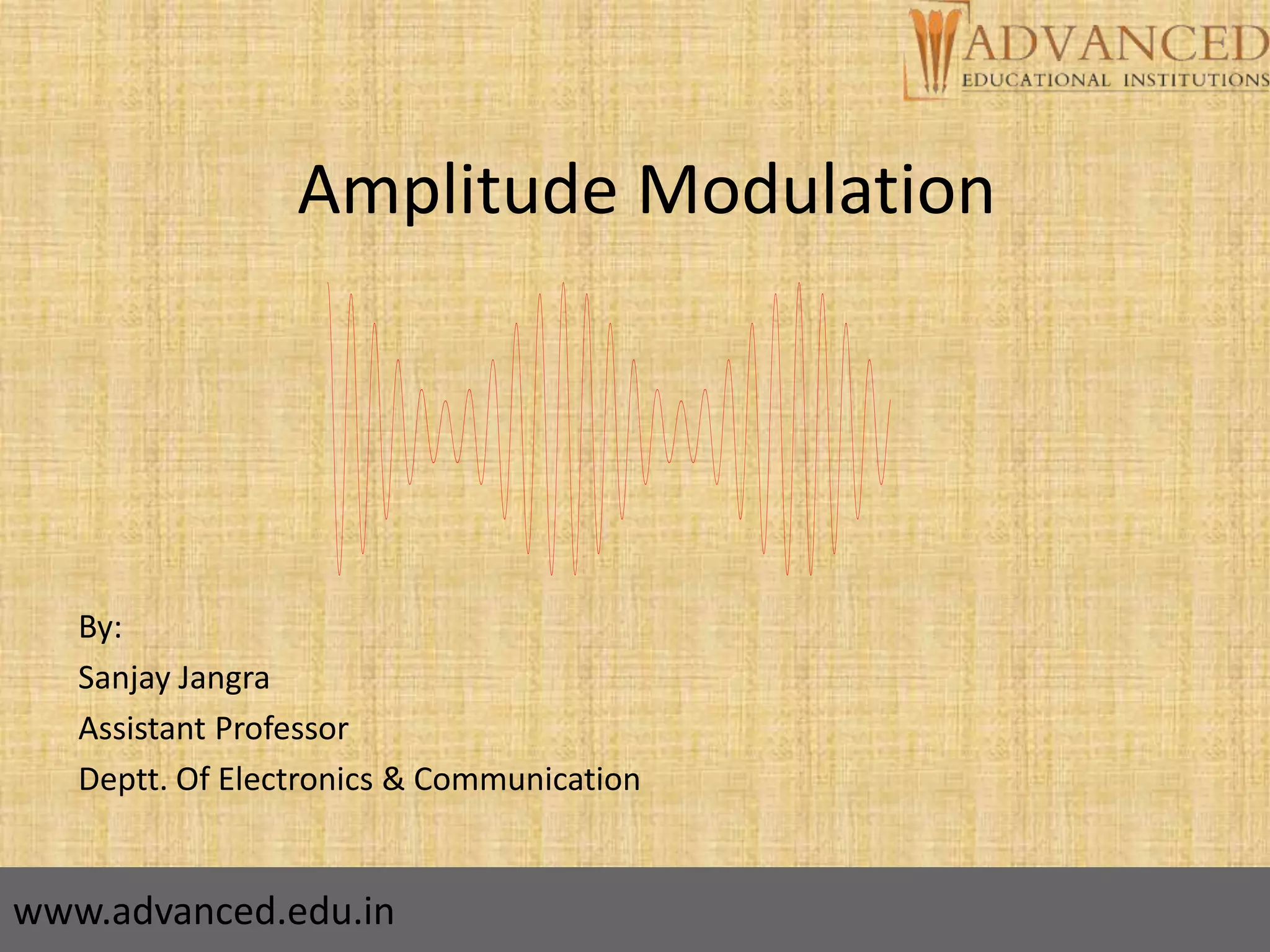
Amplitude Modulation
By:
Sanjay Jangra
Assistant Professor
Deptt. Of Electronics & Communication
www.advanced.edu.in
2
Introduction
• Modulation
– In the modulation process, some characteristic of a high-
frequency carrier signal (bandpass), is changed according to
the instantaneous amplitude of the information (baseband)
signal.
• Why Modulation
– Suitable for signal transmission (distance…etc)
– Multiple signals transmitted on the same channel
– Capacitive or inductive devices require high frequency AC
input (carrier) to operate.
– Stability and noise rejection
www.advanced.edu.in
3
About Modulation
• Application Examples
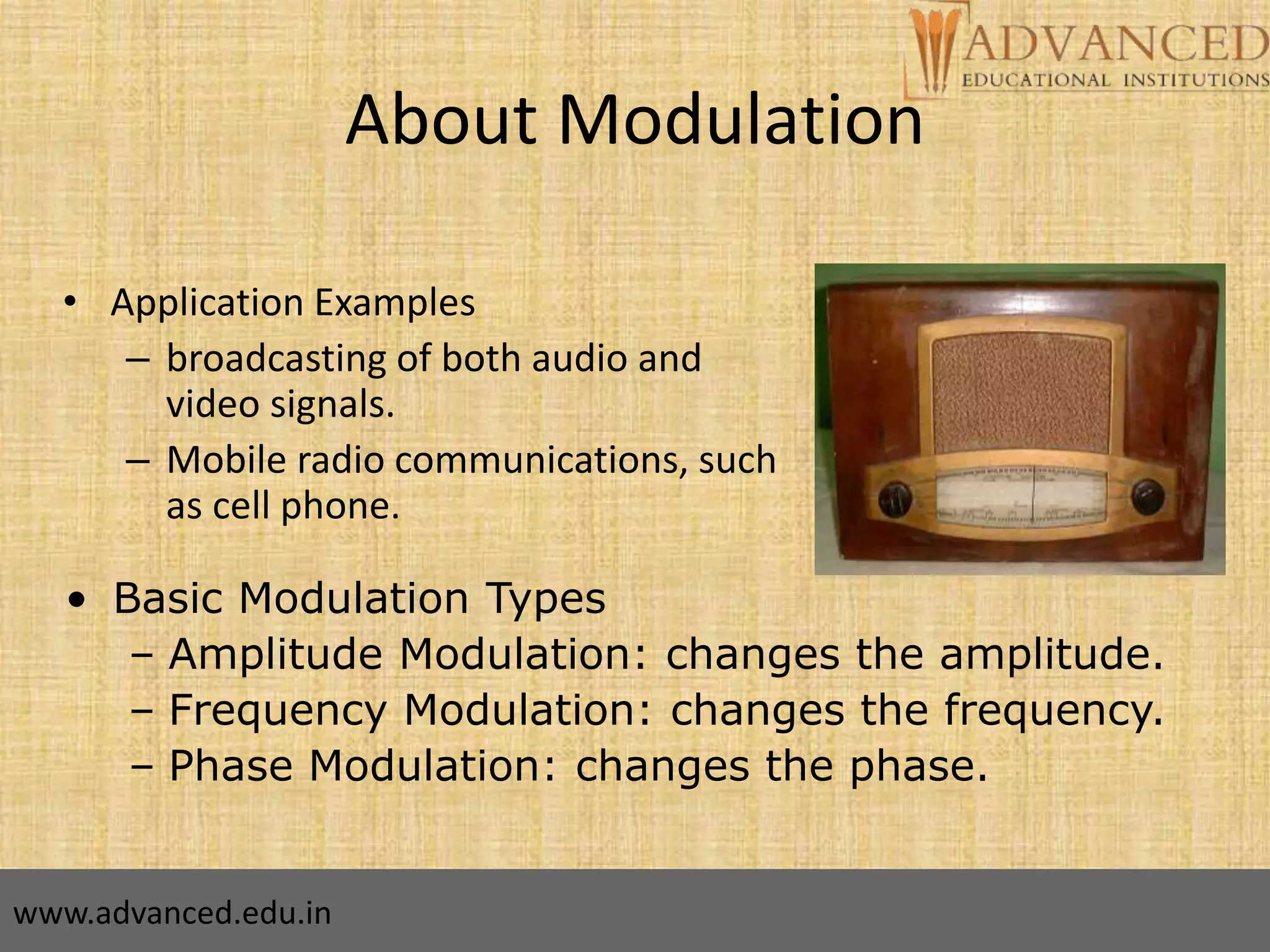
– broadcasting of both audio and
video signals.
– Mobile radio communications, such
as cell phone.
• Basic Modulation Types
– Amplitude Modulation: changes the amplitude.
– Frequency Modulation: changes the frequency.
– Phase Modulation: changes the phase.
www.advanced.edu.in
4
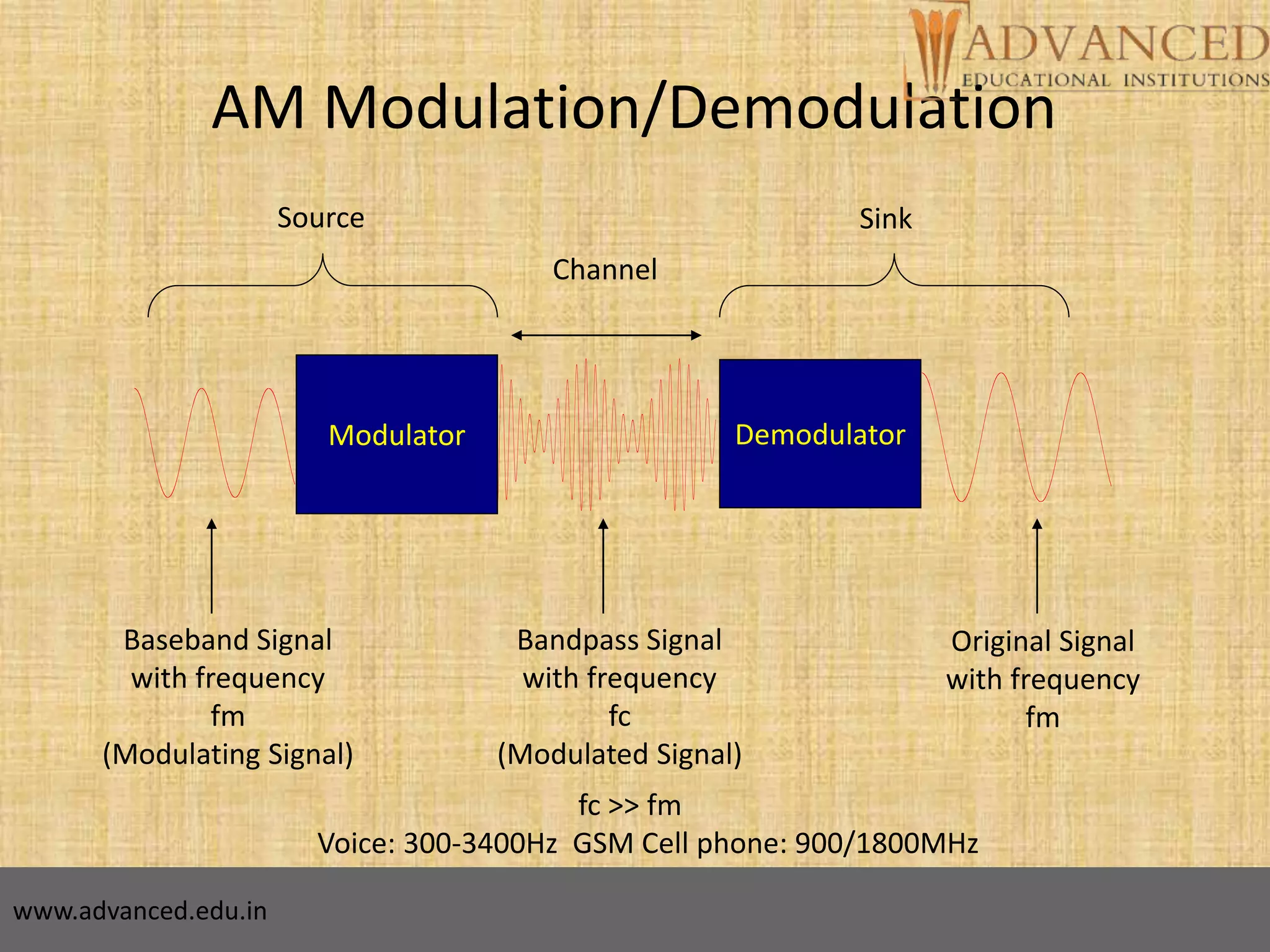
AM Modulation/Demodulation
Modulator Demodulator
Baseband Signal
with frequency
fm
(Modulating Signal)
Bandpass Signal
with frequency
fc
(Modulated Signal)
Channel
Original Signal
with frequency
fm
Source Sink
fc >> fm
Voice: 300-3400Hz GSM Cell phone: 900/1800MHz
www.advanced.edu.in
5
Amplitude Modulation
• The amplitude of high-carrier signal is varied
according to the instantaneous amplitude of the
modulating message signal m(t).
Carrier Signal: or
Modulating Message Signal: or
The AM Signal:
cos(2 ) cos( )
( ): cos(2 ) cos( )
( ) [ ( )]cos(2 )
c c
m m
AM c c
f t t
m t f t t
s t A m t f t
 
 
 
www.advanced.edu.in
6
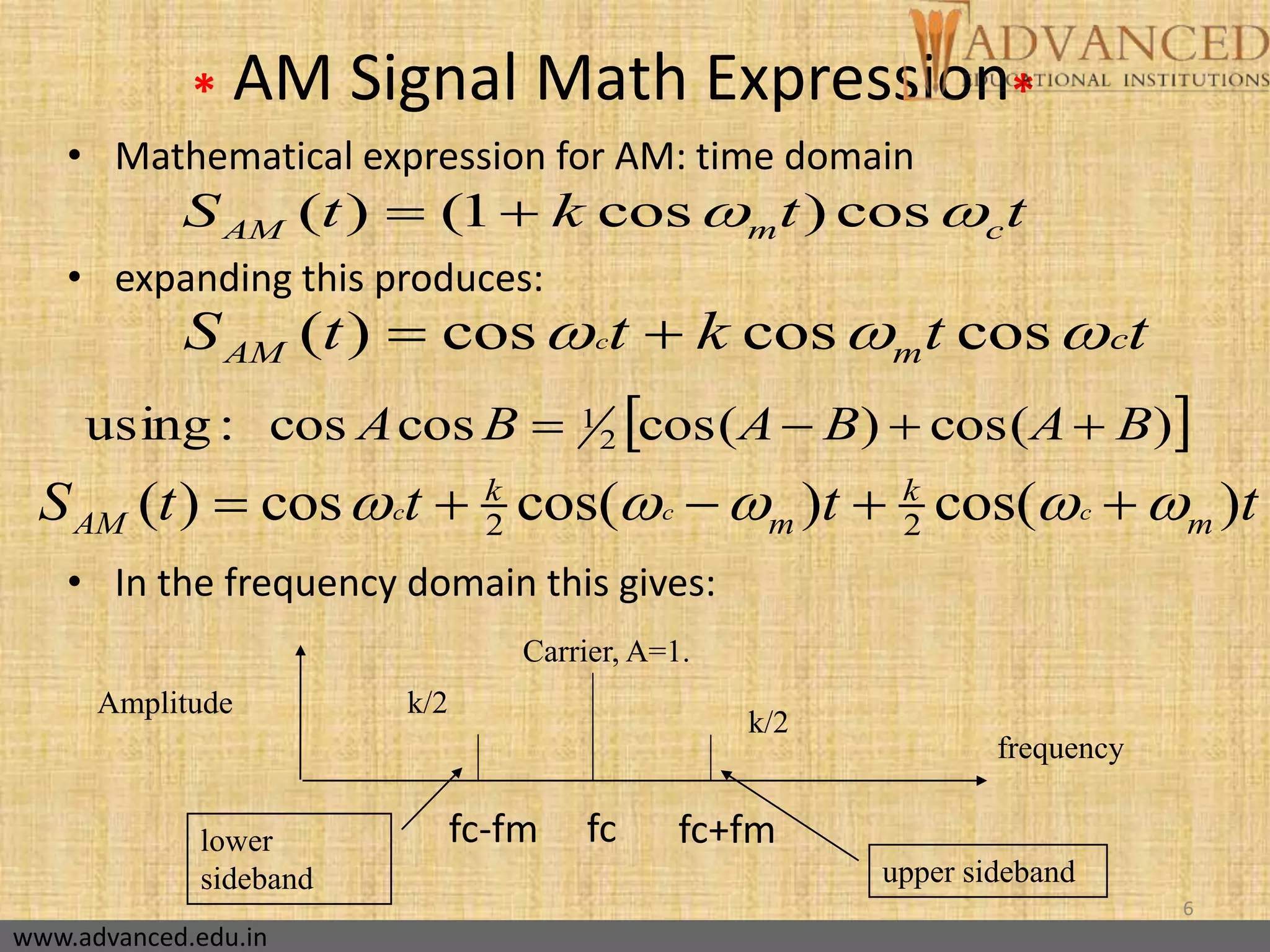
* AM Signal Math Expression*
• Mathematical expression for AM: time domain
• expanding this produces:
• In the frequency domain this gives:
( ) (1 cos ) cosAM m cS t k t t  
( ) cos cos cosc cAM mS t t k t t   
 )cos()cos(coscos:using 2
1 BABABA 
2 2( ) cos cos( ) cos( )c c c
k k
AM m mS t t t t        
frequency
k/2
k/2
Carrier, A=1.
upper sideband
lower
sideband
Amplitude
fcfc-fm fc+fm
www.advanced.edu.in
7
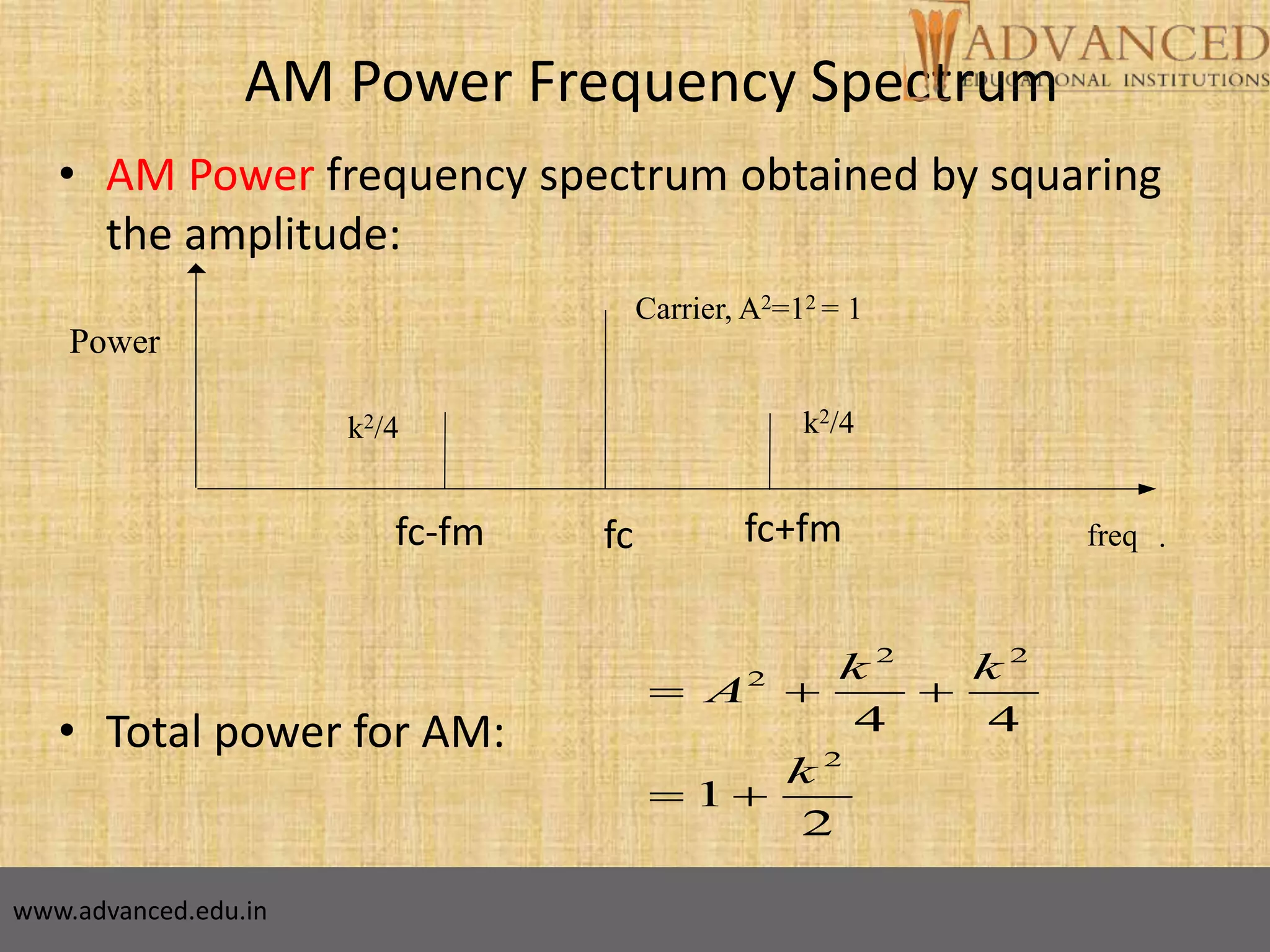
AM Power Frequency Spectrum
• AM Power frequency spectrum obtained by squaring
the amplitude:
• Total power for AM:
.
2 2
2
2
4 4
1
2
k k
A
k
  
 
freq
k2/4k2/4
Carrier, A2=12 = 1
Power
fcfc-fm fc+fm
www.advanced.edu.in
8
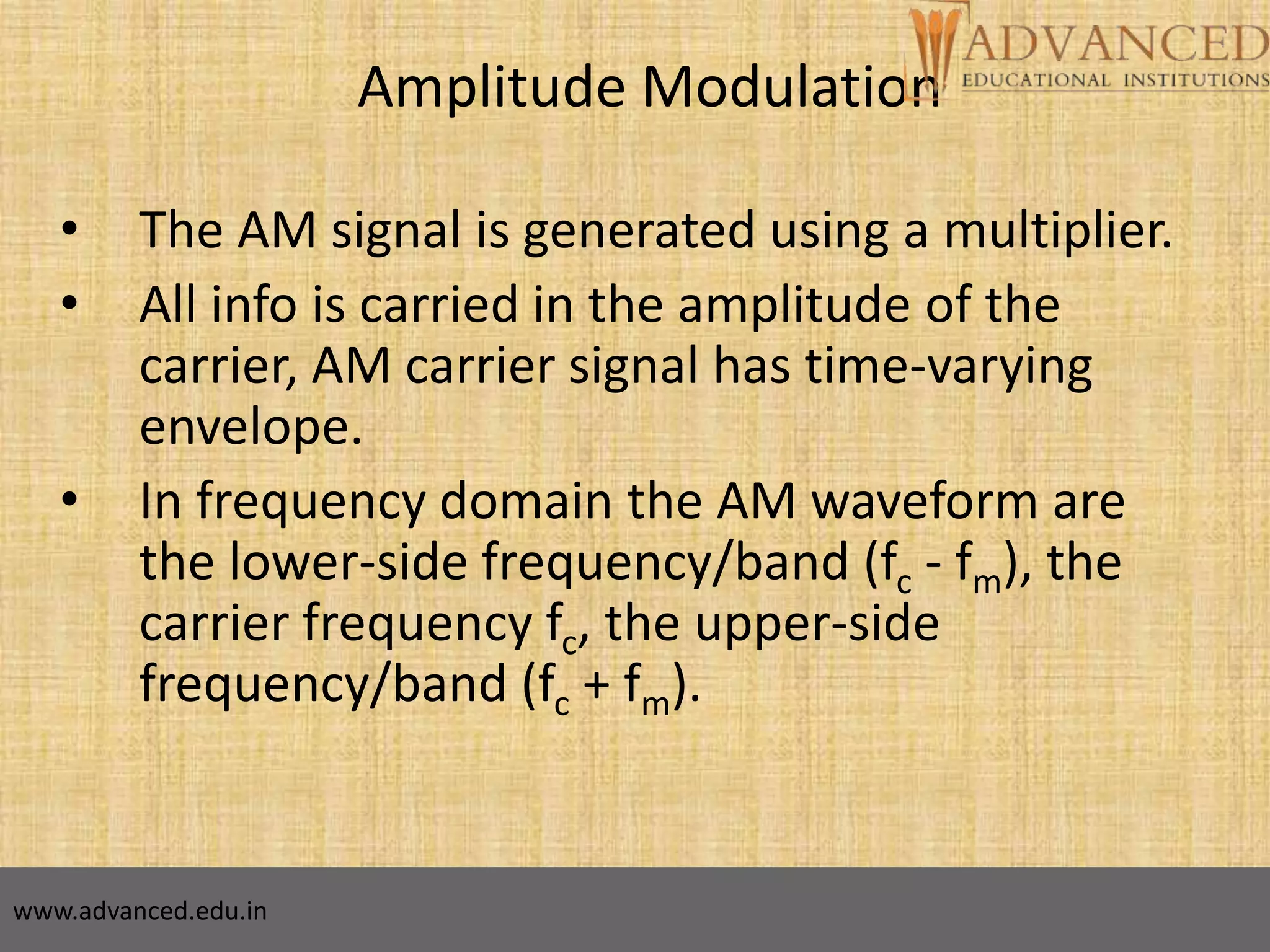
Amplitude Modulation
• The AM signal is generated using a multiplier.
• All info is carried in the amplitude of the
carrier, AM carrier signal has time-varying
envelope.
• In frequency domain the AM waveform are
the lower-side frequency/band (fc - fm), the
carrier frequency fc, the upper-side
frequency/band (fc + fm).
www.advanced.edu.in
9
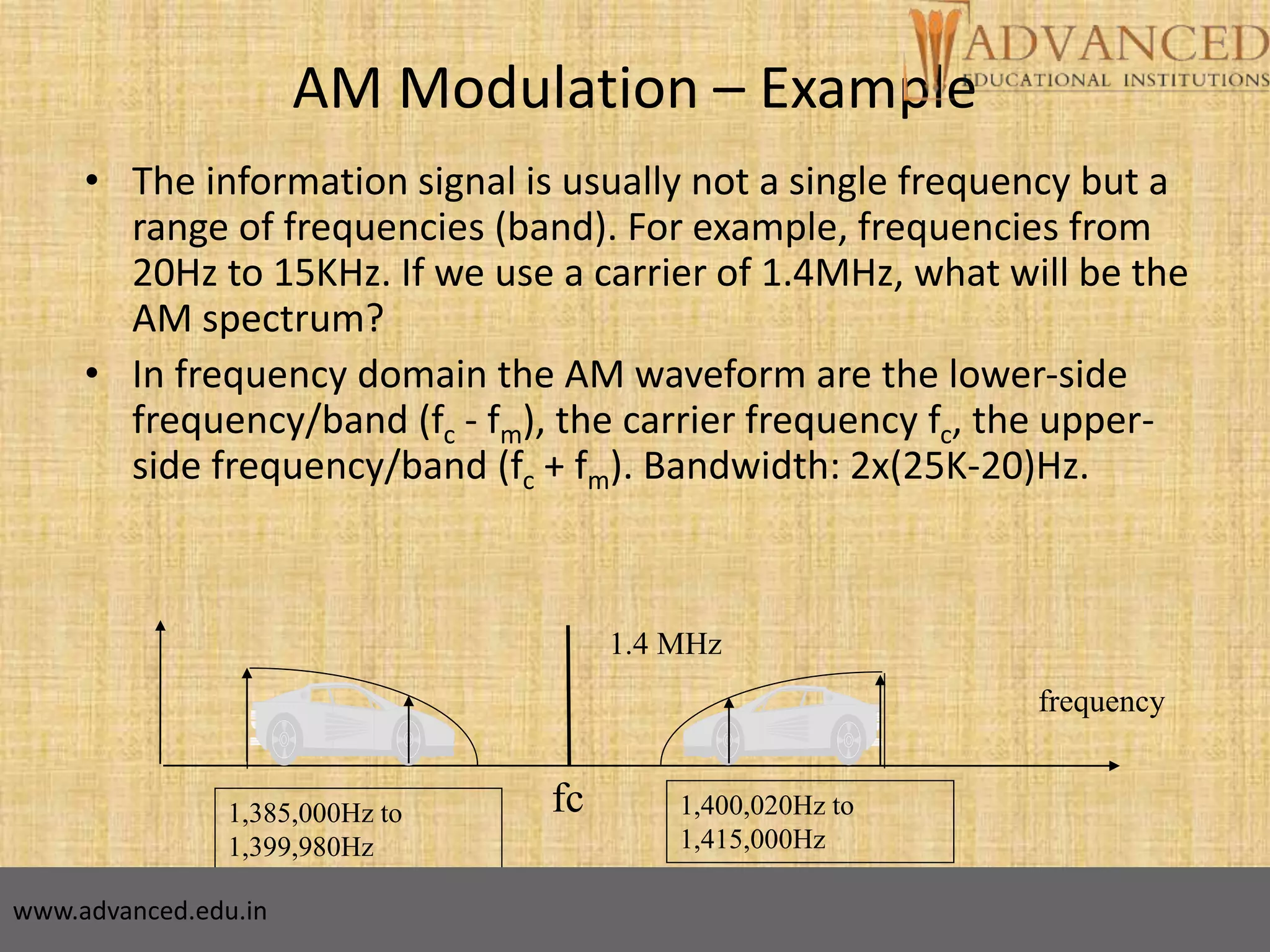
AM Modulation – Example
• The information signal is usually not a single frequency but a
range of frequencies (band). For example, frequencies from
20Hz to 15KHz. If we use a carrier of 1.4MHz, what will be the
AM spectrum?
• In frequency domain the AM waveform are the lower-side
frequency/band (fc - fm), the carrier frequency fc, the upper-
side frequency/band (fc + fm). Bandwidth: 2x(25K-20)Hz.
frequency
1.4 MHz
1,385,000Hz to
1,399,980Hz
1,400,020Hz to
1,415,000Hz
fc
www.advanced.edu.in
10
Modulation Index of AM Signal
m
c
A
k
A

)2cos()( tfAtm mm 
Carrier Signal: cos(2 ) DC:c Cf t A
For a sinusoidal message signal
Modulation Index is defined as:
Modulated Signal: ( ) [ cos(2 )]cos(2 )
[1 cos(2 )]cos(2 )
AM c m m c
c m c
S t A A f t f t
A k f t f t
 
 
 
 
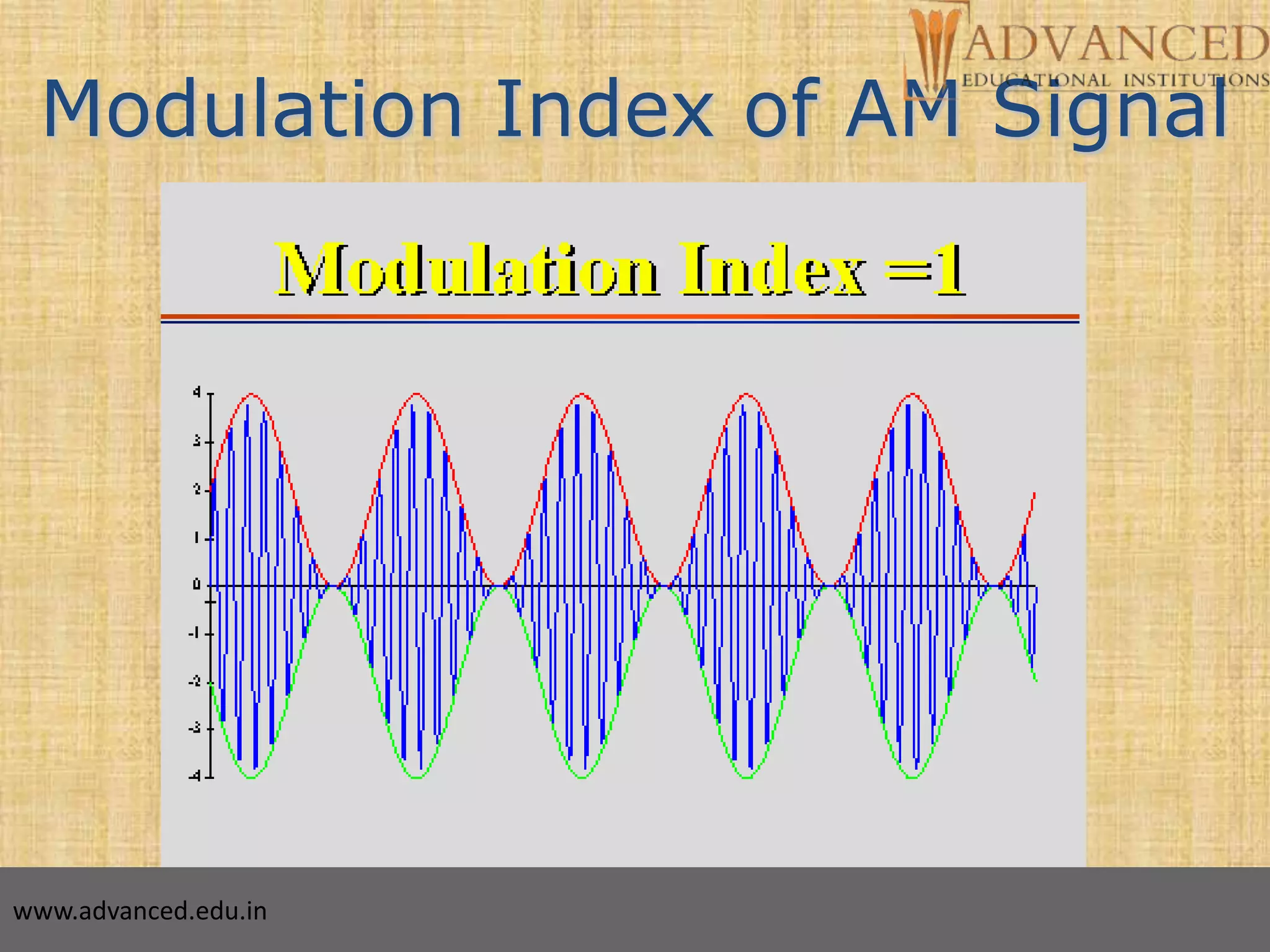
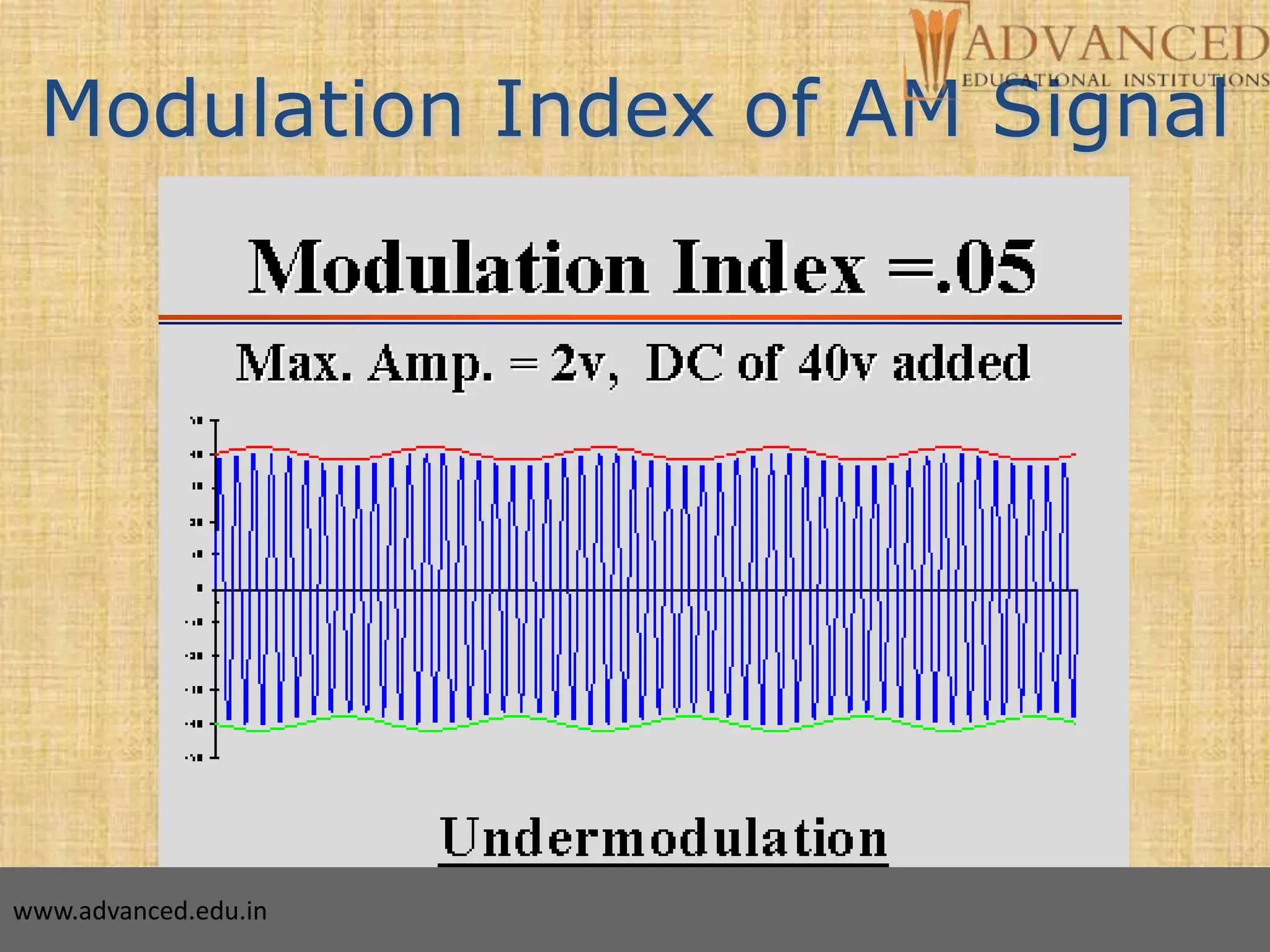
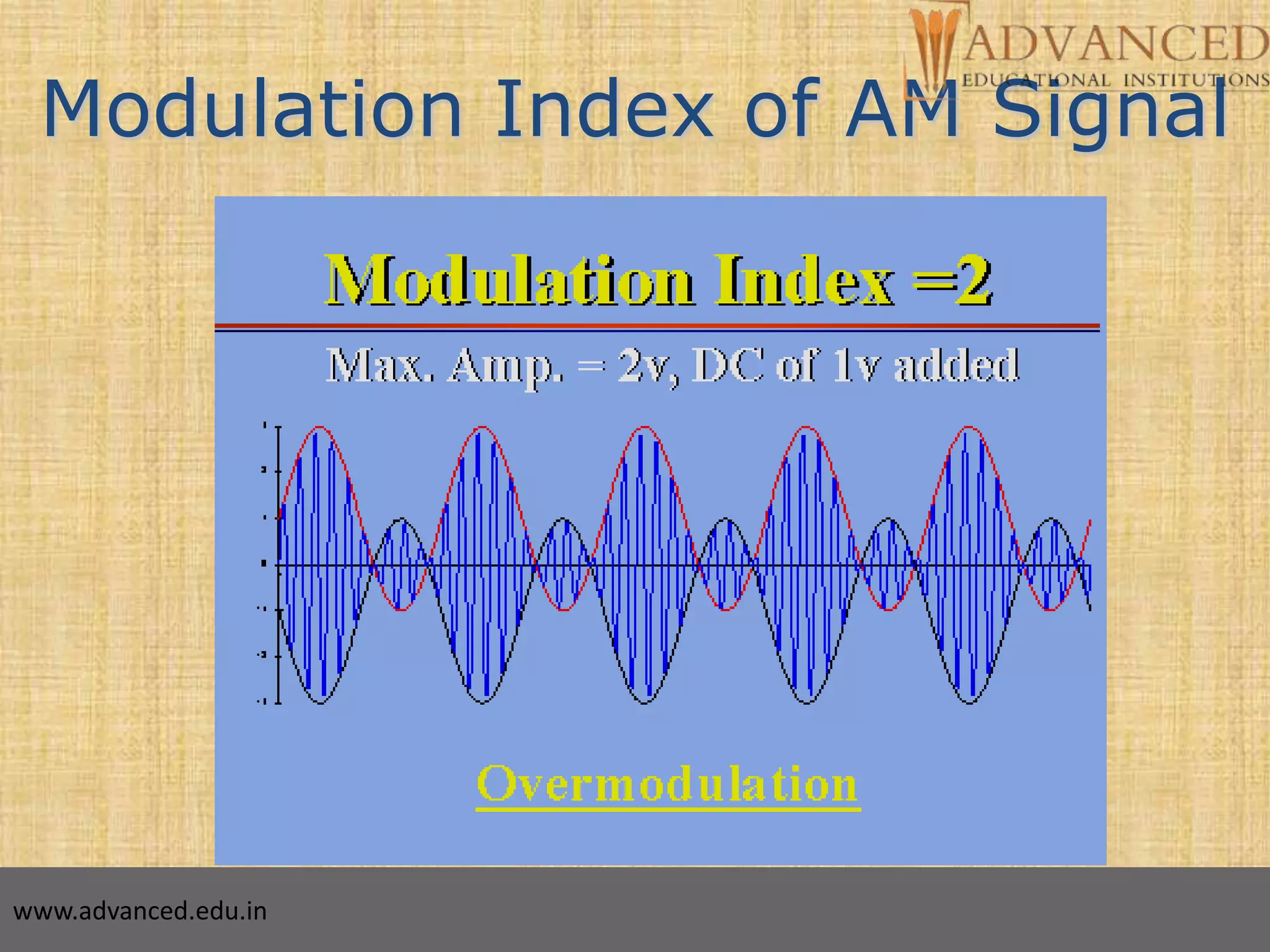
Modulation index k is a measure of the extent to
which a carrier voltage is varied by the modulating
signal. When k=0 no modulation, when k=1 100%
modulation, when k>1 over modulation.
www.advanced.edu.in
11
Modulation Index of AM Signal
www.advanced.edu.in
12
Modulation Index of AM Signal
www.advanced.edu.in
13
Modulation Index of AM Signal
www.advanced.edu.in
14
High Percentage Modulation
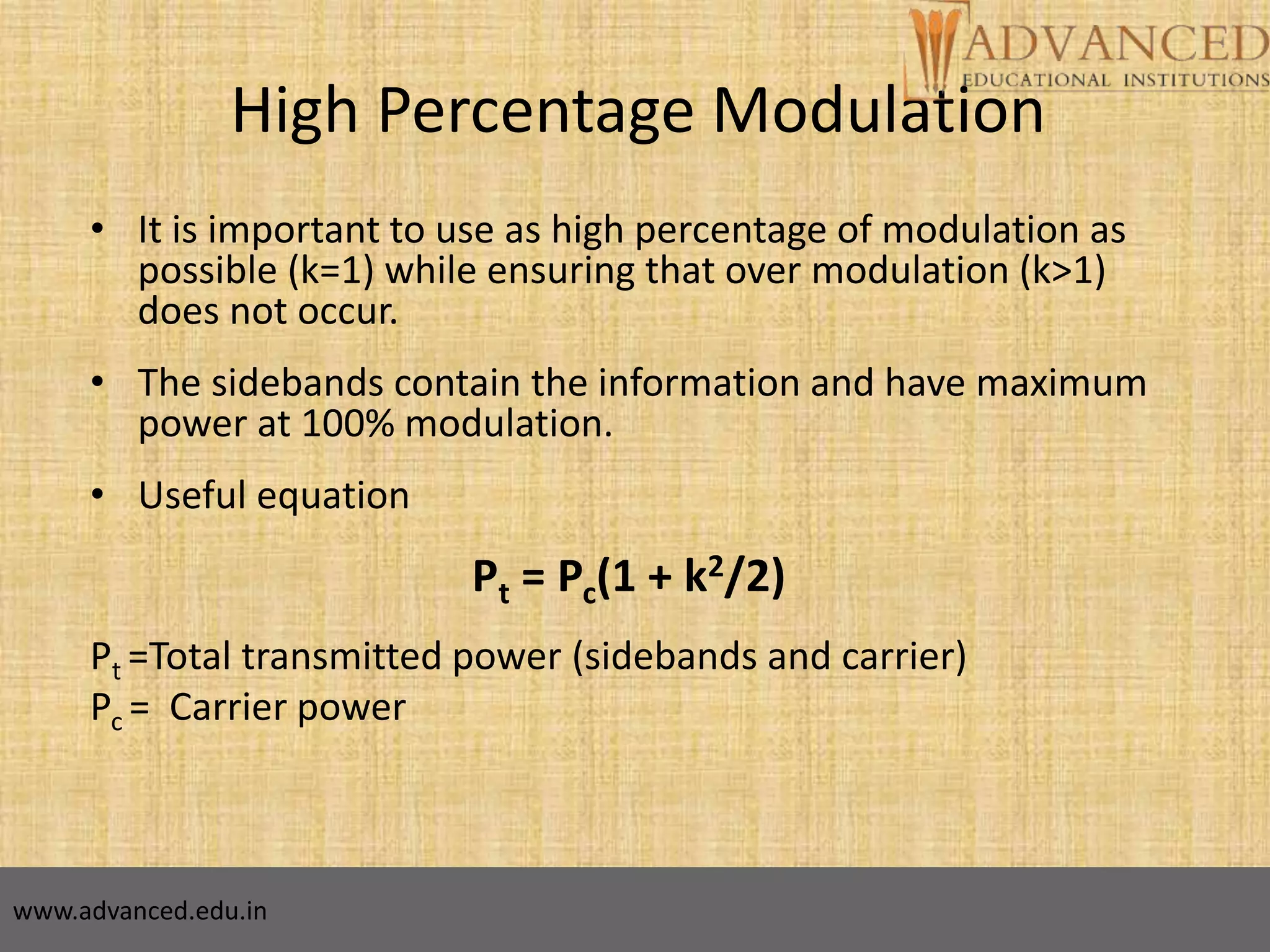
• It is important to use as high percentage of modulation as
possible (k=1) while ensuring that over modulation (k>1)
does not occur.
• The sidebands contain the information and have maximum
power at 100% modulation.
• Useful equation
Pt = Pc(1 + k2/2)
Pt =Total transmitted power (sidebands and carrier)
Pc = Carrier power
www.advanced.edu.in
15
Demodulation of AM Signals
Demodulation extracting the baseband message from
the carrier.
•There are 2 main methods of AM Demodulation:
• Envelope or non-coherent detection or demodulation.
• Synchronised or coherent demodulation.
www.advanced.edu.in
16
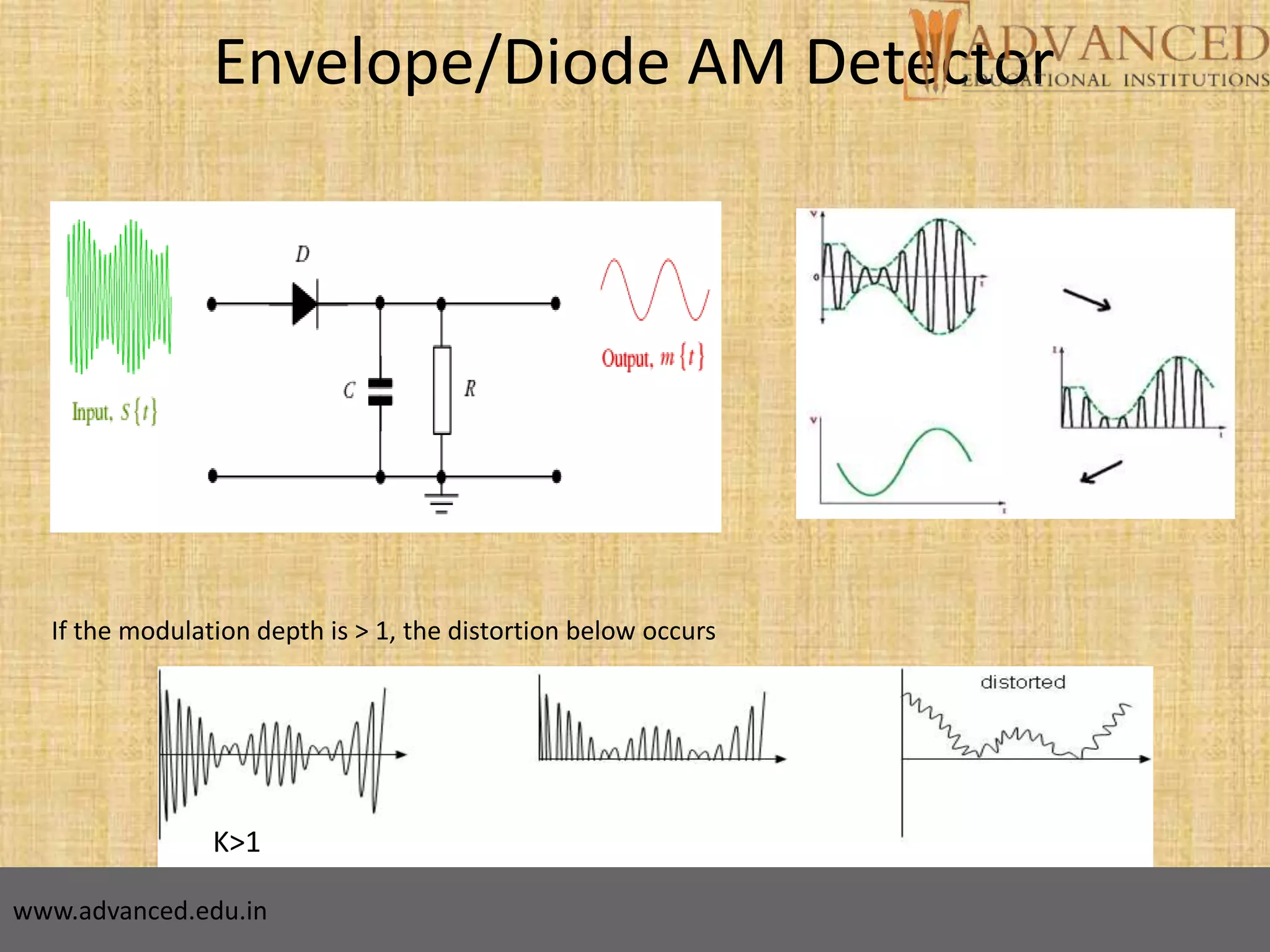
Envelope/Diode AM Detector
If the modulation depth is > 1, the distortion below occurs
K>1
www.advanced.edu.in
17
Synchronous or Coherent
Demodulation
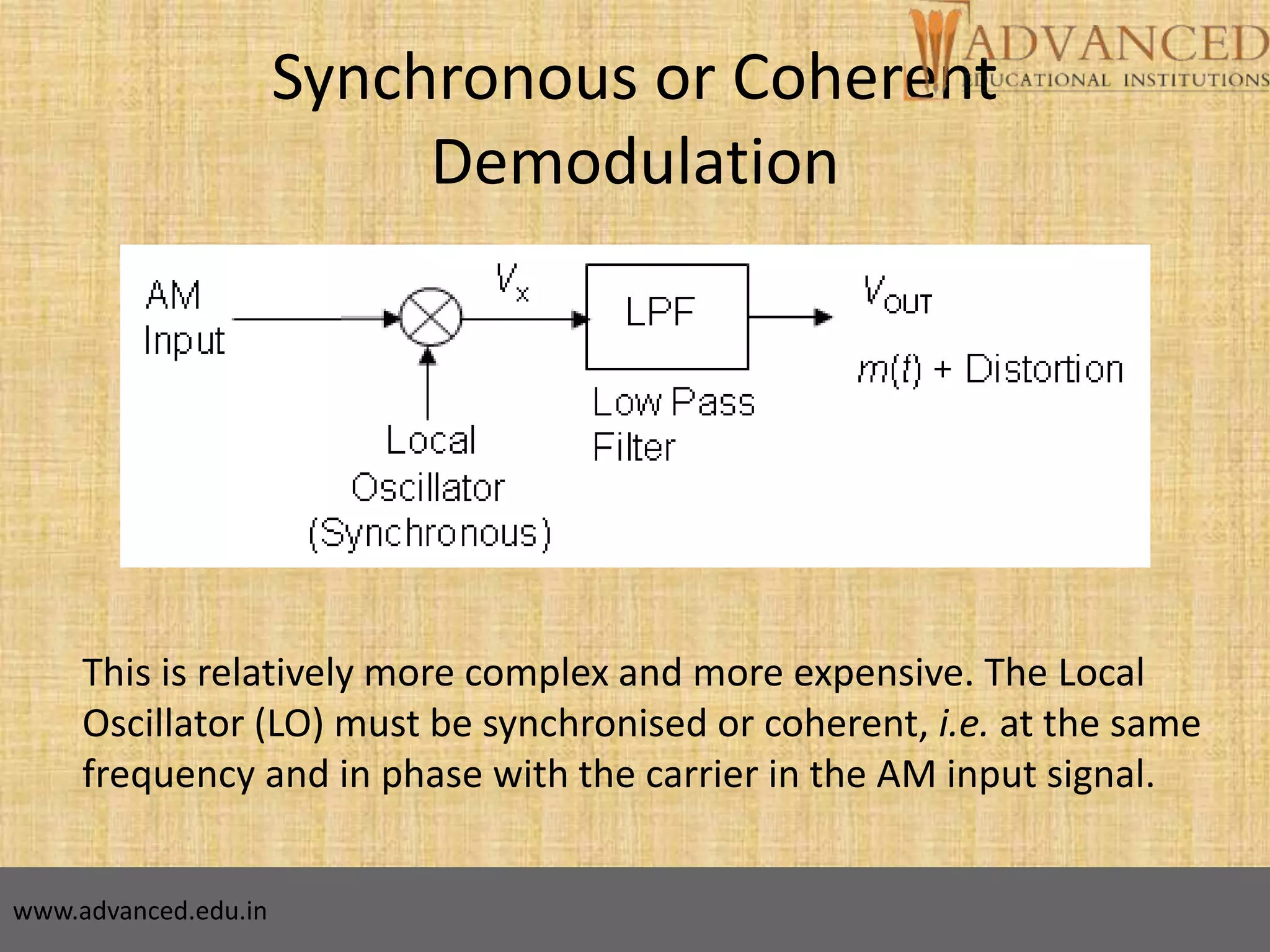
This is relatively more complex and more expensive. The Local
Oscillator (LO) must be synchronised or coherent, i.e. at the same
frequency and in phase with the carrier in the AM input signal.
www.advanced.edu.in
18
Synchronous or Coherent
Demodulation
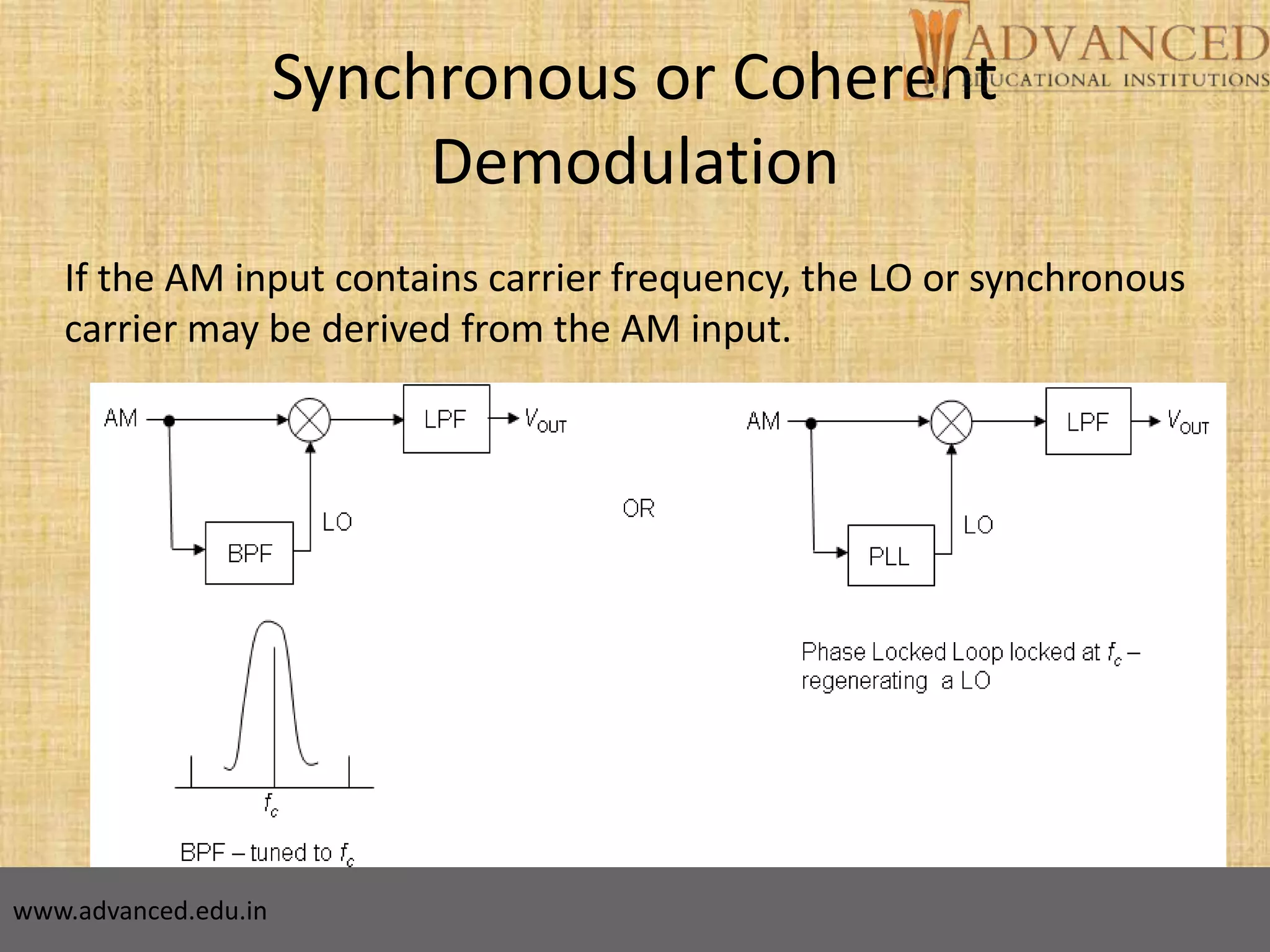
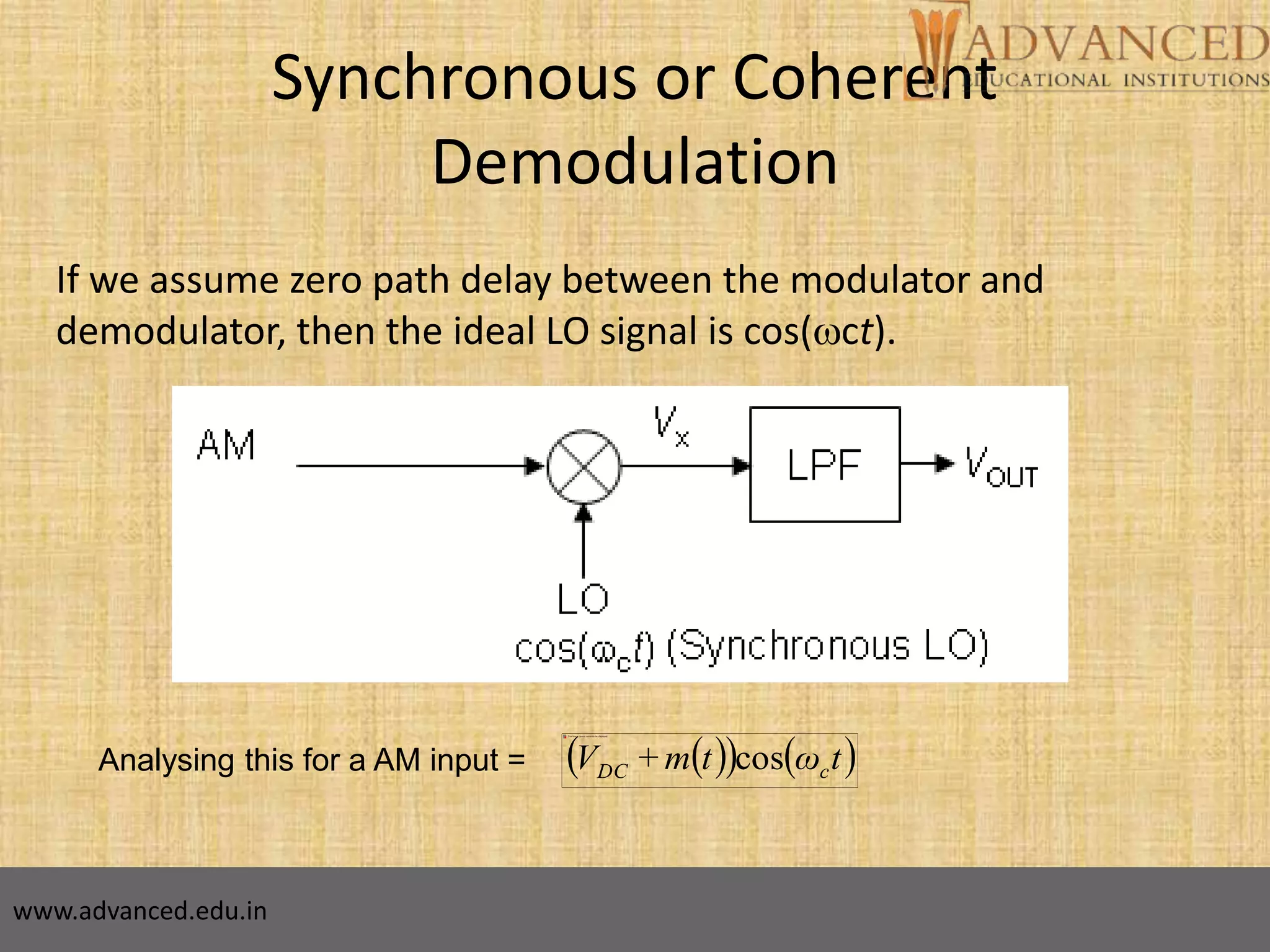
If the AM input contains carrier frequency, the LO or synchronous
carrier may be derived from the AM input.
www.advanced.edu.in
19
Synchronous or Coherent
Demodulation
If we assume zero path delay between the modulator and
demodulator, then the ideal LO signal is cos(ct).
Analysing this for a AM input =     tωtm+V cDC cos
www.advanced.edu.in
20
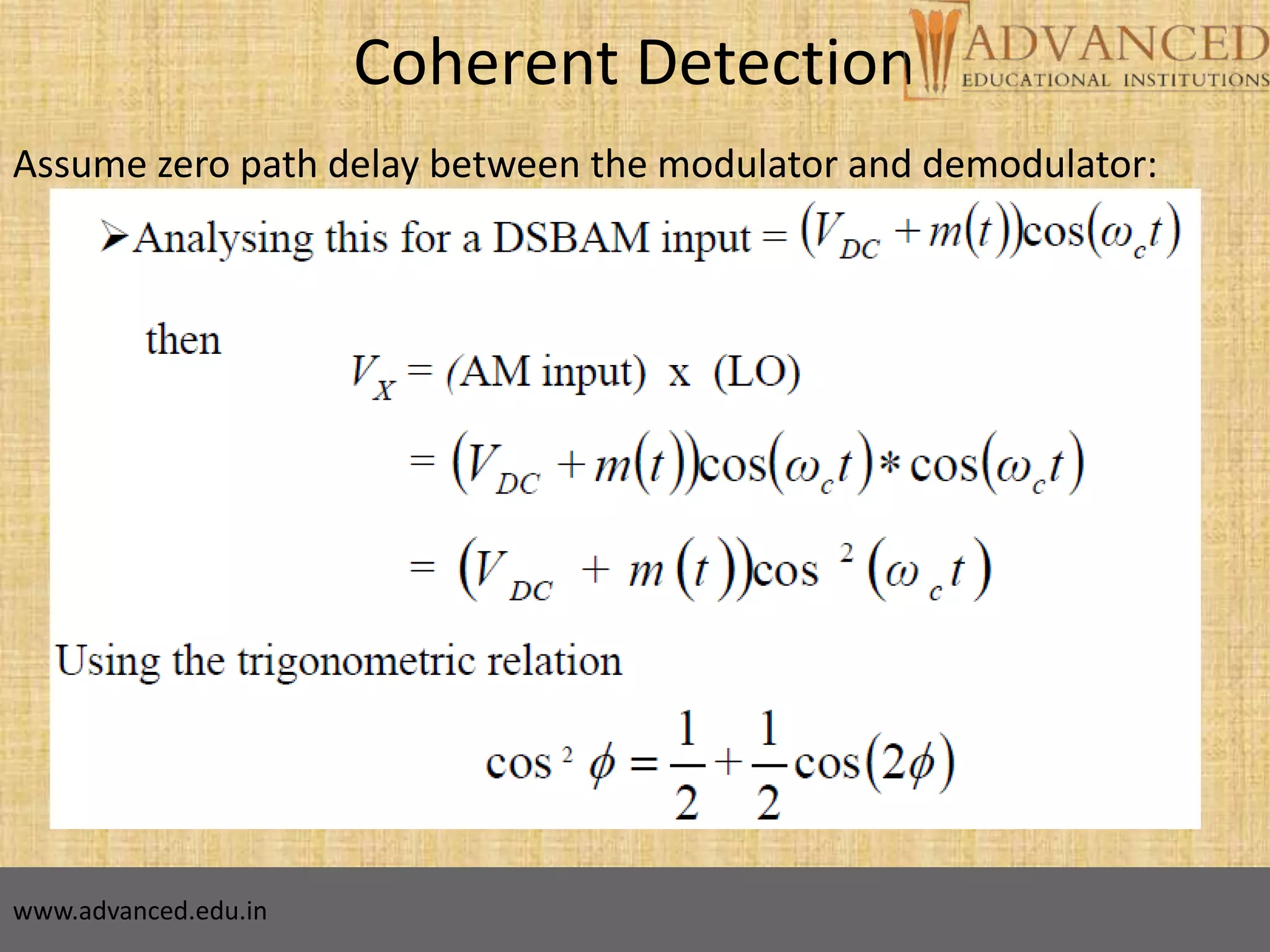
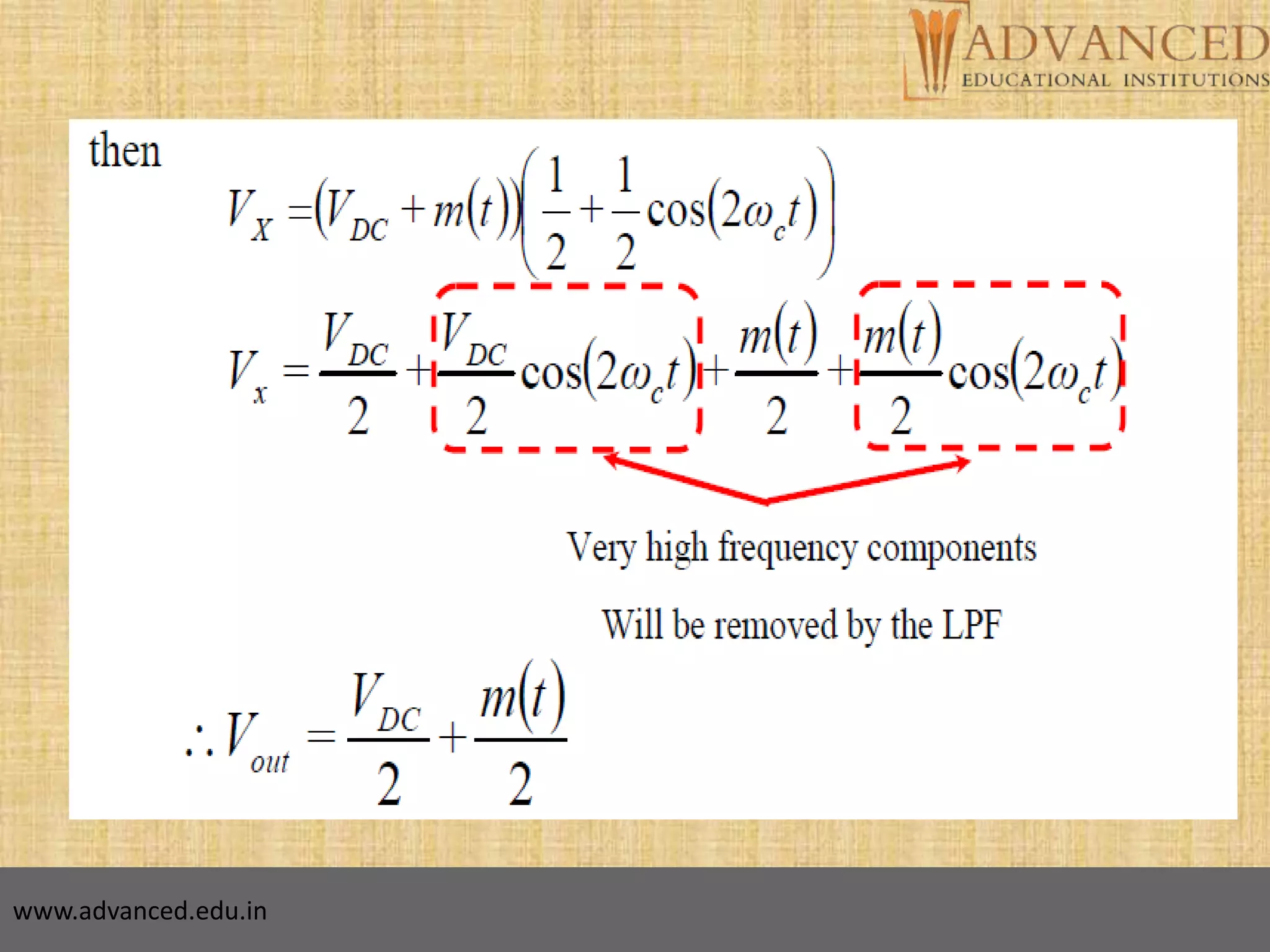
Coherent Detection
Assume zero path delay between the modulator and demodulator:
www.advanced.edu.in
21www.advanced.edu.in
22
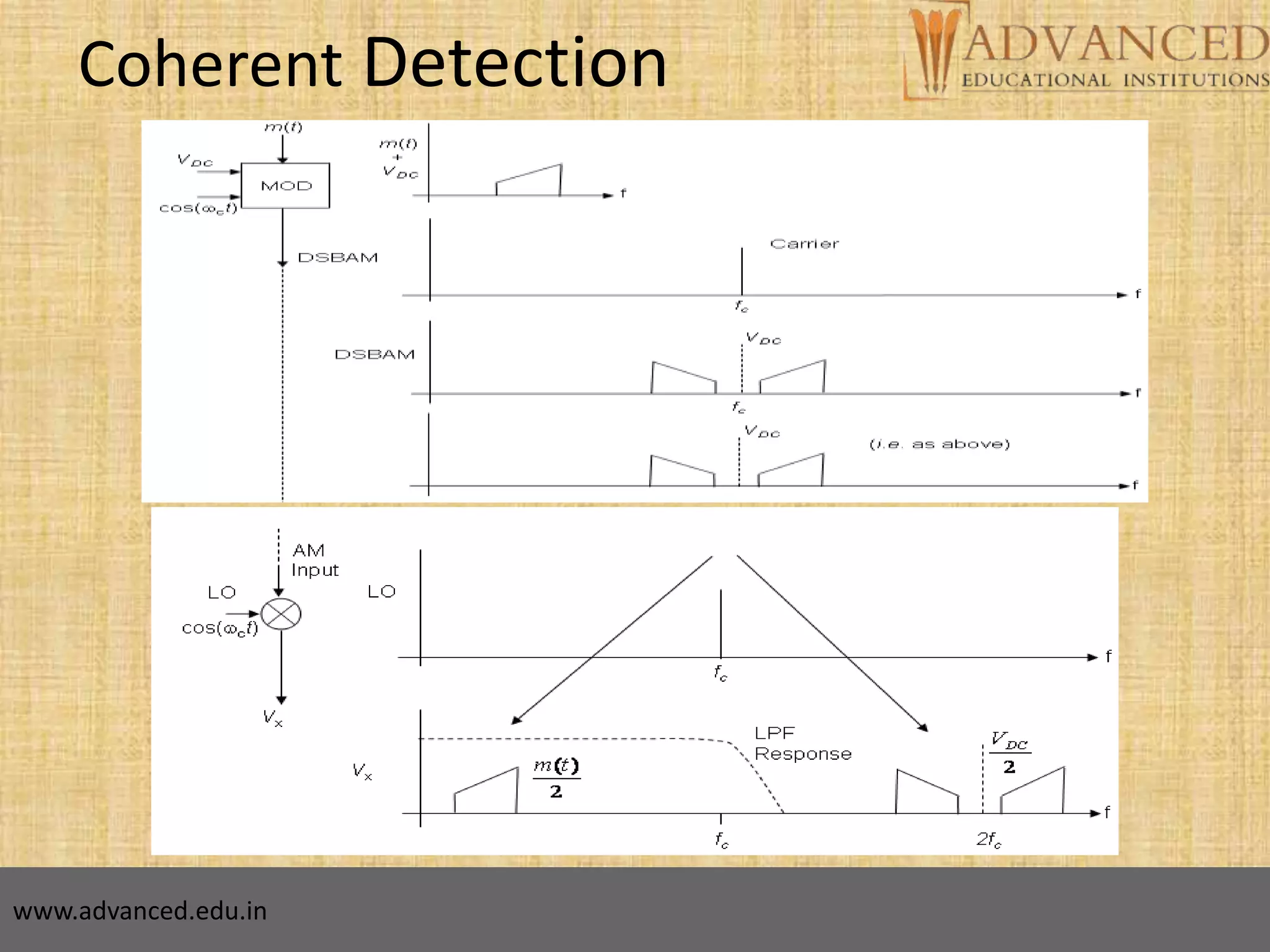
Coherent Detection
www.advanced.edu.in
23
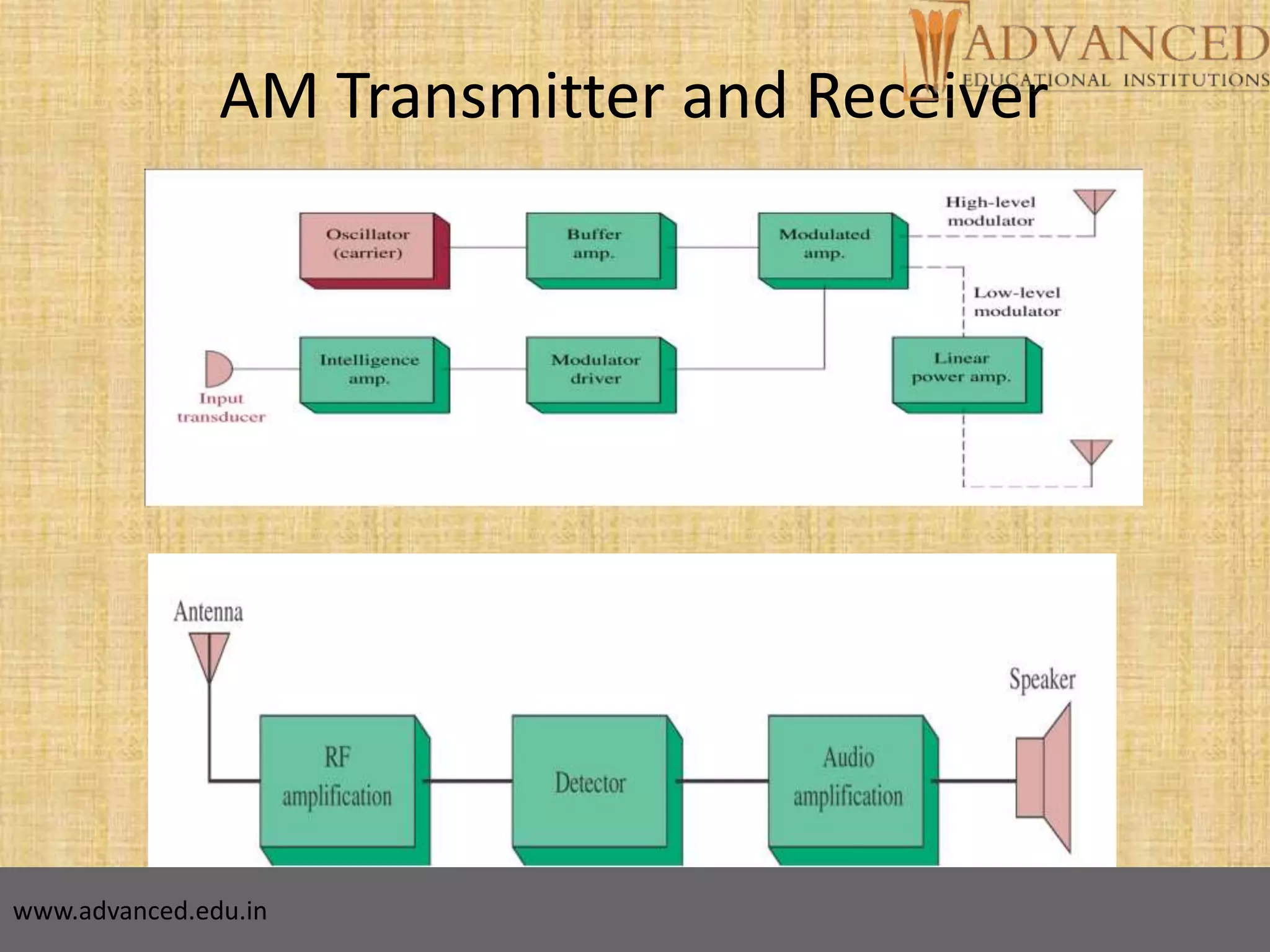
AM Transmitter and Receiver
www.advanced.edu.in
24
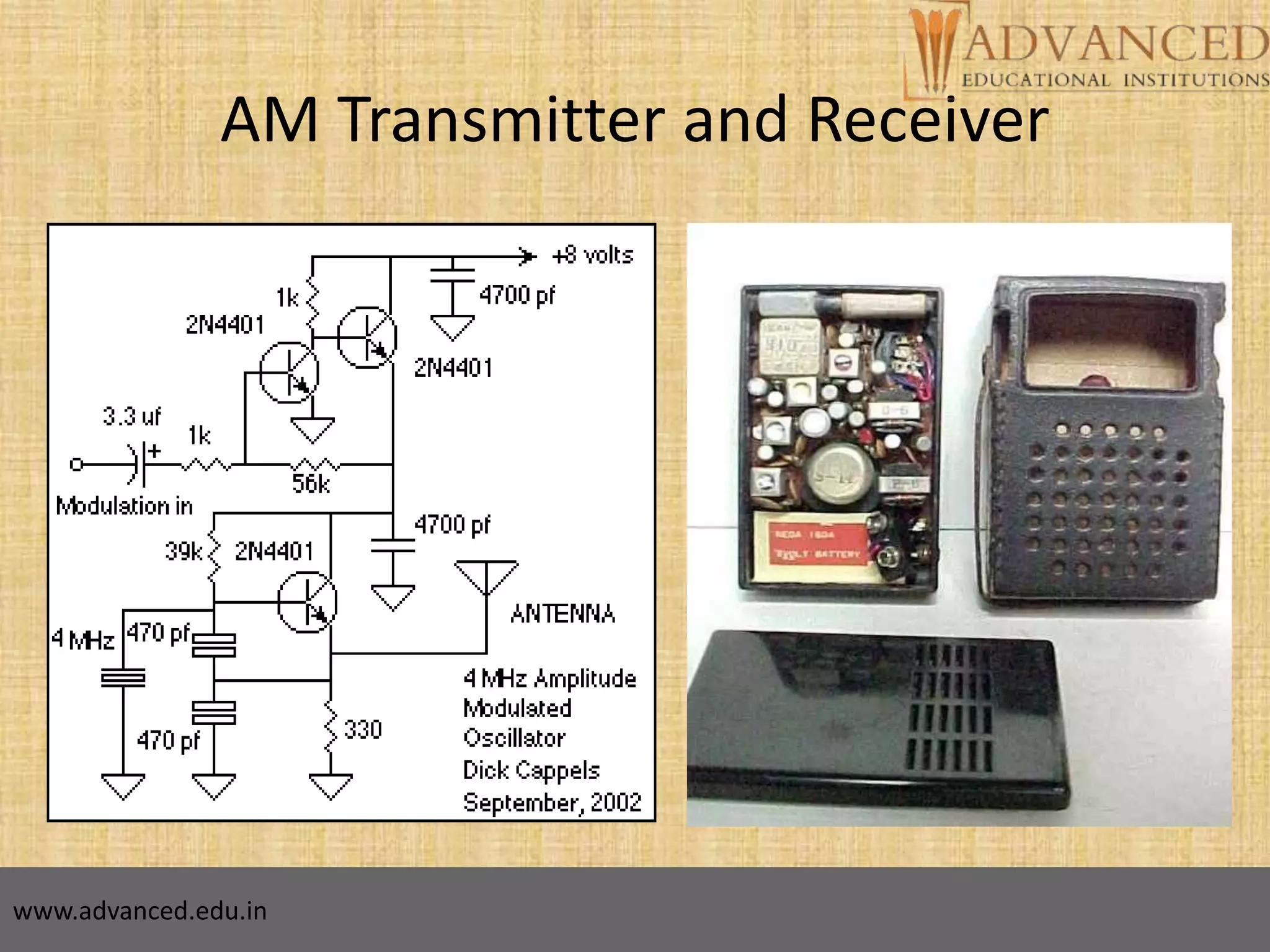
AM Transmitter and Receiver
www.advanced.edu.in
25
Summary
• Modulation, Amplitude Modulation
• Modulation Index, Modulation Depth
• Demodulation of AM signals
www.advanced.edu.in
SANJAY JANGRA
ASSISTANT PROFESSOR
sanjay_439@yahoo.co.in
Advanced Educational Institutions
70 km Milestone,
Delhi-Mathura Road, Dist. Palwal, Haryana-121105
Enquiry No: +91–1275–398400, 302222
Tele Fax: +91-1275-398406
E-mail: info@advancedinstitutions.com
Website: www.advanced.edu.in
www.advanced.edu.in

Amplitude modulation sanjay

  • 1.
    1 Amplitude Modulation By: Sanjay Jangra AssistantProfessor Deptt. Of Electronics & Communication www.advanced.edu.in
  • 2.
    2 Introduction • Modulation – Inthe modulation process, some characteristic of a high- frequency carrier signal (bandpass), is changed according to the instantaneous amplitude of the information (baseband) signal. • Why Modulation – Suitable for signal transmission (distance…etc) – Multiple signals transmitted on the same channel – Capacitive or inductive devices require high frequency AC input (carrier) to operate. – Stability and noise rejection www.advanced.edu.in
  • 3.
    3 About Modulation • ApplicationExamples – broadcasting of both audio and video signals. – Mobile radio communications, such as cell phone. • Basic Modulation Types – Amplitude Modulation: changes the amplitude. – Frequency Modulation: changes the frequency. – Phase Modulation: changes the phase. www.advanced.edu.in
  • 4.
    4 AM Modulation/Demodulation Modulator Demodulator BasebandSignal with frequency fm (Modulating Signal) Bandpass Signal with frequency fc (Modulated Signal) Channel Original Signal with frequency fm Source Sink fc >> fm Voice: 300-3400Hz GSM Cell phone: 900/1800MHz www.advanced.edu.in
  • 5.
    5 Amplitude Modulation • Theamplitude of high-carrier signal is varied according to the instantaneous amplitude of the modulating message signal m(t). Carrier Signal: or Modulating Message Signal: or The AM Signal: cos(2 ) cos( ) ( ): cos(2 ) cos( ) ( ) [ ( )]cos(2 ) c c m m AM c c f t t m t f t t s t A m t f t       www.advanced.edu.in
  • 6.
    6 * AM SignalMath Expression* • Mathematical expression for AM: time domain • expanding this produces: • In the frequency domain this gives: ( ) (1 cos ) cosAM m cS t k t t   ( ) cos cos cosc cAM mS t t k t t     )cos()cos(coscos:using 2 1 BABABA  2 2( ) cos cos( ) cos( )c c c k k AM m mS t t t t         frequency k/2 k/2 Carrier, A=1. upper sideband lower sideband Amplitude fcfc-fm fc+fm www.advanced.edu.in
  • 7.
    7 AM Power FrequencySpectrum • AM Power frequency spectrum obtained by squaring the amplitude: • Total power for AM: . 2 2 2 2 4 4 1 2 k k A k      freq k2/4k2/4 Carrier, A2=12 = 1 Power fcfc-fm fc+fm www.advanced.edu.in
  • 8.
    8 Amplitude Modulation • TheAM signal is generated using a multiplier. • All info is carried in the amplitude of the carrier, AM carrier signal has time-varying envelope. • In frequency domain the AM waveform are the lower-side frequency/band (fc - fm), the carrier frequency fc, the upper-side frequency/band (fc + fm). www.advanced.edu.in
  • 9.
    9 AM Modulation –Example • The information signal is usually not a single frequency but a range of frequencies (band). For example, frequencies from 20Hz to 15KHz. If we use a carrier of 1.4MHz, what will be the AM spectrum? • In frequency domain the AM waveform are the lower-side frequency/band (fc - fm), the carrier frequency fc, the upper- side frequency/band (fc + fm). Bandwidth: 2x(25K-20)Hz. frequency 1.4 MHz 1,385,000Hz to 1,399,980Hz 1,400,020Hz to 1,415,000Hz fc www.advanced.edu.in
  • 10.
    10 Modulation Index ofAM Signal m c A k A  )2cos()( tfAtm mm  Carrier Signal: cos(2 ) DC:c Cf t A For a sinusoidal message signal Modulation Index is defined as: Modulated Signal: ( ) [ cos(2 )]cos(2 ) [1 cos(2 )]cos(2 ) AM c m m c c m c S t A A f t f t A k f t f t         Modulation index k is a measure of the extent to which a carrier voltage is varied by the modulating signal. When k=0 no modulation, when k=1 100% modulation, when k>1 over modulation. www.advanced.edu.in
  • 11.
    11 Modulation Index ofAM Signal www.advanced.edu.in
  • 12.
    12 Modulation Index ofAM Signal www.advanced.edu.in
  • 13.
    13 Modulation Index ofAM Signal www.advanced.edu.in
  • 14.
    14 High Percentage Modulation •It is important to use as high percentage of modulation as possible (k=1) while ensuring that over modulation (k>1) does not occur. • The sidebands contain the information and have maximum power at 100% modulation. • Useful equation Pt = Pc(1 + k2/2) Pt =Total transmitted power (sidebands and carrier) Pc = Carrier power www.advanced.edu.in
  • 15.
    15 Demodulation of AMSignals Demodulation extracting the baseband message from the carrier. •There are 2 main methods of AM Demodulation: • Envelope or non-coherent detection or demodulation. • Synchronised or coherent demodulation. www.advanced.edu.in
  • 16.
    16 Envelope/Diode AM Detector Ifthe modulation depth is > 1, the distortion below occurs K>1 www.advanced.edu.in
  • 17.
    17 Synchronous or Coherent Demodulation Thisis relatively more complex and more expensive. The Local Oscillator (LO) must be synchronised or coherent, i.e. at the same frequency and in phase with the carrier in the AM input signal. www.advanced.edu.in
  • 18.
    18 Synchronous or Coherent Demodulation Ifthe AM input contains carrier frequency, the LO or synchronous carrier may be derived from the AM input. www.advanced.edu.in
  • 19.
    19 Synchronous or Coherent Demodulation Ifwe assume zero path delay between the modulator and demodulator, then the ideal LO signal is cos(ct). Analysing this for a AM input =     tωtm+V cDC cos www.advanced.edu.in
  • 20.
    20 Coherent Detection Assume zeropath delay between the modulator and demodulator: www.advanced.edu.in
  • 21.
  • 22.
  • 23.
    23 AM Transmitter andReceiver www.advanced.edu.in
  • 24.
    24 AM Transmitter andReceiver www.advanced.edu.in
  • 25.
    25 Summary • Modulation, AmplitudeModulation • Modulation Index, Modulation Depth • Demodulation of AM signals www.advanced.edu.in
  • 26.
    SANJAY JANGRA ASSISTANT PROFESSOR sanjay_439@yahoo.co.in AdvancedEducational Institutions 70 km Milestone, Delhi-Mathura Road, Dist. Palwal, Haryana-121105 Enquiry No: +91–1275–398400, 302222 Tele Fax: +91-1275-398406 E-mail: info@advancedinstitutions.com Website: www.advanced.edu.in www.advanced.edu.in