Unit 5
Non Linear Signal Processing
By Tejas Prajapati
Reference book:
1. Communication System by Sanjay Sharma.
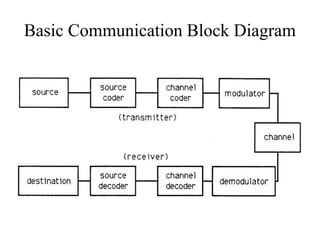
Basic Communication Block Diagram
Introduction
• Baseband signal: The message signal
generated from the information source is
known as baseband signal.
- Also known as modulating signal and message
signal.
- If the baseband signal is transmitted directly,
then it is called “baseband communication”.
Disadvantages of baseband
communication
1. Antenna size will be large for low frequency
signal.
• Equation of antenna size or height= c/2f
where c=velocity of light=3*108 m/s and f=
frequency of signal
E.g. If voice signal of 4 kHz, then antenna height
=c/2f = (3*108 )/(2*4*103)=37.5 km
Which is practically not possible.
2. Attenuation: As the baseband has low power, its
attenuation is high over long distance.
• Modulation: Modulation is defined as the
process by which some characteristics of a
carrier is varied in accordance with modulating
or baseband signal.
• Modulated wave or Modulated signal: The
result of modulation process is called
modulated signal.
• Demodulation: The receiver recreates the
original message signal ( baseband signal) from
degraded version of the transmitted signal after
propagation through channel. This recreation
process is called as demodulation.
• Carrier signal: Carrier signal is sinusoidal
signal of high frequency. For generation of
Carrier signal oscillators are used.
• Carrier frequency is grater than modulating
frequency.
• Bandwidhth (BW): The frequency range or the
band of frequency needed for particular given
transmission is known as BW.
• Channel: This band of frequency require for
particular transmission is also called “channel”.
Carrier communication
• It is the technique that uses modulation to shift
the frequency spectrum of baseband signal. In
this mode, one of the basic parameters (i.e
amplitude, frequency or phase) of sinusoidal
carrier of high frequency is varied in
proportion to the baseband signal
• This results in amplitude modulation (AM),
frequency modulation (FM) or phase
modulation (PM).
Amplitude
Modulation (AM)
Concept of Amplitude modulation
(AM)
• AM may be defined as system in which the
maximum amplitude of the carrier wave is
made proportional to the instantaneous value
(amplitude) of the modulating signal.
• Let as consider a sinusoidal carrier wave c(t)
given as
c(t)=Acos ωct … (1)
Where A=maximum amplitude of carrier
signal, ωc= carrier frequency.
For simplicity assume that the phase angle φ=0.
• Let as x(t) is modulating signal
• The standard equation of AM may expressed
as
s(t)=x(t)cos ωct + Acos ωct
s(t)= [x(t)+A]cos ωct … (2)
• FT (Fourier transform) of cos ωct
is π[δ(ω+ωc )+ δ(ω-ωc )],
So for Acos ωct πA[δ(ω+ωc )+ δ(ω-ωc )]
For x(t) X(ω)
ejωct X(ω-ωc ) and
Similarly e-jωct X(ω+ωc )
• So, x(t)cos ωct =x(t) [½ (ejωct + e-jωct )]
= ½ x(t) ejωct + ½ x(t) e-jωct
FT of above equation is
x(t)cos ωct ½ [X(ω+ωc )+ X(ω-ωc )]
So, FT of AM equation is
S(t) S(ω)= ½ [X(ω+ωc )+ X(ω-ωc )]+
πA[δ(ω+ωc )+ δ(ω-ωc )]
BW of AM signal:
BW= [(ω c +ωm )+ (ω c -ωm )]=2 ωm
ωm = modulating signal frequency
Modulation Index of AM
• It is defined as the measure of extent amplitude
variation about an unmodulated maximum carrier. It
is denoted by ma
So, Modulation Index
ma = Maximum amplitude of modulating signal
Maximum amplitude of carrier signal
ma = |x(t)|max / A
Also kwon as depth of modulation, degree of
modulation or modulation factor.
The absolute value of ma multiply by 100 is known as
percentage modulation.
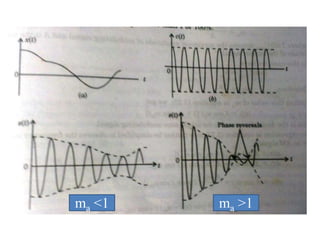
Over-modulation
• If ma >1 or ma >100% , the baseband signal is
not preserved in the envelope.
• It means that in this case, the baseband signal
recover from envelope will be distorted .
• The AM signal with ma >1 or ma >100% is
called over-modulation.
Case-1: ma <1
So, |x(t) |max< A
Case-2: ma >1 So, |x(t) |max< A.
ma <1 ma >1
Generation of AM
• Methods of AM Generation
1. Low level AM Modulation
2. High level AM Modulation
Low level AM Modulation
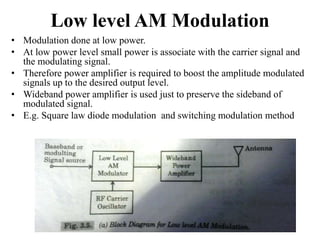
• Modulation done at low power.
• At low power level small power is associate with the carrier signal and
the modulating signal.
• Therefore power amplifier is required to boost the amplitude modulated
signals up to the desired output level.
• Wideband power amplifier is used just to preserve the sideband of
modulated signal.
• E.g. Square law diode modulation and switching modulation method
High level AM Modulation
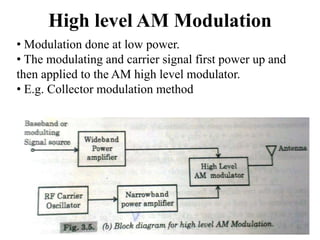
• Modulation done at low power.
• The modulating and carrier signal first power up and
then applied to the AM high level modulator.
• E.g. Collector modulation method
Square law diode modulation
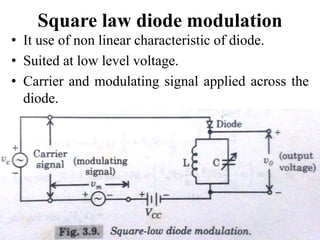
• It use of non linear characteristic of diode.
• Suited at low level voltage.
• Carrier and modulating signal applied across the
diode.
• A DC battery is connoted across diode to get fix
operating point on V-I characteristic of diode.
• The working of circuit may be explained by
considering the fact when two different frequency
are passed through a diode, the process of AM take
place.
• When carrier and modulating frequencies are
applied at the input of diode, then different
frequency term appear at the output of diode.
• These different frequency terms are applied across a
tuned circuit which is tuned to the carrier and has
narrow bandwidth just pass to two side bands along
with the carrier and reject the other frequencies.
• Hence AM wave produced.
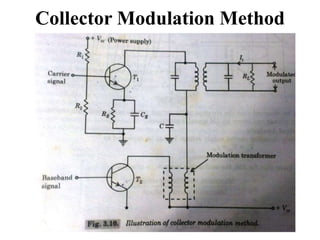
Collector Modulation Method
• Very popular method for AM generation.
• Transistor T1 makes a radio frequency (RF) Class-
C amplifier. At the base of T1 carrier signal is
applied.
• Transistor T2 makes a class-B amplifier which is
used to amplify the modulating or baseband signal.
• The modulating signal appear across modulation
transformer after amplification.
• This amplified baseband signal appear in series with
the collector supply Vcc.
• The function of capacitor C is to offer low
impedance path for the high frequency carrier and
hence the carrier signal is prevented from flowing
through the modulation transformer.
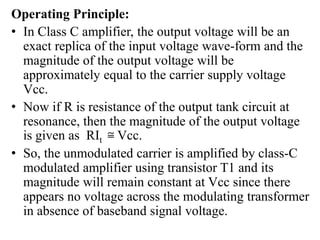
Operating Principle:
• In Class C amplifier, the output voltage will be an
exact replica of the input voltage wave-form and the
magnitude of the output voltage will be
approximately equal to the carrier supply voltage
Vcc.
• Now if R is resistance of the output tank circuit at
resonance, then the magnitude of the output voltage
is given as RIt ≅ Vcc.
• So, the unmodulated carrier is amplified by class-C
modulated amplifier using transistor T1 and its
magnitude will remain constant at Vcc since there
appears no voltage across the modulating transformer
in absence of baseband signal voltage.
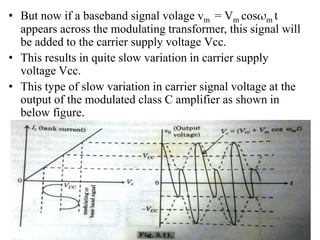
• But now if a baseband signal volage vm = Vm cosωm t
appears across the modulating transformer, this signal will
be added to the carrier supply voltage Vcc.
• This results in quite slow variation in carrier supply
voltage Vcc.
• This type of slow variation in carrier signal voltage at the
output of the modulated class C amplifier as shown in
below figure.
Demodulation of AM wave
Two methods
1. Square law detectors
2. Envelope detectors
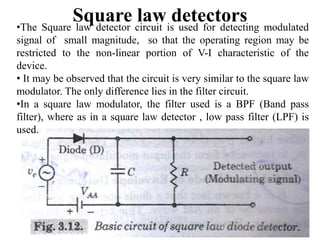
Square law detectors•The Square law detector circuit is used for detecting modulated
signal of small magnitude, so that the operating region may be
restricted to the non-linear portion of V-I characteristic of the
device.
• It may be observed that the circuit is very similar to the square law
modulator. The only difference lies in the filter circuit.
•In a square law modulator, the filter used is a BPF (Band pass
filter), where as in a square law detector , low pass filter (LPF) is
used.
• In the circuit, the DC supply voltage VAA is used to
get the fixed operating point in the non-linear
portion of the diode V-I characteristic, since the
operation is limited to the non-linear region of the
diode characteristic, the lower portion of the
modulated wave form is compressed.
• The produce envelope applied distortion. Due to
this, the average value of the diode current is no
longer constant.
i=av+bv2 … (1)
Where v=i/p modulation voltage
AM signal is expressed as,
v=A(1+macos ωmt ) cos ωct … (2)
• Put equation (2) in (1),
i=a[A(1+macos ωmt ) cos ωct]+b[A(1+macos ωmt )
cos ωct]2 … (3)
• Above expression is expanded, the we may observed
the presents of terms of frequencies like
2ωc, 2(ωc± ωm ), ωm, 2ωm besides the input frequency
term.
• Hence the diode current i containing all these
frequencies is pass the frequencies below or up to
modulating frequency ωm and reject the other higher
frequency component.
• Therefore the modulating signal with ωm frequency is
recovered from the input modulated signal.
Frequency Modulation (FM)
Concept of Frequency Modulation (FM)
• Definition: FM is that type of angle modulation in
which the instantaneous frequency ωi is varied
linearly with message or baseband signal x(t) about
an unmodulated carrier frequency ωc.
• Consider a generalized sinusoidal signal V(t) given
by
c(t)= Acos φ or c(t)= Acos(ωct+ θ0)
Where A=amplitude of carrier signal,
ωc = carrier frequency
θ0 = phase angle
φ = ωct+ θ0 is the total phase angle of the carrier wave.
In FM amplitude remain constant and only angle φ will
change.
• Frequency Deviation: The maximum change in
instantaneous frequency from the average frequency
ωc is called Frequency Deviation.
It is denoted by ∆ω
∆ω = |kf * x(t)|max
Where kf = Frequency selectivity and x(t)= base band
signal.
• Modulation index (for FM): It is ratio of
Frequency Deviation to the modulating frequency.
Denoted by mf
mf = Frequency Deviation / Modulating frequency
= ∆ω / ωm
• Modulation index may be grater then unity.
FM generation
• Two methods
1. Direct method or parameter variation method
2. Indirect method or Armstrong method
Armstrong method for FM generation
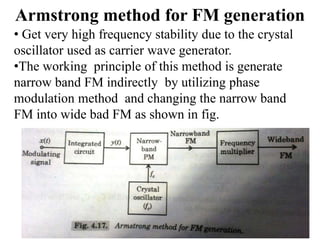
• Get very high frequency stability due to the crystal
oscillator used as carrier wave generator.
•The working principle of this method is generate
narrow band FM indirectly by utilizing phase
modulation method and changing the narrow band
FM into wide bad FM as shown in fig.
• Since in narrow band FM the modulation index is
small, therefore the distortion is very low in
narrow band FM.
• Here we prefer phase modulation method
because its generation is easy.
• The multiplier circuit apart from multiplying the
carrier frequency also increases the frequency
deviation and hence the narrow band FM is
covered into wide bad FM.
The End

Non Linear Signal Processing

  • 1.
    Unit 5 Non LinearSignal Processing By Tejas Prajapati Reference book: 1. Communication System by Sanjay Sharma.
  • 2.
  • 3.
    Introduction • Baseband signal:The message signal generated from the information source is known as baseband signal. - Also known as modulating signal and message signal. - If the baseband signal is transmitted directly, then it is called “baseband communication”.
  • 4.
    Disadvantages of baseband communication 1.Antenna size will be large for low frequency signal. • Equation of antenna size or height= c/2f where c=velocity of light=3*108 m/s and f= frequency of signal E.g. If voice signal of 4 kHz, then antenna height =c/2f = (3*108 )/(2*4*103)=37.5 km Which is practically not possible. 2. Attenuation: As the baseband has low power, its attenuation is high over long distance.
  • 5.
    • Modulation: Modulationis defined as the process by which some characteristics of a carrier is varied in accordance with modulating or baseband signal. • Modulated wave or Modulated signal: The result of modulation process is called modulated signal. • Demodulation: The receiver recreates the original message signal ( baseband signal) from degraded version of the transmitted signal after propagation through channel. This recreation process is called as demodulation.
  • 6.
    • Carrier signal:Carrier signal is sinusoidal signal of high frequency. For generation of Carrier signal oscillators are used. • Carrier frequency is grater than modulating frequency. • Bandwidhth (BW): The frequency range or the band of frequency needed for particular given transmission is known as BW. • Channel: This band of frequency require for particular transmission is also called “channel”.
  • 7.
    Carrier communication • Itis the technique that uses modulation to shift the frequency spectrum of baseband signal. In this mode, one of the basic parameters (i.e amplitude, frequency or phase) of sinusoidal carrier of high frequency is varied in proportion to the baseband signal • This results in amplitude modulation (AM), frequency modulation (FM) or phase modulation (PM).
  • 8.
  • 9.
    Concept of Amplitudemodulation (AM)
  • 10.
    • AM maybe defined as system in which the maximum amplitude of the carrier wave is made proportional to the instantaneous value (amplitude) of the modulating signal. • Let as consider a sinusoidal carrier wave c(t) given as c(t)=Acos ωct … (1) Where A=maximum amplitude of carrier signal, ωc= carrier frequency. For simplicity assume that the phase angle φ=0.
  • 11.
    • Let asx(t) is modulating signal • The standard equation of AM may expressed as s(t)=x(t)cos ωct + Acos ωct s(t)= [x(t)+A]cos ωct … (2) • FT (Fourier transform) of cos ωct is π[δ(ω+ωc )+ δ(ω-ωc )], So for Acos ωct πA[δ(ω+ωc )+ δ(ω-ωc )] For x(t) X(ω) ejωct X(ω-ωc ) and Similarly e-jωct X(ω+ωc )
  • 12.
    • So, x(t)cosωct =x(t) [½ (ejωct + e-jωct )] = ½ x(t) ejωct + ½ x(t) e-jωct FT of above equation is x(t)cos ωct ½ [X(ω+ωc )+ X(ω-ωc )] So, FT of AM equation is S(t) S(ω)= ½ [X(ω+ωc )+ X(ω-ωc )]+ πA[δ(ω+ωc )+ δ(ω-ωc )] BW of AM signal: BW= [(ω c +ωm )+ (ω c -ωm )]=2 ωm ωm = modulating signal frequency
  • 13.
    Modulation Index ofAM • It is defined as the measure of extent amplitude variation about an unmodulated maximum carrier. It is denoted by ma So, Modulation Index ma = Maximum amplitude of modulating signal Maximum amplitude of carrier signal ma = |x(t)|max / A Also kwon as depth of modulation, degree of modulation or modulation factor. The absolute value of ma multiply by 100 is known as percentage modulation.
  • 14.
    Over-modulation • If ma>1 or ma >100% , the baseband signal is not preserved in the envelope. • It means that in this case, the baseband signal recover from envelope will be distorted . • The AM signal with ma >1 or ma >100% is called over-modulation. Case-1: ma <1 So, |x(t) |max< A Case-2: ma >1 So, |x(t) |max< A.
  • 15.
  • 16.
    Generation of AM •Methods of AM Generation 1. Low level AM Modulation 2. High level AM Modulation
  • 17.
    Low level AMModulation • Modulation done at low power. • At low power level small power is associate with the carrier signal and the modulating signal. • Therefore power amplifier is required to boost the amplitude modulated signals up to the desired output level. • Wideband power amplifier is used just to preserve the sideband of modulated signal. • E.g. Square law diode modulation and switching modulation method
  • 18.
    High level AMModulation • Modulation done at low power. • The modulating and carrier signal first power up and then applied to the AM high level modulator. • E.g. Collector modulation method
  • 19.
    Square law diodemodulation • It use of non linear characteristic of diode. • Suited at low level voltage. • Carrier and modulating signal applied across the diode.
  • 20.
    • A DCbattery is connoted across diode to get fix operating point on V-I characteristic of diode. • The working of circuit may be explained by considering the fact when two different frequency are passed through a diode, the process of AM take place. • When carrier and modulating frequencies are applied at the input of diode, then different frequency term appear at the output of diode. • These different frequency terms are applied across a tuned circuit which is tuned to the carrier and has narrow bandwidth just pass to two side bands along with the carrier and reject the other frequencies. • Hence AM wave produced.
  • 21.
  • 22.
    • Very popularmethod for AM generation. • Transistor T1 makes a radio frequency (RF) Class- C amplifier. At the base of T1 carrier signal is applied. • Transistor T2 makes a class-B amplifier which is used to amplify the modulating or baseband signal. • The modulating signal appear across modulation transformer after amplification. • This amplified baseband signal appear in series with the collector supply Vcc. • The function of capacitor C is to offer low impedance path for the high frequency carrier and hence the carrier signal is prevented from flowing through the modulation transformer.
  • 23.
    Operating Principle: • InClass C amplifier, the output voltage will be an exact replica of the input voltage wave-form and the magnitude of the output voltage will be approximately equal to the carrier supply voltage Vcc. • Now if R is resistance of the output tank circuit at resonance, then the magnitude of the output voltage is given as RIt ≅ Vcc. • So, the unmodulated carrier is amplified by class-C modulated amplifier using transistor T1 and its magnitude will remain constant at Vcc since there appears no voltage across the modulating transformer in absence of baseband signal voltage.
  • 24.
    • But nowif a baseband signal volage vm = Vm cosωm t appears across the modulating transformer, this signal will be added to the carrier supply voltage Vcc. • This results in quite slow variation in carrier supply voltage Vcc. • This type of slow variation in carrier signal voltage at the output of the modulated class C amplifier as shown in below figure.
  • 25.
    Demodulation of AMwave Two methods 1. Square law detectors 2. Envelope detectors
  • 26.
    Square law detectors•TheSquare law detector circuit is used for detecting modulated signal of small magnitude, so that the operating region may be restricted to the non-linear portion of V-I characteristic of the device. • It may be observed that the circuit is very similar to the square law modulator. The only difference lies in the filter circuit. •In a square law modulator, the filter used is a BPF (Band pass filter), where as in a square law detector , low pass filter (LPF) is used.
  • 27.
    • In thecircuit, the DC supply voltage VAA is used to get the fixed operating point in the non-linear portion of the diode V-I characteristic, since the operation is limited to the non-linear region of the diode characteristic, the lower portion of the modulated wave form is compressed. • The produce envelope applied distortion. Due to this, the average value of the diode current is no longer constant. i=av+bv2 … (1) Where v=i/p modulation voltage AM signal is expressed as, v=A(1+macos ωmt ) cos ωct … (2)
  • 28.
    • Put equation(2) in (1), i=a[A(1+macos ωmt ) cos ωct]+b[A(1+macos ωmt ) cos ωct]2 … (3) • Above expression is expanded, the we may observed the presents of terms of frequencies like 2ωc, 2(ωc± ωm ), ωm, 2ωm besides the input frequency term. • Hence the diode current i containing all these frequencies is pass the frequencies below or up to modulating frequency ωm and reject the other higher frequency component. • Therefore the modulating signal with ωm frequency is recovered from the input modulated signal.
  • 29.
  • 30.
    Concept of FrequencyModulation (FM) • Definition: FM is that type of angle modulation in which the instantaneous frequency ωi is varied linearly with message or baseband signal x(t) about an unmodulated carrier frequency ωc. • Consider a generalized sinusoidal signal V(t) given by c(t)= Acos φ or c(t)= Acos(ωct+ θ0) Where A=amplitude of carrier signal, ωc = carrier frequency θ0 = phase angle φ = ωct+ θ0 is the total phase angle of the carrier wave. In FM amplitude remain constant and only angle φ will change.
  • 31.
    • Frequency Deviation:The maximum change in instantaneous frequency from the average frequency ωc is called Frequency Deviation. It is denoted by ∆ω ∆ω = |kf * x(t)|max Where kf = Frequency selectivity and x(t)= base band signal. • Modulation index (for FM): It is ratio of Frequency Deviation to the modulating frequency. Denoted by mf mf = Frequency Deviation / Modulating frequency = ∆ω / ωm • Modulation index may be grater then unity.
  • 32.
    FM generation • Twomethods 1. Direct method or parameter variation method 2. Indirect method or Armstrong method
  • 33.
    Armstrong method forFM generation • Get very high frequency stability due to the crystal oscillator used as carrier wave generator. •The working principle of this method is generate narrow band FM indirectly by utilizing phase modulation method and changing the narrow band FM into wide bad FM as shown in fig.
  • 34.
    • Since innarrow band FM the modulation index is small, therefore the distortion is very low in narrow band FM. • Here we prefer phase modulation method because its generation is easy. • The multiplier circuit apart from multiplying the carrier frequency also increases the frequency deviation and hence the narrow band FM is covered into wide bad FM.
  • 35.