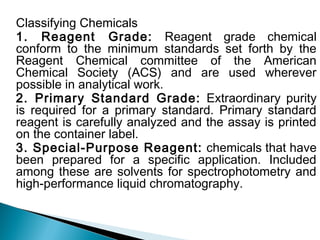
Classifying Chemicals
1. Reagent Grade: Reagent grade chemical
conform to the minimum standards set forth by the
Reagent Chemical committee of the American
Chemical Society (ACS) and are used wherever
possible in analytical work.
2. Primary Standard Grade: Extraordinary purity
is required for a primary standard. Primary standard
reagent is carefully analyzed and the assay is printed
on the container label.
3. Special-Purpose Reagent: chemicals that have
been prepared for a specific application. Included
among these are solvents for spectrophotometry and
high-performance liquid chromatography.
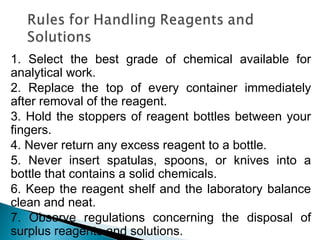
1. Select the best grade of chemical available for
analytical work.
2. Replace the top of every container immediately
after removal of the reagent.
3. Hold the stoppers of reagent bottles between your
fingers.
4. Never return any excess reagent to a bottle.
5. Never insert spatulas, spoons, or knives into a
bottle that contains a solid chemicals.
6. Keep the reagent shelf and the laboratory balance
clean and neat.
7. Observe regulations concerning the disposal of
surplus reagents and solutions.
 Use liquid detergent (preferably hot)
 Finish up with distilled water
 Use deionized water (if available)
 For water insoluble solution, use alcohol or
acetone
 Rinsing with reagent – needed especially in
titration
“It is seldom necessary to dry the interior surface of
glassware before use: it can be a waste of time
and potential source of contamination”
Marking Laboratory Ware
A chemical analysis is ordinarily performed in
duplicate or triplicate. Each vessel that holds a
sample must be marked so that its content can be
positively identified. Flask, beaker and some
crucibles have small etched areas on which semi
permanent mark can be made with a pencil.
Saturated iron(III) chloride can be used for
markings.
 Problem: Overheating
 Bumping cause partial loss of the solution
 Ans: Careful and apply gentle
heating
glass beads minimize bumping
An analytical balance is a weighing instrument with a
maximum capacity that ranges from 1 g to a few
kilograms with a precision of at least 1 part in 105
at
maximum capacity.
Macrobalances have a maximum capacity ranging
between 160 and 200 g; measurement can be made
with a standard deviation of ±0.1mg.
Semimicroanalytical balances have a maximum
load of 10 to 30 g with a precision of ±0.01mg.
Microanalytical balance has a capacity of 1 to 3 g
and a precision of ±0.001mg.
 Bouyancy error - density of the sample is very
much different from the standard masses.
 Temperature Effect – Failure to allow sufficient
time for a heated object to return to room
temperature.
 Top Loading – 150 to 200 g
25,000 g
 Triple Beam balance -
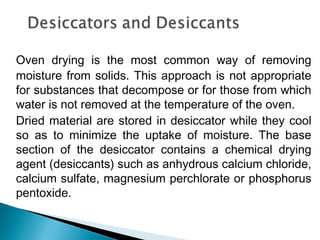
Oven drying is the most common way of removing
moisture from solids. This approach is not appropriate
for substances that decompose or for those from which
water is not removed at the temperature of the oven.
Dried material are stored in desiccator while they cool
so as to minimize the uptake of moisture. The base
section of the desiccator contains a chemical drying
agent (desiccants) such as anhydrous calcium chloride,
calcium sulfate, magnesium perchlorate or phosphorus
pentoxide.
Weighing by Difference
Weighing by difference is a simple method for
determining a series of sample weights. First the bottle
and its contents are weighed. One sample is then
transferred from the bottle to a container; gentle
tapping of the bottle with its top and slight rotation of
the bottle control over the amount of sample removed.
Following transfer, and its residual contents are
weighed. The mass of the sample is the difference
between the two weighings.
Simple Crucibles
Simple crucibles serve only as containers. Porcelain,
aluminum oxide, silica and platinum crucibles maintain
constant mass and are used principally to convert a
precipitate into a suitable weighing form. The solid is first
collected on filter paper. The filter and contents are then
transferred to a weighed crucible, and the paper is ignited.
Filtering Crucibles
Filtering crucibles serve not only as containers but also as
filters. A vacuum is used to hasten the filtration, a tight
seal between crucible and filtering flask is accomplished
with any of the several types of rubber adapters.
Sintered-glass Crucibles
Sintered-glass crucibles are manufactured in fine,
medium, and coarse porosities. The upper
temperature limit for sintered glass crucible is
ordinarily about 200o
C. Filtering crucibles made
entirely of quartz can tolerate substantially higher
temperatures.
Filter Paper
Paper is an important filtering medium. Ashless paper
is manufactured from cellulose fibers that have been
treated with hydrochloric and hydrofluoric acids to
remove metallic impurities and silica, ammonia is then
used to neutralize the acids. It is necessary to destroy
the paper by ignition if the precipitate collected on it is
to be weighed.
Heating Equipment
Many precipitate can be weighed directly after being
brought to constant mass in a low temperature drying
oven. Such an oven is electrically heated and capable
of maintaining a constant temperature to within 1o
C.
The maximum attainable temperature ranges from
140 to 260o
C, depending on make and model, for
many precipitate 110o
C is a satisfactory drying
temperature.
Microwave laboratory ovens are currently appearing
on the market. Where applicable, these greatly
shorten drying cycles.
Muffle furnace (a heavy duty electric furnace) is
capable of maintaining controlled temperatures of
1100o
C or higher. Long handled tongs and heat
resistance gloves are needed for protection.
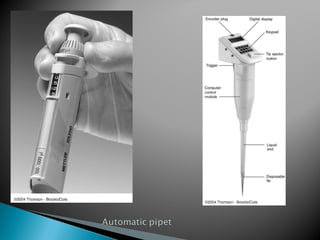
• Pipets
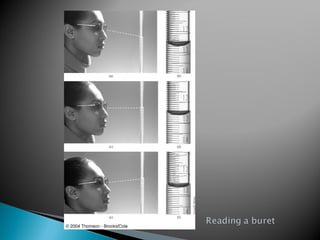
• Burets
• Volumetric flask
• Measuring cylinder
Volumetric glassware is calibrated by measuring
the mass of a liquid (water) of known density and
temperature that is contained in the volumetric
ware.
1. Record all data and observations
2. Supply each entry with a heading
3. Date each page of the notebook
4. Never attempt to erase an incorrect entry, cross it
out with single horizontal line
5. Never remove a page from the notebook
6. Do not overcrowd entries
7. Keep first few pages for table of contents
 Take a picture of 3 instruments present in the
laboratory, paste or print directly in the bond paper
with description or usage of the instruments.

Chapter 2

  • 2.
    Classifying Chemicals 1. ReagentGrade: Reagent grade chemical conform to the minimum standards set forth by the Reagent Chemical committee of the American Chemical Society (ACS) and are used wherever possible in analytical work. 2. Primary Standard Grade: Extraordinary purity is required for a primary standard. Primary standard reagent is carefully analyzed and the assay is printed on the container label. 3. Special-Purpose Reagent: chemicals that have been prepared for a specific application. Included among these are solvents for spectrophotometry and high-performance liquid chromatography.
  • 3.
    1. Select thebest grade of chemical available for analytical work. 2. Replace the top of every container immediately after removal of the reagent. 3. Hold the stoppers of reagent bottles between your fingers. 4. Never return any excess reagent to a bottle. 5. Never insert spatulas, spoons, or knives into a bottle that contains a solid chemicals. 6. Keep the reagent shelf and the laboratory balance clean and neat. 7. Observe regulations concerning the disposal of surplus reagents and solutions.
  • 4.
     Use liquiddetergent (preferably hot)  Finish up with distilled water  Use deionized water (if available)  For water insoluble solution, use alcohol or acetone  Rinsing with reagent – needed especially in titration “It is seldom necessary to dry the interior surface of glassware before use: it can be a waste of time and potential source of contamination”
  • 5.
    Marking Laboratory Ware Achemical analysis is ordinarily performed in duplicate or triplicate. Each vessel that holds a sample must be marked so that its content can be positively identified. Flask, beaker and some crucibles have small etched areas on which semi permanent mark can be made with a pencil. Saturated iron(III) chloride can be used for markings.
  • 6.
     Problem: Overheating Bumping cause partial loss of the solution  Ans: Careful and apply gentle heating glass beads minimize bumping
  • 7.
    An analytical balanceis a weighing instrument with a maximum capacity that ranges from 1 g to a few kilograms with a precision of at least 1 part in 105 at maximum capacity. Macrobalances have a maximum capacity ranging between 160 and 200 g; measurement can be made with a standard deviation of ±0.1mg. Semimicroanalytical balances have a maximum load of 10 to 30 g with a precision of ±0.01mg. Microanalytical balance has a capacity of 1 to 3 g and a precision of ±0.001mg.
  • 10.
     Bouyancy error- density of the sample is very much different from the standard masses.  Temperature Effect – Failure to allow sufficient time for a heated object to return to room temperature.
  • 11.
     Top Loading– 150 to 200 g 25,000 g  Triple Beam balance -
  • 12.
    Oven drying isthe most common way of removing moisture from solids. This approach is not appropriate for substances that decompose or for those from which water is not removed at the temperature of the oven. Dried material are stored in desiccator while they cool so as to minimize the uptake of moisture. The base section of the desiccator contains a chemical drying agent (desiccants) such as anhydrous calcium chloride, calcium sulfate, magnesium perchlorate or phosphorus pentoxide.
  • 14.
    Weighing by Difference Weighingby difference is a simple method for determining a series of sample weights. First the bottle and its contents are weighed. One sample is then transferred from the bottle to a container; gentle tapping of the bottle with its top and slight rotation of the bottle control over the amount of sample removed. Following transfer, and its residual contents are weighed. The mass of the sample is the difference between the two weighings.
  • 16.
    Simple Crucibles Simple cruciblesserve only as containers. Porcelain, aluminum oxide, silica and platinum crucibles maintain constant mass and are used principally to convert a precipitate into a suitable weighing form. The solid is first collected on filter paper. The filter and contents are then transferred to a weighed crucible, and the paper is ignited. Filtering Crucibles Filtering crucibles serve not only as containers but also as filters. A vacuum is used to hasten the filtration, a tight seal between crucible and filtering flask is accomplished with any of the several types of rubber adapters.
  • 17.
    Sintered-glass Crucibles Sintered-glass cruciblesare manufactured in fine, medium, and coarse porosities. The upper temperature limit for sintered glass crucible is ordinarily about 200o C. Filtering crucibles made entirely of quartz can tolerate substantially higher temperatures. Filter Paper Paper is an important filtering medium. Ashless paper is manufactured from cellulose fibers that have been treated with hydrochloric and hydrofluoric acids to remove metallic impurities and silica, ammonia is then used to neutralize the acids. It is necessary to destroy the paper by ignition if the precipitate collected on it is to be weighed.
  • 21.
    Heating Equipment Many precipitatecan be weighed directly after being brought to constant mass in a low temperature drying oven. Such an oven is electrically heated and capable of maintaining a constant temperature to within 1o C. The maximum attainable temperature ranges from 140 to 260o C, depending on make and model, for many precipitate 110o C is a satisfactory drying temperature. Microwave laboratory ovens are currently appearing on the market. Where applicable, these greatly shorten drying cycles. Muffle furnace (a heavy duty electric furnace) is capable of maintaining controlled temperatures of 1100o C or higher. Long handled tongs and heat resistance gloves are needed for protection.
  • 22.
    • Pipets • Burets •Volumetric flask • Measuring cylinder
  • 28.
    Volumetric glassware iscalibrated by measuring the mass of a liquid (water) of known density and temperature that is contained in the volumetric ware.
  • 29.
    1. Record alldata and observations 2. Supply each entry with a heading 3. Date each page of the notebook 4. Never attempt to erase an incorrect entry, cross it out with single horizontal line 5. Never remove a page from the notebook 6. Do not overcrowd entries 7. Keep first few pages for table of contents
  • 30.
     Take apicture of 3 instruments present in the laboratory, paste or print directly in the bond paper with description or usage of the instruments.