Analytical Weighing Balance
Md. Abdul Karim Mia
Analyst
National Control Laboratory (NCL), DGDA, Dhaka, Bangladesh
Balance
Balance: A weighing device, especially one consisting of a rigid beam horizontally
suspended by a low-friction support at its center, with identical weighing pans hung
at either end, one of which holds an unknown weight while the effective weight in
the other is increased by known amounts until the beam is level and motionless.
Analytical balance is a class of balance designed to measure small mass in the
sub-milligram range. The measuring pan of an analytical balance (0.1 mg or better)
is inside a transparent enclosure with doors so that dust does not collect and so any
air currents in the room do not affect the balance's operation. This enclosure is
often called a draft shield.
National Control Laboratory (NCL), DGDA, Dhaka, Bangladesh
History of Balance
National Control Laboratory (NCL), DGDA, Dhaka, Bangladesh
Simple Balance was used as early as 2400-
1800 B.C near Indus river valley ( Now
Pakistan)
Balance comes from the Latin word “ Lilanx”
means `Two pans`
The lightweight technique is developed
Joseph Black.
The modern analytical balance originated
during the mid-18th century
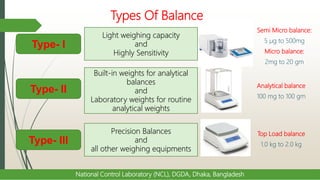
Types Of Balance
National Control Laboratory (NCL), DGDA, Dhaka, Bangladesh
Type- I
Type- II
Type- III
Light weighing capacity
and
Highly Sensitivity
Built-in weights for analytical
balances
and
Laboratory weights for routine
analytical weights
Precision Balances
and
all other weighing equipments
Semi Micro balance:
5 µg to 500mg
Micro balance:
2mg to 20 gm
Analytical balance
100 mg to 100 gm
Top Load balance
1.0 kg to 2.0 kg
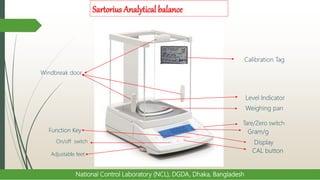
Sartorius Analytical balance
National Control Laboratory (NCL), DGDA, Dhaka, Bangladesh
Weighing pan
Tare/Zero switch
Gram/g
Display
Level Indicator
CAL button
On/off switch
Adjustable feet
Windbreak door
Function Key
Calibration Tag
Where to locate analytical Balance
 Install the balance on a solid bench that is (AVT) anti vibration table.
 Doesn't locate AVT corner of the room-room access through a sliding door.
 The balance should not be installed near sources of electromagnetic
radiation such as radio frequency generators, electric motors, hand held
communication devices (including card less telephones and cell phones)
 humidity range 45 - 60% Operate. Humidity range <20 – 80<% Never operate
 Never disconnect the balance from the power supply and leave it always
switched on / STAND BY mode. If “OFF” mode: warm-up for 1 hour after
switching ‘ON’ the power supply.
Note: Stable anti vibration table-has affect on balance for measurement 0.01g or
less.
National Control Laboratory (NCL), DGDA, Dhaka, Bangladesh
Weighing Procedure of analytical Balance
 Ensure the instrument is clean and free from dust. If presence clean with soft
brush
 Check the adjustment bubble within the center and calibration tag within expiry
date.
 Ensure that daily calibration is done and check the log book.
 Place the weighing paper on the weighing pan, close the windbreak door and
press tare button to zero.
 Place the sample of standard or sample on the weighing pan using spatula and
close the windbreak door.
 Take the reading from display shows as gram after stabilized.
 Record the weighing results on log book.
 Carefully remove the weight and left clean for another analyst
National Control Laboratory (NCL), DGDA, Dhaka, Bangladesh
Calibration Parameters
National Control Laboratory (NCL), DGDA, Dhaka, Bangladesh
Minimum Weight/Repeatability: Repeatability is a measure of the ability of a balance to
supply the same result in repetitive weighing's with one and the some load under the
same measurement conditions. Measurements must be carried out by the same
operator, using the same weighing method, in the same location on the same pan
support, in the same installation location, under constant ambient conditions, and
without interruption.
Procedure:
1. Take measurement of 50 % or more load of the balance for 10 times.
2. Record the value and calculate as follow
Minimum weight: IF SD>0.41d Desired minimum weight = 2*SD*1000
IF SD<0.41d Desired minimum weight = 2*0.41d*1000=820d
Repeatability: 2*SD / Desired minimum sample weight Lt: ≤0.1%
Calibration Parameters
National Control Laboratory (NCL), DGDA, Dhaka, Bangladesh
Accuracy: Accuracy is defined as the proximity of measured results to the reference
value. Accuracy is the systematic error.
Procedure:
1. Determine the range of test weights that will be used to make sure their mass is
between 5-100% of the balance capacity.
2. Measure the test weight placing in center position on weighing pan.
3. Repeat the measurement for all weight previously determined in that range.
4. Record the value and compare within range or not.
Lt: Measured value does not deviate by more than 0.1% of the test weight value.
Calibration Parameters
National Control Laboratory (NCL), DGDA, Dhaka, Bangladesh
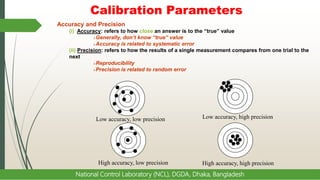
Accuracy and Precision
(i) Accuracy: refers to how close an answer is to the “true” value
Generally, don’t know “true” value
Accuracy is related to systematic error
(ii) Precision: refers to how the results of a single measurement compares from one trial to the
next
Reproducibility
Precision is related to random error
Low accuracy, low precision Low accuracy, high precision
High accuracy, low precision High accuracy, high precision
Calibration Parameters
National Control Laboratory (NCL), DGDA, Dhaka, Bangladesh
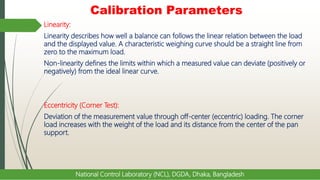
Linearity:
Linearity describes how well a balance can follows the linear relation between the load
and the displayed value. A characteristic weighing curve should be a straight line from
zero to the maximum load.
Non-linearity defines the limits within which a measured value can deviate (positively or
negatively) from the ideal linear curve.
Eccentricity (Corner Test):
Deviation of the measurement value through off-center (eccentric) loading. The corner
load increases with the weight of the load and its distance from the center of the pan
support.
Trouble shooting
National Control Laboratory (NCL), DGDA, Dhaka, Bangladesh
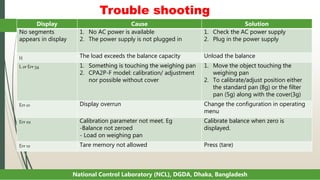
Display Cause Solution
No segments
appears in display
1. No AC power is available
2. The power supply is not plugged in
1. Check the AC power supply
2. Plug in the power supply
H The load exceeds the balance capacity Unload the balance
L or Err 54 1. Something is touching the weighing pan
2. CPA2P-F model: calibration/ adjustment
nor possible without cover
1. Move the object touching the
weighing pan
2. To calibrate/adjust position either
the standard pan (8g) or the filter
pan (5g) along with the cover(3g)
Err 01 Display overrun Change the configuration in operating
menu
Err 02 Calibration parameter not meet. Eg
-Balance not zeroed
- Load on weighing pan
Calibrate balance when zero is
displayed.
Err 10 Tare memory not allowed Press (tare)
Trouble shooting
National Control Laboratory (NCL), DGDA, Dhaka, Bangladesh
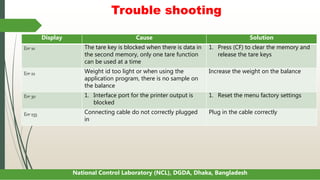
Display Cause Solution
Err 10 The tare key is blocked when there is data in
the second memory, only one tare function
can be used at a time
1. Press (CF) to clear the memory and
release the tare keys
Err 22 Weight id too light or when using the
application program, there is no sample on
the balance
Increase the weight on the balance
Err 30 1. Interface port for the printer output is
blocked
1. Reset the menu factory settings
Err 235 Connecting cable do not correctly plugged
in
Plug in the cable correctly
Thank You

Analytical balance

  • 1.
    Analytical Weighing Balance Md.Abdul Karim Mia Analyst National Control Laboratory (NCL), DGDA, Dhaka, Bangladesh
  • 2.
    Balance Balance: A weighingdevice, especially one consisting of a rigid beam horizontally suspended by a low-friction support at its center, with identical weighing pans hung at either end, one of which holds an unknown weight while the effective weight in the other is increased by known amounts until the beam is level and motionless. Analytical balance is a class of balance designed to measure small mass in the sub-milligram range. The measuring pan of an analytical balance (0.1 mg or better) is inside a transparent enclosure with doors so that dust does not collect and so any air currents in the room do not affect the balance's operation. This enclosure is often called a draft shield. National Control Laboratory (NCL), DGDA, Dhaka, Bangladesh
  • 3.
    History of Balance NationalControl Laboratory (NCL), DGDA, Dhaka, Bangladesh Simple Balance was used as early as 2400- 1800 B.C near Indus river valley ( Now Pakistan) Balance comes from the Latin word “ Lilanx” means `Two pans` The lightweight technique is developed Joseph Black. The modern analytical balance originated during the mid-18th century
  • 4.
    Types Of Balance NationalControl Laboratory (NCL), DGDA, Dhaka, Bangladesh Type- I Type- II Type- III Light weighing capacity and Highly Sensitivity Built-in weights for analytical balances and Laboratory weights for routine analytical weights Precision Balances and all other weighing equipments Semi Micro balance: 5 µg to 500mg Micro balance: 2mg to 20 gm Analytical balance 100 mg to 100 gm Top Load balance 1.0 kg to 2.0 kg
  • 5.
    Sartorius Analytical balance NationalControl Laboratory (NCL), DGDA, Dhaka, Bangladesh Weighing pan Tare/Zero switch Gram/g Display Level Indicator CAL button On/off switch Adjustable feet Windbreak door Function Key Calibration Tag
  • 6.
    Where to locateanalytical Balance  Install the balance on a solid bench that is (AVT) anti vibration table.  Doesn't locate AVT corner of the room-room access through a sliding door.  The balance should not be installed near sources of electromagnetic radiation such as radio frequency generators, electric motors, hand held communication devices (including card less telephones and cell phones)  humidity range 45 - 60% Operate. Humidity range <20 – 80<% Never operate  Never disconnect the balance from the power supply and leave it always switched on / STAND BY mode. If “OFF” mode: warm-up for 1 hour after switching ‘ON’ the power supply. Note: Stable anti vibration table-has affect on balance for measurement 0.01g or less. National Control Laboratory (NCL), DGDA, Dhaka, Bangladesh
  • 7.
    Weighing Procedure ofanalytical Balance  Ensure the instrument is clean and free from dust. If presence clean with soft brush  Check the adjustment bubble within the center and calibration tag within expiry date.  Ensure that daily calibration is done and check the log book.  Place the weighing paper on the weighing pan, close the windbreak door and press tare button to zero.  Place the sample of standard or sample on the weighing pan using spatula and close the windbreak door.  Take the reading from display shows as gram after stabilized.  Record the weighing results on log book.  Carefully remove the weight and left clean for another analyst National Control Laboratory (NCL), DGDA, Dhaka, Bangladesh
  • 8.
    Calibration Parameters National ControlLaboratory (NCL), DGDA, Dhaka, Bangladesh Minimum Weight/Repeatability: Repeatability is a measure of the ability of a balance to supply the same result in repetitive weighing's with one and the some load under the same measurement conditions. Measurements must be carried out by the same operator, using the same weighing method, in the same location on the same pan support, in the same installation location, under constant ambient conditions, and without interruption. Procedure: 1. Take measurement of 50 % or more load of the balance for 10 times. 2. Record the value and calculate as follow Minimum weight: IF SD>0.41d Desired minimum weight = 2*SD*1000 IF SD<0.41d Desired minimum weight = 2*0.41d*1000=820d Repeatability: 2*SD / Desired minimum sample weight Lt: ≤0.1%
  • 9.
    Calibration Parameters National ControlLaboratory (NCL), DGDA, Dhaka, Bangladesh Accuracy: Accuracy is defined as the proximity of measured results to the reference value. Accuracy is the systematic error. Procedure: 1. Determine the range of test weights that will be used to make sure their mass is between 5-100% of the balance capacity. 2. Measure the test weight placing in center position on weighing pan. 3. Repeat the measurement for all weight previously determined in that range. 4. Record the value and compare within range or not. Lt: Measured value does not deviate by more than 0.1% of the test weight value.
  • 10.
    Calibration Parameters National ControlLaboratory (NCL), DGDA, Dhaka, Bangladesh Accuracy and Precision (i) Accuracy: refers to how close an answer is to the “true” value Generally, don’t know “true” value Accuracy is related to systematic error (ii) Precision: refers to how the results of a single measurement compares from one trial to the next Reproducibility Precision is related to random error Low accuracy, low precision Low accuracy, high precision High accuracy, low precision High accuracy, high precision
  • 11.
    Calibration Parameters National ControlLaboratory (NCL), DGDA, Dhaka, Bangladesh Linearity: Linearity describes how well a balance can follows the linear relation between the load and the displayed value. A characteristic weighing curve should be a straight line from zero to the maximum load. Non-linearity defines the limits within which a measured value can deviate (positively or negatively) from the ideal linear curve. Eccentricity (Corner Test): Deviation of the measurement value through off-center (eccentric) loading. The corner load increases with the weight of the load and its distance from the center of the pan support.
  • 12.
    Trouble shooting National ControlLaboratory (NCL), DGDA, Dhaka, Bangladesh Display Cause Solution No segments appears in display 1. No AC power is available 2. The power supply is not plugged in 1. Check the AC power supply 2. Plug in the power supply H The load exceeds the balance capacity Unload the balance L or Err 54 1. Something is touching the weighing pan 2. CPA2P-F model: calibration/ adjustment nor possible without cover 1. Move the object touching the weighing pan 2. To calibrate/adjust position either the standard pan (8g) or the filter pan (5g) along with the cover(3g) Err 01 Display overrun Change the configuration in operating menu Err 02 Calibration parameter not meet. Eg -Balance not zeroed - Load on weighing pan Calibrate balance when zero is displayed. Err 10 Tare memory not allowed Press (tare)
  • 13.
    Trouble shooting National ControlLaboratory (NCL), DGDA, Dhaka, Bangladesh Display Cause Solution Err 10 The tare key is blocked when there is data in the second memory, only one tare function can be used at a time 1. Press (CF) to clear the memory and release the tare keys Err 22 Weight id too light or when using the application program, there is no sample on the balance Increase the weight on the balance Err 30 1. Interface port for the printer output is blocked 1. Reset the menu factory settings Err 235 Connecting cable do not correctly plugged in Plug in the cable correctly
  • 14.