Primary and secondary
standards
NEELIMA YADAV
ASST. PROF.
DR C.V. RAMAN INSTITUTE OF PHARMACY
STANDARDS:-
The word standard means a material containing a substance of our interest with a known concentration. We can
express this with definite numbers with proper units. By using this standard we can find out the concentration of
that substance in a new material.
1. Functions
standards has the following uses:-
(a) To provide a reference using which we can determine unknown concentration
(b) To standardize volumetric solutions
(c) Preparation of secondary standard
(d) To calibrate an instrument.
2. Types
Standards can be divided into two types:
1. Primary standard
2. Secondary standard
Primary standard and Secondary standards
Standards
Primary standards
Secondary standards
1.Primary standard:-
From the name itself it is obvious that this is a standard which comes first. That’s
why the name is primary.
A primary standard is a chemical or reagent which has certain properties such
as
(a) It is extremely pure
(b) Highly stable
(c) It is anhydrous
(d) It is less hygroscopic
(e) Has very high molecular weight
(f) Can be weighed easily
(g) Should be ready to use and available
(h) Should be preferably non toxic
(i) Should not be expensive
Having said that lets us understand each point one by one.
􀁺 A primary standard material should be extremely pure which means that it should be a chemical of
high grade of purity, preferably 99.98%. In a chemistry lab you will come across chemicals of different
grade of purity. If you check the label you will notice a number with percentage termed as purity. So when
a chemical has purity of 99.98% or more it is a suitable material to be considered for primary standard.
Usually those chemicals that exceed the requirement of American chemical society (ACS) are extremely pure and
can be used for making primary standard. It is an analytical reagent of extreme purity which is specially
manufactured for the purpose of being used as primary standard.
􀁺 It should be highly stable which means it usually does not react easily when kept in its pure form. Or in other
words it should have very low reactivity. This is important because if a reagent reacts easily with atmospheric
oxygen or water or changes its property over time then it is unreliable. We can never use such unstable and
unreliable chemicals as standard.
􀁺 Just being anhydrous is not sufficient. The chemical preferably should be less hygroscopic that is on opening
the container it should not absorb water molecules from atmosphere. Why water should not enter into chemical?
This will be clearer in the following point where it is explained how presence of water molecule can affect the
simple calculation of standard concentration making the entire standardization procedure unreliable.
􀁺 It can be weighed easily because it is so pure that its weight is in fact a true representative of number
of moles present in its actual weight.
􀁺 One of the uses of primary standard is to standardize a volumetric solution. That means they are
used for standardization of titration of solutions. It can be used for titration of acids as well as bases. Let
us see how a primary standard is used for titration.
􀁺 The primary standard is used for calibration of secondary standard or for method validation against
a definitive method and it corresponds to the true value of the substance analyzed.
2.Secondary standard
A secondary standard is a substance which may be used for standardizations, and whose content of the active
substance has been found by comparison against a primary standard. A secondary standard is a solution which
contain exactly known amount of the substance in unit volume of the solution and which is expressed as normality
or molarity and can be determined by titrating against a primary standard. It follows that a secondary standard
solution is a solution in which the concentration of dissolved solute has not been determined from the weight of
the compound dissolved but by reaction (titration) of a volume of a primary standard solution. Thus a solution of
sodium hydroxide may be standardized by titrating against a standard solution of Potassium Hydrogen Phthalate
or against a standard solution of Hydrochloric Acid (Secondary standard).
􀁺 There are other points one has to remember. For preparing the secondary standard solution one must use
aqueous solution of high grade purity. It must be deionized if aqueous solvent used is water. Without pure solvent,
the standard solution prepared will be worthless (These points are also applicable for preparing primary standard
solution).
􀁺 Similarly before using high grade chemicals one should also be vigilant and check for date of
manufacture, expiry date, date of receipt of chemical, whether the conditions for its transport was
followed or not, if the seal is not tampered with, its purity, standard reference material used etc.
A secondary standard is a substance which for one or more of the reasons cannot be used as a standard.
e.g., sodium hydroxide cannot be used as a primary standard for the reason that it absorbs water and
carbon dioxide from the atmosphere and the composition of its solution is subject to wide variations at
different periods. Similarly Sodium thiosulphate absorbs CO2 from the atmosphere and gets
decomposed. A deposit of Sulphur settles at the bottom. Similarly the compositions of solution of
various other substances like mineral acids, Potassium permanganate, Iodine etc , are also variable at
different times. Therefore these cannot be used as primary standards. The normality or molarity of
solution of such a substance can be found by titrating against a standard solution of a primary standard
or in other words the solution may be standardized by titrating against the standard solution of a
primary standard.
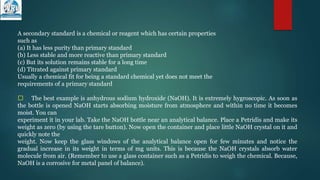
A secondary standard is a chemical or reagent which has certain properties
such as
(a) It has less purity than primary standard
(b) Less stable and more reactive than primary standard
(c) But its solution remains stable for a long time
(d) Titrated against primary standard
Usually a chemical fit for being a standard chemical yet does not meet the
requirements of a primary standard
􀁺 The best example is anhydrous sodium hydroxide (NaOH). It is extremely hygroscopic. As soon as
the bottle is opened NaOH starts absorbing moisture from atmosphere and within no time it becomes
moist. You can
experiment it in your lab. Take the NaOH bottle near an analytical balance. Place a Petridis and make its
weight as zero (by using the tare button). Now open the container and place little NaOH crystal on it and
quickly note the
weight. Now keep the glass windows of the analytical balance open for few minutes and notice the
gradual increase in its weight in terms of mg units. This is because the NaOH crystals absorb water
molecule from air. (Remember to use a glass container such as a Petridis to weigh the chemical. Because,
NaOH is a corrosive for metal panel of balance).
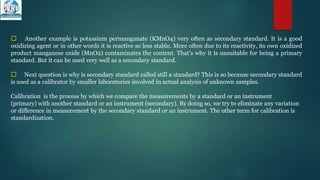
􀁺 Another example is potassium permanganate (KMnO4) very often as secondary standard. It is a good
oxidizing agent or in other words it is reactive so less stable. More often due to its reactivity, its own oxidized
product manganese oxide (MnO2) contaminates the content. That’s why it is unsuitable for being a primary
standard. But it can be used very well as a secondary standard.
􀁺 Next question is why is secondary standard called still a standard? This is so because secondary standard
is used as a calibrator by smaller laboratories involved in actual analysis of unknown samples.
Calibration is the process by which we compare the measurements by a standard or an instrument
(primary) with another standard or an instrument (secondary). By doing so, we try to eliminate any variation
or difference in measurement by the secondary standard or an instrument. The other term for calibration is
standardization.
Requirements for Primary Standards:-
One of the requirement needed for volumetric analysis is a substance having a known purity. The
solution of this substance can be employed as a titrant. There are few known substances which can
be used as a primary standard. The requirements for primary standard substances are as follows:
A Primary Standard should satisfy the following requirements
1. It must be easy to obtain, to purify, to dry (preferably at 110 – 120°c), and to preserve in a pure state.
(This requirement is not usually met by hydrated substances, since it is difficult to remove surface
moisture completely without effecting partial decomposition).
2. The Substance should be unaltered in air during weighing: this condition implies that it should not be
hygroscopic, oxidized by air, or affected by carbon dioxide. The standard should maintain an unchanged
composition during storage.
3. The substance should be capable of being tested for impurities by qualitative and other tests of known
sensitivity. (The total amount of impurities should not, in general exceed 0.01-0.02 percent).
4. It should have a high relative molecular mass so that the weighing errors may be negligible.(The precision in
weighing is ordinarily 0.1-0.2 mg; for an accuracy of 1 part in 1000. it is necessary to employ samples weighing at
least about 0.2gm).
5. The substance should be readily soluble under the conditions in which it is employed.
6. The reaction with the standard solution should be stoichiometric and practically instantaneous. The titration
error should be negligible, or easy to determine accurately by experiment.
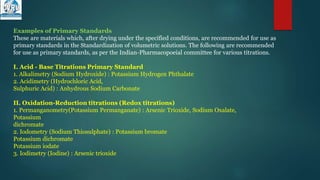
Examples of Primary Standards
These are materials which, after drying under the specified conditions, are recommended for use as
primary standards in the Standardization of volumetric solutions. The following are recommended
for use as primary standards, as per the Indian-Pharmacopoeial committee for various titrations.
I. Acid - Base Titrations Primary Standard
1. Alkalimetry (Sodium Hydroxide) : Potassium Hydrogen Phthalate
2. Acidimetry (Hydrochloric Acid,
Sulphuric Acid) : Anhydrous Sodium Carbonate
II. Oxidation-Reduction titrations (Redox titrations)
1. Permanganometry(Potassium Permanganate) : Arsenic Trioxide, Sodium Oxalate,
Potassium
dichromate
2. Iodometry (Sodium Thiosulphate) : Potassium bromate
Potassium dichromate
Potassium iodate
3. Iodimetry (Iodine) : Arsenic trioxide
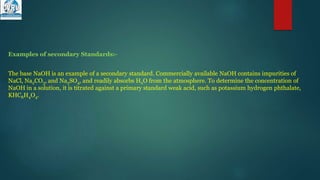
The base NaOH is an example of a secondary standard. Commercially available NaOH contains impurities of
NaCl, Na2CO3, and Na2SO4, and readily absorbs H2O from the atmosphere. To determine the concentration of
NaOH in a solution, it is titrated against a primary standard weak acid, such as potassium hydrogen phthalate,
KHC8H4O4.
Examples of secondary Standards:-
THANK YOU