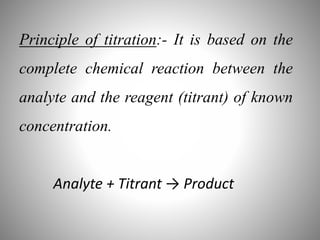
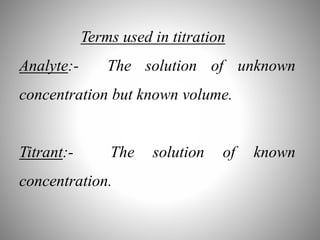
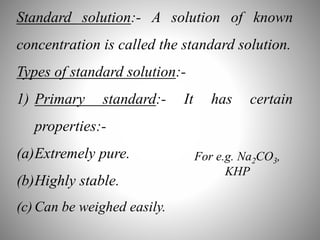
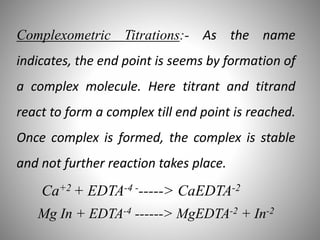
Titration, also known as titrimetry, is a technique used to determine the concentration of an unknown solution by reacting it with a solution of known concentration. The principle of titration is based on a complete chemical reaction between the analyte and titrant. Key terms in titration include the analyte, which is the unknown solution, and the titrant, which is the standard solution of known concentration. Titration calculations rely on the law of equivalence, which states that the amount of reactants must be equivalent at the endpoint of the reaction. Titration is used in various fields such as agriculture, oil industry, chemical industry, pharmaceuticals, and food industry due to its accuracy, precision, and cost effectiveness.






![Acid base titration III [Compatibility Mode].pdf](https://cdn.slidesharecdn.com/ss_thumbnails/acidbasetitrationiiicompatibilitymode-231030064045-e32b2458-thumbnail.jpg?width=640&height=640&fit=bounds)


