CHEMICALS AND REAGENTS
WRITTEN AND COMPOSED BY:
SANA ULLAH
03483800518
Topics to be discussed:
• Chemical reagents
• Primary standard and secondary standard
• Preparation of standard solution
• Rules for handling chemicals and solutions
• Classification of chemicals
• Proper labeling of chemical and reagent
• Safe use and storage of chemicals
• Safety data sheet
Chemical reagent
• A reagent is a compound or mixture added to a system to cause a chemical
reaction or test if a reaction occur.
• A reagent may be used to tell whether or not a particular substance is
present by causing a reaction to occur with it.
• Examples:
• Phenolphthalein
• Bayer reagent (KmNO4)
Primary and Secondary Standards
➢Primary Standard:
A primary standard should fulfill these requirements
1. It should be 100.00% pure, although 0.01 to 0.02% impurity is tolerable if it is accurately known.
2. It should be stable to drying temperatures, and it should be stable indefinitely at room temperature.
The primary standard is always dried before weighing.
3. It should be readily and relatively inexpensively available.
4. Although not essential, it should have a high formula weight. This is so that a relatively large amount
of it will have to be weighed. The relative error in weighing a greater amount of material will be smaller
than that for a small amount.
5. If it is to be used in titration, it should possess the properties required for a titration. In particular,
the equilibrium of the reaction should be far to the right so that a sharp end point will be obtained.
Example: potassium hydrogen phthalate(KHP): KHC8H4O4
Sodium carbonate: NA2CO3
Potassium dichromate: K2Cr2O7
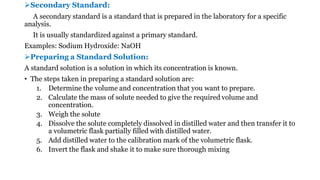
➢Secondary Standard:
A secondary standard is a standard that is prepared in the laboratory for a specific
analysis.
It is usually standardized against a primary standard.
Examples: Sodium Hydroxide: NaOH
➢Preparing a Standard Solution:
A standard solution is a solution in which its concentration is known.
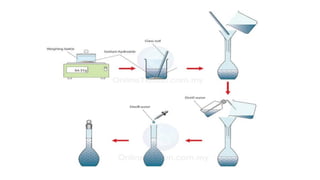
• The steps taken in preparing a standard solution are:
1. Determine the volume and concentration that you want to prepare.
2. Calculate the mass of solute needed to give the required volume and
concentration.
3. Weigh the solute
4. Dissolve the solute completely dissolved in distilled water and then transfer it to
a volumetric flask partially filled with distilled water.
5. Add distilled water to the calibration mark of the volumetric flask.
6. Invert the flask and shake it to make sure thorough mixing
Rules for Handling Reagent and Solutions
1. Select the best grade of chemical available for analytical work. Whenever
possible, pick the smallest bottle that is sufficient to do the job.
2. Replace the top of every container immediately after removing reagent.
Do not rely on someone else to do so.
3. Hold the stoppers of reagent bottles between your fingers. Never set a
stopper on a desk top.
4. Unless specifically directed otherwise, never return any excess reagent to
a bottle. The money saved by returning excesses is seldom worth the risk of
contaminating the entire bottle.
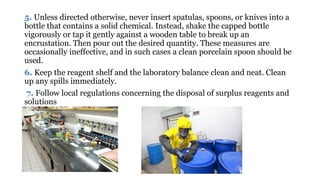
5. Unless directed otherwise, never insert spatulas, spoons, or knives into a
bottle that contains a solid chemical. Instead, shake the capped bottle
vigorously or tap it gently against a wooden table to break up an
encrustation. Then pour out the desired quantity. These measures are
occasionally ineffective, and in such cases a clean porcelain spoon should be
used.
6. Keep the reagent shelf and the laboratory balance clean and neat. Clean
up any spills immediately.
7. Follow local regulations concerning the disposal of surplus reagents and
solutions
Chemical classification
Chemical are classified into various hazard classification in accordance with their
physiochemical properties and health hazards.
➢Physiochemical Properties:
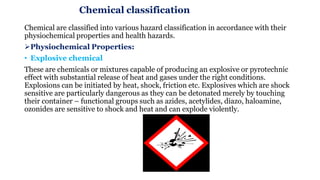
• Explosive chemical
These are chemicals or mixtures capable of producing an explosive or pyrotechnic
effect with substantial release of heat and gases under the right conditions.
Explosions can be initiated by heat, shock, friction etc. Explosives which are shock
sensitive are particularly dangerous as they can be detonated merely by touching
their container – functional groups such as azides, acetylides, diazo, haloamine,
ozonides are sensitive to shock and heat and can explode violently.
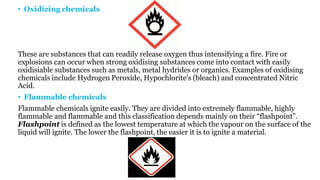
• Oxidizing chemicals
These are substances that can readily release oxygen thus intensifying a fire. Fire or
explosions can occur when strong oxidising substances come into contact with easily
oxidisiable substances such as metals, metal hydrides or organics. Examples of oxidising
chemicals include Hydrogen Peroxide, Hypochlorite's (bleach) and concentrated Nitric
Acid.
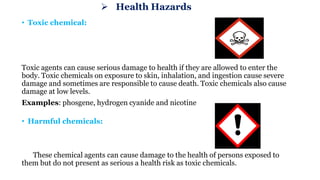
• Flammable chemicals
Flammable chemicals ignite easily. They are divided into extremely flammable, highly
flammable and flammable and this classification depends mainly on their “flashpoint”.
Flashpoint is defined as the lowest temperature at which the vapour on the surface of the
liquid will ignite. The lower the flashpoint, the easier it is to ignite a material.
➢ Health Hazards
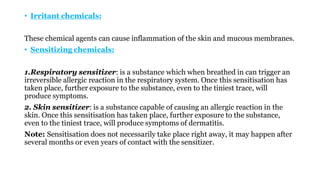
• Toxic chemical:
Toxic agents can cause serious damage to health if they are allowed to enter the
body. Toxic chemicals on exposure to skin, inhalation, and ingestion cause severe
damage and sometimes are responsible to cause death. Toxic chemicals also cause
damage at low levels.
Examples: phosgene, hydrogen cyanide and nicotine
• Harmful chemicals:
These chemical agents can cause damage to the health of persons exposed to
them but do not present as serious a health risk as toxic chemicals.
• Irritant chemicals:
These chemical agents can cause inflammation of the skin and mucous membranes.
• Sensitizing chemicals:
1.Respiratory sensitizer: is a substance which when breathed in can trigger an
irreversible allergic reaction in the respiratory system. Once this sensitisation has
taken place, further exposure to the substance, even to the tiniest trace, will
produce symptoms.
2. Skin sensitizer: is a substance capable of causing an allergic reaction in the
skin. Once this sensitisation has taken place, further exposure to the substance,
even to the tiniest trace, will produce symptoms of dermatitis.
Note: Sensitisation does not necessarily take place right away, it may happen after
several months or even years of contact with the sensitizer.
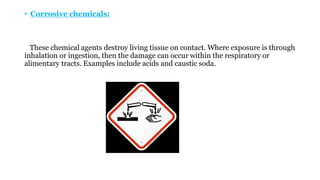
• Corrosive chemicals:
These chemical agents destroy living tissue on contact. Where exposure is through
inhalation or ingestion, then the damage can occur within the respiratory or
alimentary tracts. Examples include acids and caustic soda.
PROPER LABELING OF CHEMICAL AND REAGENT
• Manufacturer chemical labels must never be removed or defaced until the
chemical is completely used.
• All chemical and waste containers must be clearly labelled with the full chemical
name( no abbreviations) and must contain appropriate hazard warning
information's.
• Small containers that are difficult to label such as 1-10 ml test tubes etc. can be
numbered lettered, or coded as long as an associated log is available that
identifies the chemical constituents
• All chemicals should be labeled with the date received and date opened.
• All laboratory chemical waste containers must be labeled with the name of the
chemicals contained.
• All full containers must be disposed of promptly. Waste containers must Not be
filled to more than 90 % of their capacity.
• All chemical storage areas such as cabinets, shelves and refrigerators should be
labelled to identify the hazardous nature of the chemicals stored within that
area(e.g., flammable, corrosive, oxidizing, toxic etc.)
Safe use and storage of chemicals
➢Toxic Harmful and Irritating Chemical:
• Toxic chemical:
Toxic substance is one that can cause serious acute or chronic effects, even death
Examples: potassium cyanide, chloroform, barium chloride etc.
• Harmful Chemicals:
Harmful substance is one that can cause limited effects on health
Examples: benzoic acid, potassium oxalate, xylene etc.
• Irritants:
Irritating chemical is one that can cause inflammation and irritation of the skin,
mucous membranes, and respiratory tract.
Examples: ammonia solution, acetic acid, potassium dichromate etc.
• Storage:
Toxic Harmful and Irritating chemicals should be stored in a cupboard, not on an
open shelf.
• Safe use:
1. Wash the hands immediately after use. Wear suitable protective gloves and suitable
eye protectives.
2. Always lock away highly toxic chemicals immediately after use and never leave such
chemicals unattended.
3. Keep containers tightly closed
4. Never mouth-pipette any chemical or reagent, always use pipette sucker.
➢Flammable chemicals:
A flammable chemical is one that readily ignites and burns
• Storage:
Store flammable chemicals preferably in an outside locked store that is cool
and well ventilated.
Label the container “Flammable”.
• Safe use:
1. Before opening a bottle containing a flammable liquid, always make sure there
is no open flame within 2 meters.
2. Display no smoking notices.
3. Ensure stock bottles and dispensing containers are closed after use.
➢Oxidizing chemicals:
An oxidizing substance is one that produces heat or evolves oxygen in contact with
other substances causing them to burn strongly or become explosive or spontaneously
combustible.
Example: hydrogen peroxide and other strong peroxides, nitric acid, ammonium
nitrate, sodium nitrite, per chloric acid etc.
• Storage:
Must be stored well away from flammable chemicals and other chemicals with which
they can react dangerously.
• Safe Use:
1. Always handle oxidizing chemicals with care. Beside being fire promoting most
oxidizing chemicals are dangerous to skin and eyes.
2. Use protective gloves and eye protectives to be away from its harmful effects.
➢ Corrosive chemicals:
A corrosive chemical is one that can destroy living tissue and is also capable
of damaging inanimate substances.
Examples: sodium hydroxide, potassium hydroxide, concentrated sulfuric acid,
nitric acid etc.
• Storage:
Corrosive chemicals should be stored at low level.
• Safe Use:
1. Never mouth-pipette a corrosive chemical.
2. Wear suitable protective gloves and a face visor or at least eye shields, when
opening a container of corrosive chemicals and when pouring it
SAFETY DATA SHEET
• The safety data sheet provides complete details about a chemical.
• The safety data sheet is provided by the suppliers of chemicals or can be
found on the internet.
• It consist of 16 sections.
• The first 8 sections provides general information like identification, hazard
identification, first aid measures etc.
• The last eight sections provide other scientific and technical information
such as physical and chemical properties, stability and reactivity,
toxicological information, and other information including the date of
preparation etc.
• Therefor it is necessary for the user of the product to study it become
aware of the use and storage of chemical, emergency handling and to
protect himself from its dangerous effects.
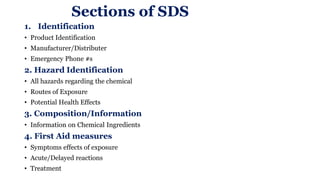
Sections of SDS
1. Identification
• Product Identification
• Manufacturer/Distributer
• Emergency Phone #s
2. Hazard Identification
• All hazards regarding the chemical
• Routes of Exposure
• Potential Health Effects
3. Composition/Information
• Information on Chemical Ingredients
4. First Aid measures
• Symptoms effects of exposure
• Acute/Delayed reactions
• Treatment
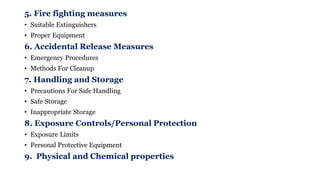
5. Fire fighting measures
• Suitable Extinguishers
• Proper Equipment
6. Accidental Release Measures
• Emergency Procedures
• Methods For Cleanup
7. Handling and Storage
• Precautions For Safe Handling
• Safe Storage
• Inappropriate Storage
8. Exposure Controls/Personal Protection
• Exposure Limits
• Personal Protective Equipment
9. Physical and Chemical properties
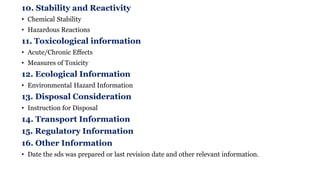
10. Stability and Reactivity
• Chemical Stability
• Hazardous Reactions
11. Toxicological information
• Acute/Chronic Effects
• Measures of Toxicity
12. Ecological Information
• Environmental Hazard Information
13. Disposal Consideration
• Instruction for Disposal
14. Transport Information
15. Regulatory Information
16. Other Information
• Date the sds was prepared or last revision date and other relevant information.
Chemicals and reagents pdf

Chemicals and reagents pdf

  • 1.
    CHEMICALS AND REAGENTS WRITTENAND COMPOSED BY: SANA ULLAH 03483800518
  • 3.
    Topics to bediscussed: • Chemical reagents • Primary standard and secondary standard • Preparation of standard solution • Rules for handling chemicals and solutions • Classification of chemicals • Proper labeling of chemical and reagent • Safe use and storage of chemicals • Safety data sheet
  • 4.
    Chemical reagent • Areagent is a compound or mixture added to a system to cause a chemical reaction or test if a reaction occur. • A reagent may be used to tell whether or not a particular substance is present by causing a reaction to occur with it. • Examples: • Phenolphthalein • Bayer reagent (KmNO4)
  • 5.
    Primary and SecondaryStandards ➢Primary Standard: A primary standard should fulfill these requirements 1. It should be 100.00% pure, although 0.01 to 0.02% impurity is tolerable if it is accurately known. 2. It should be stable to drying temperatures, and it should be stable indefinitely at room temperature. The primary standard is always dried before weighing. 3. It should be readily and relatively inexpensively available. 4. Although not essential, it should have a high formula weight. This is so that a relatively large amount of it will have to be weighed. The relative error in weighing a greater amount of material will be smaller than that for a small amount. 5. If it is to be used in titration, it should possess the properties required for a titration. In particular, the equilibrium of the reaction should be far to the right so that a sharp end point will be obtained. Example: potassium hydrogen phthalate(KHP): KHC8H4O4 Sodium carbonate: NA2CO3 Potassium dichromate: K2Cr2O7
  • 6.
    ➢Secondary Standard: A secondarystandard is a standard that is prepared in the laboratory for a specific analysis. It is usually standardized against a primary standard. Examples: Sodium Hydroxide: NaOH ➢Preparing a Standard Solution: A standard solution is a solution in which its concentration is known. • The steps taken in preparing a standard solution are: 1. Determine the volume and concentration that you want to prepare. 2. Calculate the mass of solute needed to give the required volume and concentration. 3. Weigh the solute 4. Dissolve the solute completely dissolved in distilled water and then transfer it to a volumetric flask partially filled with distilled water. 5. Add distilled water to the calibration mark of the volumetric flask. 6. Invert the flask and shake it to make sure thorough mixing
  • 8.
    Rules for HandlingReagent and Solutions 1. Select the best grade of chemical available for analytical work. Whenever possible, pick the smallest bottle that is sufficient to do the job. 2. Replace the top of every container immediately after removing reagent. Do not rely on someone else to do so. 3. Hold the stoppers of reagent bottles between your fingers. Never set a stopper on a desk top. 4. Unless specifically directed otherwise, never return any excess reagent to a bottle. The money saved by returning excesses is seldom worth the risk of contaminating the entire bottle.
  • 9.
    5. Unless directedotherwise, never insert spatulas, spoons, or knives into a bottle that contains a solid chemical. Instead, shake the capped bottle vigorously or tap it gently against a wooden table to break up an encrustation. Then pour out the desired quantity. These measures are occasionally ineffective, and in such cases a clean porcelain spoon should be used. 6. Keep the reagent shelf and the laboratory balance clean and neat. Clean up any spills immediately. 7. Follow local regulations concerning the disposal of surplus reagents and solutions
  • 10.
    Chemical classification Chemical areclassified into various hazard classification in accordance with their physiochemical properties and health hazards. ➢Physiochemical Properties: • Explosive chemical These are chemicals or mixtures capable of producing an explosive or pyrotechnic effect with substantial release of heat and gases under the right conditions. Explosions can be initiated by heat, shock, friction etc. Explosives which are shock sensitive are particularly dangerous as they can be detonated merely by touching their container – functional groups such as azides, acetylides, diazo, haloamine, ozonides are sensitive to shock and heat and can explode violently.
  • 11.
    • Oxidizing chemicals Theseare substances that can readily release oxygen thus intensifying a fire. Fire or explosions can occur when strong oxidising substances come into contact with easily oxidisiable substances such as metals, metal hydrides or organics. Examples of oxidising chemicals include Hydrogen Peroxide, Hypochlorite's (bleach) and concentrated Nitric Acid. • Flammable chemicals Flammable chemicals ignite easily. They are divided into extremely flammable, highly flammable and flammable and this classification depends mainly on their “flashpoint”. Flashpoint is defined as the lowest temperature at which the vapour on the surface of the liquid will ignite. The lower the flashpoint, the easier it is to ignite a material.
  • 12.
    ➢ Health Hazards •Toxic chemical: Toxic agents can cause serious damage to health if they are allowed to enter the body. Toxic chemicals on exposure to skin, inhalation, and ingestion cause severe damage and sometimes are responsible to cause death. Toxic chemicals also cause damage at low levels. Examples: phosgene, hydrogen cyanide and nicotine • Harmful chemicals: These chemical agents can cause damage to the health of persons exposed to them but do not present as serious a health risk as toxic chemicals.
  • 13.
    • Irritant chemicals: Thesechemical agents can cause inflammation of the skin and mucous membranes. • Sensitizing chemicals: 1.Respiratory sensitizer: is a substance which when breathed in can trigger an irreversible allergic reaction in the respiratory system. Once this sensitisation has taken place, further exposure to the substance, even to the tiniest trace, will produce symptoms. 2. Skin sensitizer: is a substance capable of causing an allergic reaction in the skin. Once this sensitisation has taken place, further exposure to the substance, even to the tiniest trace, will produce symptoms of dermatitis. Note: Sensitisation does not necessarily take place right away, it may happen after several months or even years of contact with the sensitizer.
  • 14.
    • Corrosive chemicals: Thesechemical agents destroy living tissue on contact. Where exposure is through inhalation or ingestion, then the damage can occur within the respiratory or alimentary tracts. Examples include acids and caustic soda.
  • 15.
    PROPER LABELING OFCHEMICAL AND REAGENT • Manufacturer chemical labels must never be removed or defaced until the chemical is completely used. • All chemical and waste containers must be clearly labelled with the full chemical name( no abbreviations) and must contain appropriate hazard warning information's. • Small containers that are difficult to label such as 1-10 ml test tubes etc. can be numbered lettered, or coded as long as an associated log is available that identifies the chemical constituents • All chemicals should be labeled with the date received and date opened. • All laboratory chemical waste containers must be labeled with the name of the chemicals contained. • All full containers must be disposed of promptly. Waste containers must Not be filled to more than 90 % of their capacity. • All chemical storage areas such as cabinets, shelves and refrigerators should be labelled to identify the hazardous nature of the chemicals stored within that area(e.g., flammable, corrosive, oxidizing, toxic etc.)
  • 16.
    Safe use andstorage of chemicals ➢Toxic Harmful and Irritating Chemical: • Toxic chemical: Toxic substance is one that can cause serious acute or chronic effects, even death Examples: potassium cyanide, chloroform, barium chloride etc. • Harmful Chemicals: Harmful substance is one that can cause limited effects on health Examples: benzoic acid, potassium oxalate, xylene etc. • Irritants: Irritating chemical is one that can cause inflammation and irritation of the skin, mucous membranes, and respiratory tract. Examples: ammonia solution, acetic acid, potassium dichromate etc.
  • 17.
    • Storage: Toxic Harmfuland Irritating chemicals should be stored in a cupboard, not on an open shelf. • Safe use: 1. Wash the hands immediately after use. Wear suitable protective gloves and suitable eye protectives. 2. Always lock away highly toxic chemicals immediately after use and never leave such chemicals unattended. 3. Keep containers tightly closed 4. Never mouth-pipette any chemical or reagent, always use pipette sucker.
  • 18.
    ➢Flammable chemicals: A flammablechemical is one that readily ignites and burns • Storage: Store flammable chemicals preferably in an outside locked store that is cool and well ventilated. Label the container “Flammable”. • Safe use: 1. Before opening a bottle containing a flammable liquid, always make sure there is no open flame within 2 meters. 2. Display no smoking notices. 3. Ensure stock bottles and dispensing containers are closed after use.
  • 19.
    ➢Oxidizing chemicals: An oxidizingsubstance is one that produces heat or evolves oxygen in contact with other substances causing them to burn strongly or become explosive or spontaneously combustible. Example: hydrogen peroxide and other strong peroxides, nitric acid, ammonium nitrate, sodium nitrite, per chloric acid etc. • Storage: Must be stored well away from flammable chemicals and other chemicals with which they can react dangerously. • Safe Use: 1. Always handle oxidizing chemicals with care. Beside being fire promoting most oxidizing chemicals are dangerous to skin and eyes. 2. Use protective gloves and eye protectives to be away from its harmful effects.
  • 20.
    ➢ Corrosive chemicals: Acorrosive chemical is one that can destroy living tissue and is also capable of damaging inanimate substances. Examples: sodium hydroxide, potassium hydroxide, concentrated sulfuric acid, nitric acid etc. • Storage: Corrosive chemicals should be stored at low level. • Safe Use: 1. Never mouth-pipette a corrosive chemical. 2. Wear suitable protective gloves and a face visor or at least eye shields, when opening a container of corrosive chemicals and when pouring it
  • 21.
    SAFETY DATA SHEET •The safety data sheet provides complete details about a chemical. • The safety data sheet is provided by the suppliers of chemicals or can be found on the internet. • It consist of 16 sections. • The first 8 sections provides general information like identification, hazard identification, first aid measures etc. • The last eight sections provide other scientific and technical information such as physical and chemical properties, stability and reactivity, toxicological information, and other information including the date of preparation etc. • Therefor it is necessary for the user of the product to study it become aware of the use and storage of chemical, emergency handling and to protect himself from its dangerous effects.
  • 22.
    Sections of SDS 1.Identification • Product Identification • Manufacturer/Distributer • Emergency Phone #s 2. Hazard Identification • All hazards regarding the chemical • Routes of Exposure • Potential Health Effects 3. Composition/Information • Information on Chemical Ingredients 4. First Aid measures • Symptoms effects of exposure • Acute/Delayed reactions • Treatment
  • 23.
    5. Fire fightingmeasures • Suitable Extinguishers • Proper Equipment 6. Accidental Release Measures • Emergency Procedures • Methods For Cleanup 7. Handling and Storage • Precautions For Safe Handling • Safe Storage • Inappropriate Storage 8. Exposure Controls/Personal Protection • Exposure Limits • Personal Protective Equipment 9. Physical and Chemical properties
  • 24.
    10. Stability andReactivity • Chemical Stability • Hazardous Reactions 11. Toxicological information • Acute/Chronic Effects • Measures of Toxicity 12. Ecological Information • Environmental Hazard Information 13. Disposal Consideration • Instruction for Disposal 14. Transport Information 15. Regulatory Information 16. Other Information • Date the sds was prepared or last revision date and other relevant information.