Release 16/7/2009 Jetking Infotrain Ltd.
Wireless LANs
Chapter 17
Release 16/7/2009 Jetking Infotrain Ltd.Chapter 1
Chapter Objectives
 Explain Wireless LAN concept
 Explain Wireless LAN security
 Deploy WLANs
Release 16/7/2009 Jetking Infotrain Ltd.Chapter 1
Recall - I
 IPv6 supports the features of the security protocol,
provides a way to change addresses that are assigned
to the hosts, provides globally unicast addressing
removes the need for NAT/PAT. In addition, it has many
tools to help with the transition from IPv4 to IPv6.
 You can abbreviate the IPv6 address by neglecting the
leading 0's in every block or putting (::) in place of
continuous hex 0s.
Release 16/7/2009 Jetking Infotrain Ltd.Chapter 1
Recall - II
 A prefix includes some value followed by a slash and a
prefix length.
 In the RS/RA process, the host sends an IPv6 RS
multicast message to all the routers to identify the IPv6
prefix used on the subnet and IPv6 address of the
default router on the subnet. The router replies by
sending RA message.
Release 16/7/2009 Jetking Infotrain Ltd.Chapter 1
WLAN Concept
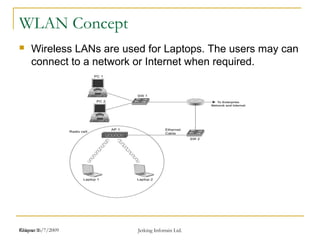
 Wireless LANs are used for Laptops. The users may can
connect to a network or Internet when required.
Release 16/7/2009 Jetking Infotrain Ltd.Chapter 1
Modes of 802.11 Wireless LANs
 WLANs use the following modes for
communication.
 Ad hoc mode
 Infrastructure mode
Release 16/7/2009 Jetking Infotrain Ltd.Chapter 1
Ad hoc Mode
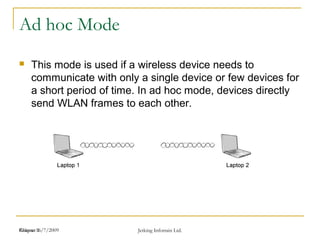
 This mode is used if a wireless device needs to
communicate with only a single device or few devices for
a short period of time. In ad hoc mode, devices directly
send WLAN frames to each other.
Release 16/7/2009 Jetking Infotrain Ltd.Chapter 1
Infrastructure mode
 This mode is used if a wireless device needs to
communicate over the entire network.
 The Infrastructure mode supports the following two types
of service sets:
 Basic Service Set (BSS)
 Extended Service Set (ESS)
Release 16/7/2009 Jetking Infotrain Ltd.Chapter 1
Wireless Encoding
 When an AP or a WLAN NIC transmits data, it modulates
the amplitude, phase and frequency of the signal to
encode the data into binary 0 or 1. The classes that can
be used to encode the data are as follows:
 Frequency Hopping Spread Spectrum (FHSS)
 Direct Sequence Spread Spectrum (DSSS)
 Orthogonal Division Multiplexing (OFDM)
Release 16/7/2009 Jetking Infotrain Ltd.Chapter 1
Coverage Area, Speed and Capacity of
WLANs
 The coverage area of a WLAN is the space in which
WLAN devices communicate successfully. The AP
creates a coverage area for the WLAN depending on the
following factors:
 Power transmitted by AP
 Materials and their locations
 Antennas
 Other factors
Release 16/7/2009 Jetking Infotrain Ltd.Chapter 1
Wireless LAN Security
 WLAN have some unique security requirements because
of the vulnerabilities introduced by WLAN which do not
exist in Ethernet LANs.
 The following are WLAN security standards:
 Wired Equivalence Privacy (WEP)
 SSID Cloaking and MAC Filtering
 Cisco Interim Solution between WEP and 802.11i
 Wi-Fi Protected Access (WPA)
 IEEE 802.11i (WPA-2)
Release 16/7/2009 Jetking Infotrain Ltd.Chapter 1
Configuring APs
 APs are installed and connected to high-speed Internet at
home.
 The following parameters are used for configuring
customer-grade and enterprise-grade APs:
 IEEE standard
 Wireless channel
 Service Set Identifier
 Transmit power
Release 16/7/2009 Jetking Infotrain Ltd.Chapter 1
Cisco's Unified Wireless Solution - I
 Organizations today implement the following wireless
solutions:
 Mesh Architecture - In this architecture each node
which is an access point is connected to another node
to transmit data between the nodes. Cisco's mesh
networks use the devices such as:
 Root Access Point (RAP)
 Mesh Access Point (MAP)
Release 16/7/2009 Jetking Infotrain Ltd.Chapter 1
Cisco's Unified Wireless Solution - II
 Lightweight Access Point protocol (LWAPP) - It is used to
communicate with WLAN systems designed by IETF.
 Adaptive Wireless Path Protocol (AWPP)- It is a new
wireless LAN protocol developed by Cisco. Even when
the best path is established, AWPP continues to run in
the background to establish alternative path ready in RAP
so that it can use when the established link fails.
Release 16/7/2009 Jetking Infotrain Ltd.Chapter 1
Summary - I
 WLAN uses wireless connection to connect mobile users
to a LAN.
 WLAN uses a device called AP (Access Point) for the
data transmission.
 IEEE has defined four major WLAN standards, namely
802.11, 802.11a, 802.11b, and 802.11g.
 WLANs use one of the two modes namely ad hoc or
Infrastructure modes.
 Ad hoc mode sends the frames directly between the
devices, whereas the Infrastructure mode uses the AP
(Access point) for frame transmission.
Release 16/7/2009 Jetking Infotrain Ltd.Chapter 1
Summary - II
 Infrastructure mode uses two type of service set namely
Basic Service Set (BSS) and Extended Service Set
(ESS).
 WLAN uses the following three general classes to
encode the data:
 Frequency Hopping Spread Spectrum (FHSS)
 Direct Sequence Spread Spectrum (DSSS)
 Orthogonal Frequency Division Multiplexing (OFDM)
Release 16/7/2009 Jetking Infotrain Ltd.Chapter 1
Summary - III
 You can measure the WLAN signals easily in
comparison to other undesired signals in the same
space using Signal-to-Noise Ratio (SNR). For sending
data successfully through WLAN, the SNR must be high.
 A device which is near to the AP will pass the data at
higher speed. The device which is at the edge of the
coverage area will transmit the data at lower speed.
Release 16/7/2009 Jetking Infotrain Ltd.Chapter 1
Summary - IV
 The AP creates a coverage area for the WLAN
depending on the following factors
 Power transmitted by AP
 Materials and their locations
 Antennas
 WLAN can have the following threats which are
suggested by Cisco authority:
 War drivers
 Hackers
 Employees
 Rogue AP
Release 16/7/2009 Jetking Infotrain Ltd.Chapter 1
Summary-V
 WLAN uses the following three types of tools to reduce
the attacks:
 Mutual Authentication
 Encryption
 Intrusion Tools
 WEP is the original 802.11 security standard that
provides the authentication and encryption services.

CCNA CHAPTER 17 BY jetarvind kumar madhukar

  • 1.
    Release 16/7/2009 JetkingInfotrain Ltd. Wireless LANs Chapter 17
  • 2.
    Release 16/7/2009 JetkingInfotrain Ltd.Chapter 1 Chapter Objectives  Explain Wireless LAN concept  Explain Wireless LAN security  Deploy WLANs
  • 3.
    Release 16/7/2009 JetkingInfotrain Ltd.Chapter 1 Recall - I  IPv6 supports the features of the security protocol, provides a way to change addresses that are assigned to the hosts, provides globally unicast addressing removes the need for NAT/PAT. In addition, it has many tools to help with the transition from IPv4 to IPv6.  You can abbreviate the IPv6 address by neglecting the leading 0's in every block or putting (::) in place of continuous hex 0s.
  • 4.
    Release 16/7/2009 JetkingInfotrain Ltd.Chapter 1 Recall - II  A prefix includes some value followed by a slash and a prefix length.  In the RS/RA process, the host sends an IPv6 RS multicast message to all the routers to identify the IPv6 prefix used on the subnet and IPv6 address of the default router on the subnet. The router replies by sending RA message.
  • 5.
    Release 16/7/2009 JetkingInfotrain Ltd.Chapter 1 WLAN Concept  Wireless LANs are used for Laptops. The users may can connect to a network or Internet when required.
  • 6.
    Release 16/7/2009 JetkingInfotrain Ltd.Chapter 1 Modes of 802.11 Wireless LANs  WLANs use the following modes for communication.  Ad hoc mode  Infrastructure mode
  • 7.
    Release 16/7/2009 JetkingInfotrain Ltd.Chapter 1 Ad hoc Mode  This mode is used if a wireless device needs to communicate with only a single device or few devices for a short period of time. In ad hoc mode, devices directly send WLAN frames to each other.
  • 8.
    Release 16/7/2009 JetkingInfotrain Ltd.Chapter 1 Infrastructure mode  This mode is used if a wireless device needs to communicate over the entire network.  The Infrastructure mode supports the following two types of service sets:  Basic Service Set (BSS)  Extended Service Set (ESS)
  • 9.
    Release 16/7/2009 JetkingInfotrain Ltd.Chapter 1 Wireless Encoding  When an AP or a WLAN NIC transmits data, it modulates the amplitude, phase and frequency of the signal to encode the data into binary 0 or 1. The classes that can be used to encode the data are as follows:  Frequency Hopping Spread Spectrum (FHSS)  Direct Sequence Spread Spectrum (DSSS)  Orthogonal Division Multiplexing (OFDM)
  • 10.
    Release 16/7/2009 JetkingInfotrain Ltd.Chapter 1 Coverage Area, Speed and Capacity of WLANs  The coverage area of a WLAN is the space in which WLAN devices communicate successfully. The AP creates a coverage area for the WLAN depending on the following factors:  Power transmitted by AP  Materials and their locations  Antennas  Other factors
  • 11.
    Release 16/7/2009 JetkingInfotrain Ltd.Chapter 1 Wireless LAN Security  WLAN have some unique security requirements because of the vulnerabilities introduced by WLAN which do not exist in Ethernet LANs.  The following are WLAN security standards:  Wired Equivalence Privacy (WEP)  SSID Cloaking and MAC Filtering  Cisco Interim Solution between WEP and 802.11i  Wi-Fi Protected Access (WPA)  IEEE 802.11i (WPA-2)
  • 12.
    Release 16/7/2009 JetkingInfotrain Ltd.Chapter 1 Configuring APs  APs are installed and connected to high-speed Internet at home.  The following parameters are used for configuring customer-grade and enterprise-grade APs:  IEEE standard  Wireless channel  Service Set Identifier  Transmit power
  • 13.
    Release 16/7/2009 JetkingInfotrain Ltd.Chapter 1 Cisco's Unified Wireless Solution - I  Organizations today implement the following wireless solutions:  Mesh Architecture - In this architecture each node which is an access point is connected to another node to transmit data between the nodes. Cisco's mesh networks use the devices such as:  Root Access Point (RAP)  Mesh Access Point (MAP)
  • 14.
    Release 16/7/2009 JetkingInfotrain Ltd.Chapter 1 Cisco's Unified Wireless Solution - II  Lightweight Access Point protocol (LWAPP) - It is used to communicate with WLAN systems designed by IETF.  Adaptive Wireless Path Protocol (AWPP)- It is a new wireless LAN protocol developed by Cisco. Even when the best path is established, AWPP continues to run in the background to establish alternative path ready in RAP so that it can use when the established link fails.
  • 15.
    Release 16/7/2009 JetkingInfotrain Ltd.Chapter 1 Summary - I  WLAN uses wireless connection to connect mobile users to a LAN.  WLAN uses a device called AP (Access Point) for the data transmission.  IEEE has defined four major WLAN standards, namely 802.11, 802.11a, 802.11b, and 802.11g.  WLANs use one of the two modes namely ad hoc or Infrastructure modes.  Ad hoc mode sends the frames directly between the devices, whereas the Infrastructure mode uses the AP (Access point) for frame transmission.
  • 16.
    Release 16/7/2009 JetkingInfotrain Ltd.Chapter 1 Summary - II  Infrastructure mode uses two type of service set namely Basic Service Set (BSS) and Extended Service Set (ESS).  WLAN uses the following three general classes to encode the data:  Frequency Hopping Spread Spectrum (FHSS)  Direct Sequence Spread Spectrum (DSSS)  Orthogonal Frequency Division Multiplexing (OFDM)
  • 17.
    Release 16/7/2009 JetkingInfotrain Ltd.Chapter 1 Summary - III  You can measure the WLAN signals easily in comparison to other undesired signals in the same space using Signal-to-Noise Ratio (SNR). For sending data successfully through WLAN, the SNR must be high.  A device which is near to the AP will pass the data at higher speed. The device which is at the edge of the coverage area will transmit the data at lower speed.
  • 18.
    Release 16/7/2009 JetkingInfotrain Ltd.Chapter 1 Summary - IV  The AP creates a coverage area for the WLAN depending on the following factors  Power transmitted by AP  Materials and their locations  Antennas  WLAN can have the following threats which are suggested by Cisco authority:  War drivers  Hackers  Employees  Rogue AP
  • 19.
    Release 16/7/2009 JetkingInfotrain Ltd.Chapter 1 Summary-V  WLAN uses the following three types of tools to reduce the attacks:  Mutual Authentication  Encryption  Intrusion Tools  WEP is the original 802.11 security standard that provides the authentication and encryption services.