IEEE 802.11
Wireless LAN
Standard
Chapter 14
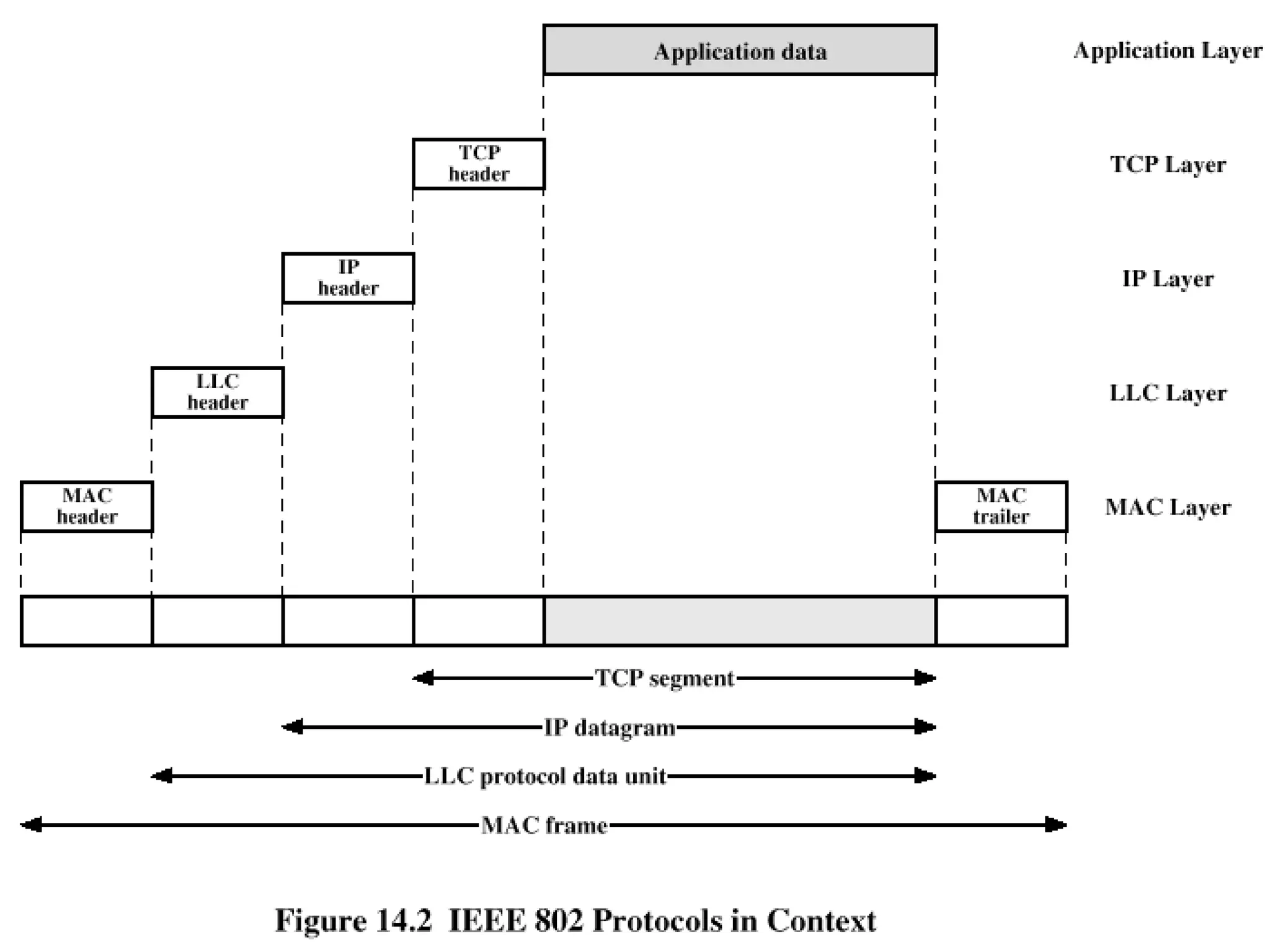
IEEE 802 Protocol Layers
Protocol Architecture
 Functions of physical layer:
 Encoding/decoding of signals
 Preamble generation/removal (for synchronization)
 Bit transmission/reception
 Includes specification of the transmission medium
Protocol Architecture
 Functions of medium access control (MAC)
layer:
 On transmission, assemble data into a frame with
address and error detection fields
 On reception, disassemble frame and perform
address recognition and error detection
 Govern access to the LAN transmission medium
 Functions of logical link control (LLC) Layer:
 Provide an interface to higher layers and perform
flow and error control
Separation of LLC and MAC
 The logic required to manage access to a shared-access
medium not found in traditional layer 2 data link control
 For the same LLC, several MAC options may be provided
MAC Frame Format
 MAC control
 Contains Mac protocol information
 Destination MAC address
 Destination physical attachment point
 Source MAC address
 Source physical attachment point
 CRC
 Cyclic redundancy check
Logical Link Control
 Characteristics of LLC not shared by other control protocols:
 Must support multiaccess, shared-medium nature of the link
 Relieved of some details of link access by MAC layer
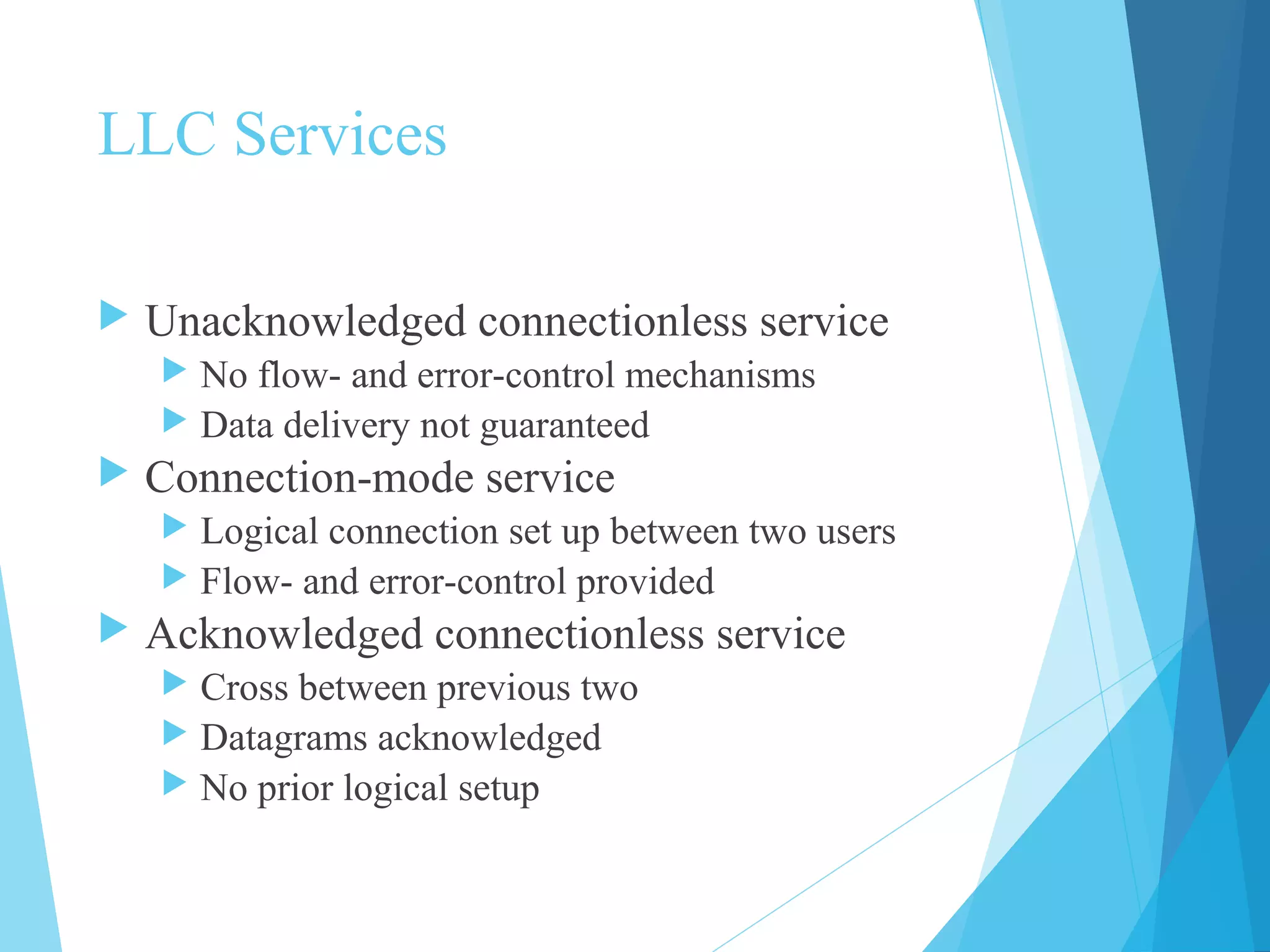
LLC Services
 Unacknowledged connectionless service
 No flow- and error-control mechanisms
 Data delivery not guaranteed
 Connection-mode service
 Logical connection set up between two users
 Flow- and error-control provided
 Acknowledged connectionless service
 Cross between previous two
 Datagrams acknowledged
 No prior logical setup
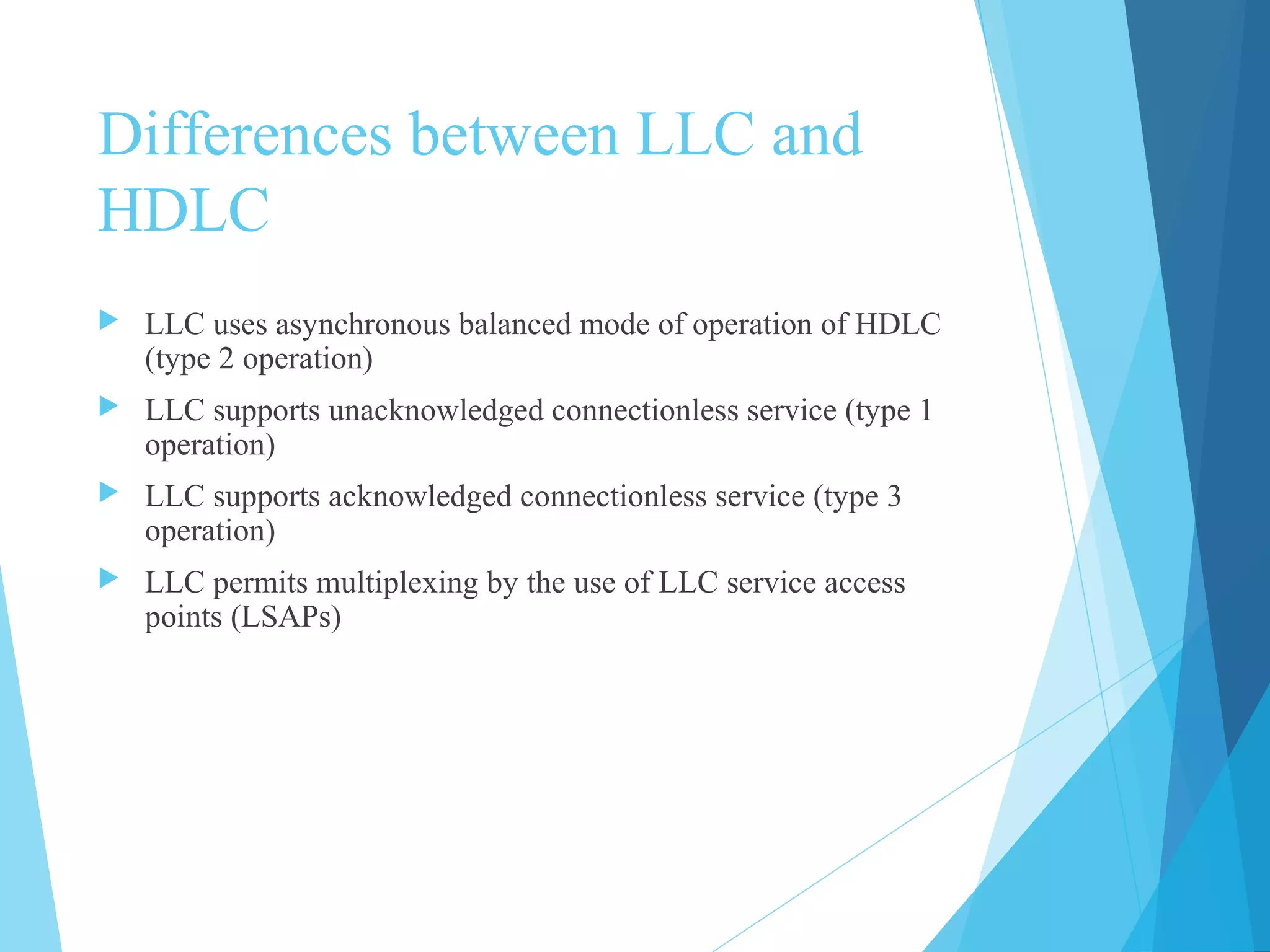
Differences between LLC and
HDLC
 LLC uses asynchronous balanced mode of operation of HDLC
(type 2 operation)
 LLC supports unacknowledged connectionless service (type 1
operation)
 LLC supports acknowledged connectionless service (type 3
operation)
 LLC permits multiplexing by the use of LLC service access
points (LSAPs)
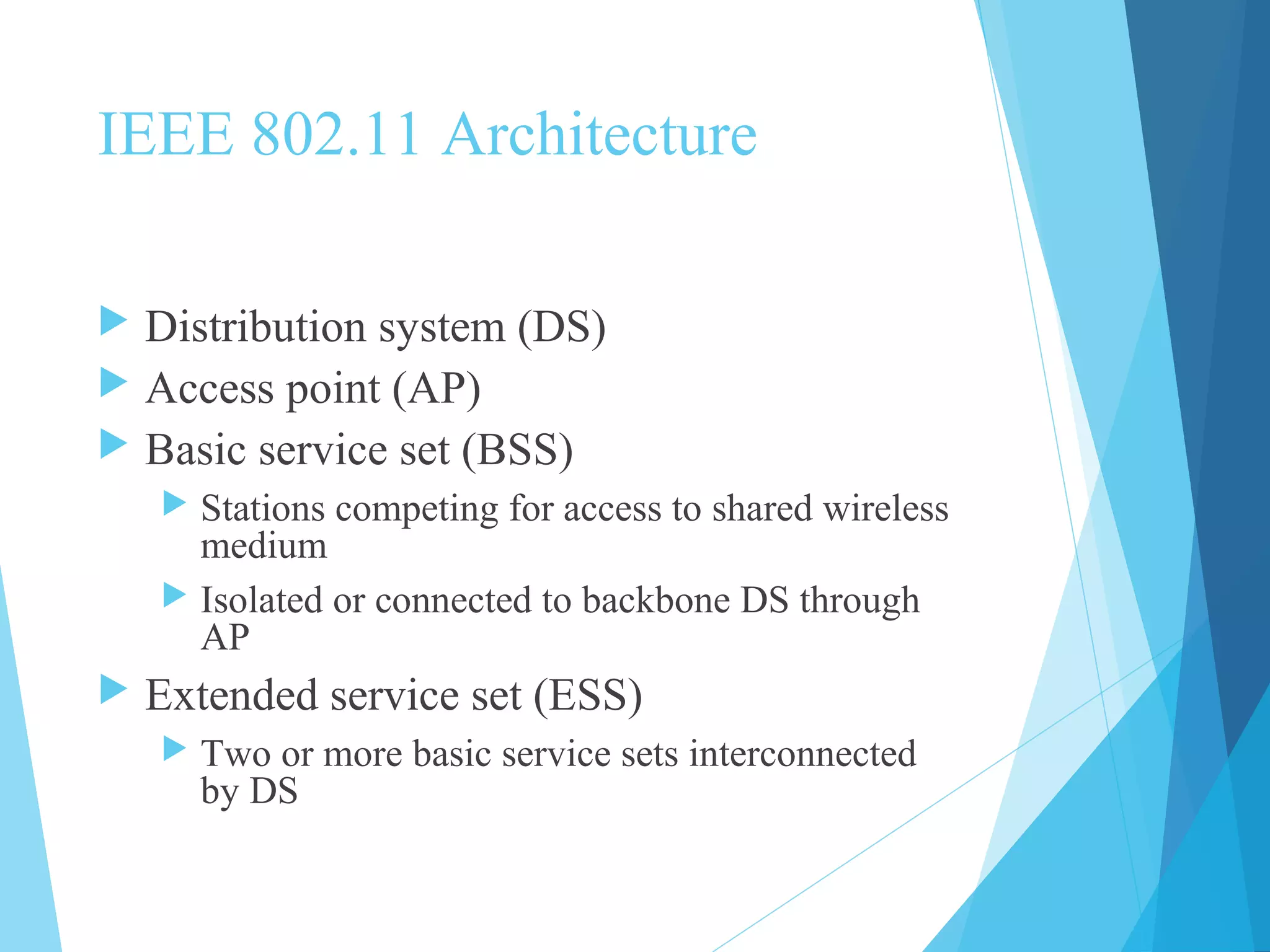
IEEE 802.11 Architecture
 Distribution system (DS)
 Access point (AP)
 Basic service set (BSS)
 Stations competing for access to shared wireless
medium
 Isolated or connected to backbone DS through
AP
 Extended service set (ESS)
 Two or more basic service sets interconnected
by DS
IEEE 802.11 Services
Distribution of Messages Within
a DS
 Distribution service
 Used to exchange MAC frames from station in one BSS to station
in another BSS
 Integration service
 Transfer of data between station on IEEE 802.11 LAN and station
on integrated IEEE 802.x LAN
Transition Types Based On
Mobility
 No transition
 Stationary or moves only within BSS
 BSS transition
 Station moving from one BSS to another BSS in same ESS
 ESS transition
 Station moving from BSS in one ESS to BSS within another ESS
Association-Related Services
 Association
 Establishes initial association between station
and AP
 Reassociation
 Enables transfer of association from one AP to
another, allowing station to move from one BSS
to another
 Disassociation
 Association termination notice from station or
AP
Access and Privacy Services
 Authentication
 Establishes identity of stations to each other
 Deathentication
 Invoked when existing authentication is terminated
 Privacy
 Prevents message contents from being read by unintended
recipient
IEEE 802.11 Medium Access
Control
 MAC layer covers three functional areas:
 Reliable data delivery
 Access control
 Security
Reliable Data Delivery
 More efficient to deal with errors at the MAC
level than higher layer (such as TCP)
 Frame exchange protocol
 Source station transmits data
 Destination responds with acknowledgment (ACK)
 If source doesn’t receive ACK, it retransmits frame
 Four frame exchange
 Source issues request to send (RTS)
 Destination responds with clear to send (CTS)
 Source transmits data
 Destination responds with ACK
Access Control
Medium Access Control Logic
Interframe Space (IFS) Values
 Short IFS (SIFS)
 Shortest IFS
 Used for immediate response actions
 Point coordination function IFS (PIFS)
 Midlength IFS
 Used by centralized controller in PCF scheme when
using polls
 Distributed coordination function IFS (DIFS)
 Longest IFS
 Used as minimum delay of asynchronous frames
contending for access
IFS Usage
 SIFS
 Acknowledgment (ACK)
 Clear to send (CTS)
 Poll response
 PIFS
 Used by centralized controller in issuing
polls
 Takes precedence over normal contention
traffic
 DIFS
MAC Frame Format
MAC Frame Fields
 Frame Control – frame type, control
information
 Duration/connection ID – channel
allocation time
 Addresses – context dependant, types
include source and destination
 Sequence control – numbering and
reassembly
 Frame body – MSDU or fragment of
Frame Control Fields
 Protocol version – 802.11 version
 Type – control, management, or data
 Subtype – identifies function of frame
 To DS – 1 if destined for DS
 From DS – 1 if leaving DS
 More fragments – 1 if fragments follow
 Retry – 1 if retransmission of previous
frame
Frame Control Fields
 Power management – 1 if transmitting
station is in sleep mode
 More data – Indicates that station has
more data to send
 WEP – 1 if wired equivalent protocol is
implemented
 Order – 1 if any data frame is sent using
the Strictly Ordered service
Control Frame Subtypes
 Power save – poll (PS-Poll)
 Request to send (RTS)
 Clear to send (CTS)
 Acknowledgment
 Contention-free (CF)-end
 CF-end + CF-ack
Data Frame Subtypes
 Data-carrying frames
 Data
 Data + CF-Ack
 Data + CF-Poll
 Data + CF-Ack + CF-Poll
 Other subtypes (don’t carry user data)
 Null Function
 CF-Ack
 CF-Poll
 CF-Ack + CF-Poll
Management Frame Subtypes
 Association request
 Association response
 Reassociation request
 Reassociation response
 Probe request
 Probe response
 Beacon
Management Frame Subtypes
 Announcement traffic indication message
 Dissociation
 Authentication
 Deauthentication
Wired Equivalent Privacy
Authentication
 Open system authentication
 Exchange of identities, no security benefits
 Shared Key authentication
 Shared Key assures authentication
Physical Media Defined by
Original 802.11 Standard
 Direct-sequence spread spectrum
 Operating in 2.4 GHz ISM band
 Data rates of 1 and 2 Mbps
 Frequency-hopping spread spectrum
 Operating in 2.4 GHz ISM band
 Data rates of 1 and 2 Mbps
 Infrared
 1 and 2 Mbps
 Wavelength between 850 and 950 nm
IEEE 802.11a and IEEE 802.11b
 IEEE 802.11a
 Makes use of 5-GHz band
 Provides rates of 6, 9 , 12, 18, 24, 36, 48, 54
Mbps
 Uses orthogonal frequency division
multiplexing (OFDM)
 Subcarrier modulated using BPSK, QPSK,
16-QAM or 64-QAM
 IEEE 802.11b
 Provides data rates of 5.5 and 11 Mbps
 Complementary code keying (CCK)

Chapter#14

  • 1.
  • 2.
  • 3.
    Protocol Architecture  Functionsof physical layer:  Encoding/decoding of signals  Preamble generation/removal (for synchronization)  Bit transmission/reception  Includes specification of the transmission medium
  • 4.
    Protocol Architecture  Functionsof medium access control (MAC) layer:  On transmission, assemble data into a frame with address and error detection fields  On reception, disassemble frame and perform address recognition and error detection  Govern access to the LAN transmission medium  Functions of logical link control (LLC) Layer:  Provide an interface to higher layers and perform flow and error control
  • 5.
    Separation of LLCand MAC  The logic required to manage access to a shared-access medium not found in traditional layer 2 data link control  For the same LLC, several MAC options may be provided
  • 6.
    MAC Frame Format MAC control  Contains Mac protocol information  Destination MAC address  Destination physical attachment point  Source MAC address  Source physical attachment point  CRC  Cyclic redundancy check
  • 7.
    Logical Link Control Characteristics of LLC not shared by other control protocols:  Must support multiaccess, shared-medium nature of the link  Relieved of some details of link access by MAC layer
  • 8.
    LLC Services  Unacknowledgedconnectionless service  No flow- and error-control mechanisms  Data delivery not guaranteed  Connection-mode service  Logical connection set up between two users  Flow- and error-control provided  Acknowledged connectionless service  Cross between previous two  Datagrams acknowledged  No prior logical setup
  • 9.
    Differences between LLCand HDLC  LLC uses asynchronous balanced mode of operation of HDLC (type 2 operation)  LLC supports unacknowledged connectionless service (type 1 operation)  LLC supports acknowledged connectionless service (type 3 operation)  LLC permits multiplexing by the use of LLC service access points (LSAPs)
  • 10.
    IEEE 802.11 Architecture Distribution system (DS)  Access point (AP)  Basic service set (BSS)  Stations competing for access to shared wireless medium  Isolated or connected to backbone DS through AP  Extended service set (ESS)  Two or more basic service sets interconnected by DS
  • 11.
  • 12.
    Distribution of MessagesWithin a DS  Distribution service  Used to exchange MAC frames from station in one BSS to station in another BSS  Integration service  Transfer of data between station on IEEE 802.11 LAN and station on integrated IEEE 802.x LAN
  • 13.
    Transition Types BasedOn Mobility  No transition  Stationary or moves only within BSS  BSS transition  Station moving from one BSS to another BSS in same ESS  ESS transition  Station moving from BSS in one ESS to BSS within another ESS
  • 14.
    Association-Related Services  Association Establishes initial association between station and AP  Reassociation  Enables transfer of association from one AP to another, allowing station to move from one BSS to another  Disassociation  Association termination notice from station or AP
  • 15.
    Access and PrivacyServices  Authentication  Establishes identity of stations to each other  Deathentication  Invoked when existing authentication is terminated  Privacy  Prevents message contents from being read by unintended recipient
  • 16.
    IEEE 802.11 MediumAccess Control  MAC layer covers three functional areas:  Reliable data delivery  Access control  Security
  • 17.
    Reliable Data Delivery More efficient to deal with errors at the MAC level than higher layer (such as TCP)  Frame exchange protocol  Source station transmits data  Destination responds with acknowledgment (ACK)  If source doesn’t receive ACK, it retransmits frame  Four frame exchange  Source issues request to send (RTS)  Destination responds with clear to send (CTS)  Source transmits data  Destination responds with ACK
  • 18.
  • 19.
  • 20.
    Interframe Space (IFS)Values  Short IFS (SIFS)  Shortest IFS  Used for immediate response actions  Point coordination function IFS (PIFS)  Midlength IFS  Used by centralized controller in PCF scheme when using polls  Distributed coordination function IFS (DIFS)  Longest IFS  Used as minimum delay of asynchronous frames contending for access
  • 21.
    IFS Usage  SIFS Acknowledgment (ACK)  Clear to send (CTS)  Poll response  PIFS  Used by centralized controller in issuing polls  Takes precedence over normal contention traffic  DIFS
  • 22.
  • 23.
    MAC Frame Fields Frame Control – frame type, control information  Duration/connection ID – channel allocation time  Addresses – context dependant, types include source and destination  Sequence control – numbering and reassembly  Frame body – MSDU or fragment of
  • 24.
    Frame Control Fields Protocol version – 802.11 version  Type – control, management, or data  Subtype – identifies function of frame  To DS – 1 if destined for DS  From DS – 1 if leaving DS  More fragments – 1 if fragments follow  Retry – 1 if retransmission of previous frame
  • 25.
    Frame Control Fields Power management – 1 if transmitting station is in sleep mode  More data – Indicates that station has more data to send  WEP – 1 if wired equivalent protocol is implemented  Order – 1 if any data frame is sent using the Strictly Ordered service
  • 26.
    Control Frame Subtypes Power save – poll (PS-Poll)  Request to send (RTS)  Clear to send (CTS)  Acknowledgment  Contention-free (CF)-end  CF-end + CF-ack
  • 27.
    Data Frame Subtypes Data-carrying frames  Data  Data + CF-Ack  Data + CF-Poll  Data + CF-Ack + CF-Poll  Other subtypes (don’t carry user data)  Null Function  CF-Ack  CF-Poll  CF-Ack + CF-Poll
  • 28.
    Management Frame Subtypes Association request  Association response  Reassociation request  Reassociation response  Probe request  Probe response  Beacon
  • 29.
    Management Frame Subtypes Announcement traffic indication message  Dissociation  Authentication  Deauthentication
  • 30.
  • 31.
    Authentication  Open systemauthentication  Exchange of identities, no security benefits  Shared Key authentication  Shared Key assures authentication
  • 32.
    Physical Media Definedby Original 802.11 Standard  Direct-sequence spread spectrum  Operating in 2.4 GHz ISM band  Data rates of 1 and 2 Mbps  Frequency-hopping spread spectrum  Operating in 2.4 GHz ISM band  Data rates of 1 and 2 Mbps  Infrared  1 and 2 Mbps  Wavelength between 850 and 950 nm
  • 33.
    IEEE 802.11a andIEEE 802.11b  IEEE 802.11a  Makes use of 5-GHz band  Provides rates of 6, 9 , 12, 18, 24, 36, 48, 54 Mbps  Uses orthogonal frequency division multiplexing (OFDM)  Subcarrier modulated using BPSK, QPSK, 16-QAM or 64-QAM  IEEE 802.11b  Provides data rates of 5.5 and 11 Mbps  Complementary code keying (CCK)