IEEE 802.11ah
TOPIC
1 IEEE 802.11ah
is the WLAN standard
operating under sub 1GHz
frequency range (about 900MHz). It
is designed to extend range of
existing 11ac wifi network
operating in 2.4/5GHz as well as to
utilize the emerging opportunities
in IoT(Internet of Things) space.
It will also be used for
home automation, smart grid,
low power sensors and
wearable consumer electronic
devices.
supports completely new
PHY(Physical) layer and
MAC(Medium Access Control)
layer. These have been described
below. Following table-1 mentions
802.11ah frequencies supported in
different parts of the world.
It supports various bandwidths
viz. 1MHz, 2MHz, 4MHz, 8MHz and 16MHz.
Hence it is considered to be 10 times
downclocked version of IEEE 802.11ac
standard. Like other wifi network, 802.11ah
network also consists of 11ah AP(Access
Point) and 11ah compliant devices such as
water meter, power meter, Gas meter as
well as systems compliant to IEEE
802.11ah protocol stack.
It has higher
frequency range.
The IEEE 802.11 is
easy to installation.
The IEEE 802.11 has
reduced wiring
expense.
Simultaneously use of
equipment. It use also
unlicensed part of the
radio spectrum.
1 There are some important advantages of IEEE 802.11 are given below,
It is less cost
effective
It has efficient coding
technique..
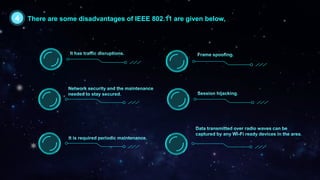
4 There are some disadvantages of IEEE 802.11 are given below,
1 IEEE 802.11ah sub GHz Wi-Fi basics
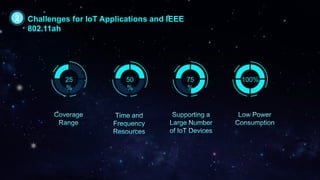
2 Challenges for IoT Applications and IEEE
802.11ah
In IEEE 802.11ah, the
extended range requirement is
fulfilled by introducing 1 MHz wide
transmission and by using a new
Modulation and Coding Scheme
(MCS) index (MCS10).
3 COVERAGE RANGE
The IEEE 802.11ah amendment is
intended to operate below 1 GHz which,
besides improved coverage, faces less
interference. This characteristic of the
IEEE 802.11ah appears particularly
attractive for IoT applications, where
hundreds or thousands of devices are
expected to coexist.
3 TIME AND FREQUENCY RESOURCES
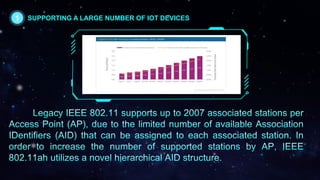
1 SUPPORTING A LARGE NUMBER OF IOT DEVICES
1 LOW POWER CONSUMING
2 MAC LAYER
In 802.11 system, an AP allocates an identifier called Association
IDentifier (AID), to each station during the association stage [15]. In a given
network, AID is a unique ID, through which the AP can indicate its associated
stations. The possible number of associated stations of an AP is up to 2,007 in
legacy 802.11 standard due to the limited length of the partial virtual bitmap of
Traffic Indication Map (TIM) Information Element (IE), where each bit indicates
the corresponding station’s AID.
4
with power saving mode, a station alternates between
awake state and doze state, where the station in doze state turns
off the radio components such that it cannot sense incoming
signals at all. When there are packets destined to a station in doze
state, the AP buffers the packets until the station wakes up and
requests the delivery of the buffered traffic.
4 POWER SAVING
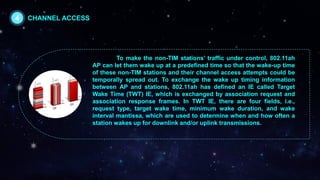
To make the non-TIM stations’ traffic under control, 802.11ah
AP can let them wake up at a predefined time so that the wake-up time
of these non-TIM stations and their channel access attempts could be
temporally spread out. To exchange the wake up timing information
between AP and stations, 802.11ah has defined an IE called Target
Wake Time (TWT) IE, which is exchanged by association request and
association response frames. In TWT IE, there are four fields, i.e.,
request type, target wake time, minimum wake duration, and wake
interval mantissa, which are used to determine when and how often a
station wakes up for downlink and/or uplink transmissions.
4 CHANNEL ACCESS
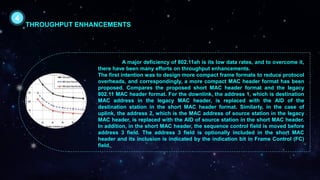
A major deficiency of 802.11ah is its low data rates, and to overcome it,
there have been many efforts on throughput enhancements.
The first intention was to design more compact frame formats to reduce protocol
overheads, and correspondingly, a more compact MAC header format has been
proposed. Compares the proposed short MAC header format and the legacy
802.11 MAC header format. For the downlink, the address 1, which is destination
MAC address in the legacy MAC header, is replaced with the AID of the
destination station in the short MAC header format. Similarly, in the case of
uplink, the address 2, which is the MAC address of source station in the legacy
MAC header, is replaced with the AID of source station in the short MAC header.
In addition, in the short MAC header, the sequence control field is moved before
address 3 field. The address 3 field is optionally included in the short MAC
header and its inclusion is indicated by the indication bit in Frame Control (FC)
field.
4
THROUGHPUT ENHANCEMENTS
3 Comparative Analysis of IEEE 802.11ah with Previous IEEE 802.11
Amendments
3 Comparative Analysis of IEEE 802.11ah with Previous
IEEE 802.11 Amendments
2 IOT APPLICATION
2 CONCLUSION
THANK YOU
MEMBERS:
ABLETES, CHARLES CHILLE
AGUSTIN, ELOISA MARIE
CURAMMENG, ALONA JANE
GALVAN, CYRUS KIM
MACAYSA, CZYRYL ANNE
PAGTACCUNAN, ROSHIELA MAE
IEEE 80211 ah

IEEE 80211 ah

  • 1.
  • 2.
    1 IEEE 802.11ah isthe WLAN standard operating under sub 1GHz frequency range (about 900MHz). It is designed to extend range of existing 11ac wifi network operating in 2.4/5GHz as well as to utilize the emerging opportunities in IoT(Internet of Things) space. It will also be used for home automation, smart grid, low power sensors and wearable consumer electronic devices. supports completely new PHY(Physical) layer and MAC(Medium Access Control) layer. These have been described below. Following table-1 mentions 802.11ah frequencies supported in different parts of the world. It supports various bandwidths viz. 1MHz, 2MHz, 4MHz, 8MHz and 16MHz. Hence it is considered to be 10 times downclocked version of IEEE 802.11ac standard. Like other wifi network, 802.11ah network also consists of 11ah AP(Access Point) and 11ah compliant devices such as water meter, power meter, Gas meter as well as systems compliant to IEEE 802.11ah protocol stack.
  • 3.
    It has higher frequencyrange. The IEEE 802.11 is easy to installation. The IEEE 802.11 has reduced wiring expense. Simultaneously use of equipment. It use also unlicensed part of the radio spectrum. 1 There are some important advantages of IEEE 802.11 are given below, It is less cost effective It has efficient coding technique..
  • 4.
    4 There aresome disadvantages of IEEE 802.11 are given below,
  • 5.
    1 IEEE 802.11ahsub GHz Wi-Fi basics
  • 6.
    2 Challenges forIoT Applications and IEEE 802.11ah
  • 7.
    In IEEE 802.11ah,the extended range requirement is fulfilled by introducing 1 MHz wide transmission and by using a new Modulation and Coding Scheme (MCS) index (MCS10). 3 COVERAGE RANGE
  • 8.
    The IEEE 802.11ahamendment is intended to operate below 1 GHz which, besides improved coverage, faces less interference. This characteristic of the IEEE 802.11ah appears particularly attractive for IoT applications, where hundreds or thousands of devices are expected to coexist. 3 TIME AND FREQUENCY RESOURCES
  • 9.
    1 SUPPORTING ALARGE NUMBER OF IOT DEVICES
  • 10.
    1 LOW POWERCONSUMING
  • 11.
  • 12.
    In 802.11 system,an AP allocates an identifier called Association IDentifier (AID), to each station during the association stage [15]. In a given network, AID is a unique ID, through which the AP can indicate its associated stations. The possible number of associated stations of an AP is up to 2,007 in legacy 802.11 standard due to the limited length of the partial virtual bitmap of Traffic Indication Map (TIM) Information Element (IE), where each bit indicates the corresponding station’s AID. 4
  • 13.
    with power savingmode, a station alternates between awake state and doze state, where the station in doze state turns off the radio components such that it cannot sense incoming signals at all. When there are packets destined to a station in doze state, the AP buffers the packets until the station wakes up and requests the delivery of the buffered traffic. 4 POWER SAVING
  • 14.
    To make thenon-TIM stations’ traffic under control, 802.11ah AP can let them wake up at a predefined time so that the wake-up time of these non-TIM stations and their channel access attempts could be temporally spread out. To exchange the wake up timing information between AP and stations, 802.11ah has defined an IE called Target Wake Time (TWT) IE, which is exchanged by association request and association response frames. In TWT IE, there are four fields, i.e., request type, target wake time, minimum wake duration, and wake interval mantissa, which are used to determine when and how often a station wakes up for downlink and/or uplink transmissions. 4 CHANNEL ACCESS
  • 15.
    A major deficiencyof 802.11ah is its low data rates, and to overcome it, there have been many efforts on throughput enhancements. The first intention was to design more compact frame formats to reduce protocol overheads, and correspondingly, a more compact MAC header format has been proposed. Compares the proposed short MAC header format and the legacy 802.11 MAC header format. For the downlink, the address 1, which is destination MAC address in the legacy MAC header, is replaced with the AID of the destination station in the short MAC header format. Similarly, in the case of uplink, the address 2, which is the MAC address of source station in the legacy MAC header, is replaced with the AID of source station in the short MAC header. In addition, in the short MAC header, the sequence control field is moved before address 3 field. The address 3 field is optionally included in the short MAC header and its inclusion is indicated by the indication bit in Frame Control (FC) field. 4 THROUGHPUT ENHANCEMENTS
  • 16.
    3 Comparative Analysisof IEEE 802.11ah with Previous IEEE 802.11 Amendments
  • 17.
    3 Comparative Analysisof IEEE 802.11ah with Previous IEEE 802.11 Amendments
  • 18.
  • 19.
  • 20.
    THANK YOU MEMBERS: ABLETES, CHARLESCHILLE AGUSTIN, ELOISA MARIE CURAMMENG, ALONA JANE GALVAN, CYRUS KIM MACAYSA, CZYRYL ANNE PAGTACCUNAN, ROSHIELA MAE