Release 16/07/2009 Jetking Infotrain Ltd.
Basic Router Configuration
Chapter 7
Release 16/07/2009 Jetking Infotrain Ltd.
Chapter Objectives
 Explain IGRP
 Explain EIGRP
 Explain OSPF
Release 16/07/2009 Jetking Infotrain Ltd.
Recall - I
 The different metrics used by the routing protocols
include:
 Hops
 Bandwidth
 Load
 cost
 Reliability
 Interior routing protocols include:
 Routing Information Protocol (RIP)
 Open Shortest Path First (OSPF)
 Interior Gateway Routing Protocol (IGRP)
Release 16/07/2009 Jetking Infotrain Ltd.
Recall - II
 Enhanced Interior Gateway Routing Protocol
(EIGRP)
 Intermediate System to Intermediate System (IS –
IS)
 The different RIP timers include:
 Route update timer
 Route invalid timer
 Holddown timer
 Route Flush timer
 Routing tables can be defined as the database that
contains the routing information of the network
Release 16/07/2009 Jetking Infotrain Ltd.
Interior Gateway Routing Protocol
(IGRP)
 IGRP is a distance-vector routing protocol
 The characteristics if IGRP include:
 Uses composite metric
 Supports unequal-cost load balancing
 Supports multipath routing
 Supports holddowns
 Supports split horizons
Release 16/07/2009 Jetking Infotrain Ltd.
Verifying IGRP
 Commands to verify IGRP configurations include:
 show ip route
 show protocols
 show ip protocols
 debug ip rip
 debug ip igrp events
 debug ip igrp transactions
Release 16/07/2009 Jetking Infotrain Ltd.
Debugging IGRP
 The debugging command displays the routing
information and the updates sent and received on
the router
 Commands for debugging IGRP include:
 debug ip igrp events
 debug ip igrp transactions
Release 16/07/2009 Jetking Infotrain Ltd.
Enhanced Interior Gateway Routing
Protocols (EIGRP)
 EIGRP saves all the routes connected to the
neighboring routers
 EIGRP has the qualities of both distance-vector and
link state protocols
 EIGRP is an ideal protocol in the large networks
Release 16/07/2009 Jetking Infotrain Ltd.
Diffusing Update Algorithm (DUAL)
 DUAL helps the router to determine the best route to
the destination using the hop count, bandwidth and
other factors as metrics
 It sends query packets to the neighboring routers to
determine the best path to reach the destination
network
 When a router receives a reply, DUAL calculates the
successor (main route) and the feasible successor
(backup route)
Release 16/07/2009 Jetking Infotrain Ltd.
Route Discovery and Maintenance
 For discovering the routes, the tables used by
EIGRP include:
 Neighbor table
 Topology table
 Route table
 Successors
 Feasible successors
 Unlike the other protocols, EIGRP uses four metrics,
bandwidth, delay, load and reliability to determine
the best path to transmit the packets
Release 16/07/2009 Jetking Infotrain Ltd.
Verifying EIGRP
 Commands to verify EIGRP configurations include:
 show ip route
 show ip route eigrp
 show ip eigrp neighbors
 show ip eigrp topology
Release 16/07/2009 Jetking Infotrain Ltd.
Border Gateway Protocol
 BGP is an Exterior Gateway Protocol used to
exchange the routing information between two or
more Autonomous Systems (AS)
 It uses cost as its metrics
 The hosts that use BGP as their routing protocol,
exchange information with the help of TCP/IP
 It uses the method of Classless Inter-Domain
Routing (CIDR)
Release 16/07/2009 Jetking Infotrain Ltd.
Link State Routing Protocols
 In Link-state routing, the routers while
communicating share the status of the links on the
network
 The protocols send Link State Advertisement (LSA)
that contains routing information and details of the
router that sent the information
 The destination router stores the LSAs in a local
database
 When a change occurs in the database, the router
runs the Shortest Path First (SPF) algorithm
Release 16/07/2009 Jetking Infotrain Ltd.
Open Shortest Path First (OSPF)
 OSPF uses the link-state concept and sends Link
State Advertisements (LSAs) to all the connected
routers
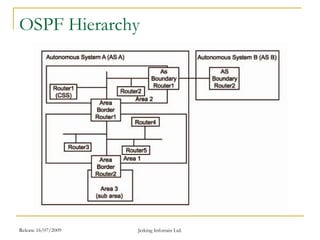
 Entities of the OSPF hierarchy include:
 Autonomous System (AS)
 Areas
 Backbone Area
 Area Border Routers (ABRs)
 Stub Area
 Autonomous System Boundary Router (ASBRs)
Release 16/07/2009 Jetking Infotrain Ltd.
OSPF Hierarchy
Release 16/07/2009 Jetking Infotrain Ltd.
Case Study
The Hyderabad branch of the Blue Diamond Steel
Company has 15 routers connected in the network.
The network uses RIP to route the packets between
the departments. Now the company has decided to
add a team of 20 Software Engineers to design the
new steel plants. The network administrator has
decided to place the engineers on a different network.
This requires the 16th router to be placed in the
network.
Release 16/07/2009 Jetking Infotrain Ltd.
Problem
The other departments cannot exchange the data with
the software engineers
Release 16/07/2009 Jetking Infotrain Ltd.
Solution
The network administrator decided to use OSPF,
which uses bandwidth as its metric to route the
packets and can be used to connect large networks
Release 16/07/2009 Jetking Infotrain Ltd.
Intermediate System to Intermediate
System (IS – IS)
 IS – IS is a link state routing protocol used to carry
IP network information
 The routing in IS – IS is carried out in two levels:
 Level 1 comprises of the routers connected in an
area
 Level 2 comprises of routers connected to the
routers in multiple areas
Release 16/07/2009 Jetking Infotrain Ltd.
Verifying OSPF
 Commands to verify EIGRP configurations include:
 show ip route
 show ip ospf
 show ip ospf database
 show ip ospf interface
 show ip protocols
Release 16/07/2009 Jetking Infotrain Ltd.
Summary - I
 IGRP is a distant-vector routing protocol, which
implies that each router sends all or a part of its
routing table in a routing message update
 The characteristics of IGRP are:
 Uses composite metric
 Supports unequal-cost load balancing
 Supports multipath routing
 Supports holdown
 Supports split horizons
Release 16/07/2009 Jetking Infotrain Ltd.
Summary - II
 The characteristics of EIGRP are:
 Fast convergence
 Link-state protocol
 Less network overhead
 Interoperation with IGRP
 Supports three routed protocols
 Six path load-balancing
 The Open Shortest Path First (OSPF) is a link-state
routing protocol, used to handle routing for Internet
Protocol (IP) traffic
Release 16/07/2009 Jetking Infotrain Ltd.
Summary - III
 The OSPF protocol is designed on the Shortest
Path First (SPF) algorithm, which enables to
determine the shortest route to each destination
 OSPF provides the following advantages:
 Open protocol
 Loop free topology
 Scalable
 Hierarchical design
 Provides multicasting
Release 16/07/2009 Jetking Infotrain Ltd.
Summary - IV
 The OSPF maintains a two-layer hierarchy
consisting of:
 Backbone area
 Off backbone
 The advantage of dividing OSPF into areas are as
follows:
 Conserves router resources
 Concealing information
 Dealing with external routes
Release 16/07/2009 Jetking Infotrain Ltd.
Summary - V
 There are different OSPF area types that help to
handle external routes:
 Normal area
 Stub area
 Totally stubby area
 Not-so-stubby area

CCNA CHAPTER 7 BY jetarvind kumar madhukar

  • 1.
    Release 16/07/2009 JetkingInfotrain Ltd. Basic Router Configuration Chapter 7
  • 2.
    Release 16/07/2009 JetkingInfotrain Ltd. Chapter Objectives  Explain IGRP  Explain EIGRP  Explain OSPF
  • 3.
    Release 16/07/2009 JetkingInfotrain Ltd. Recall - I  The different metrics used by the routing protocols include:  Hops  Bandwidth  Load  cost  Reliability  Interior routing protocols include:  Routing Information Protocol (RIP)  Open Shortest Path First (OSPF)  Interior Gateway Routing Protocol (IGRP)
  • 4.
    Release 16/07/2009 JetkingInfotrain Ltd. Recall - II  Enhanced Interior Gateway Routing Protocol (EIGRP)  Intermediate System to Intermediate System (IS – IS)  The different RIP timers include:  Route update timer  Route invalid timer  Holddown timer  Route Flush timer  Routing tables can be defined as the database that contains the routing information of the network
  • 5.
    Release 16/07/2009 JetkingInfotrain Ltd. Interior Gateway Routing Protocol (IGRP)  IGRP is a distance-vector routing protocol  The characteristics if IGRP include:  Uses composite metric  Supports unequal-cost load balancing  Supports multipath routing  Supports holddowns  Supports split horizons
  • 6.
    Release 16/07/2009 JetkingInfotrain Ltd. Verifying IGRP  Commands to verify IGRP configurations include:  show ip route  show protocols  show ip protocols  debug ip rip  debug ip igrp events  debug ip igrp transactions
  • 7.
    Release 16/07/2009 JetkingInfotrain Ltd. Debugging IGRP  The debugging command displays the routing information and the updates sent and received on the router  Commands for debugging IGRP include:  debug ip igrp events  debug ip igrp transactions
  • 8.
    Release 16/07/2009 JetkingInfotrain Ltd. Enhanced Interior Gateway Routing Protocols (EIGRP)  EIGRP saves all the routes connected to the neighboring routers  EIGRP has the qualities of both distance-vector and link state protocols  EIGRP is an ideal protocol in the large networks
  • 9.
    Release 16/07/2009 JetkingInfotrain Ltd. Diffusing Update Algorithm (DUAL)  DUAL helps the router to determine the best route to the destination using the hop count, bandwidth and other factors as metrics  It sends query packets to the neighboring routers to determine the best path to reach the destination network  When a router receives a reply, DUAL calculates the successor (main route) and the feasible successor (backup route)
  • 10.
    Release 16/07/2009 JetkingInfotrain Ltd. Route Discovery and Maintenance  For discovering the routes, the tables used by EIGRP include:  Neighbor table  Topology table  Route table  Successors  Feasible successors  Unlike the other protocols, EIGRP uses four metrics, bandwidth, delay, load and reliability to determine the best path to transmit the packets
  • 11.
    Release 16/07/2009 JetkingInfotrain Ltd. Verifying EIGRP  Commands to verify EIGRP configurations include:  show ip route  show ip route eigrp  show ip eigrp neighbors  show ip eigrp topology
  • 12.
    Release 16/07/2009 JetkingInfotrain Ltd. Border Gateway Protocol  BGP is an Exterior Gateway Protocol used to exchange the routing information between two or more Autonomous Systems (AS)  It uses cost as its metrics  The hosts that use BGP as their routing protocol, exchange information with the help of TCP/IP  It uses the method of Classless Inter-Domain Routing (CIDR)
  • 13.
    Release 16/07/2009 JetkingInfotrain Ltd. Link State Routing Protocols  In Link-state routing, the routers while communicating share the status of the links on the network  The protocols send Link State Advertisement (LSA) that contains routing information and details of the router that sent the information  The destination router stores the LSAs in a local database  When a change occurs in the database, the router runs the Shortest Path First (SPF) algorithm
  • 14.
    Release 16/07/2009 JetkingInfotrain Ltd. Open Shortest Path First (OSPF)  OSPF uses the link-state concept and sends Link State Advertisements (LSAs) to all the connected routers  Entities of the OSPF hierarchy include:  Autonomous System (AS)  Areas  Backbone Area  Area Border Routers (ABRs)  Stub Area  Autonomous System Boundary Router (ASBRs)
  • 15.
    Release 16/07/2009 JetkingInfotrain Ltd. OSPF Hierarchy
  • 16.
    Release 16/07/2009 JetkingInfotrain Ltd. Case Study The Hyderabad branch of the Blue Diamond Steel Company has 15 routers connected in the network. The network uses RIP to route the packets between the departments. Now the company has decided to add a team of 20 Software Engineers to design the new steel plants. The network administrator has decided to place the engineers on a different network. This requires the 16th router to be placed in the network.
  • 17.
    Release 16/07/2009 JetkingInfotrain Ltd. Problem The other departments cannot exchange the data with the software engineers
  • 18.
    Release 16/07/2009 JetkingInfotrain Ltd. Solution The network administrator decided to use OSPF, which uses bandwidth as its metric to route the packets and can be used to connect large networks
  • 19.
    Release 16/07/2009 JetkingInfotrain Ltd. Intermediate System to Intermediate System (IS – IS)  IS – IS is a link state routing protocol used to carry IP network information  The routing in IS – IS is carried out in two levels:  Level 1 comprises of the routers connected in an area  Level 2 comprises of routers connected to the routers in multiple areas
  • 20.
    Release 16/07/2009 JetkingInfotrain Ltd. Verifying OSPF  Commands to verify EIGRP configurations include:  show ip route  show ip ospf  show ip ospf database  show ip ospf interface  show ip protocols
  • 21.
    Release 16/07/2009 JetkingInfotrain Ltd. Summary - I  IGRP is a distant-vector routing protocol, which implies that each router sends all or a part of its routing table in a routing message update  The characteristics of IGRP are:  Uses composite metric  Supports unequal-cost load balancing  Supports multipath routing  Supports multipath routing  Supports holdown  Supports split horizons
  • 22.
    Release 16/07/2009 JetkingInfotrain Ltd. Summary - II  The characteristics of EIGRP are:  Fast convergence  Link-state protocol  Less network overhead  Interoperation with IGRP  Supports three routed protocols  Six path load-balancing  The Open Shortest Path First (OSPF) is a link-state routing protocol, used to handle routing for Internet Protocol (IP) traffic
  • 23.
    Release 16/07/2009 JetkingInfotrain Ltd. Summary - III  The OSPF protocol is designed on the Shortest Path First (SPF) algorithm, which enables to determine the shortest route to each destination  OSPF provides the following advantages:  Open protocol  Loop free topology  Scalable  Hierarchical design  Provides multicasting
  • 24.
    Release 16/07/2009 JetkingInfotrain Ltd. Summary - IV  The OSPF maintains a two-layer hierarchy consisting of:  Backbone area  Off backbone  The advantage of dividing OSPF into areas are as follows:  Conserves router resources  Concealing information  Dealing with external routes
  • 25.
    Release 16/07/2009 JetkingInfotrain Ltd. Summary - V  There are different OSPF area types that help to handle external routes:  Normal area  Stub area  Totally stubby area  Not-so-stubby area