Release 16/07/2009 Jetking Infotrain Ltd.
Establishing Serial Point-to-Point
Connection
Chapter 9
Release 16/07/2009Jetking Infotrain Ltd.
Chapter Objectives
 Explain wide area network
 Explain data-link protocols of point-to-point
leased lines
 Explain HDLC
 Explain PPP
Release 16/07/2009Jetking Infotrain Ltd.
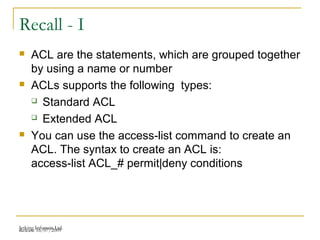
Recall - I
 ACL are the statements, which are grouped together
by using a name or number
 ACLs supports the following types:
 Standard ACL
 Extended ACL
 You can use the access-list command to create an
ACL. The syntax to create an ACL is:
access-list ACL_# permit|deny conditions
Release 16/07/2009Jetking Infotrain Ltd.
Recall - II
 Wildcard masks can be used for matching a range
of IP addresses in ACL, instead of manually
entering it
 A wildcard is similar to an inverted subnet mask
 the extended ACL filters the source and destination
IP address, IP protocols such as IP, TCP, UDP ,
ICMP etc. and protocol information such as port
numbers or message types
Release 16/07/2009Jetking Infotrain Ltd.
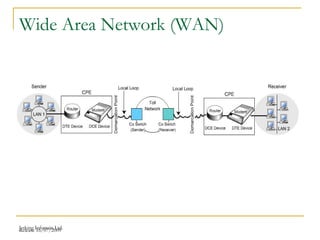
Wide Area Network
 The terms and components of WAN are:
 Data Communications Equipment (DCE)
 Data Terminal Equipment (DTE)
 Customer Premises Equipment (CPE)
 Demarcation point
 Toll network
 Central Office (CO) switch
 Local loop
Release 16/07/2009Jetking Infotrain Ltd.
Wide Area Network (WAN)
Release 16/07/2009Jetking Infotrain Ltd.
Types of WAN
 WANs are available in four types, based on the
distance covered and the equipment used
 The four types of WAN are:
 Leased-Lines Connection
 Circuit-Switched Connection
 Packet-Switched Connections
 Cell-Switched Connections
Release 16/07/2009Jetking Infotrain Ltd.
Selecting WAN
 While connecting a LAN to a WAN, you should be
aware of the connection requirements
 Some of the major factors that help to select a WAN
are:
 Frequency
 Transfer rates
 Traffic load
 Cost
Release 16/07/2009Jetking Infotrain Ltd.
Data-Link Protocols
 Data-link layer protocols are commonly called the
data link protocols
 These protocols communicate between two devices
such as, routers, and bridges
 Data packets are sent over the link created by the
protocols
 Data-link protocols consist of:
 High Level Data Link Control (HDLC) protocol
 Point-to-Point protocol (PPP)
Release 16/07/2009Jetking Infotrain Ltd.
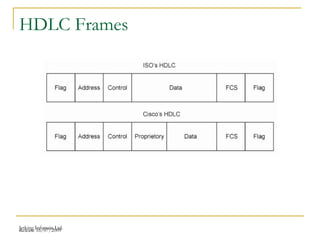
HDLC Frames
Release 16/07/2009Jetking Infotrain Ltd.
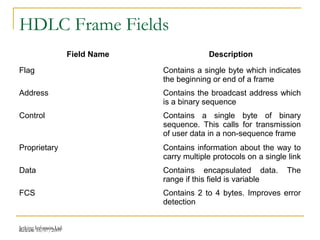
HDLC Frame Fields
Field Name Description
Flag Contains a single byte which indicates
the beginning or end of a frame
Address Contains the broadcast address which
is a binary sequence
Control Contains a single byte of binary
sequence. This calls for transmission
of user data in a non-sequence frame
Proprietary Contains information about the way to
carry multiple protocols on a single link
Data Contains encapsulated data. The
range if this field is variable
FCS Contains 2 to 4 bytes. Improves error
detection
Release 16/07/2009Jetking Infotrain Ltd.
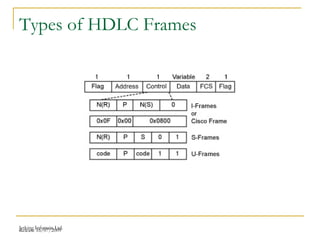
Types of HDLC Frames
Release 16/07/2009Jetking Infotrain Ltd.
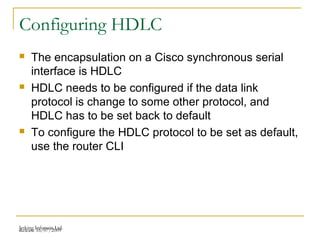
Configuring HDLC
 The encapsulation on a Cisco synchronous serial
interface is HDLC
 HDLC needs to be configured if the data link
protocol is change to some other protocol, and
HDLC has to be set back to default
 To configure the HDLC protocol to be set as default,
use the router CLI
Release 16/07/2009Jetking Infotrain Ltd.
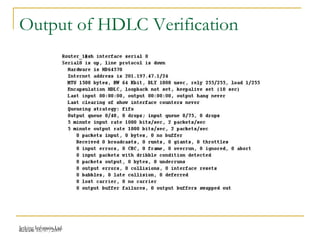
Output of HDLC Verification
Release 16/07/2009Jetking Infotrain Ltd.
PPP
 The PPP allows computers to connect to the
Internet using a dial-up telephone line and ISDN
 PPP was originally designed to transport IP traffic
over point-to-point links
 PPP can transfer data over synchronous and
asynchronous links
 It supports a transfer of data over different network
protocols
Release 16/07/2009Jetking Infotrain Ltd.
PPP Frame
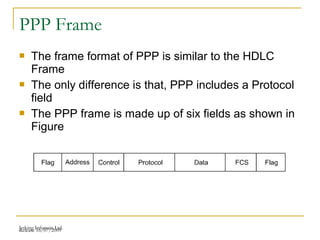
 The frame format of PPP is similar to the HDLC
Frame
 The only difference is that, PPP includes a Protocol
field
 The PPP frame is made up of six fields as shown in
Figure
Release 16/07/2009Jetking Infotrain Ltd.
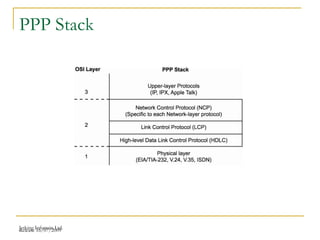
PPP Stack
Release 16/07/2009Jetking Infotrain Ltd.
Link Control Protocol (LCP)
 The PPP Link Control Protocol can establish,
configure, maintain and terminate point-to-point
connection between the devices
 LCP uses following three classes of frames for
establishing, configuring, maintaining and
terminating connection between the devices:
 Link Configuration frames
 Link Maintenance frames
 Link Termination frames
Release 16/07/2009Jetking Infotrain Ltd.
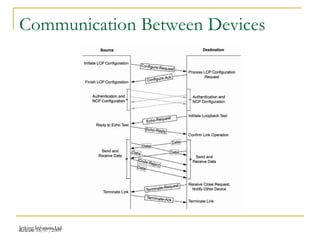
Communication Between Devices
Release 16/07/2009Jetking Infotrain Ltd.
LCP Configuration Options
 The LCP configuration options are:
 Authentication
 Compression
 Error-detection
 Multilink
 PPP callback
Release 16/07/2009Jetking Infotrain Ltd.
PPP Session Establishment
 Point-to-Point protocol is used to transmit data
packets over serial point-to-point links
 The three phases of session establishment are
given as follows:
 Link establishment phase
 Authentication phase
 Network layer protocol phase
Release 16/07/2009Jetking Infotrain Ltd.
PPP Authentication - I
 Point-to-Point protocol supports authentication of
devices
 Once a link is established between nodes the
process of authentication starts
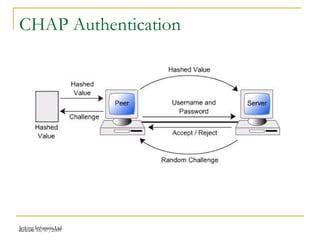
 PPP supports two authentication protocols
Password Authentication Protocol (PAP) and
Challenge Handshake Authentication Protocol
(CHAP)
Release 16/07/2009Jetking Infotrain Ltd.
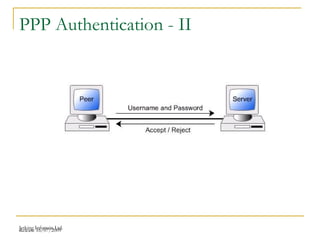
PPP Authentication - II
Release 16/07/2009Jetking Infotrain Ltd.
CHAP Authentication
Release 16/07/2009Jetking Infotrain Ltd.
Configuring PPP
 Cisco allows you to configure the PPP to be used on
WAN interface
 You can configure the PPP using encapsulation and
interface commands in the configuration mode
 The syntax of the command to configure PPP is:
encapsulation ppp
Release 16/07/2009Jetking Infotrain Ltd.
Configuring PPP Authentication
 Once the serial interface is configured to support the
PPP encapsulation, you must configure PPP
authentication on the routers
 Before authentication process, it is required to set a
hostname for the router if not already assigned
 Also, you must set username and password for the
remote router to which the router is connected
 After the hostname, username and password is set ,
select the appropriate authentication for the router
such as PAP or CHAP
Release 16/07/2009Jetking Infotrain Ltd.
Verifying PPP Encapsulation
 PPP does not begin authentication until the Link
Control Protocol (LCP) process is completed and
open
 PPP authentication needs to be set up on both ends
for the authentication process to work
 Using commands, such as show and debug you can
solve problems for PPP
Release 16/07/2009Jetking Infotrain Ltd.
Mismatched WAN Encapsulations
 Routers can communicate in a network only if their
encapsulation methods are same
 If you connect two routers in the network using
point-to-point link but the encapsulation methods are
different on each router, the connection between the
routers is not established
 In this case, if one router sends request to the other,
it will never receive a response from that router
Release 16/07/2009Jetking Infotrain Ltd.
Mismatched IP Addresses
 Routers configured with same WAN encapsulation
method such as PPP, HDLC or Frame Relay
connected in different subnets will have connection
established between them
 However, the data packets do not transfer between
the routers. It becomes very difficult to identify this
problem, as the link appears to be functioning
properly
 To resolve the problem, you can use the show
running-config and show interface command on
each router
Release 16/07/2009Jetking Infotrain Ltd.
Case Study
The Blue Diamond steel company, Gujarat branch has
all Cisco routers connected in the network. The router
of the Business Development department is
damaged. The computers in this department cannot
exchange data with the other departments in the
network. The network administrator Robert replaces
the damaged router with a new non-Cisco router.
Release 16/07/2009Jetking Infotrain Ltd.
Problem
The Business Development department still cannot
have transaction with the other departments
Release 16/07/2009Jetking Infotrain Ltd.
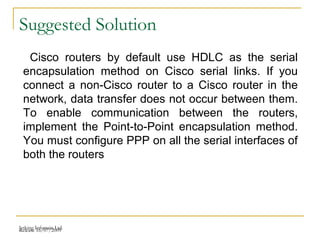
Suggested Solution
Cisco routers by default use HDLC as the serial
encapsulation method on Cisco serial links. If you
connect a non-Cisco router to a Cisco router in the
network, data transfer does not occur between them.
To enable communication between the routers,
implement the Point-to-Point encapsulation method.
You must configure PPP on all the serial interfaces of
both the routers
Release 16/07/2009Jetking Infotrain Ltd.
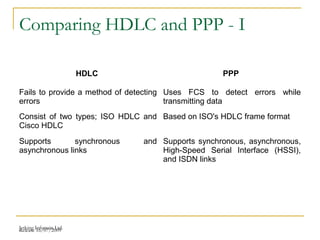
Comparing HDLC and PPP - I
HDLC PPP
Fails to provide a method of detecting
errors
Uses FCS to detect errors while
transmitting data
Consist of two types; ISO HDLC and
Cisco HDLC
Based on ISO's HDLC frame format
Supports synchronous and
asynchronous links
Supports synchronous, asynchronous,
High-Speed Serial Interface (HSSI),
and ISDN links
Release 16/07/2009Jetking Infotrain Ltd.
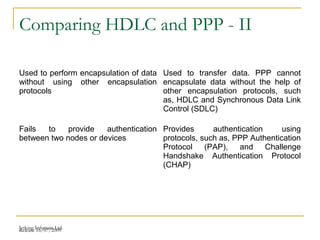
Comparing HDLC and PPP - II
Used to perform encapsulation of data
without using other encapsulation
protocols
Used to transfer data. PPP cannot
encapsulate data without the help of
other encapsulation protocols, such
as, HDLC and Synchronous Data Link
Control (SDLC)
Fails to provide authentication
between two nodes or devices
Provides authentication using
protocols, such as, PPP Authentication
Protocol (PAP), and Challenge
Handshake Authentication Protocol
(CHAP)
Release 16/07/2009Jetking Infotrain Ltd.
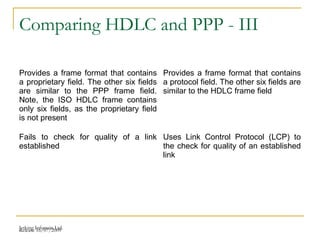
Comparing HDLC and PPP - III
Provides a frame format that contains
a proprietary field. The other six fields
are similar to the PPP frame field.
Note, the ISO HDLC frame contains
only six fields, as the proprietary field
is not present
Provides a frame format that contains
a protocol field. The other six fields are
similar to the HDLC frame field
Fails to check for quality of a link
established
Uses Link Control Protocol (LCP) to
the check for quality of an established
link
Release 16/07/2009Jetking Infotrain Ltd.
Summary - I
 WAN is a network that spans a large geographical
area
 Leased lines are a transmission line, which is provided
by telephone companies to a particular customer
 Frequency, usage, traffic and cost are factors that
need to considered when selecting a WAN connection
 Data-Link layer protocols are commonly called the
data link protocols, which communicate between two
devices
Release 16/07/2009Jetking Infotrain Ltd.
Summary - II
 Configuring HDLC only needs to be done only if the data
link protocol is change to some other protocol
 The two types of HDLC:
 ISO HDLC
 Cisco HDLC
 The Cisco HDLC contains proprietary field, which
defines carrying a multiple protocols across a link
 PPP enables computers to connect to the internet using
a dial-up telephone line and ISDN
 Configuring the PPP is to specify that PPP is to be used
on the WAN
Release 16/07/2009Jetking Infotrain Ltd.
Summary - III
 Features of PPP are:
 Authentication
 Link test
 Error-detection
 Compression
 Components of PPP are:
 HDLC
 LCP
 NCPs
 Authentication protocols supported by PPP are:
 PAP
 CHAP
Release 16/07/2009Jetking Infotrain Ltd.
Summary - IV
 By default the authentication is not mandatory but
must be specified to
 PAP is a insecure protocol because the username
and password is sent in plain text
 Using CHAP protocol the server sends challenge
messages to the node. The node calculates and
sends the results back to the server

CCNA CHAPTER 9 BY jetarvind kumar madhukar

  • 1.
    Release 16/07/2009 JetkingInfotrain Ltd. Establishing Serial Point-to-Point Connection Chapter 9
  • 2.
    Release 16/07/2009Jetking InfotrainLtd. Chapter Objectives  Explain wide area network  Explain data-link protocols of point-to-point leased lines  Explain HDLC  Explain PPP
  • 3.
    Release 16/07/2009Jetking InfotrainLtd. Recall - I  ACL are the statements, which are grouped together by using a name or number  ACLs supports the following types:  Standard ACL  Extended ACL  You can use the access-list command to create an ACL. The syntax to create an ACL is: access-list ACL_# permit|deny conditions
  • 4.
    Release 16/07/2009Jetking InfotrainLtd. Recall - II  Wildcard masks can be used for matching a range of IP addresses in ACL, instead of manually entering it  A wildcard is similar to an inverted subnet mask  the extended ACL filters the source and destination IP address, IP protocols such as IP, TCP, UDP , ICMP etc. and protocol information such as port numbers or message types
  • 5.
    Release 16/07/2009Jetking InfotrainLtd. Wide Area Network  The terms and components of WAN are:  Data Communications Equipment (DCE)  Data Terminal Equipment (DTE)  Customer Premises Equipment (CPE)  Demarcation point  Toll network  Central Office (CO) switch  Local loop
  • 6.
    Release 16/07/2009Jetking InfotrainLtd. Wide Area Network (WAN)
  • 7.
    Release 16/07/2009Jetking InfotrainLtd. Types of WAN  WANs are available in four types, based on the distance covered and the equipment used  The four types of WAN are:  Leased-Lines Connection  Circuit-Switched Connection  Packet-Switched Connections  Cell-Switched Connections
  • 8.
    Release 16/07/2009Jetking InfotrainLtd. Selecting WAN  While connecting a LAN to a WAN, you should be aware of the connection requirements  Some of the major factors that help to select a WAN are:  Frequency  Transfer rates  Traffic load  Cost
  • 9.
    Release 16/07/2009Jetking InfotrainLtd. Data-Link Protocols  Data-link layer protocols are commonly called the data link protocols  These protocols communicate between two devices such as, routers, and bridges  Data packets are sent over the link created by the protocols  Data-link protocols consist of:  High Level Data Link Control (HDLC) protocol  Point-to-Point protocol (PPP)
  • 10.
  • 11.
    Release 16/07/2009Jetking InfotrainLtd. HDLC Frame Fields Field Name Description Flag Contains a single byte which indicates the beginning or end of a frame Address Contains the broadcast address which is a binary sequence Control Contains a single byte of binary sequence. This calls for transmission of user data in a non-sequence frame Proprietary Contains information about the way to carry multiple protocols on a single link Data Contains encapsulated data. The range if this field is variable FCS Contains 2 to 4 bytes. Improves error detection
  • 12.
    Release 16/07/2009Jetking InfotrainLtd. Types of HDLC Frames
  • 13.
    Release 16/07/2009Jetking InfotrainLtd. Configuring HDLC  The encapsulation on a Cisco synchronous serial interface is HDLC  HDLC needs to be configured if the data link protocol is change to some other protocol, and HDLC has to be set back to default  To configure the HDLC protocol to be set as default, use the router CLI
  • 14.
    Release 16/07/2009Jetking InfotrainLtd. Output of HDLC Verification
  • 15.
    Release 16/07/2009Jetking InfotrainLtd. PPP  The PPP allows computers to connect to the Internet using a dial-up telephone line and ISDN  PPP was originally designed to transport IP traffic over point-to-point links  PPP can transfer data over synchronous and asynchronous links  It supports a transfer of data over different network protocols
  • 16.
    Release 16/07/2009Jetking InfotrainLtd. PPP Frame  The frame format of PPP is similar to the HDLC Frame  The only difference is that, PPP includes a Protocol field  The PPP frame is made up of six fields as shown in Figure
  • 17.
  • 18.
    Release 16/07/2009Jetking InfotrainLtd. Link Control Protocol (LCP)  The PPP Link Control Protocol can establish, configure, maintain and terminate point-to-point connection between the devices  LCP uses following three classes of frames for establishing, configuring, maintaining and terminating connection between the devices:  Link Configuration frames  Link Maintenance frames  Link Termination frames
  • 19.
    Release 16/07/2009Jetking InfotrainLtd. Communication Between Devices
  • 20.
    Release 16/07/2009Jetking InfotrainLtd. LCP Configuration Options  The LCP configuration options are:  Authentication  Compression  Error-detection  Multilink  PPP callback
  • 21.
    Release 16/07/2009Jetking InfotrainLtd. PPP Session Establishment  Point-to-Point protocol is used to transmit data packets over serial point-to-point links  The three phases of session establishment are given as follows:  Link establishment phase  Authentication phase  Network layer protocol phase
  • 22.
    Release 16/07/2009Jetking InfotrainLtd. PPP Authentication - I  Point-to-Point protocol supports authentication of devices  Once a link is established between nodes the process of authentication starts  PPP supports two authentication protocols Password Authentication Protocol (PAP) and Challenge Handshake Authentication Protocol (CHAP)
  • 23.
    Release 16/07/2009Jetking InfotrainLtd. PPP Authentication - II
  • 24.
    Release 16/07/2009Jetking InfotrainLtd. CHAP Authentication
  • 25.
    Release 16/07/2009Jetking InfotrainLtd. Configuring PPP  Cisco allows you to configure the PPP to be used on WAN interface  You can configure the PPP using encapsulation and interface commands in the configuration mode  The syntax of the command to configure PPP is: encapsulation ppp
  • 26.
    Release 16/07/2009Jetking InfotrainLtd. Configuring PPP Authentication  Once the serial interface is configured to support the PPP encapsulation, you must configure PPP authentication on the routers  Before authentication process, it is required to set a hostname for the router if not already assigned  Also, you must set username and password for the remote router to which the router is connected  After the hostname, username and password is set , select the appropriate authentication for the router such as PAP or CHAP
  • 27.
    Release 16/07/2009Jetking InfotrainLtd. Verifying PPP Encapsulation  PPP does not begin authentication until the Link Control Protocol (LCP) process is completed and open  PPP authentication needs to be set up on both ends for the authentication process to work  Using commands, such as show and debug you can solve problems for PPP
  • 28.
    Release 16/07/2009Jetking InfotrainLtd. Mismatched WAN Encapsulations  Routers can communicate in a network only if their encapsulation methods are same  If you connect two routers in the network using point-to-point link but the encapsulation methods are different on each router, the connection between the routers is not established  In this case, if one router sends request to the other, it will never receive a response from that router
  • 29.
    Release 16/07/2009Jetking InfotrainLtd. Mismatched IP Addresses  Routers configured with same WAN encapsulation method such as PPP, HDLC or Frame Relay connected in different subnets will have connection established between them  However, the data packets do not transfer between the routers. It becomes very difficult to identify this problem, as the link appears to be functioning properly  To resolve the problem, you can use the show running-config and show interface command on each router
  • 30.
    Release 16/07/2009Jetking InfotrainLtd. Case Study The Blue Diamond steel company, Gujarat branch has all Cisco routers connected in the network. The router of the Business Development department is damaged. The computers in this department cannot exchange data with the other departments in the network. The network administrator Robert replaces the damaged router with a new non-Cisco router.
  • 31.
    Release 16/07/2009Jetking InfotrainLtd. Problem The Business Development department still cannot have transaction with the other departments
  • 32.
    Release 16/07/2009Jetking InfotrainLtd. Suggested Solution Cisco routers by default use HDLC as the serial encapsulation method on Cisco serial links. If you connect a non-Cisco router to a Cisco router in the network, data transfer does not occur between them. To enable communication between the routers, implement the Point-to-Point encapsulation method. You must configure PPP on all the serial interfaces of both the routers
  • 33.
    Release 16/07/2009Jetking InfotrainLtd. Comparing HDLC and PPP - I HDLC PPP Fails to provide a method of detecting errors Uses FCS to detect errors while transmitting data Consist of two types; ISO HDLC and Cisco HDLC Based on ISO's HDLC frame format Supports synchronous and asynchronous links Supports synchronous, asynchronous, High-Speed Serial Interface (HSSI), and ISDN links
  • 34.
    Release 16/07/2009Jetking InfotrainLtd. Comparing HDLC and PPP - II Used to perform encapsulation of data without using other encapsulation protocols Used to transfer data. PPP cannot encapsulate data without the help of other encapsulation protocols, such as, HDLC and Synchronous Data Link Control (SDLC) Fails to provide authentication between two nodes or devices Provides authentication using protocols, such as, PPP Authentication Protocol (PAP), and Challenge Handshake Authentication Protocol (CHAP)
  • 35.
    Release 16/07/2009Jetking InfotrainLtd. Comparing HDLC and PPP - III Provides a frame format that contains a proprietary field. The other six fields are similar to the PPP frame field. Note, the ISO HDLC frame contains only six fields, as the proprietary field is not present Provides a frame format that contains a protocol field. The other six fields are similar to the HDLC frame field Fails to check for quality of a link established Uses Link Control Protocol (LCP) to the check for quality of an established link
  • 36.
    Release 16/07/2009Jetking InfotrainLtd. Summary - I  WAN is a network that spans a large geographical area  Leased lines are a transmission line, which is provided by telephone companies to a particular customer  Frequency, usage, traffic and cost are factors that need to considered when selecting a WAN connection  Data-Link layer protocols are commonly called the data link protocols, which communicate between two devices
  • 37.
    Release 16/07/2009Jetking InfotrainLtd. Summary - II  Configuring HDLC only needs to be done only if the data link protocol is change to some other protocol  The two types of HDLC:  ISO HDLC  Cisco HDLC  The Cisco HDLC contains proprietary field, which defines carrying a multiple protocols across a link  PPP enables computers to connect to the internet using a dial-up telephone line and ISDN  Configuring the PPP is to specify that PPP is to be used on the WAN
  • 38.
    Release 16/07/2009Jetking InfotrainLtd. Summary - III  Features of PPP are:  Authentication  Link test  Error-detection  Compression  Components of PPP are:  HDLC  LCP  NCPs  Authentication protocols supported by PPP are:  PAP  CHAP
  • 39.
    Release 16/07/2009Jetking InfotrainLtd. Summary - IV  By default the authentication is not mandatory but must be specified to  PAP is a insecure protocol because the username and password is sent in plain text  Using CHAP protocol the server sends challenge messages to the node. The node calculates and sends the results back to the server