1
Lamb, Hair, McDaniel
Chapter 10
Product
Concepts
2013-2014
Define the term product
Classify consumer products
Define the terms product item,
product line, and product mix
Describe marketing uses of branding
© 2013 by Cengage Learning Inc. All Rights Reserved. 2
1
4
2
3
Describe marketing uses of packaging
and labeling
Discuss global issues in branding
and packaging
Describe how and why product
warranties are important marketing
tools
© 2013 by Cengage Learning Inc. All Rights Reserved. 3
7
5
6
Define the term
product
What Is a Product?
© 2013 by Cengage Learning Inc. All Rights Reserved.4
1
© 2013 by Cengage Learning Inc. All Rights Reserved. 5
What Is a Product?
Everything, both favorable and
unfavorable, that a person receives in an
exchange.
 Tangible Good
 Service
 Idea
1
© 2013 by Cengage Learning Inc. All Rights Reserved. 6
What Is a Product?
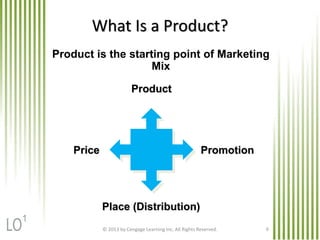
Product is the starting point of Marketing
Mix
Promotion
Place (Distribution)
Price
Product
1
Classify consumer
products
Types of Consumer Products
© 2013 by Cengage Learning Inc. All Rights Reserved.7
2
© 2013 by Cengage Learning Inc. All Rights Reserved. 8
Types of Products
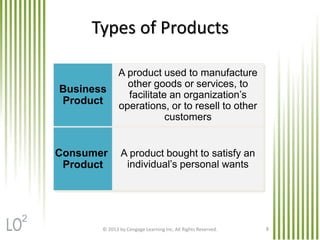
Business
Product
Consumer
Product
A product used to manufacture
other goods or services, to
facilitate an organization’s
operations, or to resell to other
customers
A product bought to satisfy an
individual’s personal wants
2
© 2013 by Cengage Learning Inc. All Rights Reserved. 9
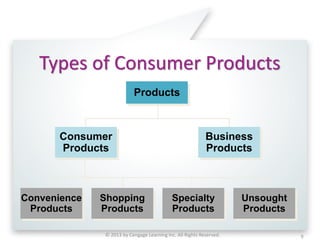
Types of Consumer Products
Unsought
Products
Specialty
Products
Shopping
Products
Convenience
Products
Consumer
Products
Business
Products
Products
© 2013 by Cengage Learning Inc. All Rights Reserved. 10
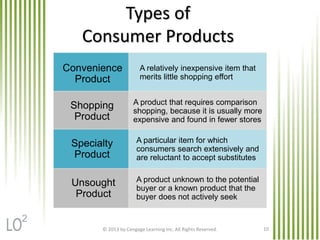
Types of
Consumer Products
Market
Development
Convenience
Product
Shopping
Product
Specialty
Product
Unsought
Product
A relatively inexpensive item that
merits little shopping effort
A product that requires comparison
shopping, because it is usually more
expensive and found in fewer stores
A particular item for which
consumers search extensively and
are reluctant to accept substitutes
A product unknown to the potential
buyer or a known product that the
buyer does not actively seek
2
Define the terms
product item,
product line,
and product mix
Product Items, Lines, and Mixes
© 2013 by Cengage Learning Inc. All Rights Reserved.11
3
© 2013 by Cengage Learning Inc. All Rights Reserved. 12
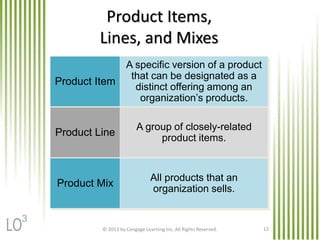
Product Items,
Lines, and Mixes
Product Item
Product Line
Product Mix
A specific version of a product
that can be designated as a
distinct offering among an
organization’s products.
A group of closely-related
product items.
All products that an
organization sells.
3
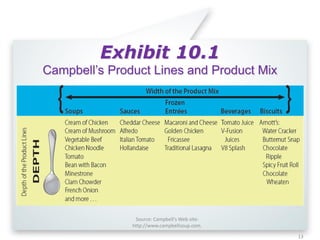
Exhibit 10.1
Campbell’s Product Lines and Product Mix
Source: Campbell's Web site:
http://www.campbellsoup.com.
13
© 2013 by Cengage Learning Inc. All Rights Reserved. 14
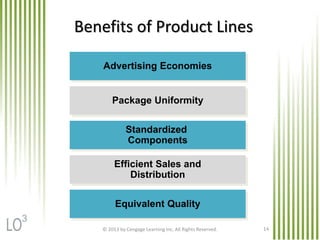
Benefits of Product Lines
Equivalent Quality
Efficient Sales and
Distribution
Standardized
Components
Package Uniformity
Advertising Economies
3
© 2013 by Cengage Learning Inc. All Rights Reserved. 15
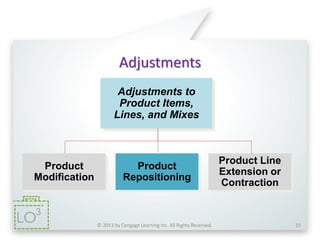
Adjustments
Product
Modification
Product
Repositioning
Product Line
Extension or
Contraction
Adjustments to
Product Items,
Lines, and Mixes
3
© 2013 by Cengage Learning Inc. All Rights Reserved. 16
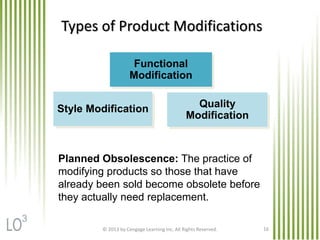
Types of Product Modifications
Quality
Modification
Functional
Modification
Style Modification
Planned Obsolescence: The practice of
modifying products so those that have
already been sold become obsolete before
they actually need replacement.
3
© 2013 by Cengage Learning Inc. All Rights Reserved. 17
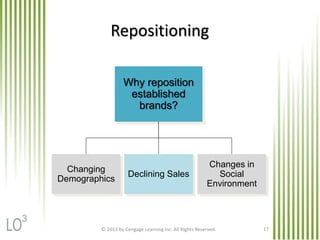
Repositioning
Changing
Demographics
Declining Sales
Changes in
Social
Environment
Why reposition
established
brands?
3
© 2013 by Cengage Learning Inc. All Rights Reserved. 18
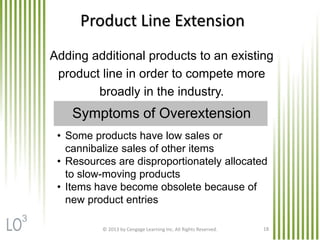
Product Line Extension
Adding additional products to an existing
product line in order to compete more
broadly in the industry.
• Some products have low sales or
cannibalize sales of other items
• Resources are disproportionately allocated
to slow-moving products
• Items have become obsolete because of
new product entries
Symptoms of Overextension
3
Describe marketing
uses of branding
Branding
© 2013 by Cengage Learning Inc. All Rights Reserved.19
4
© 2013 by Cengage Learning Inc. All Rights Reserved. 20
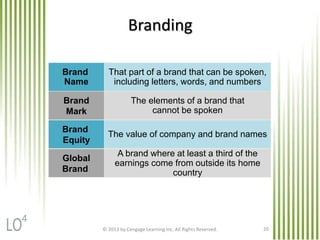
Branding
Brand
Name
Brand
Mark
Brand
Equity
That part of a brand that can be spoken,
including letters, words, and numbers
The elements of a brand that
cannot be spoken
The value of company and brand names
Global
Brand
A brand where at least a third of the
earnings come from outside its home
country
4
© 2013 by Cengage Learning Inc. All Rights Reserved. 21
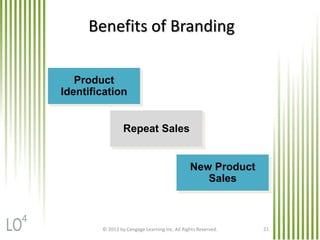
Benefits of Branding
Product
Identification
Repeat Sales
New Product
Sales
4
© 2013 by Cengage Learning Inc. All Rights Reserved. 22
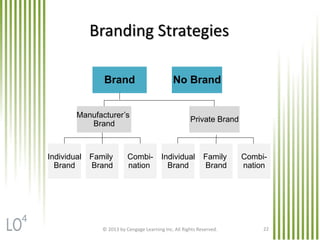
Branding Strategies
Brand No Brand
Manufacturer’s
Brand
Private Brand
Individual
Brand
Family
Brand
Combi-
nation
Individual
Brand
Family
Brand
Combi-
nation
4
© 2013 by Cengage Learning Inc. All Rights Reserved. 23
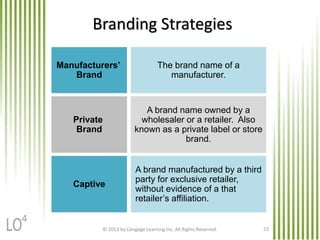
Branding Strategies
Manufacturers’
Brand
Private
Brand
The brand name of a
manufacturer.
A brand name owned by a
wholesaler or a retailer. Also
known as a private label or store
brand.
Captive
A brand manufactured by a third
party for exclusive retailer,
without evidence of a that
retailer’s affiliation.
4
© 2013 by Cengage Learning Inc. All Rights Reserved. 24
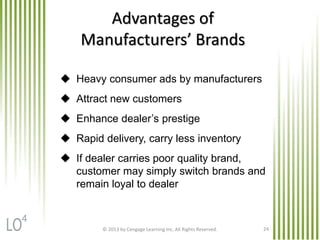
Advantages of
Manufacturers’ Brands
 Heavy consumer ads by manufacturers
 Attract new customers
 Enhance dealer’s prestige
 Rapid delivery, carry less inventory
 If dealer carries poor quality brand,
customer may simply switch brands and
remain loyal to dealer
4
Source: Beth Kowitt, “Inside Trader Joe’s,” Fortune, September 6, 2010. 86-96
Trader Joe’s—The Brand
• About 80 percent of the items offered at Trader
Joe’s are private label.
• Trader Joe’s offers several sub-brands within the
Trader Joe’s brand family, such as Trader Ming’s
for Chinese food and Trader Darwin’s for vitamins.
• Trader Joe’s purchases directly from the
manufacturer and ships directly to its distribution
centers, where many of the products are
portioned and packaged.
© 2013 by Cengage Learning Inc. All Rights Reserved.25
4
© 2013 by Cengage Learning Inc. All Rights Reserved. 26
Advantages of
Private Brands
 Earn higher profits on own brand
 Less pressure to mark down price
 Manufacturer can become a direct
competitor or drop a brand/reseller
 Ties customer to wholesaler or
retailer
 Wholesalers and retailers have no
control over the intensity of
distribution of manufacturers’ brands4
© 2013 by Cengage Learning Inc. All Rights Reserved. 27
Advantages
of Captive Brands
• No evidence of store’s affiliation
• Manufactured by third party
• Sold exclusively at the chain
• Can ask price similar to
manufacturer’s brands
4
© 2013 by Cengage Learning Inc. All Rights Reserved. 28
Individual Brands Versus
Family Brands
Individual
Brand
Family
Brand
Using different brand
names for different
products.
Marketing several different
products under the same
brand name.
4
© 2013 by Cengage Learning Inc. All Rights Reserved. 29
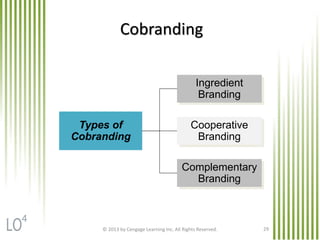
Cobranding
Ingredient
Branding
Cooperative
Branding
Complementary
Branding
Types of
Cobranding
4
© 2013 by Cengage Learning Inc. All Rights Reserved. 30
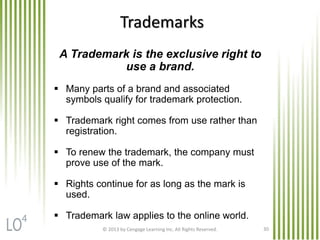
Trademarks
A Trademark is the exclusive right to
use a brand.
 Many parts of a brand and associated
symbols qualify for trademark protection.
 Trademark right comes from use rather than
registration.
 To renew the trademark, the company must
prove use of the mark.
 Rights continue for as long as the mark is
used.
 Trademark law applies to the online world.4
Describe marketing
uses of packaging and
labeling
Packaging
© 2013 by Cengage Learning Inc. All Rights Reserved.31
5
© 2013 by Cengage Learning Inc. All Rights Reserved. 32
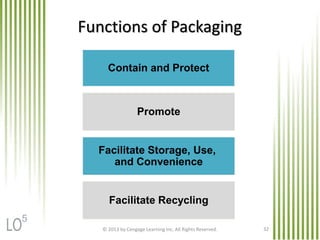
Functions of Packaging
Contain and Protect
Promote
Facilitate Storage, Use,
and Convenience
Facilitate Recycling
5
© 2013 by Cengage Learning Inc. All Rights Reserved. 33
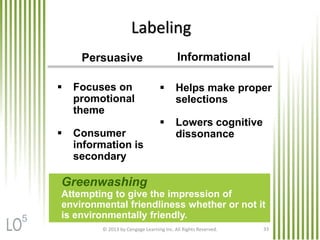
Labeling
Persuasive
 Focuses on
promotional
theme
 Consumer
information is
secondary
Informational
 Helps make proper
selections
 Lowers cognitive
dissonance
Greenwashing
Attempting to give the impression of
environmental friendliness whether or not it
is environmentally friendly.5
© 2013 by Cengage Learning Inc. All Rights Reserved. 34
Universal Product Codes
A series of thick and thin vertical
lines (bar codes), readable by
computerized optical scanners,
that represent numbers used to
track products.
5
Discuss global
issues in branding and
packaging
© 2013 by Cengage Learning Inc. All Rights Reserved.35
Global Issues in Branding and
Packaging
6
© 2013 by Cengage Learning Inc. All Rights Reserved. 36
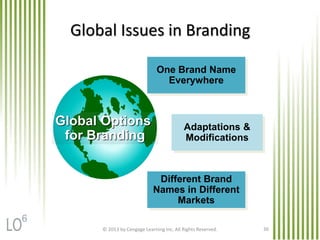
Global Issues in Branding
Adaptations &
Modifications
Global Options
for Branding
One Brand Name
Everywhere
Different Brand
Names in Different
Markets
6
© 2013 by Cengage Learning Inc. All Rights Reserved. 37
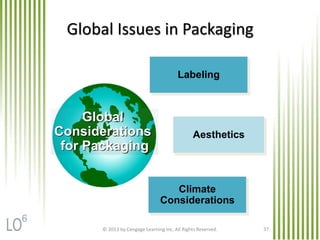
Global Issues in Packaging
Aesthetics
Global
Considerations
for Packaging
Climate
Considerations
Labeling
6
Describe how
and why product
warranties are important
marketing tools
Product Warranties
© 2013 by Cengage Learning Inc. All Rights Reserved.38
7
Product Warranties
Warranty
Express
Warranty
Implied
Warranty
A confirmation of the quality or
performance of a good or service.
A written guarantee.
An unwritten guarantee that the good
or service is fit for the purpose for
which it was sold.
© 2013 by Cengage Learning Inc. All Rights Reserved. 39
7
Chapter 10 Video
Zappos
Zappos discusses how the company builds its
product offerings and enters into new fields.
Zappos also has a limited line of private label
offerings that it creates to fill a perceived gap
in the market. Choosing the correct products is
the starting point for Zappos to offer its great
customer service and “deliver happiness.”
CLICK TO PLAY VIDEO
© 2013 by Cengage Learning Inc. All Rights Reserved.40

Chapter 10 Product Concepts

  • 1.
    1 Lamb, Hair, McDaniel Chapter10 Product Concepts 2013-2014
  • 2.
    Define the termproduct Classify consumer products Define the terms product item, product line, and product mix Describe marketing uses of branding © 2013 by Cengage Learning Inc. All Rights Reserved. 2 1 4 2 3
  • 3.
    Describe marketing usesof packaging and labeling Discuss global issues in branding and packaging Describe how and why product warranties are important marketing tools © 2013 by Cengage Learning Inc. All Rights Reserved. 3 7 5 6
  • 4.
    Define the term product WhatIs a Product? © 2013 by Cengage Learning Inc. All Rights Reserved.4 1
  • 5.
    © 2013 byCengage Learning Inc. All Rights Reserved. 5 What Is a Product? Everything, both favorable and unfavorable, that a person receives in an exchange.  Tangible Good  Service  Idea 1
  • 6.
    © 2013 byCengage Learning Inc. All Rights Reserved. 6 What Is a Product? Product is the starting point of Marketing Mix Promotion Place (Distribution) Price Product 1
  • 7.
    Classify consumer products Types ofConsumer Products © 2013 by Cengage Learning Inc. All Rights Reserved.7 2
  • 8.
    © 2013 byCengage Learning Inc. All Rights Reserved. 8 Types of Products Business Product Consumer Product A product used to manufacture other goods or services, to facilitate an organization’s operations, or to resell to other customers A product bought to satisfy an individual’s personal wants 2
  • 9.
    © 2013 byCengage Learning Inc. All Rights Reserved. 9 Types of Consumer Products Unsought Products Specialty Products Shopping Products Convenience Products Consumer Products Business Products Products
  • 10.
    © 2013 byCengage Learning Inc. All Rights Reserved. 10 Types of Consumer Products Market Development Convenience Product Shopping Product Specialty Product Unsought Product A relatively inexpensive item that merits little shopping effort A product that requires comparison shopping, because it is usually more expensive and found in fewer stores A particular item for which consumers search extensively and are reluctant to accept substitutes A product unknown to the potential buyer or a known product that the buyer does not actively seek 2
  • 11.
    Define the terms productitem, product line, and product mix Product Items, Lines, and Mixes © 2013 by Cengage Learning Inc. All Rights Reserved.11 3
  • 12.
    © 2013 byCengage Learning Inc. All Rights Reserved. 12 Product Items, Lines, and Mixes Product Item Product Line Product Mix A specific version of a product that can be designated as a distinct offering among an organization’s products. A group of closely-related product items. All products that an organization sells. 3
  • 13.
    Exhibit 10.1 Campbell’s ProductLines and Product Mix Source: Campbell's Web site: http://www.campbellsoup.com. 13
  • 14.
    © 2013 byCengage Learning Inc. All Rights Reserved. 14 Benefits of Product Lines Equivalent Quality Efficient Sales and Distribution Standardized Components Package Uniformity Advertising Economies 3
  • 15.
    © 2013 byCengage Learning Inc. All Rights Reserved. 15 Adjustments Product Modification Product Repositioning Product Line Extension or Contraction Adjustments to Product Items, Lines, and Mixes 3
  • 16.
    © 2013 byCengage Learning Inc. All Rights Reserved. 16 Types of Product Modifications Quality Modification Functional Modification Style Modification Planned Obsolescence: The practice of modifying products so those that have already been sold become obsolete before they actually need replacement. 3
  • 17.
    © 2013 byCengage Learning Inc. All Rights Reserved. 17 Repositioning Changing Demographics Declining Sales Changes in Social Environment Why reposition established brands? 3
  • 18.
    © 2013 byCengage Learning Inc. All Rights Reserved. 18 Product Line Extension Adding additional products to an existing product line in order to compete more broadly in the industry. • Some products have low sales or cannibalize sales of other items • Resources are disproportionately allocated to slow-moving products • Items have become obsolete because of new product entries Symptoms of Overextension 3
  • 19.
    Describe marketing uses ofbranding Branding © 2013 by Cengage Learning Inc. All Rights Reserved.19 4
  • 20.
    © 2013 byCengage Learning Inc. All Rights Reserved. 20 Branding Brand Name Brand Mark Brand Equity That part of a brand that can be spoken, including letters, words, and numbers The elements of a brand that cannot be spoken The value of company and brand names Global Brand A brand where at least a third of the earnings come from outside its home country 4
  • 21.
    © 2013 byCengage Learning Inc. All Rights Reserved. 21 Benefits of Branding Product Identification Repeat Sales New Product Sales 4
  • 22.
    © 2013 byCengage Learning Inc. All Rights Reserved. 22 Branding Strategies Brand No Brand Manufacturer’s Brand Private Brand Individual Brand Family Brand Combi- nation Individual Brand Family Brand Combi- nation 4
  • 23.
    © 2013 byCengage Learning Inc. All Rights Reserved. 23 Branding Strategies Manufacturers’ Brand Private Brand The brand name of a manufacturer. A brand name owned by a wholesaler or a retailer. Also known as a private label or store brand. Captive A brand manufactured by a third party for exclusive retailer, without evidence of a that retailer’s affiliation. 4
  • 24.
    © 2013 byCengage Learning Inc. All Rights Reserved. 24 Advantages of Manufacturers’ Brands  Heavy consumer ads by manufacturers  Attract new customers  Enhance dealer’s prestige  Rapid delivery, carry less inventory  If dealer carries poor quality brand, customer may simply switch brands and remain loyal to dealer 4
  • 25.
    Source: Beth Kowitt,“Inside Trader Joe’s,” Fortune, September 6, 2010. 86-96 Trader Joe’s—The Brand • About 80 percent of the items offered at Trader Joe’s are private label. • Trader Joe’s offers several sub-brands within the Trader Joe’s brand family, such as Trader Ming’s for Chinese food and Trader Darwin’s for vitamins. • Trader Joe’s purchases directly from the manufacturer and ships directly to its distribution centers, where many of the products are portioned and packaged. © 2013 by Cengage Learning Inc. All Rights Reserved.25 4
  • 26.
    © 2013 byCengage Learning Inc. All Rights Reserved. 26 Advantages of Private Brands  Earn higher profits on own brand  Less pressure to mark down price  Manufacturer can become a direct competitor or drop a brand/reseller  Ties customer to wholesaler or retailer  Wholesalers and retailers have no control over the intensity of distribution of manufacturers’ brands4
  • 27.
    © 2013 byCengage Learning Inc. All Rights Reserved. 27 Advantages of Captive Brands • No evidence of store’s affiliation • Manufactured by third party • Sold exclusively at the chain • Can ask price similar to manufacturer’s brands 4
  • 28.
    © 2013 byCengage Learning Inc. All Rights Reserved. 28 Individual Brands Versus Family Brands Individual Brand Family Brand Using different brand names for different products. Marketing several different products under the same brand name. 4
  • 29.
    © 2013 byCengage Learning Inc. All Rights Reserved. 29 Cobranding Ingredient Branding Cooperative Branding Complementary Branding Types of Cobranding 4
  • 30.
    © 2013 byCengage Learning Inc. All Rights Reserved. 30 Trademarks A Trademark is the exclusive right to use a brand.  Many parts of a brand and associated symbols qualify for trademark protection.  Trademark right comes from use rather than registration.  To renew the trademark, the company must prove use of the mark.  Rights continue for as long as the mark is used.  Trademark law applies to the online world.4
  • 31.
    Describe marketing uses ofpackaging and labeling Packaging © 2013 by Cengage Learning Inc. All Rights Reserved.31 5
  • 32.
    © 2013 byCengage Learning Inc. All Rights Reserved. 32 Functions of Packaging Contain and Protect Promote Facilitate Storage, Use, and Convenience Facilitate Recycling 5
  • 33.
    © 2013 byCengage Learning Inc. All Rights Reserved. 33 Labeling Persuasive  Focuses on promotional theme  Consumer information is secondary Informational  Helps make proper selections  Lowers cognitive dissonance Greenwashing Attempting to give the impression of environmental friendliness whether or not it is environmentally friendly.5
  • 34.
    © 2013 byCengage Learning Inc. All Rights Reserved. 34 Universal Product Codes A series of thick and thin vertical lines (bar codes), readable by computerized optical scanners, that represent numbers used to track products. 5
  • 35.
    Discuss global issues inbranding and packaging © 2013 by Cengage Learning Inc. All Rights Reserved.35 Global Issues in Branding and Packaging 6
  • 36.
    © 2013 byCengage Learning Inc. All Rights Reserved. 36 Global Issues in Branding Adaptations & Modifications Global Options for Branding One Brand Name Everywhere Different Brand Names in Different Markets 6
  • 37.
    © 2013 byCengage Learning Inc. All Rights Reserved. 37 Global Issues in Packaging Aesthetics Global Considerations for Packaging Climate Considerations Labeling 6
  • 38.
    Describe how and whyproduct warranties are important marketing tools Product Warranties © 2013 by Cengage Learning Inc. All Rights Reserved.38 7
  • 39.
    Product Warranties Warranty Express Warranty Implied Warranty A confirmationof the quality or performance of a good or service. A written guarantee. An unwritten guarantee that the good or service is fit for the purpose for which it was sold. © 2013 by Cengage Learning Inc. All Rights Reserved. 39 7
  • 40.
    Chapter 10 Video Zappos Zapposdiscusses how the company builds its product offerings and enters into new fields. Zappos also has a limited line of private label offerings that it creates to fill a perceived gap in the market. Choosing the correct products is the starting point for Zappos to offer its great customer service and “deliver happiness.” CLICK TO PLAY VIDEO © 2013 by Cengage Learning Inc. All Rights Reserved.40