1
Chapter 1
Marketing in a Changing World:
Creating Customer Value and
Satisfaction
2
What is Marketing?
Process by which individuals and
groups obtain what they needneed and
wantwant through creating and
exchanging productsexchanging products and value
with others.
Simply put: Marketing is the delivery
of customer satisfaction at a profit.
3
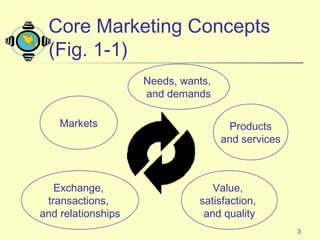
Core Marketing Concepts
(Fig. 1-1)
Needs, wants,
and demands
Products
and services
Value,
satisfaction,
and quality
Exchange,
transactions,
and relationships
Markets
4
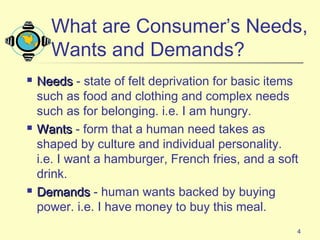
 NeedsNeeds - state of felt deprivation for basic items
such as food and clothing and complex needs
such as for belonging. i.e. I am hungry.
 WantsWants - form that a human need takes as
shaped by culture and individual personality.
i.e. I want a hamburger, French fries, and a soft
drink.
 DemandsDemands - human wants backed by buying
power. i.e. I have money to buy this meal.
What are Consumer’s Needs,
Wants and Demands?
5
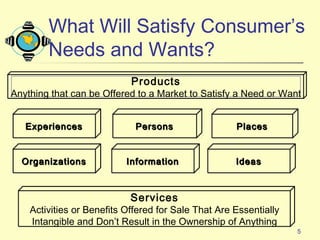
Products
Anything that can be Offered to a Market to Satisfy a Need or Want
ExperiencesExperiences PersonsPersons PlacesPlaces
OrganizationsOrganizations IdeasIdeasInformationInformation
What Will Satisfy Consumer’s
Needs and Wants?
Services
Activities or Benefits Offered for Sale That Are Essentially
Intangible and Don’t Result in the Ownership of Anything
6
How Do Consumers
Choose Among Products and
Services?
Total Quality Management Involves Improving
the Quality of Products, Services, and
Marketing Processes
Product’s Perceived Performance in Delivering
Value Relative to Buyer’s Expectations is
Customer Satisfaction
Value Gained From Owning a Product and
Costs of Obtaining the Product is
Customer Value
7
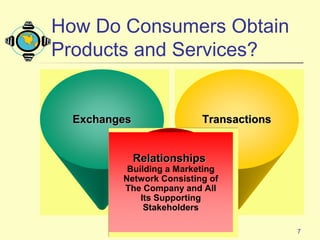
ExchangesExchanges TransactionsTransactions
RelationshipsRelationships
Building a Marketing
Network Consisting of
The Company and All
Its Supporting
Stakeholders
How Do Consumers Obtain
Products and Services?
8
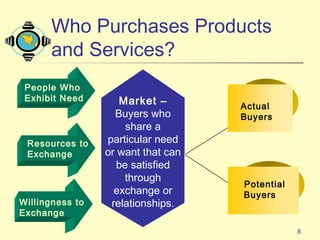
Who Purchases Products
and Services?
People Who
Exhibit Need
Resources to
Exchange
Willingness to
Exchange
Unexpected
Situational
Factors
Attitudes
of
Others
Ethical
Potential
Buyers
Market –
Buyers who
share a
particular need
or want that can
be satisfied
through
exchange or
relationships.
Actual
Buyers
9
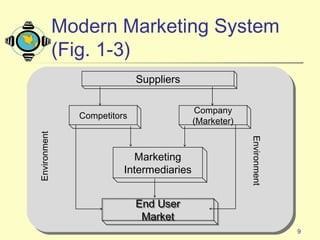
Suppliers
End User
Market
End User
Market
Marketing
Intermediaries
Competitors
Company
(Marketer)
Environment
Environment
Modern Marketing System
(Fig. 1-3)
Discussion Connections
 In your own words, what is marketing?
 What does marketing mean to you?
 Form small groups, and select a brand of athletic
shoes that a group member has purchased
recently.
 What Customer Value did the group member
expect?
 Did the member experience Customer
Satisfaction? Why or why not?
11
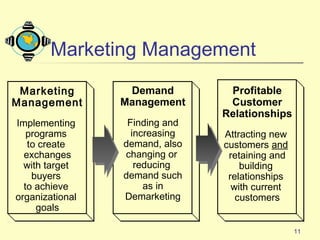
Marketing
Management
Implementing
programs
to create
exchanges
with target
buyers
to achieve
organizational
goals
Demand
Management
Finding and
increasing
demand, also
changing or
reducing
demand such
as in
Demarketing
Profitable
Customer
Relationships
Attracting new
customers and
retaining and
building
relationships
with current
customers
Marketing Management
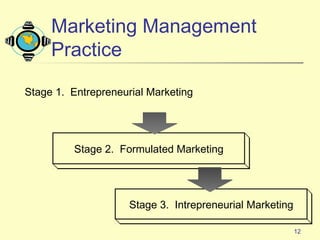
12
Stage 1. Entrepreneurial Marketing
Stage 2. Formulated Marketing
Stage 3. Intrepreneurial Marketing
Marketing Management
Practice
13
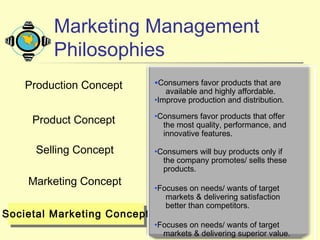
Production Concept
Product Concept
Selling Concept
Marketing Concept
Societal Marketing Concept
•Consumers favor products that are
available and highly affordable.
•Improve production and distribution.
•Consumers favor products that offer
the most quality, performance, and
innovative features.
•Consumers will buy products only if
the company promotes/ sells these
products.
•Focuses on needs/ wants of target
markets & delivering satisfaction
better than competitors.
•Focuses on needs/ wants of target
markets & delivering superior value.
Marketing Management
Philosophies
14
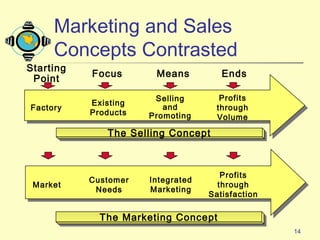
Marketing and Sales
Concepts Contrasted
Factory
Existing
Products
Selling
and
Promoting
Profits
through
Volume
The Selling ConceptThe Selling Concept
Starting
Point
Focus Means Ends
Market
Customer
Needs
Integrated
Marketing
Profits
through
Satisfaction
The Marketing ConceptThe Marketing Concept
15
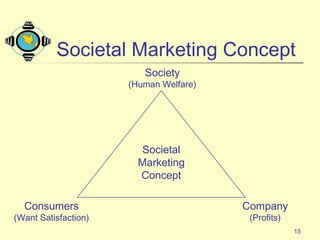
Societal Marketing Concept
Societal
Marketing
Concept
Company
(Profits)
Consumers
(Want Satisfaction)
Society
(Human Welfare)
16
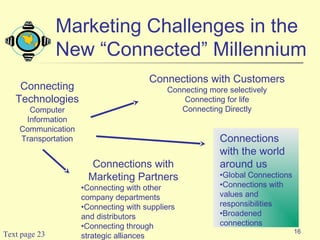
Marketing Challenges in the
New “Connected” Millennium
Text page 23
Connecting
Technologies
Computer
Information
Communication
Transportation
Connections with Customers
Connecting more selectively
Connecting for life
Connecting Directly
Connections with
Marketing Partners
•Connecting with other
company departments
•Connecting with suppliers
and distributors
•Connecting through
strategic alliances
Connections
with the world
around us
•Global Connections
•Connections with
values and
responsibilities
•Broadened
connections
17
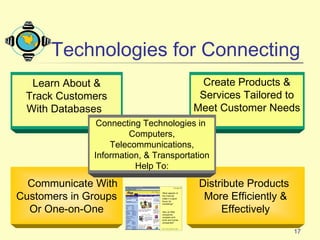
Learn About &
Track Customers
With Databases
Communicate With
Customers in Groups
Or One-on-One
Create Products &
Services Tailored to
Meet Customer Needs
Distribute Products
More Efficiently &
Effectively
Connecting Technologies in
Computers,
Telecommunications,
Information, & Transportation
Help To:
Technologies for Connecting
What aspects of
the Internet
make it a good
forum for
marketing?
How do Web
companies
compete with
brick and mortar
companies?
Click or press spacebar to return
Text page 26
18
The Internet
 The Internet has been hailed as the technology
behind a new model for doing business.
 New applications include:
 Internet – connecting with customers,
 Intranets – connecting with others in the company,
and
 Extranets – connecting with strategic partners,
suppliers, and dealers.
 Purchasing will be over $1.4 trillion in 2003.
 400,000 companies are now using the Internet
to do business.
19
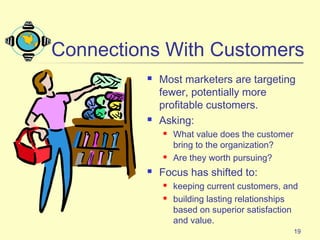
Connections With Customers
 Most marketers are targeting
fewer, potentially more
profitable customers.
 Asking:
 What value does the customer
bring to the organization?
 Are they worth pursuing?
 Focus has shifted to:
 keeping current customers, and
 building lasting relationships
based on superior satisfaction
and value.
20
Direct Connections With
Customers
 Many companies use technologies to let them
connect more directly with their customers.
 Products available via telephone, mail-order catalogs,
kiosks and e-commerce.
 Some firms sell only via direct channels (i.e. Dell
Computer, www.Amazon.com), others use a
combination.
 Direct marketing is redefining the buyer’s role in
connecting with sellers.
 Buyers are active participants in shaping the marketing
offer and process; some buyers design their own
products online such as at www.LandsEnd.com.
21
Connections With
Marketing’s Partners
 Connecting Inside the
Company
 Every employee must be
customer-focused
 Teams coordinate efforts
toward customers
 Connecting With
Outside Partners
 Supply Chain
Management
 Strategic Alliances
22
Review of Concept
Connections
 Define what marketing is and discuss its core
concepts.
 Explain the relationships between customer value,
satisfaction, and quality.
 Define marketing management and examine how
marketers manage demand and build profitable
customer relationships.
 Compare the five marketing management
philosophies.
 Analyze the major challenges facing marketers
heading into the next millennium.

Chapter 1 Creating and capturing customer value by Philip Kotler

  • 1.
    1 Chapter 1 Marketing ina Changing World: Creating Customer Value and Satisfaction
  • 2.
    2 What is Marketing? Processby which individuals and groups obtain what they needneed and wantwant through creating and exchanging productsexchanging products and value with others. Simply put: Marketing is the delivery of customer satisfaction at a profit.
  • 3.
    3 Core Marketing Concepts (Fig.1-1) Needs, wants, and demands Products and services Value, satisfaction, and quality Exchange, transactions, and relationships Markets
  • 4.
    4  NeedsNeeds -state of felt deprivation for basic items such as food and clothing and complex needs such as for belonging. i.e. I am hungry.  WantsWants - form that a human need takes as shaped by culture and individual personality. i.e. I want a hamburger, French fries, and a soft drink.  DemandsDemands - human wants backed by buying power. i.e. I have money to buy this meal. What are Consumer’s Needs, Wants and Demands?
  • 5.
    5 Products Anything that canbe Offered to a Market to Satisfy a Need or Want ExperiencesExperiences PersonsPersons PlacesPlaces OrganizationsOrganizations IdeasIdeasInformationInformation What Will Satisfy Consumer’s Needs and Wants? Services Activities or Benefits Offered for Sale That Are Essentially Intangible and Don’t Result in the Ownership of Anything
  • 6.
    6 How Do Consumers ChooseAmong Products and Services? Total Quality Management Involves Improving the Quality of Products, Services, and Marketing Processes Product’s Perceived Performance in Delivering Value Relative to Buyer’s Expectations is Customer Satisfaction Value Gained From Owning a Product and Costs of Obtaining the Product is Customer Value
  • 7.
    7 ExchangesExchanges TransactionsTransactions RelationshipsRelationships Building aMarketing Network Consisting of The Company and All Its Supporting Stakeholders How Do Consumers Obtain Products and Services?
  • 8.
    8 Who Purchases Products andServices? People Who Exhibit Need Resources to Exchange Willingness to Exchange Unexpected Situational Factors Attitudes of Others Ethical Potential Buyers Market – Buyers who share a particular need or want that can be satisfied through exchange or relationships. Actual Buyers
  • 9.
  • 10.
    Discussion Connections  Inyour own words, what is marketing?  What does marketing mean to you?  Form small groups, and select a brand of athletic shoes that a group member has purchased recently.  What Customer Value did the group member expect?  Did the member experience Customer Satisfaction? Why or why not?
  • 11.
    11 Marketing Management Implementing programs to create exchanges with target buyers toachieve organizational goals Demand Management Finding and increasing demand, also changing or reducing demand such as in Demarketing Profitable Customer Relationships Attracting new customers and retaining and building relationships with current customers Marketing Management
  • 12.
    12 Stage 1. EntrepreneurialMarketing Stage 2. Formulated Marketing Stage 3. Intrepreneurial Marketing Marketing Management Practice
  • 13.
    13 Production Concept Product Concept SellingConcept Marketing Concept Societal Marketing Concept •Consumers favor products that are available and highly affordable. •Improve production and distribution. •Consumers favor products that offer the most quality, performance, and innovative features. •Consumers will buy products only if the company promotes/ sells these products. •Focuses on needs/ wants of target markets & delivering satisfaction better than competitors. •Focuses on needs/ wants of target markets & delivering superior value. Marketing Management Philosophies
  • 14.
    14 Marketing and Sales ConceptsContrasted Factory Existing Products Selling and Promoting Profits through Volume The Selling ConceptThe Selling Concept Starting Point Focus Means Ends Market Customer Needs Integrated Marketing Profits through Satisfaction The Marketing ConceptThe Marketing Concept
  • 15.
  • 16.
    16 Marketing Challenges inthe New “Connected” Millennium Text page 23 Connecting Technologies Computer Information Communication Transportation Connections with Customers Connecting more selectively Connecting for life Connecting Directly Connections with Marketing Partners •Connecting with other company departments •Connecting with suppliers and distributors •Connecting through strategic alliances Connections with the world around us •Global Connections •Connections with values and responsibilities •Broadened connections
  • 17.
    17 Learn About & TrackCustomers With Databases Communicate With Customers in Groups Or One-on-One Create Products & Services Tailored to Meet Customer Needs Distribute Products More Efficiently & Effectively Connecting Technologies in Computers, Telecommunications, Information, & Transportation Help To: Technologies for Connecting What aspects of the Internet make it a good forum for marketing? How do Web companies compete with brick and mortar companies? Click or press spacebar to return Text page 26
  • 18.
    18 The Internet  TheInternet has been hailed as the technology behind a new model for doing business.  New applications include:  Internet – connecting with customers,  Intranets – connecting with others in the company, and  Extranets – connecting with strategic partners, suppliers, and dealers.  Purchasing will be over $1.4 trillion in 2003.  400,000 companies are now using the Internet to do business.
  • 19.
    19 Connections With Customers Most marketers are targeting fewer, potentially more profitable customers.  Asking:  What value does the customer bring to the organization?  Are they worth pursuing?  Focus has shifted to:  keeping current customers, and  building lasting relationships based on superior satisfaction and value.
  • 20.
    20 Direct Connections With Customers Many companies use technologies to let them connect more directly with their customers.  Products available via telephone, mail-order catalogs, kiosks and e-commerce.  Some firms sell only via direct channels (i.e. Dell Computer, www.Amazon.com), others use a combination.  Direct marketing is redefining the buyer’s role in connecting with sellers.  Buyers are active participants in shaping the marketing offer and process; some buyers design their own products online such as at www.LandsEnd.com.
  • 21.
    21 Connections With Marketing’s Partners Connecting Inside the Company  Every employee must be customer-focused  Teams coordinate efforts toward customers  Connecting With Outside Partners  Supply Chain Management  Strategic Alliances
  • 22.
    22 Review of Concept Connections Define what marketing is and discuss its core concepts.  Explain the relationships between customer value, satisfaction, and quality.  Define marketing management and examine how marketers manage demand and build profitable customer relationships.  Compare the five marketing management philosophies.  Analyze the major challenges facing marketers heading into the next millennium.