© 2013 by Cengage Learning Inc. All Rights Reserved.1
Lamb, Hair, McDaniel
Chapter 6
Consumer
Decision
Making
2012-2013
Explain why marketing managers should
understand consumer behavior
Analyze the components of the consumer
decision-making process
Explain the consumer’s postpurchase
evaluation process
Identify the types of consumer buying decisions
and discuss the significance of consumer
involvement
© 2013 by Cengage Learning Inc. All Rights Reserved. 2
1
2
3
4
Identify and understand the cultural factors that
affect consumer buying decisions
Identify and understand the social factors that
affect consumer buying decisions
Identify and understand the individual factors
that affect consumer buying decisions
Identify and understand the psychological
factors that affect consumer buying decisions
© 2013 by Cengage Learning Inc. All Rights Reserved. 3
5
6
7
8
Explain why marketing
managers
should understand
consumer behavior
The Importance of Understanding
Consumer Behavior
© 2013 by Cengage Learning Inc. All Rights Reserved.4
1
© 2013 by Cengage Learning Inc. All Rights Reserved. 5
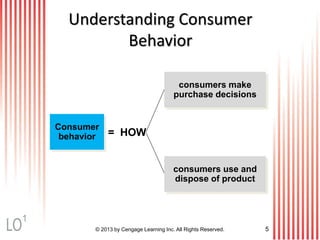
Understanding Consumer
Behavior
Consumer
behavior
consumers make
purchase decisions
consumers use and
dispose of product
= HOW
1
Analyze the components
of the consumer decision-
making process
© 2013 by Cengage Learning Inc. All Rights Reserved.6
The Consumer
Decision-Making Process
2
© 2013 by Cengage Learning Inc. All Rights Reserved. 7
Consumer
Decision-Making Process
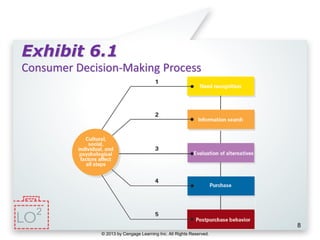
A five-step process used by consumers
when buying goods or services.
2
© 2013 by Cengage Learning Inc. All Rights Reserved.
8
Exhibit 6.1
Consumer Decision-Making Process
2
© 2013 by Cengage Learning Inc. All Rights Reserved. 9
Need Recognition
Result of an imbalance between actual and
desired states.
Need recognition is the first
stage in the decision-
making process
2
When “Need” Turns to Greed
• In 2011, a woman allegedly pepper sprayed
a crowd of shoppers reaching for discounted
Xbox 360s.
• Black Friday:
• Retailers offer their best bargains of the
year
• Consumers camp out for days at stores’
front doors
• Violent incidents were reported in at least
seven states during the 2011 Black Friday
sales, most occurring at or near Walmart
stores.
Michael Martinez, “Woman Surrenders in Black Friday Pepper Spray Incident,” CNN, November 26, 2011, http://articles.cnn.com/2011-11-
26/us/us_california-pepper-spray-suspect_1_pepper-spray-woman-surrenders-video-game?_s=PM:US (Accessed May 3, 2012).
© 2013 by Cengage Learning Inc. All Rights Reserved.10
© 2013 by Cengage Learning Inc. All Rights Reserved. 11
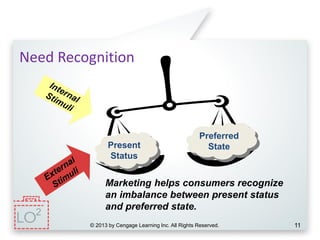
Need Recognition
Marketing helps consumers recognize
an imbalance between present status
and preferred state.
Present
Status
Preferred
State
2
© 2013 by Cengage Learning Inc. All Rights Reserved. 12
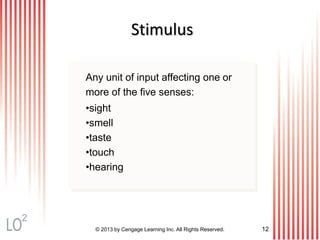
Stimulus
Any unit of input affecting one or
more of the five senses:
•sight
•smell
•taste
•touch
•hearing
2
© 2013 by Cengage Learning Inc. All Rights Reserved. 13
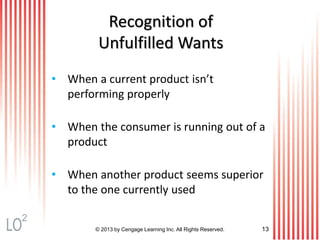
Recognition of
Unfulfilled Wants
• When a current product isn’t
performing properly
• When the consumer is running out of a
product
• When another product seems superior
to the one currently used
2
© 2013 by Cengage Learning Inc. All Rights Reserved. 14
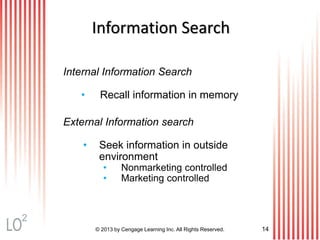
Information Search
Internal Information Search
• Recall information in memory
External Information search
• Seek information in outside
environment
• Nonmarketing controlled
• Marketing controlled
2
© 2013 by Cengage Learning Inc. All Rights Reserved. 15
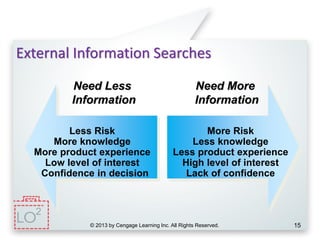
External Information Searches
Need More
Information
More Risk
Less knowledge
Less product experience
High level of interest
Lack of confidence
Less Risk
More knowledge
More product experience
Low level of interest
Confidence in decision
Need Less
Information
2
© 2013 by Cengage Learning Inc. All Rights Reserved. 16
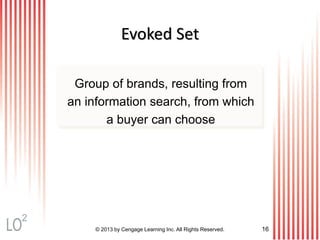
Evoked Set
Group of brands, resulting from
an information search, from which
a buyer can choose
2
© 2013 by Cengage Learning Inc. All Rights Reserved.
17
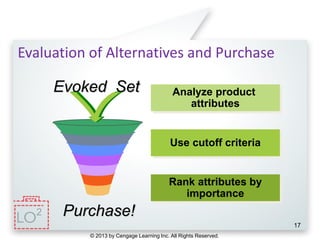
Evaluation of Alternatives and Purchase
Evoked Set
Purchase!
Analyze product
attributes
Rank attributes by
importance
Use cutoff criteria
2
© 2013 by Cengage Learning Inc. All Rights Reserved. 18
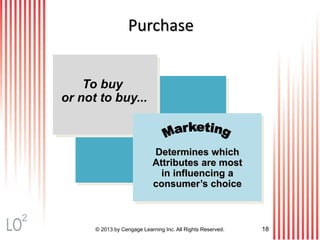
Purchase
To buy
or not to buy...
Determines which
Attributes are most
in influencing a
consumer’s choice
2
Explain the consumer’s
postpurchase evaluation
process
© 2013 by Cengage Learning Inc. All Rights Reserved.19
Postpurchase Behavior
3
© 2013 by Cengage Learning Inc. All Rights Reserved. 20
Cognitive Dissonance
Inner tension that a consumer
experiences after recognizing
an inconsistency between
behavior and values or
opinions.
3
© 2013 by Cengage Learning Inc. All Rights Reserved. 21
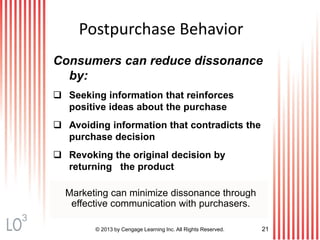
Postpurchase Behavior
Consumers can reduce dissonance
by:
 Seeking information that reinforces
positive ideas about the purchase
 Avoiding information that contradicts the
purchase decision
 Revoking the original decision by
returning the product
Marketing can minimize dissonance through
effective communication with purchasers.
3
Identify the types of
consumer buying decisions
and discuss the significance
of consumer involvement
© 2013 by Cengage Learning Inc. All Rights Reserved.22
Types of Consumer Buying Decisions
and Consumer Involvement
4
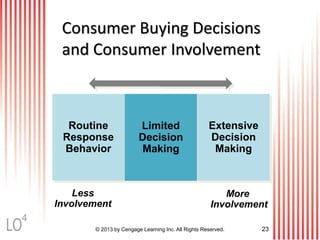
More
Involvement
Less
Involvement
Routine
Response
Behavior
Limited
Decision
Making
Extensive
Decision
Making
© 2013 by Cengage Learning Inc. All Rights Reserved. 23
Consumer Buying Decisions
and Consumer Involvement
4
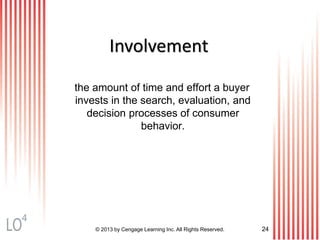
the amount of time and effort a buyer
invests in the search, evaluation, and
decision processes of consumer
behavior.
Involvement
© 2013 by Cengage Learning Inc. All Rights Reserved. 24
4
© 2013 by Cengage Learning Inc. All Rights Reserved.25
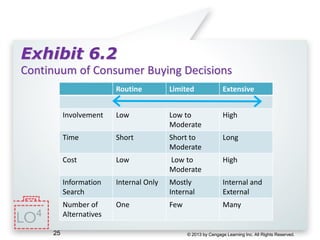
Exhibit 6.2
Continuum of Consumer Buying Decisions
Routine Limited Extensive
Involvement Low Low to
Moderate
High
Time Short Short to
Moderate
Long
Cost Low Low to
Moderate
High
Information
Search
Internal Only Mostly
Internal
Internal and
External
Number of
Alternatives
One Few Many
4
© 2013 by Cengage Learning Inc. All Rights Reserved. 26
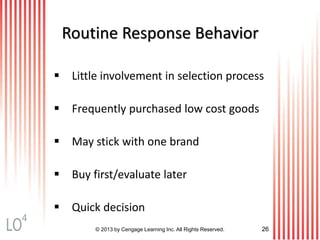
Routine Response Behavior
 Little involvement in selection process
 Frequently purchased low cost goods
 May stick with one brand
 Buy first/evaluate later
 Quick decision
4
© 2013 by Cengage Learning Inc. All Rights Reserved. 27
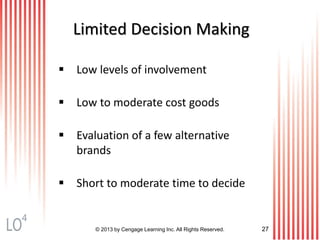
Limited Decision Making
 Low levels of involvement
 Low to moderate cost goods
 Evaluation of a few alternative
brands
 Short to moderate time to decide
4
© 2013 by Cengage Learning Inc. All Rights Reserved. 28
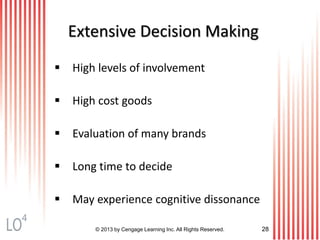
Extensive Decision Making
 High levels of involvement
 High cost goods
 Evaluation of many brands
 Long time to decide
 May experience cognitive dissonance
4
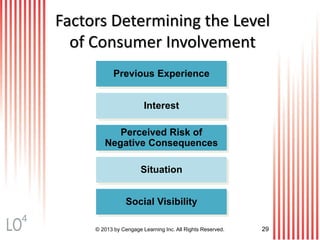
© 2013 by Cengage Learning Inc. All Rights Reserved. 29
Factors Determining the Level
of Consumer Involvement
Situation
Social Visibility
Interest
Perceived Risk of
Negative Consequences
Previous Experience
4
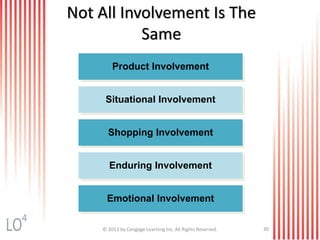
Not All Involvement Is The
Same
© 2013 by Cengage Learning Inc. All Rights Reserved. 30
Enduring Involvement
Emotional Involvement
Situational Involvement
Shopping Involvement
Product Involvement
4
© 2013 by Cengage Learning Inc. All Rights Reserved. 31
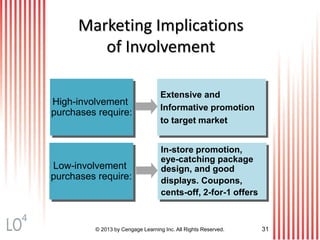
Marketing Implications
of Involvement
High-involvement
purchases require:
Extensive and
Informative promotion
to target market
Low-involvement
purchases require:
In-store promotion,
eye-catching package
design, and good
displays. Coupons,
cents-off, 2-for-1 offers
4
Identify and understand
the cultural factors that
affect consumer
buying decisions
© 2013 by Cengage Learning Inc. All Rights Reserved.32
Cultural Influences on
Consumer Buying Decisions
5
© 2013 by Cengage Learning Inc. All Rights Reserved. 33
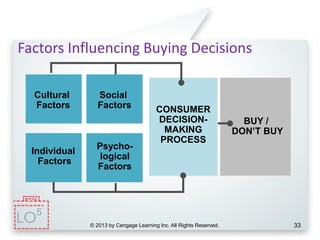
Factors Influencing Buying Decisions
Social
Factors
Individual
Factors
Psycho-
logical
Factors
Cultural
Factors CONSUMER
DECISION-
MAKING
PROCESS
BUY /
DON’T BUY
5
© 2013 by Cengage Learning Inc. All Rights Reserved. 34
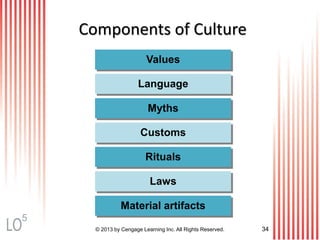
Components of Culture
Myths
Language
Values
Customs
Rituals
Laws
Material artifacts
5
© 2013 by Cengage Learning Inc. All Rights Reserved. 35
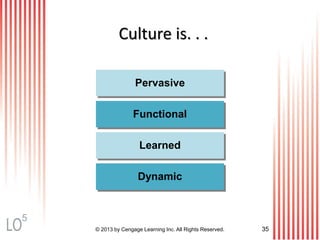
Culture is. . .
Learned
Functional
Pervasive
Dynamic
5
© 2013 by Cengage Learning Inc. All Rights Reserved. 36
Value
Enduring belief that a specific
mode of conduct is personally or
socially preferable to another
mode of conduct.
5
© 2013 by Cengage Learning Inc. All Rights Reserved. 37
Subculture
A homogeneous group
of people who share elements of the
overall culture as well as cultural
elements unique to their own group.
5
© 2013 by Cengage Learning Inc. All Rights Reserved. 38
Social Class
A group of people in a society who are
considered nearly equal in status or
community esteem, who regularly
socialize among themselves both
formally and informally, and who share
behavioral norms.
5
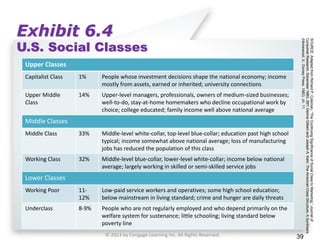
Exhibit 6.4
U.S. Social Classes
SOURCE:AdaptedfromRichardP.Coleman,“TheContinuingSignificanceofSocialClasstoMarketing,”Journalof
ConsumerResearch,December1983,267;DennisGilbertandJosephA.Kahl,TheAmericanClassStructure:ASynthesis
(Homewood,IL:DorseyPress,1982),ch.11.
© 2013 by Cengage Learning Inc. All Rights Reserved. 39
Upper Classes
Capitalist Class 1% People whose investment decisions shape the national economy; income
mostly from assets, earned or inherited; university connections
Upper Middle
Class
14% Upper-level managers, professionals, owners of medium-sized businesses;
well-to-do, stay-at-home homemakers who decline occupational work by
choice; college educated; family income well above national average
Middle Classes
Middle Class 33% Middle-level white-collar, top-level blue-collar; education past high school
typical; income somewhat above national average; loss of manufacturing
jobs has reduced the population of this class
Working Class 32% Middle-level blue-collar, lower-level white-collar; income below national
average; largely working in skilled or semi-skilled service jobs
Lower Classes
Working Poor 11-
12%
Low-paid service workers and operatives; some high school education;
below mainstream in living standard; crime and hunger are daily threats
Underclass 8-9% People who are not regularly employed and who depend primarily on the
welfare system for sustenance; little schooling; living standard below
poverty line
© 2013 by Cengage Learning Inc. All Rights Reserved. 40
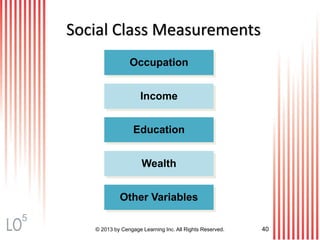
Social Class Measurements
Wealth
Other Variables
Income
Education
Occupation
5
© 2013 by Cengage Learning Inc. All Rights Reserved. 41
The Impact of
Social Class on Marketing
 Indicates which medium to use for
advertising
 Helps determine the best distribution
for products
5
Identify and understand
the social factors that
affect consumer buying
decisions
© 2013 by Cengage Learning Inc. All Rights Reserved.42
Social Influences on
Consumer Buying Decisions
6
© 2013 by Cengage Learning Inc. All Rights Reserved. 43
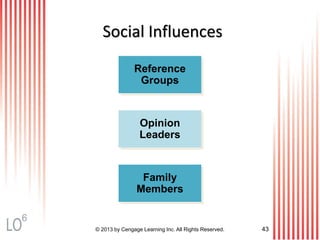
Social Influences
Reference
Groups
Opinion
Leaders
Family
Members
6
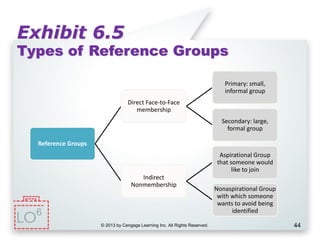
Exhibit 6.5
Types of Reference Groups
© 2013 by Cengage Learning Inc. All Rights Reserved. 44
Reference Groups
Direct Face-to-Face
membership
Primary: small,
informal group
Secondary: large,
formal group
Indirect
Nonmembership
Aspirational Group
that someone would
like to join
Nonaspirational Group
with which someone
wants to avoid being
identified6
© 2013 by Cengage Learning Inc. All Rights Reserved. 45
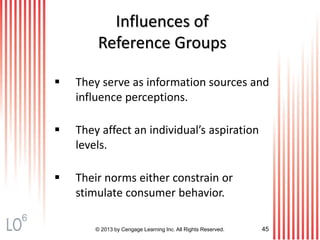
Influences of
Reference Groups
 They serve as information sources and
influence perceptions.
 They affect an individual’s aspiration
levels.
 Their norms either constrain or
stimulate consumer behavior.
6
The first to try new products and
services out of pure curiosity.
May be challenging to locate.
Marketers are increasingly using
blogs, social networking, and other
online media to determine and
attract opinion leaders.
© 2013 by Cengage Learning Inc. All Rights Reserved. 46
Opinion Leaders
6
© 2013 by Cengage Learning Inc. All Rights Reserved. 47
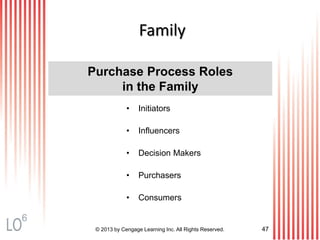
Family
• Initiators
• Influencers
• Decision Makers
• Purchasers
• Consumers
Purchase Process Roles
in the Family
6
Identify and understand
the individual factors that
affect consumer buying
decisions
© 2013 by Cengage Learning Inc. All Rights Reserved.48
Individual Influences on
Consumer Buying Decisions
7
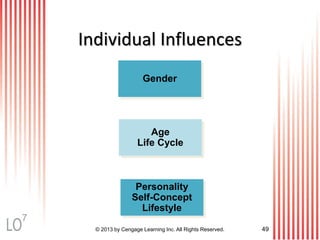
Individual Influences
Gender
Age
Life Cycle
Personality
Self-Concept
Lifestyle
© 2013 by Cengage Learning Inc. All Rights Reserved. 49
7
© 2013 by Cengage Learning Inc. All Rights Reserved. 50
Age and Family Life Cycle
Stage
• Consumer tastes in food, clothing,
cars, furniture, and recreation are
often age related.
• Marketers define target markets
according to life cycle stages such
as “young singles” or “young
married with children.”
7
© 2013 by Cengage Learning Inc. All Rights Reserved. 51
Personality, Self-Concept, and
Lifestyle
• Personality combines
psychological makeup and
environmental forces.
• Human behavior depends largely
on self-concept.
• Self-concept combines ideal self-
image and real self-image.
7
Identify and understand
the psychological factors
that affect consumer
buying decisions
© 2013 by Cengage Learning Inc. All Rights Reserved.52
Psychological Influences on
Consumer Buying Decisions
8
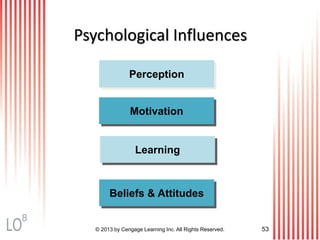
Psychological Influences
Perception
Motivation
Learning
Beliefs & Attitudes
© 2013 by Cengage Learning Inc. All Rights Reserved. 53
8
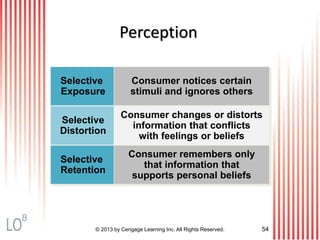
Perception
Selective
Exposure
Selective
Distortion
Selective
Retention
Consumer notices certain
stimuli and ignores others
Consumer changes or distorts
information that conflicts
with feelings or beliefs
Consumer remembers only
that information that
supports personal beliefs
© 2013 by Cengage Learning Inc. All Rights Reserved. 54
8
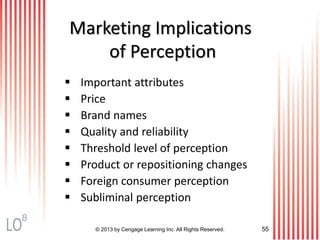
Marketing Implications
of Perception
© 2013 by Cengage Learning Inc. All Rights Reserved. 55
 Important attributes
 Price
 Brand names
 Quality and reliability
 Threshold level of perception
 Product or repositioning changes
 Foreign consumer perception
 Subliminal perception
8
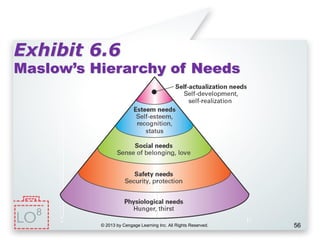
Exhibit 6.6
Maslow’s Hierarchy of Needs
© 2013 by Cengage Learning Inc. All Rights Reserved. 56
8
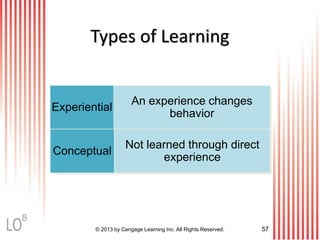
Types of Learning
Experiential
Conceptual
An experience changes
behavior
Not learned through direct
experience
© 2013 by Cengage Learning Inc. All Rights Reserved. 57
8
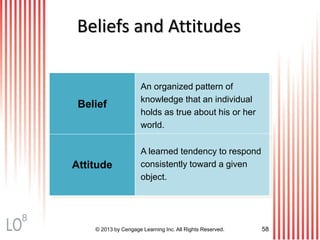
Belief
Attitude
An organized pattern of
knowledge that an individual
holds as true about his or her
world.
A learned tendency to respond
consistently toward a given
object.
Beliefs and Attitudes
© 2013 by Cengage Learning Inc. All Rights Reserved. 58
8
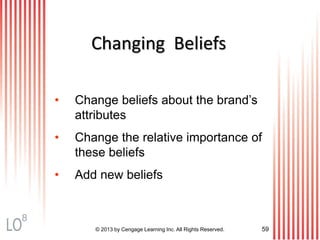
Changing Beliefs
• Change beliefs about the brand’s
attributes
• Change the relative importance of
these beliefs
• Add new beliefs
© 2013 by Cengage Learning Inc. All Rights Reserved. 59
8
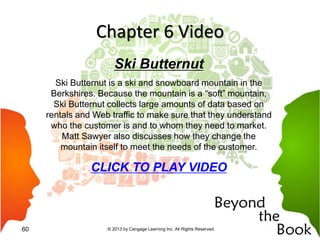
Chapter 6 Video
Ski Butternut
Ski Butternut is a ski and snowboard mountain in the
Berkshires. Because the mountain is a “soft” mountain,
Ski Butternut collects large amounts of data based on
rentals and Web traffic to make sure that they understand
who the customer is and to whom they need to market.
Matt Sawyer also discusses how they change the
mountain itself to meet the needs of the customer.
CLICK TO PLAY VIDEO
© 2013 by Cengage Learning Inc. All Rights Reserved.60

Chapter 6 Consumer Decision Making 2014

  • 1.
    © 2013 byCengage Learning Inc. All Rights Reserved.1 Lamb, Hair, McDaniel Chapter 6 Consumer Decision Making 2012-2013
  • 2.
    Explain why marketingmanagers should understand consumer behavior Analyze the components of the consumer decision-making process Explain the consumer’s postpurchase evaluation process Identify the types of consumer buying decisions and discuss the significance of consumer involvement © 2013 by Cengage Learning Inc. All Rights Reserved. 2 1 2 3 4
  • 3.
    Identify and understandthe cultural factors that affect consumer buying decisions Identify and understand the social factors that affect consumer buying decisions Identify and understand the individual factors that affect consumer buying decisions Identify and understand the psychological factors that affect consumer buying decisions © 2013 by Cengage Learning Inc. All Rights Reserved. 3 5 6 7 8
  • 4.
    Explain why marketing managers shouldunderstand consumer behavior The Importance of Understanding Consumer Behavior © 2013 by Cengage Learning Inc. All Rights Reserved.4 1
  • 5.
    © 2013 byCengage Learning Inc. All Rights Reserved. 5 Understanding Consumer Behavior Consumer behavior consumers make purchase decisions consumers use and dispose of product = HOW 1
  • 6.
    Analyze the components ofthe consumer decision- making process © 2013 by Cengage Learning Inc. All Rights Reserved.6 The Consumer Decision-Making Process 2
  • 7.
    © 2013 byCengage Learning Inc. All Rights Reserved. 7 Consumer Decision-Making Process A five-step process used by consumers when buying goods or services. 2
  • 8.
    © 2013 byCengage Learning Inc. All Rights Reserved. 8 Exhibit 6.1 Consumer Decision-Making Process 2
  • 9.
    © 2013 byCengage Learning Inc. All Rights Reserved. 9 Need Recognition Result of an imbalance between actual and desired states. Need recognition is the first stage in the decision- making process 2
  • 10.
    When “Need” Turnsto Greed • In 2011, a woman allegedly pepper sprayed a crowd of shoppers reaching for discounted Xbox 360s. • Black Friday: • Retailers offer their best bargains of the year • Consumers camp out for days at stores’ front doors • Violent incidents were reported in at least seven states during the 2011 Black Friday sales, most occurring at or near Walmart stores. Michael Martinez, “Woman Surrenders in Black Friday Pepper Spray Incident,” CNN, November 26, 2011, http://articles.cnn.com/2011-11- 26/us/us_california-pepper-spray-suspect_1_pepper-spray-woman-surrenders-video-game?_s=PM:US (Accessed May 3, 2012). © 2013 by Cengage Learning Inc. All Rights Reserved.10
  • 11.
    © 2013 byCengage Learning Inc. All Rights Reserved. 11 Need Recognition Marketing helps consumers recognize an imbalance between present status and preferred state. Present Status Preferred State 2
  • 12.
    © 2013 byCengage Learning Inc. All Rights Reserved. 12 Stimulus Any unit of input affecting one or more of the five senses: •sight •smell •taste •touch •hearing 2
  • 13.
    © 2013 byCengage Learning Inc. All Rights Reserved. 13 Recognition of Unfulfilled Wants • When a current product isn’t performing properly • When the consumer is running out of a product • When another product seems superior to the one currently used 2
  • 14.
    © 2013 byCengage Learning Inc. All Rights Reserved. 14 Information Search Internal Information Search • Recall information in memory External Information search • Seek information in outside environment • Nonmarketing controlled • Marketing controlled 2
  • 15.
    © 2013 byCengage Learning Inc. All Rights Reserved. 15 External Information Searches Need More Information More Risk Less knowledge Less product experience High level of interest Lack of confidence Less Risk More knowledge More product experience Low level of interest Confidence in decision Need Less Information 2
  • 16.
    © 2013 byCengage Learning Inc. All Rights Reserved. 16 Evoked Set Group of brands, resulting from an information search, from which a buyer can choose 2
  • 17.
    © 2013 byCengage Learning Inc. All Rights Reserved. 17 Evaluation of Alternatives and Purchase Evoked Set Purchase! Analyze product attributes Rank attributes by importance Use cutoff criteria 2
  • 18.
    © 2013 byCengage Learning Inc. All Rights Reserved. 18 Purchase To buy or not to buy... Determines which Attributes are most in influencing a consumer’s choice 2
  • 19.
    Explain the consumer’s postpurchaseevaluation process © 2013 by Cengage Learning Inc. All Rights Reserved.19 Postpurchase Behavior 3
  • 20.
    © 2013 byCengage Learning Inc. All Rights Reserved. 20 Cognitive Dissonance Inner tension that a consumer experiences after recognizing an inconsistency between behavior and values or opinions. 3
  • 21.
    © 2013 byCengage Learning Inc. All Rights Reserved. 21 Postpurchase Behavior Consumers can reduce dissonance by:  Seeking information that reinforces positive ideas about the purchase  Avoiding information that contradicts the purchase decision  Revoking the original decision by returning the product Marketing can minimize dissonance through effective communication with purchasers. 3
  • 22.
    Identify the typesof consumer buying decisions and discuss the significance of consumer involvement © 2013 by Cengage Learning Inc. All Rights Reserved.22 Types of Consumer Buying Decisions and Consumer Involvement 4
  • 23.
    More Involvement Less Involvement Routine Response Behavior Limited Decision Making Extensive Decision Making © 2013 byCengage Learning Inc. All Rights Reserved. 23 Consumer Buying Decisions and Consumer Involvement 4
  • 24.
    the amount oftime and effort a buyer invests in the search, evaluation, and decision processes of consumer behavior. Involvement © 2013 by Cengage Learning Inc. All Rights Reserved. 24 4
  • 25.
    © 2013 byCengage Learning Inc. All Rights Reserved.25 Exhibit 6.2 Continuum of Consumer Buying Decisions Routine Limited Extensive Involvement Low Low to Moderate High Time Short Short to Moderate Long Cost Low Low to Moderate High Information Search Internal Only Mostly Internal Internal and External Number of Alternatives One Few Many 4
  • 26.
    © 2013 byCengage Learning Inc. All Rights Reserved. 26 Routine Response Behavior  Little involvement in selection process  Frequently purchased low cost goods  May stick with one brand  Buy first/evaluate later  Quick decision 4
  • 27.
    © 2013 byCengage Learning Inc. All Rights Reserved. 27 Limited Decision Making  Low levels of involvement  Low to moderate cost goods  Evaluation of a few alternative brands  Short to moderate time to decide 4
  • 28.
    © 2013 byCengage Learning Inc. All Rights Reserved. 28 Extensive Decision Making  High levels of involvement  High cost goods  Evaluation of many brands  Long time to decide  May experience cognitive dissonance 4
  • 29.
    © 2013 byCengage Learning Inc. All Rights Reserved. 29 Factors Determining the Level of Consumer Involvement Situation Social Visibility Interest Perceived Risk of Negative Consequences Previous Experience 4
  • 30.
    Not All InvolvementIs The Same © 2013 by Cengage Learning Inc. All Rights Reserved. 30 Enduring Involvement Emotional Involvement Situational Involvement Shopping Involvement Product Involvement 4
  • 31.
    © 2013 byCengage Learning Inc. All Rights Reserved. 31 Marketing Implications of Involvement High-involvement purchases require: Extensive and Informative promotion to target market Low-involvement purchases require: In-store promotion, eye-catching package design, and good displays. Coupons, cents-off, 2-for-1 offers 4
  • 32.
    Identify and understand thecultural factors that affect consumer buying decisions © 2013 by Cengage Learning Inc. All Rights Reserved.32 Cultural Influences on Consumer Buying Decisions 5
  • 33.
    © 2013 byCengage Learning Inc. All Rights Reserved. 33 Factors Influencing Buying Decisions Social Factors Individual Factors Psycho- logical Factors Cultural Factors CONSUMER DECISION- MAKING PROCESS BUY / DON’T BUY 5
  • 34.
    © 2013 byCengage Learning Inc. All Rights Reserved. 34 Components of Culture Myths Language Values Customs Rituals Laws Material artifacts 5
  • 35.
    © 2013 byCengage Learning Inc. All Rights Reserved. 35 Culture is. . . Learned Functional Pervasive Dynamic 5
  • 36.
    © 2013 byCengage Learning Inc. All Rights Reserved. 36 Value Enduring belief that a specific mode of conduct is personally or socially preferable to another mode of conduct. 5
  • 37.
    © 2013 byCengage Learning Inc. All Rights Reserved. 37 Subculture A homogeneous group of people who share elements of the overall culture as well as cultural elements unique to their own group. 5
  • 38.
    © 2013 byCengage Learning Inc. All Rights Reserved. 38 Social Class A group of people in a society who are considered nearly equal in status or community esteem, who regularly socialize among themselves both formally and informally, and who share behavioral norms. 5
  • 39.
    Exhibit 6.4 U.S. SocialClasses SOURCE:AdaptedfromRichardP.Coleman,“TheContinuingSignificanceofSocialClasstoMarketing,”Journalof ConsumerResearch,December1983,267;DennisGilbertandJosephA.Kahl,TheAmericanClassStructure:ASynthesis (Homewood,IL:DorseyPress,1982),ch.11. © 2013 by Cengage Learning Inc. All Rights Reserved. 39 Upper Classes Capitalist Class 1% People whose investment decisions shape the national economy; income mostly from assets, earned or inherited; university connections Upper Middle Class 14% Upper-level managers, professionals, owners of medium-sized businesses; well-to-do, stay-at-home homemakers who decline occupational work by choice; college educated; family income well above national average Middle Classes Middle Class 33% Middle-level white-collar, top-level blue-collar; education past high school typical; income somewhat above national average; loss of manufacturing jobs has reduced the population of this class Working Class 32% Middle-level blue-collar, lower-level white-collar; income below national average; largely working in skilled or semi-skilled service jobs Lower Classes Working Poor 11- 12% Low-paid service workers and operatives; some high school education; below mainstream in living standard; crime and hunger are daily threats Underclass 8-9% People who are not regularly employed and who depend primarily on the welfare system for sustenance; little schooling; living standard below poverty line
  • 40.
    © 2013 byCengage Learning Inc. All Rights Reserved. 40 Social Class Measurements Wealth Other Variables Income Education Occupation 5
  • 41.
    © 2013 byCengage Learning Inc. All Rights Reserved. 41 The Impact of Social Class on Marketing  Indicates which medium to use for advertising  Helps determine the best distribution for products 5
  • 42.
    Identify and understand thesocial factors that affect consumer buying decisions © 2013 by Cengage Learning Inc. All Rights Reserved.42 Social Influences on Consumer Buying Decisions 6
  • 43.
    © 2013 byCengage Learning Inc. All Rights Reserved. 43 Social Influences Reference Groups Opinion Leaders Family Members 6
  • 44.
    Exhibit 6.5 Types ofReference Groups © 2013 by Cengage Learning Inc. All Rights Reserved. 44 Reference Groups Direct Face-to-Face membership Primary: small, informal group Secondary: large, formal group Indirect Nonmembership Aspirational Group that someone would like to join Nonaspirational Group with which someone wants to avoid being identified6
  • 45.
    © 2013 byCengage Learning Inc. All Rights Reserved. 45 Influences of Reference Groups  They serve as information sources and influence perceptions.  They affect an individual’s aspiration levels.  Their norms either constrain or stimulate consumer behavior. 6
  • 46.
    The first totry new products and services out of pure curiosity. May be challenging to locate. Marketers are increasingly using blogs, social networking, and other online media to determine and attract opinion leaders. © 2013 by Cengage Learning Inc. All Rights Reserved. 46 Opinion Leaders 6
  • 47.
    © 2013 byCengage Learning Inc. All Rights Reserved. 47 Family • Initiators • Influencers • Decision Makers • Purchasers • Consumers Purchase Process Roles in the Family 6
  • 48.
    Identify and understand theindividual factors that affect consumer buying decisions © 2013 by Cengage Learning Inc. All Rights Reserved.48 Individual Influences on Consumer Buying Decisions 7
  • 49.
    Individual Influences Gender Age Life Cycle Personality Self-Concept Lifestyle ©2013 by Cengage Learning Inc. All Rights Reserved. 49 7
  • 50.
    © 2013 byCengage Learning Inc. All Rights Reserved. 50 Age and Family Life Cycle Stage • Consumer tastes in food, clothing, cars, furniture, and recreation are often age related. • Marketers define target markets according to life cycle stages such as “young singles” or “young married with children.” 7
  • 51.
    © 2013 byCengage Learning Inc. All Rights Reserved. 51 Personality, Self-Concept, and Lifestyle • Personality combines psychological makeup and environmental forces. • Human behavior depends largely on self-concept. • Self-concept combines ideal self- image and real self-image. 7
  • 52.
    Identify and understand thepsychological factors that affect consumer buying decisions © 2013 by Cengage Learning Inc. All Rights Reserved.52 Psychological Influences on Consumer Buying Decisions 8
  • 53.
    Psychological Influences Perception Motivation Learning Beliefs &Attitudes © 2013 by Cengage Learning Inc. All Rights Reserved. 53 8
  • 54.
    Perception Selective Exposure Selective Distortion Selective Retention Consumer notices certain stimuliand ignores others Consumer changes or distorts information that conflicts with feelings or beliefs Consumer remembers only that information that supports personal beliefs © 2013 by Cengage Learning Inc. All Rights Reserved. 54 8
  • 55.
    Marketing Implications of Perception ©2013 by Cengage Learning Inc. All Rights Reserved. 55  Important attributes  Price  Brand names  Quality and reliability  Threshold level of perception  Product or repositioning changes  Foreign consumer perception  Subliminal perception 8
  • 56.
    Exhibit 6.6 Maslow’s Hierarchyof Needs © 2013 by Cengage Learning Inc. All Rights Reserved. 56 8
  • 57.
    Types of Learning Experiential Conceptual Anexperience changes behavior Not learned through direct experience © 2013 by Cengage Learning Inc. All Rights Reserved. 57 8
  • 58.
    Belief Attitude An organized patternof knowledge that an individual holds as true about his or her world. A learned tendency to respond consistently toward a given object. Beliefs and Attitudes © 2013 by Cengage Learning Inc. All Rights Reserved. 58 8
  • 59.
    Changing Beliefs • Changebeliefs about the brand’s attributes • Change the relative importance of these beliefs • Add new beliefs © 2013 by Cengage Learning Inc. All Rights Reserved. 59 8
  • 60.
    Chapter 6 Video SkiButternut Ski Butternut is a ski and snowboard mountain in the Berkshires. Because the mountain is a “soft” mountain, Ski Butternut collects large amounts of data based on rentals and Web traffic to make sure that they understand who the customer is and to whom they need to market. Matt Sawyer also discusses how they change the mountain itself to meet the needs of the customer. CLICK TO PLAY VIDEO © 2013 by Cengage Learning Inc. All Rights Reserved.60