Curriculum for Managing Infectious Diseases
in Early Education and Child Care Settings
Module 2
Preventing Infectious Diseases
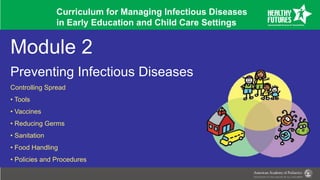
Controlling Spread
• Tools
• Vaccines
• Reducing Germs
• Sanitation
• Food Handling
• Policies and Procedures
Curriculum for Managing Infectious Diseases
in Early Education and Child Care Settings
Curriculum for Managing Infectious Diseases
in Early Education and Child Care Settings
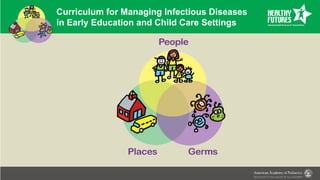
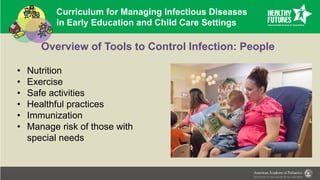
Overview of Tools to Control Infection: People
• Nutrition
• Exercise
• Safe activities
• Healthful practices
• Immunization
• Manage risk of those with
special needs
Curriculum for Managing Infectious Diseases
in Early Education and Child Care Settings
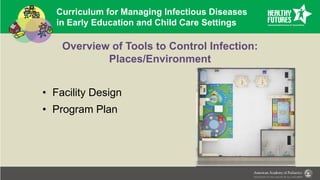
Overview of Tools to Control Infection:
Places/Environment
• Facility Design
• Program Plan
Curriculum for Managing Infectious Diseases
in Early Education and Child Care Settings
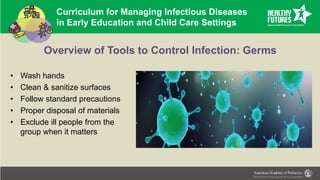
Overview of Tools to Control Infection: Germs
• Wash hands
• Clean & sanitize surfaces
• Follow standard precautions
• Proper disposal of materials
• Exclude ill people from the
group when it matters
Curriculum for Managing Infectious Diseases
in Early Education and Child Care Settings
Vaccines
Where can you find current
recommended adult and child
vaccine schedules?
Curriculum for Managing Infectious Diseases
in Early Education and Child Care Settings
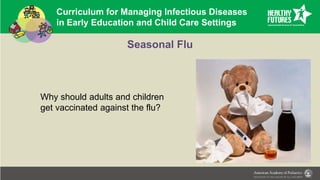
Seasonal Flu
Why should adults and children
get vaccinated against the flu?
Curriculum for Managing Infectious Diseases
in Early Education and Child Care Settings
Checking Vaccine Records
• How do you keep track of
immunization records?
• Why should early childhood
programs check vaccine
records?
• Why are so many people
overdue for vaccines?
Curriculum for Managing Infectious Diseases
in Early Education and Child Care Settings
Handwashing
• Make sinks, soap, and towels
available
• Wash hands at routine times
• Use good technique
• Have fun washing
• Soap and water are best
Curriculum for Managing Infectious Diseases
in Early Education and Child Care Settings
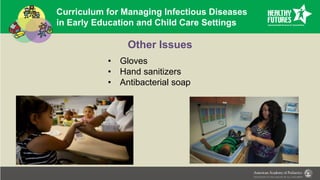
Other Issues
• Gloves
• Hand sanitizers
• Antibacterial soap
Curriculum for Managing Infectious Diseases
in Early Education and Child Care Settings
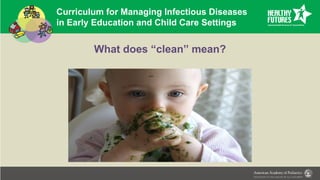
What does “clean” mean?
Curriculum for Managing Infectious Diseases
in Early Education and Child Care Settings
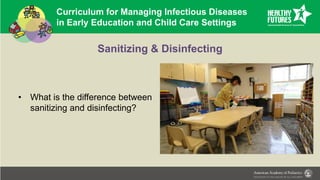
Sanitizing & Disinfecting
• What is the difference between
sanitizing and disinfecting?
Curriculum for Managing Infectious Diseases
in Early Education and Child Care Settings
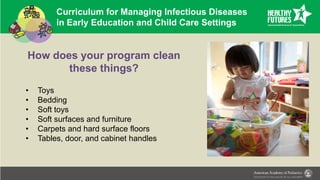
How does your program clean
these things?
• Toys
• Bedding
• Soft toys
• Soft surfaces and furniture
• Carpets and hard surface floors
• Tables, door, and cabinet handles
Curriculum for Managing Infectious Diseases
in Early Education and Child Care Settings
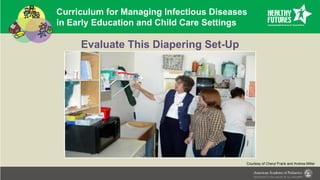
Evaluate This Diapering Set-Up
Courtesy of Cheryl Frank and Andrea Miller
Curriculum for Managing Infectious Diseases
in Early Education and Child Care Settings
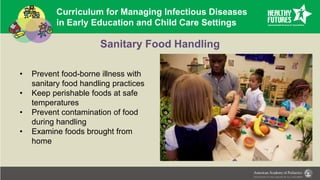
Sanitary Food Handling
• Prevent food-borne illness with
sanitary food handling practices
• Keep perishable foods at safe
temperatures
• Prevent contamination of food
during handling
• Examine foods brought from
home
Curriculum for Managing Infectious Diseases
in Early Education and Child Care Settings
Informing Parents and Child Care Staff
• Daily health check
• Talking with parents about
health policies
• Notification when children are ill
• Children with special needs
Curriculum for Managing Infectious Diseases
in Early Education and Child Care Settings
Policies and Procedures
• Caring for Our Children, National Health
and Safety Performance Standards,
fourth edition, kept updated online at
http://nrckids.org
• Model Child Care Health Policies at
www.ecels-healthychildcarepa.org
Curriculum for Managing Infectious Diseases
in Early Education and Child Care Settings
Policies and Procedures
• Does your program have clearly written
policies to minimize infectious illnesses?
• Do you share these policies with families
and child care staff?
• Do the policies need updating?
• What can you do to review and revise
your program policies to minimize
infectious illness?
Curriculum for Managing Infectious Diseases
in Early Education and Child Care Settings
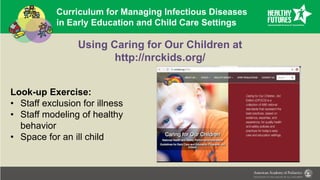
Using Caring for Our Children at
http://nrckids.org/
Look-up Exercise:
• Staff exclusion for illness
• Staff modeling of healthy
behavior
• Space for an ill child
Curriculum for Managing Infectious Diseases
in Early Education and Child Care Settings
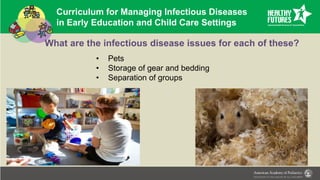
What are the infectious disease issues for each of these?
• Pets
• Storage of gear and bedding
• Separation of groups
Curriculum for Managing Infectious Diseases
in Early Education and Child Care Settings
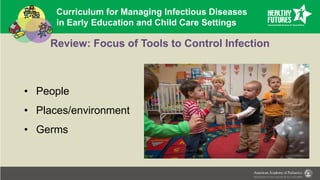
Review: Focus of Tools to Control Infection
• People
• Places/environment
• Germs
Acknowledgements
• This curriculum has been developed by the American Academy of Pediatrics (AAP). .
• The recommendations in this curriculum do not indicate an exclusive course of
treatment or serve as a standard of medical care. Variations, taking into account
individual circumstances, may be appropriate.
• Listing of resources does not imply an endorsement by the AAP. The AAP is not
responsible for the content of resources mentioned in this curriculum.
• Web site addresses are as current as possible, but may change at any time.
• Support for the Heathy Futures curricula has been provided through funding from
Johnson & Johnson Consumer Inc.
Acknowledgements
American Academy of Pediatrics
Council on Early Childhood
Reviewer:
Susan S. Aronson, MD, FAAP
Curriculum Content Consultant:
Kelly Towey, M.Ed.
Copyright Information
© Copyright 2019 American Academy of Pediatrics. All rights
reserved. Specific permission is granted to duplicate this
curriculum for distribution to child care providers for educational,
noncommercial purposes.

Module 2 Preventing Infectious Disease.pptx

  • 1.
    Curriculum for ManagingInfectious Diseases in Early Education and Child Care Settings Module 2 Preventing Infectious Diseases Controlling Spread • Tools • Vaccines • Reducing Germs • Sanitation • Food Handling • Policies and Procedures
  • 2.
    Curriculum for ManagingInfectious Diseases in Early Education and Child Care Settings
  • 3.
    Curriculum for ManagingInfectious Diseases in Early Education and Child Care Settings Overview of Tools to Control Infection: People • Nutrition • Exercise • Safe activities • Healthful practices • Immunization • Manage risk of those with special needs
  • 4.
    Curriculum for ManagingInfectious Diseases in Early Education and Child Care Settings Overview of Tools to Control Infection: Places/Environment • Facility Design • Program Plan
  • 5.
    Curriculum for ManagingInfectious Diseases in Early Education and Child Care Settings Overview of Tools to Control Infection: Germs • Wash hands • Clean & sanitize surfaces • Follow standard precautions • Proper disposal of materials • Exclude ill people from the group when it matters
  • 6.
    Curriculum for ManagingInfectious Diseases in Early Education and Child Care Settings Vaccines Where can you find current recommended adult and child vaccine schedules?
  • 7.
    Curriculum for ManagingInfectious Diseases in Early Education and Child Care Settings Seasonal Flu Why should adults and children get vaccinated against the flu?
  • 8.
    Curriculum for ManagingInfectious Diseases in Early Education and Child Care Settings Checking Vaccine Records • How do you keep track of immunization records? • Why should early childhood programs check vaccine records? • Why are so many people overdue for vaccines?
  • 9.
    Curriculum for ManagingInfectious Diseases in Early Education and Child Care Settings Handwashing • Make sinks, soap, and towels available • Wash hands at routine times • Use good technique • Have fun washing • Soap and water are best
  • 10.
    Curriculum for ManagingInfectious Diseases in Early Education and Child Care Settings Other Issues • Gloves • Hand sanitizers • Antibacterial soap
  • 11.
    Curriculum for ManagingInfectious Diseases in Early Education and Child Care Settings What does “clean” mean?
  • 12.
    Curriculum for ManagingInfectious Diseases in Early Education and Child Care Settings Sanitizing & Disinfecting • What is the difference between sanitizing and disinfecting?
  • 13.
    Curriculum for ManagingInfectious Diseases in Early Education and Child Care Settings How does your program clean these things? • Toys • Bedding • Soft toys • Soft surfaces and furniture • Carpets and hard surface floors • Tables, door, and cabinet handles
  • 14.
    Curriculum for ManagingInfectious Diseases in Early Education and Child Care Settings Evaluate This Diapering Set-Up Courtesy of Cheryl Frank and Andrea Miller
  • 15.
    Curriculum for ManagingInfectious Diseases in Early Education and Child Care Settings Sanitary Food Handling • Prevent food-borne illness with sanitary food handling practices • Keep perishable foods at safe temperatures • Prevent contamination of food during handling • Examine foods brought from home
  • 16.
    Curriculum for ManagingInfectious Diseases in Early Education and Child Care Settings Informing Parents and Child Care Staff • Daily health check • Talking with parents about health policies • Notification when children are ill • Children with special needs
  • 17.
    Curriculum for ManagingInfectious Diseases in Early Education and Child Care Settings Policies and Procedures • Caring for Our Children, National Health and Safety Performance Standards, fourth edition, kept updated online at http://nrckids.org • Model Child Care Health Policies at www.ecels-healthychildcarepa.org
  • 18.
    Curriculum for ManagingInfectious Diseases in Early Education and Child Care Settings Policies and Procedures • Does your program have clearly written policies to minimize infectious illnesses? • Do you share these policies with families and child care staff? • Do the policies need updating? • What can you do to review and revise your program policies to minimize infectious illness?
  • 19.
    Curriculum for ManagingInfectious Diseases in Early Education and Child Care Settings Using Caring for Our Children at http://nrckids.org/ Look-up Exercise: • Staff exclusion for illness • Staff modeling of healthy behavior • Space for an ill child
  • 20.
    Curriculum for ManagingInfectious Diseases in Early Education and Child Care Settings What are the infectious disease issues for each of these? • Pets • Storage of gear and bedding • Separation of groups
  • 21.
    Curriculum for ManagingInfectious Diseases in Early Education and Child Care Settings Review: Focus of Tools to Control Infection • People • Places/environment • Germs
  • 22.
    Acknowledgements • This curriculumhas been developed by the American Academy of Pediatrics (AAP). . • The recommendations in this curriculum do not indicate an exclusive course of treatment or serve as a standard of medical care. Variations, taking into account individual circumstances, may be appropriate. • Listing of resources does not imply an endorsement by the AAP. The AAP is not responsible for the content of resources mentioned in this curriculum. • Web site addresses are as current as possible, but may change at any time. • Support for the Heathy Futures curricula has been provided through funding from Johnson & Johnson Consumer Inc.
  • 23.
    Acknowledgements American Academy ofPediatrics Council on Early Childhood Reviewer: Susan S. Aronson, MD, FAAP Curriculum Content Consultant: Kelly Towey, M.Ed.
  • 24.
    Copyright Information © Copyright2019 American Academy of Pediatrics. All rights reserved. Specific permission is granted to duplicate this curriculum for distribution to child care providers for educational, noncommercial purposes.