More Related Content

PPTX
KIU BNSE 1.1 INFECTION nursing practice.pptx 
DOCX
Sufian Iskandar Infection Worksheet 
PPTX
MICROBIOLOGY �IN CLINICAL PRACTICE� what infection means? 
PDF
Student Apply Infection Prevention Techniques & workplace OHS final 2024.pdf 
PDF
Student_Apply_Infection_Prevention_Techniques_&_workplace_OHS_final (2).pdf 
PPTX
1 Nature of infection.pptx 
PPTX
1 Nature of infection.pptx 
PPTX
Apply Infection Prevention Techniques & workplace OHS final 2024.pptx Similar to Introduction to Healthcare: The Importance of Infection Control

PPTX
Apply_Infection_Prevention_Techniques_&_workplace_OHS_final_2024 (2).pptx 
PPTX
GG Apply_Infection_Prevention_Techniques_&_workplace_OHS 
PPTX
Apply_Infection_Prevention_Techniques_&_workplace_OHS_final_2024.pptx 
PPTX
Infection Control & Prevention 
PPTX

PPTX
BASIC NURSING,FIRST AID AND STERILIZATION.pptx 
PPTX

PPTX
infectioncontrolprevention-PRESENTED BY DLER.pptx 
PPT

PPTX

PPT

PPTX
Infection control concepts 
PDF
Infection Control Measures; Basic concepts 
PPTX
aster infection prevention nurse first year27.pptx 
PDF
IPC for presentation.pdf for health care 
PPTX

PPTX

PPT
Role of microbes lecture.... 1 2022-1.ppt 
PPT
Role of microbes lecture 1 2022-...1.ppt 
PPTX
More from Earlene McNair

PPTX
Personal Characteristics of Healthcare 06 26 25.pptx 
PPTX
Chapter 11 Nutrition and Chronic Diseases.pptx 
PPTX
Module 2 Preventing Infectious Disease.pptx 
PPTX
Module 6 HelmetSafety.pptx 
PPTX
Module 5 MedicationSafety.pptx 
PPTX
Module 4 PlaygroundSafety.pptx 
PPTX
Module 3 TransportationSafety.pptx 
PPTX
Module 2 Burn Prevention.pptx 
PPTX
Module 1 Introduction to Safety and Injury Prevention.pptx 
PPTX
SC NUT CHAPTER 2 Designing a Healthful Diet 11 12 23.pptx 
PPTX
PEARSON Chapter 7 Feeding Toddlers and Preschoolers.pptx 
PPTX
PEARSON Chapter 6 Feeding Infants.pptx 
PPTX
Chapter 16 Feeding Toddlers & Young Children 
PPTX
Chapter 15 Feeding Infants 
PPTX
PEARSON CHAPTER 1 CHILD WELL BEING.pptx 
PPTX
SC NUT CANVAS 16 Food Equity Sustain and Quality.pptx 
PPTX
CHAPTER 14 Nutrition and Physical Keys to Good Health.pptx 
PPTX
CHAPTER 13 Achieving and Maintaining a Healthful Weight.pptx 
PPTX
CHAPTER 8 WATER Section.pptx 
PPTX
CHAPTER 8 MINERALS Section.pptx Recently uploaded

PPTX
Gallbladder Stones Treatment__ in Hyderabad, India. 
PPTX
Outbound Medical Tourism from Bangladesh (2024–2025): A BHA Analysis of the B... 
PDF
Shane Hemsley Beals Audet ASHA 2025 Presentation on Gestalt Language Processi... 
PDF
Interstitial Lung Disease Stem Cell Therapy.pdf 
DOCX
Pharmaceutical Quality Audits for Regulatory Compliance and Risk Management.docx 
PPTX
Supraventricular tachycardia presentation.pptx 
PPT
children rights.ppt child rights CHN nursing 
PPT
Physiological changes in pregnancy 2.ppt 
PPTX
Anti hyperensive Colo +Med Chem _4490128.pptx 
PPTX
ISO 9000 & ISO 14000 in Pharmaceutical Quality and Environmental Management.pptx 
PDF
Hypertension-ppt.pdf clinical pharmacy presentation 
PPTX
NanYang Polytechnic Certificates 
PPTX
Acute Liver Failure causes, pathology, treatment 
PDF
Palliative Care vs. Curative Care | VITAS Healthcare 
PPTX
The Renal System Pathology and it’s relation 
PPTX
HOSPITAL SAFETY.pptx......................... 
PDF
Sanitary Hygiene_808858bd-d537-48df-8934-c77ce81b9a97.pdf 
PPTX
breathing exercise for repiratory problem 
PPTX
Product_Registration_Guidelines_CDSCO_USFDA.pptx 
PPTX
CIRCULATORY SYSTEM for first year Nursing students Introduction to Healthcare: The Importance of Infection Control
- 1.
Haroun/Mitchell/Grammater, Introduction toHealth Care, 6th Edition. © 2025 Cengage. All Rights Reserved. May not be scanned,
copied or duplicated, or posted to a publicly accessible website, in whole or in part. 1
1
Introduction to
Health Care, 6e
Chapter 11: Infection Control
Haroun/Mitchell/Grammater, Introduction to Health Care, 6th Edition. © 2025 Cengage. All Rights Reserved. May not be
scanned, copied or duplicated, or posted to a publicly accessible website, in whole or in part.
- 2.
Haroun/Mitchell/Grammater, Introduction toHealth Care, 6th Edition. © 2025 Cengage. All Rights Reserved. May not be scanned,
copied or duplicated, or posted to a publicly accessible website, in whole or in part. 2
Chapter Objectives (1 of 2)
By the end of this chapter, you should be able to:
11.01 Explain the importance of infection control practices in the health care
facility to maintain the safety of the health care professional, patients, and
others.
11.02 Describe methods of infection prevention.
11.03 Explain the importance of proper hand hygiene.
11.04 Describe types of microbes and the infections they may cause.
11.05 Explain the importance of personal protective equipment and standard
precautions.
- 3.
Haroun/Mitchell/Grammater, Introduction toHealth Care, 6th Edition. © 2025 Cengage. All Rights Reserved. May not be scanned,
copied or duplicated, or posted to a publicly accessible website, in whole or in part. 3
Chapter Objectives (2 of 2)
By the end of this chapter, you should be able to:
11.06 Describe the chain of infection as a model for explaining how
infection spreads.
11.07 Explain the risks of exposure for the health care worker and
methods of prevention.
11.08 Summarize the ways pathogens may be transmitted.
11.09 Describe how pathogens become drug resistant and the impact
this has on health care.
- 4.
Haroun/Mitchell/Grammater, Introduction toHealth Care, 6th Edition. © 2025 Cengage. All Rights Reserved. May not be scanned,
copied or duplicated, or posted to a publicly accessible website, in whole or in part. 4
Importance of Infection Control in Health
Care (1 of 3)
• Infection control
− Primary goal: to prevent spread of infectious diseases
• Infectious disease
− Any disease caused by the growth of pathogens
• Pathogens
− Disease-causing microorganisms (germs)
- 5.
Haroun/Mitchell/Grammater, Introduction toHealth Care, 6th Edition. © 2025 Cengage. All Rights Reserved. May not be scanned,
copied or duplicated, or posted to a publicly accessible website, in whole or in part. 5
Importance of Infection Control in Health
Care (2 of 3)
• Epidemic
− Widespread occurrences of infectious disease
• Pandemic
− Disease spread over a wide area, even worldwide
- 6.
Haroun/Mitchell/Grammater, Introduction toHealth Care, 6th Edition. © 2025 Cengage. All Rights Reserved. May not be scanned,
copied or duplicated, or posted to a publicly accessible website, in whole or in part. 6
Importance of Infection Control in Health
Care (3 of 3)
Infections are classified in two ways
• Generalized (systemic) infections
− Affecting whole body
− May include headache, fever, fatigue, vomiting, increase in pulse and
respiration
• Localized infections
− Affect one area of body
− Red, swollen, warm, and painful with possible drainage
- 7.
Haroun/Mitchell/Grammater, Introduction toHealth Care, 6th Edition. © 2025 Cengage. All Rights Reserved. May not be scanned,
copied or duplicated, or posted to a publicly accessible website, in whole or in part. 7
Scope of the Problem (1 of 3)
Health care facilities can be the source of infections
• Higher concentration of germs
• Patients with low immunity due to illness
• Health care workers have frequent contact with body fluids
- 8.
Haroun/Mitchell/Grammater, Introduction toHealth Care, 6th Edition. © 2025 Cengage. All Rights Reserved. May not be scanned,
copied or duplicated, or posted to a publicly accessible website, in whole or in part. 8
Scope of the Problem (2 of 3)
• Nosocomial infections
− Infections that occur while a patient is receiving health care
− Also known as HIA (health care-associated infections)
− Account for 99,000 deaths each year in the U.S.
- 9.
Haroun/Mitchell/Grammater, Introduction toHealth Care, 6th Edition. © 2025 Cengage. All Rights Reserved. May not be scanned,
copied or duplicated, or posted to a publicly accessible website, in whole or in part. 9
Scope of the Problem (3 of 3)
Occupational risks to health care workers
• Industrial illness
− When an employee contracts an infectious disease at work
Examples: HIV, hepatitis B, hepatitis C
Sharps injuries
− Penetrating stab wounds from needles and scalpels, resulting in
exposure to blood or other bodily fluids
− Needlestick injuries comprise high number of sharps injuries
- 10.
Haroun/Mitchell/Grammater, Introduction toHealth Care, 6th Edition. © 2025 Cengage. All Rights Reserved. May not be scanned,
copied or duplicated, or posted to a publicly accessible website, in whole or in part. 10
Regulatory Agencies
• Centers for Disease Control and Prevention (CDC)
− Part of the U.S. Dept. of Health and Human Services
− Makes safety guidelines for prevention and control of disease
− Studies causes and distribution of diseases
• Occupational Safety and Health Administration (OSHA)
− Under the U.S. Dept. of Labor
− Establishes and enforces workplace health and safety standards
- 11.
Haroun/Mitchell/Grammater, Introduction toHealth Care, 6th Edition. © 2025 Cengage. All Rights Reserved. May not be scanned,
copied or duplicated, or posted to a publicly accessible website, in whole or in part. 11
Microorganisms (1 of 5)
• Very small, usually one-celled, living plants and animals
− Cannot be seen with naked eye but can be harmful
• Normal flora
− Non-harmful microorganisms that live in or on the body
− Some necessary for normal body function
- 12.
Haroun/Mitchell/Grammater, Introduction toHealth Care, 6th Edition. © 2025 Cengage. All Rights Reserved. May not be scanned,
copied or duplicated, or posted to a publicly accessible website, in whole or in part. 12
Microorganisms (2 of 5)
• Immune response
− Body’s defense against infection
• Antibodies
− Protective proteins the body uses to fight infection
• Opportunistic infection
− An infection that occurs due to body’s weakened condition
− Physical health, nutritional state, other factors determine level of
weakness
- 13.
Haroun/Mitchell/Grammater, Introduction toHealth Care, 6th Edition. © 2025 Cengage. All Rights Reserved. May not be scanned,
copied or duplicated, or posted to a publicly accessible website, in whole or in part. 13
Microorganisms (3 of 5)
• Aerobic
− Need oxygen to live
• Anaerobic
− Do not require oxygen to live
• Preferred environment
− Warm, dark, moist, with food supply
− Human body provides ideal environment for growth
- 14.
Haroun/Mitchell/Grammater, Introduction toHealth Care, 6th Edition. © 2025 Cengage. All Rights Reserved. May not be scanned,
copied or duplicated, or posted to a publicly accessible website, in whole or in part. 14
Microorganisms (4 of 5)
• Hosts
− Where a microorganism derives nutrients for growth and reproduction
− Can be nonliving material or living organisms
• Symbiosis
− When microorganism is beneficial to the host
- 15.
Haroun/Mitchell/Grammater, Introduction toHealth Care, 6th Edition. © 2025 Cengage. All Rights Reserved. May not be scanned,
copied or duplicated, or posted to a publicly accessible website, in whole or in part. 15
Microorganisms (5 of 5)
• Neutralism
− When host is not affected by a microorganism
• Parasitic
− When a microorganism causes damage to the host
− An organism that nourishes itself at the expense of host is a parasite
- 16.
Haroun/Mitchell/Grammater, Introduction toHealth Care, 6th Edition. © 2025 Cengage. All Rights Reserved. May not be scanned,
copied or duplicated, or posted to a publicly accessible website, in whole or in part. 16
Types of Microbes
Microbes are microorganisms that cause disease
• Classifications of microbes
− Bacteria
− Viruses
− Fungi
− Rickettsia
− Protozoa
- 17.
Haroun/Mitchell/Grammater, Introduction toHealth Care, 6th Edition. © 2025 Cengage. All Rights Reserved. May not be scanned,
copied or duplicated, or posted to a publicly accessible website, in whole or in part. 17
Bacteria (1 of 2)
• One-celled organisms
• Can be pathogenic or nonpathogenic
• Colony: a group of bacteria
• Categorized according to shape
− Round
− Rod
− Spiral
• Each shape causes certain diseases and conditions
- 18.
Haroun/Mitchell/Grammater, Introduction toHealth Care, 6th Edition. © 2025 Cengage. All Rights Reserved. May not be scanned,
copied or duplicated, or posted to a publicly accessible website, in whole or in part. 18
Bacteria (2 of 2)
• Most bacterial infections can be treated with antibiotics
− Destroy bacteria or inhibit its growth
− Specific drugs attack specific types of bacteria
• Lab method used to identify the category of a microbe
− Gram staining and cultures
• Spores
− Thick protective capsule around bacterial cells
− Can be dormant for years, resistant to disinfectants and heat
− Can be killed by high-temperature steam sterilization
- 19.
Haroun/Mitchell/Grammater, Introduction toHealth Care, 6th Edition. © 2025 Cengage. All Rights Reserved. May not be scanned,
copied or duplicated, or posted to a publicly accessible website, in whole or in part. 19
Viruses (1 of 2)
• Smallest type of microbe
• Incomplete cells
− Depend on living cells for nutrients and reproduction
• Causes common cold, influenza, chicken pox, hepatitis B, acquired
immune deficiency syndrome (AIDS), measles, mumps, herpes, and
others
- 20.
Haroun/Mitchell/Grammater, Introduction toHealth Care, 6th Edition. © 2025 Cengage. All Rights Reserved. May not be scanned,
copied or duplicated, or posted to a publicly accessible website, in whole or in part. 20
Viruses (2 of 2)
• Difficult to treat
− Multiply quickly
− Easily transmitted by blood and other body secretions
− Resistant to disinfectants
− No drugs available to destroy them
• Antiviral medications inhibit symptoms but do not destroy viruses
− 3 FDA approved drugs inhibit influenza (flu) viruses
− 4 FDA approved treatment options for COVID-19 viruses
- 21.
Haroun/Mitchell/Grammater, Introduction toHealth Care, 6th Edition. © 2025 Cengage. All Rights Reserved. May not be scanned,
copied or duplicated, or posted to a publicly accessible website, in whole or in part. 21
Fungi (1 of 2)
• Neither a plant nor an animal
− Unique organisms
− Rely on animal and vegetable forms of life for survival
• Two types of fungi are potentially pathogenic
− Yeasts: one-celled
− Molds: multi-celled
• Many are nonpathogenic
− Penicillin is produced from mold
- 22.
Haroun/Mitchell/Grammater, Introduction toHealth Care, 6th Edition. © 2025 Cengage. All Rights Reserved. May not be scanned,
copied or duplicated, or posted to a publicly accessible website, in whole or in part. 22
Fungi (2 of 2)
• Some cause chronic, recurrent infections
− Superficial infections of the skin or mucous membranes
− Ringworm; athlete’s foot; infections of skin, scalp, hair follicles
• Systemic infections
− Most serious and very difficult or impossible to treat or cure
− Example is histoplasmosis (a respiratory disease)
− Treatment is toxic to humans, patients are monitored closely
- 23.
Haroun/Mitchell/Grammater, Introduction toHealth Care, 6th Edition. © 2025 Cengage. All Rights Reserved. May not be scanned,
copied or duplicated, or posted to a publicly accessible website, in whole or in part. 23
Rickettsia
• Much smaller than bacteria
• Parasitic
− Like viruses, must live inside another organism
• Causes typhus and Rocky Mountain spotted fever
− Can be passed through the bite of fleas, lice, ticks, and mites
• Not common today, but occasional outbreaks in highly unsanitary
conditions
− Homeless populations
- 24.
Haroun/Mitchell/Grammater, Introduction toHealth Care, 6th Edition. © 2025 Cengage. All Rights Reserved. May not be scanned,
copied or duplicated, or posted to a publicly accessible website, in whole or in part. 24
Protozoa
• The only organisms classified as animals
• Consist of one cell
• More than 50,000 types identified in and on the body
• Found in decayed materials, water contaminated with sewage waste,
bird and animal feces, insect bites
• Cause of dysentery (traveler’s diarrhea), trichomoniasis (an STD), and
malaria
- 25.
Haroun/Mitchell/Grammater, Introduction toHealth Care, 6th Edition. © 2025 Cengage. All Rights Reserved. May not be scanned,
copied or duplicated, or posted to a publicly accessible website, in whole or in part. 25
Defense Mechanisms
• Defense mechanisms and a strong immune system can often protect the
body from illness
− Cilia in respiratory tract catch and remove pathogens
− Coughs and sneezes propel pathogens outward
− Tears contain chemicals that kill bacteria
− Hydrochloric acid in stomach kills bacteria
− Mucous membranes trap pathogens
− Rise in body temperature kills microorganisms
− Increase in leukocytes kill pathogens
- 26.
Haroun/Mitchell/Grammater, Introduction toHealth Care, 6th Edition. © 2025 Cengage. All Rights Reserved. May not be scanned,
copied or duplicated, or posted to a publicly accessible website, in whole or in part. 26
How Infections Spread (1 of 2)
The chain of infection model explains how diseases are spread
• Links in the chain
− Infectious agent
− Reservoir host
− Portal of exit
− Route of transmission
− Portal of entry
− Susceptible host
- 27.
Haroun/Mitchell/Grammater, Introduction toHealth Care, 6th Edition. © 2025 Cengage. All Rights Reserved. May not be scanned,
copied or duplicated, or posted to a publicly accessible website, in whole or in part. 27
How Infections Spread (2 of 2)
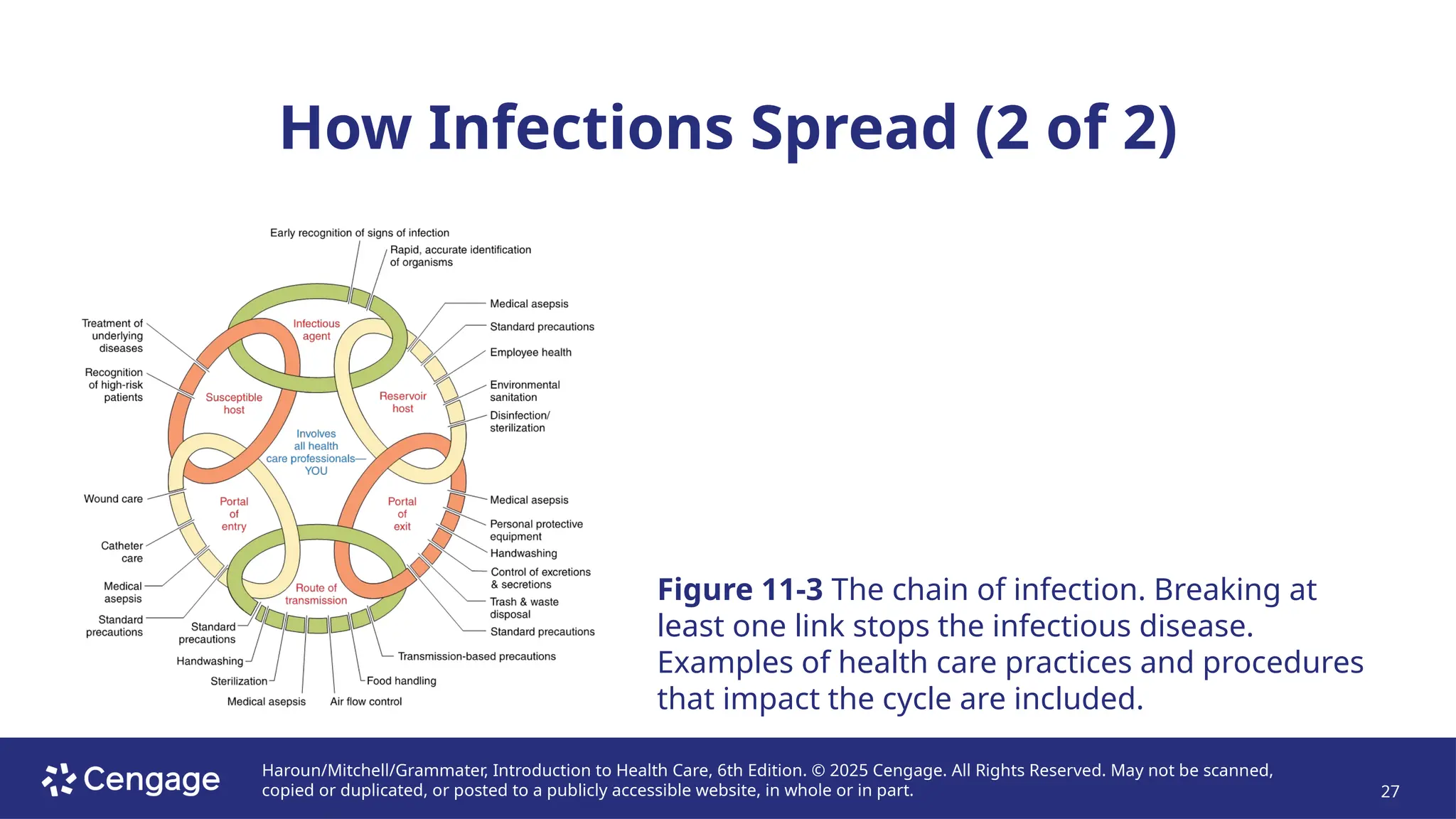
Figure 11-3 The chain of infection. Breaking at
least one link stops the infectious disease.
Examples of health care practices and procedures
that impact the cycle are included.
- 28.
Haroun/Mitchell/Grammater, Introduction toHealth Care, 6th Edition. © 2025 Cengage. All Rights Reserved. May not be scanned,
copied or duplicated, or posted to a publicly accessible website, in whole or in part. 28
Preventing Infection
• Aseptic technique: the practice used to make the patient, worker, and
environment as pathogen-free as possible
− Medical asepsis (clean technique)
Examples include handwashing, personal hygiene, cleaning of patient rooms, and
removal of gloves after contamination
− Surgical asepsis (sterile technique)
Completely eliminates the presence of pathogens from objects and areas
Examples include wearing PPE, including sterile gowns and gloves, and using
sterile instruments
- 29.
Haroun/Mitchell/Grammater, Introduction toHealth Care, 6th Edition. © 2025 Cengage. All Rights Reserved. May not be scanned,
copied or duplicated, or posted to a publicly accessible website, in whole or in part. 29
Breaking the Chain of Infection (1 of 4)
• Breaking at least one link stops the infectious cycle
• Practices health care workers use are designed to break the chain
− Decrease the sources of microorganisms
− Prevent transmission
− Maximize the resistance of the host
- 30.
Haroun/Mitchell/Grammater, Introduction toHealth Care, 6th Edition. © 2025 Cengage. All Rights Reserved. May not be scanned,
copied or duplicated, or posted to a publicly accessible website, in whole or in part. 30
Breaking the Chain of Infection (2 of 4)
Decrease the source of microorganisms
• Perform proper handwashing: single most important in preventing
health care-acquired infections
• Decontaminate surfaces and equipment
− Antiseptics, disinfectants, and sterilization
• Avoid contact with others when you are sick and contagious
− Sneezing can propel microorganisms several feet away
- 31.
Haroun/Mitchell/Grammater, Introduction toHealth Care, 6th Edition. © 2025 Cengage. All Rights Reserved. May not be scanned,
copied or duplicated, or posted to a publicly accessible website, in whole or in part. 31
Breaking the Chain of Infection (3 of 4)
Prevent transmission
• Wear personal protective equipment (PPE) when indicated
− Caps (hair covers), gloves, gowns, masks, booties, and eye protection
• Follow isolation procedures when indicated
− Followed when working with patients with highly contagious diseases
- 32.
Haroun/Mitchell/Grammater, Introduction toHealth Care, 6th Edition. © 2025 Cengage. All Rights Reserved. May not be scanned,
copied or duplicated, or posted to a publicly accessible website, in whole or in part. 32
Breaking the Chain of Infection (4 of 4)
Maximize the resistance of the host
• Provide good hygiene
• Ensure proper nutrition and fluid intake
• Decrease stressors that weaken the immune response
- 33.
Haroun/Mitchell/Grammater, Introduction toHealth Care, 6th Edition. © 2025 Cengage. All Rights Reserved. May not be scanned,
copied or duplicated, or posted to a publicly accessible website, in whole or in part. 33
Handwashing (1 of 4)
• The first line of defense in medical asepsis
• CDC states proper handwashing technique is the most effective way
to help prevent the spread of pathogens
- 34.
Haroun/Mitchell/Grammater, Introduction toHealth Care, 6th Edition. © 2025 Cengage. All Rights Reserved. May not be scanned,
copied or duplicated, or posted to a publicly accessible website, in whole or in part. 34
Handwashing (2 of 4)
• Appropriate times for handwashing
− Coming on or off duty, during break times
− Immediately before and after wearing gloves
− Before and after touching face
− After touching any contaminated object or possibility of cross-contamination
− Before touching clean items such as patient’s food or drink
− After using the restroom
− With glove changes, before touching non-intact skin or body fluids
- 35.
Haroun/Mitchell/Grammater, Introduction toHealth Care, 6th Edition. © 2025 Cengage. All Rights Reserved. May not be scanned,
copied or duplicated, or posted to a publicly accessible website, in whole or in part. 35
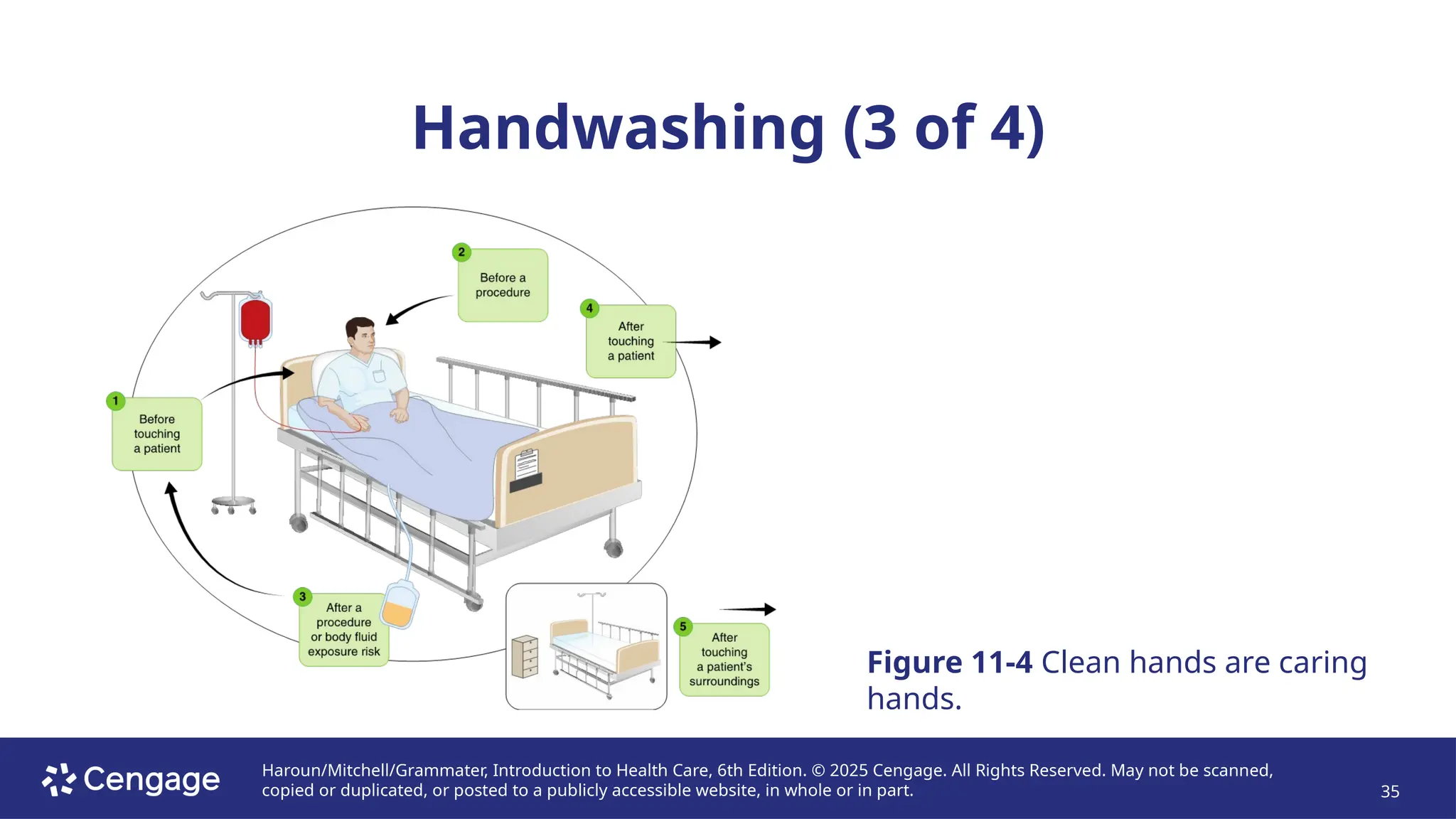
Handwashing (3 of 4)
Figure 11-4 Clean hands are caring
hands.
- 36.
Haroun/Mitchell/Grammater, Introduction toHealth Care, 6th Edition. © 2025 Cengage. All Rights Reserved. May not be scanned,
copied or duplicated, or posted to a publicly accessible website, in whole or in part. 36
Handwashing (4 of 4)
• Nail polish, especially colored nail polish, not recommended for workers
− Polish hides dirt under nails, and chipped polish harbors organisms resistant
to removal
• Use of waterless handwashing foams, gels, or lotions
− Easy access in patient rooms; use when hands not visibly soiled
− Follow manufacturer’s instructions and facility policy
• CDC reports handwashing is more effective than hand sanitizer
− Sanitizers do not kill certain types of parasites and noroviruses
- 37.
Haroun/Mitchell/Grammater, Introduction toHealth Care, 6th Edition. © 2025 Cengage. All Rights Reserved. May not be scanned,
copied or duplicated, or posted to a publicly accessible website, in whole or in part. 37
Personal Protective Equipment
Worn during times of potential contact or splashes with body fluids, or
contact with contaminated items
• Gloves
− Should be changed between tasks, handwash done after removal
• Masks, eye protection, face shields
− Protection of mucous membranes of eyes, nose and mouth
• Gowns
− Select appropriate gown type/thickness for the task
− Remove soiled gowns as soon as possible and wash hands
- 38.
Haroun/Mitchell/Grammater, Introduction toHealth Care, 6th Edition. © 2025 Cengage. All Rights Reserved. May not be scanned,
copied or duplicated, or posted to a publicly accessible website, in whole or in part. 38
Antiseptics, Disinfectants, and Sterilization
(1 of 4)
• Bacteriostatic: A method or action that only inhibits growth of a
microorganism
• Bactericidal: A method or action that kills microorganisms
• Methods used are broken into three categories
− Antiseptics
− Disinfectants
− Sterilization
- 39.
Haroun/Mitchell/Grammater, Introduction toHealth Care, 6th Edition. © 2025 Cengage. All Rights Reserved. May not be scanned,
copied or duplicated, or posted to a publicly accessible website, in whole or in part. 39
Antiseptics, Disinfectants, and Sterilization
(2 of 4)
• Antiseptics
− Chemical antiseptics are only bacteriostatic
− Can be used on skin
− Example: 70% isopropyl alcohol
- 40.
Haroun/Mitchell/Grammater, Introduction toHealth Care, 6th Edition. © 2025 Cengage. All Rights Reserved. May not be scanned,
copied or duplicated, or posted to a publicly accessible website, in whole or in part. 40
Antiseptics, Disinfectants, and Sterilization
(3 of 4)
• Disinfectants
− Chemical agents that destroy most bacteria and viruses
− Instruments and equipment used on the outside of the body and on
environmental surfaces (floors, bathrooms)
− Example: 10% bleach solution
− Carefully read manufacturer’s directions when using chemical agents
- 41.
Haroun/Mitchell/Grammater, Introduction toHealth Care, 6th Edition. © 2025 Cengage. All Rights Reserved. May not be scanned,
copied or duplicated, or posted to a publicly accessible website, in whole or in part. 41
Antiseptics, Disinfectants, and Sterilization
(4 of 4)
• Sterilization
− Agents or methods that destroy all microorganisms, including viruses
and spores
− Examples: Steam, gas, chemical agents, radiation
− Autoclave using high-temperature steam is most commonly used for
sterilization
- 42.
Haroun/Mitchell/Grammater, Introduction toHealth Care, 6th Edition. © 2025 Cengage. All Rights Reserved. May not be scanned,
copied or duplicated, or posted to a publicly accessible website, in whole or in part. 42
Standard Precautions
• Specific procedures practiced by personnel to prevent spread of
infection
• Always use with every patient
• Used to prevent contact and contamination from:
− All body fluids, including blood and any unidentified body fluids
− Nonintact skin
− Mucous membranes
- 43.
Haroun/Mitchell/Grammater, Introduction toHealth Care, 6th Edition. © 2025 Cengage. All Rights Reserved. May not be scanned,
copied or duplicated, or posted to a publicly accessible website, in whole or in part. 43
Environmental Control
• Procedures performed for care, cleaning, and disinfection of
surfaces, beds, bed rails, bedside equipment, etc.
• Handle soiled linens in a way that prevents bodily exposure
• Place patients with contagious infections in private rooms when
possible
- 44.
Haroun/Mitchell/Grammater, Introduction toHealth Care, 6th Edition. © 2025 Cengage. All Rights Reserved. May not be scanned,
copied or duplicated, or posted to a publicly accessible website, in whole or in part. 44
Blood-Borne Pathogens
• Spread through contact with blood, mucous membranes, secretions,
excretions, and nonintact skin
• Common means of infection is from injury using needles and sharp
instruments
− Never recap needles
− Use puncture-proof containers for disposal
• Use alternative equipment when performing resuscitation rather
than mouth-to-mouth methods
- 45.
Haroun/Mitchell/Grammater, Introduction toHealth Care, 6th Edition. © 2025 Cengage. All Rights Reserved. May not be scanned,
copied or duplicated, or posted to a publicly accessible website, in whole or in part. 45
Transmission Precautions (1 of 3)
Certain pathogens are easily transmitted and have potential of causing
epidemics
• Pathogens transmitted three ways
− Through air (coughing, sneezing, talking)
− In liquid droplets (projected during talking, sneezing, or bronchoscopy)
− Physical contact
Direct-contact transmission (infected touches uninfected)
Indirect-contact transmission (infected touches object, uninfected touches same
object)
- 46.
Haroun/Mitchell/Grammater, Introduction toHealth Care, 6th Edition. © 2025 Cengage. All Rights Reserved. May not be scanned,
copied or duplicated, or posted to a publicly accessible website, in whole or in part. 46
Transmission Precautions (2 of 3)
• CDC recommends transmission-based precautions for patients
suspected or confirmed to be infected with certain pathogens
• Specific precautions for each type of transmission
• Used in addition to standard precautions
- 47.
Haroun/Mitchell/Grammater, Introduction toHealth Care, 6th Edition. © 2025 Cengage. All Rights Reserved. May not be scanned,
copied or duplicated, or posted to a publicly accessible website, in whole or in part. 47
Transmission Precautions (3 of 3)
• Isolation of patient has challenges
− Patient must be in private room, using valuable space
− Specialized equipment and modifications add to cost
− Nursing challenges for prompt and frequent care
− Forced solitude may cause psychological stress for patient
− Special procedures for PPE and hazardous waste disposal
- 48.
Haroun/Mitchell/Grammater, Introduction toHealth Care, 6th Edition. © 2025 Cengage. All Rights Reserved. May not be scanned,
copied or duplicated, or posted to a publicly accessible website, in whole or in part. 48
Neutropenic Precautions
• Also called reverse isolation
• Ordered for patients who are very susceptible to infections
• Patient is protected from pathogens that may come from outside, rather
than protecting others from an infected patient
• Commonly seen with oncology patients with repressed immune system
due to chemotherapy or radiation therapy
• Precautions include: no one with an infection or recent vaccination can
enter patient room; no unwashed fruits or vegetables, raw eggs or yogurt
may be eaten; no flowers or plants in room; any kind of standing water is
avoided
- 49.
Haroun/Mitchell/Grammater, Introduction toHealth Care, 6th Edition. © 2025 Cengage. All Rights Reserved. May not be scanned,
copied or duplicated, or posted to a publicly accessible website, in whole or in part. 49
The Challenges
• Despite progress, some infectious diseases remain unconquered
− Viruses quickly mutate and remain resistant to drugs
− Bacteria have become resistant to antibiotics
- 50.
Haroun/Mitchell/Grammater, Introduction toHealth Care, 6th Edition. © 2025 Cengage. All Rights Reserved. May not be scanned,
copied or duplicated, or posted to a publicly accessible website, in whole or in part. 50
Influenza
• Common infectious disease of the respiratory system (“the flu”)
• May cause more than 30 million illnesses a year
• Annual death rate between 12,000 and 56,000
• Especially lethal for very young and very old
• Vaccines prevent many cases
− Fewer than 50% of adults get the vaccine
• Flu virus believed to be spread in droplets
• Prevention focuses on vaccination, handwashing, and sanitizing objects
that may be infected
- 51.
Haroun/Mitchell/Grammater, Introduction toHealth Care, 6th Edition. © 2025 Cengage. All Rights Reserved. May not be scanned,
copied or duplicated, or posted to a publicly accessible website, in whole or in part. 51
Workplace Risks
• Hepatitis B
− Highly contagious, spread through exposure to blood and other body fluids
− Vaccine available
• HIV (Human Immunodeficiency Virus)
− The virus that causes AIDS
− Transmitted by blood and other body fluids, not by casual contact
− Antiretroviral therapy (ART) reduces the amount of HIV in the body for those
infected
• Follow standard precautions with all patients
- 52.
Haroun/Mitchell/Grammater, Introduction toHealth Care, 6th Edition. © 2025 Cengage. All Rights Reserved. May not be scanned,
copied or duplicated, or posted to a publicly accessible website, in whole or in part. 52
Tuberculosis
• Caused by Mycobacterium tuberculosis
• Increased cases in U.S. due to drug resistance and global travel
• One of the world’s deadliest diseases
• Latent TB infection: TB bacteria lives in body without making person
sick
• TB disease: bacteria becomes active if immune system cannot stop
them from growing
− After bacteria becomes active, the person will be sick and can infect
others
- 53.
Haroun/Mitchell/Grammater, Introduction toHealth Care, 6th Edition. © 2025 Cengage. All Rights Reserved. May not be scanned,
copied or duplicated, or posted to a publicly accessible website, in whole or in part. 53
Other Infectious Diseases
• Diseases more commonly seen in other countries
− Ebola, bird flu, mad cow disease, swine flu
− Not currently threats in the U.S.
• Potential problems for international travelers
− Yellow fever
− Zika virus
• CDC posts current warnings (https://wwwnc.cdc.gov/travel)
- 54.
Haroun/Mitchell/Grammater, Introduction toHealth Care, 6th Edition. © 2025 Cengage. All Rights Reserved. May not be scanned,
copied or duplicated, or posted to a publicly accessible website, in whole or in part. 54
Drug-Resistant Organisms (1 of 3)
• Drug resistance is one of the biggest health challenges of our time
• Result of long and widespread use of antibiotics
− Overused for minor conditions
− Problem compounded by patients not taking all doses of prescribed
antibiotics
• 2.8 million people become infected each year with drug-resistant
bacteria
• At least 35,000 die each year
- 55.
Haroun/Mitchell/Grammater, Introduction toHealth Care, 6th Edition. © 2025 Cengage. All Rights Reserved. May not be scanned,
copied or duplicated, or posted to a publicly accessible website, in whole or in part. 55
Drug-Resistant Organisms (2 of 3)
• Commonly encountered in health care
− Methicillin-resistant Staphylococcus aureus (MRSA)
− Vancomycin-resistant enterococcus (VRE)
• Both cause serious infections
• If available, treatment can be expensive and have severe side effects
• The infection and the treatment can often lead to death for the
elderly
- 56.
Haroun/Mitchell/Grammater, Introduction toHealth Care, 6th Edition. © 2025 Cengage. All Rights Reserved. May not be scanned,
copied or duplicated, or posted to a publicly accessible website, in whole or in part. 56
Drug-Resistant Organisms (3 of 3)
• Clostridium difficile (C. difficile)
− Immediate public health threat
− Often occurs in those with recent medical care and antibiotics
− Causes life-threatening diarrhea
− Bacteria spread rapidly
− 12,800 deaths in 2017
• Always follow standard precautions to prevent spread
• The actions of the health care worker determine the spread of
infections within the health care facility
- 57.
Haroun/Mitchell/Grammater, Introduction toHealth Care, 6th Edition. © 2025 Cengage. All Rights Reserved. May not be scanned,
copied or duplicated, or posted to a publicly accessible website, in whole or in part. 57
Reporting Accidental Exposure (1 of 2)
• Immediately wash the area of injury
• Immediately report the incident to the supervisor
− Follow by completion of written incident report according to facility
policy
• Failure to report can result in negative health consequences
including the need to take time from work to recover
- 58.
Haroun/Mitchell/Grammater, Introduction toHealth Care, 6th Edition. © 2025 Cengage. All Rights Reserved. May not be scanned,
copied or duplicated, or posted to a publicly accessible website, in whole or in part. 58
Reporting Accidental Exposure (2 of 2)
OSHA requires each facility have an exposure control plan and
established policies and procedures for exposure injuries
• Policies and procedures should include:
− Immediate actions to be taken to care for the injury
− Reporting time frames
− To whom incident must be reported
− Forms to complete
− Procedures for evaluating risk and outcome
− Plan for counseling on safe practices