©JasperWhite/Stone/GettyImages
© 2013 by Cengage Learning Inc. All Rights Reserved.1
Lamb, Hair, McDaniel
Chapter 11
Developing
and Managing
Products
2013-2014
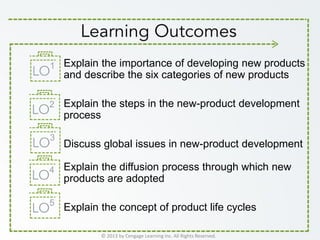
Explain the importance of developing new products
and describe the six categories of new products
Explain the steps in the new-product development
process
Discuss global issues in new-product development
Explain the diffusion process through which new
products are adopted
Explain the concept of product life cycles
© 2013 by Cengage Learning Inc. All Rights Reserved.
1
4
2
3
5
Explain the importance of
developing new products
and describe the six
categories of new
products
The Importance of New Products
© 2013 by Cengage Learning Inc. All Rights Reserved.3
1
© 2013 by Cengage Learning Inc. All Rights Reserved. 4
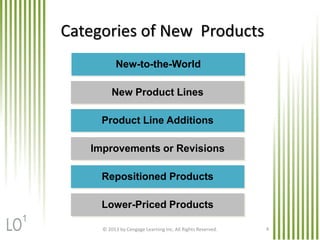
Categories of New Products
New-to-the-World
New Product Lines
Product Line Additions
Improvements or Revisions
Repositioned Products
Lower-Priced Products
1
Explain the steps in
the new-product
development process
The New-Product
Development Process
© 2013 by Cengage Learning Inc. All Rights Reserved.5
2
© 2013 by Cengage Learning Inc. All Rights Reserved. 6
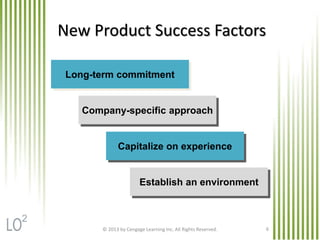
New Product Success Factors
Long-term commitment
Company-specific approach
Capitalize on experience
Establish an environment
2
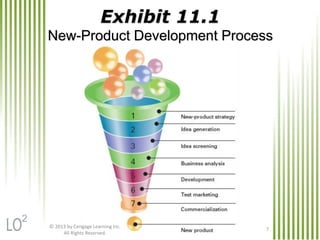
Exhibit 11.1
New-Product Development Process
© 2013 by Cengage Learning Inc.
All Rights Reserved.
7
2
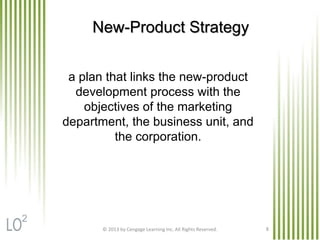
a plan that links the new-product
development process with the
objectives of the marketing
department, the business unit, and
the corporation.
© 2013 by Cengage Learning Inc. All Rights Reserved. 8
New-Product Strategy
2
© 2013 by Cengage Learning Inc. All Rights Reserved. 9
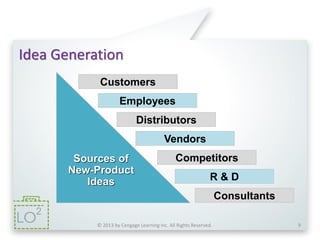
Idea Generation
Customers
Employees
Distributors
Vendors
Competitors
R & D
Consultants
Sources of
New-Product
Ideas
2
© 2013 by Cengage Learning Inc. All Rights Reserved. 10
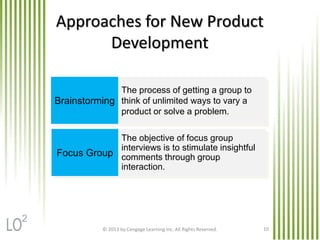
Approaches for New Product
Development
Brainstorming
Focus Group
The process of getting a group to
think of unlimited ways to vary a
product or solve a problem.
The objective of focus group
interviews is to stimulate insightful
comments through group
interaction.
2
11
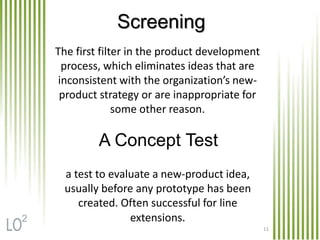
The first filter in the product development
process, which eliminates ideas that are
inconsistent with the organization’s new-
product strategy or are inappropriate for
some other reason.
a test to evaluate a new-product idea,
usually before any prototype has been
created. Often successful for line
extensions.
Screening
A Concept Test
2
© 2013 by Cengage Learning Inc. All Rights Reserved. 12
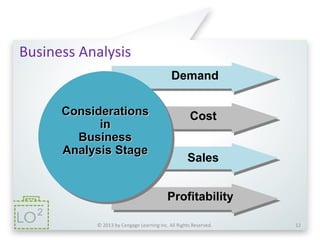
Business Analysis
Considerations
in
Business
Analysis Stage
Demand
Cost
Sales
Profitability
2
© 2013 by Cengage Learning Inc. All Rights Reserved. 13
Development
 Creation of prototype
 Sketch marketing strategy
 Packaging, branding, labeling
 Promotion, price, and distribution
strategy
 Manufacturing feasibility
2
© 2013 by Cengage Learning Inc. All Rights Reserved. 14
Simultaneous Product
Development
A new team-oriented approach to
new-product development where
all relevant functional areas and
outside suppliers participate in the
development process.
2
© 2013 by Cengage Learning Inc. All Rights Reserved. 15
Test Marketing
The limited introduction of a
product and a marketing program
to determine the reactions of
potential customers in a market
situation.
2
© 2013 by Cengage Learning Inc. All Rights Reserved. 16
Costs of Test Marketing
• Often take 1 year or more
• Can cost over $1 million
• Exposes new product to
competitors
• Competitors can “jam” testing
programs with their own
promotions
2
© 2013 by Cengage Learning Inc. All Rights Reserved. 17
Alternatives to
Test Marketing
 Single-source research using
supermarket scanner data
 Simulated (laboratory) market
testing
 Online test marketing
2
© 2013 by Cengage Learning Inc. All Rights Reserved. 18
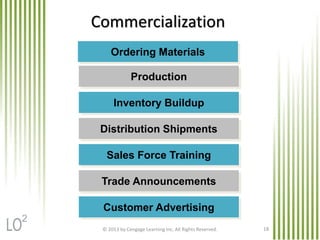
Commercialization
Production
Inventory Buildup
Distribution Shipments
Sales Force Training
Trade Announcements
Customer Advertising
Ordering Materials
2
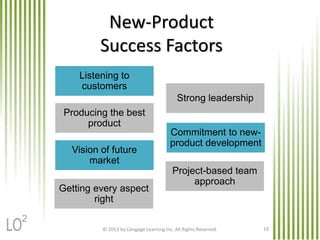
New-Product
Success Factors
Listening to
customers
Producing the best
product
Vision of future
market
Strong leadership
Commitment to new-
product development
Project-based team
approach
Getting every aspect
right
© 2013 by Cengage Learning Inc. All Rights Reserved. 19
2
Why New Products Fail
NOTE: Supplemental content – not in book.
© 2013 by Cengage Learning Inc. All Rights Reserved.20
• No discernible benefits
• Poor match between features and customer
desires
• Overestimation of market size
• Incorrect positioning
• Price too high or too low
• Inadequate distribution
• Poor promotion
• Inferior product
Discuss global issues in
new-product
development
Global Issues in
New-Product Development
© 2013 by Cengage Learning Inc. All Rights Reserved.21
3
Global Marketing Questions
• Develop product for potential
worldwide distribution
• Modify for unique market
requirements
• Design products to meet regulations
and key market requirements
© 2013 by Cengage Learning Inc. All Rights Reserved. 22
3
Explain the diffusion
process through
which new products are
adopted
© 2013 by Cengage Learning Inc. All Rights Reserved.23
The Spread of New Products
4
The process by which the
adoption of an innovation
spreads.
Diffusion
© 2013 by Cengage Learning Inc. All Rights Reserved. 24
4
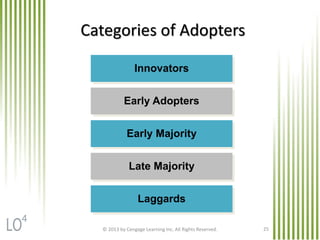
Laggards
Late Majority
Early Majority
Early Adopters
Innovators
Categories of AdoptersCategories of Adopters
© 2013 by Cengage Learning Inc. All Rights Reserved. 25
4
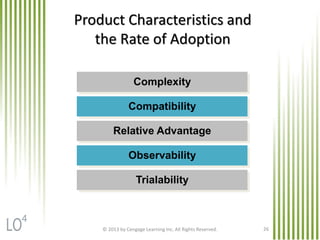
Trialability
Observability
Relative Advantage
Compatibility
Complexity
Product Characteristics and
the Rate of Adoption
© 2013 by Cengage Learning Inc. All Rights Reserved. 26
4
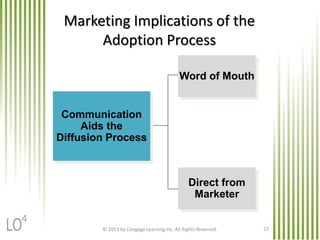
Direct from
Marketer
Word of Mouth
Communication
Aids the
Diffusion Process
Marketing Implications of the
Adoption Process
© 2013 by Cengage Learning Inc. All Rights Reserved. 27
4
Explain the concept of
product life cycles
Product Life Cycles
© 2013 by Cengage Learning Inc. All Rights Reserved.28
5
A concept that provides a way to trace the
stages of a product’s acceptance, from its
introduction (birth) to its decline (death).
Product Life Cycle
© 2013 by Cengage Learning Inc. All Rights Reserved. 29
5
© 2013 by Cengage Learning Inc. All Rights Reserved. 30
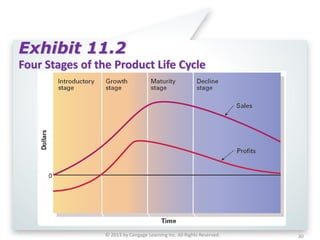
Exhibit 11.2
Four Stages of the Product Life Cycle
© 2013 by Cengage Learning Inc. All Rights Reserved. 31
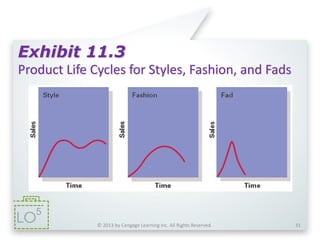
Exhibit 11.3
Product Life Cycles for Styles, Fashion, and Fads
5
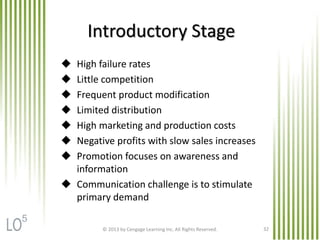
Introductory Stage
© 2013 by Cengage Learning Inc. All Rights Reserved. 32
 High failure rates
 Little competition
 Frequent product modification
 Limited distribution
 High marketing and production costs
 Negative profits with slow sales increases
 Promotion focuses on awareness and
information
 Communication challenge is to stimulate
primary demand
5
Growth Stage
© 2013 by Cengage Learning Inc. All Rights Reserved. 33
 Increasing rate of sales
 Entrance of competitors
 Market consolidation
 Initial healthy profits
 Aggressive advertising of the
differences between brands
 Wider distribution
5
Maturity Stage
© 2013 by Cengage Learning Inc. All Rights Reserved. 34
 Sales increase at a decreasing rate
 Saturated markets
 Annual models appear
 Lengthened product lines
 Service and repair assume important roles
 Heavy promotions to consumers and
dealers
 Marginal competitors drop out
 Niche marketers emerge
5
Decline Stage
© 2013 by Cengage Learning Inc. All Rights Reserved. 35
 Long-run drop in sales
 Large inventories of
unsold items
 Elimination of all nonessential
marketing expenses
 “Organized abandonment”
5
© 2013 by Cengage Learning Inc. All Rights Reserved. 36
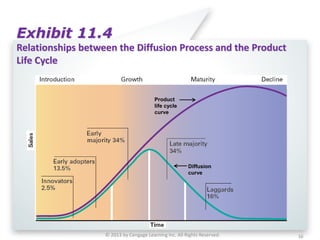
Exhibit 11.4
Relationships between the Diffusion Process and the Product
Life Cycle
Product
life cycle
curve
Diffusion
curve
Chapter 11 Video
GaGa’s Inc.
Jim King and his wife discuss how they decided to create
the company GaGa’s Inc. using the product Sherbetter.
The line expanded from just Lemon to several other
flavors as well as Sherbetter bars, the struggles of
branding, line extension, and other aspects of the frozen
dessert market.
CLICK TO PLAY VIDEO
© 2013 by Cengage Learning Inc. All Rights Reserved.37

Chapter 11 Developing and Managing Products 2014

  • 1.
    ©JasperWhite/Stone/GettyImages © 2013 byCengage Learning Inc. All Rights Reserved.1 Lamb, Hair, McDaniel Chapter 11 Developing and Managing Products 2013-2014
  • 2.
    Explain the importanceof developing new products and describe the six categories of new products Explain the steps in the new-product development process Discuss global issues in new-product development Explain the diffusion process through which new products are adopted Explain the concept of product life cycles © 2013 by Cengage Learning Inc. All Rights Reserved. 1 4 2 3 5
  • 3.
    Explain the importanceof developing new products and describe the six categories of new products The Importance of New Products © 2013 by Cengage Learning Inc. All Rights Reserved.3 1
  • 4.
    © 2013 byCengage Learning Inc. All Rights Reserved. 4 Categories of New Products New-to-the-World New Product Lines Product Line Additions Improvements or Revisions Repositioned Products Lower-Priced Products 1
  • 5.
    Explain the stepsin the new-product development process The New-Product Development Process © 2013 by Cengage Learning Inc. All Rights Reserved.5 2
  • 6.
    © 2013 byCengage Learning Inc. All Rights Reserved. 6 New Product Success Factors Long-term commitment Company-specific approach Capitalize on experience Establish an environment 2
  • 7.
    Exhibit 11.1 New-Product DevelopmentProcess © 2013 by Cengage Learning Inc. All Rights Reserved. 7 2
  • 8.
    a plan thatlinks the new-product development process with the objectives of the marketing department, the business unit, and the corporation. © 2013 by Cengage Learning Inc. All Rights Reserved. 8 New-Product Strategy 2
  • 9.
    © 2013 byCengage Learning Inc. All Rights Reserved. 9 Idea Generation Customers Employees Distributors Vendors Competitors R & D Consultants Sources of New-Product Ideas 2
  • 10.
    © 2013 byCengage Learning Inc. All Rights Reserved. 10 Approaches for New Product Development Brainstorming Focus Group The process of getting a group to think of unlimited ways to vary a product or solve a problem. The objective of focus group interviews is to stimulate insightful comments through group interaction. 2
  • 11.
    11 The first filterin the product development process, which eliminates ideas that are inconsistent with the organization’s new- product strategy or are inappropriate for some other reason. a test to evaluate a new-product idea, usually before any prototype has been created. Often successful for line extensions. Screening A Concept Test 2
  • 12.
    © 2013 byCengage Learning Inc. All Rights Reserved. 12 Business Analysis Considerations in Business Analysis Stage Demand Cost Sales Profitability 2
  • 13.
    © 2013 byCengage Learning Inc. All Rights Reserved. 13 Development  Creation of prototype  Sketch marketing strategy  Packaging, branding, labeling  Promotion, price, and distribution strategy  Manufacturing feasibility 2
  • 14.
    © 2013 byCengage Learning Inc. All Rights Reserved. 14 Simultaneous Product Development A new team-oriented approach to new-product development where all relevant functional areas and outside suppliers participate in the development process. 2
  • 15.
    © 2013 byCengage Learning Inc. All Rights Reserved. 15 Test Marketing The limited introduction of a product and a marketing program to determine the reactions of potential customers in a market situation. 2
  • 16.
    © 2013 byCengage Learning Inc. All Rights Reserved. 16 Costs of Test Marketing • Often take 1 year or more • Can cost over $1 million • Exposes new product to competitors • Competitors can “jam” testing programs with their own promotions 2
  • 17.
    © 2013 byCengage Learning Inc. All Rights Reserved. 17 Alternatives to Test Marketing  Single-source research using supermarket scanner data  Simulated (laboratory) market testing  Online test marketing 2
  • 18.
    © 2013 byCengage Learning Inc. All Rights Reserved. 18 Commercialization Production Inventory Buildup Distribution Shipments Sales Force Training Trade Announcements Customer Advertising Ordering Materials 2
  • 19.
    New-Product Success Factors Listening to customers Producingthe best product Vision of future market Strong leadership Commitment to new- product development Project-based team approach Getting every aspect right © 2013 by Cengage Learning Inc. All Rights Reserved. 19 2
  • 20.
    Why New ProductsFail NOTE: Supplemental content – not in book. © 2013 by Cengage Learning Inc. All Rights Reserved.20 • No discernible benefits • Poor match between features and customer desires • Overestimation of market size • Incorrect positioning • Price too high or too low • Inadequate distribution • Poor promotion • Inferior product
  • 21.
    Discuss global issuesin new-product development Global Issues in New-Product Development © 2013 by Cengage Learning Inc. All Rights Reserved.21 3
  • 22.
    Global Marketing Questions •Develop product for potential worldwide distribution • Modify for unique market requirements • Design products to meet regulations and key market requirements © 2013 by Cengage Learning Inc. All Rights Reserved. 22 3
  • 23.
    Explain the diffusion processthrough which new products are adopted © 2013 by Cengage Learning Inc. All Rights Reserved.23 The Spread of New Products 4
  • 24.
    The process bywhich the adoption of an innovation spreads. Diffusion © 2013 by Cengage Learning Inc. All Rights Reserved. 24 4
  • 25.
    Laggards Late Majority Early Majority EarlyAdopters Innovators Categories of AdoptersCategories of Adopters © 2013 by Cengage Learning Inc. All Rights Reserved. 25 4
  • 26.
    Trialability Observability Relative Advantage Compatibility Complexity Product Characteristicsand the Rate of Adoption © 2013 by Cengage Learning Inc. All Rights Reserved. 26 4
  • 27.
    Direct from Marketer Word ofMouth Communication Aids the Diffusion Process Marketing Implications of the Adoption Process © 2013 by Cengage Learning Inc. All Rights Reserved. 27 4
  • 28.
    Explain the conceptof product life cycles Product Life Cycles © 2013 by Cengage Learning Inc. All Rights Reserved.28 5
  • 29.
    A concept thatprovides a way to trace the stages of a product’s acceptance, from its introduction (birth) to its decline (death). Product Life Cycle © 2013 by Cengage Learning Inc. All Rights Reserved. 29 5
  • 30.
    © 2013 byCengage Learning Inc. All Rights Reserved. 30 Exhibit 11.2 Four Stages of the Product Life Cycle
  • 31.
    © 2013 byCengage Learning Inc. All Rights Reserved. 31 Exhibit 11.3 Product Life Cycles for Styles, Fashion, and Fads 5
  • 32.
    Introductory Stage © 2013by Cengage Learning Inc. All Rights Reserved. 32  High failure rates  Little competition  Frequent product modification  Limited distribution  High marketing and production costs  Negative profits with slow sales increases  Promotion focuses on awareness and information  Communication challenge is to stimulate primary demand 5
  • 33.
    Growth Stage © 2013by Cengage Learning Inc. All Rights Reserved. 33  Increasing rate of sales  Entrance of competitors  Market consolidation  Initial healthy profits  Aggressive advertising of the differences between brands  Wider distribution 5
  • 34.
    Maturity Stage © 2013by Cengage Learning Inc. All Rights Reserved. 34  Sales increase at a decreasing rate  Saturated markets  Annual models appear  Lengthened product lines  Service and repair assume important roles  Heavy promotions to consumers and dealers  Marginal competitors drop out  Niche marketers emerge 5
  • 35.
    Decline Stage © 2013by Cengage Learning Inc. All Rights Reserved. 35  Long-run drop in sales  Large inventories of unsold items  Elimination of all nonessential marketing expenses  “Organized abandonment” 5
  • 36.
    © 2013 byCengage Learning Inc. All Rights Reserved. 36 Exhibit 11.4 Relationships between the Diffusion Process and the Product Life Cycle Product life cycle curve Diffusion curve
  • 37.
    Chapter 11 Video GaGa’sInc. Jim King and his wife discuss how they decided to create the company GaGa’s Inc. using the product Sherbetter. The line expanded from just Lemon to several other flavors as well as Sherbetter bars, the struggles of branding, line extension, and other aspects of the frozen dessert market. CLICK TO PLAY VIDEO © 2013 by Cengage Learning Inc. All Rights Reserved.37