Keeping Children Safe From
Injuries in Early Care and
Education Settings
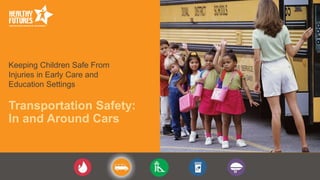
Transportation Safety:
In and Around Cars
Keeping Children Safe From Injuries
in Early Care and Education Settings
Welcome
• Date
• Location
• PRESENTER INFORMATION HERE
Learning Objectives
• State how long a child should remain rear-facing
• State how tall a child should be before transitioning to seat belt
• Explain how tightly a car seat should be installed
• Know when harness is properly secured on a child
• State 2 key points to teach children about pedestrian safety
• List steps to prevent children from being left in vehicles
“If a disease were killing our
children in the proportions that
injuries are, people would be
outraged and demand that
this killer be stopped.”
C. Everett Koop, MD
Former US Surgeon General
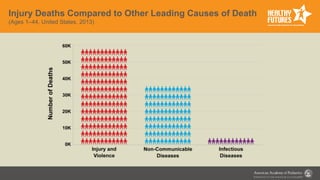
Injury Deaths Compared to Other Leading Causes of Death
(Ages 1–44, United States, 2013)
SOURCE: CDC Vital Signs, 2012
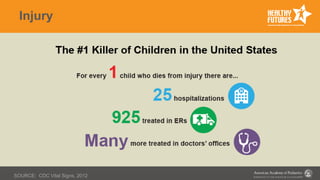
Injury
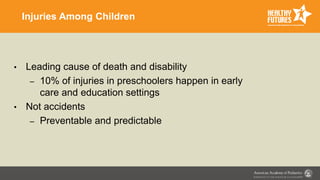
Injuries Among Children
• Leading cause of death and disability
– 10% of injuries in preschoolers happen in early
care and education settings
• Not accidents
– Preventable and predictable
Imagine
Caring for Our Children Standards
• Caring for Our Children: National
Health and Safety Performance
Standards—Guidelines for Early
Care and Education Programs
(CFOC)
• 3rd edition
• Available at http://cfoc.nrckids.org
(free download and purchase
options)
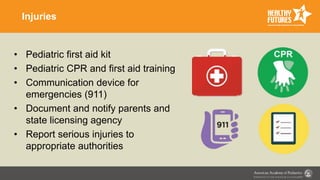
Injuries
• Pediatric first aid kit
• Pediatric CPR and first aid training
• Communication device for
emergencies (911)
• Document and notify parents and
state licensing agency
• Report serious injuries to
appropriate authorities
The Early Care and Education Provider
• Relationship with family
and child
• Model safety for children
and families
THE PROBLEM: IN CARS
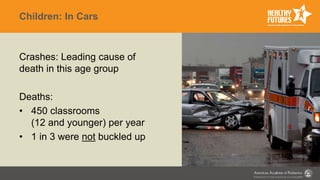
Children: In Cars
Crashes: Leading cause of
death in this age group
Deaths:
• 450 classrooms
(12 and younger) per year
• 1 in 3 were not buckled up
Children: In Cars
• Low rates of appropriate restraint use in the child care
settings have been reported.
• Facilities transporting children or with cars in driveway
– Know best practices in transporting kids safely
– Liability issues
Children: In Cars
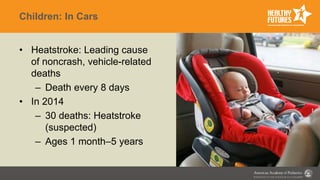
• Heatstroke: Leading cause
of noncrash, vehicle-related
deaths
– Death every 8 days
• In 2014
– 30 deaths: Heatstroke
(suspected)
– Ages 1 month–5 years
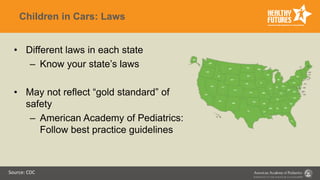
Children in Cars: Laws
• Different laws in each state
– Know your state’s laws
• May not reflect “gold standard” of
safety
– American Academy of Pediatrics:
Follow best practice guidelines
Source: CDC
Transportation Policies (1)
Policies should address:
• Use of car safety seats, seat belts, and booster seats
• Drop-off and pick-up plans
• Vehicle check for children
• Vehicle selection for safe transport
• Backup arrangements for emergencies
Transportation Policies: (2)
• Vehicle operation and maintenance
• Driver selection, training, & supervision/licensing
• Child/staff ratio during transport
• Accessible first aid kit, emergency ID, contact and health
information
• Communication plan: driver and facility
• Maximum travel time for children
CHILD PASSENGER SAFETY
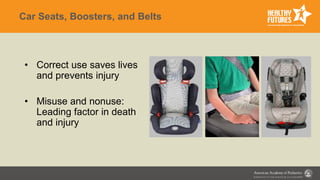
Car Seats, Boosters, and Belts
• Correct use saves lives
and prevents injury
• Misuse and nonuse:
Leading factor in death
and injury
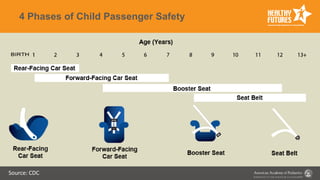
4 Phases of Child Passenger Safety
Source: CDC
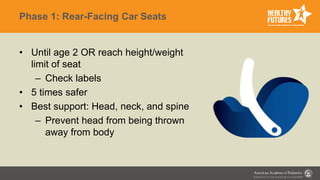
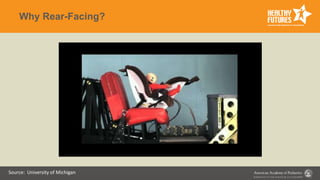
Phase 1: Rear-Facing Car Seats
• Until age 2 OR reach height/weight
limit of seat
– Check labels
• 5 times safer
• Best support: Head, neck, and spine
– Prevent head from being thrown
away from body
Why Rear-Facing?
Source: University of Michigan
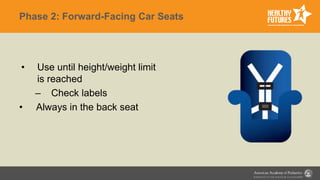
Phase 2: Forward-Facing Car Seats
• Use until height/weight limit
is reached
– Check labels
• Always in the back seat
INSTALLATION
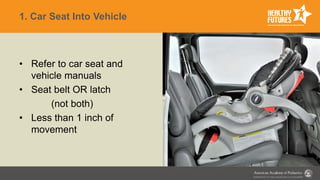
1. Car Seat Into Vehicle
• Refer to car seat and
vehicle manuals
• Seat belt OR latch
(not both)
• Less than 1 inch of
movement
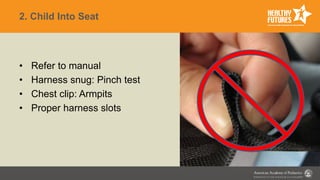
2. Child Into Seat
• Refer to manual
• Harness snug: Pinch test
• Chest clip: Armpits
• Proper harness slots
BOOSTERS AND BELTS
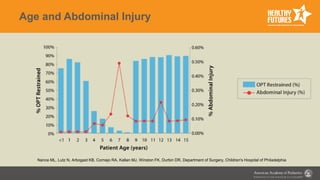
Age and Abdominal Injury
Nance ML, Lutz N, Arbogast KB, Cornejo RA, Kallan MJ, Winston FK, Durbin DR. Department of Surgery, Children's Hospital of Philadelphia
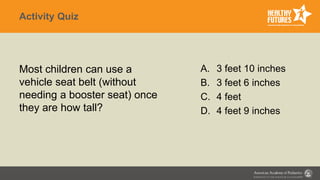
Activity Quiz
Most children can use a
vehicle seat belt (without
needing a booster seat) once
they are how tall?
A. 3 feet 10 inches
B. 3 feet 6 inches
C. 4 feet
D. 4 feet 9 inches
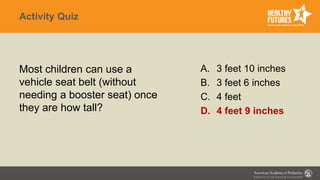
Activity Quiz
Most children can use a
vehicle seat belt (without
needing a booster seat) once
they are how tall?
A. 3 feet 10 inches
B. 3 feet 6 inches
C. 4 feet
D. 4 feet 9 inches
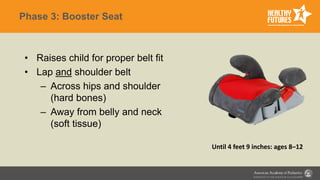
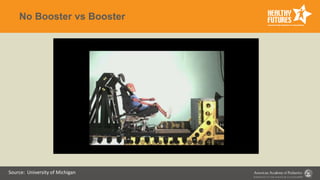
Phase 3: Booster Seat
• Raises child for proper belt fit
• Lap and shoulder belt
– Across hips and shoulder
(hard bones)
– Away from belly and neck
(soft tissue)
Until 4 feet 9 inches: ages 8–12
No Booster vs Booster
Source: University of Michigan
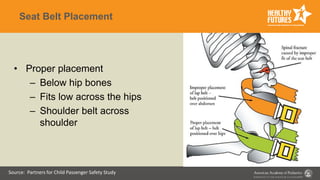
Seat Belt Placement
• Proper placement
– Below hip bones
– Fits low across the hips
– Shoulder belt across
shoulder
Source: Partners for Child Passenger Safety Study
Activity Quiz
All children should ride in the back
seat until they are ___ years old.
A. 8
B. 10
C. 13
D. 15
Activity Quiz
All children should ride in the back
seat until they are ___ years old.
A. 8
B. 10
C. 13
D. 15
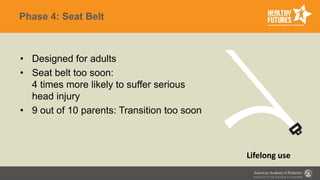
Phase 4: Seat Belt
• Designed for adults
• Seat belt too soon:
4 times more likely to suffer serious
head injury
• 9 out of 10 parents: Transition too soon
Lifelong use
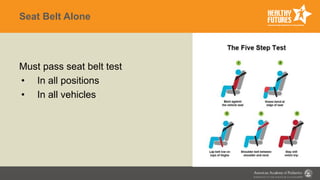
Seat Belt Alone
Must pass seat belt test
• In all positions
• In all vehicles
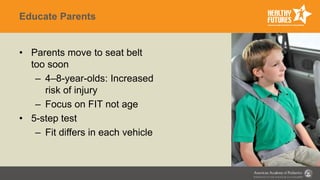
Educate Parents
• Parents move to seat belt
too soon
– 4–8-year-olds: Increased
risk of injury
– Focus on FIT not age
• 5-step test
– Fit differs in each vehicle
CHILDREN WITH SPECIAL NEEDS
Children with Special Needs
• Access to resources for safe transportation.
• Not exempt from state laws for seat belt use.
• Develop policy for special transportation needs.
• Collaboration of parents, physicians and child
care providers (MEDICAL HOME)
Children with Special Needs - Resources
• National Center for the Safe Transportation of Children with
Special Needs (www.preventinjury.org)
– Automotive Safety Program
HEATSTROKE (HYPERTHERMIA)
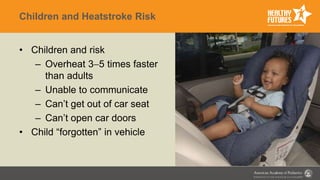
Children and Heatstroke Risk
• Children and risk
– Overheat 35 times faster
than adults
– Unable to communicate
– Can’t get out of car seat
– Can’t open car doors
• Child “forgotten” in vehicle
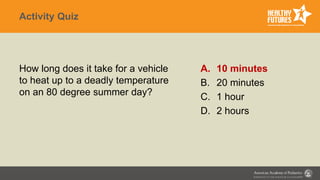
Activity Quiz
How long does it take for a vehicle
to heat up to a deadly temperature
on an 80 degree summer day?
A. 10 minutes
B. 20 minutes
C. 1 hour
D. 2 hours
Activity Quiz
How long does it take for a vehicle
to heat up to a deadly temperature
on an 80 degree summer day?
A. 10 minutes
B. 20 minutes
C. 1 hour
D. 2 hours
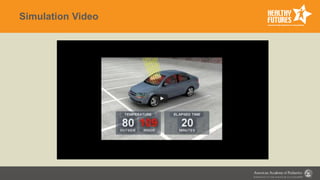
Simulation Video
Prevention: ACT for early learning providers
• Avoid Heatstroke
– Never leave child alone in vehicle
– Keep vehicle locked
• Create Reminders
– Signs or checklist in vehicle
– Confirm head count
• Take Action
– Check backseat & confirm
headcount
– “Look before you lock”
THE PROBLEM: AROUND CARS
Children: Around Cars
• 9,000 treated in ER each year
– Driver not aware of children near vehicle
– Frontovers and backovers: Driveways and parking lots
• Injuries can occur during loading and unloading
– Vans
– School buses
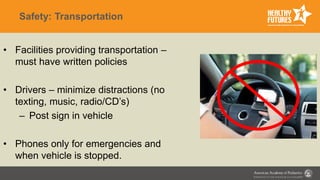
Safety: Transportation
• Facilities providing transportation –
must have written policies
• Drivers – minimize distractions (no
texting, music, radio/CD’s)
– Post sign in vehicle
• Phones only for emergencies and
when vehicle is stopped.
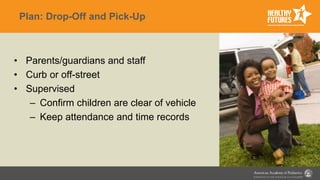
Plan: Drop-Off and Pick-Up
• Parents/guardians and staff
• Curb or off-street
• Supervised
– Confirm children are clear of vehicle
– Keep attendance and time records
TEACHING KIDS
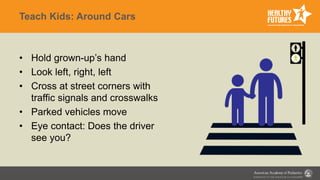
Teach Kids: Around Cars
• Hold grown-up’s hand
• Look left, right, left
• Cross at street corners with
traffic signals and crosswalks
• Parked vehicles move
• Eye contact: Does the driver
see you?
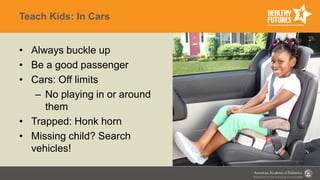
Teach Kids: In Cars
• Always buckle up
• Be a good passenger
• Cars: Off limits
– No playing in or around
them
• Trapped: Honk horn
• Missing child? Search
vehicles!
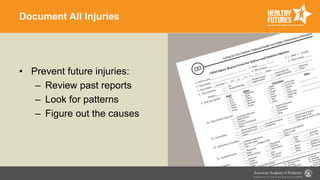
Document All Injuries
• Prevent future injuries:
– Review past reports
– Look for patterns
– Figure out the causes
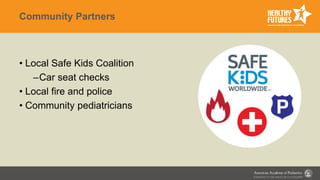
Community Partners
• Local Safe Kids Coalition
–Car seat checks
• Local fire and police
• Community pediatricians
Summary
• Motor vehicle crashes: A leading cause of death and
disability among children in the United States
• Children should ride rear-facing until age 2 or reach the
height/weight limit of the car seat
• Use car seat and vehicle manuals
• Check for tight car seat installation: Less than 1 inch
of movement
Summary
• Snug harness: No pinch or slack
• Children should stay in a booster seat until they are
approximately 4 feet 9 inches, unless seat belt fits properly
• Teach children safety in and around cars
• Prevent vehicle heatstroke: Head count, keys out of reach,
and arrival plan policy
Resources
• American Academy of Pediatrics:
http://www.healthychildren.org
• Safe Kids Worldwide—A global organization dedicated to
preventing injuries in children:
http://www.safekids.org
• Centers for Disease Control and Prevention:
http://www.cdc.gov/motorvehiclesafety
• Children’s Safety Network (CSN)—A national resource center
for the prevention of childhood injuries and violence:
http://www.childrenssafetynetwork.org
Acknowledgments
• This curriculum has been developed by the American Academy of Pediatrics (AAP).
The authors and contributors are expert authorities in the field of pediatrics.
• The recommendations in this curriculum do not indicate an exclusive course of
treatment or serve as a standard of medical care. Variations, taking into account
individual circumstances, may be appropriate.
• Listing of resources does not imply an endorsement by the AAP. The AAP is not
responsible for the content of resources mentioned in this curriculum.
• Website addresses are as current as possible but may change at any time.
• Support for the Heathy Futures curricula has been provided through funding from
Johnson & Johnson Consumer Inc.
Acknowledgments
Project Advisor
Andrew N. Hashikawa, MD, MS, FAAP
AAP Early Childhood Champion (Michigan)
University of Michigan Injury Center
(Assistant Professor)
Curriculum Content Consultant
Amy Teddy – Child Safety & Injury Prevention Expert
(University of Michigan)
Steering Committee
Danette Glassy, MD, FAAP
AAP Council on Early Childhood Member
Nancy Topping-Tailby, MSW, LICSW
National Center on Early Childhood Health & Wellness
Susan Pollack, MD, FAAP
AAP Committee, Section, Council Reviewers
Council on Early Childhood
Council on Injury, Violence, and Poison Prevention
Disaster Preparedness Advisory Council
University of Michigan Contributor/Reviewer
Aviva Alpert, MD
Copyright Information
Copyright©2016 American Academy of Pediatrics. All rights reserved.
Specific permission is granted to duplicate this curriculum for
distribution to child care providers for educational, noncommercial
purposes.
Module 3 TransportationSafety.pptx

  • 1.
    Keeping Children SafeFrom Injuries in Early Care and Education Settings Transportation Safety: In and Around Cars
  • 2.
    Keeping Children SafeFrom Injuries in Early Care and Education Settings Welcome • Date • Location • PRESENTER INFORMATION HERE
  • 3.
    Learning Objectives • Statehow long a child should remain rear-facing • State how tall a child should be before transitioning to seat belt • Explain how tightly a car seat should be installed • Know when harness is properly secured on a child • State 2 key points to teach children about pedestrian safety • List steps to prevent children from being left in vehicles
  • 4.
    “If a diseasewere killing our children in the proportions that injuries are, people would be outraged and demand that this killer be stopped.” C. Everett Koop, MD Former US Surgeon General
  • 5.
    Injury Deaths Comparedto Other Leading Causes of Death (Ages 1–44, United States, 2013)
  • 6.
    SOURCE: CDC VitalSigns, 2012 Injury
  • 7.
    Injuries Among Children •Leading cause of death and disability – 10% of injuries in preschoolers happen in early care and education settings • Not accidents – Preventable and predictable
  • 8.
  • 9.
    Caring for OurChildren Standards • Caring for Our Children: National Health and Safety Performance Standards—Guidelines for Early Care and Education Programs (CFOC) • 3rd edition • Available at http://cfoc.nrckids.org (free download and purchase options)
  • 10.
    Injuries • Pediatric firstaid kit • Pediatric CPR and first aid training • Communication device for emergencies (911) • Document and notify parents and state licensing agency • Report serious injuries to appropriate authorities
  • 11.
    The Early Careand Education Provider • Relationship with family and child • Model safety for children and families
  • 12.
  • 13.
    Children: In Cars Crashes:Leading cause of death in this age group Deaths: • 450 classrooms (12 and younger) per year • 1 in 3 were not buckled up
  • 14.
    Children: In Cars •Low rates of appropriate restraint use in the child care settings have been reported. • Facilities transporting children or with cars in driveway – Know best practices in transporting kids safely – Liability issues
  • 15.
    Children: In Cars •Heatstroke: Leading cause of noncrash, vehicle-related deaths – Death every 8 days • In 2014 – 30 deaths: Heatstroke (suspected) – Ages 1 month–5 years
  • 16.
    Children in Cars:Laws • Different laws in each state – Know your state’s laws • May not reflect “gold standard” of safety – American Academy of Pediatrics: Follow best practice guidelines Source: CDC
  • 17.
    Transportation Policies (1) Policiesshould address: • Use of car safety seats, seat belts, and booster seats • Drop-off and pick-up plans • Vehicle check for children • Vehicle selection for safe transport • Backup arrangements for emergencies
  • 18.
    Transportation Policies: (2) •Vehicle operation and maintenance • Driver selection, training, & supervision/licensing • Child/staff ratio during transport • Accessible first aid kit, emergency ID, contact and health information • Communication plan: driver and facility • Maximum travel time for children
  • 19.
  • 20.
    Car Seats, Boosters,and Belts • Correct use saves lives and prevents injury • Misuse and nonuse: Leading factor in death and injury
  • 21.
    4 Phases ofChild Passenger Safety Source: CDC
  • 22.
    Phase 1: Rear-FacingCar Seats • Until age 2 OR reach height/weight limit of seat – Check labels • 5 times safer • Best support: Head, neck, and spine – Prevent head from being thrown away from body
  • 23.
  • 24.
    Phase 2: Forward-FacingCar Seats • Use until height/weight limit is reached – Check labels • Always in the back seat
  • 25.
  • 26.
    1. Car SeatInto Vehicle • Refer to car seat and vehicle manuals • Seat belt OR latch (not both) • Less than 1 inch of movement
  • 27.
    2. Child IntoSeat • Refer to manual • Harness snug: Pinch test • Chest clip: Armpits • Proper harness slots
  • 28.
  • 29.
    Age and AbdominalInjury Nance ML, Lutz N, Arbogast KB, Cornejo RA, Kallan MJ, Winston FK, Durbin DR. Department of Surgery, Children's Hospital of Philadelphia
  • 30.
    Activity Quiz Most childrencan use a vehicle seat belt (without needing a booster seat) once they are how tall? A. 3 feet 10 inches B. 3 feet 6 inches C. 4 feet D. 4 feet 9 inches
  • 31.
    Activity Quiz Most childrencan use a vehicle seat belt (without needing a booster seat) once they are how tall? A. 3 feet 10 inches B. 3 feet 6 inches C. 4 feet D. 4 feet 9 inches
  • 32.
    Phase 3: BoosterSeat • Raises child for proper belt fit • Lap and shoulder belt – Across hips and shoulder (hard bones) – Away from belly and neck (soft tissue) Until 4 feet 9 inches: ages 8–12
  • 33.
    No Booster vsBooster Source: University of Michigan
  • 34.
    Seat Belt Placement •Proper placement – Below hip bones – Fits low across the hips – Shoulder belt across shoulder Source: Partners for Child Passenger Safety Study
  • 35.
    Activity Quiz All childrenshould ride in the back seat until they are ___ years old. A. 8 B. 10 C. 13 D. 15
  • 36.
    Activity Quiz All childrenshould ride in the back seat until they are ___ years old. A. 8 B. 10 C. 13 D. 15
  • 37.
    Phase 4: SeatBelt • Designed for adults • Seat belt too soon: 4 times more likely to suffer serious head injury • 9 out of 10 parents: Transition too soon Lifelong use
  • 38.
    Seat Belt Alone Mustpass seat belt test • In all positions • In all vehicles
  • 39.
    Educate Parents • Parentsmove to seat belt too soon – 4–8-year-olds: Increased risk of injury – Focus on FIT not age • 5-step test – Fit differs in each vehicle
  • 40.
  • 41.
    Children with SpecialNeeds • Access to resources for safe transportation. • Not exempt from state laws for seat belt use. • Develop policy for special transportation needs. • Collaboration of parents, physicians and child care providers (MEDICAL HOME)
  • 42.
    Children with SpecialNeeds - Resources • National Center for the Safe Transportation of Children with Special Needs (www.preventinjury.org) – Automotive Safety Program
  • 43.
  • 44.
    Children and HeatstrokeRisk • Children and risk – Overheat 35 times faster than adults – Unable to communicate – Can’t get out of car seat – Can’t open car doors • Child “forgotten” in vehicle
  • 45.
    Activity Quiz How longdoes it take for a vehicle to heat up to a deadly temperature on an 80 degree summer day? A. 10 minutes B. 20 minutes C. 1 hour D. 2 hours
  • 46.
    Activity Quiz How longdoes it take for a vehicle to heat up to a deadly temperature on an 80 degree summer day? A. 10 minutes B. 20 minutes C. 1 hour D. 2 hours
  • 47.
  • 48.
    Prevention: ACT forearly learning providers • Avoid Heatstroke – Never leave child alone in vehicle – Keep vehicle locked • Create Reminders – Signs or checklist in vehicle – Confirm head count • Take Action – Check backseat & confirm headcount – “Look before you lock”
  • 49.
  • 50.
    Children: Around Cars •9,000 treated in ER each year – Driver not aware of children near vehicle – Frontovers and backovers: Driveways and parking lots • Injuries can occur during loading and unloading – Vans – School buses
  • 51.
    Safety: Transportation • Facilitiesproviding transportation – must have written policies • Drivers – minimize distractions (no texting, music, radio/CD’s) – Post sign in vehicle • Phones only for emergencies and when vehicle is stopped.
  • 52.
    Plan: Drop-Off andPick-Up • Parents/guardians and staff • Curb or off-street • Supervised – Confirm children are clear of vehicle – Keep attendance and time records
  • 53.
  • 54.
    Teach Kids: AroundCars • Hold grown-up’s hand • Look left, right, left • Cross at street corners with traffic signals and crosswalks • Parked vehicles move • Eye contact: Does the driver see you?
  • 55.
    Teach Kids: InCars • Always buckle up • Be a good passenger • Cars: Off limits – No playing in or around them • Trapped: Honk horn • Missing child? Search vehicles!
  • 56.
    Document All Injuries •Prevent future injuries: – Review past reports – Look for patterns – Figure out the causes
  • 57.
    Community Partners • LocalSafe Kids Coalition –Car seat checks • Local fire and police • Community pediatricians
  • 58.
    Summary • Motor vehiclecrashes: A leading cause of death and disability among children in the United States • Children should ride rear-facing until age 2 or reach the height/weight limit of the car seat • Use car seat and vehicle manuals • Check for tight car seat installation: Less than 1 inch of movement
  • 59.
    Summary • Snug harness:No pinch or slack • Children should stay in a booster seat until they are approximately 4 feet 9 inches, unless seat belt fits properly • Teach children safety in and around cars • Prevent vehicle heatstroke: Head count, keys out of reach, and arrival plan policy
  • 60.
    Resources • American Academyof Pediatrics: http://www.healthychildren.org • Safe Kids Worldwide—A global organization dedicated to preventing injuries in children: http://www.safekids.org • Centers for Disease Control and Prevention: http://www.cdc.gov/motorvehiclesafety • Children’s Safety Network (CSN)—A national resource center for the prevention of childhood injuries and violence: http://www.childrenssafetynetwork.org
  • 61.
    Acknowledgments • This curriculumhas been developed by the American Academy of Pediatrics (AAP). The authors and contributors are expert authorities in the field of pediatrics. • The recommendations in this curriculum do not indicate an exclusive course of treatment or serve as a standard of medical care. Variations, taking into account individual circumstances, may be appropriate. • Listing of resources does not imply an endorsement by the AAP. The AAP is not responsible for the content of resources mentioned in this curriculum. • Website addresses are as current as possible but may change at any time. • Support for the Heathy Futures curricula has been provided through funding from Johnson & Johnson Consumer Inc.
  • 62.
    Acknowledgments Project Advisor Andrew N.Hashikawa, MD, MS, FAAP AAP Early Childhood Champion (Michigan) University of Michigan Injury Center (Assistant Professor) Curriculum Content Consultant Amy Teddy – Child Safety & Injury Prevention Expert (University of Michigan) Steering Committee Danette Glassy, MD, FAAP AAP Council on Early Childhood Member Nancy Topping-Tailby, MSW, LICSW National Center on Early Childhood Health & Wellness Susan Pollack, MD, FAAP AAP Committee, Section, Council Reviewers Council on Early Childhood Council on Injury, Violence, and Poison Prevention Disaster Preparedness Advisory Council University of Michigan Contributor/Reviewer Aviva Alpert, MD
  • 63.
    Copyright Information Copyright©2016 AmericanAcademy of Pediatrics. All rights reserved. Specific permission is granted to duplicate this curriculum for distribution to child care providers for educational, noncommercial purposes.