Facebook Group Marketing Tips for
Sustainable Growth
For many marketers, Facebook Groups are still treated as side projects rather than serious
growth assets. Most public advice focuses on posting frequency, engagement tricks, or generic
community management tips. While those elements have value, they barely address how
experienced marketers actually use Facebook Groups to drive measurable business results.
If you already understand funnels, paid media, and audience segmentation, the true value of
Facebook Group marketing is not likes or comments. It is distribution control, behavioral
insight, and warm audience development. When structured correctly, a Facebook Group
becomes an owned environment where you can observe intent signals, refine messaging, and
improve the performance of your paid campaigns over time.
This guide breaks down advanced Facebook Group marketing tips, focusing on what works
today, supported by benchmarks and real-world use cases, and highlighting the strategic gaps
most competitors overlook.
Why Facebook Groups Still Matter for Marketers
Organic reach on Facebook Pages has declined significantly over the past decade. Industry
benchmarks show that the average Business Page reaches less than 2–5% of its followers
organically. Facebook Groups operate under a different algorithmic priority.
Algorithm Preference for Groups
Meta has publicly emphasized “meaningful social interactions” as a ranking factor. In practice,
this means Group content is more likely to appear in the main News Feed than Page posts.
Well-managed Groups commonly see 30–50% active participation, making them one of the
highest-visibility organic assets on the platform.
For marketers, this represents a rare opportunity: an owned distribution channel that does not
require continuous ad spend to reach core audiences.
Groups as Owned Distribution Channels
Unlike Pages, where visibility is subject to constant UI and algorithm changes, Groups provide
more predictable access to members. Features such as pinned posts, announcements, and
notifications allow marketers to ensure critical messages are seen.
Functionally, a Group behaves like an interactive email list. You control the environment, set the
rules, and guide discussions, while still benefiting from Facebook’s native reach mechanics.
Groups as Insight Engines for Ads
Advanced marketers treat Facebook Groups as live research panels. By observing how
members describe problems, objections, and goals, you gain language and context that paid
ads often lack.
Groups help you:
●​ Refine ad copy using real customer phrasing
●​ Identify high-performing creative angles based on repeated questions
●​ Segment audiences by engagement behavior rather than assumptions
These qualitative insights often outperform traditional interest targeting when translated into
paid campaigns.
The Strategic Role of Facebook Groups Across the
Funnel
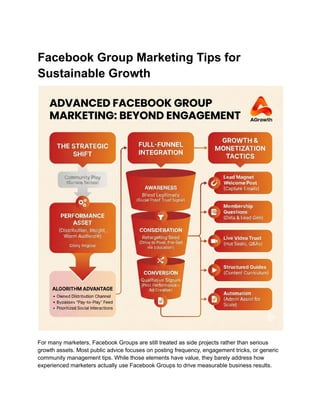
A common mistake is positioning Groups only at the top of the funnel. In reality, Groups support
every stage of the customer journey.
Awareness: Trust and Legitimacy Signals
In crowded ad environments, trust is a major conversion barrier. A visible, active Group with
consistent discussions acts as social proof. When prospects click an ad and discover a Group
with engaged members, perceived brand credibility increases immediately.
This legitimacy effect often reduces bounce rates and improves first-click engagement.
Consideration: Engagement as Retargeting Fuel
While Meta does not allow direct ad targeting of Group members, Groups still generate powerful
retargeting signals. By driving members to specific resources or landing pages, you can build
high-intent Custom Audiences based on real interaction.
These audiences typically outperform cold traffic because they are already familiar with your
positioning and tone.
Conversion: Pre-Qualification Before the Offer
Groups allow you to educate before selling. Running short challenges, live sessions, or focused
discussions helps “pre-sell” concepts. By the time an offer is introduced, members are already
problem-aware and solution-ready.
In many niches, this pre-qualification shortens sales cycles and increases conversion rates.
How to Start Facebook Group Marketing the Right Way
Effective Group marketing begins long before the first post. Treat your Group like a product
launch, not an afterthought.
Define the Group’s Purpose Clearly
Avoid generic names that center on your brand. Instead, name the Group around the outcome
your audience wants. Outcome-based naming improves organic discovery and attracts
higher-intent members.
A clear purpose also guides content decisions and prevents the Group from becoming
unfocused.
Focus on a Specific Audience Segment
Groups perform best when they serve a defined persona. Broad Groups tend to dilute
discussions and reduce engagement quality. Narrow positioning attracts members who are
more likely to participate and convert.
Clarity at this stage directly impacts long-term scalability.
Establish a Value-First Culture
Over-promotion is the fastest way to damage a Group. A sustainable value-to-pitch ratio is
approximately 80/20. Prioritize education, problem-solving, and peer interaction. Authority builds
naturally when members see consistent value.
Building Momentum and Early Growth
Early-stage Groups require intentional growth strategies.
Controlled Entry and Quality Signals
Membership questions serve two purposes: filtering low-quality members and collecting insights.
Simple qualification questions can dramatically improve Group quality and discussion relevance.
Clear rules against spam and self-promotion help set expectations and protect long-term value.
Content Structure from Day One
Successful Groups follow predictable content patterns:
●​ Educational posts that solve specific problems
●​ Engagement prompts that invite experience sharing
●​ Scheduled live sessions that create anticipation
This structure trains members on how to participate and increases algorithmic visibility.
Turning Facebook Groups Into Revenue Drivers
Engagement alone does not equal business impact. Monetization requires systems.
Lead Capture Through Value Exchanges
Pinned posts and welcome threads are ideal for offering lead magnets. Turning members into
email subscribers allows you to measure ROI and build cross-channel funnels.
Live Video as a Conversion Tool
Facebook prioritizes live content in Groups. Regular live sessions, such as audits or Q&A
formats, build trust quickly and position offers as solutions rather than sales pitches.
Strategic Collaborations
Partnering with adjacent Groups or niche experts introduces fresh perspectives and expands
reach. These collaborations often outperform traditional cross-promotions because they are
contextually relevant.
Advanced Group Optimization Techniques
As Groups scale, moderation and structure become critical.
Automation and Moderation Systems
Admin tools help maintain quality by automatically filtering spam and low-quality posts. Strong
moderation protects engagement rates and member experience.
Content Organization for Long-Term Value
Using Guides or Files to organize evergreen content prevents valuable insights from
disappearing in the feed. Structured resources increase repeat visits and long-term
engagement.
Engagement Patterns That Scale
Low-friction polls and experience-based questions outperform generic engagement bait. These
formats generate interaction without reducing content quality.
Recognizing top contributors reinforces positive behavior and strengthens community
ownership.
Measuring Success and ROI
Group success should be evaluated beyond member count.
Key metrics include:
●​ Active member percentage
●​ Comment depth and quality
●​ Click-through rates on shared resources
●​ Conversion rates from Group-driven traffic
Using UTM tracking on shared links allows you to attribute leads and sales directly to Group
activity.
Frequently Asked Questions
Should a Facebook Group be public or private?​
Private but visible Groups often perform best for marketing, balancing discoverability with
exclusivity.
How often should content be posted?​
One to two high-value posts per day is typically sufficient. Over-posting can reduce notification
engagement.
Can Groups support direct selling?​
Yes, when framed as education and case-based solutions rather than transactional pitches.
Are Groups better than Pages?​
They serve different roles. Pages enable ads and discovery; Groups drive deeper engagement
and conversion.
Recommended Resources for Facebook Group Marketing
Facebook Group Marketing Tips​
A practical guide explaining how to structure, grow, and monetize Facebook Groups using
advanced strategies.
Rent Meta Agency Ads Account​
An overview of agency-tier Meta ad accounts designed to improve stability, scalability, and
campaign performance.
https://agrowth.io/blogs/knowledge/facebook-group-marketing-tips ​
A practical guide explaining how to structure, grow, and monetize Facebook Groups using
advanced strategies.
https://agrowth.io/pages/rent-meta-agency-ads-account​
An overview of agency-tier Meta ad accounts designed to improve stability, scalability, and
campaign performance.
1) ~3000 characters — In-depth educational version
Facebook Group Marketing Tips for Sustainable Growth
Many marketers still treat Facebook Groups as “nice-to-have” communities. That mindset is why
most groups never generate revenue. High-performing teams use Facebook Groups as
structured growth assets that create trust, capture intent, and improve paid campaign
performance.
Across multiple industries, brands with active Groups consistently see better ad efficiency.
Retargeting audiences exposed to Group content typically reduces acquisition costs by 20–40%
compared to cold prospecting. The reason is simple: Group engagement is behavior-based
data, not guessed interest targeting.
Organic Page reach has declined to roughly 2–5%, while well-managed Groups often maintain
30–50% active participation. This makes Groups one of the most reliable owned distribution
channels on Facebook today.
The real power of Groups is insight. Every comment, question, and objection becomes
qualitative research you can use to refine ad copy, creatives, and positioning. Marketers who
listen carefully win faster.
Groups work across the funnel:
●​ Awareness: A visible, active Group builds legitimacy and reduces skepticism toward
your ads.
●​ Consideration: Group discussions warm audiences before they ever see an offer.
●​ Conversion: Education-first engagement pre-qualifies members so offers feel natural,
not pushy.
Success starts with structure. Name your Group around an outcome your audience wants, not
your brand. Define a clear persona, set strict rules against spam, and use membership
questions to filter quality.
Growth comes from systems, not luck. Use pinned lead magnets, weekly live sessions, and
structured content pillars. Facebook prioritizes Live in Groups, making it the best format for
trust-building.
As you scale, automate moderation with Admin Assist, organize your best content in Guides,
and analyze peak engagement times before posting important updates.
ROI is measurable. Use UTMs for every link shared in the Group and track conversions in your
CRM or analytics platform.
If you want predictable growth beyond paid ads, treat your Facebook Group as your most
strategic asset — not a side project.
Full framework here:​
https://agrowth.io/blogs/knowledge/facebook-group-marketing-tips
#FacebookGroups #MetaMarketing #CommunityMarketing #GrowthStrategy #DigitalMarketing
#PaidSocial
2) ~1000 characters — Mid-funnel version
Why Smart Marketers Win With Facebook Groups
Facebook Groups are no longer just communities — they are data engines. Every comment,
reaction, and post becomes a signal you can reuse for better ads, messaging, and
segmentation.
With average Page reach below 5%, Groups now offer 30–50% participation, making them one
of the strongest organic channels on Meta.
Start with purpose: name your Group around your audience’s desired outcome, keep it
private-but-visible, and use membership questions to qualify members.
Build momentum before selling. Post polls, case studies, and weekly Live Q&As to generate
trust and engagement. This consistently improves ad performance when you later scale paid
campaigns.
Use Groups as a funnel bridge: educate first, then retarget engaged members through landing
pages and email.
Groups don’t replace ads — they make ads work better.
Learn the full playbook here:​
https://agrowth.io/blogs/knowledge/facebook-group-marketing-tips
#FacebookGroups #MetaAds #CommunityGrowth #PaidSocial #MarketingTips
3) ~300 characters — Short insight post
Facebook Groups aren’t side projects — they’re growth engines.​
With 30–50% participation vs. 2–5% Page reach, Groups provide owned distribution, real
audience insight, and stronger ad performance.
Full framework:​
https://agrowth.io/blogs/knowledge/facebook-group-marketing-tips
#FacebookGroups #MetaMarketing #GrowthHacking #DigitalStrategy
4) Short social post (punchy)
Most brands chase reach.​
Smart brands build Groups.
Use Facebook Pages for ads, and Groups for trust, insight, and warm audiences.
Playbook here 👇​
https://agrowth.io/blogs/knowledge/facebook-group-marketing-tips
#FacebookGroups #MetaAds #CommunityMarketing #DigitalGrowth
5) Long social post — storytelling + helpful content
A few years ago, we treated Facebook Groups like everyone else:​
create one, post occasionally, and hope people engaged.
Then something changed.
Ad costs rose. Competition intensified. Trust in ads dropped. But one pattern stood out —
brands with active Groups consistently performed better in paid campaigns.
Here’s what worked in practice:
• Name the Group around your audience’s goal​
• Make it private-but-visible​
• Use membership questions to qualify members​
• Post polls, case studies, and weekly Lives​
• Pin a high-value lead magnet​
• Retarget engaged members via landing pages​
• Track everything with UTMs
Groups turned out to be the missing bridge between organic trust and paid performance.
If you want sustainable growth beyond ads, start here:​
https://agrowth.io/blogs/knowledge/facebook-group-marketing-tips
#FacebookGroups #MetaMarketing #CommunityGrowth #PaidSocial #MarketingStory