Chapter 15
Feeding Infants
Marotz, Health, Safety, and Nutrition for the Young Child, 10th Edition. © 2020 Cengage. All Rights Reserved. May not be
scanned, copied or duplicated, or posted to a publicly accessible website, in whole or in part.
Marotz, Health, Safety, and Nutrition for the Young Child, 10th Edition. © 2020 Cengage. All Rights Reserved. May not be scanned,
copied or duplicated, or posted to a publicly accessible website, in whole or in part.
Infant Growth Patterns
• Infants experience rapid growth during the first year. Their:
• Weight increases by approximately ⅔ ounce/day between birth and 6 months;
½ ounce/day between 6 and 12 months.
• Length increases by approximately 10 inches.
• Basal metabolic rate (BMR) is higher than an adults’.
Marotz, Health, Safety, and Nutrition for the Young Child, 10th Edition. © 2020 Cengage. All Rights Reserved. May not be scanned,
copied or duplicated, or posted to a publicly accessible website, in whole or in part.
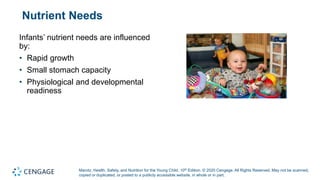
Nutrient Needs
Infants’ nutrient needs are influenced
by:
• Rapid growth
• Small stomach capacity
• Physiological and developmental
readiness
Marotz, Health, Safety, and Nutrition for the Young Child, 10th Edition. © 2020 Cengage. All Rights Reserved. May not be scanned,
copied or duplicated, or posted to a publicly accessible website, in whole or in part.
Determinants of Infants’ Nutrient Needs (1 of 2)
• Rapid growth
• Infants require approximately 45 to 55 calories per pound/body weight during the
first six months; 40 to 50 calories/pound are needed during the second six
months.
• Small stomach capacity
• Infants are able to consume only small amounts at each feeding so they must
eat often.
Marotz, Health, Safety, and Nutrition for the Young Child, 10th Edition. © 2020 Cengage. All Rights Reserved. May not be scanned,
copied or duplicated, or posted to a publicly accessible website, in whole or in part.
Determinants of Infants’ Nutrient Needs (2 of 2)
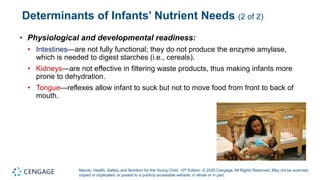
• Physiological and developmental readiness:
• Intestines—are not fully functional; they do not produce the enzyme amylase,
which is needed to digest starches (i.e., cereals).
• Kidneys—are not effective in filtering waste products, thus making infants more
prone to dehydration.
• Tongue—reflexes allow infant to suck but not to move food from front to back of
mouth.
Marotz, Health, Safety, and Nutrition for the Young Child, 10th Edition. © 2020 Cengage. All Rights Reserved. May not be scanned,
copied or duplicated, or posted to a publicly accessible website, in whole or in part.
Feeding Infants
• Breast milk or formula provide all nutrients an infant requires for optimal
growth and development during the first 4 to 6 months with the exception of
vitamin D.
• The American Academy of Pediatrics recommends a daily supplement of 400 IU
of vitamin D for breast fed infants. Formula-fed infants may not require this
because most formulas contain vitamin D
• Semisolid (pureed) foods should not be introduced before six months.
Marotz, Health, Safety, and Nutrition for the Young Child, 10th Edition. © 2020 Cengage. All Rights Reserved. May not be scanned,
copied or duplicated, or posted to a publicly accessible website, in whole or in part.
Breast-Feeding (1 of 4)
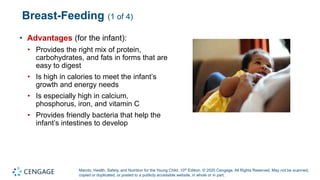
• Advantages (for the infant):
• Provides the right mix of protein,
carbohydrates, and fats in forms that are
easy to digest
• Is high in calories to meet the infant’s
growth and energy needs
• Is especially high in calcium,
phosphorus, iron, and vitamin C
• Provides friendly bacteria that help the
infant’s intestines to develop
Marotz, Health, Safety, and Nutrition for the Young Child, 10th Edition. © 2020 Cengage. All Rights Reserved. May not be scanned,
copied or duplicated, or posted to a publicly accessible website, in whole or in part.
Breast-Feeding (2 of 4)
• Advantages (for infant):
• Provides the infant with temporary protection (antibodies) against many viral and
bacterial illnesses
• Is less likely to cause an allergic response
• Volume of milk is produced in response to the infant’s needs
• Always ready on demand
• Breast-fed infants have been shown to have lower rates of obesity
Marotz, Health, Safety, and Nutrition for the Young Child, 10th Edition. © 2020 Cengage. All Rights Reserved. May not be scanned,
copied or duplicated, or posted to a publicly accessible website, in whole or in part.
Breast-Feeding (3 of 4)
• Advantages (for mother):
• A convenience food—no mixing, correct temperature, no dishes to wash
• Less expensive—no formula to purchase; however, mothers must increase their
dietary intake of certain nutrients
• Sanitary conditions—always clean; less chance for introduction of harmful
bacteria
• Helps to return the reproductive system back to normal
Marotz, Health, Safety, and Nutrition for the Young Child, 10th Edition. © 2020 Cengage. All Rights Reserved. May not be scanned,
copied or duplicated, or posted to a publicly accessible website, in whole or in part.
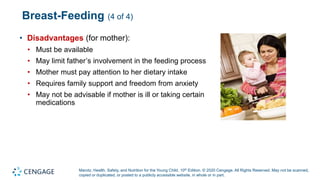
Breast-Feeding (4 of 4)
• Disadvantages (for mother):
• Must be available
• May limit father’s involvement in the feeding process
• Mother must pay attention to her dietary intake
• Requires family support and freedom from anxiety
• May not be advisable if mother is ill or taking certain
medications
Marotz, Health, Safety, and Nutrition for the Young Child, 10th Edition. © 2020 Cengage. All Rights Reserved. May not be scanned,
copied or duplicated, or posted to a publicly accessible website, in whole or in part.
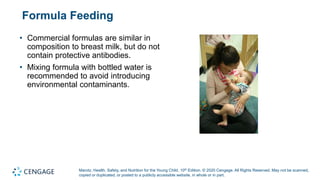
Formula Feeding
• Commercial formulas are similar in
composition to breast milk, but do not
contain protective antibodies.
• Mixing formula with bottled water is
recommended to avoid introducing
environmental contaminants.
Marotz, Health, Safety, and Nutrition for the Young Child, 10th Edition. © 2020 Cengage. All Rights Reserved. May not be scanned,
copied or duplicated, or posted to a publicly accessible website, in whole or in part.
Breast Milk versus Formula
• Both methods adequately meet an infant’s nutrient needs and provide an
opportunity for emotional bonding.
• Mothers may choose not to nurse or to use a combination of breast- and
formula feeding based on a variety of factors, including:
• Illness or mother’s need to take certain medications
• Mother needs to be away from the infant periods of time
• Personal choice
• Use of addictive drugs and tobacco
Marotz, Health, Safety, and Nutrition for the Young Child, 10th Edition. © 2020 Cengage. All Rights Reserved. May not be scanned,
copied or duplicated, or posted to a publicly accessible website, in whole or in part.
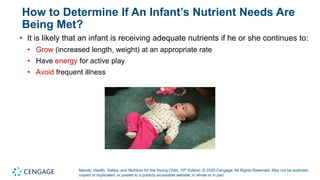
How to Determine If An Infant’s Nutrient Needs Are
Being Met?
• It is likely that an infant is receiving adequate nutrients if he or she continues to:
• Grow (increased length, weight) at an appropriate rate
• Have energy for active play
• Avoid frequent illness
Marotz, Health, Safety, and Nutrition for the Young Child, 10th Edition. © 2020 Cengage. All Rights Reserved. May not be scanned,
copied or duplicated, or posted to a publicly accessible website, in whole or in part.
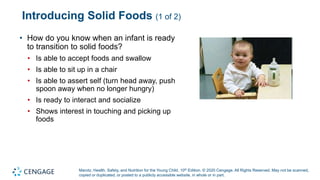
Introducing Solid Foods (1 of 2)
• How do you know when an infant is ready
to transition to solid foods?
• Is able to accept foods and swallow
• Is able to sit up in a chair
• Is able to assert self (turn head away, push
spoon away when no longer hungry)
• Is ready to interact and socialize
• Shows interest in touching and picking up
foods
Marotz, Health, Safety, and Nutrition for the Young Child, 10th Edition. © 2020 Cengage. All Rights Reserved. May not be scanned,
copied or duplicated, or posted to a publicly accessible website, in whole or in part.
Introducing Solid Foods (2 of 2)
• Semi-solid foods are usually introduced in the following order:
• Cereals—rice being the first because it is less likely to cause an allergic response
• Vegetables
• Fruits
• Meats and other proteins
• Avoid honey and foods containing honey; may contain botulism spores.
• Introducing semi-solid foods may be delayed for some children who have
special needs.
Marotz, Health, Safety, and Nutrition for the Young Child, 10th Edition. © 2020 Cengage. All Rights Reserved. May not be scanned,
copied or duplicated, or posted to a publicly accessible website, in whole or in part.
Feeding Precautions
• Choking is common during an infant’s transition from milk to solid foods.
Children with certain developmental disabilities and medical conditions may
also have difficulty swallowing.
• Know how to perform the Heimlich maneuver and CPR.
• Always cut food into small pieces!
• Avoid serving foods that are hard to chew (raw carrots) or sticky (peanut
butter) and difficult to swallow.

Chapter 15 Feeding Infants

  • 1.
    Chapter 15 Feeding Infants Marotz,Health, Safety, and Nutrition for the Young Child, 10th Edition. © 2020 Cengage. All Rights Reserved. May not be scanned, copied or duplicated, or posted to a publicly accessible website, in whole or in part.
  • 2.
    Marotz, Health, Safety,and Nutrition for the Young Child, 10th Edition. © 2020 Cengage. All Rights Reserved. May not be scanned, copied or duplicated, or posted to a publicly accessible website, in whole or in part. Infant Growth Patterns • Infants experience rapid growth during the first year. Their: • Weight increases by approximately ⅔ ounce/day between birth and 6 months; ½ ounce/day between 6 and 12 months. • Length increases by approximately 10 inches. • Basal metabolic rate (BMR) is higher than an adults’.
  • 3.
    Marotz, Health, Safety,and Nutrition for the Young Child, 10th Edition. © 2020 Cengage. All Rights Reserved. May not be scanned, copied or duplicated, or posted to a publicly accessible website, in whole or in part. Nutrient Needs Infants’ nutrient needs are influenced by: • Rapid growth • Small stomach capacity • Physiological and developmental readiness
  • 4.
    Marotz, Health, Safety,and Nutrition for the Young Child, 10th Edition. © 2020 Cengage. All Rights Reserved. May not be scanned, copied or duplicated, or posted to a publicly accessible website, in whole or in part. Determinants of Infants’ Nutrient Needs (1 of 2) • Rapid growth • Infants require approximately 45 to 55 calories per pound/body weight during the first six months; 40 to 50 calories/pound are needed during the second six months. • Small stomach capacity • Infants are able to consume only small amounts at each feeding so they must eat often.
  • 5.
    Marotz, Health, Safety,and Nutrition for the Young Child, 10th Edition. © 2020 Cengage. All Rights Reserved. May not be scanned, copied or duplicated, or posted to a publicly accessible website, in whole or in part. Determinants of Infants’ Nutrient Needs (2 of 2) • Physiological and developmental readiness: • Intestines—are not fully functional; they do not produce the enzyme amylase, which is needed to digest starches (i.e., cereals). • Kidneys—are not effective in filtering waste products, thus making infants more prone to dehydration. • Tongue—reflexes allow infant to suck but not to move food from front to back of mouth.
  • 6.
    Marotz, Health, Safety,and Nutrition for the Young Child, 10th Edition. © 2020 Cengage. All Rights Reserved. May not be scanned, copied or duplicated, or posted to a publicly accessible website, in whole or in part. Feeding Infants • Breast milk or formula provide all nutrients an infant requires for optimal growth and development during the first 4 to 6 months with the exception of vitamin D. • The American Academy of Pediatrics recommends a daily supplement of 400 IU of vitamin D for breast fed infants. Formula-fed infants may not require this because most formulas contain vitamin D • Semisolid (pureed) foods should not be introduced before six months.
  • 7.
    Marotz, Health, Safety,and Nutrition for the Young Child, 10th Edition. © 2020 Cengage. All Rights Reserved. May not be scanned, copied or duplicated, or posted to a publicly accessible website, in whole or in part. Breast-Feeding (1 of 4) • Advantages (for the infant): • Provides the right mix of protein, carbohydrates, and fats in forms that are easy to digest • Is high in calories to meet the infant’s growth and energy needs • Is especially high in calcium, phosphorus, iron, and vitamin C • Provides friendly bacteria that help the infant’s intestines to develop
  • 8.
    Marotz, Health, Safety,and Nutrition for the Young Child, 10th Edition. © 2020 Cengage. All Rights Reserved. May not be scanned, copied or duplicated, or posted to a publicly accessible website, in whole or in part. Breast-Feeding (2 of 4) • Advantages (for infant): • Provides the infant with temporary protection (antibodies) against many viral and bacterial illnesses • Is less likely to cause an allergic response • Volume of milk is produced in response to the infant’s needs • Always ready on demand • Breast-fed infants have been shown to have lower rates of obesity
  • 9.
    Marotz, Health, Safety,and Nutrition for the Young Child, 10th Edition. © 2020 Cengage. All Rights Reserved. May not be scanned, copied or duplicated, or posted to a publicly accessible website, in whole or in part. Breast-Feeding (3 of 4) • Advantages (for mother): • A convenience food—no mixing, correct temperature, no dishes to wash • Less expensive—no formula to purchase; however, mothers must increase their dietary intake of certain nutrients • Sanitary conditions—always clean; less chance for introduction of harmful bacteria • Helps to return the reproductive system back to normal
  • 10.
    Marotz, Health, Safety,and Nutrition for the Young Child, 10th Edition. © 2020 Cengage. All Rights Reserved. May not be scanned, copied or duplicated, or posted to a publicly accessible website, in whole or in part. Breast-Feeding (4 of 4) • Disadvantages (for mother): • Must be available • May limit father’s involvement in the feeding process • Mother must pay attention to her dietary intake • Requires family support and freedom from anxiety • May not be advisable if mother is ill or taking certain medications
  • 11.
    Marotz, Health, Safety,and Nutrition for the Young Child, 10th Edition. © 2020 Cengage. All Rights Reserved. May not be scanned, copied or duplicated, or posted to a publicly accessible website, in whole or in part. Formula Feeding • Commercial formulas are similar in composition to breast milk, but do not contain protective antibodies. • Mixing formula with bottled water is recommended to avoid introducing environmental contaminants.
  • 12.
    Marotz, Health, Safety,and Nutrition for the Young Child, 10th Edition. © 2020 Cengage. All Rights Reserved. May not be scanned, copied or duplicated, or posted to a publicly accessible website, in whole or in part. Breast Milk versus Formula • Both methods adequately meet an infant’s nutrient needs and provide an opportunity for emotional bonding. • Mothers may choose not to nurse or to use a combination of breast- and formula feeding based on a variety of factors, including: • Illness or mother’s need to take certain medications • Mother needs to be away from the infant periods of time • Personal choice • Use of addictive drugs and tobacco
  • 13.
    Marotz, Health, Safety,and Nutrition for the Young Child, 10th Edition. © 2020 Cengage. All Rights Reserved. May not be scanned, copied or duplicated, or posted to a publicly accessible website, in whole or in part. How to Determine If An Infant’s Nutrient Needs Are Being Met? • It is likely that an infant is receiving adequate nutrients if he or she continues to: • Grow (increased length, weight) at an appropriate rate • Have energy for active play • Avoid frequent illness
  • 14.
    Marotz, Health, Safety,and Nutrition for the Young Child, 10th Edition. © 2020 Cengage. All Rights Reserved. May not be scanned, copied or duplicated, or posted to a publicly accessible website, in whole or in part. Introducing Solid Foods (1 of 2) • How do you know when an infant is ready to transition to solid foods? • Is able to accept foods and swallow • Is able to sit up in a chair • Is able to assert self (turn head away, push spoon away when no longer hungry) • Is ready to interact and socialize • Shows interest in touching and picking up foods
  • 15.
    Marotz, Health, Safety,and Nutrition for the Young Child, 10th Edition. © 2020 Cengage. All Rights Reserved. May not be scanned, copied or duplicated, or posted to a publicly accessible website, in whole or in part. Introducing Solid Foods (2 of 2) • Semi-solid foods are usually introduced in the following order: • Cereals—rice being the first because it is less likely to cause an allergic response • Vegetables • Fruits • Meats and other proteins • Avoid honey and foods containing honey; may contain botulism spores. • Introducing semi-solid foods may be delayed for some children who have special needs.
  • 16.
    Marotz, Health, Safety,and Nutrition for the Young Child, 10th Edition. © 2020 Cengage. All Rights Reserved. May not be scanned, copied or duplicated, or posted to a publicly accessible website, in whole or in part. Feeding Precautions • Choking is common during an infant’s transition from milk to solid foods. Children with certain developmental disabilities and medical conditions may also have difficulty swallowing. • Know how to perform the Heimlich maneuver and CPR. • Always cut food into small pieces! • Avoid serving foods that are hard to chew (raw carrots) or sticky (peanut butter) and difficult to swallow.