GREEN UNIVERSITY
OF BANGLADESH
Department: EEE (Eve)
Prepared by:
Md. Ferozul Islam
ID # 143010015
Course Title: Electronics II
Prepared For:
Nusrat Alim
Lecturer, GUB
Full Wave Rectifier Circuit
With Working Theory
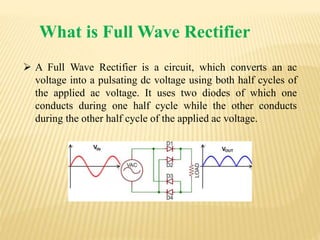
What is Full Wave Rectifier
 A Full Wave Rectifier is a circuit, which converts an ac
voltage into a pulsating dc voltage using both half cycles of
the applied ac voltage. It uses two diodes of which one
conducts during one half cycle while the other conducts
during the other half cycle of the applied ac voltage.
Classification of Full Wave Rectifier
 The full wave rectifier can be further divided mainly into
following types.
1. Center Tapped Full Wave Rectifier.
2. Full Wave Bridge Rectifier
Center Tapped Full Wave Rectifier
 In the center tapped full wave rectifier two diodes were used.
 These are connected to the center tapped secondary winding of
the transformer.
 The positive terminal of two diodes is connected to the two
ends of the transformer.
 Center tap divides the total secondary voltage into equal parts.
 The centre-tap is usually considered as the ground point or the
zero voltage reference point.
Full Wave Bridge Rectifier
 Full wave bridge rectifier four diodes are arranged in the form of a
bridge.
 This configuration provides same polarity output with either
polarity.
 The main advantage of this bridge circuit is that it does not require
a special centre tapped transformer.
 The single secondary winding is connected to one side of the
diode bridge network and the load to the other side
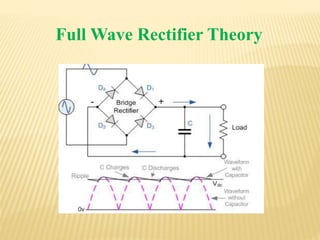
Full Wave Rectifier Theory
Advantages
 Ripple frequency is two times the input frequency.
 The output and efficiency of centre tap full wave
rectifier are high because AC supply delivers power
during both the halves.
 For the same secondary voltage bridge rectifier has
double output.
Disadvantages
It is difficult to locate the centre tap on the secondary winding.
The DC output is small as each diode utilizes only one half of the
transformer's secondary Voltages.
The diodes used have high peak inverse voltage.
Full wave rectifier requires more diodes i.e two for centre tap
rectifier and four for bridge rectifier.
When a small voltage is required to be rectified this full wave
rectifier circuit is not suitable.
Conclusion
 To design and simulate a Full Wave Rectifier circuit with working
theory and the analysis for the full-bridge rectifier circuit. The full-
wave rectifier allows us to convert almost all the incoming AC
power to DC.
Full Wave Rectifier Circuit

Full Wave Rectifier Circuit

  • 1.
    GREEN UNIVERSITY OF BANGLADESH Department:EEE (Eve) Prepared by: Md. Ferozul Islam ID # 143010015 Course Title: Electronics II Prepared For: Nusrat Alim Lecturer, GUB
  • 2.
    Full Wave RectifierCircuit With Working Theory
  • 3.
    What is FullWave Rectifier  A Full Wave Rectifier is a circuit, which converts an ac voltage into a pulsating dc voltage using both half cycles of the applied ac voltage. It uses two diodes of which one conducts during one half cycle while the other conducts during the other half cycle of the applied ac voltage.
  • 4.
    Classification of FullWave Rectifier  The full wave rectifier can be further divided mainly into following types. 1. Center Tapped Full Wave Rectifier. 2. Full Wave Bridge Rectifier
  • 5.
    Center Tapped FullWave Rectifier  In the center tapped full wave rectifier two diodes were used.  These are connected to the center tapped secondary winding of the transformer.  The positive terminal of two diodes is connected to the two ends of the transformer.  Center tap divides the total secondary voltage into equal parts.  The centre-tap is usually considered as the ground point or the zero voltage reference point.
  • 6.
    Full Wave BridgeRectifier  Full wave bridge rectifier four diodes are arranged in the form of a bridge.  This configuration provides same polarity output with either polarity.  The main advantage of this bridge circuit is that it does not require a special centre tapped transformer.  The single secondary winding is connected to one side of the diode bridge network and the load to the other side
  • 7.
  • 8.
    Advantages  Ripple frequencyis two times the input frequency.  The output and efficiency of centre tap full wave rectifier are high because AC supply delivers power during both the halves.  For the same secondary voltage bridge rectifier has double output.
  • 9.
    Disadvantages It is difficultto locate the centre tap on the secondary winding. The DC output is small as each diode utilizes only one half of the transformer's secondary Voltages. The diodes used have high peak inverse voltage. Full wave rectifier requires more diodes i.e two for centre tap rectifier and four for bridge rectifier. When a small voltage is required to be rectified this full wave rectifier circuit is not suitable.
  • 10.
    Conclusion  To designand simulate a Full Wave Rectifier circuit with working theory and the analysis for the full-bridge rectifier circuit. The full- wave rectifier allows us to convert almost all the incoming AC power to DC.