1
WELCOMEWELCOME
TOTO
OUR PRESENTATIONOUR PRESENTATION
2
ARIFUL ISLAMARIFUL ISLAM
ID : 151-15-4869ID : 151-15-4869
3
Presented by
 Group 5
 ID:
 151-15-4869
 151-15-4856
 151-15-4861
 151-15-4883
 Dept: CSE
 DIU
Presnted to
 S.M. Safayet Ullah
 Lecturer
 Dept. of CSE
 DIU
4
4
ALTERNATING CURRENT
5
NODE
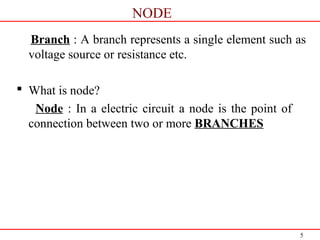
Branch : A branch represents a single element such as
voltage source or resistance etc.
 What is node?
Node : In a electric circuit a node is the point of
connection between two or more BRANCHES
6
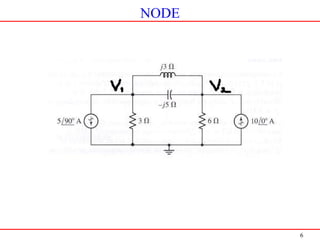
NODE
7
Steps to Determine V (Voltage)
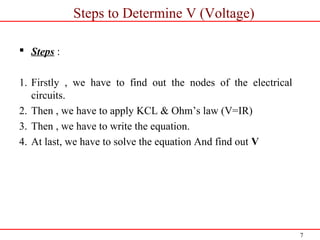
 Steps :
1. Firstly , we have to find out the nodes of the electrical
circuits.
2. Then , we have to apply KCL & Ohm’s law (V=IR)
3. Then , we have to write the equation.
4. At last, we have to solve the equation And find out V
8
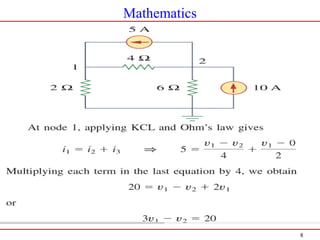
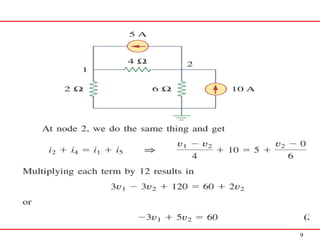
Mathematics
9
10
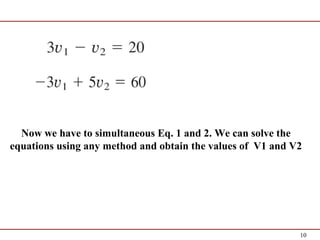
Now we have to simultaneous Eq. 1 and 2. We can solve the
equations using any method and obtain the values of V1 and V2
11
Shamsuzzaman ZihanShamsuzzaman Zihan
ID : 151-15-4861ID : 151-15-4861
12
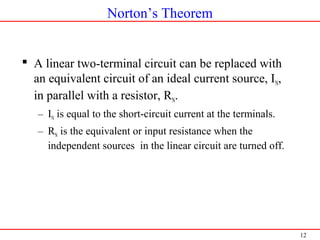
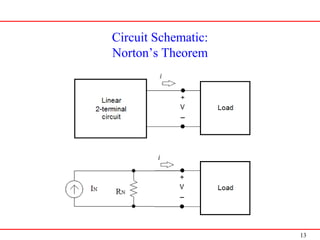
Norton’s Theorem
 A linear two-terminal circuit can be replaced with
an equivalent circuit of an ideal current source, IN,
in parallel with a resistor, RN.
– IN is equal to the short-circuit current at the terminals.
– RN is the equivalent or input resistance when the
independent sources in the linear circuit are turned off.
13
Circuit Schematic:
Norton’s Theorem
14
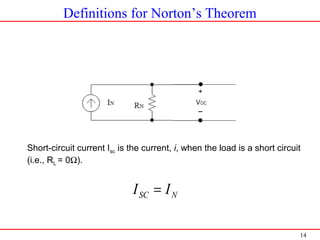
Definitions for Norton’s Theorem
Short-circuit current Isc is the current, i, when the load is a short circuit
(i.e., RL = 0Ω).
NSC II =
15
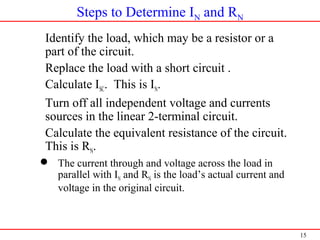
Steps to Determine IN and RN
1. Identify the load, which may be a resistor or a
part of the circuit.
2. Replace the load with a short circuit .
3. Calculate ISC. This is IN.
4. Turn off all independent voltage and currents
sources in the linear 2-terminal circuit.
5. Calculate the equivalent resistance of the circuit.
This is RN.
 The current through and voltage across the load in
parallel with IN and RN is the load’s actual current and
voltage in the original circuit.
16
Nazmul AhsanNazmul Ahsan
ID : 151-15-4856ID : 151-15-4856
17
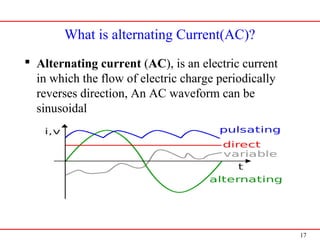
What is alternating Current(AC)?
 Alternating current (AC), is an electric current
in which the flow of electric charge periodically
reverses direction, An AC waveform can be
sinusoidal
18
HISTORY OF ALTERNATING CURRENT
ALTERNATING CURRENT
18
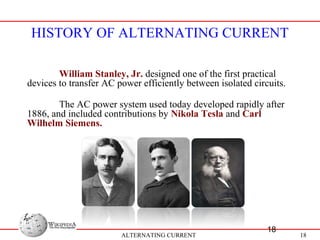
William Stanley, Jr. designed one of the first practical
devices to transfer AC power efficiently between isolated circuits.
The AC power system used today developed rapidly after
1886, and included contributions by Nikola Tesla and Carl
Wilhelm Siemens.
19
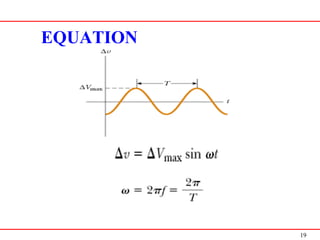
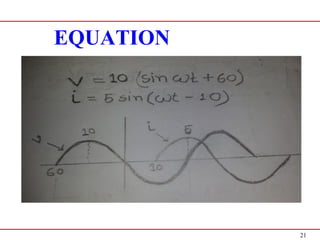
EQUATION
20
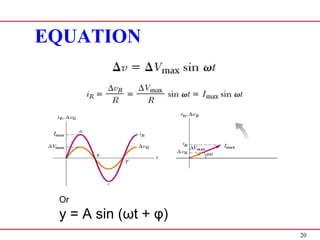
EQUATION
Or
y = A sin (ωt + φ)
21
EQUATION
22
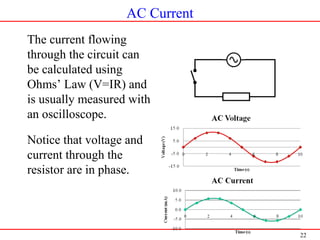
AC Current
The current flowing
through the circuit can
be calculated using
Ohms’ Law (V=IR) and
is usually measured with
an oscilloscope.
Notice that voltage and
current through the
resistor are in phase.
23
Akash Ahmed Khan
ID : 151-15-4883ID : 151-15-4883
24
RMS VALUES
ALTERNATING CURRENT
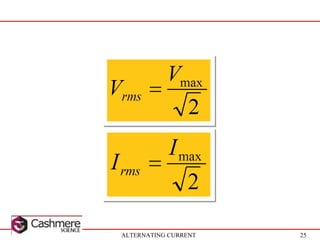
 Since voltage and current are always changing we need some way
of averaging out their effect.
 We use r.m.s values (root-mean-square)
 The r.m.s values are the DC values which give the same average
power output
25ALTERNATING CURRENT
26
AC in capacitors
ALTERNATING CURRENT
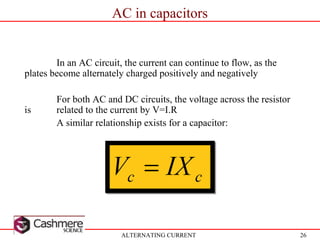
In an AC circuit, the current can continue to flow, as the
plates become alternately charged positively and negatively
For both AC and DC circuits, the voltage across the resistor
is related to the current by V=I.R
A similar relationship exists for a capacitor:
27
Advantages
ALTERNATING CURRENT
 The single greatest advantage of alternating current is that AC
current can be transformed and DC current cannot be
transformed.
 It can be controlled by a wide range of components
eg.resistors,capacitors and inductors.
 This allows high-voltage electrical power to be distributed with
smaller wires and lower amperage.
28
references
ALTERNATING CURRENT
28
 http://www.teachersdomain.org
 http://www.peetvs.co.za
 http://www.sjsu.edu
 http://www.youtube.com
 http://www.wikipedia.com
 http://www.upscale.utoronto.ca
 NCEA A.S 3.6 Text Chapters 18-19
 Yrd. Doç. Dr. Levent Çetin/ alternatif akım
29
THANKS FOR LISENTING……..
THE END

Node and mesh analysis

  • 1.
  • 2.
    2 ARIFUL ISLAMARIFUL ISLAM ID: 151-15-4869ID : 151-15-4869
  • 3.
    3 Presented by  Group5  ID:  151-15-4869  151-15-4856  151-15-4861  151-15-4883  Dept: CSE  DIU Presnted to  S.M. Safayet Ullah  Lecturer  Dept. of CSE  DIU
  • 4.
  • 5.
    5 NODE Branch : Abranch represents a single element such as voltage source or resistance etc.  What is node? Node : In a electric circuit a node is the point of connection between two or more BRANCHES
  • 6.
  • 7.
    7 Steps to DetermineV (Voltage)  Steps : 1. Firstly , we have to find out the nodes of the electrical circuits. 2. Then , we have to apply KCL & Ohm’s law (V=IR) 3. Then , we have to write the equation. 4. At last, we have to solve the equation And find out V
  • 8.
  • 9.
  • 10.
    10 Now we haveto simultaneous Eq. 1 and 2. We can solve the equations using any method and obtain the values of V1 and V2
  • 11.
    11 Shamsuzzaman ZihanShamsuzzaman Zihan ID: 151-15-4861ID : 151-15-4861
  • 12.
    12 Norton’s Theorem  Alinear two-terminal circuit can be replaced with an equivalent circuit of an ideal current source, IN, in parallel with a resistor, RN. – IN is equal to the short-circuit current at the terminals. – RN is the equivalent or input resistance when the independent sources in the linear circuit are turned off.
  • 13.
  • 14.
    14 Definitions for Norton’sTheorem Short-circuit current Isc is the current, i, when the load is a short circuit (i.e., RL = 0Ω). NSC II =
  • 15.
    15 Steps to DetermineIN and RN 1. Identify the load, which may be a resistor or a part of the circuit. 2. Replace the load with a short circuit . 3. Calculate ISC. This is IN. 4. Turn off all independent voltage and currents sources in the linear 2-terminal circuit. 5. Calculate the equivalent resistance of the circuit. This is RN.  The current through and voltage across the load in parallel with IN and RN is the load’s actual current and voltage in the original circuit.
  • 16.
    16 Nazmul AhsanNazmul Ahsan ID: 151-15-4856ID : 151-15-4856
  • 17.
    17 What is alternatingCurrent(AC)?  Alternating current (AC), is an electric current in which the flow of electric charge periodically reverses direction, An AC waveform can be sinusoidal
  • 18.
    18 HISTORY OF ALTERNATINGCURRENT ALTERNATING CURRENT 18 William Stanley, Jr. designed one of the first practical devices to transfer AC power efficiently between isolated circuits. The AC power system used today developed rapidly after 1886, and included contributions by Nikola Tesla and Carl Wilhelm Siemens.
  • 19.
  • 20.
    20 EQUATION Or y = Asin (ωt + φ)
  • 21.
  • 22.
    22 AC Current The currentflowing through the circuit can be calculated using Ohms’ Law (V=IR) and is usually measured with an oscilloscope. Notice that voltage and current through the resistor are in phase.
  • 23.
    23 Akash Ahmed Khan ID: 151-15-4883ID : 151-15-4883
  • 24.
    24 RMS VALUES ALTERNATING CURRENT Since voltage and current are always changing we need some way of averaging out their effect.  We use r.m.s values (root-mean-square)  The r.m.s values are the DC values which give the same average power output
  • 25.
  • 26.
    26 AC in capacitors ALTERNATINGCURRENT In an AC circuit, the current can continue to flow, as the plates become alternately charged positively and negatively For both AC and DC circuits, the voltage across the resistor is related to the current by V=I.R A similar relationship exists for a capacitor:
  • 27.
    27 Advantages ALTERNATING CURRENT  Thesingle greatest advantage of alternating current is that AC current can be transformed and DC current cannot be transformed.  It can be controlled by a wide range of components eg.resistors,capacitors and inductors.  This allows high-voltage electrical power to be distributed with smaller wires and lower amperage.
  • 28.
    28 references ALTERNATING CURRENT 28  http://www.teachersdomain.org http://www.peetvs.co.za  http://www.sjsu.edu  http://www.youtube.com  http://www.wikipedia.com  http://www.upscale.utoronto.ca  NCEA A.S 3.6 Text Chapters 18-19  Yrd. Doç. Dr. Levent Çetin/ alternatif akım
  • 29.

Editor's Notes

  • #8 A primary concern for this course is efficiency. You might believe that faster computers make it unnecessary to be concerned with efficiency. However… So we need special training.
  • #28 The electrical power is then transformed to a lower voltage where it is needed It can be produced directly from generators