Chapter 2:
Diode Applications (cont.)
                Prepared by:
           Ikhwan Hafiz Muhamad
              ikhwanh@ump.edu.my
                 Block 1, E10-C13


Copyright Ikhwan H Muhamad, Universiti Malaysia Pahang © 2010   1
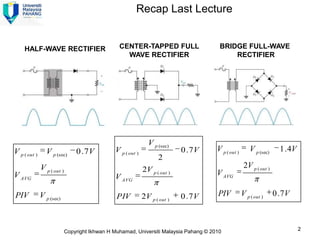
Recap Last Lecture


    HALF-WAVE RECTIFIER                          CENTER-TAPPED FULL                     BRIDGE FULL-WAVE
                                                   WAVE RECTIFIER                           RECTIFIER


                                                               V p (sec)
V p ( out )     V p (sec)       0 . 7V         V p ( out )                  0 . 7V     V p ( out )       V p (sec)     1 . 4V
                                                                    2
              V p ( out )                                    2V p ( out )
                                                                                                      2V p ( out )
V AVG                                          V AVG                                   V AVG

PIV           V p (sec)                         PIV          2V p ( out )   0 . 7V     PIV           V p ( out )     0 . 7V


                            Copyright Ikhwan H Muhamad, Universiti Malaysia Pahang © 2010                                       2
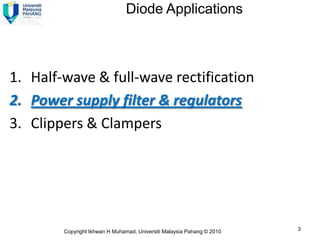
Diode Applications


1. Half-wave & full-wave rectification
2. Power supply filter & regulators
3. Clippers & Clampers


        Copyright Ikhwan H Muhamad, Universiti Malaysia Pahang © 2010   3
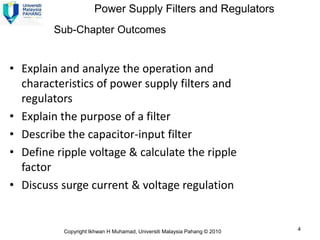
Power Supply Filters and Regulators
        Sub-Chapter Outcomes


• Explain and analyze the operation and
  characteristics of power supply filters and
  regulators
• Explain the purpose of a filter
• Describe the capacitor-input filter
• Define ripple voltage & calculate the ripple
  factor
• Discuss surge current & voltage regulation


           Copyright Ikhwan H Muhamad, Universiti Malaysia Pahang © 2010   4
Power Supply Filters
                                                                             AL
                                                                         Difference
                                                                         AC & DC?


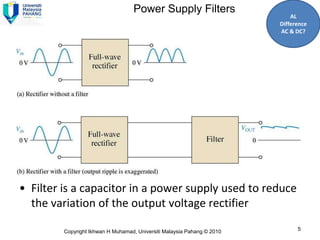
• Filter is a capacitor in a power supply used to reduce
  the variation of the output voltage rectifier

         Copyright Ikhwan H Muhamad, Universiti Malaysia Pahang © 2010         5
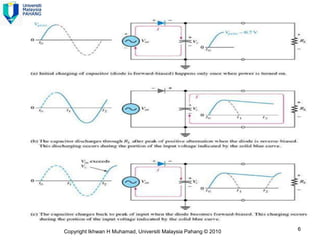
Capacitor-Input Filter


   Copyright Ikhwan H Muhamad, Universiti Malaysia Pahang © 2010   6
Power Supply Filters
       Capacitor-Input Filter


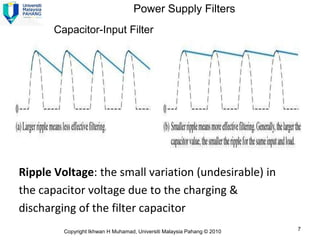
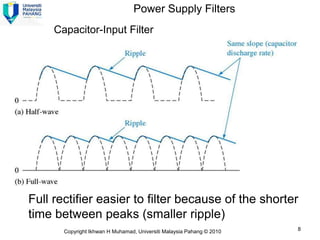
Ripple Voltage: the small variation (undesirable) in
the capacitor voltage due to the charging &
discharging of the filter capacitor
         Copyright Ikhwan H Muhamad, Universiti Malaysia Pahang © 2010   7
Power Supply Filters
     Capacitor-Input Filter


Full rectifier easier to filter because of the shorter
time between peaks (smaller ripple)
       Copyright Ikhwan H Muhamad, Universiti Malaysia Pahang © 2010   8
Power Supply Filters
          Capacitor-Input Filter

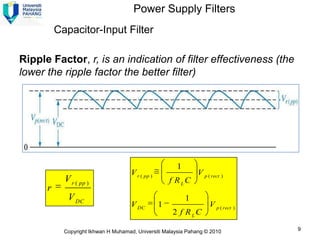
Ripple Factor, r, is an indication of filter effectiveness (the
lower the ripple factor the better filter)


                                                       1
                                     V r ( pp )                V p ( rect )
            V r ( pp )                                f RLC
      r
             V DC                                          1
                                     V DC         1                 V p ( rect )
                                                      2 f RLC

            Copyright Ikhwan H Muhamad, Universiti Malaysia Pahang © 2010          9
Power Supply Filters
                       Capacitor-Input Filter


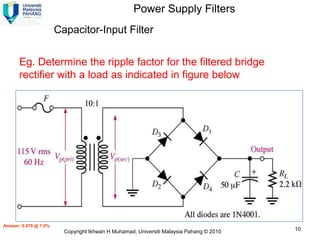
      Eg. Determine the ripple factor for the filtered bridge
      rectifier with a load as indicated in figure below


Answer: 0.079 @ 7.9%
                         Copyright Ikhwan H Muhamad, Universiti Malaysia Pahang © 2010   10
Power Supply Filters
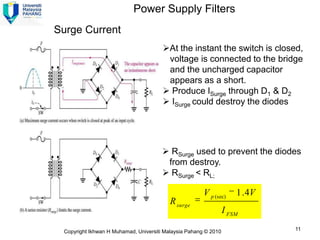
Surge Current
                                       At the instant the switch is closed,
                                        voltage is connected to the bridge
                                        and the uncharged capacitor
                                        appears as a short.
                                        Produce ISurge through D1 & D2
                                        ISurge could destroy the diodes


                                        RSurge used to prevent the diodes
                                        from destroy.
                                        RSurge < RL;

                                                       V p (sec)     1 . 4V
                                          R surge
                                                                 I FSM

 Copyright Ikhwan H Muhamad, Universiti Malaysia Pahang © 2010                11
Voltage Regulators
        Voltage Regulators
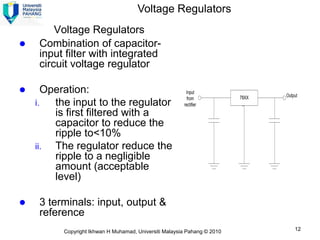
   Combination of capacitor-
    input filter with integrated
    circuit voltage regulator

     Operation:                                         Input
                                                                          78XX   Output
                                                          from
    i.  the input to the regulator                      rectifier
        is first filtered with a
        capacitor to reduce the
        ripple to<10%
    ii. The regulator reduce the
        ripple to a negligible
        amount (acceptable
        level)

   3 terminals: input, output &
    reference
          Copyright Ikhwan H Muhamad, Universiti Malaysia Pahang © 2010              12
Voltage Regulators
    Percent Regulation – present the performance of
    a voltage regulator

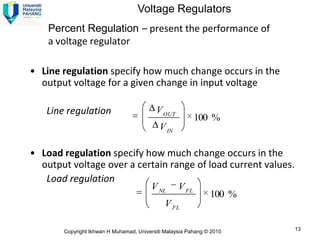
• Line regulation specify how much change occurs in the
  output voltage for a given change in input voltage

   Line regulation                        V OUT
                                                          100 %
                                            V IN

• Load regulation specify how much change occurs in the
  output voltage over a certain range of load current values.
   Load regulation
                                        V NL       V FL
                                                               100 %
                                              V FL

       Copyright Ikhwan H Muhamad, Universiti Malaysia Pahang © 2010   13
Exercise


  1) A certain 7805 regulator has a measured no-load
  output voltage of 5.18V and a full load output of 5.15V.
  What is the load regulation expressed as a percentage?


  2) If the no-load output voltage of a regulator is 24.8V
  and the full-load output is 23.9V, what is the load
  regulation expressed as a percentage?


                                                             14
Review section

1) When a 60Hz sinusoidal voltage is applied to the
   input of a half-wave rectifier, what is the output
   frequency?
2) When a 60Hz sinusoidal voltage is applied to the
   input of a full-wave rectifier, what is the output
   frequency?
3) What cause the ripple voltage on the output of a
   capacitor-input filter?
4) If the load resistance connected to a filtered power
   supply is decreased, what happens to the ripple
   voltage?


                                                          15
5. A certain rectifier filter produce a dc o/p voltage of
   75V with peak-to-peak ripple voltage of 0.5V.
   Calculate the ripple factor?

6. A certain full-wave rectifier has a peak o/p voltage of
   30V. A 50uF capacitor-input filter is connected to the
   rectifier. Calculate the peak-to-peak ripple and the
   dc o/p voltage developed across a 600ohm
   resistance.

7. What is the percentage of ripple for the rectifier in
   question 6?

                                                            16
Diode Applications


1. Half-wave & full-wave rectification
2. Power supply filter & regulators
3. Clippers & Clampers


        Copyright Ikhwan H Muhamad, Universiti Malaysia Pahang © 2010   17
Clippers and Clampers
     Sub-Chapter Outcomes


• Explain and analyze the operation of
  diode limiting & clamping circuits
• Explain the operation of diode limiters
• Determine the output voltage of a biased
  limiter
• Explain the operation of diodes clampers


      Copyright Ikhwan H Muhamad, Universiti Malaysia Pahang © 2010   18
Diode Limiters (Clippers)

                           Diode Limiters
• A diode network that have the ability to “clip”
  (cut short/crop) off portions of signal voltages
  above or below certain limits, i.e. the circuits
  limit the range of the output signal.
• Such a circuit may be used to;
   – protect the input of a CMOS logic gate against
     static
   – eliminate amplitude noise
   – fabricate new waveforms from an existing
     signal
     Copyright Ikhwan H Muhamad, Universiti Malaysia Pahang © 2010   19
Diode Limiters (Clippers)

                              Diode Limiters

• 2 general of clippers:
     a) Series clippers
     b) Parallel clippers
• Parallel Clippers
   Diode in a branch parallel to the load.
• Series Clippers
   Diode is in series with the load.


       Copyright Ikhwan H Muhamad, Universiti Malaysia Pahang © 2010   20
Diode Limiters (Clippers)

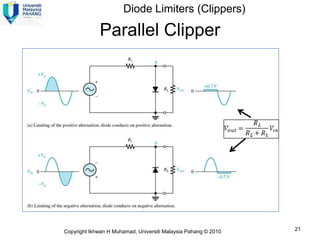
             Parallel Clipper


Copyright Ikhwan H Muhamad, Universiti Malaysia Pahang © 2010   21
Diode Limiters (Clippers)
                                        Parallel Clipper


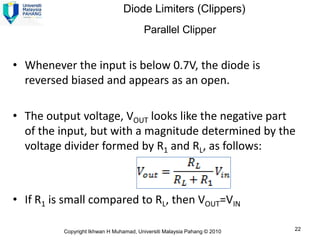
• Whenever the input is below 0.7V, the diode is
  reversed biased and appears as an open.

• The output voltage, VOUT looks like the negative part
  of the input, but with a magnitude determined by the
  voltage divider formed by R1 and RL, as follows:


• If R1 is small compared to RL, then VOUT=VIN

          Copyright Ikhwan H Muhamad, Universiti Malaysia Pahang © 2010   22
Diode Limiters (Clippers)
       Analysis Steps for Parallel Clipper


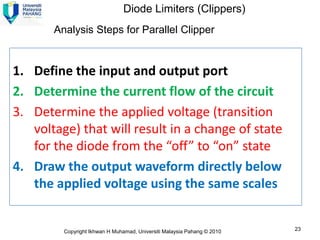
1. Define the input and output port
2. Determine the current flow of the circuit
3. Determine the applied voltage (transition
   voltage) that will result in a change of state
   for the diode from the “off” to “on” state
4. Draw the output waveform directly below
   the applied voltage using the same scales


         Copyright Ikhwan H Muhamad, Universiti Malaysia Pahang © 2010   23
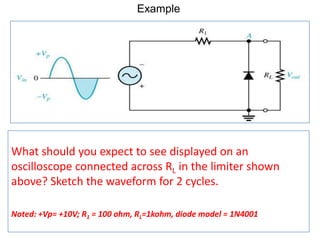
Example


What should you expect to see displayed on an
oscilloscope connected across RL in the limiter shown
above? Sketch the waveform for 2 cycles.

Noted: +Vp= +10V; R1 = 100 ohm, RL=1kohm, diode model = 1N4001
Diode Limiters (Clippers)
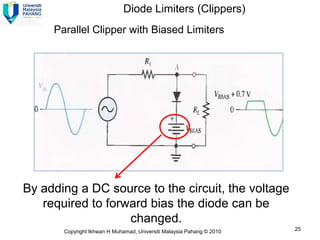
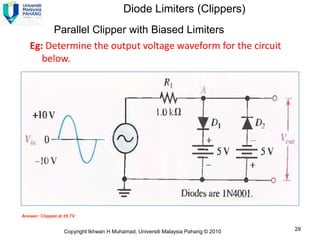
     Parallel Clipper with Biased Limiters


By adding a DC source to the circuit, the voltage
   required to forward bias the diode can be
                   changed.
       Copyright Ikhwan H Muhamad, Universiti Malaysia Pahang © 2010   25
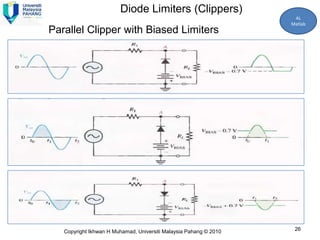
Diode Limiters (Clippers)
                                                                    AL
                                                                   Matlab
Parallel Clipper with Biased Limiters


   Copyright Ikhwan H Muhamad, Universiti Malaysia Pahang © 2010    26
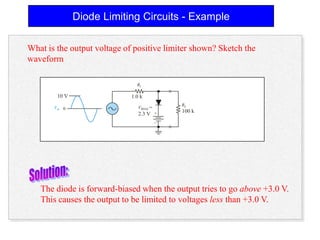
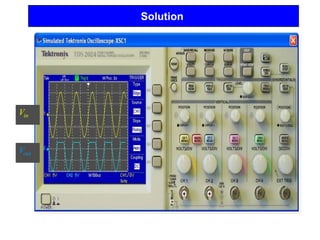
Diode Limiting Circuits - Example

What is the output voltage of positive limiter shown? Sketch the
waveform

                               R1

        10 V                 1.0 k
                                              RL      3.0 V
       Vin 0                    VBIAS =                   0
                                              100 k
                                2.3 V +
                                          –


   The diode is forward-biased when the output tries to go above +3.0 V.
   This causes the output to be limited to voltages less than +3.0 V.
Solution


Vin


Vout
Diode Limiters (Clippers)
        Parallel Clipper with Biased Limiters
   Eg: Determine the output voltage waveform for the circuit
      below.


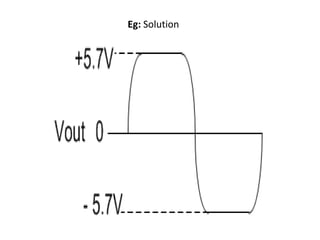
Answer: Clipped at ±5.7V


                   Copyright Ikhwan H Muhamad, Universiti Malaysia Pahang © 2010   29
Eg: Solution
Diode Limiters (Clippers)
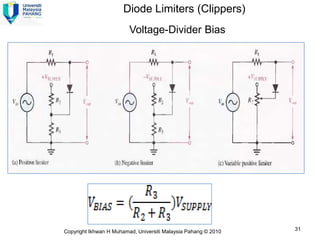
                         Voltage-Divider Bias


Copyright Ikhwan H Muhamad, Universiti Malaysia Pahang © 2010   31
Diode Limiters (Clippers)
                        Voltage-Divider Bias
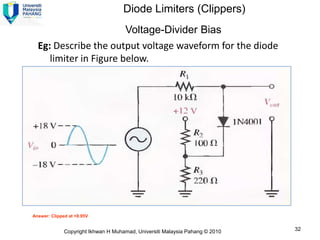
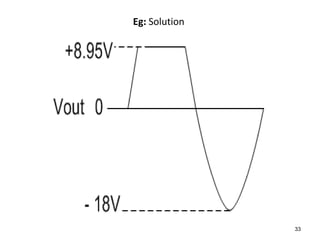
  Eg: Describe the output voltage waveform for the diode
     limiter in Figure below.


Answer: Clipped at +8.95V


              Copyright Ikhwan H Muhamad, Universiti Malaysia Pahang © 2010   32
Eg: Solution


               33
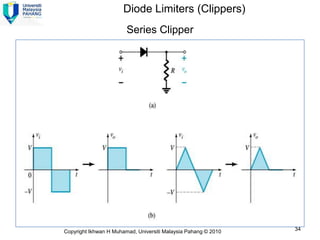
Diode Limiters (Clippers)
                        Series Clipper


Copyright Ikhwan H Muhamad, Universiti Malaysia Pahang © 2010   34
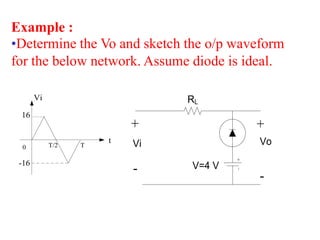
Example :
•Determine the Vo and sketch the o/p waveform
for the below network. Assume diode is ideal.

       Vi                      RL
 16
                          +             +
                      t   Vi            Vo
 0          T/2   T

 -16                           V=4 V
                          -
                                        -
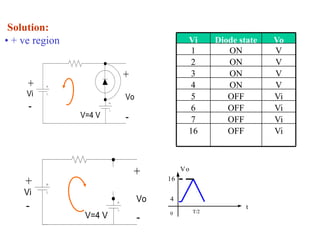
Solution:
• + ve region                            Vi        Diode state   Vo
                                         1            ON         V
                                         2            ON         V
                         +               3            ON         V
     +                                   4            ON         V
     Vi                  Vo              5            OFF        Vi
     -                                   6            OFF        Vi
                V=4 V    -               7            OFF        Vi
                                         16           OFF        Vi


                             +          Vo

    +                              16

    Vi
                              Vo   4
     -                             0         T/2
                                                           t
                 V=4 V        -
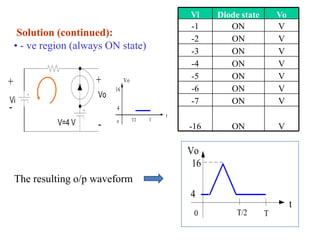
Vi    Diode state       Vo
                                                    -1       ON             V
     Solution (continued):
                                                    -2       ON             V
    • - ve region (always ON state)                 -3       ON             V
                                                    -4       ON             V
                                                    -5       ON             V
+                      +         Vo
                            16                      -6       ON             V
                       Vo
Vi                                                  -7       ON             V
-                           4
                                                t
                                      T/2   T
              V=4 V    -    0
                                                    -16      ON             V

                                                    Vo
                                                     16
    The resulting o/p waveform
                                                    4
                                                                                 t
                                                     0         T/2      T
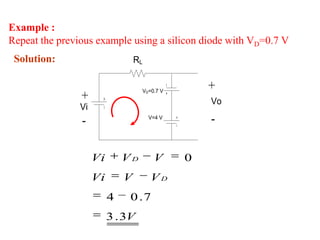
Example :
Repeat the previous example using a silicon diode with VD=0.7 V
 Solution:                        RL


                                   VD=0.7 V
                                                   +
                +                                  Vo
                Vi
                -                      V=4 V
                                                   -

                     Vi       VD        V      0
                     Vi       V        VD
                          4    0 .7
                          3 . 3V
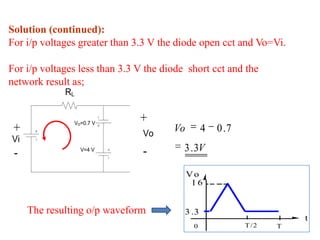
Solution (continued):
For i/p voltages greater than 3.3 V the diode open cct and Vo=Vi.

For i/p voltages less than 3.3 V the diode short cct and the
network result as;
             RL


               VD=0.7 V
                               +
 +                              Vo
                                       Vo        4   0 .7
Vi
 -                V=4 V
                                -         3 . 3V

                                            Vo
                                             16


     The resulting o/p waveform           3 .3
                                                                       t
                                             0              T /2   T
Diode Limiters (Clippers)


  Summary of Series Clippers : Refer

    Electronic Devices and Circuit
  Theory: International Edition, 8th
Edition (Robert L. Boylestad) page 87.


                                         40
Diode Clampers


• Known as DC-Restorer

• Widely use in analogue television
  receivers

• A clamper is a network constructed of a
  diode, resistor, and a capacitor that
  shifts a waveform to a different dc level
  without changing the appearance of
  the applied signal
      Copyright Ikhwan H Muhamad, Universiti Malaysia Pahang © 2010   41
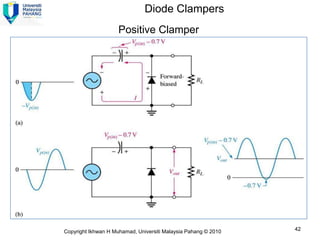
Diode Clampers
                     Positive Clamper


Copyright Ikhwan H Muhamad, Universiti Malaysia Pahang © 2010   42
Diode Clampers
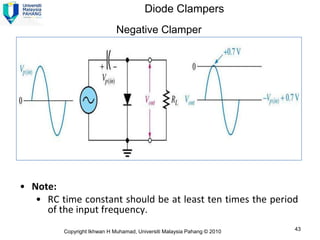
                             Negative Clamper


• Note:
   • RC time constant should be at least ten times the period
     of the input frequency.
         Copyright Ikhwan H Muhamad, Universiti Malaysia Pahang © 2010   43
Diode Clampers
                                          Negative Clamper
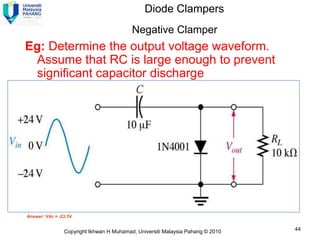
Eg: Determine the output voltage waveform.
 Assume that RC is large enough to prevent
 significant capacitor discharge


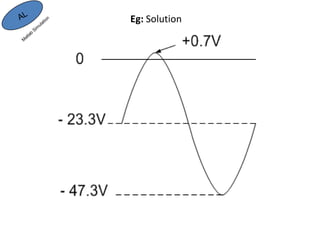
Answer: Vdc = -23.3V


                Copyright Ikhwan H Muhamad, Universiti Malaysia Pahang © 2010   44
Eg: Solution
Diode Clampers


  Summary of clamping circuits : Refer

Electronic Devices and Circuit Theory:
   International Edition, 8th Edition
     (Robert L. Boylestad) page 91.


                                         46
Review section

1) What component in a clamping
   circuit effectively acts as a battery?

2) What is the difference between a
   +ve limiter and a –ve limiter?

Lecture 4 ver2 diode_app

  • 1.
    Chapter 2: Diode Applications(cont.) Prepared by: Ikhwan Hafiz Muhamad ikhwanh@ump.edu.my Block 1, E10-C13 Copyright Ikhwan H Muhamad, Universiti Malaysia Pahang © 2010 1
  • 2.
    Recap Last Lecture HALF-WAVE RECTIFIER CENTER-TAPPED FULL BRIDGE FULL-WAVE WAVE RECTIFIER RECTIFIER V p (sec) V p ( out ) V p (sec) 0 . 7V V p ( out ) 0 . 7V V p ( out ) V p (sec) 1 . 4V 2 V p ( out ) 2V p ( out ) 2V p ( out ) V AVG V AVG V AVG PIV V p (sec) PIV 2V p ( out ) 0 . 7V PIV V p ( out ) 0 . 7V Copyright Ikhwan H Muhamad, Universiti Malaysia Pahang © 2010 2
  • 3.
    Diode Applications 1. Half-wave& full-wave rectification 2. Power supply filter & regulators 3. Clippers & Clampers Copyright Ikhwan H Muhamad, Universiti Malaysia Pahang © 2010 3
  • 4.
    Power Supply Filtersand Regulators Sub-Chapter Outcomes • Explain and analyze the operation and characteristics of power supply filters and regulators • Explain the purpose of a filter • Describe the capacitor-input filter • Define ripple voltage & calculate the ripple factor • Discuss surge current & voltage regulation Copyright Ikhwan H Muhamad, Universiti Malaysia Pahang © 2010 4
  • 5.
    Power Supply Filters AL Difference AC & DC? • Filter is a capacitor in a power supply used to reduce the variation of the output voltage rectifier Copyright Ikhwan H Muhamad, Universiti Malaysia Pahang © 2010 5
  • 6.
    Capacitor-Input Filter Copyright Ikhwan H Muhamad, Universiti Malaysia Pahang © 2010 6
  • 7.
    Power Supply Filters Capacitor-Input Filter Ripple Voltage: the small variation (undesirable) in the capacitor voltage due to the charging & discharging of the filter capacitor Copyright Ikhwan H Muhamad, Universiti Malaysia Pahang © 2010 7
  • 8.
    Power Supply Filters Capacitor-Input Filter Full rectifier easier to filter because of the shorter time between peaks (smaller ripple) Copyright Ikhwan H Muhamad, Universiti Malaysia Pahang © 2010 8
  • 9.
    Power Supply Filters Capacitor-Input Filter Ripple Factor, r, is an indication of filter effectiveness (the lower the ripple factor the better filter) 1 V r ( pp ) V p ( rect ) V r ( pp ) f RLC r V DC 1 V DC 1 V p ( rect ) 2 f RLC Copyright Ikhwan H Muhamad, Universiti Malaysia Pahang © 2010 9
  • 10.
    Power Supply Filters Capacitor-Input Filter Eg. Determine the ripple factor for the filtered bridge rectifier with a load as indicated in figure below Answer: 0.079 @ 7.9% Copyright Ikhwan H Muhamad, Universiti Malaysia Pahang © 2010 10
  • 11.
    Power Supply Filters SurgeCurrent At the instant the switch is closed, voltage is connected to the bridge and the uncharged capacitor appears as a short.  Produce ISurge through D1 & D2  ISurge could destroy the diodes  RSurge used to prevent the diodes from destroy.  RSurge < RL; V p (sec) 1 . 4V R surge I FSM Copyright Ikhwan H Muhamad, Universiti Malaysia Pahang © 2010 11
  • 12.
    Voltage Regulators Voltage Regulators  Combination of capacitor- input filter with integrated circuit voltage regulator  Operation: Input 78XX Output from i. the input to the regulator rectifier is first filtered with a capacitor to reduce the ripple to<10% ii. The regulator reduce the ripple to a negligible amount (acceptable level)  3 terminals: input, output & reference Copyright Ikhwan H Muhamad, Universiti Malaysia Pahang © 2010 12
  • 13.
    Voltage Regulators Percent Regulation – present the performance of a voltage regulator • Line regulation specify how much change occurs in the output voltage for a given change in input voltage Line regulation V OUT 100 % V IN • Load regulation specify how much change occurs in the output voltage over a certain range of load current values. Load regulation V NL V FL 100 % V FL Copyright Ikhwan H Muhamad, Universiti Malaysia Pahang © 2010 13
  • 14.
    Exercise 1)A certain 7805 regulator has a measured no-load output voltage of 5.18V and a full load output of 5.15V. What is the load regulation expressed as a percentage? 2) If the no-load output voltage of a regulator is 24.8V and the full-load output is 23.9V, what is the load regulation expressed as a percentage? 14
  • 15.
    Review section 1) Whena 60Hz sinusoidal voltage is applied to the input of a half-wave rectifier, what is the output frequency? 2) When a 60Hz sinusoidal voltage is applied to the input of a full-wave rectifier, what is the output frequency? 3) What cause the ripple voltage on the output of a capacitor-input filter? 4) If the load resistance connected to a filtered power supply is decreased, what happens to the ripple voltage? 15
  • 16.
    5. A certainrectifier filter produce a dc o/p voltage of 75V with peak-to-peak ripple voltage of 0.5V. Calculate the ripple factor? 6. A certain full-wave rectifier has a peak o/p voltage of 30V. A 50uF capacitor-input filter is connected to the rectifier. Calculate the peak-to-peak ripple and the dc o/p voltage developed across a 600ohm resistance. 7. What is the percentage of ripple for the rectifier in question 6? 16
  • 17.
    Diode Applications 1. Half-wave& full-wave rectification 2. Power supply filter & regulators 3. Clippers & Clampers Copyright Ikhwan H Muhamad, Universiti Malaysia Pahang © 2010 17
  • 18.
    Clippers and Clampers Sub-Chapter Outcomes • Explain and analyze the operation of diode limiting & clamping circuits • Explain the operation of diode limiters • Determine the output voltage of a biased limiter • Explain the operation of diodes clampers Copyright Ikhwan H Muhamad, Universiti Malaysia Pahang © 2010 18
  • 19.
    Diode Limiters (Clippers) Diode Limiters • A diode network that have the ability to “clip” (cut short/crop) off portions of signal voltages above or below certain limits, i.e. the circuits limit the range of the output signal. • Such a circuit may be used to; – protect the input of a CMOS logic gate against static – eliminate amplitude noise – fabricate new waveforms from an existing signal Copyright Ikhwan H Muhamad, Universiti Malaysia Pahang © 2010 19
  • 20.
    Diode Limiters (Clippers) Diode Limiters • 2 general of clippers: a) Series clippers b) Parallel clippers • Parallel Clippers Diode in a branch parallel to the load. • Series Clippers Diode is in series with the load. Copyright Ikhwan H Muhamad, Universiti Malaysia Pahang © 2010 20
  • 21.
    Diode Limiters (Clippers) Parallel Clipper Copyright Ikhwan H Muhamad, Universiti Malaysia Pahang © 2010 21
  • 22.
    Diode Limiters (Clippers) Parallel Clipper • Whenever the input is below 0.7V, the diode is reversed biased and appears as an open. • The output voltage, VOUT looks like the negative part of the input, but with a magnitude determined by the voltage divider formed by R1 and RL, as follows: • If R1 is small compared to RL, then VOUT=VIN Copyright Ikhwan H Muhamad, Universiti Malaysia Pahang © 2010 22
  • 23.
    Diode Limiters (Clippers) Analysis Steps for Parallel Clipper 1. Define the input and output port 2. Determine the current flow of the circuit 3. Determine the applied voltage (transition voltage) that will result in a change of state for the diode from the “off” to “on” state 4. Draw the output waveform directly below the applied voltage using the same scales Copyright Ikhwan H Muhamad, Universiti Malaysia Pahang © 2010 23
  • 24.
    Example What should youexpect to see displayed on an oscilloscope connected across RL in the limiter shown above? Sketch the waveform for 2 cycles. Noted: +Vp= +10V; R1 = 100 ohm, RL=1kohm, diode model = 1N4001
  • 25.
    Diode Limiters (Clippers) Parallel Clipper with Biased Limiters By adding a DC source to the circuit, the voltage required to forward bias the diode can be changed. Copyright Ikhwan H Muhamad, Universiti Malaysia Pahang © 2010 25
  • 26.
    Diode Limiters (Clippers) AL Matlab Parallel Clipper with Biased Limiters Copyright Ikhwan H Muhamad, Universiti Malaysia Pahang © 2010 26
  • 27.
    Diode Limiting Circuits- Example What is the output voltage of positive limiter shown? Sketch the waveform R1 10 V 1.0 k RL 3.0 V Vin 0 VBIAS = 0 100 k 2.3 V + – The diode is forward-biased when the output tries to go above +3.0 V. This causes the output to be limited to voltages less than +3.0 V.
  • 28.
  • 29.
    Diode Limiters (Clippers) Parallel Clipper with Biased Limiters Eg: Determine the output voltage waveform for the circuit below. Answer: Clipped at ±5.7V Copyright Ikhwan H Muhamad, Universiti Malaysia Pahang © 2010 29
  • 30.
  • 31.
    Diode Limiters (Clippers) Voltage-Divider Bias Copyright Ikhwan H Muhamad, Universiti Malaysia Pahang © 2010 31
  • 32.
    Diode Limiters (Clippers) Voltage-Divider Bias Eg: Describe the output voltage waveform for the diode limiter in Figure below. Answer: Clipped at +8.95V Copyright Ikhwan H Muhamad, Universiti Malaysia Pahang © 2010 32
  • 33.
  • 34.
    Diode Limiters (Clippers) Series Clipper Copyright Ikhwan H Muhamad, Universiti Malaysia Pahang © 2010 34
  • 35.
    Example : •Determine theVo and sketch the o/p waveform for the below network. Assume diode is ideal. Vi RL 16 + + t Vi Vo 0 T/2 T -16 V=4 V - -
  • 36.
    Solution: • + veregion Vi Diode state Vo 1 ON V 2 ON V + 3 ON V + 4 ON V Vi Vo 5 OFF Vi - 6 OFF Vi V=4 V - 7 OFF Vi 16 OFF Vi + Vo + 16 Vi Vo 4 - 0 T/2 t V=4 V -
  • 37.
    Vi Diode state Vo -1 ON V Solution (continued): -2 ON V • - ve region (always ON state) -3 ON V -4 ON V -5 ON V + + Vo 16 -6 ON V Vo Vi -7 ON V - 4 t T/2 T V=4 V - 0 -16 ON V Vo 16 The resulting o/p waveform 4 t 0 T/2 T
  • 38.
    Example : Repeat theprevious example using a silicon diode with VD=0.7 V Solution: RL VD=0.7 V + + Vo Vi - V=4 V - Vi VD V 0 Vi V VD 4 0 .7 3 . 3V
  • 39.
    Solution (continued): For i/pvoltages greater than 3.3 V the diode open cct and Vo=Vi. For i/p voltages less than 3.3 V the diode short cct and the network result as; RL VD=0.7 V + + Vo Vo 4 0 .7 Vi - V=4 V - 3 . 3V Vo 16 The resulting o/p waveform 3 .3 t 0 T /2 T
  • 40.
    Diode Limiters (Clippers) Summary of Series Clippers : Refer Electronic Devices and Circuit Theory: International Edition, 8th Edition (Robert L. Boylestad) page 87. 40
  • 41.
    Diode Clampers • Knownas DC-Restorer • Widely use in analogue television receivers • A clamper is a network constructed of a diode, resistor, and a capacitor that shifts a waveform to a different dc level without changing the appearance of the applied signal Copyright Ikhwan H Muhamad, Universiti Malaysia Pahang © 2010 41
  • 42.
    Diode Clampers Positive Clamper Copyright Ikhwan H Muhamad, Universiti Malaysia Pahang © 2010 42
  • 43.
    Diode Clampers Negative Clamper • Note: • RC time constant should be at least ten times the period of the input frequency. Copyright Ikhwan H Muhamad, Universiti Malaysia Pahang © 2010 43
  • 44.
    Diode Clampers Negative Clamper Eg: Determine the output voltage waveform. Assume that RC is large enough to prevent significant capacitor discharge Answer: Vdc = -23.3V Copyright Ikhwan H Muhamad, Universiti Malaysia Pahang © 2010 44
  • 45.
  • 46.
    Diode Clampers Summary of clamping circuits : Refer Electronic Devices and Circuit Theory: International Edition, 8th Edition (Robert L. Boylestad) page 91. 46
  • 47.
    Review section 1) Whatcomponent in a clamping circuit effectively acts as a battery? 2) What is the difference between a +ve limiter and a –ve limiter?